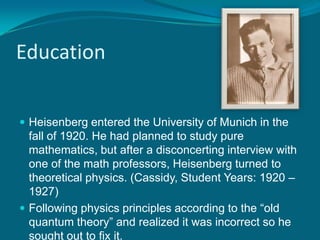
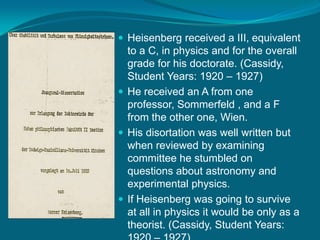
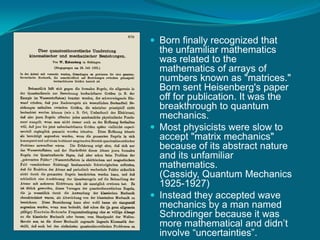
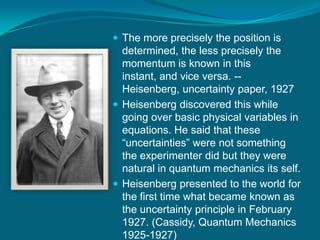
Werner Heisenberg was a German physicist born in 1901 who made major contributions to the foundations of quantum mechanics. He studied mathematics and physics in university, developing an interest in theoretical physics. In 1925, he formulated the first complete quantum mechanics theory called matrix mechanics. This breakthrough established the new field and described the behavior of atoms and molecules. Although initially controversial due to its abstract nature, matrix mechanics was later shown to be equivalent to Erwin Schrodinger's wave mechanics formulation. Heisenberg also discovered the uncertainty principle in 1927, which states that the more precisely one property of a particle is known, the less precisely its complementary property can be known. Heisenberg's work was seminal in the development of modern physics.








![The Heisenberg Uncertainty Principle[1]](https://cdn.slidesharecdn.com/ss_thumbnails/theheisenberguncertaintyprinciple1-091020215730-phpapp01-thumbnail.jpg?width=640&height=640&fit=bounds)


