


The French and Indian War By Brad Dougherty & Peter Shim
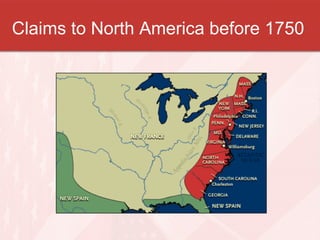
Origins of the War By the 1750’s, English and French settlements were expanding The French had claimed a region of the interior stretching from The Great Lakes south to Louisiana To secure their hold, the French built up communities and fortresses
Origins of the War (cont’d) The English were preparing to spread across the Appalachian Mtns. In 1749 a group of Virginia businessmen secured 500,000 acres of Ohio Valley land for settlement The French, in an effort to keep the English from expanding, constructed new fortresses in the Ohio Valley
Origins of the War (cont’d) The English interpreted this as a threat to their settlements and began to make military preparations
Claims to North America before 1750
Beginning of the War In the summer of 1745, the governor of Virginia sent a militia force into the Ohio Valley to challenge French expansion This militia was led by an inexperienced young colonel named George Washington
Fort Necessity Washington built a small fort called Fort Necessity After an unsuccessful attack on the French, the French trapped Washington and his troops inside the fort After a third of his troops were killed, Washington was forced to surrender
1754 - 1756 Primarily a North American Conflict Dominated by French Most Indian tribes allied with the French Colonists had to manage the war themselves
1756 – 1758 Governments of France and Britain formally opened hostilities In 1757, the English secretary of state William Pitt started to bring the war effort under control of the British government This caused resentment from the colonists By 1758, the friction between the colonists and the British threatened to bring the war efforts to a halt
1758 - 1760 This caused Pitt to relax some of the policies Resulted in an immediate increase in colonist support Pitt dispatched a large number of additional troops In July 1759, the fortress of Louisbourg was captured by Jeffrey Amherst and James Wolfe In September, Quebec fell to Wolfe and his army A year later, the French formally surrendered
Land Reorganization Britain gained control over half the North American continent, including: French Canada All French territorial claims east of the Mississippi River Spanish Florida In return, Britain gave Cuba and the Philippines back to Spain France compensated its Spanish ally for the loss of Florida by giving it title to all of Louisiana west of the Mississippi River
Effects on the British Empire Meant that expansion could continue westward into the New World Caused substantial debt Generated much resentment towards the colonists Set plans in motion to have greater control over the colonies
Effects on the Indian Tribes All the tribes that had allied with the French were now left alienated, and on bad terms with the British The Iroquois continued to contest British control of the Ohio River Valley
Effects on American Colonists Learned to unite Left lots of space to colonize, but the British decided otherwise The British proclaimed that no one could settle west of the Allegheny Mtns. They set up a permanent army, paid for by the colonists’ taxes, to keep them from expanding This infuriated the colonists These policies became a major part in the reasons behind the American Revolution
Bibliography http://odur.let.rug.nl/~usa/E/7yearswar/fiw03.htm http://encarta.msn.com/media_461516744_761575603_-1_1/French_and_Indian_War.html http://encarta.msn.com/encyclopedia_761575603/French_and_Indian_War.html http://www.learner.org/biographyofamerica/prog03/maps/page02.html

The French and Indian War

  • 1.
    The French andIndian War By Brad Dougherty & Peter Shim
  • 2.
    Origins of theWar By the 1750’s, English and French settlements were expanding The French had claimed a region of the interior stretching from The Great Lakes south to Louisiana To secure their hold, the French built up communities and fortresses
  • 3.
    Origins of theWar (cont’d) The English were preparing to spread across the Appalachian Mtns. In 1749 a group of Virginia businessmen secured 500,000 acres of Ohio Valley land for settlement The French, in an effort to keep the English from expanding, constructed new fortresses in the Ohio Valley
  • 4.
    Origins of theWar (cont’d) The English interpreted this as a threat to their settlements and began to make military preparations
  • 5.
    Claims to NorthAmerica before 1750
  • 6.
    Beginning of theWar In the summer of 1745, the governor of Virginia sent a militia force into the Ohio Valley to challenge French expansion This militia was led by an inexperienced young colonel named George Washington
  • 7.
    Fort Necessity Washingtonbuilt a small fort called Fort Necessity After an unsuccessful attack on the French, the French trapped Washington and his troops inside the fort After a third of his troops were killed, Washington was forced to surrender
  • 8.
    1754 - 1756Primarily a North American Conflict Dominated by French Most Indian tribes allied with the French Colonists had to manage the war themselves
  • 9.
    1756 – 1758Governments of France and Britain formally opened hostilities In 1757, the English secretary of state William Pitt started to bring the war effort under control of the British government This caused resentment from the colonists By 1758, the friction between the colonists and the British threatened to bring the war efforts to a halt
  • 10.
    1758 - 1760This caused Pitt to relax some of the policies Resulted in an immediate increase in colonist support Pitt dispatched a large number of additional troops In July 1759, the fortress of Louisbourg was captured by Jeffrey Amherst and James Wolfe In September, Quebec fell to Wolfe and his army A year later, the French formally surrendered
  • 11.
    Land Reorganization Britaingained control over half the North American continent, including: French Canada All French territorial claims east of the Mississippi River Spanish Florida In return, Britain gave Cuba and the Philippines back to Spain France compensated its Spanish ally for the loss of Florida by giving it title to all of Louisiana west of the Mississippi River
  • 12.
    Effects on theBritish Empire Meant that expansion could continue westward into the New World Caused substantial debt Generated much resentment towards the colonists Set plans in motion to have greater control over the colonies
  • 13.
    Effects on theIndian Tribes All the tribes that had allied with the French were now left alienated, and on bad terms with the British The Iroquois continued to contest British control of the Ohio River Valley
  • 14.
    Effects on AmericanColonists Learned to unite Left lots of space to colonize, but the British decided otherwise The British proclaimed that no one could settle west of the Allegheny Mtns. They set up a permanent army, paid for by the colonists’ taxes, to keep them from expanding This infuriated the colonists These policies became a major part in the reasons behind the American Revolution
  • 15.
    Bibliography http://odur.let.rug.nl/~usa/E/7yearswar/fiw03.htm http://encarta.msn.com/media_461516744_761575603_-1_1/French_and_Indian_War.htmlhttp://encarta.msn.com/encyclopedia_761575603/French_and_Indian_War.html http://www.learner.org/biographyofamerica/prog03/maps/page02.html