MARIE CURIE
MANSI GUPTA
11th SCIENCE CBSE
INTERNATIONAL SENIOR
SECONDARY SCHOOL
PODDAR BRIO
One never notices what
has been done; one can
only see what remains
to be done.
“
”
~ Marie Curie
Contents
1. Introduction
2. Childhood
3. Education
4. Career
5. Pierre Curie
6. Marie Curie’s Research
7. Nobel Prize in Physics and Chemistry
8. Legacies
Introduction
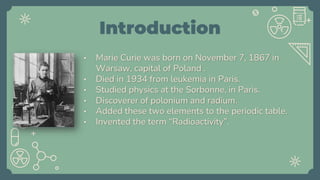
• Marie Curie was born on November 7, 1867 in
Warsaw, capital of Poland .
• Died in 1934 from leukemia in Paris.
• Studied physics at the Sorbonne, in Paris.
• Discoverer of polonium and radium.
• Added these two elements to the periodic table.
• Invented the term “Radioactivity”.
Childhood
1. Finished her studies with the higher marks in their class.
But despite being a top student in her secondary school,
curie could not attend the male-only university of Warsaw.
2.The household was crowded with many family members.
3.Marie’s mother died from tuberculosis on 1878.
Education
• Wanted to study at Sorbonne University.
• In 1891 Marie went to Paris and, She had degree in Physics and
Math.
• Joined the “floating university”.
• Received her doctorate of Science in June 1903 and, with
Pierre, was awarded the Davy Medal of the Royal Society.
• At the age of 16 she won a gold medal for completion of her secondary
education
• Finished her studies on 1883.
Career
o 1900s- Appointed lecturer in Physics at the French university for
girls and introduced there method of teaching based on
experimental demonstrations.
(appointed as director of research in University of Paris.)
• December 1904- appointed as chief assistant in the laboratory
directed by Pierre Curie.
(death of her husband in 1906)
• May 13, 1906- appointed to the professorship that had been left
vacant on her husband’s death.
(she was the first woman to teach in the Sorbonne.)
• 1908- edited the collected works of her late husband.
• 1910- she published her massive discovery of pure metal.
Pierre Curie
1. Marie met a young physicist, Pierre Curie.
2. They married in 26th July,1895 in the south of
Paris.
3. They had two daughters: Irene (1897) & Eve
(1904)
4. Marie’s husband died due to a run over by
horse-drawn wagon in April 1906.
Marie’s Researches
o Marie and Pierre researched the mysterious, invisible energy from uranium.
o They worked in a deserted local lab, in terrible conditions.
o She had to extract the radioactive substances from tons of rock pitchblende.
o The rock was named pitchblende, a mineral.
Polonium -They published the existence of metal not ye known in July, 1898: they
called it POLONIUM
Radium -Months later, 26th December, 1898 they announced the existence on the
pitchblende of another element: RADIUM , a new radioactive substance.
• obtained the title of doctor in physical science in June 25th,1903.
• She was first to find that these radioactive rays can be used in treatment
1. of cancer.
Nobel prize in physics
and chemistry
1.(Together with her husband, she was awarded half of the-)
Nobel Prize for Physics in 1903, for their study into the spontaneous radiation
discovered by Becquerel, who was awarded the other half of the Prize.
2.Nobel Prize in chemistry -The Swedish Nobel committee announced Marie
Curie had won the prize for chemistry in 1911 for the extraction of pure Radium.
3. As the first of the Curie family legacy of five Nobel Prizes, she was the first
woman to win a Nobel Prize, the first person and the only woman to win the
Nobel Prize twice, and the only person to win the Nobel Prize in two scientific
fields.
Legacies
• During World War I. Marie, with her daughter Irene helped the
soldiers with a X-rays, which located bullets for the surgeons.
• There is a film about Marie Curie, by Mervyn Leroy (1943)
• Eve Curie wrote a biography about her mother (1937)
• Marie Curie was the first woman of the. degree in physics,
graduate in France, obtain a Nobel Prize, obtain a chair at the
Sorbonne, obtain two Nobel Prices
• Albert Einstein (1879–1955) once said, "Marie Curie is, of all
celebrated beings, the only one whose fame has not corrupted."
THANK YOU

Ppt marie curie

  • 1.
    MARIE CURIE MANSI GUPTA 11thSCIENCE CBSE INTERNATIONAL SENIOR SECONDARY SCHOOL PODDAR BRIO
  • 2.
    One never noticeswhat has been done; one can only see what remains to be done. “ ” ~ Marie Curie
  • 3.
    Contents 1. Introduction 2. Childhood 3.Education 4. Career 5. Pierre Curie 6. Marie Curie’s Research 7. Nobel Prize in Physics and Chemistry 8. Legacies
  • 4.
    Introduction • Marie Curiewas born on November 7, 1867 in Warsaw, capital of Poland . • Died in 1934 from leukemia in Paris. • Studied physics at the Sorbonne, in Paris. • Discoverer of polonium and radium. • Added these two elements to the periodic table. • Invented the term “Radioactivity”.
  • 5.
    Childhood 1. Finished herstudies with the higher marks in their class. But despite being a top student in her secondary school, curie could not attend the male-only university of Warsaw. 2.The household was crowded with many family members. 3.Marie’s mother died from tuberculosis on 1878.
  • 6.
    Education • Wanted tostudy at Sorbonne University. • In 1891 Marie went to Paris and, She had degree in Physics and Math. • Joined the “floating university”. • Received her doctorate of Science in June 1903 and, with Pierre, was awarded the Davy Medal of the Royal Society. • At the age of 16 she won a gold medal for completion of her secondary education • Finished her studies on 1883.
  • 7.
    Career o 1900s- Appointedlecturer in Physics at the French university for girls and introduced there method of teaching based on experimental demonstrations. (appointed as director of research in University of Paris.) • December 1904- appointed as chief assistant in the laboratory directed by Pierre Curie. (death of her husband in 1906) • May 13, 1906- appointed to the professorship that had been left vacant on her husband’s death. (she was the first woman to teach in the Sorbonne.) • 1908- edited the collected works of her late husband. • 1910- she published her massive discovery of pure metal.
  • 8.
    Pierre Curie 1. Mariemet a young physicist, Pierre Curie. 2. They married in 26th July,1895 in the south of Paris. 3. They had two daughters: Irene (1897) & Eve (1904) 4. Marie’s husband died due to a run over by horse-drawn wagon in April 1906.
  • 9.
    Marie’s Researches o Marieand Pierre researched the mysterious, invisible energy from uranium. o They worked in a deserted local lab, in terrible conditions. o She had to extract the radioactive substances from tons of rock pitchblende. o The rock was named pitchblende, a mineral. Polonium -They published the existence of metal not ye known in July, 1898: they called it POLONIUM Radium -Months later, 26th December, 1898 they announced the existence on the pitchblende of another element: RADIUM , a new radioactive substance. • obtained the title of doctor in physical science in June 25th,1903. • She was first to find that these radioactive rays can be used in treatment 1. of cancer.
  • 10.
    Nobel prize inphysics and chemistry 1.(Together with her husband, she was awarded half of the-) Nobel Prize for Physics in 1903, for their study into the spontaneous radiation discovered by Becquerel, who was awarded the other half of the Prize. 2.Nobel Prize in chemistry -The Swedish Nobel committee announced Marie Curie had won the prize for chemistry in 1911 for the extraction of pure Radium. 3. As the first of the Curie family legacy of five Nobel Prizes, she was the first woman to win a Nobel Prize, the first person and the only woman to win the Nobel Prize twice, and the only person to win the Nobel Prize in two scientific fields.
  • 11.
    Legacies • During WorldWar I. Marie, with her daughter Irene helped the soldiers with a X-rays, which located bullets for the surgeons. • There is a film about Marie Curie, by Mervyn Leroy (1943) • Eve Curie wrote a biography about her mother (1937) • Marie Curie was the first woman of the. degree in physics, graduate in France, obtain a Nobel Prize, obtain a chair at the Sorbonne, obtain two Nobel Prices • Albert Einstein (1879–1955) once said, "Marie Curie is, of all celebrated beings, the only one whose fame has not corrupted."
  • 12.