By:-
Mandeep Neupane
Introduction 1
Principles 2
 Business Activities 3
 Principles of Management 4,5
 Management Functions 6
 Managerial Skills 7
Contributions 8
Limitations 9
References 10
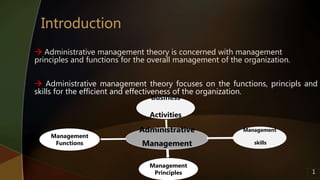
 Administrative management theory is concerned with management
principles and functions for the overall management of the organization.
 Administrative management theory focuses on the functions, principls and
skills for the efficient and effectiveness of the organization.
Administrative
Management
Business
Activities
Management
skills
Management
Principles
Management
Functions
1
The four main principles on the basis of which Administrative
management theory helps to make the organization more effective
and efficient can be listed as:
1. Business Activities
2. Principles of management
3. Management Functions
4. Managerial Skills
2
The theory of business activities classifies all business activities into
six catagories.
i. Technical : Manufacturing Products
ii. Commercial : Marketing Products (Buying, Selling,
Exchange)
iii. Financial : Acquiring and controlling capital
iv. Security : Protecting property and people
v. Accounting : Recording Financial transaction
vi. Managerial : Planning, Organizing, Commanding,
Coordinating and Controlling function
3
This theory consists of 14 principles of Management and can
be listed as:
1. Division of Work : Specialization of work results in efficiency.
2. Authority and Responsibility : Authority flows from
responsibility.
3. Descipline : Obedience and respect for rules.
4. Unity of Command : One employee one boss.
5. Unity of Direction : One plan and one head for a group.
4
6. Subordination of Individual Interest : Interest of organization
should be above the interest of individual.
7. Remuneration : Fair and equitable wages to employees.
8. Centralization : Centralized power structure.
9. Scalar Chain : Chain of authority from top to bottom.
10. Order : A place for everything and everything in a place.
11. Equity : Sense of kindness and justice to all levels while dealing.
12. Stability of Tenure : Job security to avoid employee turnover.
13. Initiative : Give employee freedom to take initiative.
14. Espirit de Corps : Union Is strength.
5
This Theory states that management should perform the
following functions.
 Forecast and plan : Setting goals and actions to achieve.
Organize : Grouping of activities and resources.
Command : Providing leadership.
Coordinate : Achieving harmony of effort.
Control : Monitoring and correcting performance.
6
This theory states that management is a skill that can be
learned. Hence, managers are made not born.
A good manager should have following skills:
 Physical skill
 Mental skill
 Moral skill
 Educational skill
 Technical skill and
Experience.
7
Contribution of the Administrative Management Theory can be
listed as :
 It identified management functions for the first time.
 Universal Principles of Management laid out by this theory
serve as guide for management behavior.
 It identified skills needed fro management.
 It introduced management as a profession.
8
 It ignores the importance of behavior in organization
 It is mechanistic in nature and is not applicable n all
situations.
It has limited application in complex and dynamic
environment.
9
Following materials were the sources for the presentation.
Principles of Management in Nepal – Dr. Govind Ram
Agrawal.
https://study.com
10
Thank You !!!

Presentation on Administrative management theory

  • 1.
  • 2.
    Introduction 1 Principles 2 Business Activities 3  Principles of Management 4,5  Management Functions 6  Managerial Skills 7 Contributions 8 Limitations 9 References 10
  • 3.
     Administrative managementtheory is concerned with management principles and functions for the overall management of the organization.  Administrative management theory focuses on the functions, principls and skills for the efficient and effectiveness of the organization. Administrative Management Business Activities Management skills Management Principles Management Functions 1
  • 4.
    The four mainprinciples on the basis of which Administrative management theory helps to make the organization more effective and efficient can be listed as: 1. Business Activities 2. Principles of management 3. Management Functions 4. Managerial Skills 2
  • 5.
    The theory ofbusiness activities classifies all business activities into six catagories. i. Technical : Manufacturing Products ii. Commercial : Marketing Products (Buying, Selling, Exchange) iii. Financial : Acquiring and controlling capital iv. Security : Protecting property and people v. Accounting : Recording Financial transaction vi. Managerial : Planning, Organizing, Commanding, Coordinating and Controlling function 3
  • 6.
    This theory consistsof 14 principles of Management and can be listed as: 1. Division of Work : Specialization of work results in efficiency. 2. Authority and Responsibility : Authority flows from responsibility. 3. Descipline : Obedience and respect for rules. 4. Unity of Command : One employee one boss. 5. Unity of Direction : One plan and one head for a group. 4
  • 7.
    6. Subordination ofIndividual Interest : Interest of organization should be above the interest of individual. 7. Remuneration : Fair and equitable wages to employees. 8. Centralization : Centralized power structure. 9. Scalar Chain : Chain of authority from top to bottom. 10. Order : A place for everything and everything in a place. 11. Equity : Sense of kindness and justice to all levels while dealing. 12. Stability of Tenure : Job security to avoid employee turnover. 13. Initiative : Give employee freedom to take initiative. 14. Espirit de Corps : Union Is strength. 5
  • 8.
    This Theory statesthat management should perform the following functions.  Forecast and plan : Setting goals and actions to achieve. Organize : Grouping of activities and resources. Command : Providing leadership. Coordinate : Achieving harmony of effort. Control : Monitoring and correcting performance. 6
  • 9.
    This theory statesthat management is a skill that can be learned. Hence, managers are made not born. A good manager should have following skills:  Physical skill  Mental skill  Moral skill  Educational skill  Technical skill and Experience. 7
  • 10.
    Contribution of theAdministrative Management Theory can be listed as :  It identified management functions for the first time.  Universal Principles of Management laid out by this theory serve as guide for management behavior.  It identified skills needed fro management.  It introduced management as a profession. 8
  • 11.
     It ignoresthe importance of behavior in organization  It is mechanistic in nature and is not applicable n all situations. It has limited application in complex and dynamic environment. 9
  • 12.
    Following materials werethe sources for the presentation. Principles of Management in Nepal – Dr. Govind Ram Agrawal. https://study.com 10
  • 13.