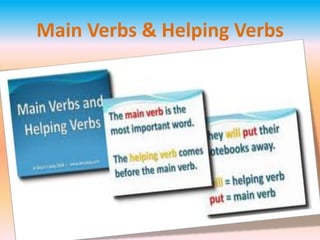
Main Verbs & Helping Verbs
HELPING VERBS
Main VerbS
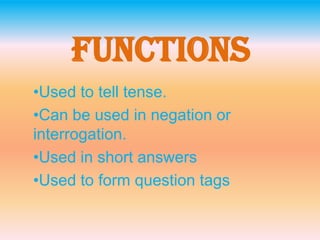
Functions
•Used to tell tense.
•Can be used in negation or
interrogation.
•Used in short answers
•Used to form question tags
Kinds of Auxiliaries
Primary auxiliaries
Modal auxiliaries
Semi Modals/Marginal
Primary Auxiliaries
•Be: be, is, am, are, being,
been, was, were
•Have: have, has, had
•Do: do, does, did
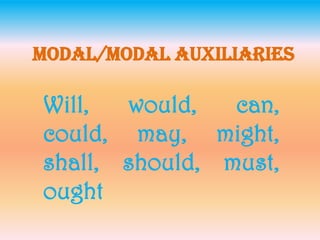
Modal/Modal Auxiliaries
Will, would, can,
could, may, might,
shall, should, must,
ought
Semi Modal / Marginal
•need, used &
dare
Shall/Should
Future Tense-
I shall go to Shillong next year.
Express suggestion/advice-
Shall we go to play football now?
Expresses duty/ obligation-
You shouldn’t travel without a ticket.
Used when seeking advice-
What should I do now?
Will/Would
To express future tense-
He will like your idea.
To express wish/ determination-
Given a chance, I would certainly go to the
Himalayas.
I will like to go on a cruise.
To express an invitation
Will you join us for lunch?( use would with
please)
Can/Could
Express ability, capability or capacity-
He can lift this log with ease.
Make a request-
Can you help me with this sum?
Could I borrow your vehicle for a day?(Too
polite)
Express permission-
You can go out to play.
Express past ability-
I could write neatly when I was young.
May/Might
To seek/give permission-
May I help you with your bag?
You may go out to ply now.
To express a curse/wish-
May you suffer bitterly for every mean act
you do.
May God bless you.
To express strong possibility-
It may rain this afternoon.
Must
To express duty/obligation-
We must do as our teacher tells us to do.
We must look after our parents in their old
age.
To express compulsion/ necessity-
You must be punctual in all matters.
You must hurry, otherwise you will miss the
bus.
Ought To
Used to express sense of obligation/
duty-
We ought to respect our teachers.
We ought to help the orphans.
Sense of necessity/ advice-
You ought to reach home before dark each
day.
Note:-
‘ Ought to have’ is the Past tense of
ought to.
Must expresses more compulsion
but less obligation than ought to.
Ought to expresses more moral
obligation than should and must.
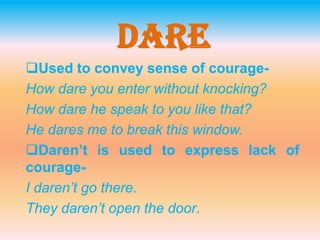
Dare
Used to convey sense of courage-
How dare you enter without knocking?
How dare he speak to you like that?
He dares me to break this window.
Daren’t is used to express lack of
courage-
I daren’t go there.
They daren’t open the door.
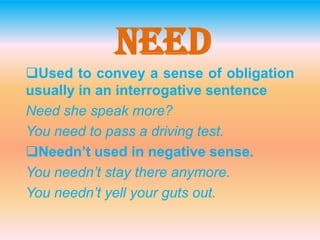
Need
Used to convey a sense of obligation
usually in an interrogative sentence
Need she speak more?
You need to pass a driving test.
Needn’t used in negative sense.
You needn’t stay there anymore.
You needn’t yell your guts out.
Used To
Used to express a past habit/state
which has ceased now.
We used to walk all the way to school.
I am not used to waking up late in the
mornings.
I used to play football at school.
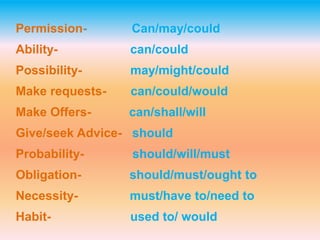
Permission- Can/may/could
Ability- can/could
Possibility- may/might/could
Make requests- can/could/would
Make Offers- can/shall/will
Give/seek Advice- should
Probability- should/will/must
Obligation- should/must/ought to
Necessity- must/have to/need to
Habit- used to/ would
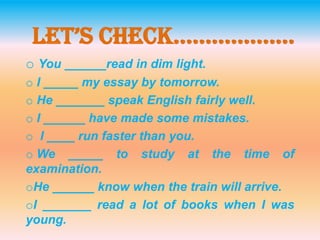
Let’s check...................
o You ______read in dim light.
o I _____ my essay by tomorrow.
o He _______ speak English fairly well.
o I ______ have made some mistakes.
o I ____ run faster than you.
o We _____ to study at the time of
examination.
oHe ______ know when the train will arrive.
oI _______ read a lot of books when I was
young.
1. Should not
2. Have to
3. Can/can’t
4. Might/must
5. Can
6. Ought
7. Might
8. Used to
Helping verbs

Helping verbs

  • 2.
    Main Verbs &Helping Verbs
  • 3.
  • 4.
    Functions •Used to telltense. •Can be used in negation or interrogation. •Used in short answers •Used to form question tags
  • 5.
    Kinds of Auxiliaries Primaryauxiliaries Modal auxiliaries Semi Modals/Marginal
  • 6.
    Primary Auxiliaries •Be: be,is, am, are, being, been, was, were •Have: have, has, had •Do: do, does, did
  • 7.
    Modal/Modal Auxiliaries Will, would,can, could, may, might, shall, should, must, ought
  • 8.
    Semi Modal /Marginal •need, used & dare
  • 9.
    Shall/Should Future Tense- I shallgo to Shillong next year. Express suggestion/advice- Shall we go to play football now? Expresses duty/ obligation- You shouldn’t travel without a ticket. Used when seeking advice- What should I do now?
  • 10.
    Will/Would To express futuretense- He will like your idea. To express wish/ determination- Given a chance, I would certainly go to the Himalayas. I will like to go on a cruise. To express an invitation Will you join us for lunch?( use would with please)
  • 11.
    Can/Could Express ability, capabilityor capacity- He can lift this log with ease. Make a request- Can you help me with this sum? Could I borrow your vehicle for a day?(Too polite) Express permission- You can go out to play. Express past ability- I could write neatly when I was young.
  • 12.
    May/Might To seek/give permission- MayI help you with your bag? You may go out to ply now. To express a curse/wish- May you suffer bitterly for every mean act you do. May God bless you. To express strong possibility- It may rain this afternoon.
  • 13.
    Must To express duty/obligation- Wemust do as our teacher tells us to do. We must look after our parents in their old age. To express compulsion/ necessity- You must be punctual in all matters. You must hurry, otherwise you will miss the bus.
  • 14.
    Ought To Used toexpress sense of obligation/ duty- We ought to respect our teachers. We ought to help the orphans. Sense of necessity/ advice- You ought to reach home before dark each day.
  • 15.
    Note:- ‘ Ought tohave’ is the Past tense of ought to. Must expresses more compulsion but less obligation than ought to. Ought to expresses more moral obligation than should and must.
  • 16.
    Dare Used to conveysense of courage- How dare you enter without knocking? How dare he speak to you like that? He dares me to break this window. Daren’t is used to express lack of courage- I daren’t go there. They daren’t open the door.
  • 17.
    Need Used to conveya sense of obligation usually in an interrogative sentence Need she speak more? You need to pass a driving test. Needn’t used in negative sense. You needn’t stay there anymore. You needn’t yell your guts out.
  • 18.
    Used To Used toexpress a past habit/state which has ceased now. We used to walk all the way to school. I am not used to waking up late in the mornings. I used to play football at school.
  • 19.
    Permission- Can/may/could Ability- can/could Possibility-may/might/could Make requests- can/could/would Make Offers- can/shall/will Give/seek Advice- should Probability- should/will/must Obligation- should/must/ought to Necessity- must/have to/need to Habit- used to/ would
  • 21.
    Let’s check................... o You______read in dim light. o I _____ my essay by tomorrow. o He _______ speak English fairly well. o I ______ have made some mistakes. o I ____ run faster than you. o We _____ to study at the time of examination. oHe ______ know when the train will arrive. oI _______ read a lot of books when I was young.
  • 22.
    1. Should not 2.Have to 3. Can/can’t 4. Might/must 5. Can 6. Ought 7. Might 8. Used to