Modal Verbs
 Modal Verbs
 Can / could
 Shall / should
 May / might
 Will / would
 must / ought to
 need
 Used
 dare
 Can / could
ability
permission
could can be asked to express polite way of
asking questions
Shall / should
command and Promise -----with second and
third person.
should -----obligation.
 May / might
Permission
possibility
wish
Might
indicate doubt
Polite protest
request more polite than ‘may’
suggestion
 will / would
intention
willingness
promise
would same as ‘will’
Must
necessity ----- in present / future
obligation
Ought to
moral obligation
Need
necessary
Used to
routine / habit in the past.
Dare
expression of the feeling courage enough /
bold enough
 Can
I can swim across the river.
He can work this sum.
Can you lift this box?
Could
I could swim across the river when I was
young.
Could you please close the window?
She wondered whether it could be true.
 Shall (Permission, Command)
When shall I see you again?
Shall I rub the board?
Shall I close the window?
Shall I wind up the session?
Shall I bring chocolate for all?
You shall have holiday tomorrow.
Should
We should obey the laws.
You should keep your promise.
Children should obey their parents.
May ( Possibility in affirmative sentence / Permission)
It may rain tomorrow.
He may be at home.
May God bless you.
May I come in?
Might
It might rain tomorrow.
You might pay a little more attention.
I thought he might be at home.
Raju might have gone with Ravi.
Will
You will see that I am right .
We will need the fees on 15th
november.
I will carry your book.
I will try to do better next month.
I will succeed or die in the next attempt.
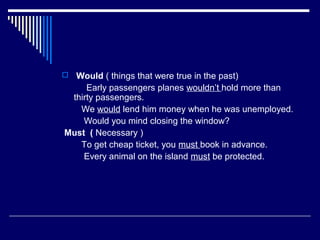
 Would ( things that were true in the past)
Early passengers planes wouldn’t hold more than
thirty passengers.
We would lend him money when he was unemployed.
Would you mind closing the window?
Must ( Necessary )
To get cheap ticket, you must book in advance.
Every animal on the island must be protected.
 Must
( When we conclude that something
happened.)
Tony might be wishing he had never
taken teaching job.
There must be 200 students in VTC ,Sur.
 Ought to (moral obligation)
This soup is too salty .You ought to
send it back.
I ought to visit my parents
You ought to have received the report
by now.
I enjoyed her first novel, so the new
one ought to be good.
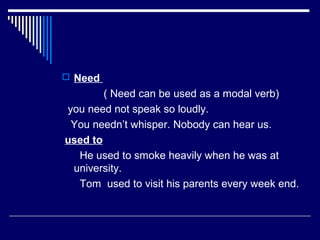
 Need
( Need can be used as a modal verb)
you need not speak so loudly.
You needn’t whisper. Nobody can hear us.
used to
He used to smoke heavily when he was at
university.
Tom used to visit his parents every week end.
 Dare ( be brave enough to) as distinct from the ordinary
verb.
dare –challenge.
How dare you contradict me ?
How dare you oppose the boss?
He doesn’t dare to speak to me.
He dare not take such a step.
Note:
It doesn’t take ‘s’ in the third person singular present
tense.
It is generally used in the negative and interrogative
sentences
Thank You

Modal verbs 4

  • 1.
  • 2.
     Modal Verbs Can / could  Shall / should  May / might  Will / would  must / ought to  need  Used  dare
  • 3.
     Can /could ability permission could can be asked to express polite way of asking questions Shall / should command and Promise -----with second and third person. should -----obligation.
  • 4.
     May /might Permission possibility wish Might indicate doubt Polite protest request more polite than ‘may’ suggestion
  • 5.
     will /would intention willingness promise would same as ‘will’ Must necessity ----- in present / future obligation
  • 6.
    Ought to moral obligation Need necessary Usedto routine / habit in the past. Dare expression of the feeling courage enough / bold enough
  • 7.
     Can I canswim across the river. He can work this sum. Can you lift this box? Could I could swim across the river when I was young. Could you please close the window? She wondered whether it could be true.
  • 8.
     Shall (Permission,Command) When shall I see you again? Shall I rub the board? Shall I close the window? Shall I wind up the session? Shall I bring chocolate for all? You shall have holiday tomorrow.
  • 9.
    Should We should obeythe laws. You should keep your promise. Children should obey their parents. May ( Possibility in affirmative sentence / Permission) It may rain tomorrow. He may be at home. May God bless you. May I come in?
  • 10.
    Might It might raintomorrow. You might pay a little more attention. I thought he might be at home. Raju might have gone with Ravi. Will You will see that I am right . We will need the fees on 15th november. I will carry your book. I will try to do better next month. I will succeed or die in the next attempt.
  • 11.
     Would (things that were true in the past) Early passengers planes wouldn’t hold more than thirty passengers. We would lend him money when he was unemployed. Would you mind closing the window? Must ( Necessary ) To get cheap ticket, you must book in advance. Every animal on the island must be protected.
  • 12.
     Must ( Whenwe conclude that something happened.) Tony might be wishing he had never taken teaching job. There must be 200 students in VTC ,Sur.
  • 13.
     Ought to(moral obligation) This soup is too salty .You ought to send it back. I ought to visit my parents You ought to have received the report by now. I enjoyed her first novel, so the new one ought to be good.
  • 14.
     Need ( Needcan be used as a modal verb) you need not speak so loudly. You needn’t whisper. Nobody can hear us. used to He used to smoke heavily when he was at university. Tom used to visit his parents every week end.
  • 15.
     Dare (be brave enough to) as distinct from the ordinary verb. dare –challenge. How dare you contradict me ? How dare you oppose the boss? He doesn’t dare to speak to me. He dare not take such a step. Note: It doesn’t take ‘s’ in the third person singular present tense. It is generally used in the negative and interrogative sentences
  • 16.