Prepositions commonly convey the 
following relationships: 
agency (by); comparison (like, as . . . as); 
direction (to, toward, through); place (at, 
by, on); possession (of); purpose (for); 
source (from, out of); and time (at, before, 
on).
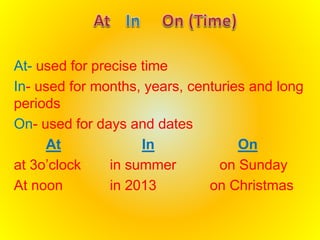
At- used for precise time 
In- used for months, years, centuries and long 
periods 
On- used for days and dates 
At In On 
at 3o’clock in summer on Sunday 
At noon in 2013 on Christmas
In 
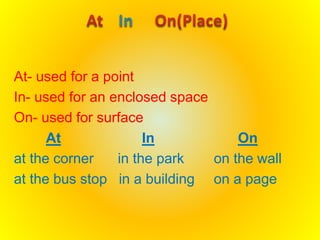
At- used for a point 
In- used for an enclosed space 
On- used for surface 
At In On 
at the corner in the park on the wall 
at the bus stop in a building on a page
At- stationary position while In shows motion 
She is at home. The train is in motion. 
At for small place while In for big place 
He lives at Ahmedabad in Gujarat. 
At for point of time while In for period of time 
I will see you at 6 am in the morning.
TO 
Direction -Turn to the right. 
Destination- I am going to Delhi. 
Duration- From Monday to Friday 
Compared with- I prefer tea to coffee. 
In order to- We went to visit him. 
TOWARDS 
Indicates movement in a particular direction
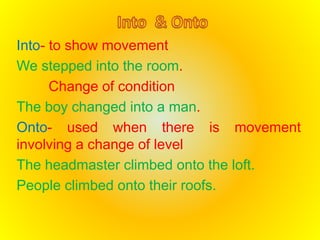
Into- to show movement 
We stepped into the room. 
Change of condition 
The boy changed into a man. 
Onto- used when there is movement 
involving a change of level 
The headmaster climbed onto the loft. 
People climbed onto their roofs.
Accompanying- came with her, my pen is 
with me 
Having, containing- book with maps 
By means of, using- The snake was killed 
with stick 
Manner- He solved the sum with difficulty 
Agreement- I agree with you. 
Because of- He paralyzed with fear.
Since- point of time 
Since January, since 2013 
For- period of time 
For two hours, for a year 
From- used with to, till and until 
Most people work from 8 to 6. 
-Used for place 
He is from Mumbai. 
Where do you come from?
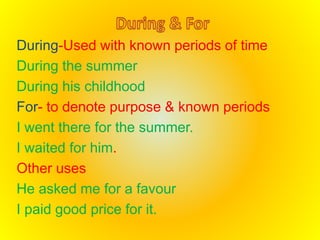
During-Used with known periods of time 
During the summer 
During his childhood 
For- to denote purpose & known periods 
I went there for the summer. 
I waited for him. 
Other uses 
He asked me for a favour 
I paid good price for it.
Below & under- both mean lower than(in 
level) 
But under usually denotes physical contact 
and below denotes space between the 
things 
He put the books under the pillow. 
They live below us. 
Beneath- something under the other thing 
He sat beneath the tree to escape sun.
In- maximum time limit 
Submit your report in one week. 
Within- before the length of time 
He returned within first half of the movie
Ago- used for past events 
He came three hours ago. 
Before- Used in reference to two events 
The train had left before he reached the 
station.
Between- used for two things/persons 
No one can come between us. 
Among- used for more than two 
things/persons 
He was happy to be among his friends 
again. 
Amongst- used if followed by a word 
beginning with a vowel 
He distributed the chocolates amongst us.
Of- 
Location-the middle of the road 
Possession- a friend of mine 
Part of a group- a member of the team 
Measurement- a cup of milk 
Off- 
Not on/ away from- Please keep off the grass. 
At some distance from- There are islands off 
the coast.
Above & Over- higher than 
The helicopter hovered above/over us. 
Over also means covering/ on the other side 
of/across 
There is a bridge over the railway line. 
I put a shroud over the dead body. 
Note, Above cannot be used here. 
Over also used with meals/food/drink 
We had a chat over the lunch. 
Above- previous or earlier 
He lives at the above address.
Across- movement from one side to another 
How are we going to get across the stream? 
When something is positioned on the opposite 
side of a place in relation to the speaker 
His house is across the street. 
Along-show movement following a line 
We walked along the river.
Through- Movement from one side to another 
He walked through the house. 
He cut through the wire.
Preposition

Preposition

  • 3.
    Prepositions commonly conveythe following relationships: agency (by); comparison (like, as . . . as); direction (to, toward, through); place (at, by, on); possession (of); purpose (for); source (from, out of); and time (at, before, on).
  • 4.
    At- used forprecise time In- used for months, years, centuries and long periods On- used for days and dates At In On at 3o’clock in summer on Sunday At noon in 2013 on Christmas
  • 5.
    In At- usedfor a point In- used for an enclosed space On- used for surface At In On at the corner in the park on the wall at the bus stop in a building on a page
  • 6.
    At- stationary positionwhile In shows motion She is at home. The train is in motion. At for small place while In for big place He lives at Ahmedabad in Gujarat. At for point of time while In for period of time I will see you at 6 am in the morning.
  • 8.
    TO Direction -Turnto the right. Destination- I am going to Delhi. Duration- From Monday to Friday Compared with- I prefer tea to coffee. In order to- We went to visit him. TOWARDS Indicates movement in a particular direction
  • 9.
    Into- to showmovement We stepped into the room. Change of condition The boy changed into a man. Onto- used when there is movement involving a change of level The headmaster climbed onto the loft. People climbed onto their roofs.
  • 10.
    Accompanying- came withher, my pen is with me Having, containing- book with maps By means of, using- The snake was killed with stick Manner- He solved the sum with difficulty Agreement- I agree with you. Because of- He paralyzed with fear.
  • 11.
    Since- point oftime Since January, since 2013 For- period of time For two hours, for a year From- used with to, till and until Most people work from 8 to 6. -Used for place He is from Mumbai. Where do you come from?
  • 12.
    During-Used with knownperiods of time During the summer During his childhood For- to denote purpose & known periods I went there for the summer. I waited for him. Other uses He asked me for a favour I paid good price for it.
  • 13.
    Below & under-both mean lower than(in level) But under usually denotes physical contact and below denotes space between the things He put the books under the pillow. They live below us. Beneath- something under the other thing He sat beneath the tree to escape sun.
  • 14.
    In- maximum timelimit Submit your report in one week. Within- before the length of time He returned within first half of the movie
  • 15.
    Ago- used forpast events He came three hours ago. Before- Used in reference to two events The train had left before he reached the station.
  • 16.
    Between- used fortwo things/persons No one can come between us. Among- used for more than two things/persons He was happy to be among his friends again. Amongst- used if followed by a word beginning with a vowel He distributed the chocolates amongst us.
  • 17.
    Of- Location-the middleof the road Possession- a friend of mine Part of a group- a member of the team Measurement- a cup of milk Off- Not on/ away from- Please keep off the grass. At some distance from- There are islands off the coast.
  • 18.
    Above & Over-higher than The helicopter hovered above/over us. Over also means covering/ on the other side of/across There is a bridge over the railway line. I put a shroud over the dead body. Note, Above cannot be used here. Over also used with meals/food/drink We had a chat over the lunch. Above- previous or earlier He lives at the above address.
  • 19.
    Across- movement fromone side to another How are we going to get across the stream? When something is positioned on the opposite side of a place in relation to the speaker His house is across the street. Along-show movement following a line We walked along the river.
  • 20.
    Through- Movement fromone side to another He walked through the house. He cut through the wire.