AUXILIARY ---MODAL VERBS
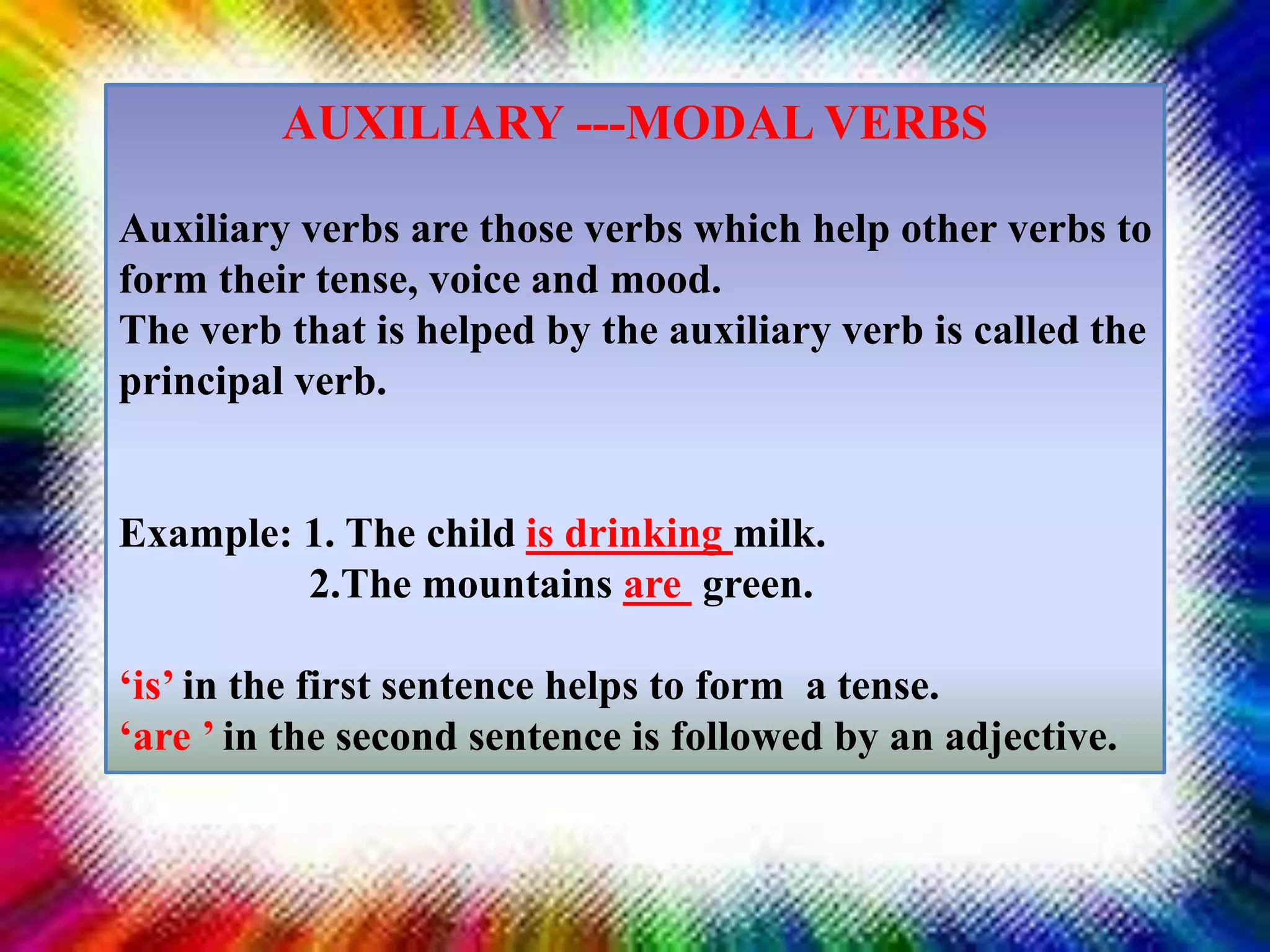
Auxiliary verbs are those verbs which help other verbs to
form their tense, voice and mood.
The verb that is helped by the auxiliary verb is called the
principal verb.
Example: 1. The child is drinking milk.
2.The mountains are green.
‘is’ in the first sentence helps to form a tense.
‘are ’ in the second sentence is followed by an adjective.
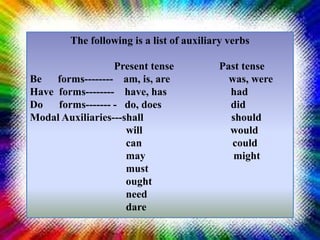
The following is a list of auxiliary verbs
Present tense Past tense
Be forms-------- am, is, are was, were
Have forms-------- have, has had
Do forms------- - do, does did
Modal Auxiliaries---shall should
will would
can could
may might
must
ought
need
dare
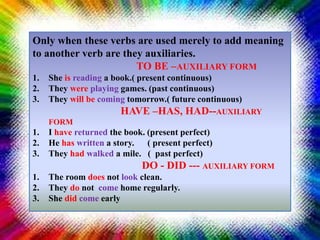
Only when these verbs are used merely to add meaning
to another verb are they auxiliaries.
TO BE –AUXILIARY FORM
1. She is reading a book.( present continuous)
2. They were playing games. (past continuous)
3. They will be coming tomorrow.( future continuous)
HAVE –HAS, HAD--AUXILIARY
FORM
1. I have returned the book. (present perfect)
2. He has written a story. ( present perfect)
3. They had walked a mile. ( past perfect)
DO - DID --- AUXILIARY FORM
1. The room does not look clean.
2. They do not come home regularly.
3. She did come early
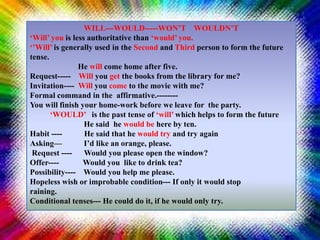
WILL---WOULD-----WON’T WOULDN’T
‘Will’ you is less authoritative than ‘would’ you.
‘’Will’ is generally used in the Second and Third person to form the future
tense.
He will come home after five.
Request----- Will you get the books from the library for me?
Invitation---- Will you come to the movie with me?
Formal command in the affirmative.--------
You will finish your home-work before we leave for the party.
‘WOULD’ is the past tense of ‘will’ which helps to form the future
He said he would be here by ten.
Habit ---- He said that he would try and try again
Asking— I’d like an orange, please.
Request ---- Would you please open the window?
Offer---- Would you like to drink tea?
Possibility---- Would you help me please.
Hopeless wish or improbable condition--- If only it would stop
raining.
Conditional tenses--- He could do it, if he would only try.
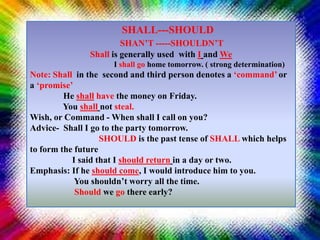
SHALL---SHOULD
SHAN’T -----SHOULDN’T
Shall is generally used with I and We
I shall go home tomorrow. ( strong determination)
Note: Shall in the second and third person denotes a ‘command’ or
a ‘promise’
He shall have the money on Friday.
You shall not steal.
Wish, or Command - When shall I call on you?
Advice- Shall I go to the party tomorrow.
SHOULD is the past tense of SHALL which helps
to form the future
I said that I should return in a day or two.
Emphasis: If he should come, I would introduce him to you.
You shouldn’t worry all the time.
Should we go there early?
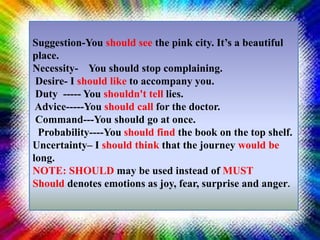
Suggestion-You should see the pink city. It’s a beautiful
place.
Necessity- You should stop complaining.
Desire- I should like to accompany you.
Duty ----- You shouldn't tell lies.
Advice-----You should call for the doctor.
Command---You should go at once.
Probability----You should find the book on the top shelf.
Uncertainty– I should think that the journey would be
long.
NOTE: SHOULD may be used instead of MUST
Should denotes emotions as joy, fear, surprise and anger.
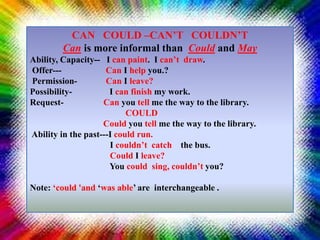
CAN COULD –CAN’T COULDN’T
Can is more informal than Could and May
Ability, Capacity-- I can paint. I can’t draw.
Offer--- Can I help you.?
Permission- Can I leave?
Possibility- I can finish my work.
Request- Can you tell me the way to the library.
COULD
Could you tell me the way to the library.
Ability in the past---I could run.
I couldn’t catch the bus.
Could I leave?
You could sing, couldn’t you?
Note: ‘could 'and ‘was able’ are interchangeable .
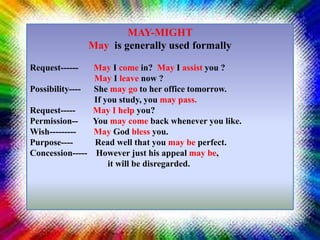
MAY-MIGHT
May is generally used formally
Request------ May I come in? May I assist you ?
May I leave now ?
Possibility---- She may go to her office tomorrow.
If you study, you may pass.
Request----- May I help you?
Permission-- You may come back whenever you like.
Wish--------- May God bless you.
Purpose---- Read well that you may be perfect.
Concession----- However just his appeal may be,
it will be disregarded.
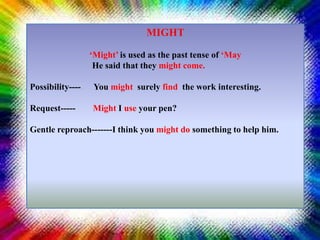
MIGHT
‘Might’ is used as the past tense of ‘May
He said that they might come.
Possibility---- You might surely find the work interesting.
Request----- Might I use your pen?
Gentle reproach-------I think you might do something to help him.
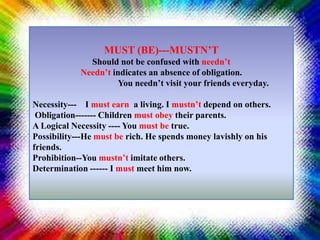
MUST (BE)---MUSTN’T
Should not be confused with needn’t
Needn’t indicates an absence of obligation.
You needn’t visit your friends everyday.
Necessity--- I must earn a living. I mustn’t depend on others.
Obligation------- Children must obey their parents.
A Logical Necessity ---- You must be true.
Possibility---He must be rich. He spends money lavishly on his
friends.
Prohibition--You mustn’t imitate others.
Determination ------ I must meet him now.
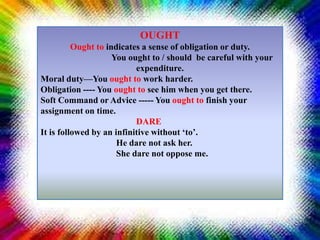
OUGHT
Ought to indicates a sense of obligation or duty.
You ought to / should be careful with your
expenditure.
Moral duty—You ought to work harder.
Obligation ---- You ought to see him when you get there.
Soft Command or Advice ----- You ought to finish your
assignment on time.
DARE
It is followed by an infinitive without ‘to’.
He dare not ask her.
She dare not oppose me.
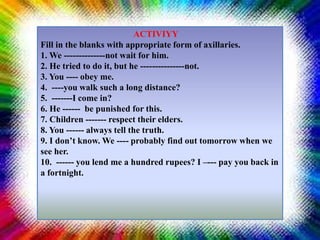
ACTIVIYY
Fill in the blanks with appropriate form of axillaries.
1. We --------------not wait for him.
2. He tried to do it, but he ---------------not.
3. You ---- obey me.
4. ----you walk such a long distance?
5. -------I come in?
6. He ------ be punished for this.
7. Children ------- respect their elders.
8. You ------ always tell the truth.
9. I don’t know. We ---- probably find out tomorrow when we
see her.
10. ------ you lend me a hundred rupees? I –--- pay you back in
a fortnight.

Modalverbs 1

  • 1.
    AUXILIARY ---MODAL VERBS Auxiliaryverbs are those verbs which help other verbs to form their tense, voice and mood. The verb that is helped by the auxiliary verb is called the principal verb. Example: 1. The child is drinking milk. 2.The mountains are green. ‘is’ in the first sentence helps to form a tense. ‘are ’ in the second sentence is followed by an adjective.
  • 2.
    The following isa list of auxiliary verbs Present tense Past tense Be forms-------- am, is, are was, were Have forms-------- have, has had Do forms------- - do, does did Modal Auxiliaries---shall should will would can could may might must ought need dare
  • 3.
    Only when theseverbs are used merely to add meaning to another verb are they auxiliaries. TO BE –AUXILIARY FORM 1. She is reading a book.( present continuous) 2. They were playing games. (past continuous) 3. They will be coming tomorrow.( future continuous) HAVE –HAS, HAD--AUXILIARY FORM 1. I have returned the book. (present perfect) 2. He has written a story. ( present perfect) 3. They had walked a mile. ( past perfect) DO - DID --- AUXILIARY FORM 1. The room does not look clean. 2. They do not come home regularly. 3. She did come early
  • 4.
    WILL---WOULD-----WON’T WOULDN’T ‘Will’ youis less authoritative than ‘would’ you. ‘’Will’ is generally used in the Second and Third person to form the future tense. He will come home after five. Request----- Will you get the books from the library for me? Invitation---- Will you come to the movie with me? Formal command in the affirmative.-------- You will finish your home-work before we leave for the party. ‘WOULD’ is the past tense of ‘will’ which helps to form the future He said he would be here by ten. Habit ---- He said that he would try and try again Asking— I’d like an orange, please. Request ---- Would you please open the window? Offer---- Would you like to drink tea? Possibility---- Would you help me please. Hopeless wish or improbable condition--- If only it would stop raining. Conditional tenses--- He could do it, if he would only try.
  • 5.
    SHALL---SHOULD SHAN’T -----SHOULDN’T Shall isgenerally used with I and We I shall go home tomorrow. ( strong determination) Note: Shall in the second and third person denotes a ‘command’ or a ‘promise’ He shall have the money on Friday. You shall not steal. Wish, or Command - When shall I call on you? Advice- Shall I go to the party tomorrow. SHOULD is the past tense of SHALL which helps to form the future I said that I should return in a day or two. Emphasis: If he should come, I would introduce him to you. You shouldn’t worry all the time. Should we go there early?
  • 6.
    Suggestion-You should seethe pink city. It’s a beautiful place. Necessity- You should stop complaining. Desire- I should like to accompany you. Duty ----- You shouldn't tell lies. Advice-----You should call for the doctor. Command---You should go at once. Probability----You should find the book on the top shelf. Uncertainty– I should think that the journey would be long. NOTE: SHOULD may be used instead of MUST Should denotes emotions as joy, fear, surprise and anger.
  • 7.
    CAN COULD –CAN’TCOULDN’T Can is more informal than Could and May Ability, Capacity-- I can paint. I can’t draw. Offer--- Can I help you.? Permission- Can I leave? Possibility- I can finish my work. Request- Can you tell me the way to the library. COULD Could you tell me the way to the library. Ability in the past---I could run. I couldn’t catch the bus. Could I leave? You could sing, couldn’t you? Note: ‘could 'and ‘was able’ are interchangeable .
  • 8.
    MAY-MIGHT May is generallyused formally Request------ May I come in? May I assist you ? May I leave now ? Possibility---- She may go to her office tomorrow. If you study, you may pass. Request----- May I help you? Permission-- You may come back whenever you like. Wish--------- May God bless you. Purpose---- Read well that you may be perfect. Concession----- However just his appeal may be, it will be disregarded.
  • 9.
    MIGHT ‘Might’ is usedas the past tense of ‘May He said that they might come. Possibility---- You might surely find the work interesting. Request----- Might I use your pen? Gentle reproach-------I think you might do something to help him.
  • 10.
    MUST (BE)---MUSTN’T Should notbe confused with needn’t Needn’t indicates an absence of obligation. You needn’t visit your friends everyday. Necessity--- I must earn a living. I mustn’t depend on others. Obligation------- Children must obey their parents. A Logical Necessity ---- You must be true. Possibility---He must be rich. He spends money lavishly on his friends. Prohibition--You mustn’t imitate others. Determination ------ I must meet him now.
  • 11.
    OUGHT Ought to indicatesa sense of obligation or duty. You ought to / should be careful with your expenditure. Moral duty—You ought to work harder. Obligation ---- You ought to see him when you get there. Soft Command or Advice ----- You ought to finish your assignment on time. DARE It is followed by an infinitive without ‘to’. He dare not ask her. She dare not oppose me.
  • 12.
    ACTIVIYY Fill in theblanks with appropriate form of axillaries. 1. We --------------not wait for him. 2. He tried to do it, but he ---------------not. 3. You ---- obey me. 4. ----you walk such a long distance? 5. -------I come in? 6. He ------ be punished for this. 7. Children ------- respect their elders. 8. You ------ always tell the truth. 9. I don’t know. We ---- probably find out tomorrow when we see her. 10. ------ you lend me a hundred rupees? I –--- pay you back in a fortnight.