AUXILARY VERBS
TYPES OF AUXILARY VERBS
Auxilary verb is used with a main verb to
show tense, etc. or form question.
There are two types of Auxilary verbs.
They are
1) Primary Auxilary
2) Modals
PRIMARY AUXILARY
Primary Auxiliaries are used as main verbs
to denote time (present, past and future).
They are also used as main verbs or linking
verbs in sentences.
Eg: I’m watching cricket on TV.
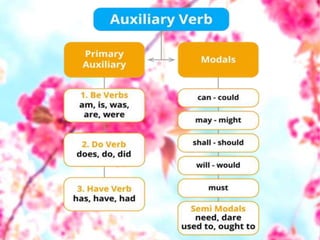
The three primary auxiliary verbs are ‘be’,
‘have’ and ‘do’.
BE VERBS
Be verbs are used to describe or tell us the
condition of people, things, places and ideas.
• Are
• Am
• Is
• Was
• Were
• Been
• Being
DO VERBS
Do is an irregular verb. Its three forms are
• Do
• Did
• Done
The present simple third person singular is
does: will you do a job for me?
HAVE VERBS
Have verb is an irregular verb. Its three forms
are
• Have
• Had
• Has
The present simple third person singular is
has: We usually have breakfast at about eight.
MODAL
Modal verbs is used with a main verb
to express ideas such as possibility,
intention, ability, or necessity.
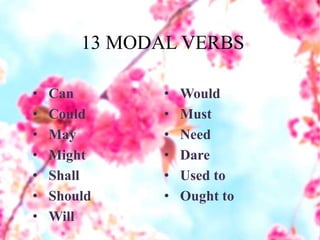
13 MODAL VERBS
• Can
• Could
• May
• Might
• Shall
• Should
• Will
• Would
• Must
• Need
• Dare
• Used to
• Ought to
CAN
The verb “can” in its present form is perfect
to ask for permission or to give permission to
someone.
Eg: You can play outside.
Can I use your bike?
Its negative form, can’t, be used to refuse
permission.
Eg: You can’t talk here.
COULD
“Could” is a modal verb used to express
possibility or past ability as well as to make
suggestions and requests.
Eg: Could I go the park?
Could I speak to mary?
MAY
The verb “may” is used to indicate that
something will possibly happen or be true in
the future, but you cannot be certain.
Eg: May I sit here?
she may be at home.
MIGHT
The verb “might” used to express the
possibility that something will happen or be
done, or that something is true although not
very likely.
Eg: I might see you tomorrow.
I wished I might go abroad.
SHALL
The verb “shall” used to indicate that
something must happen, usually because of a
rule or law.
Eg: Shall I get a pizza?
I shall meet you there at 7.
SHOULD
The verb “should” used when you are saying
what would be the right thing to do or the
right state for something to be in.
Eg: I should eat more vegetables.
We should study more.
WILL
“Will” is a modal verb used with promises or
voluntary actions that take place in the future.
“will” can also be used to make predictions
about the future.
Eg: I will make dinner tonight.– voluntary
action.
He thinks it will rain tomorrow. –
prediction.
WOULD
We use would as the past of will, to describe
past beliefs about the future. We also use
“would” to make requests or ask permission
to do something.
Eg: Would you help me? – request
She said that she would be help them
move next month. – future in the past
MUST
The verb “must” to indicate that you think it
is very important or necessary for something
to happen.
Eg: You must stop playing computer games.
Banks must examine all documents.
SEMI MODAL
Dare, need, ought to and used to are often
called semi-modal because in some ways they
are formed like modal verbs and in some ways
they are like other main verbs. Like modal
verbs, ought to and used to do change form
for person.
SEMI MODAL
DARE: I dare not go out this time. – Auxiliary verb
I dared him jump. – main verb
NEED: You need not wait. – Auxiliary verb
I need to do it. – main verb
OUGHT TO: You ought to practice more. – Auxiliary verb
It ought to be fine tomorrow. – main verb
USED TO: I used to sing in my school days. –Auxiliary
verb
There use to be a direct flight at 10.00 pm to
London. – main verb

9th auxilary verb.pptx

  • 1.
  • 2.
    TYPES OF AUXILARYVERBS Auxilary verb is used with a main verb to show tense, etc. or form question. There are two types of Auxilary verbs. They are 1) Primary Auxilary 2) Modals
  • 4.
    PRIMARY AUXILARY Primary Auxiliariesare used as main verbs to denote time (present, past and future). They are also used as main verbs or linking verbs in sentences. Eg: I’m watching cricket on TV. The three primary auxiliary verbs are ‘be’, ‘have’ and ‘do’.
  • 5.
    BE VERBS Be verbsare used to describe or tell us the condition of people, things, places and ideas. • Are • Am • Is • Was • Were • Been • Being
  • 6.
    DO VERBS Do isan irregular verb. Its three forms are • Do • Did • Done The present simple third person singular is does: will you do a job for me?
  • 7.
    HAVE VERBS Have verbis an irregular verb. Its three forms are • Have • Had • Has The present simple third person singular is has: We usually have breakfast at about eight.
  • 8.
    MODAL Modal verbs isused with a main verb to express ideas such as possibility, intention, ability, or necessity.
  • 9.
    13 MODAL VERBS •Can • Could • May • Might • Shall • Should • Will • Would • Must • Need • Dare • Used to • Ought to
  • 10.
    CAN The verb “can”in its present form is perfect to ask for permission or to give permission to someone. Eg: You can play outside. Can I use your bike? Its negative form, can’t, be used to refuse permission. Eg: You can’t talk here.
  • 11.
    COULD “Could” is amodal verb used to express possibility or past ability as well as to make suggestions and requests. Eg: Could I go the park? Could I speak to mary?
  • 12.
    MAY The verb “may”is used to indicate that something will possibly happen or be true in the future, but you cannot be certain. Eg: May I sit here? she may be at home.
  • 13.
    MIGHT The verb “might”used to express the possibility that something will happen or be done, or that something is true although not very likely. Eg: I might see you tomorrow. I wished I might go abroad.
  • 14.
    SHALL The verb “shall”used to indicate that something must happen, usually because of a rule or law. Eg: Shall I get a pizza? I shall meet you there at 7.
  • 15.
    SHOULD The verb “should”used when you are saying what would be the right thing to do or the right state for something to be in. Eg: I should eat more vegetables. We should study more.
  • 16.
    WILL “Will” is amodal verb used with promises or voluntary actions that take place in the future. “will” can also be used to make predictions about the future. Eg: I will make dinner tonight.– voluntary action. He thinks it will rain tomorrow. – prediction.
  • 17.
    WOULD We use wouldas the past of will, to describe past beliefs about the future. We also use “would” to make requests or ask permission to do something. Eg: Would you help me? – request She said that she would be help them move next month. – future in the past
  • 18.
    MUST The verb “must”to indicate that you think it is very important or necessary for something to happen. Eg: You must stop playing computer games. Banks must examine all documents.
  • 19.
    SEMI MODAL Dare, need,ought to and used to are often called semi-modal because in some ways they are formed like modal verbs and in some ways they are like other main verbs. Like modal verbs, ought to and used to do change form for person.
  • 20.
    SEMI MODAL DARE: Idare not go out this time. – Auxiliary verb I dared him jump. – main verb NEED: You need not wait. – Auxiliary verb I need to do it. – main verb OUGHT TO: You ought to practice more. – Auxiliary verb It ought to be fine tomorrow. – main verb USED TO: I used to sing in my school days. –Auxiliary verb There use to be a direct flight at 10.00 pm to London. – main verb