
Uploaded bylaurieputnam
Helping Students Improve Their Writing
The document provides a guide for educators on improving student writing through various strategies, including clear assignments, peer reviews, and constructive feedback. Key tips include setting clear expectations, encouraging progress, and using evaluation tools like checklists or rubrics. Additional resources and support networks are offered for students and faculty to enhance writing skills and facilitate collaboration.
More Related Content


Similar to Helping Students Improve Their Writing


Helping Students Improve Their Writing
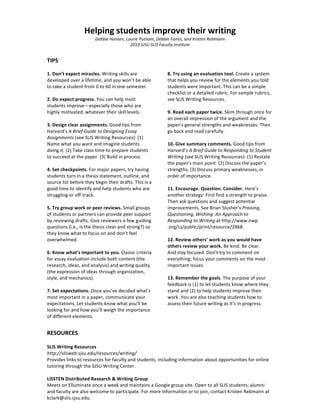
- 1. Helping students improve their writing Debbie Hansen, Laurie Putnam, Debbie Faires, and Kristen Rebmann 2010 SJSU SLIS Faculty Institute TIPS 1. Don’t expect miracles. Writing skills are 8. Try using an evaluation tool. Create a system developed over a lifetime, and you won’t be able that helps you review for the elements you told to take a student from 0 to 60 in one semester. students were important. This can be a simple checklist or a detailed rubric. For sample rubrics, 2. Do expect progress. You can help most see SLIS Writing Resources. students improve—especially those who are highly motivated, whatever their skill levels. 9. Read each paper twice. Skim through once for an overall impression of the argument and the 3. Design clear assignments. Good tips from paper’s general strengths and weaknesses. Then Harvard’s A Brief Guide to Designing Essay go back and read carefully. Assignments (see SLIS Writing Resources): (1) Name what you want and imagine students 10. Give summary comments. Good tips from doing it. (2) Take class time to prepare students Harvard’s A Brief Guide to Responding to Student to succeed at the paper. (3) Build in process. Writing (see SLIS Writing Resources): (1) Restate the paper’s main point. (2) Discuss the paper’s 4. Set checkpoints. For major papers, try having strengths. (3) Discuss primary weaknesses, in students turn in a thesis statement, outline, and order of importance. source list before they begin their drafts. This is a good time to identify and help students who are 11. Encourage. Question. Consider. Here’s struggling or off‐track. another strategy: First find a strength to praise. Then ask questions and suggest potential 5. Try group work or peer reviews. Small groups improvements. See Brian Slusher’s Praising, of students or partners can provide peer support Questioning, Wishing: An Approach to by reviewing drafts. Give reviewers a few guiding Responding to Writing at http://www.nwp questions (i.e., Is the thesis clear and strong?) so .org/cs/public/print/resource/2868. they know what to focus on and don’t feel overwhelmed. 12. Review others’ work as you would have others review your work. Be kind. Be clear. 6. Know what’s important to you. Classic criteria And stay focused. Don’t try to comment on for essay evaluation include both content (the everything; focus your comments on the most research, ideas, and analysis) and writing quality important issues. (the expression of ideas through organization, style, and mechanics). 13. Remember the goals. The purpose of your feedback is (1) to let students know where they 7. Set expectations. Once you’ve decided what’s stand and (2) to help students improve their most important in a paper, communicate your work. You are also teaching students how to expectations. Let students know what you’ll be assess their future writing as it’s in progress. looking for and how you’ll weigh the importance of different elements. RESOURCES SLIS Writing Resources http://slisweb.sjsu.edu/resources/writing/ Provides links to resources for faculty and students, including information about opportunities for online tutoring through the SJSU Writing Center. LISSTEN Distributed Research & Writing Group Meets on Elluminate once a week and maintains a Google group site. Open to all SLIS students; alumni and faculty are also welcome to participate. For more information or to join, contact Kristen Rebmann at kclark@slis.sjsu.edu.