Evaluating Writing Assignments
Successful writing assignments depend on preparation, careful and thorough
instructions, and on explicit criteria for evaluation. Although experience with a
given assignment will suggest ways of improving a specific paper in class, the
following guidelines should help you anticipate many potential problems and
considerably reduce your grading time.

I. Purpose

   Explain the purpose of the writing assignment.

II. The assignment

   A. Provide complete written instructions.
   B. Provide format models where possible.
   C. Discuss sample strong, average, and weak papers.

III. Evaluation

On a grading sheet, indicate the percentage of the grade devoted to content and
the percentage devoted to writing skills (expression, punctuation, spelling,
mechanics). The grading sheet should indicate the important content features.

Five Principles

As you think about creating writing assignments, use these five principles:

   •   Tie the writing task to specific pedagogical goals.
   •   Note rhetorical aspects of the task, i.e., audience, purpose, writing situation.
   •   Make all elements of the task clear.
   •   Include grading criteria on the assignment sheet.
   •   Break down the task into manageable steps.

                                         ***

Checksheet 1:

Have I

   •   written out the assignment so that students can take away a copy of the
       precise task?
   •   specified the audience and purpose of the assignment?
   •   included my grading criteria on the assignment sheet?
   •   given students models or appropriate samples?

Checksheet 2:

   1. Is the assignment written clearly on the board or on a handout?
   2. Do the instructions explain the purpose(s) of the assignment?
   3. Is the assignment stated in precise language that cannot be misunderstood?


                                           1
4. Is the due date clearly visible? (Are late assignments accepted? If so, any
      penalty?)
   5. Are the grading criteria spelled out as specifically as possible? How much
      does content count? Organization? Writing skills? One grade or separate
      grades on form and content? Etc.
   6. Does the grading criteria section specifically indicate which writing skills the
      teacher considers important as well as the various aspects of content?
   7. What part of the course grade is this assignment?
   8. Does the assignment include use of models (strong, average, weak) or
      samples outlines?


Focus your commenting energy

   •    remember that students can only take in so much information about a paper
        at one time;
   •    writers tend to feel overloaded quickly by excessively detailed feedback
        about their writing;
   •    commenting exhaustively on every feature of a draft is counter-productive;
   •    too many comments can make student writers feel as if the teacher is taking
        control of the paper and cutting off productive avenues for revision;
   •    peer review is excellent way to enhance your students' writing experience
   •    typically, it is recommend that teachers comment in detail on the one or two
        most important features of a paper, determined either by your criteria for the
        assignment or by the seriousness of the effect on a reader of a given paper.

Sample policies on grading grammar versus content

Form:

Your paper should contain from 1,500 to 2,000 words, or about five to seven
pages. The paper must be typewritten, double spaced, and bound. Neatness is
essential.

A Check List of Points to Consider:

I. Mechanics

Neatness. Is your report clean, neatly organized, with a look of professional pride
about it?

Spelling. Two points will be deducted for each misspelled word.

Grammar and punctuation. Five points will be deducted for each sentence which
uses improper grammar or punctuation.

Form. Is your paper in the proper form?

II. Content. . . .

NB! – be careful with assigning points for errors – you will have to mark
and count them all

                                           2
Use a grading sheet

Grading comment sheets or checksheets give teachers and students two
advantages over free-form grading:

    •     Even if you decide to use a simple checksheet that ranks students'
          performance on each criterion on a 1-10 scale, students will be able to see
          quickly where their strengths and weaknesses are as writers for this
          assignment.
    •     Grading sheets, particularly checksheets, typically save teachers time. Even
          composition teachers don't comment exhaustively about each criterion for
          each assignment; they can comment at some length on just one or two
          points (typically the major strengths and the major weakness) and then rely
          on the checksheet to fill in for less crucial areas of the paper.

Grading Sheet 1


                                      Strengths                Weaknesses

I. Introductory paragraphs
A. Lead-in

B. Thesis (narrowed topic + clear
stance)

II. Body paragraphs: (Effective
transition, clear focus,
development with details, clear
transitional words) A. Body
paragraph one

B. Body paragraph two

C. Body paragraph three

D. Body paragraph four

E. etc.


III. Conclusion

IV. Punctuation, grammar,
style, spelling


Grade for essay: ___________

Revision Instructions:


                                            3
***

Grading Sheet 2

These are the areas in which your paper is
strong                      weak
           Thesis
           Development
           Paragraphs
           Sentences
           Grammar
           Word choice
           Punctuation
           Style


                  General Grading Criteria: Composition 1xx

Very        Consistently, clearly and effectively communicates it purpose to its
Good        audience in all areas of writing: Consistently clear focus, sufficient
            development, and coherent in terms of organization and style. The
            ideas are also well thought-out and worthwhile.

Good        Strong in most areas, but intermittently deficient in one area of
            containing minor problems in more than one area. For instance, the
            essay may be strong in all areas but have some problems with
            audience contact, portions may lose focus or be underdeveloped, or
            there may be some distracting inconsistencies or errors in style
            (coherence).

Fair        The essay generally does the main job of the assignment--so it
            maintains its purpose. But it's either intermittently deficient in two
            categories or consistently deficient in one. For instance, there may be
            intermittent problems with both audience contact and development, or
            the whole essay may be consistently underdeveloped.

Poor        The essay is consistently deficient in two areas--for example,
            consistently unfocused and underdeveloped to the degree that the
            deficiencies undermine the purpose of the essay. An unfocused and
            underdeveloped essay, for instance, would not be able to convey its
            message to a reader in any significant way. The essay could also have
            enough serious problems in a combination of areas that the purpose is
            undermined. It could also miss a major portion of the assignment--like
            an essay which has no connection to the assigned topic.

Very poor   This is an essay that either was not turned in, or is so deficient in so
            many areas that it might just as well not have been. Or, it could be an
            essay which completely misses the assignment altogether.


                                          4
7 Tips for Evaluating Student Writing


1. Respond to the content first, not the mechanics, of each paper you read.
Sometimes we spend more time looking for errors than ideas.

2. Respond positively and personally where possible.
Caring is the necessary first step to actually writing better.

3. Comment critically on one item at a time. Once you see that a paper has
multiple problems, it may be a good idea to single out one or two conceptual or
organizational problems for comment, suggesting that the other problems will be
dealt with on subsequent drafts.

4. Be specific when you comment on problems. Point out exactly what you
object to but without necessarily correcting it yourself; that way the writer has
something concrete to go on when he or she turns attention to revision.

5. Learning to critique is a part of learning to write. Include peer evaluation
where you can in your class. Learning how to be critical is part of learning how to
write yourself.

6. Discuss samples of good and bad writing with your class. Bring the
students into the evaluation process, trusting them to have voices and make
reasonable judgments.

7. What is said includes how it is said: Don't split grades. It is important to
quit separating ideas from the language in which they're expressed.


                                           5

Theory handout

  • 1.
    Evaluating Writing Assignments Successfulwriting assignments depend on preparation, careful and thorough instructions, and on explicit criteria for evaluation. Although experience with a given assignment will suggest ways of improving a specific paper in class, the following guidelines should help you anticipate many potential problems and considerably reduce your grading time. I. Purpose Explain the purpose of the writing assignment. II. The assignment A. Provide complete written instructions. B. Provide format models where possible. C. Discuss sample strong, average, and weak papers. III. Evaluation On a grading sheet, indicate the percentage of the grade devoted to content and the percentage devoted to writing skills (expression, punctuation, spelling, mechanics). The grading sheet should indicate the important content features. Five Principles As you think about creating writing assignments, use these five principles: • Tie the writing task to specific pedagogical goals. • Note rhetorical aspects of the task, i.e., audience, purpose, writing situation. • Make all elements of the task clear. • Include grading criteria on the assignment sheet. • Break down the task into manageable steps. *** Checksheet 1: Have I • written out the assignment so that students can take away a copy of the precise task? • specified the audience and purpose of the assignment? • included my grading criteria on the assignment sheet? • given students models or appropriate samples? Checksheet 2: 1. Is the assignment written clearly on the board or on a handout? 2. Do the instructions explain the purpose(s) of the assignment? 3. Is the assignment stated in precise language that cannot be misunderstood? 1
  • 2.
    4. Is thedue date clearly visible? (Are late assignments accepted? If so, any penalty?) 5. Are the grading criteria spelled out as specifically as possible? How much does content count? Organization? Writing skills? One grade or separate grades on form and content? Etc. 6. Does the grading criteria section specifically indicate which writing skills the teacher considers important as well as the various aspects of content? 7. What part of the course grade is this assignment? 8. Does the assignment include use of models (strong, average, weak) or samples outlines? Focus your commenting energy • remember that students can only take in so much information about a paper at one time; • writers tend to feel overloaded quickly by excessively detailed feedback about their writing; • commenting exhaustively on every feature of a draft is counter-productive; • too many comments can make student writers feel as if the teacher is taking control of the paper and cutting off productive avenues for revision; • peer review is excellent way to enhance your students' writing experience • typically, it is recommend that teachers comment in detail on the one or two most important features of a paper, determined either by your criteria for the assignment or by the seriousness of the effect on a reader of a given paper. Sample policies on grading grammar versus content Form: Your paper should contain from 1,500 to 2,000 words, or about five to seven pages. The paper must be typewritten, double spaced, and bound. Neatness is essential. A Check List of Points to Consider: I. Mechanics Neatness. Is your report clean, neatly organized, with a look of professional pride about it? Spelling. Two points will be deducted for each misspelled word. Grammar and punctuation. Five points will be deducted for each sentence which uses improper grammar or punctuation. Form. Is your paper in the proper form? II. Content. . . . NB! – be careful with assigning points for errors – you will have to mark and count them all 2
  • 3.
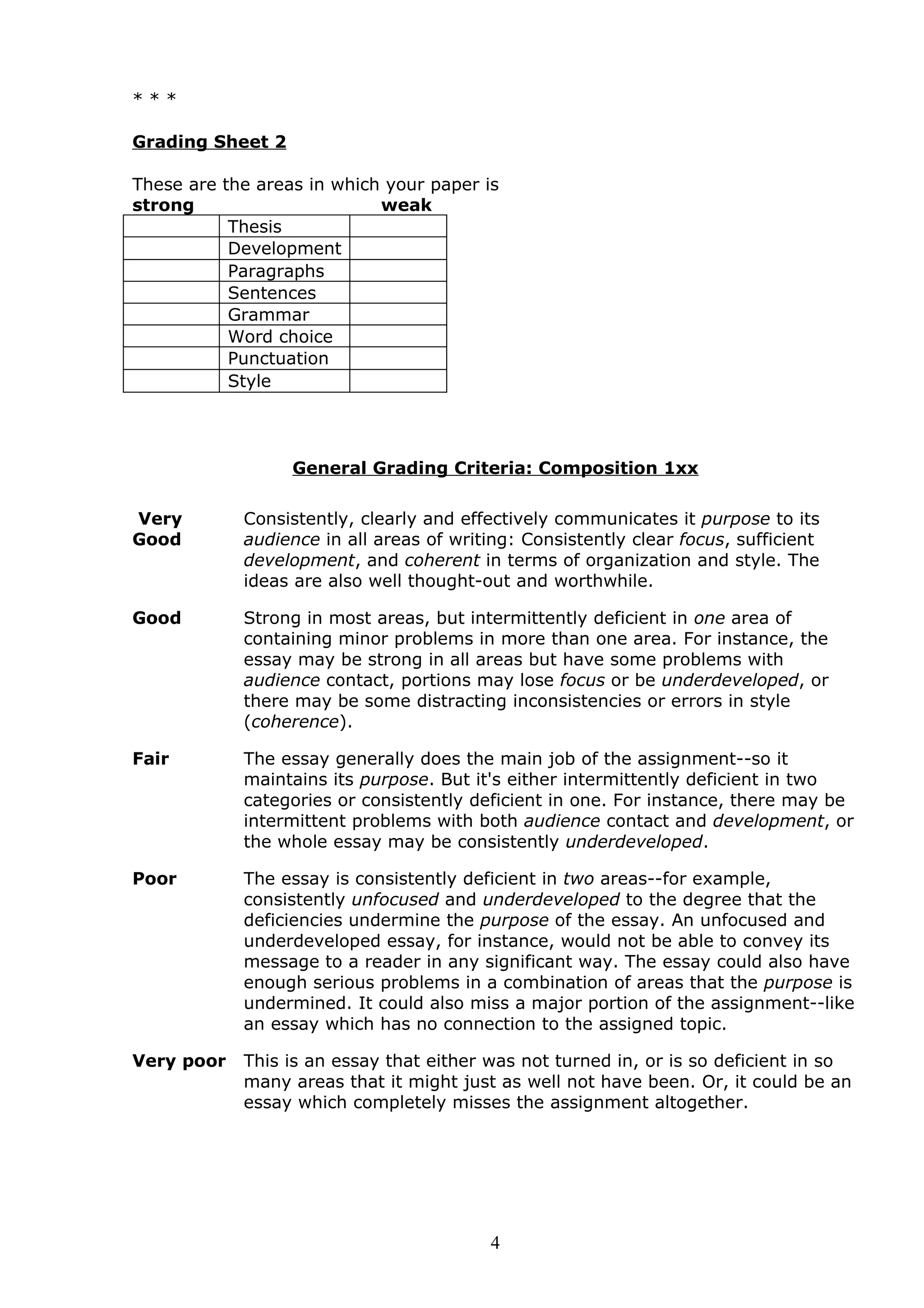
    Use a gradingsheet Grading comment sheets or checksheets give teachers and students two advantages over free-form grading: • Even if you decide to use a simple checksheet that ranks students' performance on each criterion on a 1-10 scale, students will be able to see quickly where their strengths and weaknesses are as writers for this assignment. • Grading sheets, particularly checksheets, typically save teachers time. Even composition teachers don't comment exhaustively about each criterion for each assignment; they can comment at some length on just one or two points (typically the major strengths and the major weakness) and then rely on the checksheet to fill in for less crucial areas of the paper. Grading Sheet 1 Strengths Weaknesses I. Introductory paragraphs A. Lead-in B. Thesis (narrowed topic + clear stance) II. Body paragraphs: (Effective transition, clear focus, development with details, clear transitional words) A. Body paragraph one B. Body paragraph two C. Body paragraph three D. Body paragraph four E. etc. III. Conclusion IV. Punctuation, grammar, style, spelling Grade for essay: ___________ Revision Instructions: 3
  • 4.
    *** Grading Sheet 2 Theseare the areas in which your paper is strong weak Thesis Development Paragraphs Sentences Grammar Word choice Punctuation Style General Grading Criteria: Composition 1xx Very Consistently, clearly and effectively communicates it purpose to its Good audience in all areas of writing: Consistently clear focus, sufficient development, and coherent in terms of organization and style. The ideas are also well thought-out and worthwhile. Good Strong in most areas, but intermittently deficient in one area of containing minor problems in more than one area. For instance, the essay may be strong in all areas but have some problems with audience contact, portions may lose focus or be underdeveloped, or there may be some distracting inconsistencies or errors in style (coherence). Fair The essay generally does the main job of the assignment--so it maintains its purpose. But it's either intermittently deficient in two categories or consistently deficient in one. For instance, there may be intermittent problems with both audience contact and development, or the whole essay may be consistently underdeveloped. Poor The essay is consistently deficient in two areas--for example, consistently unfocused and underdeveloped to the degree that the deficiencies undermine the purpose of the essay. An unfocused and underdeveloped essay, for instance, would not be able to convey its message to a reader in any significant way. The essay could also have enough serious problems in a combination of areas that the purpose is undermined. It could also miss a major portion of the assignment--like an essay which has no connection to the assigned topic. Very poor This is an essay that either was not turned in, or is so deficient in so many areas that it might just as well not have been. Or, it could be an essay which completely misses the assignment altogether. 4
  • 5.
    7 Tips forEvaluating Student Writing 1. Respond to the content first, not the mechanics, of each paper you read. Sometimes we spend more time looking for errors than ideas. 2. Respond positively and personally where possible. Caring is the necessary first step to actually writing better. 3. Comment critically on one item at a time. Once you see that a paper has multiple problems, it may be a good idea to single out one or two conceptual or organizational problems for comment, suggesting that the other problems will be dealt with on subsequent drafts. 4. Be specific when you comment on problems. Point out exactly what you object to but without necessarily correcting it yourself; that way the writer has something concrete to go on when he or she turns attention to revision. 5. Learning to critique is a part of learning to write. Include peer evaluation where you can in your class. Learning how to be critical is part of learning how to write yourself. 6. Discuss samples of good and bad writing with your class. Bring the students into the evaluation process, trusting them to have voices and make reasonable judgments. 7. What is said includes how it is said: Don't split grades. It is important to quit separating ideas from the language in which they're expressed. 5