Scaffolding student research & Writing: A win-win SolutionWriting Across the CurriculumMarch 1, 2010Elizabeth Swaggerty
	Purpose of Course: The purpose of this course is to provide an opportunity for students to engage in the independent study of problems/issues/topics in the teaching of reading.	Major ObjectivesTo become familiar with the many and varied topics/issues associated with reading and reading instruction.
To gain knowledge about reading topics/issues through research, reading, writing.
To identify one (1) specific topic of choice for further study.
To gain knowledge about the selected topic.
To be able to synthesize information and develop analytical and critical thinking skills associated with the research of a topic.
To become familiar with the electronic resources available for obtaining information.
To gain skill in using electronic resources for the purpose of obtaining information.ScaffoldingVygotsky’s ZPDProvide scaffolding to support learning within a continuum of supportLOTS of initial support from the instructorReading sets/Response log papers Thorough feedbackRead like a reading teacher AND 	a writer
Write a quality research paper. 	Is this asking our undergraduates to do the impossible?
Timeline/Organization
MoodleLiterature Review MatrixSource: Broemmel, A., & Swaggerty, E. (2008). “Examining the possibilities: Planning your research project.” In C.A. Lassonde & S.E. Israel (Eds.), Teachers taking action: A comprehensive guide to teacher research.International Reading Association.
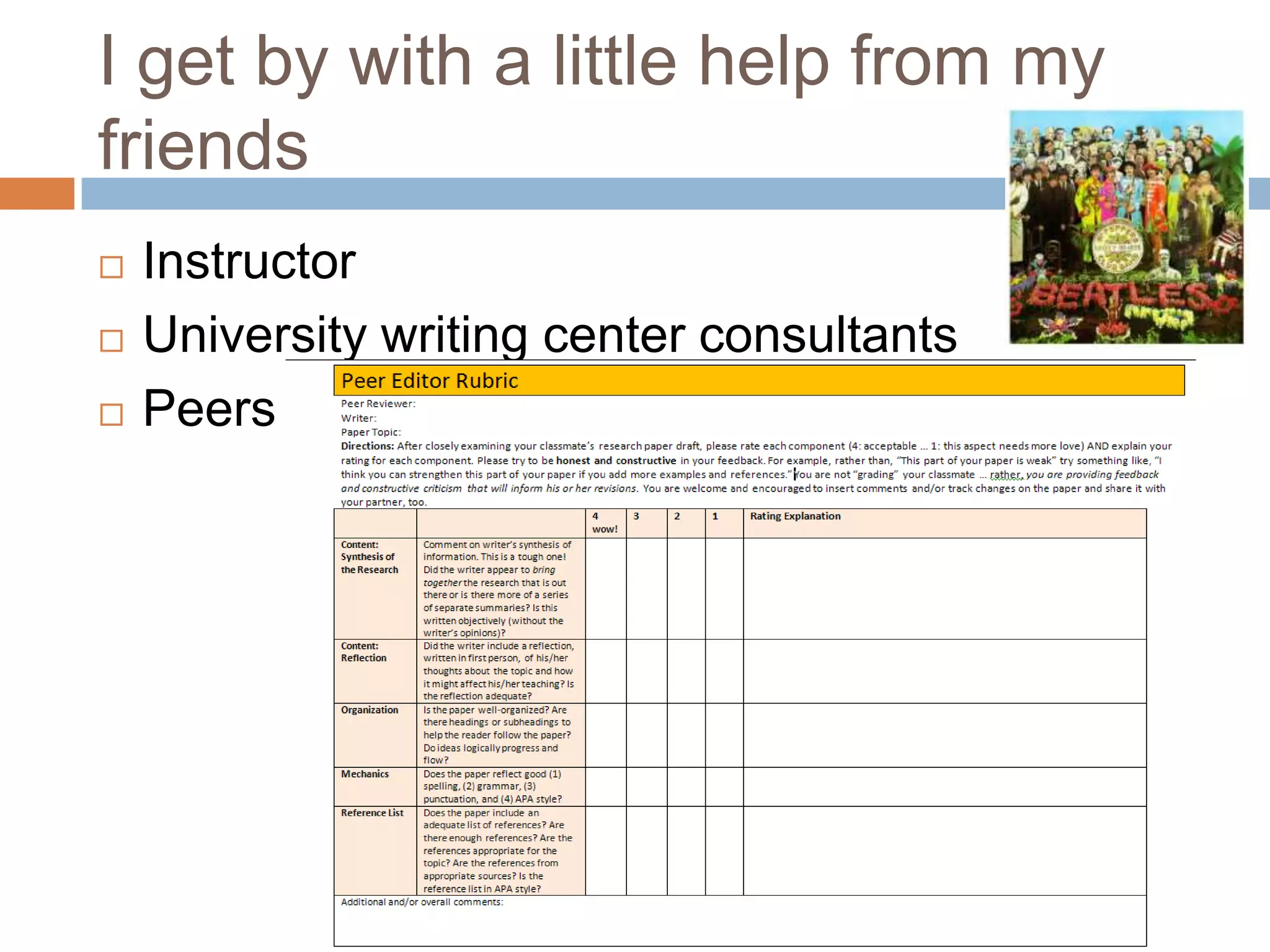
I get by with a little help from my friendsInstructorUniversity writing center consultantsPeers

Scaffolding Student Research & Writing in Higher Education

  • 1.
    Scaffolding student research& Writing: A win-win SolutionWriting Across the CurriculumMarch 1, 2010Elizabeth Swaggerty
  • 2.
    Purpose of Course:The purpose of this course is to provide an opportunity for students to engage in the independent study of problems/issues/topics in the teaching of reading. Major ObjectivesTo become familiar with the many and varied topics/issues associated with reading and reading instruction.
  • 3.
    To gain knowledgeabout reading topics/issues through research, reading, writing.
  • 4.
    To identify one(1) specific topic of choice for further study.
  • 5.
    To gain knowledgeabout the selected topic.
  • 6.
    To be ableto synthesize information and develop analytical and critical thinking skills associated with the research of a topic.
  • 7.
    To become familiarwith the electronic resources available for obtaining information.
  • 8.
    To gain skillin using electronic resources for the purpose of obtaining information.ScaffoldingVygotsky’s ZPDProvide scaffolding to support learning within a continuum of supportLOTS of initial support from the instructorReading sets/Response log papers Thorough feedbackRead like a reading teacher AND a writer
  • 9.
    Write a qualityresearch paper. Is this asking our undergraduates to do the impossible?
  • 10.
  • 11.
    MoodleLiterature Review MatrixSource:Broemmel, A., & Swaggerty, E. (2008). “Examining the possibilities: Planning your research project.” In C.A. Lassonde & S.E. Israel (Eds.), Teachers taking action: A comprehensive guide to teacher research.International Reading Association.
  • 12.
    I get bywith a little help from my friendsInstructorUniversity writing center consultantsPeers
  • 13.
    Revising and EditingRevision= "see again," to look at something with a fresh, critical eye. Ongoing process of RETHINKING the paper: reconsider arguments, review evidence, refine the purpose, reorganize, revive.TIPS:Print the draft and work from hardcopy. Problems that seem invisible on the screen somehow tend to show up better on paper.Read the paper out loud. Don't try to tackle all revision questions and issues in one draft. Pick a few to tackle at a time. Ask questions and be critical when answering them. For example, are there opposing viewpoints that you haven't considered yet? Editing = capitalization, punctuation, sentence structure, subject/verb agreement, consistent verb tense, word usage http://www.unc.edu/depts/wcweb/handouts/revision.html (UNC Chapel Hill Writing Center)
  • 14.
    APA StyleThere isno use hiding …
  • 15.
    APA can beyour friend.
  • 16.
    AudienceFinal drafts areposted on discussion board, read by me, and read by two peersSummary component (commercial) is viewed by the entire class (Moodle discussion board) and publicly availableVoice Thread J. Baillargeon: http://voicethread.com/#u255282.b564803.i3021265 Lori and David: http://voicethread.com/#u255282.b862302.i4859821Glogster T. Johnson: http://taichi23.glogster.com/Shame-of-a-Nation/ J. Jones: http://hellojenjones.glogster.com/mosaic-of-thought/Prezi Presentation Creator
  • 17.

Editor's Notes

  • #2 Setting students up for success with their writing … making their lives and my life easier.
  • #3 READ 4534: Fundamentals of Reading (undergraduate).
  • #4 Reading sets and corresponding response log papers help students to (a) learn about problems/issues in reading theory and instruction, (b) become familiar with professional resources related to reading, (c) allow students to read like writers (look for purpose statement, headings, APA style), and (d) allow me to provide thorough feedback on the kind of writing I expect.
  • #6 Explore 4 topics, get feedback on writing 4 times; craft a topic and rational paper (I provide individualized feedback on this); post topic on DB to encourage sharing of resources and tips for researching articles; organize sources in a lit review matrix (I again provide individualized feedback); go through four rough drafts of the paper (one to me, twice to peer reviewers, and once to WC. Students are encouraged to visit the WC more than once. Final draft is graded by me and each student must read thoroughly two papers and provide feedback to the authors. Students compose a “commercial” summary component using a web 2.0 tool. They will share the link with everyone.
  • #7 Citation Include full citationOverview; Research design/article typeQualitative, quantitative, mixed methods, descriptive, experiment, case study, survey research, etc. Describe the research contextWhere did the study take place? Also note the age level and number of participants and the duration of the studyFindingsBe specific. What did the study find related to the research question? What are the implications? What are the recommendations?NotesInclude clarification of important terms/definitions, note key references/citations, note key graphics (tables, charts, etc.), note key quotes, your personal reaction, etc. Include page numbers as necessaryIt is your “cheat sheet.”Look for patterns, varying perspectives, discrepancies, common findings, etc. You want to present a “full picture” in your paper.No opinions yet … just the facts right now.What does the research say about your topic?Pull it together.Look for topics, subtopics, etc. THINK!Draft an outline or graphic organizer.
  • #8 Writing can be a very isolating activity, but we can learn much by “running naked through the park” and letting others read our writing.