1
MEM 160: WORKSHOP PRACTICE
CHAPTER 3
MEASURING INSTRUMENT, GAUGES AND
MARKING OUT TOOLS
2
OBJECTIVES & LEARNING OUTCOMES
1. Describe common measuring
instruments, gauges and marking
out tools in mechanical workshop.
2. Select suitable measuring
instruments, gauges and marking
out tools in engineering application.
3. Use accurately common measuring
instruments, gauges and marking
out tools in engineering application.
3
3. INTRODUCTION
1. Why we need measurement?.
a. To make things, either own design or somebody else’s.
b. To control the way other people make things. (industry-mass
production)
c. For scientific description. (comparison between stone &
wood-weight)
2. Precise measurement usually required when fitting or
assembling 2 separate parts together.
3. To archive the precise measurement, not only the
measurement instrument need to be precisely produced but
the method of using it also need to be correct.
4
4. If someone measure same thing, exactly with the same
measurement instrument, the measurement reading or result
may not be exactly same. This phenomenon called as error in
measurement.
5. Error in measurement not means that our reading have
mistake, but is a mathematical way to show the uncertainty in
the measurement.
6. Errors can be minimized but cannot be eliminated.
5
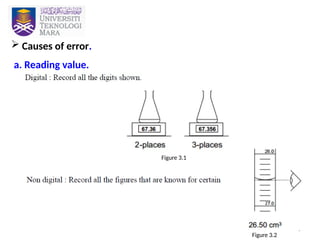
 Causes of error.
a. Reading value.
Figure 3.1
Figure 3.2
6
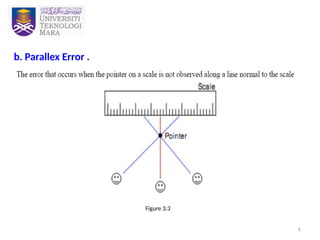
b. Parallex Error .
Figure 3.3
7
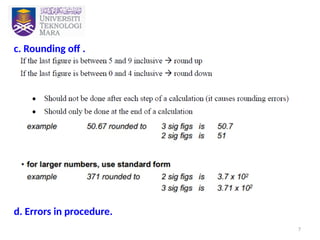
c. Rounding off .
d. Errors in procedure.
8
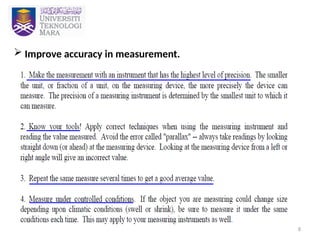
 Improve accuracy in measurement.
9
3.1.1 Vernier Caliper
3. 1 VERNIER SCALE
WHAT? – A precision instrument that can be used to measure
internal, external step and depth measurement.
ACCURACY? – Accurate to within 0.001 inch or 0.02 mm,
depending to the unit whether imperial or
metric.
FEATURES: Generally has a L shape design with a moveable arm.
10
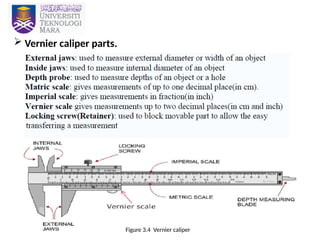
 Vernier caliper parts.
Figure 3.4 Vernier caliper
11
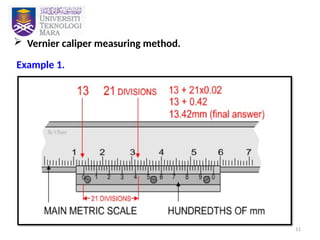
 Vernier caliper measuring method.
Example 1.
12
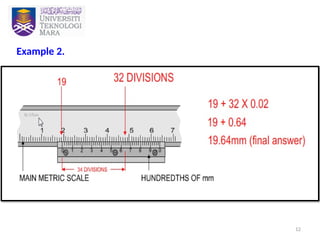
Example 2.
13
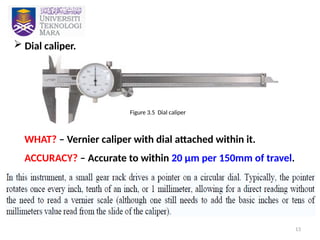
 Dial caliper.
WHAT? – Vernier caliper with dial attached within it.
ACCURACY? – Accurate to within 20 µm per 150mm of travel.
Figure 3.5 Dial caliper
14
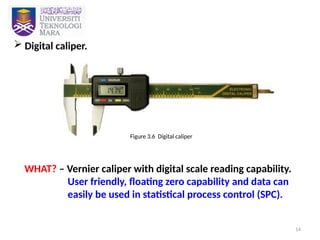
 Digital caliper.
WHAT? – Vernier caliper with digital scale reading capability.
User friendly, floating zero capability and data can
easily be used in statistical process control (SPC).
Figure 3.6 Digital caliper
15
3.1.2 Vernier Height Gauges
WHAT? – A sort of vernier caliper with a special base block and
other attachment which make suitable for height
measurement.
ACCURACY? – Vertical distance accurate to within +/- 0.001
inch or 0.02 mm, depending to the unit whether
imperial or metric.
PURPOSE? – Mainly used to inspect part or layout work.
16
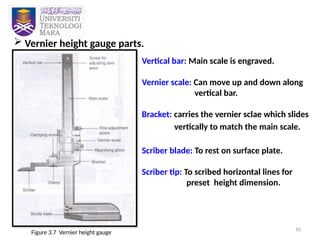
 Vernier height gauge parts.
Figure 3.7 Vernier height gauge
Vertical bar: Main scale is engraved.
Vernier scale: Can move up and down along
vertical bar.
Bracket: carries the vernier sclae which slides
vertically to match the main scale.
Scriber blade: To rest on surface plate.
Scriber tip: To scribed horizontal lines for
preset height dimension.
17
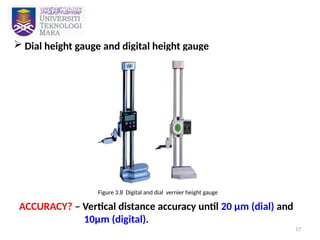
 Dial height gauge and digital height gauge
ACCURACY? – Vertical distance accuracy until 20 µm (dial) and
10µm (digital).
Figure 3.8 Digital and dial vernier height gauge
18
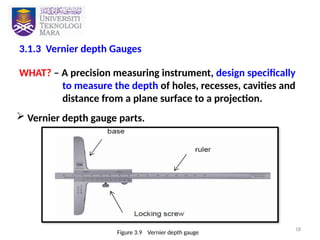
3.1.3 Vernier depth Gauges
WHAT? – A precision measuring instrument, design specifically
to measure the depth of holes, recesses, cavities and
distance from a plane surface to a projection.
 Vernier depth gauge parts.
Figure 3.9 Vernier depth gauge
19
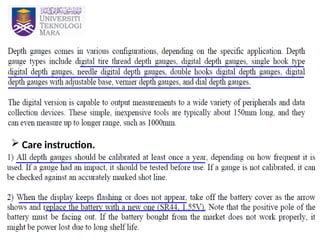
 Care instruction.
20
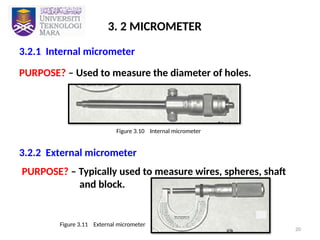
3. 2 MICROMETER
3.2.1 Internal micrometer
PURPOSE? – Used to measure the diameter of holes.
3.2.2 External micrometer
Figure 3.10 Internal micrometer
PURPOSE? – Typically used to measure wires, spheres, shaft
and block.
Figure 3.11 External micrometer
21
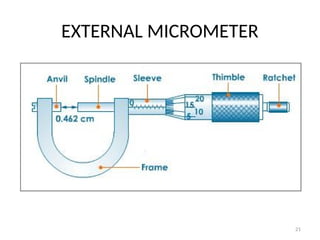
EXTERNAL MICROMETER
22
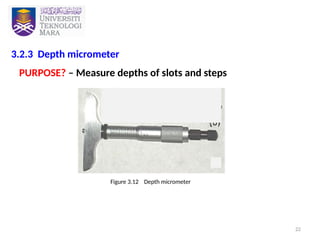
3.2.3 Depth micrometer
PURPOSE? – Measure depths of slots and steps
Figure 3.12 Depth micrometer
23
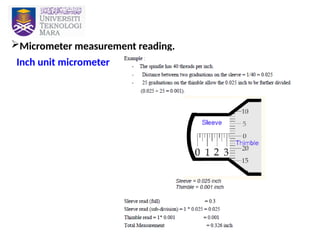
Micrometer measurement reading.
Inch unit micrometer
24
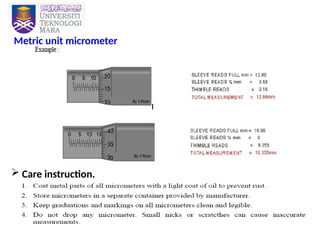
Metric unit micrometer
 Care instruction.
25
3. 3 GAUGES
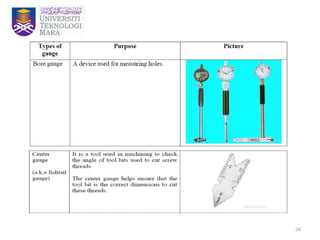
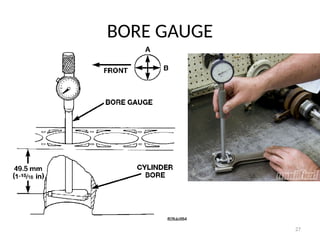
TYPES OF GAUGES? – a. Bore gauge
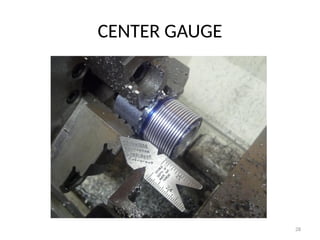
b. Centre gauge
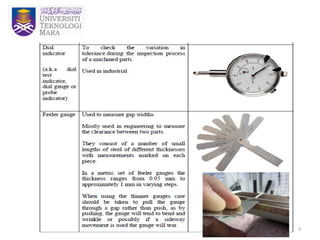
c. Dial indicator
d. Feeler gauge
e. Block gauge
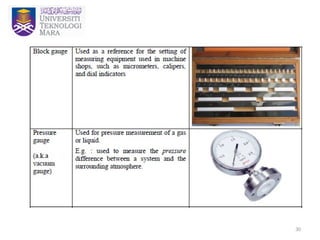
f. Pressure gauge
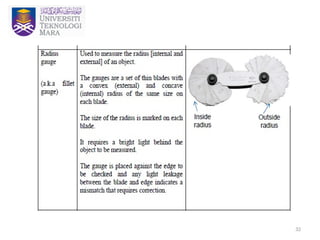
g. Radius gauge
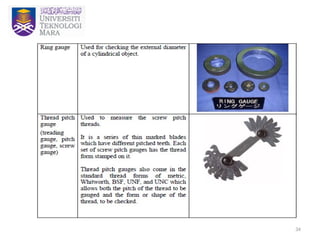
h. Ring gauge
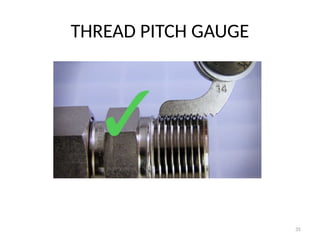
i. Thread pitch gauge
26
27
BORE GAUGE
28
CENTER GAUGE
29
30
31
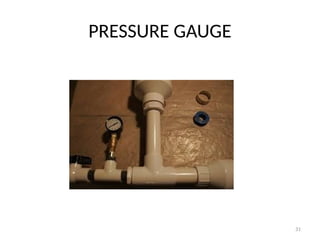
PRESSURE GAUGE
32
33
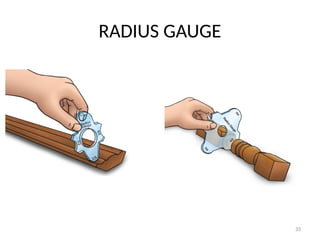
RADIUS GAUGE
34
35
THREAD PITCH GAUGE
36
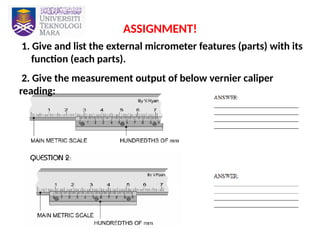
ASSIGNMENT!
1. Give and list the external micrometer features (parts) with its
function (each parts).
2. Give the measurement output of below vernier caliper
reading:
37
REFERENCES
1. Bawa, H. S. (1995). Workshop Technology. New Delhi, Tata McGraw-Hill.
2. Kalpakjian, S & Schmid, S. R. (2010). Manufacturing Processes
for Engineering Materials, 6th
edition, Prentice Hall.
3. Farrah, N. (2013). Introduction to Bench Fitting [PDF document].
Retrieved from http://i-learn.uitm.edu.my/v2/
4. Rao, P.N. (2001), Manufacturing Technology : Foundry, Forming and
Welding. New Delhi, Tata McGraw-Hill.
MEM 160 Chapter 3. Measurement tool (1).pptx

  • 1.
    1 MEM 160: WORKSHOPPRACTICE CHAPTER 3 MEASURING INSTRUMENT, GAUGES AND MARKING OUT TOOLS
  • 2.
    2 OBJECTIVES & LEARNINGOUTCOMES 1. Describe common measuring instruments, gauges and marking out tools in mechanical workshop. 2. Select suitable measuring instruments, gauges and marking out tools in engineering application. 3. Use accurately common measuring instruments, gauges and marking out tools in engineering application.
  • 3.
    3 3. INTRODUCTION 1. Whywe need measurement?. a. To make things, either own design or somebody else’s. b. To control the way other people make things. (industry-mass production) c. For scientific description. (comparison between stone & wood-weight) 2. Precise measurement usually required when fitting or assembling 2 separate parts together. 3. To archive the precise measurement, not only the measurement instrument need to be precisely produced but the method of using it also need to be correct.
  • 4.
    4 4. If someonemeasure same thing, exactly with the same measurement instrument, the measurement reading or result may not be exactly same. This phenomenon called as error in measurement. 5. Error in measurement not means that our reading have mistake, but is a mathematical way to show the uncertainty in the measurement. 6. Errors can be minimized but cannot be eliminated.
  • 5.
    5  Causes oferror. a. Reading value. Figure 3.1 Figure 3.2
  • 6.
    6 b. Parallex Error. Figure 3.3
  • 7.
    7 c. Rounding off. d. Errors in procedure.
  • 8.
    8  Improve accuracyin measurement.
  • 9.
    9 3.1.1 Vernier Caliper 3.1 VERNIER SCALE WHAT? – A precision instrument that can be used to measure internal, external step and depth measurement. ACCURACY? – Accurate to within 0.001 inch or 0.02 mm, depending to the unit whether imperial or metric. FEATURES: Generally has a L shape design with a moveable arm.
  • 10.
    10  Vernier caliperparts. Figure 3.4 Vernier caliper
  • 11.
    11  Vernier calipermeasuring method. Example 1.
  • 12.
  • 13.
    13  Dial caliper. WHAT?– Vernier caliper with dial attached within it. ACCURACY? – Accurate to within 20 µm per 150mm of travel. Figure 3.5 Dial caliper
  • 14.
    14  Digital caliper. WHAT?– Vernier caliper with digital scale reading capability. User friendly, floating zero capability and data can easily be used in statistical process control (SPC). Figure 3.6 Digital caliper
  • 15.
    15 3.1.2 Vernier HeightGauges WHAT? – A sort of vernier caliper with a special base block and other attachment which make suitable for height measurement. ACCURACY? – Vertical distance accurate to within +/- 0.001 inch or 0.02 mm, depending to the unit whether imperial or metric. PURPOSE? – Mainly used to inspect part or layout work.
  • 16.
    16  Vernier heightgauge parts. Figure 3.7 Vernier height gauge Vertical bar: Main scale is engraved. Vernier scale: Can move up and down along vertical bar. Bracket: carries the vernier sclae which slides vertically to match the main scale. Scriber blade: To rest on surface plate. Scriber tip: To scribed horizontal lines for preset height dimension.
  • 17.
    17  Dial heightgauge and digital height gauge ACCURACY? – Vertical distance accuracy until 20 µm (dial) and 10µm (digital). Figure 3.8 Digital and dial vernier height gauge
  • 18.
    18 3.1.3 Vernier depthGauges WHAT? – A precision measuring instrument, design specifically to measure the depth of holes, recesses, cavities and distance from a plane surface to a projection.  Vernier depth gauge parts. Figure 3.9 Vernier depth gauge
  • 19.
  • 20.
    20 3. 2 MICROMETER 3.2.1Internal micrometer PURPOSE? – Used to measure the diameter of holes. 3.2.2 External micrometer Figure 3.10 Internal micrometer PURPOSE? – Typically used to measure wires, spheres, shaft and block. Figure 3.11 External micrometer
  • 21.
  • 22.
    22 3.2.3 Depth micrometer PURPOSE?– Measure depths of slots and steps Figure 3.12 Depth micrometer
  • 23.
  • 24.
  • 25.
    25 3. 3 GAUGES TYPESOF GAUGES? – a. Bore gauge b. Centre gauge c. Dial indicator d. Feeler gauge e. Block gauge f. Pressure gauge g. Radius gauge h. Ring gauge i. Thread pitch gauge
  • 26.
  • 27.
  • 28.
  • 29.
  • 30.
  • 31.
  • 32.
  • 33.
  • 34.
  • 35.
  • 36.
    36 ASSIGNMENT! 1. Give andlist the external micrometer features (parts) with its function (each parts). 2. Give the measurement output of below vernier caliper reading:
  • 37.
    37 REFERENCES 1. Bawa, H.S. (1995). Workshop Technology. New Delhi, Tata McGraw-Hill. 2. Kalpakjian, S & Schmid, S. R. (2010). Manufacturing Processes for Engineering Materials, 6th edition, Prentice Hall. 3. Farrah, N. (2013). Introduction to Bench Fitting [PDF document]. Retrieved from http://i-learn.uitm.edu.my/v2/ 4. Rao, P.N. (2001), Manufacturing Technology : Foundry, Forming and Welding. New Delhi, Tata McGraw-Hill.