MARXISM&HEGEMONY
•Media Issues and Debates
How much
money do you
have on you
right now?
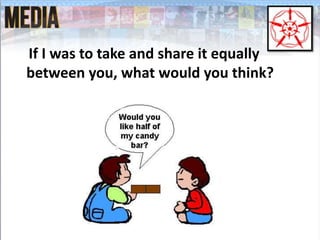
If I was to take and share it equally
between you, what would you think?
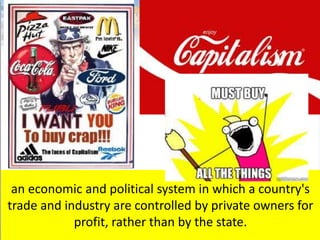
an economic and political system in which a country's
trade and industry are controlled by private owners for
profit, rather than by the state.
In the most simple terms...
• Capitalism is the idea that everyone has to make their
own money and what you earn should be yours.
A capitalist person wants to be richer than everyone
else.. Where as a communist person wants to be the
same as everyone else.
• Benefits ‘the rich’
• Makes life difficult for ‘the poor’
Karl Marx believed that there are two fundamental classes:
The Proletariat – Workers who have to sell their labour to survive
The Bourgeoisie – The ruling class, own the means of production
(i.e Factories), property or wealth
• Marx argued that in capitalist systems the bourgeoisie
dominates and exploits the proletariat in pursuit of profit.
• He also suggested that ideology, values and beliefs are
important in persuading the proletariat to accept the power
of the bourgeoisie.
MARXISM
Who are the bourgeoisie?
MARXISM&MASS MEDIA
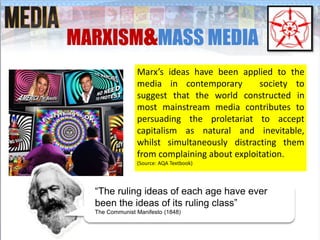
Marx’s ideas have been applied to the
media in contemporary society to
suggest that the world constructed in
most mainstream media contributes to
persuading the proletariat to accept
capitalism as natural and inevitable,
whilst simultaneously distracting them
from complaining about exploitation.
(Source: AQA Textbook)
“The ruling ideas of each age have ever
been the ideas of its ruling class”
The Communist Manifesto (1848)
Why don’t we over throw the Government?
Why do we follow procedures and rules?
HEGEMONY
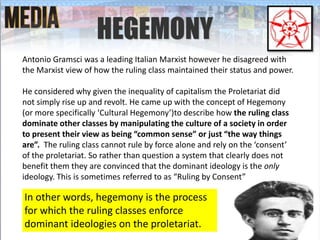
Antonio Gramsci was a leading Italian Marxist however he disagreed with
the Marxist view of how the ruling class maintained their status and power.
He considered why given the inequality of capitalism the Proletariat did
not simply rise up and revolt. He came up with the concept of Hegemony
(or more specifically ‘Cultural Hegemony’)to describe how the ruling class
dominate other classes by manipulating the culture of a society in order
to present their view as being “common sense” or just “the way things
are”. The ruling class cannot rule by force alone and rely on the ‘consent’
of the proletariat. So rather than question a system that clearly does not
benefit them they are convinced that the dominant ideology is the only
ideology. This is sometimes referred to as “Ruling by Consent”
In other words, hegemony is the process
for which the ruling classes enforce
dominant ideologies on the proletariat.
Can you think of any examples of
dominant ideologies that we are
encouraged to believe relating to the
following?
• Ethnicity, Age, Gender, Nationality, Class, Religion,
Family, Politics
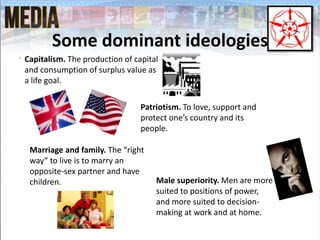
Some dominant ideologies
•
Patriotism. To love, support and
protect one’s country and its
people.
Marriage and family. The “right
way” to live is to marry an
opposite-sex partner and have
children.
Capitalism. The production of capital
and consumption of surplus value as
a life goal.
Male superiority. Men are more
suited to positions of power,
and more suited to decision-
making at work and at home.
Applying Marx to the
mass media today
• When Marxists apply this
ideology to the mass media they
will argue:
• The institutions of the mass media
are owned by the ruling classes
(e.g. Rupert Murdoch, Richard
Branson)
• These institutions are used to
indoctrinate the masses into
believing capitalism is good for all
• Media industry workers are
exploited just as other workers
• …therefore the mass media exists
to serve the ideological interests
of the ruling class.
• Can you summarise Marxism and Hegemony?
• Who are the bourgeoisie and who are the
proletariat in a modern, British society?
• Can you find examples of Hegemony in:
• The coverage of Brexit and immigration
• Advertising

Marxism and Hegemony

  • 1.
  • 2.
    How much money doyou have on you right now?
  • 3.
    If I wasto take and share it equally between you, what would you think?
  • 4.
    an economic andpolitical system in which a country's trade and industry are controlled by private owners for profit, rather than by the state.
  • 5.
    In the mostsimple terms... • Capitalism is the idea that everyone has to make their own money and what you earn should be yours. A capitalist person wants to be richer than everyone else.. Where as a communist person wants to be the same as everyone else. • Benefits ‘the rich’ • Makes life difficult for ‘the poor’
  • 6.
    Karl Marx believedthat there are two fundamental classes: The Proletariat – Workers who have to sell their labour to survive The Bourgeoisie – The ruling class, own the means of production (i.e Factories), property or wealth • Marx argued that in capitalist systems the bourgeoisie dominates and exploits the proletariat in pursuit of profit. • He also suggested that ideology, values and beliefs are important in persuading the proletariat to accept the power of the bourgeoisie. MARXISM
  • 7.
    Who are thebourgeoisie?
  • 8.
    MARXISM&MASS MEDIA Marx’s ideashave been applied to the media in contemporary society to suggest that the world constructed in most mainstream media contributes to persuading the proletariat to accept capitalism as natural and inevitable, whilst simultaneously distracting them from complaining about exploitation. (Source: AQA Textbook) “The ruling ideas of each age have ever been the ideas of its ruling class” The Communist Manifesto (1848)
  • 9.
    Why don’t weover throw the Government? Why do we follow procedures and rules?
  • 10.
    HEGEMONY Antonio Gramsci wasa leading Italian Marxist however he disagreed with the Marxist view of how the ruling class maintained their status and power. He considered why given the inequality of capitalism the Proletariat did not simply rise up and revolt. He came up with the concept of Hegemony (or more specifically ‘Cultural Hegemony’)to describe how the ruling class dominate other classes by manipulating the culture of a society in order to present their view as being “common sense” or just “the way things are”. The ruling class cannot rule by force alone and rely on the ‘consent’ of the proletariat. So rather than question a system that clearly does not benefit them they are convinced that the dominant ideology is the only ideology. This is sometimes referred to as “Ruling by Consent” In other words, hegemony is the process for which the ruling classes enforce dominant ideologies on the proletariat.
  • 11.
    Can you thinkof any examples of dominant ideologies that we are encouraged to believe relating to the following? • Ethnicity, Age, Gender, Nationality, Class, Religion, Family, Politics
  • 12.
    Some dominant ideologies • Patriotism.To love, support and protect one’s country and its people. Marriage and family. The “right way” to live is to marry an opposite-sex partner and have children. Capitalism. The production of capital and consumption of surplus value as a life goal. Male superiority. Men are more suited to positions of power, and more suited to decision- making at work and at home.
  • 13.
    Applying Marx tothe mass media today • When Marxists apply this ideology to the mass media they will argue: • The institutions of the mass media are owned by the ruling classes (e.g. Rupert Murdoch, Richard Branson) • These institutions are used to indoctrinate the masses into believing capitalism is good for all • Media industry workers are exploited just as other workers • …therefore the mass media exists to serve the ideological interests of the ruling class.
  • 14.
    • Can yousummarise Marxism and Hegemony? • Who are the bourgeoisie and who are the proletariat in a modern, British society? • Can you find examples of Hegemony in: • The coverage of Brexit and immigration • Advertising