Hedging
Hedging
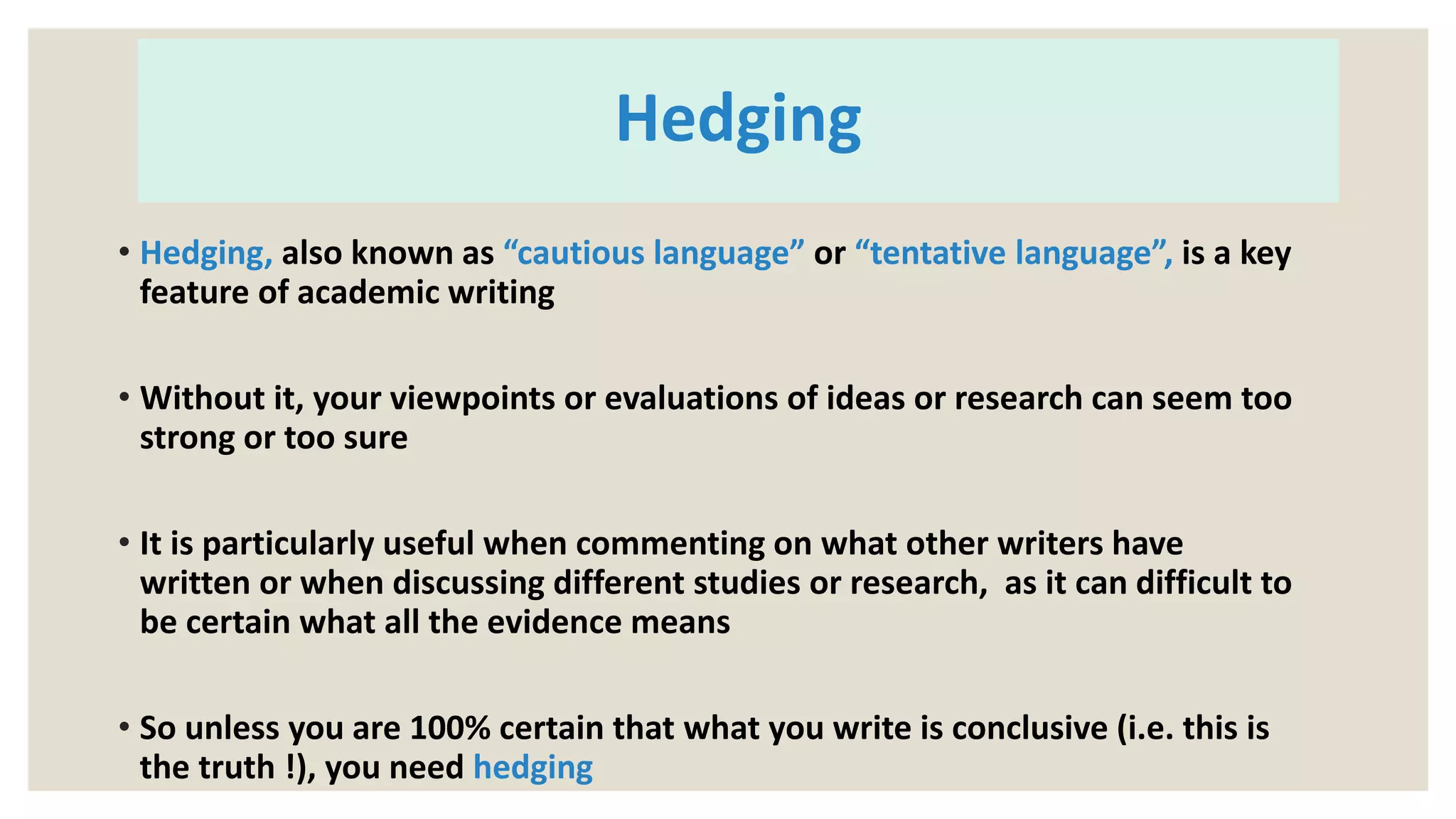
• Hedging, also known as “cautious language” or “tentative language”, is a key
feature of academic writing
• Without it, your viewpoints or evaluations of ideas or research can seem too
strong or too sure
• It is particularly useful when commenting on what other writers have
written or when discussing different studies or research, as it can difficult to
be certain what all the evidence means
• So unless you are 100% certain that what you write is conclusive (i.e. this is
the truth !), you need hedging
Example
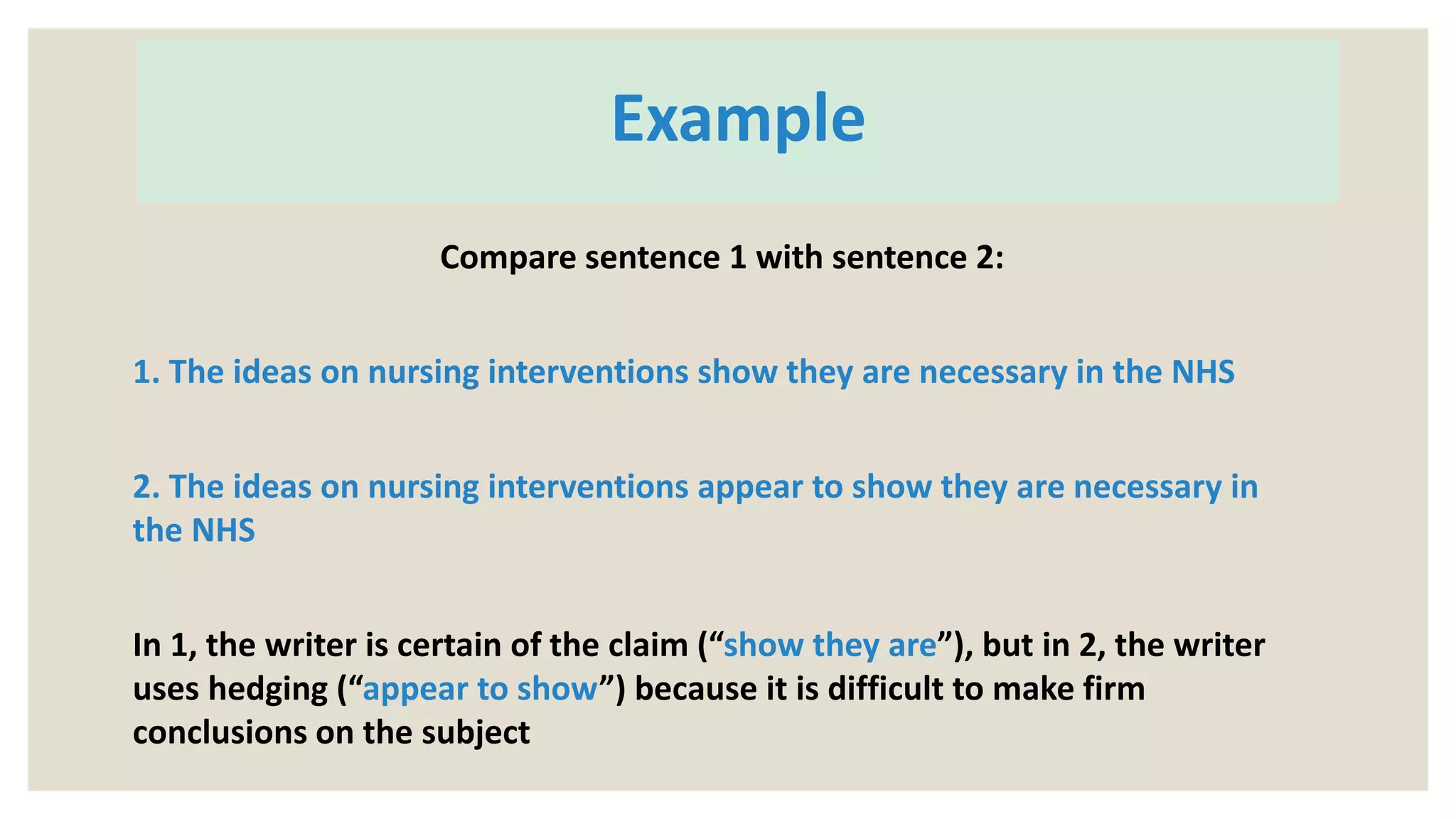
Compare sentence 1 with sentence 2:
1. The ideas on nursing interventions show they are necessary in the NHS
2. The ideas on nursing interventions appear to show they are necessary in
the NHS
In 1, the writer is certain of the claim (“show they are”), but in 2, the writer
uses hedging (“appear to show”) because it is difficult to make firm
conclusions on the subject
Example (cont’d)
1. The ideas on nursing interventions show they are necessary in the NHS
• Because the claim, “interventions show”, is strong , the reader will now
expect a lot of good evidence to prove this view
• If there is not, then the view could be opposed or dismissed (remember :
your subject teacher will know your assignment area, so write carefully)
2. The ideas on nursing interventions appear to show they are necessary in
the NHS
• In sentence 2, “appear to show” indicates the writer is aware of other
interpretations of the ideas, and therefore the reader is more likely to agree
Writing Precisely
If you sometimes write too simplistically or generally, then hedging can help
you to think and write more precisely :
e.g. Bad parenting leads to poorly behaved children
Instead of writing this, think if such statements are always true.
Can you say that every bad parent has bad children? No
Are there examples of where it does not happen? Yes, of course.
So you could write “Bad parenting can sometimes lead to poorly behaved
children”
Practice
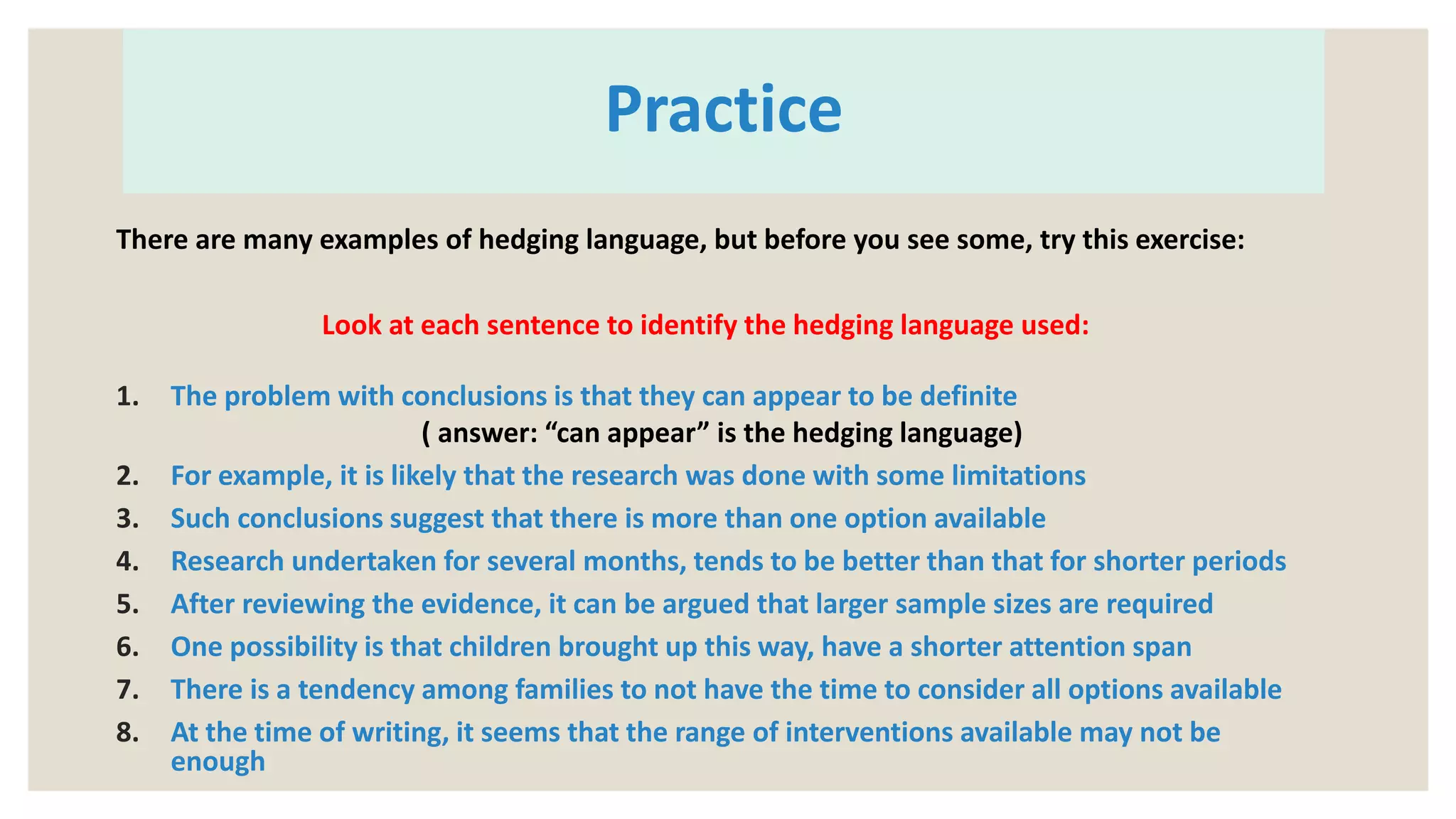
There are many examples of hedging language, but before you see some, try this exercise:
Look at each sentence to identify the hedging language used:
1. The problem with conclusions is that they can appear to be definite
( answer: “can appear” is the hedging language)
2. For example, it is likely that the research was done with some limitations
3. Such conclusions suggest that there is more than one option available
4. Research undertaken for several months, tends to be better than that for shorter periods
5. After reviewing the evidence, it can be argued that larger sample sizes are required
6. One possibility is that children brought up this way, have a shorter attention span
7. There is a tendency among families to not have the time to consider all options available
8. At the time of writing, it seems that the range of interventions available may not be
enough
Answers
1. The problem with conclusions is that they can appear to be definite
2. For example, it is likely that the research was done with some limitations
3. Such conclusions suggest that there is more than one option available
4. Research undertaken for several months, tends to be better than that for shorter periods
5. After reviewing the evidence, it can be argued that larger sample sizes are required
6. One possibility is that children brought up this way, have a shorter attention span
7. There is a tendency among families to not have the time to consider all options available
8. At the time of writing, it seems that the range of interventions available may not be
enough
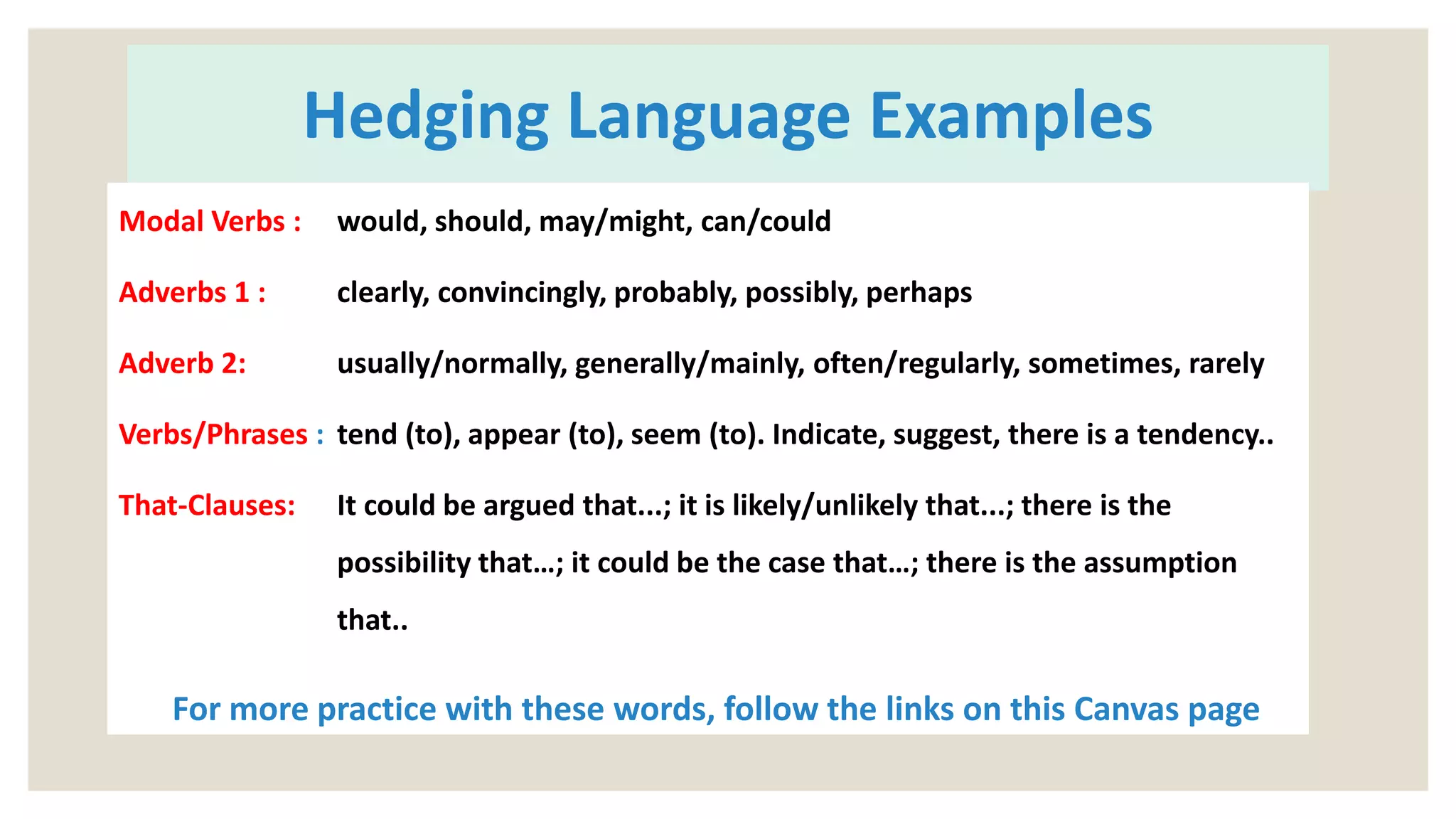
Hedging Language Examples
Modal Verbs : would, should, may/might, can/could
Adverbs 1 : clearly, convincingly, probably, possibly, perhaps
Adverb 2: usually/normally, generally/mainly, often/regularly, sometimes, rarely
Verbs/Phrases : tend (to), appear (to), seem (to). Indicate, suggest, there is a tendency..
That-Clauses: It could be argued that...; it is likely/unlikely that...; there is the
possibility that…; it could be the case that…; there is the assumption
that..
For more practice with these words, follow the links on this Canvas page
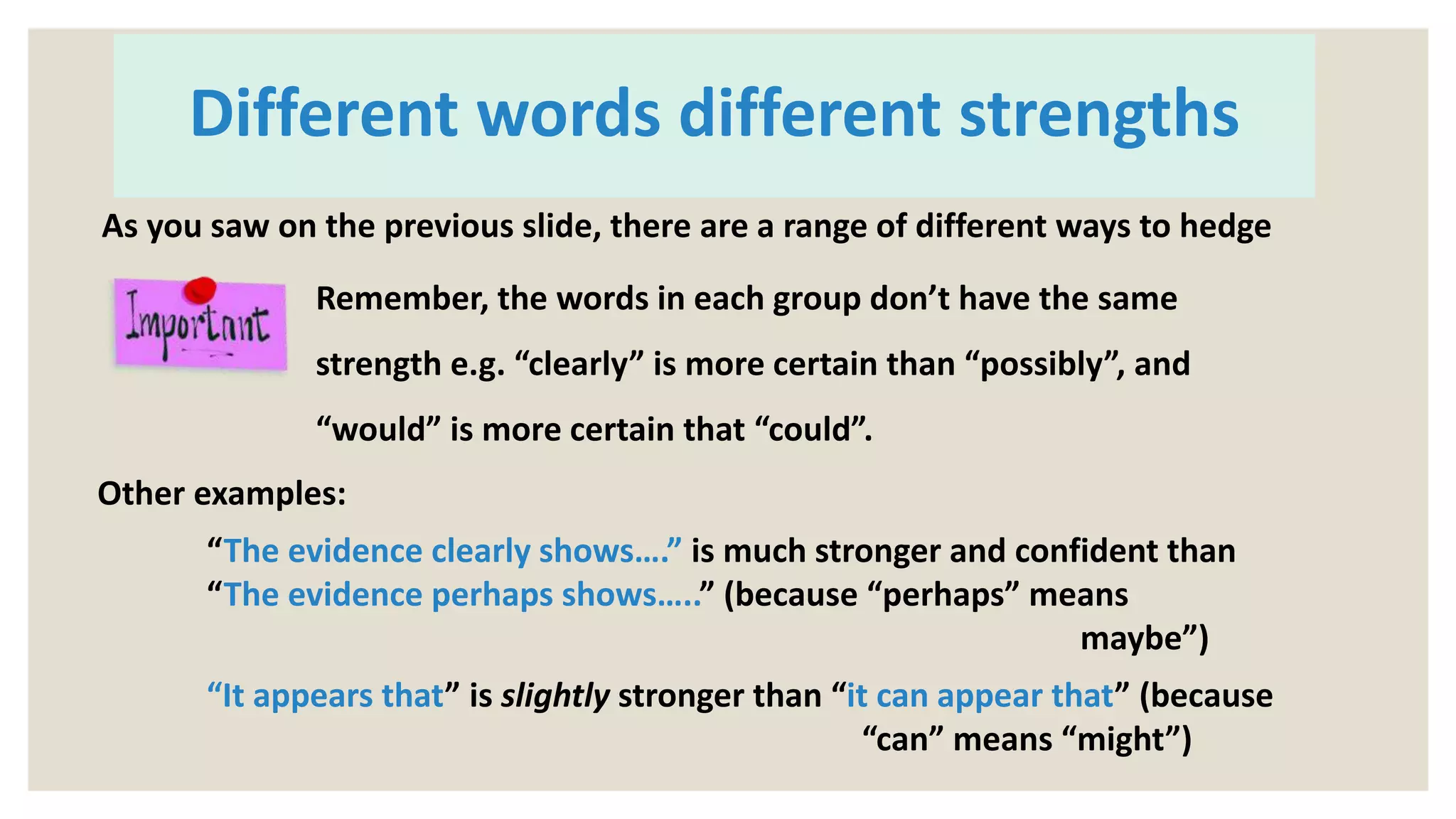
Different words different strengths
As you saw on the previous slide, there are a range of different ways to hedge
Remember, the words in each group don’t have the same
strength e.g. “clearly” is more certain than “possibly”, and
“would” is more certain that “could”.
Other examples:
“The evidence clearly shows….” is much stronger and confident than
“The evidence perhaps shows…..” (because “perhaps” means
maybe”)
“It appears that” is slightly stronger than “it can appear that” (because
“can” means “might”)
Possible problems….
• Even though hedging is necessary, if you overuse it, your reader may not
know your stance (view) on your subject – and that is something they need
to see
• Too much hedging can make it seem that you have no confidence in your
views or ideas, so use hedging for a reason, and not just because “I have to
use it”
• So you could (see the hedging there ?), use stronger language when you
are clearer of your ideas (e.g. “clearly”, “certainly”), and weaker language
(e.g. “possibly”, “could”, “appears to”) when you are less sure : use the
language to reflect your opinions.
As you read this paragraph, note the different ways the writer has hedged, and also
how strong the language is (detailed answer on the next slide):
“There are a number of explanations for why musicians have superior cognitive
abilities to non-musician controls. First, it is possible that only the more intellectually
rigorous people continue with music training once they have been exposed to it.
Practicing a musical instrument takes a tremendous amount of discipline. Individuals
who are willing to work that hard may also work hard in academic settings, thus
improving their cognitive abilities. Secondly, socio-economic class could be playing a
role. In a study comparing scholastic aptitude among musicians and non-musicians,
Phillips found a difference in the two groups, but once socio-economic class was
taken into account the difference nearly disappeared (Phillips, 1976). It is possible
that the differences between musicians and non-musicians is actually innate or
caused by something not musically related in the environment.”
Putting it together
“There are a number of explanations for why musicians have superior cognitive abilities to non-
musician controls. First, it is possible that only the more intellectually rigorous people continue
with music training once they have been exposed to it. Practicing a musical instrument takes a
tremendous amount of discipline. Individuals who are willing to work that hard may also work
hard in academic settings, thus improving their cognitive abilities. Secondly, socio-economic class
could be playing a role. In a study comparing scholastic aptitude among musicians and non-
musicians, Phillips found a difference in the two groups, but once socio-economic class was taken
into account the difference nearly disappeared (Phillips, 1976). It is possible that the differences
between musicians and non-musicians is actually innate or caused by something not musically
related in the environment.”
• The writer sees different reasons why musicians have better intellect (“a number of….”)
• that his first reason is “is possible” (and so agrees there can be other reasons)
• it “takes” effort (quite certain)
• that musicians “may” word hard at university (but it is impossible to say all do)
• suggests financial background “could” be another reason (again, there may be others)
• uses evidence form Phillips and sees he “found” differences ( is clear on what Philips concluded)
• concludes “it is possible” as the writer does not believe the evidence can give strong conclusions
So……
• Hedging is a key area of academic writing
• You can use it to :
make your writing more credible
give you some protection when making your claims
write more precisely, rather than in generalisations
show the reader what you think about the evidence you have
Reflect for a moment on whether you use hedging language in your writing
When you do your next assignment, think about different language you can use
Next
There are links on this Canvas page to give you more practice
with using hedging language

Hedging

  • 1.
  • 2.
    Hedging • Hedging, alsoknown as “cautious language” or “tentative language”, is a key feature of academic writing • Without it, your viewpoints or evaluations of ideas or research can seem too strong or too sure • It is particularly useful when commenting on what other writers have written or when discussing different studies or research, as it can difficult to be certain what all the evidence means • So unless you are 100% certain that what you write is conclusive (i.e. this is the truth !), you need hedging
  • 3.
    Example Compare sentence 1with sentence 2: 1. The ideas on nursing interventions show they are necessary in the NHS 2. The ideas on nursing interventions appear to show they are necessary in the NHS In 1, the writer is certain of the claim (“show they are”), but in 2, the writer uses hedging (“appear to show”) because it is difficult to make firm conclusions on the subject
  • 4.
    Example (cont’d) 1. Theideas on nursing interventions show they are necessary in the NHS • Because the claim, “interventions show”, is strong , the reader will now expect a lot of good evidence to prove this view • If there is not, then the view could be opposed or dismissed (remember : your subject teacher will know your assignment area, so write carefully) 2. The ideas on nursing interventions appear to show they are necessary in the NHS • In sentence 2, “appear to show” indicates the writer is aware of other interpretations of the ideas, and therefore the reader is more likely to agree
  • 5.
    Writing Precisely If yousometimes write too simplistically or generally, then hedging can help you to think and write more precisely : e.g. Bad parenting leads to poorly behaved children Instead of writing this, think if such statements are always true. Can you say that every bad parent has bad children? No Are there examples of where it does not happen? Yes, of course. So you could write “Bad parenting can sometimes lead to poorly behaved children”
  • 6.
    Practice There are manyexamples of hedging language, but before you see some, try this exercise: Look at each sentence to identify the hedging language used: 1. The problem with conclusions is that they can appear to be definite ( answer: “can appear” is the hedging language) 2. For example, it is likely that the research was done with some limitations 3. Such conclusions suggest that there is more than one option available 4. Research undertaken for several months, tends to be better than that for shorter periods 5. After reviewing the evidence, it can be argued that larger sample sizes are required 6. One possibility is that children brought up this way, have a shorter attention span 7. There is a tendency among families to not have the time to consider all options available 8. At the time of writing, it seems that the range of interventions available may not be enough
  • 7.
    Answers 1. The problemwith conclusions is that they can appear to be definite 2. For example, it is likely that the research was done with some limitations 3. Such conclusions suggest that there is more than one option available 4. Research undertaken for several months, tends to be better than that for shorter periods 5. After reviewing the evidence, it can be argued that larger sample sizes are required 6. One possibility is that children brought up this way, have a shorter attention span 7. There is a tendency among families to not have the time to consider all options available 8. At the time of writing, it seems that the range of interventions available may not be enough
  • 8.
    Hedging Language Examples ModalVerbs : would, should, may/might, can/could Adverbs 1 : clearly, convincingly, probably, possibly, perhaps Adverb 2: usually/normally, generally/mainly, often/regularly, sometimes, rarely Verbs/Phrases : tend (to), appear (to), seem (to). Indicate, suggest, there is a tendency.. That-Clauses: It could be argued that...; it is likely/unlikely that...; there is the possibility that…; it could be the case that…; there is the assumption that.. For more practice with these words, follow the links on this Canvas page
  • 9.
    Different words differentstrengths As you saw on the previous slide, there are a range of different ways to hedge Remember, the words in each group don’t have the same strength e.g. “clearly” is more certain than “possibly”, and “would” is more certain that “could”. Other examples: “The evidence clearly shows….” is much stronger and confident than “The evidence perhaps shows…..” (because “perhaps” means maybe”) “It appears that” is slightly stronger than “it can appear that” (because “can” means “might”)
  • 10.
    Possible problems…. • Eventhough hedging is necessary, if you overuse it, your reader may not know your stance (view) on your subject – and that is something they need to see • Too much hedging can make it seem that you have no confidence in your views or ideas, so use hedging for a reason, and not just because “I have to use it” • So you could (see the hedging there ?), use stronger language when you are clearer of your ideas (e.g. “clearly”, “certainly”), and weaker language (e.g. “possibly”, “could”, “appears to”) when you are less sure : use the language to reflect your opinions.
  • 11.
    As you readthis paragraph, note the different ways the writer has hedged, and also how strong the language is (detailed answer on the next slide): “There are a number of explanations for why musicians have superior cognitive abilities to non-musician controls. First, it is possible that only the more intellectually rigorous people continue with music training once they have been exposed to it. Practicing a musical instrument takes a tremendous amount of discipline. Individuals who are willing to work that hard may also work hard in academic settings, thus improving their cognitive abilities. Secondly, socio-economic class could be playing a role. In a study comparing scholastic aptitude among musicians and non-musicians, Phillips found a difference in the two groups, but once socio-economic class was taken into account the difference nearly disappeared (Phillips, 1976). It is possible that the differences between musicians and non-musicians is actually innate or caused by something not musically related in the environment.” Putting it together
  • 12.
    “There are anumber of explanations for why musicians have superior cognitive abilities to non- musician controls. First, it is possible that only the more intellectually rigorous people continue with music training once they have been exposed to it. Practicing a musical instrument takes a tremendous amount of discipline. Individuals who are willing to work that hard may also work hard in academic settings, thus improving their cognitive abilities. Secondly, socio-economic class could be playing a role. In a study comparing scholastic aptitude among musicians and non- musicians, Phillips found a difference in the two groups, but once socio-economic class was taken into account the difference nearly disappeared (Phillips, 1976). It is possible that the differences between musicians and non-musicians is actually innate or caused by something not musically related in the environment.” • The writer sees different reasons why musicians have better intellect (“a number of….”) • that his first reason is “is possible” (and so agrees there can be other reasons) • it “takes” effort (quite certain) • that musicians “may” word hard at university (but it is impossible to say all do) • suggests financial background “could” be another reason (again, there may be others) • uses evidence form Phillips and sees he “found” differences ( is clear on what Philips concluded) • concludes “it is possible” as the writer does not believe the evidence can give strong conclusions
  • 13.
    So…… • Hedging isa key area of academic writing • You can use it to : make your writing more credible give you some protection when making your claims write more precisely, rather than in generalisations show the reader what you think about the evidence you have Reflect for a moment on whether you use hedging language in your writing When you do your next assignment, think about different language you can use
  • 14.
    Next There are linkson this Canvas page to give you more practice with using hedging language