LANGUAGE
FEATURES IN
ACADEMIC TEXTS
Presented by: Ma'am Raya
ENGLISH FOR ACADEMIC AND
PROFESSIONAL PURPOSES
Quarter 1 Week 1 Module
LEARNING COMPETENCY
CS_EN11/12A-EAPP-Ia-c-2:
Differentiates language used in
academic texts from various
disciplines
OBJECTIVES
At the end of this module, you are expected
to:
a. Name examples of academic texts;
b. Distinguish the hedging expressions in
the sentences; and
c. Write a synthesis of information from the
academic text read.
Think of any words that you can
relate to the word ACADEMIC
Dr. Leila Kanso (2020) defined
academic language as follows:
1. The language used in classrooms
2. The language of texts
3. The language of assessments
4. The language of academic success
5. The language of power
NON-ACADEMIC TEXTS
ACADEMIC VS
• both can be useful for researchers and studen
• both are required not to plagiarize
• both may be written with the same goal
– persuade, entertain, or inform
• both may be found in print, periodical,
and digital forms
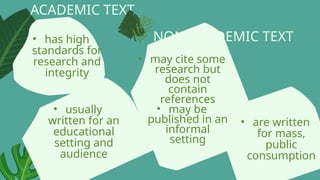
• has high
standards for
research and
integrity
• usually
written for an
educational
setting and
audience
• may cite some
research but
does not
contain
references
• may be
published in an
informal
setting
• are written
for mass,
public
consumption
ACADEMIC TEXT
NON-ACADEMIC TEXT
EXAMPLES OF
ACADEMIC TEXTS
• Academic journal – a periodical publication in
which a study relating to an academic
discipline is published
• Conference papers – often both a written
document and an oral presentation
• Reviews – are research, analysis, and
critical commentary on credible sources
used in a thesis, essay, or any academic
paper
EXAMPLES OF
ACADEMIC TEXTS
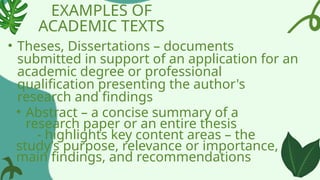
• Theses, Dissertations – documents
submitted in support of an application for an
academic degree or professional
qualification presenting the author's
research and findings
• Abstract – a concise summary of a
research paper or an entire thesis
- highlights key content areas – the
study’s purpose, relevance or importance,
main findings, and recommendations
• to better
comprehend
a prevailing
idea
• to gain
more
information
• to identify
breaches in
current
studies or
researches
GENERAL PURPOSES FOR
READING ACADEMIC TEXTS
• to get the
concepts
that support
a better
writing
assignment
• to relate
fresh
ideas to
surviving
ones
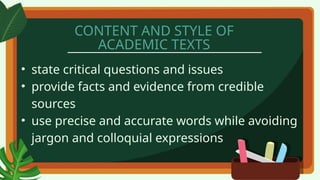
CONTENT AND STYLE OF
ACADEMIC TEXTS
• state critical questions and issues
• provide facts and evidence from credible
sources
• use precise and accurate words while avoiding
jargon and colloquial expressions
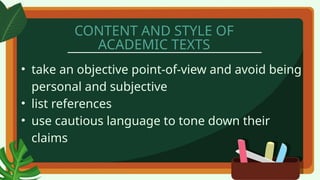
CONTENT AND STYLE OF
ACADEMIC TEXTS
• take an objective point-of-view and avoid being
personal and subjective
• list references
• use cautious language to tone down their
claims
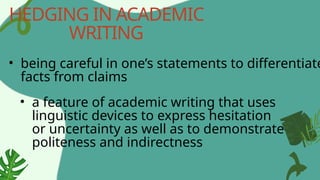
HEDGING IN ACADEMIC
WRITING
• a feature of academic writing that uses
linguistic devices to express hesitation
or uncertainty as well as to demonstrate
politeness and indirectness
• being careful in one’s statements to differentiate
facts from claims
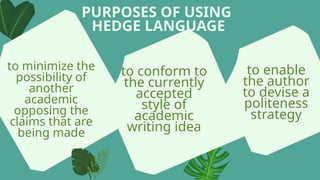
to minimize the
possibility of
another
academic
opposing the
claims that are
being made
to enable
the author
to devise a
politeness
strategy
PURPOSES OF USING
HEDGE LANGUAGE
to conform to
the currently
accepted
style of
academic
writing idea
ENAGO ACADEMY (ENAGO.COM), HEDGING WORDS
AND PHRASES ARE GROUPED TO ACHIEVE THESE
PURPOSES:
• Introductory verbs – seem, tend, look like,
appear to be, think, believe, doubt, be sure,
indicate, suggest
• Certain lexical verbs – believe, assume, suggest
• Certain modal verbs – will, must, would, may,
might, could
ENAGO ACADEMY (ENAGO.COM), HEDGING WORDS
AND PHRASES ARE GROUPED TO ACHIEVE THESE
PURPOSES:
• Modal adverbs – possibly, perhaps, conceivably
• Modal adjectives – certain, definite, clear,
probable, possible
• Modal nouns – assumption, possibility,
probability
ENAGO ACADEMY (ENAGO.COM), HEDGING WORDS
AND PHRASES ARE GROUPED TO ACHIEVE THESE
PURPOSES:
• That clauses – It could be the case that…, it
might be suggested that…, there is every
hope that…
• Adverbs of frequency – often, sometimes,
usually
• To-clause + adjective – It may be
possible to obtain…, It is important to
develop…, It is useful to study…
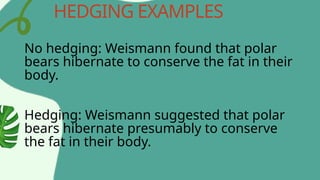
HEDGING EXAMPLES
No hedging: Weismann found that polar
bears hibernate to conserve the fat in their
body.
Hedging: Weismann suggested that polar
bears hibernate presumably to conserve
the fat in their body.
HEDGING EXAMPLES
1. It may be said that the commitment to
some of the social and economic concepts
was less strong than it is now.
2. The lives they chose may seem overly
ascetic and self-denying to most women
today.
Performance Task
Write a synthesis of a sample abstract
entitled:
“Science Poetry: The Allusions To Saudadẽ”
THANK YOU
FOR JOINING IN
TODAY'S LESSON!
ENJOY LEARNING!

LANGUAGE FEATURES IN ACADEMIC TEXTS.pptx

  • 1.
    LANGUAGE FEATURES IN ACADEMIC TEXTS Presentedby: Ma'am Raya ENGLISH FOR ACADEMIC AND PROFESSIONAL PURPOSES Quarter 1 Week 1 Module
  • 2.
    LEARNING COMPETENCY CS_EN11/12A-EAPP-Ia-c-2: Differentiates languageused in academic texts from various disciplines
  • 3.
    OBJECTIVES At the endof this module, you are expected to: a. Name examples of academic texts; b. Distinguish the hedging expressions in the sentences; and c. Write a synthesis of information from the academic text read.
  • 4.
    Think of anywords that you can relate to the word ACADEMIC
  • 5.
    Dr. Leila Kanso(2020) defined academic language as follows: 1. The language used in classrooms 2. The language of texts 3. The language of assessments 4. The language of academic success 5. The language of power
  • 6.
    NON-ACADEMIC TEXTS ACADEMIC VS •both can be useful for researchers and studen • both are required not to plagiarize • both may be written with the same goal – persuade, entertain, or inform • both may be found in print, periodical, and digital forms
  • 7.
    • has high standardsfor research and integrity • usually written for an educational setting and audience • may cite some research but does not contain references • may be published in an informal setting • are written for mass, public consumption ACADEMIC TEXT NON-ACADEMIC TEXT
  • 8.
    EXAMPLES OF ACADEMIC TEXTS •Academic journal – a periodical publication in which a study relating to an academic discipline is published • Conference papers – often both a written document and an oral presentation • Reviews – are research, analysis, and critical commentary on credible sources used in a thesis, essay, or any academic paper
  • 9.
    EXAMPLES OF ACADEMIC TEXTS •Theses, Dissertations – documents submitted in support of an application for an academic degree or professional qualification presenting the author's research and findings • Abstract – a concise summary of a research paper or an entire thesis - highlights key content areas – the study’s purpose, relevance or importance, main findings, and recommendations
  • 10.
    • to better comprehend aprevailing idea • to gain more information • to identify breaches in current studies or researches GENERAL PURPOSES FOR READING ACADEMIC TEXTS • to get the concepts that support a better writing assignment • to relate fresh ideas to surviving ones
  • 11.
    CONTENT AND STYLEOF ACADEMIC TEXTS • state critical questions and issues • provide facts and evidence from credible sources • use precise and accurate words while avoiding jargon and colloquial expressions
  • 12.
    CONTENT AND STYLEOF ACADEMIC TEXTS • take an objective point-of-view and avoid being personal and subjective • list references • use cautious language to tone down their claims
  • 13.
    HEDGING IN ACADEMIC WRITING •a feature of academic writing that uses linguistic devices to express hesitation or uncertainty as well as to demonstrate politeness and indirectness • being careful in one’s statements to differentiate facts from claims
  • 14.
    to minimize the possibilityof another academic opposing the claims that are being made to enable the author to devise a politeness strategy PURPOSES OF USING HEDGE LANGUAGE to conform to the currently accepted style of academic writing idea
  • 15.
    ENAGO ACADEMY (ENAGO.COM),HEDGING WORDS AND PHRASES ARE GROUPED TO ACHIEVE THESE PURPOSES: • Introductory verbs – seem, tend, look like, appear to be, think, believe, doubt, be sure, indicate, suggest • Certain lexical verbs – believe, assume, suggest • Certain modal verbs – will, must, would, may, might, could
  • 16.
    ENAGO ACADEMY (ENAGO.COM),HEDGING WORDS AND PHRASES ARE GROUPED TO ACHIEVE THESE PURPOSES: • Modal adverbs – possibly, perhaps, conceivably • Modal adjectives – certain, definite, clear, probable, possible • Modal nouns – assumption, possibility, probability
  • 17.
    ENAGO ACADEMY (ENAGO.COM),HEDGING WORDS AND PHRASES ARE GROUPED TO ACHIEVE THESE PURPOSES: • That clauses – It could be the case that…, it might be suggested that…, there is every hope that… • Adverbs of frequency – often, sometimes, usually • To-clause + adjective – It may be possible to obtain…, It is important to develop…, It is useful to study…
  • 18.
    HEDGING EXAMPLES No hedging:Weismann found that polar bears hibernate to conserve the fat in their body. Hedging: Weismann suggested that polar bears hibernate presumably to conserve the fat in their body.
  • 19.
    HEDGING EXAMPLES 1. Itmay be said that the commitment to some of the social and economic concepts was less strong than it is now. 2. The lives they chose may seem overly ascetic and self-denying to most women today.
  • 21.
    Performance Task Write asynthesis of a sample abstract entitled: “Science Poetry: The Allusions To Saudadẽ”
  • 23.
    THANK YOU FOR JOININGIN TODAY'S LESSON! ENJOY LEARNING!