Critical Writing
Neil Roberts
The Academic Achievement Team
Skills@ljmu.ac.uk
Lesson Aims
• Analyse and evaluate critical analysis in writing
• Explain how to write with critical analysis in your assignments
Session aims:
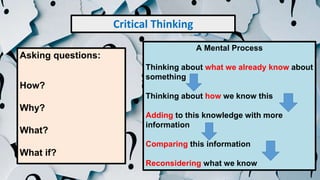
Critical Thinking
Asking questions:
How?
Why?
What?
What if?
A Mental Process
Thinking about what we already know about
something
Thinking about how we know this
Adding to this knowledge with more
information
Comparing this information
Reconsidering what we know
Bloom’s Model (1956)
Evaluation
Synthesis
Analysis
Application
Comprehension
Knowledge
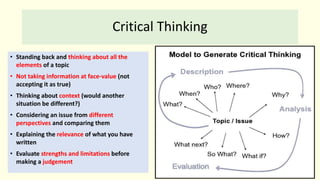
Critical Thinking
• Standing back and thinking about all the
elements of a topic
• Not taking information at face-value (not
accepting it as true)
• Thinking about context (would another
situation be different?)
• Considering an issue from different
perspectives and comparing them
• Explaining the relevance of what you have
written
• Evaluate strengths and limitations before
making a judgement
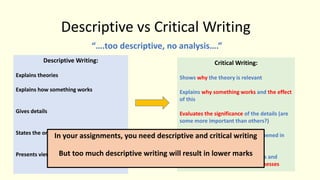
Descriptive vs Critical Writing
“….too descriptive, no analysis….”
Descriptive Writing:
Explains theories
Explains how something works
Gives details
States the order in which things happen
Presents views
Critical Writing:
Shows why the theory is relevant
Explains why something works and the effect
of this
Evaluates the significance of the details (are
some more important than others?)
Makes judgments why things happened in
this way and not another way
Explains the relevance of the views and
evaluates the strengths and weaknesses
In your assignments, you need descriptive and critical writing
But too much descriptive writing will result in lower marks
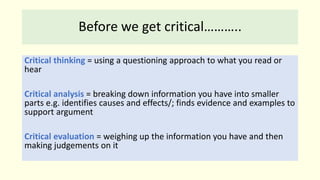
Before we get critical………..
Critical thinking = using a questioning approach to what you read or
hear
Critical analysis = breaking down information you have into smaller
parts e.g. identifies causes and effects/; finds evidence and examples to
support argument
Critical evaluation = weighing up the information you have and then
making judgements on it
Practice
Descriptive or Critical? 1
A number of studies have investigated people’s preferences for pets.
Some people prefer cats (Alcott, 2007; Bentley 2011) but some
people prefer dogs (Harrison, 2008; Bailey 2010).
A number of studies have investigated people’s preferences for pets.
Some people prefer cats (Alcott, 2007; Bentley 2011) but some
people prefer dogs (Harrison, 2008; Bailey 2010). Those who prefer
cats are usually quiet people who live alone (Samson, 2009), while
those who prefer dogs are active people (Kreen, 2004).
A number of studies have investigated
Synthesise different
studies who share the
same view
Descriptive : the writer is just reporting ideas
from other people
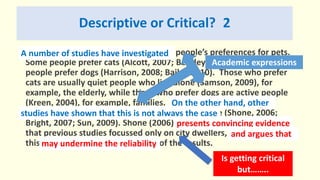
Descriptive or Critical? 2
A number of studies have investigated people’s preferences for pets.
Some people prefer cats (Alcott, 2007; Bentley 2011) but some
people prefer dogs (Harrison, 2008; Bailey 2010). Those who prefer
cats are usually quiet people who live alone (Samson, 2009), for
example, the elderly, while those who prefer dogs are active people
(Kreen, 2004), for example, families. On the other hand, other
studies have shown that this is not always the case (Shone, 2006;
Bright, 2007; Sun, 2009). Shone (2006) presents convincing evidence
that previous studies focussed only on city dwellers, and argues that
this may undermine the reliability of the results.
A number of studies have investigated
On the other hand, other
studies have shown that this is not always the case
presents convincing evidence
and argues that
may undermine the reliability
Is getting critical
but……..
Academic expressions
Descriptive or Critical? 3
A number of studies have investigated people’s preferences for pets.
Some people prefer cats (Alcott, 2007; Bentley 2011) but some
people prefer dogs (Harrison, 2008; Bailey 2010). Those who prefer
cats have been characterised as ‘quiet’ people who live alone
(Samson, 2009), for example, the elderly, while those who prefer
dogs are described as ‘active’ people (Kreen, 2004), for example,
families. It is not clear, however, whether it is because these people
are ‘active’ that they choose to have a dog or whether it is the
presence of a dog in the household that in fact causes these people
to be more active.
have been characterised
It is not clear
Final sentence questioning /
thinking what information is
missing
that in fact causes
Critical !
Your Academic Voice
• Your tutors already know about your
subject but they do not know what you
think
• They want to know what ideas you
consider to be important and why
• When you write critically and comment,
this is your opinion coming through
• Your opinion = your voice
Claim-Evidence-Support
• As always, your opinions must be
supported
• You should use evidence and then
explain why it supports your viewpoint
• Distinguish between:
• Your Viewpoint (claim)
• Your Evidence (support)
• Your Reasons for believing it
(argument)
• Be clear about how the evidence leads
you to form your conclusions
The W.E.E.D. Paragraph Structure: Critical Analysis
WHAT is your paragraph about? This will be your topic sentence (tells the
reader what the paragraph is about)
EXPLANATION: what do you mean? Can you use add some evidence?
EXAMPLES/EVIDENCE: make sure that you support you point with
examples from your reading. Start synthesising the literature (combining
similar ideas)
DO: What can you conclude? What is your evaluation? Why are you
telling the reader this – make your point. This is your academic
voice – your line of argument.
Scientists do not agree about the extent to which creativity
can be linked to activity in the right hemisphere of the
brain. It is known that the biochemistry of the two
hemispheres of the brain is different. For example, there is
more norepinephrine in the right hemisphere than in the
left (Carlsson, 1996). Norepinephrine is associated with
increased alertness to visual stimuli, and it has been
suggested by Springer and Deutsch (2002) that this may
lead to increased right-hemisphere specialisation for visual
and spatial perception. This link, however, has not yet
been adequately demonstrated, and it may indeed be the
case that the ‘right brain’ produces the norepinephrine in
response to activity, rather than producing it to cause
activity.
What paragraph is about
Explanation
Examples /
evidence
Critical
comment
Practice
Example paragraph using the W.E.E.D.
structure : Nursing
Koenig’s (1998) study of patients with terminal disease, found over 90% of these patients used
religion as a coping mechanism. Spirituality can enhance a person’s desire to live longer by any
means, avoiding an afterlife of punishment or, conversely, hastening death to relieve suffering and
pain on entering the afterlife (Hamel and Lysaught, 1994). However, each faith community can hold
its own unique set of beliefs, but that different denominations or strands of each faith can also
differ in their belief system, including in their approach to palliative care. For example, the
Methodist Church promotes the right to die in dignity without efforts to prolong life ‘merely
because the technology is available to do so’ (Thobaben, 1997), while the Catholic Church believes
that removing ANH will cause unnecessary suffering and therefore condone palliation towards end
of life (Evangelista, 2008). Yet, as Pugh et al (2009) suggest, it is also important to note that beliefs
and choices can vary dependant on the individuals within any given belief system and that all
tenants of their religion may not necessarily be adhered to. Therefore, although health care
professionals must have a broad understanding of the stance that major religions take on palliative
care, in order to approach patients and their families with empathy and sensitivity, clinical decision-
making should also avoid generalisations and make allowances for individual preferences and
choices, regardless of the patient’s religious affiliation.
What the
paragraph
is about
Explanation
Example to
support the
point
Adding more
detail
Comment :
evaluation of
points about
healthcare
and religion
Point: awareness of
problems
Turning first to the alleged economic benefits of tourism, we can see that in
the case of the Cook Islands, there is a variety of sources of income from
tourist receipts. In an unsurprisingly positive report from the Tourism Council
of the South Pacific (2013), after beach activities and natural scenery (62%),
visitors to the Cook Islands are looking for entertainment and folklore and
culture experiences (27%). Tourists contribute to the local economy by
spending money on travel to and around the country, as well as on
accommodation, food, entertainment and souvenirs. Results from this same
survey, for example, revealed that in the survey period (October 2012 to
February 2013) 90% of tourists surveyed stayed in hotels or similar
accommodation, 78% of which are owned by multi-national organisations.
Also, close to 70% of total tourist expenditure was on accommodation,
restaurants and bars, with a further 16% on transport, tours and
entertainment (Tourism Council of the South Pacific, 2013). These figures are
presented to suggest, as Brown et al. (2016) have similarly proposed, that
tourists are helping to create jobs and investment in the local economy by
directly by paying for services. However, the study by Mahmood (2017)
persuasively highlights the low-wage nature of this employment and the lack
of investment in local infrastructure, which has had the effect of stifling
growth locally despite the high profits external tourism companies have
gained from their placement on the Cook Islands. It could therefore be
suggested that control of the Cook Islands tourism industry by local people,
with advice from those outside working in a partnership mode as has been
seen in Barbados (Mahmood, 2017), could mean that tourism brings many
more benefits than it currently is.
What the paragraph is about
Evaluating the source material for its
reliability and its strength.
Comparing and contrasting literature
(evidence)
Evaluating how literature is being
used
Alternative viewpoint + evaluation
Final evaluation of paragraph topic
A protocol study has been used to investigate issues of teamwork in
design on the basis of extensive literature review under this section.
However, various matters, such as common design teamwork goals,
have not been properly investigated. Most studies were unable to
extend beyond communication, technology, and environmental
approaches to the design teamwork. Apart from communication,
cognitive actions, thinking, and environment, studies on teamwork in
design should also acknowledge transformations that emerge from
stakeholders' interaction.
At present, there are several studies concerning the sustainable
development of healthcare units. However, most of them are oriented to
business management or to waste management and energy efficiency, as in
the study developed by Murray et al. (2008). Sustainable practices in these
buildings are not widespread mainly due to the fact that they are not
conventional. Additionally, the implementation of sustainable practices,
normally related to the concept of ‘‘reduction’’, is not always very well
perceived by society and can generate some resistance (Castro et al. 2012).
Several studies and professionals, such us Malkin (2006), also agree that it is
possible to work through the weaknesses of actions and measures. Some of
them are simple and inexpensive, but capable of reducing the environmental
impact.
Critical Writing Language
• X’s research is not wholly persuasive because she
overlooks ___________
• X’s theory of ___________ is extremely useful because it
sheds insight on the difficult problem of ___________
• Whereas X provides ample evidence that ___________, Y
and Z’s research on ___________ and ___________ is more
convincing in its argument that ___________ because
___________
• This suggests that ___________
• Conversely, it could be argued that ___________
Useful link: Manchester
University Phrasebank
http://www.phrasebank.man
chester.ac.uk/being-critical/
Academic Writing
Neil Roberts
The Academic Achievement Team
Skills@ljmu.ac.uk

Critical writing lesson

  • 1.
    Critical Writing Neil Roberts TheAcademic Achievement Team Skills@ljmu.ac.uk
  • 2.
    Lesson Aims • Analyseand evaluate critical analysis in writing • Explain how to write with critical analysis in your assignments
  • 3.
    Session aims: Critical Thinking Askingquestions: How? Why? What? What if? A Mental Process Thinking about what we already know about something Thinking about how we know this Adding to this knowledge with more information Comparing this information Reconsidering what we know
  • 4.
  • 5.
    Critical Thinking • Standingback and thinking about all the elements of a topic • Not taking information at face-value (not accepting it as true) • Thinking about context (would another situation be different?) • Considering an issue from different perspectives and comparing them • Explaining the relevance of what you have written • Evaluate strengths and limitations before making a judgement
  • 6.
    Descriptive vs CriticalWriting “….too descriptive, no analysis….” Descriptive Writing: Explains theories Explains how something works Gives details States the order in which things happen Presents views Critical Writing: Shows why the theory is relevant Explains why something works and the effect of this Evaluates the significance of the details (are some more important than others?) Makes judgments why things happened in this way and not another way Explains the relevance of the views and evaluates the strengths and weaknesses In your assignments, you need descriptive and critical writing But too much descriptive writing will result in lower marks
  • 7.
    Before we getcritical……….. Critical thinking = using a questioning approach to what you read or hear Critical analysis = breaking down information you have into smaller parts e.g. identifies causes and effects/; finds evidence and examples to support argument Critical evaluation = weighing up the information you have and then making judgements on it
  • 8.
  • 9.
    Descriptive or Critical?1 A number of studies have investigated people’s preferences for pets. Some people prefer cats (Alcott, 2007; Bentley 2011) but some people prefer dogs (Harrison, 2008; Bailey 2010). A number of studies have investigated people’s preferences for pets. Some people prefer cats (Alcott, 2007; Bentley 2011) but some people prefer dogs (Harrison, 2008; Bailey 2010). Those who prefer cats are usually quiet people who live alone (Samson, 2009), while those who prefer dogs are active people (Kreen, 2004). A number of studies have investigated Synthesise different studies who share the same view Descriptive : the writer is just reporting ideas from other people
  • 10.
    Descriptive or Critical?2 A number of studies have investigated people’s preferences for pets. Some people prefer cats (Alcott, 2007; Bentley 2011) but some people prefer dogs (Harrison, 2008; Bailey 2010). Those who prefer cats are usually quiet people who live alone (Samson, 2009), for example, the elderly, while those who prefer dogs are active people (Kreen, 2004), for example, families. On the other hand, other studies have shown that this is not always the case (Shone, 2006; Bright, 2007; Sun, 2009). Shone (2006) presents convincing evidence that previous studies focussed only on city dwellers, and argues that this may undermine the reliability of the results. A number of studies have investigated On the other hand, other studies have shown that this is not always the case presents convincing evidence and argues that may undermine the reliability Is getting critical but…….. Academic expressions
  • 11.
    Descriptive or Critical?3 A number of studies have investigated people’s preferences for pets. Some people prefer cats (Alcott, 2007; Bentley 2011) but some people prefer dogs (Harrison, 2008; Bailey 2010). Those who prefer cats have been characterised as ‘quiet’ people who live alone (Samson, 2009), for example, the elderly, while those who prefer dogs are described as ‘active’ people (Kreen, 2004), for example, families. It is not clear, however, whether it is because these people are ‘active’ that they choose to have a dog or whether it is the presence of a dog in the household that in fact causes these people to be more active. have been characterised It is not clear Final sentence questioning / thinking what information is missing that in fact causes Critical !
  • 12.
    Your Academic Voice •Your tutors already know about your subject but they do not know what you think • They want to know what ideas you consider to be important and why • When you write critically and comment, this is your opinion coming through • Your opinion = your voice
  • 13.
    Claim-Evidence-Support • As always,your opinions must be supported • You should use evidence and then explain why it supports your viewpoint • Distinguish between: • Your Viewpoint (claim) • Your Evidence (support) • Your Reasons for believing it (argument) • Be clear about how the evidence leads you to form your conclusions
  • 14.
    The W.E.E.D. ParagraphStructure: Critical Analysis WHAT is your paragraph about? This will be your topic sentence (tells the reader what the paragraph is about) EXPLANATION: what do you mean? Can you use add some evidence? EXAMPLES/EVIDENCE: make sure that you support you point with examples from your reading. Start synthesising the literature (combining similar ideas) DO: What can you conclude? What is your evaluation? Why are you telling the reader this – make your point. This is your academic voice – your line of argument.
  • 15.
    Scientists do notagree about the extent to which creativity can be linked to activity in the right hemisphere of the brain. It is known that the biochemistry of the two hemispheres of the brain is different. For example, there is more norepinephrine in the right hemisphere than in the left (Carlsson, 1996). Norepinephrine is associated with increased alertness to visual stimuli, and it has been suggested by Springer and Deutsch (2002) that this may lead to increased right-hemisphere specialisation for visual and spatial perception. This link, however, has not yet been adequately demonstrated, and it may indeed be the case that the ‘right brain’ produces the norepinephrine in response to activity, rather than producing it to cause activity. What paragraph is about Explanation Examples / evidence Critical comment
  • 16.
  • 17.
    Example paragraph usingthe W.E.E.D. structure : Nursing Koenig’s (1998) study of patients with terminal disease, found over 90% of these patients used religion as a coping mechanism. Spirituality can enhance a person’s desire to live longer by any means, avoiding an afterlife of punishment or, conversely, hastening death to relieve suffering and pain on entering the afterlife (Hamel and Lysaught, 1994). However, each faith community can hold its own unique set of beliefs, but that different denominations or strands of each faith can also differ in their belief system, including in their approach to palliative care. For example, the Methodist Church promotes the right to die in dignity without efforts to prolong life ‘merely because the technology is available to do so’ (Thobaben, 1997), while the Catholic Church believes that removing ANH will cause unnecessary suffering and therefore condone palliation towards end of life (Evangelista, 2008). Yet, as Pugh et al (2009) suggest, it is also important to note that beliefs and choices can vary dependant on the individuals within any given belief system and that all tenants of their religion may not necessarily be adhered to. Therefore, although health care professionals must have a broad understanding of the stance that major religions take on palliative care, in order to approach patients and their families with empathy and sensitivity, clinical decision- making should also avoid generalisations and make allowances for individual preferences and choices, regardless of the patient’s religious affiliation. What the paragraph is about Explanation Example to support the point Adding more detail Comment : evaluation of points about healthcare and religion Point: awareness of problems
  • 18.
    Turning first tothe alleged economic benefits of tourism, we can see that in the case of the Cook Islands, there is a variety of sources of income from tourist receipts. In an unsurprisingly positive report from the Tourism Council of the South Pacific (2013), after beach activities and natural scenery (62%), visitors to the Cook Islands are looking for entertainment and folklore and culture experiences (27%). Tourists contribute to the local economy by spending money on travel to and around the country, as well as on accommodation, food, entertainment and souvenirs. Results from this same survey, for example, revealed that in the survey period (October 2012 to February 2013) 90% of tourists surveyed stayed in hotels or similar accommodation, 78% of which are owned by multi-national organisations. Also, close to 70% of total tourist expenditure was on accommodation, restaurants and bars, with a further 16% on transport, tours and entertainment (Tourism Council of the South Pacific, 2013). These figures are presented to suggest, as Brown et al. (2016) have similarly proposed, that tourists are helping to create jobs and investment in the local economy by directly by paying for services. However, the study by Mahmood (2017) persuasively highlights the low-wage nature of this employment and the lack of investment in local infrastructure, which has had the effect of stifling growth locally despite the high profits external tourism companies have gained from their placement on the Cook Islands. It could therefore be suggested that control of the Cook Islands tourism industry by local people, with advice from those outside working in a partnership mode as has been seen in Barbados (Mahmood, 2017), could mean that tourism brings many more benefits than it currently is. What the paragraph is about Evaluating the source material for its reliability and its strength. Comparing and contrasting literature (evidence) Evaluating how literature is being used Alternative viewpoint + evaluation Final evaluation of paragraph topic
  • 19.
    A protocol studyhas been used to investigate issues of teamwork in design on the basis of extensive literature review under this section. However, various matters, such as common design teamwork goals, have not been properly investigated. Most studies were unable to extend beyond communication, technology, and environmental approaches to the design teamwork. Apart from communication, cognitive actions, thinking, and environment, studies on teamwork in design should also acknowledge transformations that emerge from stakeholders' interaction.
  • 20.
    At present, thereare several studies concerning the sustainable development of healthcare units. However, most of them are oriented to business management or to waste management and energy efficiency, as in the study developed by Murray et al. (2008). Sustainable practices in these buildings are not widespread mainly due to the fact that they are not conventional. Additionally, the implementation of sustainable practices, normally related to the concept of ‘‘reduction’’, is not always very well perceived by society and can generate some resistance (Castro et al. 2012). Several studies and professionals, such us Malkin (2006), also agree that it is possible to work through the weaknesses of actions and measures. Some of them are simple and inexpensive, but capable of reducing the environmental impact.
  • 21.
    Critical Writing Language •X’s research is not wholly persuasive because she overlooks ___________ • X’s theory of ___________ is extremely useful because it sheds insight on the difficult problem of ___________ • Whereas X provides ample evidence that ___________, Y and Z’s research on ___________ and ___________ is more convincing in its argument that ___________ because ___________ • This suggests that ___________ • Conversely, it could be argued that ___________ Useful link: Manchester University Phrasebank http://www.phrasebank.man chester.ac.uk/being-critical/
  • 22.
    Academic Writing Neil Roberts TheAcademic Achievement Team Skills@ljmu.ac.uk

Editor's Notes

  • #2  It would be worth commenting here that as it is a lecture, there will be an element of self-reflection to assess their own learning throughout the session
  • #4 Re-cap
  • #5 So, let’s look at Bloom’s model of critical thinking, as this shows the steps and the process that we need to go through to become critical thinkers. At the bottom of the pyramid are the skills of knowledge and comprehension. Particularly in scientific disciplines, it is important to be able to describe processes with clarity and precision. Being able to convey complex ideas clearly, accurately and concisely is also an important skill. However, whilst these skills are essential, on their own they will not get you a degree. ‘Application’ refers to the process of applying theories to practice. For example, a teacher who has studied debates about inclusivity in the classroom might apply the theories to their own working situation. Analysis involves demonstrating an ability to break a topic into its component parts and show the relationship between those parts (e.g. the global financial crisis had various causal factors, e.g. government borrowing and over-spending, sub-prime lending, the long period of economic and price stability, and house price inflation. Analysing the crisis might include thinking about how rising house prices were caused by confidence caused by over-spending by the government. ‘Synthesis’ involves putting different parts together to form a new whole. It builds upon the skills of analysis to create something new, even out of material that may have been examined by others many times before. Evaluation is the ability to judge the value of material for a given purpose. Evaluating involves asking sometimes complex questions that involve issues such as relevance, quality of argument, evidence, bias and alternative explanations.
  • #6 This is a good place to relate some of the features of critical analysis to their own work. For example you could suggest the type of contexts they could take into consideration, the different perspectives they need to consider, such as different ethical approaches to palliative care, and the aspects of their reading they could be evaluating. I often use the analogy of a room when explain critical analysis: rather than walking into a room and only looking at one corner of it and possibly asking the views of the one person sitting in that corner before walking out again, they should stand in the middle of the room and turn all the way around. This way, they can take in the whole room (all the elements of a topic) and will be able to ask the views and experiences of everyone sitting there. When they walk out, they will then be able to describe in far more detail what they have seen and therefore be able to analyse all the features of the room but they will also have received a range of different perspectives which they can then evaluate to reach their own conclusions. Their analysis and conclusions will then be more fully informed and richer. This does often work but, of course, you may not think these analogies would! However, you could remind them of the key elements below: Choose your reading carefully so that you get a wide range of different (academic/expert) opinions. Ask questions about your sources: what is the argument, what evidence is used to support this, do all sources agree? Record your thoughts and ideas (i.e. your analysis) alongside your notes. Plan your argument (your answer) on the theories and evidence you have read, as well as your interpretation of these. All of that is the foundation to you showing critical analysis in your writing.
  • #10 The next 5 slides are for students to read and the comment on. Depending on group you may have students compare ideas before the answers, or ask the class to volunteer answers. Click to show each separately. Both are descriptive.
  • #11 THIS is getting critical/analytical. In final sentence writer shows that s/he is convinced by Shone’s arguments– questions previous results.
  • #12 Another example of critical/analytical. In this case the writer (student) is challenging the meaning/interpretation of the findings. Note that descriptive writing precedes the analysis/critique– information needs to be presented before it is discussed.
  • #13 Explain what we mean by academic voice and why they should feel confident at L7 to be using it, and that as they start to write assignments that relate to their practical and professional experiences, they will be developing a greater sense of authority when discussing the subjects they will be studying. Of course, there needs to be a note of caution here – they still need research-based evidence and academic authorities, not just anecdotes! I often use the analogy of them sitting around a table having a meal with the academic authors they will be reading and that they should feel that they are developing enough knowledge and experience to join in their conversation with their opinions and views, which leads into the next phase of the lesson, critical analysis.
  • #14 Explain what we mean by academic voice and why they should feel confident at L7 to be using it, and that as they start to write assignments that relate to their practical and professional experiences, they will be developing a greater sense of authority when discussing the subjects they will be studying. Of course, there needs to be a note of caution here – they still need research-based evidence and academic authorities, not just anecdotes! I often use the analogy of them sitting around a table having a meal with the academic authors they will be reading and that they should feel that they are developing enough knowledge and experience to join in their conversation with their opinions and views, which leads into the next phase of the lesson, critical analysis.
  • #15 Make link between critical grid and then planning paragraphs – will have seen this on the assignment planner. Explain WEED.
  • #22 Brush over this pretty quickly – just highlight that phrases like this introduce an academic tone and style.
  • #23  It would be worth commenting here that as it is a lecture, there will be an element of self-reflection to assess their own learning throughout the session