Heat Transfer It is that area of mechanical engineering that deals with the different principles and mechanisms involved in transferring heat from one point to another. Heat Transfer
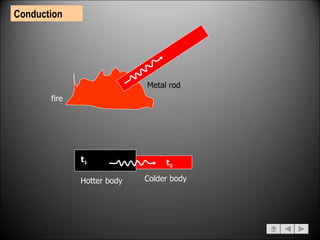
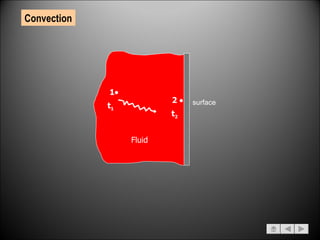
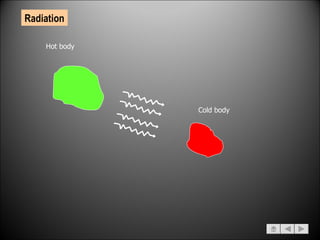
Modes of Heat Transfer Conduction:  Is the transfer of heat from one point to another point within a body or from one body to another body when they are physical contact with each other. Convection:   Is the transfer of heat from one point to another within a fluid. a. Natural or Free convection – motion of the fluid is due to the  difference in density because of a difference in temperature. b. Force Convection – motion of fluid is  accomplished by mechanical  means, such as a fan or a blower. 3.   Radiation:   It the flow of heat from one body to another body separated by a distance due to electromagnetic waves.
Conduction fire Metal rod t 1 Hotter body t 2 Colder body
Convection 2   t 2 t 1 1  Fluid surface
Radiation Hot body Cold body
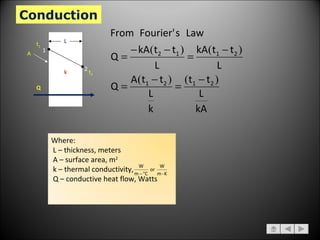
Conduction L 1 2 k A Q t 1 t 2 Where: L – thickness, meters A – surface area, m 2 k – thermal conductivity, Q – conductive heat flow, Watts
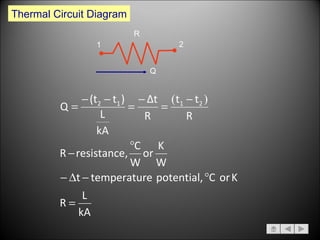
Thermal Circuit Diagram 1 2 R Q
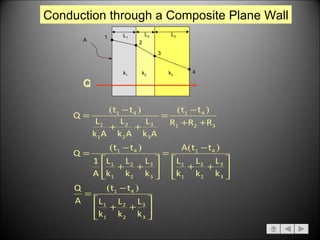
Conduction through a Composite Plane Wall L 1 L 2 L 3 k 1 k 2 k 3 1 A 2 3 4 Q
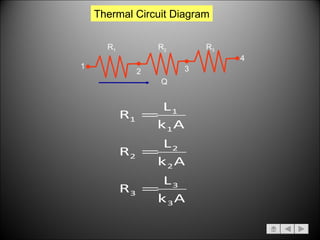
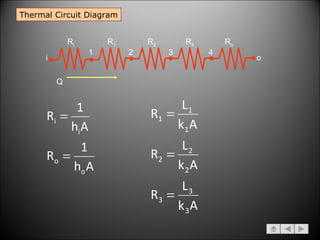
Thermal Circuit   Diagram 1 2 R 1 Q 4 3 R 2 R 3
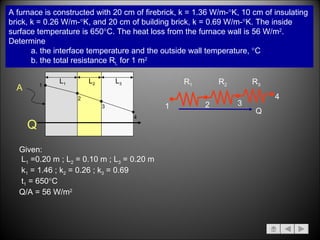
A furnace is constructed with 20 cm of firebrick, k = 1.36 W/m-  K, 10 cm of insulating  brick, k = 0.26 W/m-  K, and 20 cm of building brick, k = 0.69 W/m-  K. The inside  surface temperature is 650  C. The heat loss from the furnace wall is 56 W/m 2 .  Determine a. the interface temperature and the outside wall temperature,   C b. the total resistance R t,  for 1 m 2 Given: L 1  =0.20 m ; L 2  = 0.10 m ; L 3  = 0.20 m k 1  = 1.46 ; k 2  = 0.26 ; k 3  = 0.69 t 1  = 650  C  Q/A = 56 W/m 2 L 1 L 2 L 3 1 2 3 4 Q A 1 2 R 1 Q 4 3 R 2 R 3
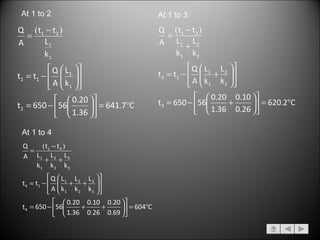
At 1 to 2 At 1 to 3 At 1 to 4
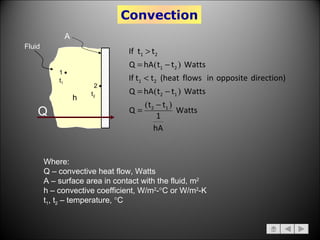
Convection Where: Q – convective heat flow, Watts A – surface area in contact with the fluid, m 2 h – convective coefficient, W/m 2 -  C or W/m 2 -K t 1 , t 2  – temperature,   C Fluid A 1  2  Q t 2 t 1 h
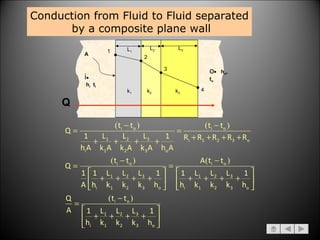
Conduction from Fluid to Fluid separated by a composite plane wall L 1 L 2 L 3 k 1 k 2 k 3 1 A 2 3 4 Q i    h i   t i o    h o , t o
Thermal Circuit Diagram 1 2 R 1 Q 4 3 R 2 R 3 i o R i R o
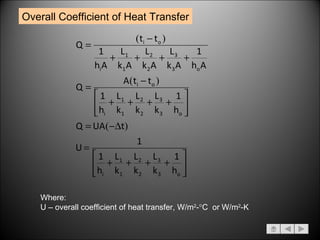
Overall Coefficient of Heat Transfer Where: U – overall coefficient of heat transfer, W/m 2 -  C  or W/m 2 -K
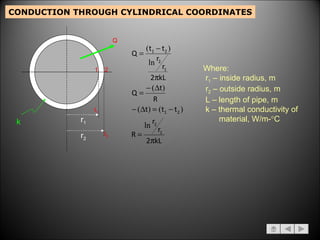
CONDUCTION THROUGH CYLINDRICAL COORDINATES Where: r 1  – inside radius, m r 2  – outside radius, m L – length of pipe, m k – thermal conductivity of material, W/m-  C r 1 r 2 1 2 t 1 t 2 Q k
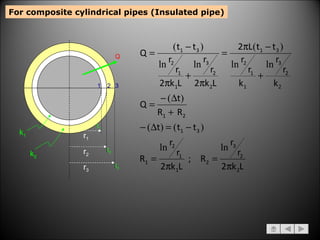
For composite cylindrical pipes (Insulated pipe) r 1 r 2 1 2 t 1 t 2 Q k 1 3 r 3 t 3 k 2
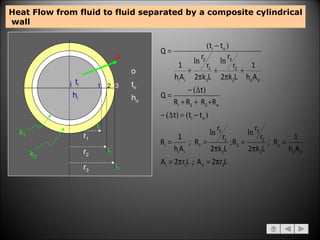
Heat Flow from fluid to fluid separated by a composite cylindrical wall r 1 r 2 1 2 t 1 t 2 Q k 1 3 r 3 t 3 k 2 i h i t i o h o t o
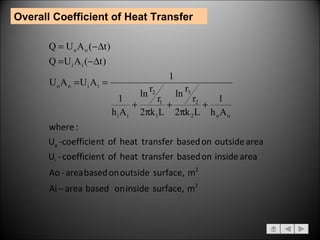
Overall Coefficient of Heat Transfer
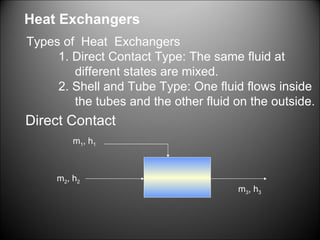
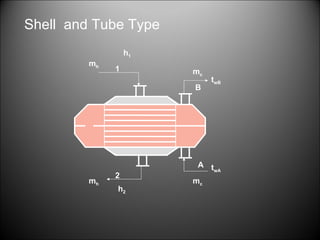
Heat Exchangers Types of  Heat  Exchangers 1. Direct Contact Type: The same fluid at  different states are mixed. 2. Shell and Tube Type: One fluid flows inside the tubes and the other fluid on the outside.  Direct Contact m 1 , h 1 m 2 , h 2 m 3 , h 3
 
Shell  and Tube Type m c m c m h m h 1 2 A B t wA t wB h 1 h 2
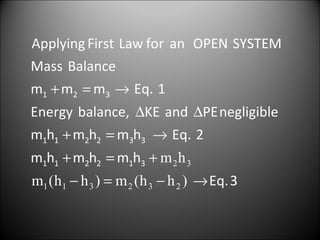
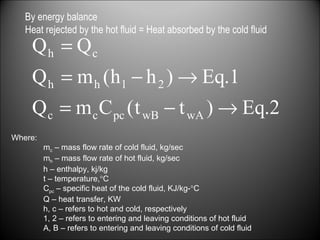
By energy balance Heat rejected by the hot fluid = Heat absorbed by the cold fluid  Where: m c  – mass flow rate of cold fluid, kg/sec m h  – mass flow rate of hot fluid, kg/sec h – enthalpy, kj/kg t – temperature,  C C pc  – specific heat of the cold fluid, KJ/kg-  C Q – heat transfer, KW h, c – refers to hot and cold, respectively 1, 2 – refers to entering and leaving conditions of hot fluid A, B – refers to entering and leaving conditions of cold fluid
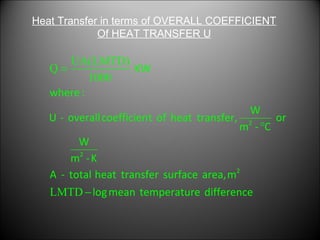
Heat Transfer in terms of OVERALL COEFFICIENT Of HEAT TRANSFER U
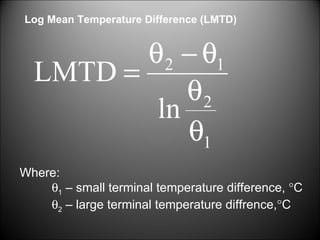
Log Mean Temperature Difference (LMTD) Where:  1  – small terminal temperature difference,   C  2  – large terminal temperature diffrence,  C
 

Heat Transfer

  • 1.
    Heat Transfer Itis that area of mechanical engineering that deals with the different principles and mechanisms involved in transferring heat from one point to another. Heat Transfer
  • 2.
    Modes of HeatTransfer Conduction: Is the transfer of heat from one point to another point within a body or from one body to another body when they are physical contact with each other. Convection: Is the transfer of heat from one point to another within a fluid. a. Natural or Free convection – motion of the fluid is due to the difference in density because of a difference in temperature. b. Force Convection – motion of fluid is accomplished by mechanical means, such as a fan or a blower. 3. Radiation: It the flow of heat from one body to another body separated by a distance due to electromagnetic waves.
  • 3.
    Conduction fire Metalrod t 1 Hotter body t 2 Colder body
  • 4.
    Convection 2  t 2 t 1 1  Fluid surface
  • 5.
  • 6.
    Conduction L 12 k A Q t 1 t 2 Where: L – thickness, meters A – surface area, m 2 k – thermal conductivity, Q – conductive heat flow, Watts
  • 7.
  • 8.
    Conduction through aComposite Plane Wall L 1 L 2 L 3 k 1 k 2 k 3 1 A 2 3 4 Q
  • 9.
    Thermal Circuit Diagram 1 2 R 1 Q 4 3 R 2 R 3
  • 10.
    A furnace isconstructed with 20 cm of firebrick, k = 1.36 W/m-  K, 10 cm of insulating brick, k = 0.26 W/m-  K, and 20 cm of building brick, k = 0.69 W/m-  K. The inside surface temperature is 650  C. The heat loss from the furnace wall is 56 W/m 2 . Determine a. the interface temperature and the outside wall temperature,  C b. the total resistance R t, for 1 m 2 Given: L 1 =0.20 m ; L 2 = 0.10 m ; L 3 = 0.20 m k 1 = 1.46 ; k 2 = 0.26 ; k 3 = 0.69 t 1 = 650  C Q/A = 56 W/m 2 L 1 L 2 L 3 1 2 3 4 Q A 1 2 R 1 Q 4 3 R 2 R 3
  • 11.
    At 1 to2 At 1 to 3 At 1 to 4
  • 12.
    Convection Where: Q– convective heat flow, Watts A – surface area in contact with the fluid, m 2 h – convective coefficient, W/m 2 -  C or W/m 2 -K t 1 , t 2 – temperature,  C Fluid A 1  2  Q t 2 t 1 h
  • 13.
    Conduction from Fluidto Fluid separated by a composite plane wall L 1 L 2 L 3 k 1 k 2 k 3 1 A 2 3 4 Q i  h i t i o  h o , t o
  • 14.
    Thermal Circuit Diagram1 2 R 1 Q 4 3 R 2 R 3 i o R i R o
  • 15.
    Overall Coefficient ofHeat Transfer Where: U – overall coefficient of heat transfer, W/m 2 -  C or W/m 2 -K
  • 16.
    CONDUCTION THROUGH CYLINDRICALCOORDINATES Where: r 1 – inside radius, m r 2 – outside radius, m L – length of pipe, m k – thermal conductivity of material, W/m-  C r 1 r 2 1 2 t 1 t 2 Q k
  • 17.
    For composite cylindricalpipes (Insulated pipe) r 1 r 2 1 2 t 1 t 2 Q k 1 3 r 3 t 3 k 2
  • 18.
    Heat Flow fromfluid to fluid separated by a composite cylindrical wall r 1 r 2 1 2 t 1 t 2 Q k 1 3 r 3 t 3 k 2 i h i t i o h o t o
  • 19.
  • 20.
    Heat Exchangers Typesof Heat Exchangers 1. Direct Contact Type: The same fluid at different states are mixed. 2. Shell and Tube Type: One fluid flows inside the tubes and the other fluid on the outside. Direct Contact m 1 , h 1 m 2 , h 2 m 3 , h 3
  • 21.
  • 22.
    Shell andTube Type m c m c m h m h 1 2 A B t wA t wB h 1 h 2
  • 23.
    By energy balanceHeat rejected by the hot fluid = Heat absorbed by the cold fluid Where: m c – mass flow rate of cold fluid, kg/sec m h – mass flow rate of hot fluid, kg/sec h – enthalpy, kj/kg t – temperature,  C C pc – specific heat of the cold fluid, KJ/kg-  C Q – heat transfer, KW h, c – refers to hot and cold, respectively 1, 2 – refers to entering and leaving conditions of hot fluid A, B – refers to entering and leaving conditions of cold fluid
  • 24.
    Heat Transfer interms of OVERALL COEFFICIENT Of HEAT TRANSFER U
  • 25.
    Log Mean TemperatureDifference (LMTD) Where:  1 – small terminal temperature difference,  C  2 – large terminal temperature diffrence,  C
  • 26.

Editor's Notes

  • #3 Modes of Heat Transfer