Electric Heat Tracing 
Maintenance and Troubleshooting Guide
1 
Introduction 
A complete electric heat tracing system will 
typically include the following components: 
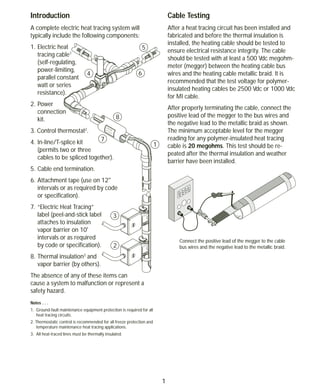
1. Electric heat 
tracing cable1 
(self-regulating, 
power-limiting, 
parallel constant 
watt or series 
resistance). 
2. Power 
connection 
kit. 
3. Control thermostat2. 
4. In-line/T-splice kit 
(permits two or three 
cables to be spliced together). 
5. Cable end termination. 
6. Attachment tape (use on 12" 
intervals or as required by code 
or specification). 
7. “Electric Heat Tracing” 
label (peel-and-stick label 
attaches to insulation 
vapor barrier on 10' 
intervals or as required 
by code or specification). 
8. Thermal insulation3 and 
vapor barrier (by others). 
The absence of any of these items can 
cause a system to malfunction or represent a 
safety hazard. 
Notes . . . 
1. Ground-fault maintenance equipment protection is required for all 
heat tracing circuits. 
2. Thermostatic control is recommended for all freeze protection and 
temperature maintenance heat tracing applications. 
3. All heat-traced lines must be thermally insulated. 
Cable Testing 
After a heat tracing circuit has been installed and 
fabricated and before the thermal insulation is 
installed, the heating cable should be tested to 
ensure electrical resistance integrity. The cable 
should be tested with at least a 500 Vdc megohm-meter 
(megger) between the heating cable bus 
wires and the heating cable metallic braid. It is 
recommended that the test voltage for polymer-insulated 
heating cables be 2500 Vdc or 1000 Vdc 
for MI cable. 
After properly terminating the cable, connect the 
positive lead of the megger to the bus wires and 
the negative lead to the metallic braid as shown. 
The minimum acceptable level for the megger 
reading for any polymer-insulated heat tracing 
cable is 20 megohms. This test should be re-peated 
after the thermal insulation and weather 
barrier have been installed. 
Connect the positive lead of the megger to the cable 
bus wires and the negative lead to the metallic braid. 
5 
4 6 
8 
7 
1 
3 
2
2 
Final Inspection 
The heating circuit can now be tested for proper 
operation. This includes measuring and recording 
the connected voltage, steady-state current draw, 
length and type of cable, ambient temperature and 
temperature of the pipe. (See the Inspection 
Report Form on page 3.) 
The complete system (especially the thermal 
insulation) should now be visually inspected. 
Additional insulation should be applied snugly 
around pipe shoes or other heat sinks and sealed 
from the weather. Expansion joints on high-temperature 
lines should be examined carefully. 
There may be exposed insulation where sections fit 
together or around flanges, valves, pipe hangers or 
connection kits; these locations should be sealed 
to prevent ingress of moisture. 
“Electric Heat Tracing” caution labels should be 
applied to the outer surface of the weather barrier 
at regular intervals of 10 feet (or as required by 
code or specification). The location of splices and 
end terminations should also be marked with splice 
and end termination caution labels. 
Maintenance 
Once the heat tracing system has been installed, 
an ongoing preventive maintenance program 
should be implemented using qualified personnel. 
Support documentation providing general informa-tion 
and an operating history of the specific cir-cuits 
in the system should be maintained. 
The results of the operational testing described 
above form the testing “base line” or normal range. 
Subsequent measurements should be recorded 
periodically and compared to this base-line data to 
help identify potential malfunctions. 
Thermal Insulation 
The value of properly installed and well-maintained 
thermal insulation cannot be overemphasized. 
Without the insulation, the heat loss is generally 
too high to be offset by a conventional heat tracing 
system. 
Before the thermal insulation is installed on a heat-traced 
pipe, the tracing circuit should be tested for 
dielectric insulation resistance. This will ensure that 
the cable has not been damaged while exposed on 
the uninsulated pipe. 
In addition to piping and in-line equipment such as 
pumps and valves, all heat sinks must be properly 
insulated. This includes pipe shoes, hangers, 
flanges and, in many cases, valve bonnets. 
There are many different pipe insulation materials, 
each of which has advantages in particular appli-cations. 
Regardless of the type or thickness of 
insulation used, a protective barrier should be 
installed. This protects the insulation from moisture 
intrusion and physical damage and helps ensure 
the proper performance of the heat tracing system. 
Notes . . . 
• When rigid (noncompressible) materials are used, the inside diameter 
of the insulation is usually oversized to accommodate the heating cable 
on the pipe. 
• Insulating materials are very susceptible to water absorption, which 
dramatically increases the heat loss and should be replaced if the ma-terials 
get wet.
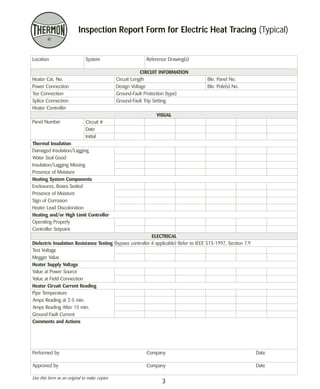
Inspection Report Form for Electric Heat Tracing (Typical) 
Location System Reference Drawing(s) 
CIRCUIT INFORMATION 
Heater Cat. No. Circuit Length Bkr. Panel No. 
Power Connection Design Voltage Bkr. Pole(s) No. 
Tee Connection Ground-Fault Protection (type) 
Splice Connection Ground-Fault Trip Setting 
Heater Controller 
VISUAL 
3 
Panel Number Circuit # 
Date 
Initial 
Thermal Insulation 
Damaged Insulation/Lagging 
Water Seal Good 
Insulation/Lagging Missing 
Presence of Moisture 
Heating System Components 
Enclosures, Boxes Sealed 
Presence of Moisture 
Sign of Corrosion 
Heater Lead Discoloration 
Heating and/or High Limit Controller 
Operating Properly 
Controller Setpoint 
ELECTRICAL 
Dielectric Insulation Resistance Testing (bypass controller if applicable) Refer to IEEE 515-1997, Section 7.9 
Test Voltage 
Megger Value 
Heater Supply Voltage 
Value at Power Source 
Value at Field Connection 
Heater Circuit Current Reading 
Pipe Temperature 
Amps Reading at 2-5 min. 
Amps Reading After 15 min. 
Ground-Fault Current 
Comments and Actions 
Performed by Company Date 
Approved by Company Date 
Use this form as an original to make copies
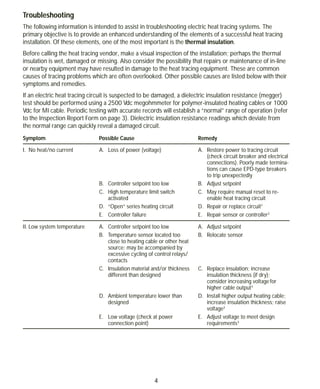
Troubleshooting 
The following information is intended to assist in troubleshooting electric heat tracing systems. The 
primary objective is to provide an enhanced understanding of the elements of a successful heat tracing 
installation. Of these elements, one of the most important is the thermal insulation. 
Before calling the heat tracing vendor, make a visual inspection of the installation; perhaps the thermal 
insulation is wet, damaged or missing. Also consider the possibility that repairs or maintenance of in-line 
or nearby equipment may have resulted in damage to the heat tracing equipment. These are common 
causes of tracing problems which are often overlooked. Other possible causes are listed below with their 
symptoms and remedies. 
If an electric heat tracing circuit is suspected to be damaged, a dielectric insulation resistance (megger) 
test should be performed using a 2500 Vdc megohmmeter for polymer-insulated heating cables or 1000 
Vdc for MI cable. Periodic testing with accurate records will establish a “normal” range of operation (refer 
to the Inspection Report Form on page 3). Dielectric insulation resistance readings which deviate from 
the normal range can quickly reveal a damaged circuit. 
Symptom Possible Cause Remedy 
I. No heat/no current A. Loss of power (voltage) 
B. Controller setpoint too low 
C. High temperature limit switch 
4 
activated 
D. “Open” series heating circuit 
E. Controller failure 
A. Restore power to tracing circuit 
(check circuit breaker and electrical 
connections). Poorly made termina-tions 
can cause EPD-type breakers 
to trip unexpectedly 
B. Adjust setpoint 
C. May require manual reset to re-enable 
heat tracing circuit 
D. Repair or replace circuit1 
E. Repair sensor or controller2 
II. Low system temperature A. Controller setpoint too low 
B. Temperature sensor located too 
close to heating cable or other heat 
source; may be accompanied by 
excessive cycling of control relays/ 
contacts 
C. Insulation material and/or thickness 
different than designed 
D. Ambient temperature lower than 
designed 
E. Low voltage (check at power 
connection point) 
A. Adjust setpoint 
B. Relocate sensor 
C. Replace insulation; increase 
insulation thickness (if dry); 
consider increasing voltage for 
higher cable output3 
D. Install higher output heating cable; 
increase insulation thickness; raise 
voltage3 
E. Adjust voltage to meet design 
requirements3
Symptom Possible Cause Remedy 
Notes . . . 
1. Flexible, plastic-jacketed heating cables may be field-spliced; MI cables usually require replacement. 
2. Mechanical thermostat sensors cannot be repaired or replaced; RTD or thermocouple sensors can be replaced. Some controllers have replaceable 
contacts/relays or may require a manual reset if a “trip-off” condition on the heating circuit was detected. 
3. The operation of most electric heat tracing cables is dramatically affected by changes in the supply voltage. Before making any changes, consult the 
cable manufacturer with information on the alternate voltages available. Otherwise, cable failure and/or an electrical safety hazard may result in 
some situations. 
5 
III. Low temperature in 
sections 
A. Wet, damaged or missing insulation 
B. Parallel heating cable; open element 
or damaged matrix 
C. Heat sinks (valves, pumps, pipe 
supports, etc.) 
D. Significant changes in elevation 
along length of the heat-traced pipe 
A. Repair or replace insulation and 
jacket 
B. Repair or replace; splice kits are 
available from cable manufacturer 
C. Insulate heat sinks or increase 
amount of tracing on heat sinks 
D. Consider dividing heating circuit 
into separate, independently 
controlled segments 
IV. High system temperature A. Controller “on” continuously 
B. Controller failed with contacts 
closed 
C. Sensor located on uninsulated pipe 
or too close to heat sink 
D. Backup heating circuit controller 
“on” continuously 
A. Adjust setpoint or replace sensor2 
B. Replace sensor or controller2 
C. Relocate sensor to an area repre-sentative 
of conditions along entire 
pipe length 
D. Adjust setpoint or replace backup 
controller 
V. Excessive cycling A. Temperature sensor located too 
close to heating cable or other heat 
source; may be accompanied by 
low system temperature 
B. Ambient temperature near con-troller 
setpoint 
C. Connected voltage too high 
D. Heating cable output too high 
(overdesign) 
E. Controller differential too narrow 
A. Relocate sensor 
B. Temporarily alter controller setpoint 
C. Lower voltage 
D. Install lower output heating cable or 
lower voltage 
E. Widen differential or replace con-troller 
to avoid premature contact 
failure 
VI. Temperature variations 
from setpoint along 
pipeline 
A. Unanticipated flow patterns or 
process operating temperatures 
B. Inconsistent cable installation along 
pipeline 
C. Inconsistent cable performance 
A. Redistribute heating circuits to ac-commodate 
existing flow patterns; 
confirm process conditions 
B. Check method of cable installation, 
especially at heat sinks 
C. Compare calculated watts/foot 
[(volts x amps) ÷ length] for the 
measured pipe temperature with 
designed cable output for the same 
temperature; regional damage to 
parallel cable can cause partial 
failure
PN 20745 Form TEP0066-0800 © Thermon Manufacturing Co. Printed in U.S.A. 
THERMON . . . The Heat Tracing Specialists® 
100 Thermon Dr. • PO Box 609 • San Marcos, TX 78667-0609 
Phone: 512-396-5801 • Facsimile: 512-396-3627 • 800-820-HEAT 
www.thermon.com In Canada call 800-563-8461

Electric Heat tracing maintenance and troubleshooting by Thermon

  • 1.
    Electric Heat Tracing Maintenance and Troubleshooting Guide
  • 2.
    1 Introduction Acomplete electric heat tracing system will typically include the following components: 1. Electric heat tracing cable1 (self-regulating, power-limiting, parallel constant watt or series resistance). 2. Power connection kit. 3. Control thermostat2. 4. In-line/T-splice kit (permits two or three cables to be spliced together). 5. Cable end termination. 6. Attachment tape (use on 12" intervals or as required by code or specification). 7. “Electric Heat Tracing” label (peel-and-stick label attaches to insulation vapor barrier on 10' intervals or as required by code or specification). 8. Thermal insulation3 and vapor barrier (by others). The absence of any of these items can cause a system to malfunction or represent a safety hazard. Notes . . . 1. Ground-fault maintenance equipment protection is required for all heat tracing circuits. 2. Thermostatic control is recommended for all freeze protection and temperature maintenance heat tracing applications. 3. All heat-traced lines must be thermally insulated. Cable Testing After a heat tracing circuit has been installed and fabricated and before the thermal insulation is installed, the heating cable should be tested to ensure electrical resistance integrity. The cable should be tested with at least a 500 Vdc megohm-meter (megger) between the heating cable bus wires and the heating cable metallic braid. It is recommended that the test voltage for polymer-insulated heating cables be 2500 Vdc or 1000 Vdc for MI cable. After properly terminating the cable, connect the positive lead of the megger to the bus wires and the negative lead to the metallic braid as shown. The minimum acceptable level for the megger reading for any polymer-insulated heat tracing cable is 20 megohms. This test should be re-peated after the thermal insulation and weather barrier have been installed. Connect the positive lead of the megger to the cable bus wires and the negative lead to the metallic braid. 5 4 6 8 7 1 3 2
  • 3.
    2 Final Inspection The heating circuit can now be tested for proper operation. This includes measuring and recording the connected voltage, steady-state current draw, length and type of cable, ambient temperature and temperature of the pipe. (See the Inspection Report Form on page 3.) The complete system (especially the thermal insulation) should now be visually inspected. Additional insulation should be applied snugly around pipe shoes or other heat sinks and sealed from the weather. Expansion joints on high-temperature lines should be examined carefully. There may be exposed insulation where sections fit together or around flanges, valves, pipe hangers or connection kits; these locations should be sealed to prevent ingress of moisture. “Electric Heat Tracing” caution labels should be applied to the outer surface of the weather barrier at regular intervals of 10 feet (or as required by code or specification). The location of splices and end terminations should also be marked with splice and end termination caution labels. Maintenance Once the heat tracing system has been installed, an ongoing preventive maintenance program should be implemented using qualified personnel. Support documentation providing general informa-tion and an operating history of the specific cir-cuits in the system should be maintained. The results of the operational testing described above form the testing “base line” or normal range. Subsequent measurements should be recorded periodically and compared to this base-line data to help identify potential malfunctions. Thermal Insulation The value of properly installed and well-maintained thermal insulation cannot be overemphasized. Without the insulation, the heat loss is generally too high to be offset by a conventional heat tracing system. Before the thermal insulation is installed on a heat-traced pipe, the tracing circuit should be tested for dielectric insulation resistance. This will ensure that the cable has not been damaged while exposed on the uninsulated pipe. In addition to piping and in-line equipment such as pumps and valves, all heat sinks must be properly insulated. This includes pipe shoes, hangers, flanges and, in many cases, valve bonnets. There are many different pipe insulation materials, each of which has advantages in particular appli-cations. Regardless of the type or thickness of insulation used, a protective barrier should be installed. This protects the insulation from moisture intrusion and physical damage and helps ensure the proper performance of the heat tracing system. Notes . . . • When rigid (noncompressible) materials are used, the inside diameter of the insulation is usually oversized to accommodate the heating cable on the pipe. • Insulating materials are very susceptible to water absorption, which dramatically increases the heat loss and should be replaced if the ma-terials get wet.
  • 4.
    Inspection Report Formfor Electric Heat Tracing (Typical) Location System Reference Drawing(s) CIRCUIT INFORMATION Heater Cat. No. Circuit Length Bkr. Panel No. Power Connection Design Voltage Bkr. Pole(s) No. Tee Connection Ground-Fault Protection (type) Splice Connection Ground-Fault Trip Setting Heater Controller VISUAL 3 Panel Number Circuit # Date Initial Thermal Insulation Damaged Insulation/Lagging Water Seal Good Insulation/Lagging Missing Presence of Moisture Heating System Components Enclosures, Boxes Sealed Presence of Moisture Sign of Corrosion Heater Lead Discoloration Heating and/or High Limit Controller Operating Properly Controller Setpoint ELECTRICAL Dielectric Insulation Resistance Testing (bypass controller if applicable) Refer to IEEE 515-1997, Section 7.9 Test Voltage Megger Value Heater Supply Voltage Value at Power Source Value at Field Connection Heater Circuit Current Reading Pipe Temperature Amps Reading at 2-5 min. Amps Reading After 15 min. Ground-Fault Current Comments and Actions Performed by Company Date Approved by Company Date Use this form as an original to make copies
  • 5.
    Troubleshooting The followinginformation is intended to assist in troubleshooting electric heat tracing systems. The primary objective is to provide an enhanced understanding of the elements of a successful heat tracing installation. Of these elements, one of the most important is the thermal insulation. Before calling the heat tracing vendor, make a visual inspection of the installation; perhaps the thermal insulation is wet, damaged or missing. Also consider the possibility that repairs or maintenance of in-line or nearby equipment may have resulted in damage to the heat tracing equipment. These are common causes of tracing problems which are often overlooked. Other possible causes are listed below with their symptoms and remedies. If an electric heat tracing circuit is suspected to be damaged, a dielectric insulation resistance (megger) test should be performed using a 2500 Vdc megohmmeter for polymer-insulated heating cables or 1000 Vdc for MI cable. Periodic testing with accurate records will establish a “normal” range of operation (refer to the Inspection Report Form on page 3). Dielectric insulation resistance readings which deviate from the normal range can quickly reveal a damaged circuit. Symptom Possible Cause Remedy I. No heat/no current A. Loss of power (voltage) B. Controller setpoint too low C. High temperature limit switch 4 activated D. “Open” series heating circuit E. Controller failure A. Restore power to tracing circuit (check circuit breaker and electrical connections). Poorly made termina-tions can cause EPD-type breakers to trip unexpectedly B. Adjust setpoint C. May require manual reset to re-enable heat tracing circuit D. Repair or replace circuit1 E. Repair sensor or controller2 II. Low system temperature A. Controller setpoint too low B. Temperature sensor located too close to heating cable or other heat source; may be accompanied by excessive cycling of control relays/ contacts C. Insulation material and/or thickness different than designed D. Ambient temperature lower than designed E. Low voltage (check at power connection point) A. Adjust setpoint B. Relocate sensor C. Replace insulation; increase insulation thickness (if dry); consider increasing voltage for higher cable output3 D. Install higher output heating cable; increase insulation thickness; raise voltage3 E. Adjust voltage to meet design requirements3
  • 6.
    Symptom Possible CauseRemedy Notes . . . 1. Flexible, plastic-jacketed heating cables may be field-spliced; MI cables usually require replacement. 2. Mechanical thermostat sensors cannot be repaired or replaced; RTD or thermocouple sensors can be replaced. Some controllers have replaceable contacts/relays or may require a manual reset if a “trip-off” condition on the heating circuit was detected. 3. The operation of most electric heat tracing cables is dramatically affected by changes in the supply voltage. Before making any changes, consult the cable manufacturer with information on the alternate voltages available. Otherwise, cable failure and/or an electrical safety hazard may result in some situations. 5 III. Low temperature in sections A. Wet, damaged or missing insulation B. Parallel heating cable; open element or damaged matrix C. Heat sinks (valves, pumps, pipe supports, etc.) D. Significant changes in elevation along length of the heat-traced pipe A. Repair or replace insulation and jacket B. Repair or replace; splice kits are available from cable manufacturer C. Insulate heat sinks or increase amount of tracing on heat sinks D. Consider dividing heating circuit into separate, independently controlled segments IV. High system temperature A. Controller “on” continuously B. Controller failed with contacts closed C. Sensor located on uninsulated pipe or too close to heat sink D. Backup heating circuit controller “on” continuously A. Adjust setpoint or replace sensor2 B. Replace sensor or controller2 C. Relocate sensor to an area repre-sentative of conditions along entire pipe length D. Adjust setpoint or replace backup controller V. Excessive cycling A. Temperature sensor located too close to heating cable or other heat source; may be accompanied by low system temperature B. Ambient temperature near con-troller setpoint C. Connected voltage too high D. Heating cable output too high (overdesign) E. Controller differential too narrow A. Relocate sensor B. Temporarily alter controller setpoint C. Lower voltage D. Install lower output heating cable or lower voltage E. Widen differential or replace con-troller to avoid premature contact failure VI. Temperature variations from setpoint along pipeline A. Unanticipated flow patterns or process operating temperatures B. Inconsistent cable installation along pipeline C. Inconsistent cable performance A. Redistribute heating circuits to ac-commodate existing flow patterns; confirm process conditions B. Check method of cable installation, especially at heat sinks C. Compare calculated watts/foot [(volts x amps) ÷ length] for the measured pipe temperature with designed cable output for the same temperature; regional damage to parallel cable can cause partial failure
  • 7.
    PN 20745 FormTEP0066-0800 © Thermon Manufacturing Co. Printed in U.S.A. THERMON . . . The Heat Tracing Specialists® 100 Thermon Dr. • PO Box 609 • San Marcos, TX 78667-0609 Phone: 512-396-5801 • Facsimile: 512-396-3627 • 800-820-HEAT www.thermon.com In Canada call 800-563-8461