ERECTION
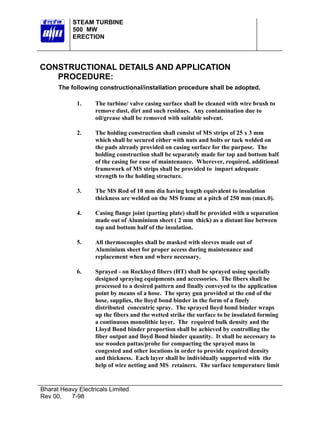
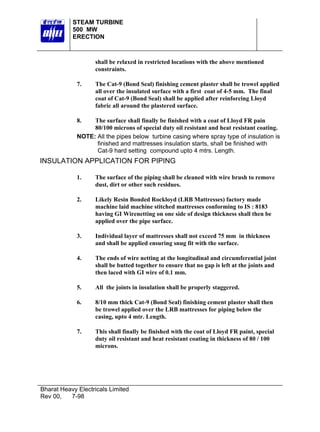
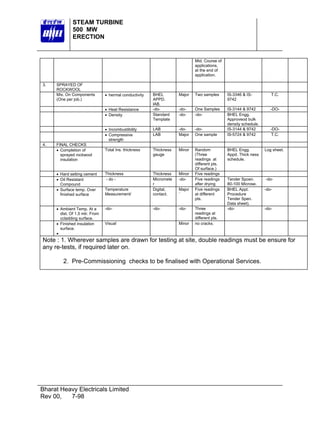
                   MANUAL

                              STEAM TURBINE
                                  500 MW
                               (KWU DESIGN)


                    DOCUMENT NO. TS-T1-08


       Bharat Heavy Electricals Limited
                          POWER SECTOR
                      TECHNICAL SERVICES (HQ)
                                   NOIDA


Bharat Heavy Electricals Limited                T1-08-0801G
Rev 00, 7-98                                      Page No. 1
FOREWORD


I am glad that Power Sector - Technical Services ( Head Quarters),
Noida has brought out this erection manual of 500 MW steam
turbine (KWU design) being produced by BHEL. This manual lays
emphasis on site optimisation techniques which aims at uniform
erection practices, improvement in quality, reduction in time cycle
and saving in cost.


I am sure, this manual will form the basis for site erection activities
so that the organisation can derive      full benefit out of this. It is
needless to emphasize that upgrading of technology is a continuous
process and we have to review our methods of working and make
suitable changes, wherever required.


                                                      (K P Mathur)
New Delhi                                          Executive Director
                                                     (PEM & TS)


Bharat Heavy Electricals Limited                            T1-08-0801G
Rev 00, 7-98                                                  Page No. 2
PREFACE
The Erection Manual for 500 MW Steam Turbine (KWU design)
manufactured by BHEL      for Thermal Power Stations has been
prepared by a team of BHEL engineers having long experience in
Erection & Commissioning, Design, Quality control of steam turbines.
This dedicated team has been drawn from regional erection group,
designed department of manufacturing units, PS-Q & TS-HQ,
Noida.

The manual carries general description of steam turbine, erection
procedure, special instruction, general instructions, and various other
technical instructions with an intention to establish an uniform
approach for erection of steam turbine.

The Erection Manual provides broad based guide line for erection of
steam turbine.     Product standard, technical circulars & BHEL
drawings for the specific project will precede the instructions and
guidelines furnished in this manual. Project specific document will be
generated by region concerned. This document is generated as a
standard Erection Manual for 500 MW fixed pedestal type steam
turbine with spring loaded foundation.

The work done by TASK FORCE is commendable. Feed-back and
suggestions are welcome for the improvement of this Erection
Manual to bringing down the cycle time with quality.

BHEL reserves the right to suggest alternative            procedure    if
necessity arises at site due to local site conditions .


                                                    (BABOO RAM)
NOIDA                                     GENERAL MANAGER(TS&Q)

SNO   DESCRIPTION                                INSTRUCTION NO


Bharat Heavy Electricals Limited                             T1-08-0801G
Rev 00, 7-98                                                   Page No. 3
1     TECHNICAL DATA                         T 1- 08-0101G

2     INSTRUCTION FOR HANDLING AND           T 1-08-0202G
      STORAGE OF TURBINE
3     ERECTION SEQUENCE                      T 1-08-0303G

4     ERECTION PROCEDURE                     T 1-08-0404G

5     GROUTING PROCEDURE                     T 1- 08-0505G

6     ASSEMBLY OF IP MODULE AT SITE          T 1-08-0606G

7     SEALING AND ANTISEIZING COMPOUNDS      T 1-08-0707G

8     CRITICAL ACTIVITIES                    T 1-08-0808G

9     SPRING LOADED FOUNDATION               T 1- 08-0909G

10    ERECTION OF PIPING                     T 1-08-1010G

11    SPECIFICATION FOR GAS HEATING DEVICE   T 1-08-1111G

12    SPECIFICATION FOR BREECH NUT HEATING   T 1-08-1212G
      DEVICE
13    SPECIFICATION FOR THERMAL INSULATION   T1-08-1313 G


Bharat Heavy Electricals Limited                             T1-08-0801G
Rev 00, 7-98                                                   Page No. 4
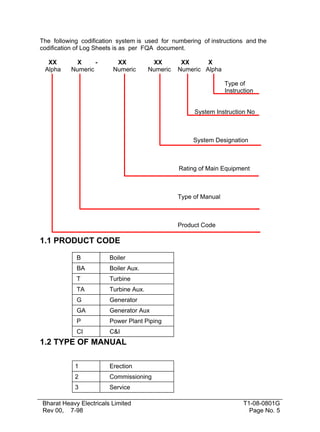
The following codification system is used for numbering of instructions and the
codification of Log Sheets is as per FQA document.

  XX        X     -       XX            XX        XX      X
 Alpha    Numeric        Numeric       Numeric   Numeric Alpha

                                                                  Type of
                                                                  Instruction


                                                      System Instruction No


                                                      System Designation


                                                 Rating of Main Equipment


                                                 Type of Manual


                                                 Product Code

1.1 PRODUCT CODE

            B           Boiler
            BA          Boiler Aux.
            T           Turbine
            TA          Turbine Aux.
            G           Generator
            GA          Generator Aux
            P           Power Plant Piping
            CI          C&I
1.2 TYPE OF MANUAL

            1           Erection
            2           Commissioning
            3           Service

Bharat Heavy Electricals Limited                                         T1-08-0801G
Rev 00, 7-98                                                               Page No. 5
1.3 RATING OF MAIN EQUIPMENT

           01        200/210 MW
           02        120 MW
           03        110 MW
           04         60 MW
           05          30 MW
           06        100 MW
           07        235 MW
           08        500 MW             KWU Design
           09        210 MW             KWU Design
           10        120 MW             KWU Design
           11         60 MW             KWU Design
           12          70 MW            KWU Design
           13        Industrial Units
           14        210 MW             Tower Type Concrete Pylem
           15        210 MW             Tower Type Steel Structure
           16        500 MW             Tower Type Once through
           17        250 MW
           18        CCP


Bharat Heavy Electricals Limited                              T1-08-0801G
Rev 00, 7-98                                                    Page No. 6
1.4 SYSTEM DESIGNATION

            SNO      DESCRIPTION
             1.      TECHNICAL DATA
             2.      INSTRUCTION FOR HANDLING AND STORAGE
                     OF TURBINE
             3.      ERECTION SEQUENCE
             4.      ERECTION PROCEDURE
             5.      GROUTING PROCEDURE
             6.      ASSEMBLY OF IP MODULE AT SITE
             7.      SEALING AND ANTISEIZING COMPOUNDS
             8.      CRITICAL ACTIVITIES
             9.      SPRING LOADED FOUNDATION
             10.     ERECTION OF PIPING
             11.     SPECIFICATION FOR GAS HEATING DEVICE
             12.     SPECIFICATION FOR BREECH NUT HEATING
                     DEVICE
             13.     SPECIFICATION FOR THERMAL INSULATION


1.5 TYPE OF INSTRUCTION
            G           General
            T           Technical
            L           Log Sheet
            C           Check List


Bharat Heavy Electricals Limited                            T1-08-0801G
Rev 00, 7-98                                                  Page No. 7
LOAD
RATED                                                                  500 MW

MAX. UNDER VALVE WIDE OPEN (VWO) CONDITION                               524.2


CONSTRUCTION
THREE CYLINDER REHEAT CONDENSING TURBINE                               500 MW

SINGLE FLOW HP TURBINE WITH 17 REACTION STAGES            TYPE       H30-100-2

DOUBLE FLOW IP TURBINE WITH 12 REACTION STAGES PER        TYPE         M30-63
FLOW

DOUBLE FLOW LP TURBINE WITH 6 REACTION STAGES PER         TYPE        N30-2X10
FLOW

2 MAIN STOP AND CONTROL VALVES                            TYPE         EV320-1

2 REHEAT STOP AND CONTROL VALVES                          TYPE           IV560

1 SWING CHECK VALVE IN COLD REHEAT LINE                                 DN-800
                                                          MAKE   BHEL,TIRUCHY

2 BYPASS STOP AND CONTROL VALVES                                       DN-320


EXTRACTION SWING CHECK VALVES :

EXTRACTION-1     : NO VALVE                                                   -

EXTRACTION-2     : 1 SWING CHECK VALVE WITH ACTUATOR                    DN-800
                                                          MAKE   BHEL,TIRUCHY

EXTRACTION-3     : 1 SWING CHECK VALVE WITH ACTUATOR                    DN-500
                   &                                      MAKE   BHEL,TIRUCHY
                   1 SWING CHECK VALVE WITHOUT
                   ACTUATOR

EXTRACTION-4.1   : 2 SWING CHECK VALVE WITH ACTUATOR                    DN-500
                                                          MAKE   BHEL,TIRUCHY

EXTRACTION-4.2   : 2 SWING CHECK VALVE WITH ACTUATOR             DN-500
                                                          MAKE   BHEL,TIRUCHY

EXTRACTION-5     : 1 SWING CHECK VALVE WITH ACTUATOR                    DN-400
                   &                                      MAKE   BHEL,TIRUCHY
                   1 SWING CHECK VALVE WITHOUT ACTUATOR

EXTRACTION-6     : NO VALVE

SPEED
RATED SPEED                                                             50.0 /S


Bharat Heavy Electricals Limited                                   T1-08-0801G
Rev 00, 7-98                                                         Page No. 8
SPEED LIMITATION IN LOAD & STATION AUX. LOAD                                524.2
                                              OPERATION          :                     51.5 /S
                           MAX. SPEED, NO TIME LIMITATION        :                     47.5 /S
                           MIN. SPEED, NO TIME LIMITATION

PERMISSIBLE FOR A MAXIMUM OF 2 HRS. DURING THE LIFE OF           :                  47.5 /S
LP BLADING                               SPEED                   :            51.5 TO 60 /S
BELOW
                                         SPEED
ABOVE

SPEED EXECUTION RANGE AT OPERATION WITHOUT LOAD*                 :           6.7 TO 47.5 /S

STANDARD OVER SPEED TRIP SETTING                                 :                MAX. 55.5 /s


 * THIS SPEED RANGE SHOULD BE PASSED THROUGH IN ONE
   SMOOTH OPERATION TO AVOID ENDANGERING THE
   BLADES DUE TO RESONANCE

STEAM PRESSURES
                                       RATED*       LONG TIME        SHORT TIME
                                                    OPERATION        OPERATION

INITIAL STEAM                           166.7           166.7              20.7          BAR

BEFORE 1st HP DRUM STAGE                154.4           163.4          169.9             BAR

HP CYLINDER EXHAUST                      44.9           52.0           57.4**            BAR

IP CYLINDER STOP VALVE INLET             40.3           46.7           55.2**            BAR

EXTRACTION 6                             44.9           52.0               57.4          BAR

EXTRACTION 5                             17.5           22.2               22.2          BAR

EXTRACTION 4                              7.2            8.7               8.7           BAR

EXTRACTION 3                             2.58            3.2               3.2           BAR

EXTRACTION 2                            1.329           1.66               1.66          BAR

EXTRACTION 1                            0.257           0.41               0.41          BAR

LP CYLINDER EXHAUST                     0.1013           0.3               0.3           BAR


* THESE VALUES CORRESPOND TO 500 MW LOAD WITH 3% MAKE-UP AND 0.1013 BAR BACK
 PRESSURE WITH ALL HEATERS IN SERVICE AND RATED STEAM CONDITIONS.

** THE SAFETY VALVES MUST BE SET SO THAT THESE SHORT TIME VALUES ARE NOT EXCEEDED.


LONG TIME OPERATION : UPPER LIMIT VALUE, PERMISSIBLE WITHOUT TIME LIMIT.

SHORT TIME OPERATION : PERMISSIBLE MOMENTARY VALUE. THE AGGREGATE DURATION OF
                      SUCH SWINGS MUST NOT EXCEED 12 HOURS IN ANY ONE YEAR.

ALL PRESSURES ARE ABSOLUTE PRESSURES


 Bharat Heavy Electricals Limited                                                 T1-08-0801G
 Rev 00, 7-98                                                                       Page No. 9
LOW VACUUM TRIP, STANDARD SETTING
HYDRAULIC LOW VACUUM TRIP                             :         0.3   BAR

ELECTRICAL LOW VACUUM TRIP                            :         0.3   BAR

HYDRAULIC LOW VACUUM TRIP BYPASS OPERATION            :         0.6   BAR


SEAL STEAM SUPPLY SYSTEM
PRESSURE IN SEAL STEAM HEADER (ABOVE ATMOSPHERIC)     :         35    MBAR


AXIAL SHIFT
                ALARM                                TRIP

               * 0.5 mm                             * 1 mm


* DIRECTION OF ROTATION
  ANTI CLOCK WISE WHEN VIEWED FROM FRONT PEDESTAL TOWARDS THE
  GENERATOR


Bharat Heavy Electricals Limited                                T1-08-0801G
Rev 00, 7-98                                                     Page No. 10
STEAM TEMPERATURES
                                        RATED    LONG TIME     400 h     80 h PER
                                         VAL.      VALUE       PER        ANNUM
                                       ANNUAL     (WITHIN     ANNUM      MAX. 15
                                        MEAN      ANNUAL                  MIN IN
                                        VALUE      MEAN                 INDIVIDUA
                                                    VAL.)                 L CASE
                                                                                    O
INITIAL STEAM                           536.0      546.O       552.O      566.0         C
                                                                                    O
IP CYLINDER STOP VALVE INLET            536.0      546.3       552.0      566.0         C


                                       RATED      LONG       80 h PER      IN
                                       VALVE *    TIME        ANNUM     SPECIAL
                                                 OPERATI     MAX. 15     CASES
                                                   ON         MIN IN     AT NO
                                                             INDIVIDU    LOAD
                                                             AL CASE
                                                                                    O
HP CYLINDER EXHAUST                     340.0      360.0      440.0      500.0**    C
                                                                                    O
EXTRACTION 6                            340.0      360.0      440.0      500.0**    C
                                                                                    O
EXTRACTION 5                            413.9      421.9      459.9                 C
                                                                                    O
EXTRACTION 4                            292.1      304.1      346.4                 C
                                                                                    O
EXTRACTION 3                            187.3      195.3      242.3                 C
                                                                                    O
EXTRACTION 2                            128.3      139.3      184.3                 C
                                                                                    O
EXTRACTION 1                            66.5       86.5       136.5                 C
                                                                                    O
LP CYLINDER EXHAUST                     46.1       70.0        70.0                 C


       LONG TIME OPERATION : UPPER LIMIT VALUE, PERMISSIBLE WITHOUT TIME
       LIMIT.

*      THESE VALUES CORRESPOND TO 500 MW LOAD WITH 3% MAKE-UP AND 0.1013 BAR
       BACK PRESSURE WITH ALL HEATERS IN SERVICE AND RATED STEAM
       CONDITIONS.

**    ONLY VALID FOR THE NO LOAD PERIOD WITH HIGH REHEAT PRESSURE AFTER
      TRIP-OUT FROM FULL LOAD OPERATION. FOR INDIVIDUAL CASE APPROX. 15
      MINUTES

       THE TURBINE IS IMMEDIATELY RE-LOADED OR THE BOILER IMMEDIATELY
       REDUCED TO MINIMUM LOAD IF NO LOAD OPERATION IS MAINTAINED.


    Bharat Heavy Electricals Limited                                        T1-08-0801G
    Rev 00, 7-98                                                             Page No. 11
CASING TEMPERATURES
WALL TEMPERATURES                                          ALARM         MACHINE MUST BE
                                                             AT           SHUT DOWN AT
                                                                                                     O
HP TURBINE CASING EXHAUST                                       480               500                  C
                                                                                                     O
OUTER CASING OF LP CYLINDER                                     90                110                  C

PERMISSIBLE DIFFERENTIAL TEMP. BETWEEN PARALLEL STEAM SUPPLY LINES :
                                                                                                 O
                                                            •     NO TIME LIMITATION         : 17 C
                                                                                                 O
                                                            •     SHORT TIME PERIOD (15 MIN.) : 28 C

IN THE HOTTEST LINE THE LIMITATIONS INDICATED FOR INITIAL STEAM & REHEAT TEMP. MUST NOT BE EXCEEDED.
                                                     O
SPRAY WATER TO LP TURBINE MUST BE SWITCHED ON AT 90 C.

TEMPERATURES DIFFERENCE                                    ALARM         MACHINE MUST BE
                                                             AT           SHUT DOWN AT
                                                                                                     O
DIFFERENCE BETWEEN UPPER & LOWER                             * 90                * 100                 C
CASING HALVES HP TURBINE. MIDDLE
                                                                                                     O
LP TURBINE. FRONT                                            * 30                 * 45                 C
                                                                                                     O
LP TURBINE. REAR                                             * 30                 * 45                 C

FEEDWATER HEATER OUT OF SERVICE
OPERATION WITH FEEDWATER HEATER OUT OF SERVICE                           MAIN STEAM           LOAD
                                                                         FLOW Kg/s             MW

EXTRACTION A6 = 0                                                              395             500

EXTRACTION A5 = 0                                                              421             500

EXTRACTION A3 = 0                                                              423             500

EXTRACTION A2 = 0                                                              425             500

EXTRACTION A1 = 0                                                              423             500

EXTRACTION A6, A5 = 0                                                          400             525

OUTPUT LIMIT DURING TESTING WITH AUTOMATIC TURBINE TESTER
TESTING OF MAIN STEAM STOP & CONTROL VALVE                                     400             MW

TESTING OF HRH STEAM STOP & CONTROL VALVE                                   200 - 500          MW

MOTORING :
MOTORING IS THE CONDITION IN WHICH THE TURBINE IS DRIVEN BY THE GENERATOR AT
RATED SPEED WITH THE STOP & CONTROL VALVES CLOSED. IN THIS OPERATING MODE,
CERTAIN TURBINE COMPONENTS ARE HEATED UP BY WINDAGE POWER IN THE BLADING.
TO PREVENT HEAT-UP BEYOND PERMISSIBLE TEMPERATURES, MOTORING MUST NOT BE
ALLOWED TO CONTINUE FOR LONGER THAN ONE MINUTE. IF THE CONDENSER LOW
VACUUM LIMIT OF 0.3 BAR IS EXCEEDED, MOTORING MUST NOT BE ALLOWED TO CONTINUE
FOR MORE THAN 4 SECONDS.


 Bharat Heavy Electricals Limited                                                        T1-08-0801G
 Rev 00, 7-98                                                                             Page No. 12
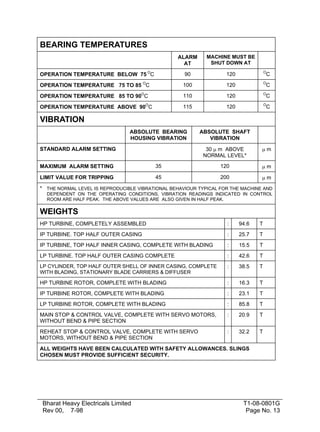
BEARING TEMPERATURES
                                                 ALARM      MACHINE MUST BE
                                                   AT        SHUT DOWN AT
                                                                                    O
OPERATION TEMPERATURE BELOW 75 OC                   90             120              C
                                                                                    O
OPERATION TEMPERATURE 75 TO 85 OC                  100             120              C
                                                                                    O
OPERATION TEMPERATURE 85 TO 90OC                   110             120              C
                                                                                    O
OPERATION TEMPERATURE ABOVE 90OC                   115             120              C

VIBRATION
                                ABSOLUTE BEARING         ABSOLUTE SHAFT
                                HOUSING VIBRATION           VIBRATION

STANDARD ALARM SETTING                                     30 µ m ABOVE         µm
                                                          NORMAL LEVEL*

MAXIMUM ALARM SETTING                    35                      120            µm

LIMIT VALUE FOR TRIPPING                 45                      200            µm
* THE NORMAL LEVEL IS REPRODUCIBLE VIBRATIONAL BEHAVIOUR TYPICAL FOR THE MACHINE AND
  DEPENDENT ON THE OPERATING CONDITIONS, VIBRATION READINGS INDICATED IN CONTROL
  ROOM ARE HALF PEAK. THE ABOVE VALUES ARE ALSO GIVEN IN HALF PEAK.

WEIGHTS
HP TURBINE, COMPLETELY ASSEMBLED                                   :     94.6   T
IP TURBINE. TOP HALF OUTER CASING                                  :     25.7   T
IP TURBINE, TOP HALF INNER CASING, COMPLETE WITH BLADING           :     15.5   T
LP TURBINE. TOP HALF OUTER CASING COMPLETE                         :     42.6   T
LP CYLINDER, TOP HALF OUTER SHELL OF INNER CASING, COMPLETE        :     38.5   T
WITH BLADING, STATIONARY BLADE CARRIERS & DIFFUSER

HP TURBINE ROTOR, COMPLETE WITH BLADING                            :     16.3   T
IP TURBINE ROTOR, COMPLETE WITH BLADING                            :     23.1   T
LP TURBINE ROTOR, COMPLETE WITH BLADING                            :     85.8   T
MAIN STOP & CONTROL VALVE, COMPLETE WITH SERVO MOTORS,             :     20.9   T
WITHOUT BEND & PIPE SECTION
REHEAT STOP & CONTROL VALVE, COMPLETE WITH SERVO                   :     32.2   T
MOTORS, WITHOUT BEND & PIPE SECTION

ALL WEIGHTS HAVE BEEN CALCULATED WITH SAFETY ALLOWANCES. SLINGS
CHOSEN MUST PROVIDE SUFFICIENT SECURITY.


Bharat Heavy Electricals Limited                                          T1-08-0801G
Rev 00, 7-98                                                               Page No. 13
OIL SUPPLY
MAIN OIL TANK, RATED CAPACITY                           :   25/40      Cu . M
Ist OIL FILLING (ESTIMATED)                             :   47.5       Cu . M
FLUSHING OIL QUANTITY (ESTIMATED)                       :   28.5       Cu . M
OIL COOLER FOR OPERATION, NUMBER                        :    1         NO.
OIL COOLER FOR RESERVE, NUMBER                          :     I        NO.
OIL TEMP. AT COOLER OUTLET, UNIT IN OPERATION
                                            MIN.        :    38
                                                                         O
                                            NORMAL      :    45           C
                                            MAX.        :    47

OIL TEMP. AT COOLER OUTLET, UNIT SHUT DOWN
                                                                         O
                                               MAX.     :    75           C
TEMP. RISE OF OIL IN BEARINGS
                                                                         O
                                               NORMAL   :    20           C
                                               MAX.     :    25

ESTIMATED OIL REQUIREMENTS OF BEARINGS :
BEARING 1(HP TURBINE, FRONT PEDESTAL)                   :    0.8       dm3/S
BEARING 2                                               :   15.4       dm3/S
BEARING 3                                               :    4.1       dm3/S
BEARING 4                                               :    8.6       dm3/S
GENERATOR FRONT BEARING                                 :   7.92       dm3/S
GENERATOR REAR BEARING                                  :   7.92       dm3/S
EXCITER BEARING                                         :   0.70       dm3/S
1 DUPLEX OIL FILTER FOR BEARING OIL (FULL FLOW)         :   200         mm
DUPLEX OIL FILTER . TYPE - 2.62.9. SIZE 355/750. MAKE   :   BOLL & KIRCH
FILTRATION PARTICLE SIZE OF DUPLEX FILTER ELEMENT       :    37         µm
FILTRATION PARTICLE SIZE OF MAIN OIL TANK FILTER        :   250         µm
ELEMENT
SAFETY VALVE IN JACKING OIL SYSTEM, SETTING             :   200         BAR
MAX.
PRESSURE LIMITING VALVE IN JACKING OIL SYSTEM,          :   100         BAR
SETTING
1 DUPLEX OIL FILTER FOR JACKING OIL                     :    25         mm
FILTRATION PARTICLE SIZE OF JACKING OIL FILTER          :    37         µm


Bharat Heavy Electricals Limited                                    T1-08-0801G
Rev 00, 7-98                                                         Page No. 14
OIL PUMPS
               MAIN OIL     AUXILIARY        DC         JACKING
                PUMP        OIL PUMP     EMERGENCY      OIL PUMP
                                          OIL PUMP

QUANTITY           1                2        1       AC : 2          DC : 1

MAKER            BHEL              KSB      KSB         TUSHAKO

TYPE          97.22 dm3/S    ETA-150-     ETA-100-        SDF80
                              50VVL        33VVL

CAPACITY          75           89.25        30                1.53            dm3/s
(RATED)

DISCHARGE         8.6              6.2      2.3               178             BAR
PRESSURE
(GAUGE)

SPEED             50           24.75        24.3          49.42                /s

DRIVE          TURBINE      AC MOTOR     DC MOTOR     AC          DC
                                                     MOTOR       MOTOR


Bharat Heavy Electricals Limited                                         T1-08-0801G
Rev 00, 7-98                                                              Page No. 15
CONTROL FLUID SUPPLY
CONTROL FLUID TANK, RATED CAPACITY                           :     10/16      Cu . M

Ist FLUID FILLING (ESTIMATED)                                :       15       Cu . M

FLUSHING FLUID QUANTITY (ESTIMATED)                          :       10       Cu . M

CONTROL FLUID COOLER FOR OPERATION, NUMBER                   :       1        NO.

CONTROL FLUID COOLER FOR RESERVE, NUMBER                     :       I        NO.

CONTROL FLUID MAINTENANCE EQUIPMENT :
GEAR PUMP
                                        MANUFACTURER         :        STEIMEL
                                        TYPE                 :       BGK 2-24R

FLUID FLOW                                                   :      0.28      dm3/S

GAUGE PRESSURE                                               :      3.06          at

SPEED                                                        :       25           S-1

MOTOR POWER                                                  :      0.75          KW

2 EARTH FILTERS
                                        MANUFACTURER         :        ROTRING
                                        TYPE                 :        PYG5-350

EARTH FILLING MESH                                           :      140           Kg

1 FINE MESH FILTER
                                        MANUFACTURER         :       ROTRING
                                        TYPE                 :     S-1800-14-TUY

FILTRATION PARTICLE SIZE                                     :      3-5           µm

FILTER MATERIAL                                              :           COTTON


CONTROL FLUID SUPPLY SYSTEM

A FIRE RESISTANT FLUID IS USED FOR THE CONTROL SYSTEM


SCOPE
        The document covers all steam turbine components and provides the handling,
        inspection and storage instructions for large steam turbine components at site.
        A strict adherence to these instructions is necessary to avoid damages during
        handling and storage at site.
Bharat Heavy Electricals Limited                                           T1-08-0801G
Rev 00, 7-98                                                                Page No. 16
HANDLING OF EQUIPMENT :
In any kind of rigging work it is necessary to strictly observe the safety precautions,
      since even the slightest negligence and non observance of the rules may result
      in accidents, which may cause damage to equipment or injury to men.
The site for the rigging work involving lifting and conveying of loads should be well
     lighted. The loads must not be lifted unless the crane operator can see clearly
     the signals given by the rigger.
The positions where the slings are to be put, are marked on the packages and on
      the drawings. While lifting/handling these packages/equipment, the slings
      should only be put at the proper places.
The slings of the proper sizes and lengths should only be used for handling the
      equipment/packages. The angle between the two arms of the sling at the
      crane hook should be small (depending upon the dia of the sling) so as to have
      proper loading of the sling.
The turbine rotors and cylinder covers (in assembled condition are lifted by the
     use of special lifting devices supplied by BHEL. The use of these lifting
     devices facilitates correct slinging and maintain horizontal position of the
     components. These devices, after use, should be properly stored and
     conserved so as to ensure that they do not get damaged during storage.
     Before using them, they should be thoroughly inspected.
The work related to handling of the loads (packages or equipment) by crane or by
     other hoisting mechanism should be entrusted to trained riggers only. If
     the rigger/operator is not sure of the weight of the item/package (load) to
     be handled, he must ask for the required information before handling the
     equipment.


The rigger and the crane operator should see that the hook and the ropes of the
      crane occupy vertical position, before hoisting the load. Dragging of the load
      by slanting ropes is not allowed. The center of gravity of the load should be
      aligned with the vertical axis of the crane hook.
The eye bolts, 'D' shackles, turn buckles, and wire ropes of suitable sizes should
     only be used for handling of the equipment. Before using, they should be
     thoroughly inspected to their full threads, so as to avoid any chance of
     slipping then the load comes on them.
Before giving a signal to lift the load, the rigger must check and ensure that there are
      no loose parts or tools on the load, which might fall during lifting. Then the load
      must be lifted 100 or 200 mm high for checking the uniformity             of sling
      tensioning and reliability of lashing. If it is necessary to rearrange the sling
      lengths, the load must be lowered and then the slings rearranged.
Before horizontal conveyance of the load the rigger must see that the load has been
      lifted to a height at least 0.5 M above the tallest object, on the path of the load.

 Bharat Heavy Electricals Limited                                           T1-08-0801G
 Rev 00, 7-98                                                                Page No. 17
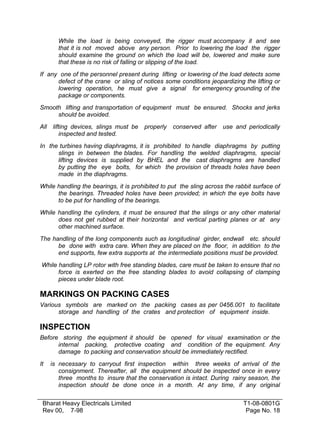
While the load is being conveyed, the rigger must accompany it and see
        that it is not moved above any person. Prior to lowering the load the rigger
        should examine the ground on which the load will be, lowered and make sure
        that these is no risk of falling or slipping of the load.
If any one of the personnel present during lifting or lowering of the load detects some
      defect of the crane or sling of notices some conditions jeopardizing the lifting or
      lowering operation, he must give a signal for emergency grounding of the
      package or components.
Smooth lifting and transportation of equipment must be ensured. Shocks and jerks
     should be avoided.
All   lifting devices, slings must be   properly   conserved after   use and periodically
          inspected and tested.
In the turbines having diaphragms, it is prohibited to handle diaphragms by putting
      slings in between the blades. For handling the welded diaphragms, special
      lifting devices is supplied by BHEL and the cast diaphragms are handled
      by putting the eye bolts, for which the provision of threads holes have been
      made in the diaphragms.
While handling the bearings, it is prohibited to put the sling across the rabbit surface of
      the bearings. Threaded holes have been provided; in which the eye bolts have
      to be put for handling of the bearings.
While handling the cylinders, it must be ensured that the slings or any other material
      does not get rubbed at their horizontal and vertical parting planes or at any
      other machined surface.
The handling of the long components such as longitudinal girder, endwall etc. should
      be done with extra care. When they are placed on the floor, in addition to the
      end supports, few extra supports at the intermediate positions must be provided.
 While handling LP rotor with free standing blades, care must be taken to ensure that no
       force is exerted on the free standing blades to avoid collapsing of clamping
       pieces under blade root.

MARKINGS ON PACKING CASES
Various symbols are marked on the packing cases as per 0456.001 to facilitate
      storage and handling of the crates and protection of equipment inside.

INSPECTION
Before storing the equipment it should be opened for visual examination or the
      internal packing, protective coating and condition of the equipment. Any
      damage to packing and conservation should be immediately rectified.
It    is necessary to carryout first inspection within three weeks of arrival of the
         consignment. Thereafter, all the equipment should be inspected once in every
         three months to insure that the conservation is intact. During rainy season, the
         inspection should be done once in a month. At any time, if any original

 Bharat Heavy Electricals Limited                                            T1-08-0801G
 Rev 00, 7-98                                                                 Page No. 18
conservation is found damaged, it should be reconserved as per                relevant
       conservation instructions No. ST 33004.
While inspecting the packages containing rotors, special care should be taken to check
       the journals. In case of slightest sign of pitting on the journals and thrust
       collar, immediate steps for rectification should be taken and equipment
       reconserved as per relevant conservation instructions.

STORAGE
All steam turbine equipment should be accommodated in the designated place of
      storage immediately after arrival at destination. This is very essential particularly
      during the rainy season.


Store houses fall into the following categories


        TYPE OF                                CONDITIONS
         STORE        TEMP.       RELATIVE                  ARRANGEMENT
         HOUSE                    HUMIDITY

           'P'         +50 C        < 70 %      Totally enclosed, rain proof, ventilated
                        to                      and dry with cemented floor.
                       500 C

           'Q'         upto             -       Roofed area with walls (of brick /
                       500 C                    asbestos/ GI sheet ) around and
                                                cemented / pucca hard floor.

           'R'           -             -        Raised platform with shed of asbestos /
                                                GI sheet / water proof tarapaulin.

           'S'           -             -        Raised Platform.


 Bharat Heavy Electricals Limited                                            T1-08-0801G
 Rev 00, 7-98                                                                 Page No. 19
The   platforms and store-houses should be built up in conformity with the fire
      prevention rules and standards. Complete storage area especially the ‘R’ & ‘S’
      catagory must be adequately fenced & protected against theft & pilferage.
These store houses and areas around them should have proper drainage facility for
     the sub-soil, surface and rain water. The water should not be allowed to stand
     or get accumulated in these areas, especially where the material has been
     stored.
Store house should be provided with proper ventilation facilities.
Level should be maintained for all the packages and equipment and should be
      uniformly supported to avoid distortion. The long packages should be
      supported at intermediate places also, so as to avoid sagging during storage.
Store houses should preferably be equipped with proper lifting devices to ensure
      normal handling of equipment.
Small and medium size parts can be kept on shelves with proper identification tags.
Packages upto 5 tones can be placed on upon the other upto 2.5m in height using
     required number of wooden spacers 50 mm thick. In doing so, lighter
     packages would be laid upon heavier once to avoid any damage to lower
     packages.
Articles weighing more than 5 tones should be laid in a single tier.
For heavier components under ‘Q’, the roof/walls may be constructed/fabricated after
      placement of the component on cemented/pucca hard floor.


 Bharat Heavy Electricals Limited                                        T1-08-0801G
 Rev 00, 7-98                                                             Page No. 20
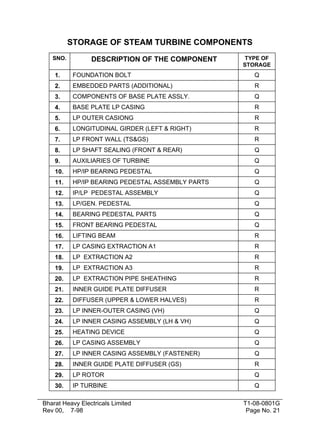
STORAGE OF STEAM TURBINE COMPONENTS
   SNO.          DESCRIPTION OF THE COMPONENT      TYPE OF
                                                   STORAGE
    1.     FOUNDATION BOLT                            Q
    2.     EMBEDDED PARTS (ADDITIONAL)                R
    3.     COMPONENTS OF BASE PLATE ASSLY.            Q
    4.     BASE PLATE LP CASING                       R
    5.     LP OUTER CASIONG                           R
    6.     LONGITUDINAL GIRDER (LEFT & RIGHT)         R
    7.     LP FRONT WALL (TS&GS)                      R
    8.     LP SHAFT SEALING (FRONT & REAR)            Q
    9.     AUXILIARIES OF TURBINE                     Q
    10.    HP/IP BEARING PEDESTAL                     Q
    11.    HP/IP BEARING PEDESTAL ASSEMBLY PARTS      Q
    12.    IP/LP PEDESTAL ASSEMBLY                    Q
    13.    LP/GEN. PEDESTAL                           Q
    14.    BEARING PEDESTAL PARTS                     Q
    15.    FRONT BEARING PEDESTAL                     Q
    16.    LIFTING BEAM                               R
    17.    LP CASING EXTRACTION A1                    R
    18.    LP EXTRACTION A2                           R
    19.    LP EXTRACTION A3                           R
    20.    LP EXTRACTION PIPE SHEATHING               R
    21.    INNER GUIDE PLATE DIFFUSER                 R
    22.    DIFFUSER (UPPER & LOWER HALVES)            R
    23.    LP INNER-OUTER CASING (VH)                 Q
    24.    LP INNER CASING ASSEMBLY (LH & VH)         Q
    25.    HEATING DEVICE                             Q
    26.    LP CASING ASSEMBLY                         Q
    27.    LP INNER CASING ASSEMBLY (FASTENER)        Q
    28.    INNER GUIDE PLATE DIFFUSER (GS)            R
    29.    LP ROTOR                                   Q
    30.    IP TURBINE                                 Q

Bharat Heavy Electricals Limited                   T1-08-0801G
Rev 00, 7-98                                        Page No. 21
31.   IP TURBINE PARTS                         Q
    32.   IP INLET PIPES                           Q
    33.   HP TURBINE                               Q
    34.   HP INLET ASSEMBLY                        Q
    35.   HP EXHAUST ELBOW                         Q
    36.   HPT RELATED PARTS                        Q
    37.   FRAME FOR SUSPENSION (ESV)               R
    38.   SUSPENSION OF VALVE (ESV)                Q
    39.   ESV & CV CASING WITH VALVE               Q
    40.   ESV SERVOMOTORS WITH LIMIT SWITCH        Q
    41.   HP CONTROL VALVE SERVOMOTORS             Q
    42.   SUSPENSION OF VALVE (IV)                 Q
    43.   IV & CV CASING WITH VALVE                Q
    44.   IV SERVOMOTORS WITH LIMIT SWITCH         Q
    45.   IP CONTROL VALVE SERVOMOTORS             Q
    46.   FRAME FOR SUSPENSION (IV)                R
    47.   IV SERVOMOTORS WITH LIMIT SWITCH         Q
    48.   STEAM BLOWING & HYD. TEST DEVICE         Q
    49.   TOOLS FOR GOVERNING SYSTEM               Q
    50.   SUSPENSION OF LPB VALVE                  Q
    51.   WATER INJECTION VALVES                   Q
    52.   CHEST LPB WITH STOP & CONTROL VALVE      q
    53.   LPB STOP VALVE SERVOMOTOR                Q
    54.   LPB CONTROL VALVES SERVOMOTORS           Q
    55.   INJR. FOR SUCTION PIPE NB 350            R
    56.   INJR. FOR SUCTION PIPE NB 300            R
    57.   MAIN OIL TANK                            R
    58.   MAIN OIL TANK & NOZZLE ASSEMBLY          R
    59.   OIL STRAINER                             Q
    60.   LEVEL MONITOR INSTALLATION               Q
    61.   INSTRUMENTS                              Q
    62.   LEAKAGE / DIRTY FLUID TANK               R
    63.   VARIABLE ORIFICES & THROTTLE             Q

Bharat Heavy Electricals Limited                T1-08-0801G
Rev 00, 7-98                                     Page No. 22
64.   CONTROL FLUID TANK                              R
    65.   CONTROL FLUID TANK NOZZLE ARRANGEMENT           R
    66.   EXPANSION TANK                                  R
    67.   FILTER & PR. DAMPING DEVICES                    Q
    68.   CROSS AROUND PIPE                               R
    69.   SUPPORT FOR CAP                                 R
    70.   CHANGE OVER VALVE                               R
    71.   RATING & MONOGRAM PLATES                        Q
    72.   OIL STRIPER                                     R
    73.   HOUSING FOR HRH STEAM STRAINER                  R
    74.   HOUSING FOR MAIN STEAM STRAINER                 R
    75.   MS & HRH STR.HSG GASKET                         Q
    76.   STEAM STRAINER MS                               Q
    77.   STEAM STRAINER HRH                              Q
    78.   COMPENSATOR                                     Q
    79.   TURBINE CONTROL LPB / SUPPLY RACK               Q
    80.   TEMPERATURE & PRESSURE CONNECTIONS              Q
    81.   PR. TRANSMITTERS BAR. PROBES THERMOCOUPLES      Q
    82.   TRANSMITTERS & JUNCTION BOXES                   Q


Bharat Heavy Electricals Limited                       T1-08-0801G
Rev 00, 7-98                                            Page No. 23
STORAGE & PRESERVATION OF COMPONENTS OF
       TURBOGENERATOR, EXCITER AND SYSTEMS
   SNO.          DESCRIPTION OF THE COMPONENT        TYPE OF
                                                     STORAGE
    1.    EMBEDDED PARTS                                R
    2.    FOUNDATION PARTS                              R
    3.    WOUND STATOR WITH GAS COOLERS                 Q
    4.    TURNION FOOT PLATES                           Q
    5.    ROTOR                                         Q
    6.    ASSEMBLY OF PIPE CONTROL FOR GAS COOLERS      R
    7.    END SHIELDS                                   Q
    8.    FAN SHIELD, GEN VVIEW HEADER ASSEMBLY         R
    9.    TERMINAL BUSHING AND HEADER ASSEMBLY          Q
    10.   BEARING WITH BRUSH GEAR                       Q
    11.   SEAL BODY                                     Q
    12.   TEMP. CONNECTION                              Q
    13.   CASING FOR TURNIONS                           R
    14.   ERECTION MATERIALS                            Q
    15.   ERECTION DEVICES                              R
    16.   SHAFT SEALS                                   Q
    17.   SEAL RINGS                                    Q
    18.   ADOPTING RING                                 Q
    19.   AUXILIARY BEARING                             Q
    20.   CENTRIFUGAL FAN                               Q
    21.   CARBON DIOXIDE VAPOURISER                     Q
    22.   FILTER O.C.P.                                 Q
    23.   EXPANSION TANK                                R
    24.   OIL SEPARATOR                                 R
    25.   PRE CHAMBER                                   R
    26.   S.O.S.T.                                      R
    27.   SEAL OIL UNIT                                 Q
    28.   HYDROGEN DISTRIBUTION                         R
    29.   CARBON DIOXIDE DISTRIBUTION                   R
    30.   VALVES FOR AUXILIARY SYSTEMS                  P
    31.   GAS UNITS                                     Q
    32.   FLEXIBLE LEADS                                Q
     STORAGE & PRESERVATION OF COMPONENTS OF
                 HEAT EXCHANGERS

   SNO.          DESCRIPTION OF THE COMPONENT        TYPE OF
                                                     STORAGE
   PRODUCT : CONDENSER

Bharat Heavy Electricals Limited                     T1-08-0801G
Rev 00, 7-98                                          Page No. 24
1.    BOTTOM PLATE                            S
    2.    LOWER DOM WALL                          S
    3.    SIDE WALL                               S
    4.    WATER CHAMBER                           Q
    5.    UPPER DOM WALL                          S
    6.    STIFFENING PIPES                        S
    7.    STIFFENING RODS                         S
    8.    TUBE SUPPORT PLATE                      R
    9.    WATER BOX                               R
    10.   AIR EXTRACTION PIPING                   R
    11.   HOTWELL                                 S
    12.   SPRING ELEMENTS                         R
    13.   LOOSE ITEMS                             Q
    14.   INSTRUMENTS                             Q
    15.   CONDENSER TUBES (STAINLESS STEEL)       R
    16.   CONDENSER TUBES (NON-FERROUS)           Q
    17.   VACUUM PUMP                             Q
    18.   EJECTOR                                 R
    19.   AIR MEASURING DEVICE                    Q

   PRODUCT : HEATER
   1.     GLAND STEAM CONDENSER               R
   2.     STAND PIPE                          Q
   3.     INSTRUMENTS                         Q
   4.     DRAIN COOLER                        R
   5.     L.P.HEATERS                         R
          PRODUCT : COOLER
   1.     OIL COOLER                          R
   2.     CONTROL FLUID COOLER                R
   3.     STATOR WATER COOLER                 R
   4.     HYDROGEN COOLER                     Q
   5.     EXCITER AIR COOLER                  Q
   6.     INSTRUMENTS / LOOSE ITEM            Q


Bharat Heavy Electricals Limited              T1-08-0801G
Rev 00, 7-98                                   Page No. 25
MAXIMUM PERMISSIBLE LOADING FOR WIRE ROPES IN KG.
 NOMINAL        SINGLE              DOUBLE CORD WITH INCLUDED ANGLE OF
DIA (d) OF       CORD
ROPES mm                            0o        45o        90o        120o

    9             522              1044       965        738        522

    12           1170              2340       2070      1580        1170

    18           2150              4300       4000      3060        2150

    24           3850              7700       2100      5400        3850

    30           6200              12400     11500      8800        6200

    36           9000              18000     16600      12700       9000

    42           12200             24400     22600      17300      12200

    48           16000             32000     29500      22600      16000

    54           20200             40400     37300      28500      20200

    60           24900             49800     46000      35200      24900

    66           30100             60200     55700      42600      30100

    72           35800             71600     66200      50700      35800

    78           42100             84200     77700      59500      42100

    84           48800             97600     90200      69000      48800

    90           56000         112000        103500     79200      56000

    96           63700         127400        117700     90000      63700

   102           71900         143800        132900    101700      71900

   108           81000         162000        149700    114500      81000

   114           89900         179800        166100    127100      89900

   120           99700         199400        184300    141100      99700


Bharat Heavy Electricals Limited                                T1-08-0801G
Rev 00, 7-98                                                     Page No. 26
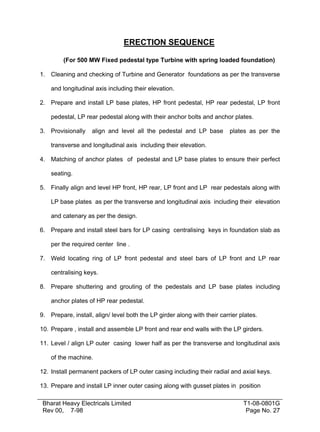
ERECTION SEQUENCE

         (For 500 MW Fixed pedestal type Turbine with spring loaded foundation)

1. Cleaning and checking of Turbine and Generator foundations as per the transverse

    and longitudinal axis including their elevation.

2. Prepare and install LP base plates, HP front pedestal, HP rear pedestal, LP front

    pedestal, LP rear pedestal along with their anchor bolts and anchor plates.

3. Provisionally    align and level all the pedestal and LP base          plates as per the

    transverse and longitudinal axis including their elevation.

4. Matching of anchor plates of pedestal and LP base plates to ensure their perfect

    seating.

5. Finally align and level HP front, HP rear, LP front and LP rear pedestals along with

    LP base plates as per the transverse and longitudinal axis including their elevation

    and catenary as per the design.

6. Prepare and install steel bars for LP casing centralising keys in foundation slab as

    per the required center line .

7. Weld locating ring of LP front pedestal and steel bars of LP front and LP rear

    centralising keys.

8. Prepare shuttering and grouting of the pedestals and LP base plates including

    anchor plates of HP rear pedestal.

9. Prepare, install, align/ level both the LP girder along with their carrier plates.

10. Prepare , install and assemble LP front and rear end walls with the LP girders.

11. Level / align LP outer casing lower half as per the transverse and longitudinal axis

    of the machine.

12. Install permanent packers of LP outer casing including their radial and axial keys.

13. Prepare and install LP inner outer casing along with gusset plates in position

 Bharat Heavy Electricals Limited                                              T1-08-0801G
 Rev 00, 7-98                                                                   Page No. 27
14. Align LP inner outer casing lower half and level it. Install LP casing parting plane

    platform .

15. Prepare and install LP front and LP rear lower half shaft seals housing and align it

    provisionally.

16. Prepare and install LP rotor along with their bellows in position.

17. Align LP rotor radially and axially in position and record free run out of rotor.

18. Record/ Ensure radial and axial clearances of the LP casing including rotor float

    including fitting of final axial keys of the LP inner casing .

19. Box up LP inner inner casing and heat tighten the parting plane bolts.

20. Box up LP inner outer casing .

21. Prepare and place HP module in position on temporary packers.

22. Transfer the load of HP rotor on bearings from the transport device and align it

    radially and axially.

23. Check free run out of HP rotor on journal and coupling face including its float.

24. Prepare and place IP module in position on temporary packers. (In case IP module

    is sent to site in disassembled condition, refer Instruction T1-08-0606G.

25. Loading of IP rear end of the shaft on bearing and removal of transport device.

26. Provisionally align HP , IP and LP rotor .

27. Couple HP / IP rotor on temporary Bolts and align rotor / casing radially and axially.

28. Record/ Ensure IP rotor float by shifting HP casing axially.

29. Conduct Horn drop test of HP casing without any radial and axial keys and pipe

    lines.

30. Conduct Horn drop test of IP casing without IP inlet upper half pipe lines.

31. Assembly of breech nut of HP casing and Main Steam Stop & Control valve

    assembly.


 Bharat Heavy Electricals Limited                                              T1-08-0801G
 Rev 00, 7-98                                                                   Page No. 28
32. Erection of Reheat Stop & Control valve assembly.

33. Weld IP inlet upper half pipe and record Horn drop values without radial-axial keys.

34. Alignment of HP/IP/LP rotors and their coupling on temporary bolts including its

    couple runout.

35. Swing check of HP rotor on its front end with temporary alternate bolt tightened on

    HP/IP coupling .

36. MOP alignment and its doweling.

37. Reaming/honing of HP/IP and LP/IP coupling including fitting of final coupling bolts.

38. Fixing of axial position of shaft and assembly of thrust bearing including its colour

    matching.

39. Roll check of HP/IP casing and fixing of radial and axial keys of the casing (Casing

    final packers need not to be put at this stage).

40. Assembly of bearings and checking of all clearances including fittings of side pads

    of bearing, yoke keys etc.

41. Turbovisory works in all the pedestal i.e. assembly and calibration of thrust bearing

    axial   shift, LP rotor expansions pick up, Hall generator and thermocouples of

    bearing .

42. Preparations of the bearing for oil flushing.

43. Oil flushing of the machine and normalizing the bearing after oil flushing.

44. Preparation and floating of TG deck as per Instruction No. T1-08-0909G.

45. Decoupling of HP / IP, LP/IP, LP/Gen., Gen./Exciter coupling and rechecking of

    alignment/catenary after floating of TG deck spring.

46. Final tightening of HP/IP, IP/LP , LP/Generator and Generator / Exciter coupling

    after correcting the alignment including their couple run out and swing check of rotor

    on HP Front and exciter rotor.


 Bharat Heavy Electricals Limited                                            T1-08-0801G
 Rev 00, 7-98                                                                 Page No. 29
47. Checking /Correction of LP shaft seal clearance after floating of TG deck with CW

    pump in operation and water in the hot well of condenser upto operating level.

48. Roll check of HP, IP casing in up and down direction only with TG deck in floating

    condition and CW pump in operation including water in hot well upto normal level.

49. Assembly of final packers of the HP, IP casing after completing the roll check in up

    and down direction.

50. Recording of final Horn drop of HP and IP casing after completing the welding of

    HP inlet, HP exhaust , IP inlet and Cross around piping.

51. Preparation and boxing up of LP casing after competing the full Roll check of LP

    casing and fitting of final casing packers and radial keys.

52. Barring gear.


 Bharat Heavy Electricals Limited                                           T1-08-0801G
 Rev 00, 7-98                                                                Page No. 30
CHECKING OF FOUNDATION BEFORE CASTING
Customer to provide, center line and elevation point.

Check positioning of all the inserts and fixed points with respect to center line
     in transverse and longitudinal direction as per BHEL Hardwar drawings.

Check elevation of all points.

Check verticality of all the pipe sleeves with the help of plumb.

Ensure proper locking of all the insert and fixed points before grouting.

Ensure leveling on the fixed points of LP girder and LP rear pedestal.

Preserve machined surfaces of all the fixed points against any damages due to
      Improper handling.

Ensure proper flatness of the bottom seating plate of all the inserts.

Ensure proper stiffeners in all the vertical and horizontal embedment provided
     for various purposes like hangers and supports etc.

Ensure proper cleaning of the area before casting.

Remove all unwanted material.

      NOTE: In case of spring loaded TG deck refer Installation Instruction
              No. T1-08-0909G prior to positioning of inserts etc.

CHECKS DURING CASTING/POURING OF CONCRETE
Casting of foundationTG deck should be carried out immediately after
      inspection of the foundationTG deck i.e. within 3-4 days after final
      inspection to avoid any disturbance to the inserts and fixed point.

Ensure no disturbance to the insert etc. during pouring of concrete while
     vibrators are used.


Bharat Heavy Electricals Limited                                         T1-08-0801G
Rev 00, 7-98                                                              Page No. 31
About 15-20 mm extra concrete may be left on top on all the pedestals and LP
     base plate area for chipping/cleaning purpose at a later date.

Close all the pipe sleeve from top to avoid entry of concrete inside. Alternately
      the pipe sleeve should be filled with sand.

CHECKING OF FOUNDATION AFTER CASTING
Clean complete foundation and remove all shuttering etc.

Ensure there is no loose concrete layer in the region where the pedestal and
     base plates are to be laid. No repair should be done in this region without
     consulting the turbine erection engineer.

Cover all the opening before checking any dimensional measurement to
     avoid any accident.

Establish a suitable longitudinal axis considering the fixed point of the LP rear
      pedestal and various pipe sleeves / inserts.

Establish a transverse axis as 90 degree with the help of the odolite.

Measure pitching/elevation of all the inserts and fixed points.

Measure elevation of all foundation on different pedestal and LP base plate area.

Check level of LP rear pedestal fixed points and if required correction may
     be carried out.

PREPARATION OF FOUNDATION FOR PLACEMENT OF
   PEDESTALS AND BASE PLATES:
Foundation are to be cleaned and loose concrete are to be chipped off.

Maintain elevation of foundation to ensure correct thickness of non-shrink
      grout.

A reference point for elevation in respect of machine center line (equivalent to LP
      rear pedestal) is to be maintained at a proper place. This point is to be
      preserved with proper protection. For making reference point a one side
      ground plate of about 200 x300 x20 mm may be used. This may be
      welded on a I-beam near Generator. The ground position of the plate is
      to be kept on top side and all elevation are to be transferred from this
      point with the help of water level jar. A correct elevation reading is to
      be punched on this plate. This reference point is to be used only during the
      turbine erection period.

Clean and deburr piping sleeves of the foundation on ID/OD       of the pipe.

Ensure all corners of the foundation remains perfect during chipping of extra
     concrete of foundation.


Bharat Heavy Electricals Limited                                       T1-08-0801G
Rev 00, 7-98                                                            Page No. 32
PLACEMENT OF PEDESTALS
Open and clean the pedestal.

Ensure there is no paint/oil on bottom face of the pedestal sole plate.

Ensure there is no paint on inside surface or the pedestal and if required sand
     blasting may be carried out at site.

Ensure correct fitting/clearance of locating rings of LP rear pedestal.

The half bore error of pedestals is punched by manufacturing unit however in
      case it is not there, measure and punch half bore error of pedestal in
      left/right side of the pedestal. If the error is nil then this may be
      punched as zero-zero.

Ensure that the pedestal parting plane is feeler tight after tightening all the
     parting plane bolts. If required, colour matching may be carried out but
     scraping/cutting is to be done on upper half cover only.

Check proper colour contact of spherical/cylindrical supports of the bearing
     with the pedestal.


Bharat Heavy Electricals Limited                                          T1-08-0801G
Rev 00, 7-98                                                               Page No. 33
Check contact between spherical Torus piece of bearing and
     spherical/cylindrical seat. In case of any variation in contact no
     scraping/cutting to be carried out at site and this may be referred to
     manufacturing unit. Also refer T1-08-0808G. Check centering of individual
     bearing w.r.t. pedestal seal bores by fixing pianowire on individual
     pedestal.

Ensure cleanliness of all pedestal oil lines. Close opening of oil lines of
     pedestal to avoid any foreign material entering in these pipe lines during
     erection at site.

Weld MOP suction and discharge pipe lines in HP front pedestal as per the
     drawing before placement.

Assemble protection sheet in the foundation bolt holes of pedestals.

Assemble anchor bolts along with anchor plate of the pedestals. Ensure that
     there is good contact available to the backing plate with the
     foundation. If required colour matching/grinding may be carried out to
     achieve the contact.

Assemble protection sheet in the anchor bolt hole from bottom side of HP rear
     pedestal foundation to avoid entry of grout metal.

Ensure level of both anchor plate of H.P. rear pedestal with 70-90 mm gap for
     filling of grouting concrete.

Adjust height of the Anchor Bolts as specified in the drawing.

PLACEMENT OF LP BASE PLATE, OVER THE FOUNDATION :
Clean all the four base plates.

Mark/punch center line on the base plate as per drawing.

Ensure proper cleaning of base plate on bottom side.

Put identification marks on each base plate to avoid any mistake in positioning of
      the same.

Do colour matching of all the eight nos. carrier plate on both the faces.

Match LP base plate with the individual carrier plate.

Place all the four base plates in position along with their leveling screws and
      foundation bolts.

Provisionally align and level all the four base plates.

Assemble protection sheet in the foundation bolt holes.


Bharat Heavy Electricals Limited                                      T1-08-0801G
Rev 00, 7-98                                                           Page No. 34
ALIGNMENT OF PEDESTALS AND LP BASE PLATES
Provisionally align and level all the four pedestals including LP base plates with
      reference to the earlier marked longitudinal and transverse axis. The
      elevation reference is to be taken from the already positioned plate for
      this purpose.

Align and level LP rear pedestal and set the elevation as per machine center line.

Use piano wire arrangement with micrometer for centering of pedestal bore and
      use water level jar for setting of elevation. Use measuring tape to
      maintain pitching of the bearing from one pedestal to another. Pedestals
      are to be set in level condition on both longitudinal and transverse
      direction. Align and level HP front, HP rear and LP front pedestals.
      Elevation of the pedestals are to be set as per catenary of the machine
      considering the half bore error of the pedestal if any.

Align and level, LP base plates. Elevation of LP base plate is to be kept higher
      than the rear pair of LP base plate in line with catenary of rotor.

After alignment of LP rear pedestal weld the locating rings as mentioned in the
       drawing.

During welding of locating ring, ensure that there is no movement in the
      pedestal in any of the direction.


Bharat Heavy Electricals Limited                                      T1-08-0801G
Rev 00, 7-98                                                           Page No. 35
GROUTING OF PEDESTALS AND LP BASE PLATES
Fill 3 to 8 mm washed Pea-gravel in all the anchor bolts sleeves. These gravel
       are necessary to give damping effect to the anchor bolts during operation
       of the machine.

Seal anchor bolts holes after filling of gravel to avoid any entry of grout metal.
      Medical tape may be used for sealing of these anchor bolt holes.

Clean foundation with compressed air.

Make shuttering of all the pedestal and LP base plates. Use thick polythene
     sheet inside the shuttering to give better finish and avoid moisture
     absorption by shuttering.

Shuttering should be made with maximum care to avoid any leakage of grout
      concrete. All sides of the shuttering are to be sealed either with some
      sealing compound or with thick mixture of grout material to avoid leakage
      of grout material.

Foundation are to be kept wet for about 6 hrs. before grouting.

Non shrinkage cement duly approved by BHEL is to be used for grouting of the
     pedestals and base plate.

Use fresh stock of the grouting material only and check the strength of the
      material before use.

During grouting, the mixture has to be poured from one end only and it has to
      flow to opposite end to avoid any blockage of air pocket.

Water curing is to be carried out for about 10 days duration.

All anchor bolts are to be stretched minimum after 21 days of grouting.

HP, IP & LP module placement work can be taken up after 24 hours of grouting
      of the pedestal and base plates.

For individual pedestal and base plate, grout mixture should be poured in one lot
      only.

PLACEMENT OF HP MODULE IN POSITION
Ensure matching of all the four palms of the module where it is resting on the
     pedestals.

Ensure matching and parallelity of front and rear key block of the HP casing.

Assemble all four jacking screw of HPC and ensure their free movement.

Clean journals and coupling of the HP rotor.

Record journal dia, coupling hole sizes and spigot dia of HP rotor.


Bharat Heavy Electricals Limited                                        T1-08-0801G
Rev 00, 7-98                                                             Page No. 36
Lift module in level condition and place it in position by keeping it 3 to 5 mm
      toward front pedestal side.

During placement of module use temporary packers similar to permanent and
      additionally support it by four jacking screws.

Ensure load on all four packers with the help of some additional shims if
     required.

Install temporary radial and axial keys of the casing.

Prepare HP rotor for alignment (Ref. section 20 before placing the IP module.

PLACEMENT OF IP MODULE IN POSITION
Ensure matching of all the four palms of the module where it is resting on the
     pedestals.

Ensure matching and parallelity of front and rear key block of IP casing.

Assemble all four jacking screws of IP casing and ensure their free
     movement. If these jacking screw holes are provided with the bolts
     from factory then same are to be removed before placement of module.

Clean IP rotor on both sides including coupling and journal.

Record spigot /recess, journal dia, and coupling hole sizes.

Lift the module in level condition and place the module in position by moving
       about 7 to 8 mm towards generator end. Use temporary packers for
       placement of module in position and additionally support the module with
       jacking screws.

Ensure load on all four packers with the help of some additional shims if
     required.

Provisionally align the casing on front and rear pedestal bore. Install temporary
      radial and axial keys of the casing with some shims.

Prepare IP rotor for alignment (Ref. section 20).
      NOTE: In case IP module is sent to site in disassembled condition, refer
              Instruction T1-08-0606G.


ASSEMBLY OF LP MODULE
      This assembly can be divided in following sub assemblies:


Bharat Heavy Electricals Limited                                      T1-08-0801G
Rev 00, 7-98                                                           Page No. 37
Assembly of girder and end walls.

Assembly of LP inner inner and LP inner outer casing lower half.

Assembly / welding of LP outer casing.

            Before starting assembly of LP casing in position, following works are
            also to be completed :

            - Positioning and welding of LP casing centering pin of front and rear
              side.

            - Positioning of key block of LP casing axial keys.

            - Positioning of all internal of condenser.


POSITIONING AND WELDING OF LP CASING CENTERING
   PIN

      Two nos. centering pins are to be located below LP front and LP rear pedestal.
      Necessary pipe along with two sq. end plates are already provided in the
      foundation to take the radial load of the LP casing:
Plumb the center line from LP front and LP rear pedestal bore on both side
     over the square plate of the foundation.

Establish accurate position of the pin and put a punch mark at a required height
      and mark a circle and a controlling circle over all the four sq. Plates.


Bharat Heavy Electricals Limited                                         T1-08-0801G
Rev 00, 7-98                                                              Page No. 38
Dia of the circle must be equal to pin dia. A template equivalent to pin dia has
      to be made for this purpose with about 20 mm thick plate and a welded
      pipe for using as an handle. The template dia must be very accurate and
      same may be made on machine.

Make precise hole with gas cutting/grinding to match template on all four
     embedded plate. Ensure that the template is fitted with minimum
     clearance and hole center are perfect as per marking.

Drill hole of about 10 mm dia on one of square plate of LP front and on one
       plate of LP rear for air venting to avoid cracks during welding.

Insert both the pins and carry out the welding as per laid down procedure.
      Before welding set correct axial position of the pins.

Insert key block on both the pins and weld their locking ring also. Ensure
      proper clearances in key block before welding of its locking ring.

Preheating of 200 degree Celsius or more to be achieved before any welding.
     Dye penetrate test on root run and after final welding is to be carried out.


Bharat Heavy Electricals Limited                                     T1-08-0801G
Rev 00, 7-98                                                          Page No. 39
ASSEMBLY OF GIRDER AND END WALL
Colour match side matching flange of girder with the surface plate.

Colour match seating flange of girder where it rests over the LP base plate.

Match and ensure parallality of axial key ways of girder.

Colour match side flanges of end wall.

Match and ensure parallality of key block of end wall.

Place left and right girder with carrier plate, spacer and lubrite packer on LP
      base plate.

Provisionally align and level the girders. Set height of the girder equivalent to
      machine center line maintaining catenary of the machine with the help of
      water level jar arrangement.

Assemble locking plate of the front and rear end wall to facilitate its assembly
     with the girders.

Assemble front and rear end wall with the girders and ensure perfect parting
     plane level during tightening.

Align, level LP outer casing and ensure contact of packers by colour
      matching/machining of spacer height.

Install LP casing radial and axial keys.

Assemble inner outer casing axial key blocks on left and right side of girder
     and dowel them.

Lock with tack welding all the vertical joint bolts.

Put a seal weld run between girder and end wall joint all around except on top
      face.

Weld girder and end wall parting plane joint with argon welding. Before
     welding make a V groove with the help of a chisel and allow the projection
     of material on surface. Do not make the groove by grinding.

Do colour matching with a surface plate on all four corner where argon welding
     have been carried out.


ASSEMBLY OF LP INNER INNER AND LP INNER OUTER
   CASING LOWER HALF
      The LP inner inner casing lower half is received from factory in assembled
      condition with LP inner outer casing lower half.


Bharat Heavy Electricals Limited                                       T1-08-0801G
Rev 00, 7-98                                                            Page No. 40
Clean the casing and check all the threaded holes.

Do colour matching on all four corners of the casing where it rest over the
     girder.

Colour match all eight carrier plates of inner casing on both side.

Assemble all carrier plates on girder and do the colour matching with
     individual carrier plate.

Prepare Gusset plate of front and rear side with temporary radial keys for fitting
      in LP inner casing.


Level and lift LP inner outer casing and assemble/weld both the gusset plates
      with the help of some temporary support.

Lower the casing in position over the carrier plates fitted with spacer and lubrite
     packer.

Provisionally align the casing radially and axially.


Support the gusset plate with the help of screw jack (about 10-15 tons) on front
     and rear side by taking support from condenser stiffeners. Screw jack is to
     be unscrewed after box-up.


Bharat Heavy Electricals Limited                                       T1-08-0801G
Rev 00, 7-98                                                            Page No. 41
Adjust the height of the LP inner outer casing as per center line of the machine
      and then level it with the help of water level jar arrangement.

Ensure that all the eight packers have good contact. Loading of each packer is
     to be ensured.

Lower the casing by about 2 mm on all the eight packers with the help of shims
     for placement of LP rotor to avoid any fauling during placement of rotor.

Fit and weld all gusset plate stiffener pipes except pipe between LP inner outer
      casing and condenser. Do not make any weld connection between
      condenser and any of these stiffeners till neck welding of the condenser
      is over.


PLACEMENT OF LP ROTOR
Measure journal dia, spigot dia and coupling hole sizes.

Ensure centering of temporary bearing support in the LP front pedestal for
     placement of LP rotor.

Place LP rear bearing in position.

Prepare shaft seal compensator along with gaskets (Gasket to be installed in
      fully ring shape only ) and position them on LP rotor with the help of
      supplied supports of compensator.

Lift LP rotor with the supplied lifting beam in perfectly level condition and place
      it in position. During lowering of rotor ensure radial clearance with the
      help of long feeler gauges in the LP casing.

WELDING OF LP OUTER CASING
     The welding of LP outer cover is to be carried out before placement of LP
     Rotor in position to avoid damage to the rotor.


Bharat Heavy Electricals Limited                                      T1-08-0801G
Rev 00, 7-98                                                           Page No. 42
Colour match and remove all high spots of the matching flange of the LP
     outer casing.

Ensure good contact between parted diffuser of LP front and LP rear cover.

Colour match and remove all the high spots of the parted diffuser/vertical face
     to ensure good contact with the compensator at a later stage.

Colour match and remove all burrs and high spots from parting plane of LP outer
     casing.

Side flange of LP front and rear cover are to be ensured in right angle to
       achieve good contact with their matching flanges.

Place LP front LP rear cover along with parted diffuser and ensure feeler tight
      joint after tightening the parting plane bolts. The joint must be feeler
      tight just after normal tightening of bolts. Do not over tighten parting
      plane bolts.

Ensure matching of parted diffuser face on both side of LP casing. If necessary
     colour matching may be carried out to achieve a feeler tight joint.

Drill/ream all the parting plane holes as per drawings and install all dowel pins.

After fixing of LP front and rear cover measure the dimension for
      positioning of both the center flanges. The dimension are to be recorded
      in such a way that there is no clearance after fitting of center flanges in
      position on both side with the LP front and rear cover. The center
      flanges are supplied in extra length on both sides from the factory and
      final length are to be maintained at site only.

Drill/ream dowel pin holes in center flanges and install all dowel pins in position.
        Ensure drilling and reaming of all dowel pin holes to equal depth.

Fit both the center pieces of the cover in position.

Achieve the fitting clearances for welding as per laid down procedure.

Weld/lock LP upper half flange with respect to lower half casing with the help
      of metal cleats to minimise the distortion during welding of LP cover.
      The cleats may be welded at an interval of about one meter distance.

Carry out the welding as per the following welding procedure.

WELDING PROCEDURE
Tack weld the crowned seam joint. permanently welding approx. 100 mm at the
      generator end of the joint.

Opposite tack welded radial joint 2, permanently weld approx. 100 mm of the
     crowned seam joint, pos. 1, staggering the two weld ends to ensure a
     perfect transition when the crowned seam joint is finish welded.


Bharat Heavy Electricals Limited                                        T1-08-0801G
Rev 00, 7-98                                                             Page No. 43
Tack weld the crowned seam joint at regular intervals with a tack of 5T and pitch
      of 25T.

When welding radial joint 2, shell plates 1 & 2, tacked together, rest on but are
    not tacked to the retaining strip in the region of joint 1, so that any
    shrinkage occurring during welding of seam 2 is not obstructed.

The tacking & welding sequence applies for all shells courses.

Weld radial seam at TE according to welding sequence plan.

Align, adjust and tack weld radial seam at GE.

Weld radial seam at GE according to welding sequence plan.

Weld crowned seam joint.

Align shell courses on joint strips and tack weld,

Weld on joint strips from center & ends of shell plate.

Insert pins in top half casing, release top half casing and lift to insert and tack
       filler piece between joint strips.

Unbolt top half casing and lift in order to weld and finish - machine filler pieces in
     the region of the joint surface.

Check welds according to specifications.


ALIGNMENT AND COUPLING OF LP-IP & HP ROTOR
     LP rotor is to be aligned on pedestal seal bore and LP inner outer casing is to be
     centralised in such a way that enough clearances are available to LP rotor,
     during alignment. Now this alignment activity of all the three rotor can be
     divided as below :


Bharat Heavy Electricals Limited                                          T1-08-0801G
Rev 00, 7-98                                                               Page No. 44
Preparation of HP rotor for alignment.

Preparation of IP rotor for alignment.

Preparation of LP rotor for alignment.

Alignment of LP-IP & HP rotors.

Reaming, honing of the coupling holes.

Balancing of coupling bolts weight.

PREPARATION OF HP ROTOR FOR ALIGNMENT
Align HP rotor with reference to front and rear pedestal seal bore reading. If
      required move complete HP module along with the rotor.

Fix temporary radial and axial key of the casing on both front and rear side of
      the casing. Remove HP front upper half transportation device.

Lift module by 0.20 mm on front side by putting additional shims in front
      packers.

Insert HP front bearing in position.

Reduce 0.20 mm shims gradually and ensure about 0.10 mm load on the rotor. If
     required further lower the front side of the module to achieve the loading
     on bearing by about 0.10 mm.


Bharat Heavy Electricals Limited                                    T1-08-0801G
Rev 00, 7-98                                                         Page No. 45
Remove HP front lower half transport device gradually and ensure no
    movement between HP casing and rotor. If necessary adjust shims of
    HP casing front packers.

During loading of bearing always ensure that the rotor is not fouling inside the
      casing with the shaft seals. This may be ensured by checking with feeler
      gauge also.

Check axial position of HP rotor in front side on left; right and top position
     from the rotor reference point to the HPC as given in the shop protocol.

Insert and load the bearing in HP rear end in similar way as carried out in
      case of HP front end and record axial position of rotor as per shop
      protocol.

Lock axially HP rotor with some fixture along with the arrangement of
     jacking screw for movement of rotor. This fixture may be mounted on rear
     pedestal. Before locking of rotor ensure axial position of the shaft.

Center HP shaft with reference to HP casing front and rear spigot. If necessary,
      move the casing readily to achieve the centering. A fixture can be
      fabricated at site for mounting the dial gauge on both the end of the rotor
      to check the centering of the shaft.

Use thick oil during rotation of shaft on the bearing.

Protect bearing from any of the dust particles. It is recommended to place
      upper half of bearing in position to avoid dust and any other damage to
      the shaft journal.

Realign the rotor shaft with respect to pedestal seal bore and if necessary
      adjust the shims below spherical support of the bearing.

Care should be taken during alignment that radial and axial clearances
      between rotor and casings does not get bridged.

Check HP rotor radial run out on journal and coupling.

Check axial run out on thrust collar and both the coupling faces of HP rotor.

Check axial float of the rotor. Compare values with shop protocol values. (Ref. T1-
     08-0802G). Deviations to be reported to Manufacturing Unit.


PREPARATION OF IP ROTOR FOR ALIGNMENT
      The IP module is also to be prepared in line with the HP module. However
      as IP rotor is provided with one side bearing and opposite side is coupled
      with the HP rotor without a bearing, extra care is necessary during
      alignment of rotor in IP casing. The additional point which are to be taken care
      are explained below :


Bharat Heavy Electricals Limited                                        T1-08-0801G
Rev 00, 7-98                                                             Page No. 46
Place IP rotor rear end on bearing similar to the HP rotor and remove
      transportation device.

Provisionally align HP/IP rotors and couple on temporary bolts by moving both
      the modules. During coupling of the rotors, the transportation device of IP
      front end is also to be taken out.

Check axial position of rotor w.r.t. IP casing and adjust as per shop protocol.

Check centering of IP rotor front and rear end w.r.t. IP casing (similar to the HP
     rotor centering check).

Check float of the IP rotor. Compare values with the shop protocol values. (Ref.
     T1-08-0802G). During checking of float ensure HP casing is not fouling
     with HP rotor. If required HP casing may be moved axially for this purpose.

Check facial runout on IP rear coupling face and radial runout on journals and
     couplings.

PREPARATION OF LP ROTOR FOR ALIGNMENT
Provisionally align LP rotor in pedestal seal bore placing the front end of shaft
      on auxiliary bearing and rear end on bearing.

Align LP inner outer casing radially with the help of long feeler gauges and
      install temporary radial keys in the gusset plate.


Bharat Heavy Electricals Limited                                      T1-08-0801G
Rev 00, 7-98                                                           Page No. 47
Record all the radial and axial clearances of the LP casing without coupling
     the LP-IP rotor. Variation if any in radial or axial clearances are to be
     corrected/approved at this stage.

Remove shims from the front end of auxiliary bearing and keep rotor on lifting
    tackle.

Record radial run out of LP rotor coupling and journal and axial run out of the
     coupling faces of the both end.

Record float of the LP rotor by moving the LP inner outer casing lower half.

After ensuring the radial and axial run out of the LP rotor the LP inner outer
       casing can be boxed up. Parting plane bolts of LP inner-inner casing are to
       be heat tightened.

ALIGNMENT OF HP, IP AND LP ROTORS
Ensure radial and axial runout of all the three rotors are individually in order. If
     necessary individual rotor module can be taken out for correction of
     coupling face runout. Any variation on radial runout of rotor is to be
     referred to the factory.

Match coupling faces of two rotor as per the axial face reading of the rotor.
     Ensure that the higher point of the rotor coupling face and lower point of
     another rotor coupling face are matched together. This is to be compared
     with shop protocol also.

Preliminary align radially and axially all the three rotors and shift them in spigot
      along with the casing to avoid fouling of rotor inside the casing.

During alignment achieve left and right movement of the rotor with the help of
      shims in spherical / torus piece of the bearing. The up and down
      movement of the rotor is to be achieved with the help of shims in the
      cylindrical/spherical support of the bearing . The adjustment of shims in
      the bearing should be within the permissible limits only.

Ensure during alignment that the catenary of the shaft is maintained.

Check/record spigot clearance of HP-IP and LP-IP rotors by actually moving them
     in spigot.

Install four nos. supplied bolts along with one/two pins in HP-IP and LP-IP
       coupling. Hand tighten the coupling bolts by keeping a gap of > 1.00 mm
       in coupling faces for alignment.

Rotate the rotor system and record the coupling gap at 90 Deg. interval on
      left, right and top position. Ensure that the coupling, bolts and pins
      remain free while recording the gap of the coupling for the alignment
      purposes.


Bharat Heavy Electricals Limited                                        T1-08-0801G
Rev 00, 7-98                                                             Page No. 48
Check swing check value of the HP rotor with alternate bolts in position. The
     above value must be within the prescribed limit only otherwise a
     correction must be carried out at site in consultation with designer.

Ensure free movement of rotor on their bearing. Do not rotate the              rotor if it
     is tight during its rotation.

Ensue that the coupling holes are properly aligned to avoid unnecessary
     enlargement of holes.

Ensure HP-IP-LP rotor radial run out after tightening with alternate clearance
     bolts. Release the couplings for reaming / honing of couplings.

      In case of spring loaded TG decks, refer alignment procedure                 T1-08-
             0909G

REAMING / HONING OF COUPLING
Ensure that there is no disturbance on coupling during reaming/honing
     operation.

First ream/hone two opposite holes of the coupling and install two pins/bolts
       with sliding fit and then take up all other holes.

Enlarge coupling holes to the minimum possible diameter and try to make all the
      holes to same dia.

Ensure that the finished holes are straight and there is no banana shape. This
     can be ensured by checking hole with a straight ground finish pin having
     0.02/0.03 mm clearance.

The length of the pin should be equal to the bolt length. In case, few holes have
      gone considerably over size during reaming/honing at site/works, do not
      enlarge all the holes. As a special case in such cases these few holes
      may be left as oversize.

Ensure that the holes during reaming/honing are perfectly finished as ground
     bore and size obtained should be within 0.005 mm. Ensure all the coupling
     bolts are fitted within 0.02/0.03 mm clearance with sliding fit and bolts are
     to be ground within an accuracy of 0.005 mm.

Coupling bolts are not to be hammered in the holes and these are to be fitted with
      thumb pressure only.

Do not decouple the coupling in any case without ensuring the fitting of all the
     coupling bolts.


BALANCING OF COUPLING BOLTS
      After fitting the coupling bolts in all the holes these are to be balanced within 5
      gms accuracy and an accurate balance which can take a load of about 20 kg.


Bharat Heavy Electricals Limited                                             T1-08-0801G
Rev 00, 7-98                                                                  Page No. 49
may be used. During balancing of coupling bolts following points are to be taken
      care.
Final balancing of the coupling bolts are to be done along with the coupling
      nut of individual bolt.

If all the coupling bolt hole sizes are same before/after reaming and honing
        then all the bolts can be kept of equal weight.

If necessary adjust the weight of the bolts by machining the metal from the bolt
       head.

When the holes of the coupling are of different sizes then it must be seen that
    whether excess enlargement have been done at site or works. In such
    cases if excess cutting have been done at site in a particular hole then
    coupling bolt with excess weight are to be used. The amount of excess
    weight must be equivalent to the excess enlargement of hole at site. If a
    particular hole of excess dia. is noticed from factory then it is assured that
    the particular rotor is balanced with excess dia hole and there is no
    need of providing excess weight bolt at site.

COLOUR MATCHING OF THRUST BEARING
      After completion of reaming/honing and preliminary tightening of the coupling
      bolts, the colour matching of the thrust bearing pad have to be carried out with
      respect to the thrust collar of the HP Rotor. During colour matching a good
      contact on all the pads of front and rear side are to be ensured with respect to
      rotor collar by moving the rotor in +/- direction during its hand rotation. Following
      points are to be taken care during colour matching.


Bharat Heavy Electricals Limited                                            T1-08-0801G
Rev 00, 7-98                                                                 Page No. 50
Thrust bearing must be axially locked with the help of axial keys during the
      colour matching of the pads. Axial keys to be fitted while finalising the
      alignment of thrust bearing with rotor collar without pads.

Few drops of oil is to be put on journal portion of the thrust bearing during
     rotation of rotor to ensure that the oil is not entering in pad portion of the
     bearing.

Colour is to be applied on the thrust collar of the rotor.

If necessary move the spherical support of the bearing pedestal to ensure the
       equal thickness of the pads before fittment of axial keys of the bearing.

During moving of the spherical support in front or rear direction ensure that
      there is no left - right movement to the support otherwise that may
      cause misalignment of the bearing.

After colour matching of the thrust pad the axial zero position of the rotor is
      achieved and this can be taken for all other future reference for setting of
      axial position of HP, IP & LP casing.

HP, IP and LP lower casing are to be set axially after fixing the axial position
      of the rotor and their final axial keys can be installed at this stage.


Bharat Heavy Electricals Limited                                       T1-08-0801G
Rev 00, 7-98                                                            Page No. 51
ALIGNMENT OF HP, IP & LP CASING
      After completion of colour matching of the thrust bearing pads the casing
      alignment work can be taken up. The following points are to be taken care
      while aligning HP, IP and LP casing.
The roll check have to be carried out in HP, IP and LP casing to ensure the
     correct radial clearances of the casing.

TG deck springs are to be kept in floating condition while recording the roll
     check of LP casing. However the roll check of HP/IP casing may be carried
     out before floating of TG deck for fitting of their radial keys but up and
     down roll check of HP/IP casings are to be done with TG deck in floating
     condition as per the procedure TS/ST/ 01/0008/00/96.

Ensure that there is no obstruction in the movement of LP inner casing due to
     welding of any of extraction piping. The one of the joint of extraction
     piping may be left free till completion of roll check of the casing.

The welding of steam inlet pipes between LP inner casing and LP girders are to
     be taken up after completion of roll check of the casing.

HP, IP and LP casing are to be fitted with final packers and axial key immediately
      after the roll check. During fitting of casing axial keys and palm packers
      ensure proper contact on lubrite coating of the keys/packers to avoid any
      damage of these coating during operation of the machine,

After completion of fitting of final keys and packers only the casing are to be
      cleared for further works of welding of various pipe lines.

The gland steam, balancing leak of lines, steam inlet and exhaust pipes are to
     be welded with HP casing after fitting of final axial keys and packers of the
     casing.

Center HP rotor w.r.t. casing front and rear spigots. Compare the readings with
      shop protocol and record the readings.

Offset center line of the HP, IP & LP casing w.r.t. respective rotor center line as
      per recommended logsheet.


Bharat Heavy Electricals Limited                                         T1-08-0801G
Rev 00, 7-98                                                              Page No. 52
Check/record LP diffusers centering readings after roll check of the casing.

Before roll check of LP casing all the stiffener pipe welding work must be
      completed. Refer T1-08-0909G.


FINAL TIGHTENING OF COUPLINGS
     In case of spring loaded foundation after completing all other works the HP / IP ,
      IP/LP , LP/GEN , GEN/EXCITER couplings are to be reopened and realigned
      after completing the reaming /honing . The rotors alignment are to be checked
      with TG deck in floating condition       as per the laid down procedure. After
      checking of alignment /catenary the final couplings are to be tightened including
      their coupled run out and swing check of rotors on HP front and Exciter end of
      the shaft.

BOXING UP OF LP INNER INNER AND LP INNER OUTER
   CASING
     The boxing up of LP inner inner and LP inner outer casing can be taken up
     before starting the alignment of HP-IP & LP rotor for coupling work. The
     following points are to be taken care before/during boxing up of these two
     casings.

Ensure matching of all the parting plane holes, fitting of cap nuts and
     accessibility of spanner .

Ensure feeler tightness of the parting plane joint of both the casing.

Check/record all the radial and axial clearances of the casing.

Ensure proper cleanliness of the LP inner inner and LP inner outer casing.

Ensure adequate clearance between LP inner inner casing and LP inner outer
     casing to avoid any obstruction during expansion of the LP inner casing
     inside the LP inner outer casing during operation of machines.


BOXING UP OF LP OUTER CASING
      During the boxing up of the LP outer casing following points are to be taken care.


Bharat Heavy Electricals Limited                                          T1-08-0801G
Rev 00, 7-98                                                               Page No. 53
Roll check of LP inner casing including the fitting of key, packers etc. must be
      finished.

All the works must be finished inside the LP casing before boxing up of LP
      casing including LP extraction pipe line works.

Ensure matching of all parting plane holes and feeler tightness of the joint
     before boxing up of the casing.

Ensure feeler tightness of bursting diaphragm flange joint before boxing up of
     the casing.

Ensure proper assembly of parting plane rubber cord.

FINAL HORN DROP CHECK
            After completing the welding of HP inlet, HP exhaust, IP inlet, IP exhaust
            and other piping of HP/IP casing the final horn drop readings are recorded
            as per the laid down procedure mentioned in the manual for horn drop
            check. However the IP casing horn drop is also to be recorded with IP
            inlet upper half pipe welded with casing alone.


Bharat Heavy Electricals Limited                                        T1-08-0801G
Rev 00, 7-98                                                             Page No. 54
Grouting of turbine base plates, bearing pedestals, foundation frame with shrink-free
grouting compound is intended to ensure uniform transmission of the force and vibration
of the TG unit to the foundation.


Caution:
Preparations for grouting, and grouting must be carried out with great care as it is no
longer possible to check and rectify the parts once they have been grouted.


CONBEXTRA GP-II or equivalent should be used as grouting compound.               Further
details on the grouting depths, mixing time, quantity of water to be mixed, should be
refereed from the manufacturers brochures.


PROCEDURE

The foundation should be thoroughly cleaned. All foundation bolt holes should be filled
with pea-gravels and covered at the top to avoid entry and sticking of grouting materials
with the bolts.


NOTE:- Remove all rust preventive paints, grease etc. from surfaces by wire brushes
to ensure proper adhesion of the grouting compound.


SETTING UP OF SHUTTERING
Set up shuttering from suitable material in box like manner around the foundation plates
and secure it firmly.


NOTE:- Shuttering must be sealed well to prevent the liquid grouting compound from
running out. This can be done by using paste of grout materials and allowing it sets.
As the grouting compound remains workable for a limited time, to prevent air bubbles, it
must be poured from one side only. For this, a large size filling heaped should be used.


 Bharat Heavy Electricals Limited                                          T1-08-0801G
 Rev 00, 7-98                                                               Page No. 55
PREPARATION OF GROUT MIX

Following measure must be taken before commencing mixing and grouting due to
limited time that the grouting compound remains workable.


Keep the foundation moist for at least 6 hours before the grouting.


-Set up mixers in the immediate vicinity of the foundation plates. The capacity of the
mixers, should be adequate to cope with the quantity of mixed cement required at a
time. Two or more mixers are required for grouting of bearing pedestal foundation
frame.


-Store the grouting compound next to mixer.


- Ensure that the compound is well within its expiry date.


-Provide the water hose and measuring pans near the mixers.


-Ensure uninterrupted power supply to the mixers and EOT Crane for handling the
ready mix.


-Provide adequate workmen for grouting.


-Ensure six empty cubes for filling the grout for strength testing. This is to be done as
per recommended FQP


-Take 80 % of the required water quantity first in the mixture. Then add gradually the
grout, ensuring that no lumps are found. It is desirable to add five or six large sizes
stones to break any lumps. Finally add the balance quantity of water and mix for at-
least another five minutes


 Bharat Heavy Electricals Limited                                          T1-08-0801G
 Rev 00, 7-98                                                               Page No. 56
This mixture is then taken into through heaped mesh. The hopper must be big enough
to make the full quantity of grout.


Than pour the grout with a hose through the filling hopper until the desired height is
achieved on the opposite side. (Flow may be accelerated by moving the grout in the
filling nozzles underneath the plates with chains or material strips.) This should be done
only if it is permitted by the grout supplier.


CAUTIONS


1. Do not use concrete vibrator.
2. Pour grout from one side only so that no air bubbles remains entrapped in the
  grouting compound.
3. Due to short workability times, never mix more grouting compound at one time than
  is required for one plate or volume to be grouted.
4. Pour in one continuous operation, without interruption.
5. Do not install any woven steel fabric reinforcing mats beneath the foundation plates.
6. It is desirable that in hot weather the grouting is done in the evening so that ambient
  temperature is low during the initial setting time.
7. Water should be clean and free from dissolved chlorides, as these weaken the grout.
8. In case during the grouting operations heavy leakage is observed from the shuttering
  that cannot be plugged during the grouting operation, and the level of grout has
  fallen below the base plate level, it is desirable to wash out the complete grout. The
  operation should be repeated after the shuttering has been rectified.


NOTE:- After at-least 72 hours setting time, work may be commenced on pre-
tensioning of the foundation both.


After the grouting compound has set (approximately. 24 hours after grouting), remove
all shuttering and smooth off the excess grout. The grouting compound is subjected to


 Bharat Heavy Electricals Limited                                           T1-08-0801G
 Rev 00, 7-98                                                                Page No. 57
compressive forces only.     Resultant hair cracks are insignificant with regard to TG
stability. These can be avoided by covering the exposed areas of grout by polythene
sheets to avoid excess loss of moisture during initial setting.


 Bharat Heavy Electricals Limited                                        T1-08-0801G
 Rev 00, 7-98                                                             Page No. 58
ASSEMBLY PROCEDURE OF IP MODULE
Due to oversize dimension of the IP module (M30 - 63) and its limitation in
transportation from Hardwar to site, the same will be dispatched to site in dismantled
condition in various packages after completing the shop assembly at Hardwar. First
the complete assembly of IP module will be done at works except the heat tightening of
parting plane bolts of IP inner and IP outer casing. Afterward complete casing will be
dismantled and dispatched to site.

The above machines are equipped with the spring loaded foundation deck.                 As a
general requirement initially all the turbine and generator rotors will be aligned/coupled
without floating the TG deck. The coupling will be opened and again re-aligned after
floating of the TG deck which is generally done after erecting all the components of
Turbine -Generator including their piping etc.

ASSEMBLY PROCEDURE AT SITE :
Place IP outer casing lower half in position after its cleaning over the pedestals by
       supporting it on the Jacking screws at four corners of casing. Additionally
       support the casing on temporary packers with the pedestals also.
Align IP outer casing radially with the help of piano wire keeping the HP rear and IP
       front pedestals seal as reference. Install temporary radial keys of the IP outer
       casing with the pedestal.
Clean and install IP inner casing lower half along with its radial keys (Drg. No. 0-106-01-
      27500 item No. 25) of front and rear end. During placement


 Bharat Heavy Electricals Limited                                            T1-08-0801G
 Rev 00, 7-98                                                                 Page No. 59
of inner casing support it on its four nos. Jacking screws. (Drg no. 0-106-01-
       27500# 18). After placement of inner casing install its axial keys (drg N. 0-106-
       01-27500 # 20). Before placement of inner casing install its thermocouple,
       parting plane studs (drg N. 0-106-01-27500 # 33 & 34 ). Seal ring of inlet insert
       & extraction line (drg N. 0-106-01-27500 # 3,4,9,10,13,14 ).
Place IP inner casing upper half in position and tighten alternate parting plane bolts.
       During this process the heat tightening the bolts are not necessary as this is
       required for ensuring the feeler tight parting plane joints of the IP inner casing.
       The IP inner casing packers are also to be installed during tightening of the P/P
       bolts and load of the inner casing is to be transferred on these casing packers
       (drg N0-106-01-27500 # 17) fter taking the load on the packers release the
       jacking screws of the IP casing.
Loosen IP inner casing parting plane bolts and remove IP inner casing upper half.
      Before loosening the IP inner casing parting plane bolts support inner casing
      again on its four jacking screws and ensure that the parting plane level of lower
      half inner casing is not disturbed and remain same as it was kept after tightening
      of parting plane bolts with load on its four packers.
Place IP rotor in position after its cleaning. The front end of the rotor is to be placed
       over segment (drg N. 0-106-01-27500 # 21) and rear end of the rotor on its
       bearing. During placement of IP rotor ensure that the rotor is free on its seal fins
       of IP inner casing and necessary the IP outer casing may be lowered on its rear
       end.
Provisionally align and couple HP/IP/LP/ Generator rotors and complete reaming
       /honing of the coupling including swing check etc. Before rotation of IP rotor
       remove segment (drg N. 0-106-01-27500 # 21).
Set axial position of the IP rotor as per the zero position of the thrust bearing and set
       axial position of the IP outer casing as per Hardwar protocol on front and rear
       end of the IP outer casing.
Align radially IP outer casing with reference to the IP rotor on front and rear glands.
       Recheck/correct axial position of the IP casing.
Assemble IP inner casing upper half end tighten the alternate parting plane bolts to
     ensure feeler tight joint.
Do roll check of IP inner casing by moving the IP outer casing in left/right direction and
       IP inner casing itself in up/down direction with the help of inner casing jacking
       screws by removing the inner casing packers. Ensure / compare roll check
       values with shop records.
Check IP rotor axial float in IP inner casing and compare with shop protocol.
Loosen IP inner casing bolts and remove IP inner casing upper half.
Decouple and lift IP rotor for assembly of rear end shaft seals of IP casing. The front
     end of the seals may also be assembled now of afterward with the IP rotor in
     position.


 Bharat Heavy Electricals Limited                                             T1-08-0801G
 Rev 00, 7-98                                                                  Page No. 60
Place IP rotor in position and provisionally couple it with HP rotor on temporary bolts.
       The IP rotor may not be coupled at its rear end with the LP rotor at this stage.
Assemble and heat tighten IP inner casing upper half as per required elongation of
     parting plane bolts. Install seal rings of inlet insert and extraction pipe on IP
     inner casing upper half (drg N. 0-106-01-27500 # 1,2,7,8,11,12). The taper pins
     of IP inner casing parting planes are to be removed before placement of IP outer
     casing upper half after the heat tightening of IP inner casing bolts.
Assemble IP outer casing upper half and tighten the parting plane bolts to ensure feeler
     tight joints. The heat tightening of the bolts are not to be done now. Before
     placement of IP outer casing upper half assemble casing shaft seals of front &
     rear end also.
Do roll check & float of completely assemble IP turbine and compare it with factory
       protocol.
Heat tighten IP outer casing parting plane bolts to required values, and carry out final
      roll check and float of completely assembled turbine.

NOTE : These are general instructions for the assembly of IP
        module M 30 - 63 at site. However, depending on the site
        conditions the same may be suitably reviewed, if necessary.


 Bharat Heavy Electricals Limited                                            T1-08-0801G
 Rev 00, 7-98                                                                 Page No. 61
SEALING & ANTISIEZING COMPOUNDS

 SNO            LOCATION              FEATURES       RECOMMENDED
                                                      COMPOUND
  01    JOINT PLANE OF HPT IPT     METAL TO METAL   − BIRKOSIT
        & VALVE CASINGS,           JOINT IN HIGH    − STAG B
        GLAND BOXES &              TEMPERATURE
        STRAINER HOUSINGS,         ZONE             − MAGNESITE
        BREECH NUT MATING                             COMPOUND OF
        FACE.                                         BHEL BHOPAL
  02    JOINT PLANE OF LP          METAL TO METAL   − HOLDITE
        OUTER CASING               JOINT IN LOW     − LOCTITE 574
        (WITHOUT RUBBER            TEMPERATURE
        SEALING CHORD).            ZONE
  03    JOINT PLANE OF             METAL TO METAL   − HYLOMER
        BEARING PEDESTALS,         JOINT IN OIL     − GOLDEN
        MOP CASING, VALVE          ENVIRONMENT        HERMETITE
        SERVOMOTOR.
                                                    − VICTOR
                                                      SHELLAC
  04    THREADED FASTNERS          HIGH             − MOLYKOTE P37
        INCLUDING, BREECH          TEMPERATURE      − OKS 255
        NUT THREADS, KEYS,         ( < 350°c)
        PACKERS, DOWEL PINS        ANTISIEZING
        U & I - SEAL RINGS IN
        HIGH TEMPERATURE
        ZONE.
  05    THREADED FASTNERS,                          − MOLYKOTE D 21
        KEYS, PACKERS, DOWEL       LOW              − OKS 511
        PINS IN LOW TEMP.          TEMPERATURE
        ZONE, COUPLING BOLTS                        − MGS 400
                                   ( < 350°c)
        SEAL SEGMENTS, HP/IP
                                   ANTISIEZING
        CASING PALM PACKERS,
        HP FRONT & REAR
        BEARING PEDESTAL
        PACKERS (OTHER THAN
        SELF LUBRICATED
        LUBRITE PACKERS).

NOTE: NO COMPOUND IS TO BE APPLIED ON SELF LUBRICATED LUBRITE
      PACKERS.


Bharat Heavy Electricals Limited                            T1-08-0801G
Rev 00, 7-98                                                 Page No. 62
ASSEMBLY OF BEARING AT SITE
GENERAL DESCRIPTION
The KWU design machine are supplied with four bearings out of which three are the
journal bearing and one is combined thrust and journal bearing on H.P. rear end of the
shaft. All the turbine bearing are self aligning type and they adjust themselves as
per the catenary of the machine.
The function of a journal bearing is to support the turbine shaft , but the thrust
bearing support the shaft as well as work as a fix point for the turbine shaft. The contact
arrangements between bearing and bearing supports are of two types i.e. sphere to
sphere in HP front and HP rear bearing and torus to cylindrical in other bearings.
The bearings are supplied to site after ensuring their contact at works. During erection
all the bearing are supplied to site in aligned and assemble condition in their individual
pedestal from the works. After alignment of the bearing in their pedestal the seat of
the bearing are doweled before dispatch to site.
In case of Thrust and Journal bearing the seat of the bearing neither doweled from
the works nor it is recommended to be doweled at site. The bearings need
preparation before placement of module in position at site. This can be done even
before the placement of pedestal in position for grouting.

ASSEMBLY PROCEDURE

              1.     After opening the pedestal remove and clean the bearing including its
                     spherical/ cylindrical seat.

              2.     Remove oil guard ring and its duct and keep them in proper place
                     for their storage at site.


              3.     Handle bearing carefully to avoid any damage to the babbit and
                     its torus/spherical piece. During storage at site avoid direct loading of
                     bearing on its torus. A thick rubber seat may be used during
                     handling of bearing at site on its torus.

              4.      Ensure 0.03 feeler tightness on bearing parting plane. In case of
                     any variation the matter may be referred to designers.

              5.     Measure bore dia of the bearing and journal dia at site and ensure
                     the oil clearances. If any discrepancy is observed , designer may be
                     referred.

              6.     Ensure torus/spherical contact with their seats at site. While checking
                     the contact the seat may be bolted with their pedestal. In case
                     variation contact from their specified diagrams are noticed then
                     following may be carried out at site:-

                     a)     In case of torus to cylindrical seats the line contact are
                            recommended by designers. If these lines are not straight

 Bharat Heavy Electricals Limited                                              T1-08-0801G
 Rev 00, 7-98                                                                   Page No. 63
and are in angle then the bearing may be rejected straight way
                          and sent to works for rectification. These line contact may be in
                          a width of about 20 mm throughout on its seat leaving with
                          area on both sides. The contact may be wide in Center and then
                          gradually reducing on sides. In case there is no contact is
                          achieved in the center and only sides are having contact then
                          a feeler gap may be recorded in bottom. In case if the bottom
                          is tight to a feeler of 0.03 mm the bearing may be accepted
                          at site without doing any rectification.

                   b)     In a reverse case the contact are achieved in center only
                          though the 0.03 feeler is not going in the side. The bearing
                          may be still accepted at site. In case if the feeler is going in the
                          bottom or in sides by 0.03 mm. the bearing are not accepted at
                          site and can be sent back for the rectification to the works.
                          Similarly if the contact are intermittent on its seat but in a
                          straight line and no feeler is going the bearing may be accepted.
                          In case of very wide contact also the bearing may be sent back
                          for the rectification. While checking these contact very light
                          color may be put on torus of the bearing. Before sending back
                          the bearing to the works the matter may be referred to
                          designers and their concurrence is to be obtained. No
                          scrapping/lapping is recommended in these bearing for
                          improvement of the contact.

                   c)     In case of spherical to spherical bearing the contacts are called
                          in the center like a moon shape. In these bearings even full
                          contact may be accepted. But in case if there are contact on
                          sides and a feeler gap is noticed on center then the bearing
                          may not be accepted.
                   In such cases if the gap is upto 0.03 mm then the
                   matching/lapping may be carried out at site. But in case of higher
                   gap the matter may be referred to designers. In case of reverse
                   case if the feeler gap of 0.03 is noticed on both sides of the
                   bearing the bearing may not accepted at site and matter may be
                   referred to designers.


Bharat Heavy Electricals Limited                                               T1-08-0801G
Rev 00, 7-98                                                                    Page No. 64
7.     Before checking the contact between torus and its seat ensure that the
                   seat is feeler tight to 0.03 mm without tightening of any bolts with the
                   pedestal. If necessary this may be corrected with consultation of
                   designers. Similarly ensure contact between torus spherical piece
                   with bearing and in case of variation the matter be referred to
                   designers and no correction is to be carried out at site without the
                   approval of manufacturing unit.

            8.     Before checking the contact between torus/spherical piece with
                   bearing and in case of variation the matter may be referred to
                   designers and no correction is to be carried out at site without their
                   recommendations.

            9.     The sizes of all the shims may be punched in bearing body and
                   spherical/torus piece of the bearing. The number of shims are to be
                   limited to 3-4 numbers only even after complete alignment of
                   machine. A protocol for number of shims may be prepared.

            10.    Torus/spherical should not have any radial movement over its
                   bearing. This can be seen after opening the torus from the bearing.

            11.     Check jacking oil lines of the bearing and clean them thoroughly.
                   Ensure jacking oil lines fittings also for their male female threads
                   etc otherwise this may create the oil leakage through these lines
                   during operation of the machine. The jacking oil pocket in the
                   bearing may be checked if necessary they may be corrected at site as
                   per the drawings.

            12.     When ever JOP is not available, use always thick oil during rotation
                   of shaft over bearing.The type of oil may be used as servo cylinder
                   1000 grade of IOC.

            13.    After installation of bearing in position the oil clearances may
                   be checked after few rotation of the shaft. But the final oil clearances
                   are to be checked after final coupling of the shaft. In case of
                   variation in side oil clearances no cutting of babbitt metal is
                   permitted at site. Any variation in clearances may be counter
                   checked by measuring journal / bearing bore dia. Bearing bore dia is
                   to be measured by assembling and tightening of top & bottom halves
                   of bearing.

            14.    In case of skew side oil clearances, the investigation may be carried
                   out, if necessary consult manufacturing unit.

            15.    Ensure good contact between journal and babbitt metal of the
                   bearing in the center. Any minor high spot may be removed from
                   the babbitt metal while checking with blue color. Ensure full
                   contact of shaft over the jacking oil pocket also.


Bharat Heavy Electricals Limited                                             T1-08-0801G
Rev 00, 7-98                                                                  Page No. 65
16.    Always cover rotor journal with the upper half bearing to avoid
                   entry of any sand particles etc. in the bearing . During pouring of
                   oil the upper bearing may be removed and replaced back after the
                   pouring of oil.

            17.    After completing the reaming/honing and final tightening of
                   coupling bolts the work of bearing side pad, yoke keys and oil guard
                   fitting may be taken up.

            18.    Before starting the side pad and top keys ensure that the bearing is
                   perfectly level on parting plane. Ensure that the gap for the side
                   pads are parallel otherwise these are to be made by
                   cutting/scrapping.

            19.    After fitting of the bearing cap if the gap for the radial top keys are
                   in taper a proper correction is to be made here. The bearing cap
                   may also be repositioned to achieve the parallelity of the key way.
                   The cap may be re-doweled after repositioning it but no taper are to
                   be left on these area. If repositioning of cap is not helping then the
                   cutting may be carried out in bearing cap.

            20.    The gap for the top packer of bearing may also be checked. In case
                   of any taper the same is to be corrected by cutting on bearing cap.
                   Sometime the size of this packer comes to very low i.e. even below
                   5.00 mm. This may be corrected by matching the cap and size for
                   this packer may be kept around 6.00 mm.

            21.    On all these bearing cap key a proper fitting and clearances are to be
                   maintained during assembly. These key of proper material are to
                   be only used and no welding deposits are permitted here. The new
                   key may be made at site by EN-24 material if correct key are not
                   available at site.

            22.    Use of local made shims in bearing may be avoided and shims
                   supplied from the works with proper cutting of holes are to be used.
                   Ensure drawing requirement of maximum adjustment at site by +
                   0.3mm in shim size from manufactured condition.

            23.    A proper care should be given during fitting of bearing oil guard ring
                   otherwise it causes the oil leakage during operation of the machine
                   through pedestals. Parting plane joint of oil guard ring and duct
                   should be feeler tight and no elongation of holes on these area may be
                   permitted.

            24.    The bearing parting plane bolt are to be tightened to required torque
                   only no other method of tightening of these bolts may be used.

            25.    Adjustment of shims between spherical/torus and bearing body is
                   limited to +0.30 mm in up and down and left, right direction. this
Bharat Heavy Electricals Limited                                             T1-08-0801G
Rev 00, 7-98                                                                  Page No. 66
margin may be left for emergency work during overhauling of the
                     machine any adjustment during erection and normal overhauling
                     may be done by adjusting shims between spherical/cylindrical seat
                     and pedestal base only. For left and right adjustment the complete
                     pedestal of HP front and HP rear may be moved with the help of
                     their radial keys.
                     The above discussed points were common for Journal bearing
                     and combined thrust and journal bearing. Now some specific
                     points are detailed here for the assembly of combined Thrust
                     and Journal bearing:

                 • Remove all the thrust pads before placement of bearing in
                   position and store them in a proper place.
                 • Pressure proper fitting of babbitt metal liner in the bearing body
                   including necessary pinch in the fitting of its liner.
                 • During alignment of rotor along the bearing with respect to the
                   shaft by moving spherical seat of the bearing radially and axially.

                 • No elongation of holes are to be carried out in spherical sat of
                   the bearing for the purpose of its alignment.
      Before deciding axial position of the bearing the axial position of the rotor is to be
  determined. If necessary the H.P. rear pedestal as a whole may be shifted axially
  to ensure correct position of the thrust bearing.
                 •    Align the thrust bearing in such a way that the thrust pad gap
                     achieved are prallel and no difference are noticed in front and rear
                     pad thicknesses.
                 •   Movement in the thrust pad should be ensured and a difference in
                     thickness of packers including shims should be with in + 0.10 mm
                     may be permitted on front and rear pad sizes in exceptional cases.
                 •   After ensuring the perfect alignment of the bearing the axial keys
                     are fitted after assembly of upper half bearing. These axial keys
                     are to be fitted in perfect parallel slots without any clearances.
                     The keys are to be fitted in such a way that there is no movement
                     to the bearing during fitting of these axial keys. Necessary dial
                     gauges are to be installed on bearing during fitting of these keys.
                 •    After completion of axial key works of the bearing the thrust pads
                     may be fitted in the bearing with a clearance of about 0.10/0.15
                     mm.
                 •   Before fitting of pads in the bearing ensure that there dimension
                     are made parallel to suit the front and rear slot size of the bearing
                     (size between thrust collar and bearing body).
                 •   Ater fitting of pads in the bearing ensure their free movement
                     over the bearing.
                 •    Install lower half bearing in position along with their pads and put
                     very small quantity of oil on journal then rotate the rotor and put
                     blue color on the thrust collar of the rotor on both front and rear
                     side.
                 •   Install upper half bearing along with all pads and fix their axial keys.


Bharat Heavy Electricals Limited                                               T1-08-0801G
Rev 00, 7-98                                                                    Page No. 67
• Rotate the rotor and move + direction axially with the help of
                  wooden planks. Remove both halves of the bearing and see the
                  blue contact on thrust pads. If necessary some cutting may be
                  carried out on the pads to achieve the color contact. This
                  exercise may be repeated few times to achieve the blue contact
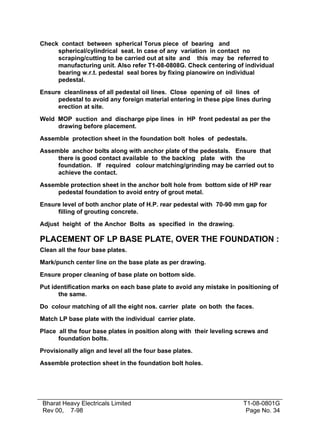
                • Ensure a float of 0.30 + 0.10mm during color matching of the
                  thrust pads. If necessary the minor adjustment of shims may be
                  carried out in the bearing pads.
                • Before installation of thrust bearing along with thrust pads in
                  position the both halves may be bolted out side and their pads
                  may be checked for color contact over a surface plate also in
                  front and rear both sides. This will reduce the time cycle while
                  carrying out the color contact of the bearing with the rotor.
                • During overhauling of the unit the bearing contact are to be
                  rechecked and need correction. In case of torus to cylindrical
                  type of bearing if the contact are not satisfactory then the
                  bearing and its seat may be remachined at works. In spherical
                  to spherical bearing the variation in contact if noticed can be
                  corrected by matching/lapping at site. Sometimes the heavy
                  pitting marks are also noticed on same of the bearing and these
                  need correction by machining it.


Bharat Heavy Electricals Limited                                     T1-08-0801G
Rev 00, 7-98                                                          Page No. 68
Bharat Heavy Electricals Limited   T1-08-0801G
Rev 00, 7-98                        Page No. 69
Bharat Heavy Electricals Limited   T1-08-0801G
Rev 00, 7-98                        Page No. 70
Bharat Heavy Electricals Limited   T1-08-0801G
Rev 00, 7-98                        Page No. 71
STEAM TURBINE
             500 MW                        CRITICAL ACTIVITIES
                                              (BUMP CHECK)
             ERECTION


BUMP TEST
The axial clearance check is determined after radial clearance measurement has
been completed.
In this case the shaft is shifted in the “+” and “-” directions from its operating
position and the dimensions with the shaft in limit position are measured using a
depth gauge.

Note: Enter the measured values ( actual dimensions ) on the record sheet and
compare them with the specified dimensions.

If the deviations from the specified dimensions is greater then the permitted
tolerances, the manufacturer must be consulted.

Note : Based on the readings of bump check, axial position of the shaft wrt
casing is not to be altered.


 Bharat Heavy Electricals Limited                                    T1-08-0802G
 Rev 00,   7-98                                                   Page No. 72of 40
STEAM TURBINE
                  500 MW                          CRITICAL ACTIVITIES
                                                     (ROLL CHECK)
                  ERECTION


ROLL CHECK
GENERAL DESCRIPTION

In KWU machine the minimum radial clearances HP, IP and LP casing are measured
by actually by moving the casing radially at site while rotor is rotated by hand. This is
a very accurate and fast method of measuring the minimum radial clearance of any
of the casing.
The major variation in these reading may cause vibration in the machine and
obstruction in barring gear operation etc. Such facilities are not available in many
other designs of machine and causes longer duration in erection and overhauling of
the units.
After completing the alignment of rotors the casing alignments are carried out by roll
check method but equal importance should also be given to the centering of HP and
IP casing.
The centering of casing may not be fully sacrificed in comparison of rolling test
readings and a compromise between these two readings should be made. The rolling
test should be carried out in cold machine only.

PROCEDURE
ROLL CHECK OF HP AND IP CASING

             1.     Alignment and coupling of HP-IP and LP rotors are to be
                    completed before starting the rolling test of the casing in normal
                    case but this can be done without coupling of LP rotor also.


Bharat Heavy Electricals Limited                                           T1-08-0803G
Rev 00, 7-98                                                            Page No. 73of 40
STEAM TURBINE
                  500 MW                           CRITICAL ACTIVITIES
                                                      (ROLL CHECK)
                  ERECTION

             2.     Centering of the casing on HP front, HP rear IP front and IP rear
                    spigot are also to be completed before starting of the rolling test.
                    These readings can be compared as per the factory protocol also.
                    Fix temporary radial and axial keys of the casing before rolling test
                    of casing. During dialing on spigot a proper care should be taken
                    that the dials are properly mounted over the fixture and the
                    fixture fabricated at site is strong enough to give the correct
                    readings. The point dial indicator may be used here for the better
                    results of the dial readings.

             3.     All the four jacking screw of HP and IP casing are to installed along
                    with dial gauges for monitoring of up and down, and left and right
                    movement of the casing.

             4.     One number hydraulic jack on each corner of the casing along with
                    a spanner on each corner for jacking screw are also to be made
                    available.

             5.     During erection of machine the turbine rotor are generally rotated by
                    hand with the help of periphery holes on coupling. Two pipes of
                    about 1250 mm long along with a pin to suit the dia of periphery
                    may be used for rotating the rotor shaft. The initial jerk to the
                    rotor is given by the help of crane and it is further rotated by these
                    pipes through periphery holes of the coupling. During overhauling
                    generally the jacking oil system is available and the rotation of rotors
                    are achieved with the hand barring of the machine.

             6.     Before starting the rolling check it should be ensured that the rotor
                    shaft is absolutely free on manual rotation/hand barring as the
                    case may be. During manual rotation two persons are to be
                    employed for this work and during hand barring only one person is
                    enough.

             7.     Always use thick oil for rotation of rotor over bearing in absence of
                    jacking oil system. The type oil may be servo cylinder 1000 grade
                    (IOC) oil.

             8.     During the rolling test the temporary casing packers are to be fitted
                    with about 1.00 mm shims.

             9.     During the rolling test of any one of the casing the same is lifted first
                    on all four corners in a step of 0.05 mm with the help of hydraulic
                    jack and jacking screw. The rotor is also rotated manually side by
                    side with the lifting of casing. The rotation of rotor and lifting of


Bharat Heavy Electricals Limited                                              T1-08-0803G
Rev 00, 7-98                                                               Page No. 74of 40
STEAM TURBINE
               500 MW                              CRITICAL ACTIVITIES
                                                      (ROLL CHECK)
               ERECTION

                   casing continued till it becomes little bit tight on the seals of the
                   casing
                   After this the casing is lowered by about 0.05mm and rotor is
                   rotated again if it is completely free. In case the rotor is still tight on
                   its manual rotation the casing is further lowered by 0.05 mm on all
                   four corners. After ensuring the freeness of rotor it is again
                   rotated and casing is lifted simultaneously on front end till the
                   rotor rotation becomes tight on seals portion of the casing.
                   As soon as the shaft becomes tight the lifting of casing and
                   rotation of shaft is stopped and dial readings on front end are
                   recorded. The average lift on front end of the casing is the bottom
                   clearance on front end of the casing.
                   After this the casing on front end is lowered by 0.05 mm and
                   freeness of rotor is ensured. In case it is still tight the casing is
                   further lowered by 0.05 mm. On front end and the freeness of
                   rotor is achieved. Now the rear end of the casing are lifted similar
                   to front end and bottom clearance of rear end are recorded . After
                   recording the bottom clearance of front and rear end of
                   individual casing the casing is lowered with the help of hydraulic
                   jacks and jacking screws to its original zero-zero position.
                   Repeat similar operation of rotating the rotor and lowering the
                   casing on front and rear end for deciding the top clearance in front
                   and rear end of the casing. Before starting the rolling test in
                   downward direction of the casing remove about 1.00 mm shims
                   from each packer of the casing, but kept the casing on
                   hydraulic jacks and jacking screws on its original position. The
                   casing is again brought back to its original position by
                   installation of the shims back to the packers of the casing after
                   recording the top clearances of the casing.
                   After recording the up and down rolling test values the radial
                   keys of the casing are removed and again rolling test for left
                   and right direction are done similar to up and down. During this
                   process the radial dial on the casing are also installed. After this
                   check the casing is brought back to its zero position in radial
                   direction also.
                   After completing the rolling test readings of one of the HP/IP
                   casing in up/downand left/right direction the clearances are
                   readjusted as required at site in radial direction by moving the
                   casing with the help of temporary radial key or shims on the casing
                   packers. The casing is then locked on four corners and final dial
                   readings of spigot are recorded on front and rear end. Immediately
                   after this the final radial key of the casing are fixed and the
                   locked of the casing are released for fitting of the final casing
                   packers. The final spigot dial reading are repeated and confirmed
                   with the earlier readings.


Bharat Heavy Electricals Limited                                             T1-08-0803G
Rev 00, 7-98                                                              Page No. 75of 40
STEAM TURBINE
               500 MW                             CRITICAL ACTIVITIES
                                                     (ROLL CHECK)
               ERECTION

             10.   After doing the full rolling test and fixing of a final radial keys
                   and packers of one of the casing the rolling test of another casing is
                   done including the fitting of final keys and packers.

             11.   Necessary offset in the radial clear-ance is also kept before fitting
                   of final packers of the casing toward the lift of the shaft during
                   operation of the unit.

             12.   No inlet and outlet pipes are to be welded with the casing till
                   completion of rolling test and installation of final keys and packer
                   of the casing.


             13.   Radial clearance of the casing are to be ensured with reference to the
                   factory supplied protocol also.

             14.   After fitting of final keys and packers of the casing the final spigot
                   dial values of HP front, HP rear, IP front and IP rear casing are
                   to be recorded for future reference in the protocol.

             15.   The horn drop readings are also to be checked after the fitting of
                   final packer of the casing.

             16.   In case of IP casing the roll test readings are to be taken with the
                   IP front end rear shaft scales. The spigot dial readings are also to be
                   taken over the spigot of shaft seales.

             17.   During rolling test of the HP and IP casing if the rotor is rotated over
                   the jacking oil then the adjustment of readings are to adjusted for
                   the lift of the rotor also.

             18.   Four numbers 1.00 mm undersize packers for HP & IP casing may
                   be made during erection and supplied to customers as T&P items
                   for further roll test during overhauling of the unit. If any taper is
                   left on final packers of the casing then these four packers may be
                   made to similar taper also.


Bharat Heavy Electricals Limited                                           T1-08-0803G
Rev 00, 7-98                                                            Page No. 76of 40
STEAM TURBINE
                  500 MW                            CRITICAL ACTIVITIES
                                                       (ROLL CHECK)
                  ERECTION

ROLLING TEST OF L.P. INNER CASING

             1.     The rolling test of L.P. inner casing is done similar to the HP or IP
                    casing but both side joints of L.P. inlet bellows are kept free or
                    bellow itself are not positioned at all, till completion of rolling test.
                    But during overhauling the rolling test is done with already welded
                    bellows.

             2.     Rolling test of L.P. inner casing is done after the neck welding of
                    condenser andstiffener pipes inside the condenser. This include the
                    welding of stiffener pipes of L.P. casing and gusset plates also.

             3.     After rolling test of the casing the final radial keys of the Gusset
                    block and casing packers on all four corners are installed.

             4.     Necessary offset in the radial clearances of the casing is also kept
                    before fitting of final L.,P. inner casing packers.

             5.     Radial clearances of the casing are to be ensured to the design values.
                    In case of any variation the matter may be referred to the designers.

             6.     If the rotor is rotated on jacking oil then the rolling test readings
                    are to be adjuted for the lift of the rotor also.


Bharat Heavy Electricals Limited                                              T1-08-0803G
Rev 00, 7-98                                                               Page No. 77of 40
STEAM TURBINE
                  500 MW
                                                 CRITICAL ACTIVITIES
                  ERECTION                   (CATENARY AND ALIGNMENTS)


CATENARY AND ALIGNMENTS
General Description

The catenary of the machine is very important for a turbine and Generator assembly
to achieve proper alignment of various rotors and loading on their bearing. Any
deviation may lead to various operational problem in the machine like high shaft
vibration, high bearing vibration, high babbitt metal temperature of the bearing etc. To
avoid these problems it is necessary to maintain the catenary of the machine during
erection and subsequent realignment/overhaul of the unit. Many times it is observed
that though the alignment of rotors are within limit but the catenary as a whole get
deviated from the prescribed design value of the machine. In order to avoid such
derivation a need is felt to devise a procedure which shall ensure rotors alignment
alongwith proper catenary of the machine.

During first few years of the operation of the unit the possibility to the disturbance
of the catenary are much more due to settlement of the foundation frame.
 In each overhaul of the unit the catenary of the machine is to be corrected. The L.P.
front and L.P. rear pedestal are directly grouted here without any separate base
plate. As such any correction on lifting or lowering. These pedestals are not very
convenient so if necessary the rotor may be lifted or lowered with respect to pedestal
seal bore and required catenary may be achieved. In extreme cases these pedestals
may be even regrouted during major overhauls of the unit to correct the catenary of the
machine.
Procedure


             1.       Install a bench mark plate near L.P. rear pedestal as height of
                      the machine center line with the consultation of civil Engrs at site. A
                      plate of 200 m.m x 300 m.m size with 20 m.m thickness
                      machined/ground on top side may be welded over a I Beam or a
                      channel in level condition. This plate is to be installed very carefully
                      as this will be a future reference for setting up the all elevation of
                      the machine.

             2.       Record half bore error of all the four pedestals and confirm the
                      readings with the factory records also. The half bore error may be
                      checked in both upper half and lower half of the pedestal and same
                      may be punched on both halves in left and right side for all
                      future references of the machine.

             3.       During alignment of pedestal at the time of grouting with conbextra
                      cement set the height of the pedestals as per required catenary of
                      the machine considering +value for the half bore error of the

Bharat Heavy Electricals Limited                                              T1-08-0804G
Rev 00, 7-98                                                               Page No. 78of 40
STEAM TURBINE
                   500 MW
                                               CRITICAL ACTIVITIES
                   ERECTION                (CATENARY AND ALIGNMENTS)

                    pedestals. While setting the height of the pedestals it should be kept
                    in mind that the height for the center of the pedestal bore are to be
                    kept as per the catenary of the machine not the parting plane of
                    the pedestal.

             4.     For better results four water level jar connected to each other with
                    a polythene pipe may be installed on each pedestal. The D.M., water
                    may be used here and leakage through polythene tubes should be
                    avoided fully while making the connections. These jars may be
                    fabricated at site by about 125 mm. dia pipe with a plate welded in
                    bottom and then machined for better seating on pedestal base. The
                    height of the jar may be kept as about 175 mm. A depth
                    micrometer installed and clamped over a magnetic base is also
                    required for measurement of the water level in the jar. The
                    micrometer point is to be made very sharp by grinding it. Here the
                    magnetic base of the 0-10mm dial gauge may be used.

             5.     .During measurement of water level in the jar the micrometer is to be
                    kept approximately in center of the jar. The micrometer along with
                    the magnetic base to be transferred from one pedestal to another
                    pedestal very carefully so there is no disturbance to the height of the
                    micrometer. All the necessary care are to be taken during this
                    measurement i.e. there should not be any air bubble in the polythene
                    pipe and the polythene pipe should be kept as stationary.

             6.     While finalizing the catenary of the machine these measurements are
                    to be repeated 3-4 times in a day at different intervals to avoid any
                    possibility of the error.

             7.     The height of the L.P. rear pedestal is the reference point for setting
                    the height of all other pedestal and L.P. base plates. The L.P. rear
                    pedestal height is to be first made with the benchmark plate as per
                    the center line of the machine with the help of water level jar.

             8.      The benchmark plate is to be preserved for all future references.

             9.     The catenary is to be counter checked after grouting all the
                    pedestals as well as after final alignment of the rotors. The final value
                    of the catenary may be worked out as center of the shaft on each
                    pedestal bore after taking the final seal bore readings. The final
                    catenary should match with the design value of the catenary
                    otherwise a necessary correction may be carried out.

             10.    After ensuring the required catenary of the machine the coupling
                    alignments are to be made as parallel coupling.
Bharat Heavy Electricals Limited                                             T1-08-0804G
Rev 00, 7-98                                                              Page No. 79of 40
STEAM TURBINE
                   500 MW
                                                CRITICAL ACTIVITIES
                   ERECTION                 (CATENARY AND ALIGNMENTS)

             11.      The value of the catenary given over the drawing are theoretical value
                      calculated by the designers but due to the human error in site
                      measurements some time the correct coupling alignment are not
                      achieved then an alternate method for checking of catenary may
                      also be used i.e. optical measurement method or a method by which
                      direct journal heights are taken on each bearing in place of pedestal
                      height.

             12.      For measurements of direct journal height a special fixture is to be
                      fabricated and necessary information about it can be separately given
                      by PS-TS if such necessity arises.


HORN DROP TEST
General description

By horn drop test the loading of the casing on each corner is determined. The horn
drop test is repeated at various stages in individual casing i.e. first without connection
of any pipe lines the horn drop readings are recorded then it is compared after welding
of inlet, outlet and extraction pipe lines etc. The horn drop readings are very important
in HP & IP casing. First the proper horn drop readings are made without connection
of any pipe lines and then the reading are taken after welding of all pipe lines on HP
& IP casing. As such the influence of these major pipe lines are notices on each
corner of HP/IP casing by comparing the horn drop test readings. The horn drop test
will indicate the quality of work during assembly/welding of pipe lines with the HP & IP
casing.

This is a very important check and may cause serious problem in operation of the
machine like high vibration in the machine failure of barring gear in hot/cold machine,
obstruction during expansion of machine etc. In horn drop test a drop is measured on
an individual corner of the casing with the help of a dial indicator by removing the
support of individual corner and then it is compared with the opposite corner. As such
this gives an indication of indifferent loading of the casing. In Russian design machine
the value of direct dynoxmetre loadings are recorded in place of this horn drop test.


Bharat Heavy Electricals Limited                                             T1-08-0804G
Rev 00, 7-98                                                              Page No. 80of 40
STEAM TURBINE
                  500 MW                          CRITICAL ACTIVITIES
                                                   (HORN DROP TEST)
                  ERECTION

             1.       Procedure

             2.      After placement of HP and IP casing on four temporary packers
                     ensure that the each corner of the casing is loaded on temporary
                     packer and if necessary the shims may be given on packer for loading
                     of the casing. The load of shaft is also taken on transport device
                     during this stage.

             3.      After transferring the load of the rotor on bearing and ensuring the
                     casing centering with respect to shaft the horn drop check may be
                     carried out.

             4.      Before taking the horn drop reading ensure that the enough
                     clearance is available on front & rear portion of the shaft with their
                     seals in the casing inside. After completing the centering of the
                     casing the some may be lifted by 0. 20 mm on all four corners by
                     providing shims. This will help in avoiding the touching of seals with
                     the rotor during the horn drop test readings.

             5.      No adjustment on packer of the HP front and HP rear pedestals are
                     to be carried out after taking the horn drop test of the casing In
                     case if any adjustment is carried out on these pedestal packers then
                     horn drop test are to be repeated again.

             6.      No piping may be connected to HP & IP casing till initial horn drop
                     readings are over. The piping work should not be postponed for
                     want of horn drop the only thing the last joint with HP/IP casing may
                     be left free till completion of horn drop check.

             7.      While recording the horn drop readings the casing must be
                     absolutely free and even the radial and axial key of front and rear
                     portion of the casing are either to be removed fully or these are to be
                     made completely free by removing their shims etc. Actually during
                     this stage of erection only temporary axial and radial keys are fitted
                     in the casing and even they carry some shims also. Before making
                     the casings free on axial and radial key portion the dial gauges are
                     to be installed to monitor the movement of the casing on radial
                     and axial direction. Immediately after the completion of the horn
                     drop test these keys/shims may be installed back and centering of
                     casing may be rechecked before further works.

             8.      In HP casing the initial horn drop test may be done even after fitting
                     of breach nut assembly and HP exhaust elbow of both sides.


Bharat Heavy Electricals Limited                                             T1-08-0806G
Rev 00,   7-98                                                            Page No. 81of 40
STEAM TURBINE
                  500 MW                           CRITICAL ACTIVITIES
                                                    (HORN DROP TEST)
                  ERECTION

             9.      In IP casing the initial horn drop test may also be done after fitting
                     of IP inlet pipe lower half assembly but this pipe of upper half
                     casing should not be fitted till completion of the horn drop test.

             10.     All the four Jacking screw and hydraulic jack on each corner of
                     the casing are to be installed for the horn drop test readings. A dial
                     indicator is also to be installed on each corner of the casing for
                     measuring the drop of the casing.

             11.     After initial centering of the casing the each corner packer may
                     be fitted with a shim of about 1 mm. for further adjustment during
                     the horn drop test.

             12.     During the horn drop test the individual packer of the casing is
                     removed and the load of that corner is supported over the jacking
                     screw of the casing. Now gradually the jacking screw is also relieved
                     with the help of hydraulic jack on that corner and drop reading is
                     recorded. This is repeated for each corner of the casing. In case of
                     variation in left and right side reading the drop is adjusted by +
                     adjustment of shims from left to right side or vise-versa. No
                     subtraction / addition in shim sizes from outside is done here and
                     only the shims are adjusted from left to right or vise versa till equal
                     loading are achieved in left/right side of individual casing. The sizes
                     of these casing packers are recorded after completion of horn drop
                     to avoid any confusion at a later date while fitting the final packers.

             13.     While recording the horn drop readings the drop on each
                     individual corner may be controlled with the help of Jacking screw
                     so that during this test the casing is not touching with the shaft in
                     gland portion of the seals at all and enough clearance is left there to
                     avoid damage to the seals inside the casing.

             14.     During the initial horn drop the best reading within 0.05/0.06 may
                     be achieved by fine adjustment of the packer shims. The
                     comparison in horn drop value should always be made in left and
                     right side only of an individual casing.

             15.     In case of HP casing the drop on rear end is so high that unless
                     the casing is locked on diagonally opposite end the horn drop check is
                     not possible. Therefore while recording drop on HP rear end the
                     front end of the casing diagonally opposite to it should be locked
                     with casing clamp. The pedestal is also required to be locked on all
                     four side with its sole plate with the help of the clamps. In case of IP
                     casing no locking of any corner of the casing is necessary during the
                     horn drop test.

Bharat Heavy Electricals Limited                                             T1-08-0806G
Rev 00,   7-98                                                            Page No. 82of 40
STEAM TURBINE
               500 MW                           CRITICAL ACTIVITIES
                                                 (HORN DROP TEST)
               ERECTION

             16.   The final packers on HP & Ip casing are installed only after
                   completing the rolling test of these casing., The horn drop reading
                   for an individual casing may be recorded after the fixing of final
                   packers also. If necessary a fine adjustment may be carried out at
                   this stage to achieve correct value of the horn drop reading.

             17.   After completing the welding of all pipe lines with the casing , the
                   horn drop readings are repeated again for comparison with the
                   earlier readings. These readings are taken along with its radial and
                   axial keys of the casing.

             18.   During this stage exactly this can not be defined that how much
                   variation is permitted on these values of horn drop readings., But
                   this variation will indicate the influence of the piping load on the
                   HP/IP casing caused due to welding/connection of various pipe lines
                   with the casing. The variation in horn drop readings are permitted
                   as long as sufficient positive loading is there on each corner of the
                   casing. But if any corner of the casing is fully
                   unloaded/heavily loaded then there is no choice left and pipe lines
                   are to be corrected by dismantling it and making again a free joint
                   with the casing.

             19.   During variation of horn drop reading no correction is to be made
                   on casing packers by adjustment of shims etc. The variation at this
                   stage is caused due to the piping pull/push only so if any correction
                   is required then the same may be carried out in piping joints and
                   support etc. And any adjustment in piping supports can be carried
                   out only after disconnecting the pipe line with the casing. Even
                   some time it is necessary to cut the individual or more piping joint
                   for correction of horn drop readings.

             20.   The variation in horn drop reading of left and right side of a casing
                   may be permitted upto a difference of 50%.

             21.   The horn drop readings are not taken for L.P. inner outer casing due
                   to its fabricated structure and the parting plane of the casing are
                   leveled on four corner with the help of water level jar arrangements.


Bharat Heavy Electricals Limited                                          T1-08-0806G
Rev 00,   7-98                                                         Page No. 83of 40
STEAM TURBINE
                  500 MW                         CRITICAL ACTIVITIES
                                                   (SWING CHECK)
                  ERECTION


SWING CHECK
GENERAL DESCRIPTION

The swing check is the measurement of radial throw caused due to coupling
face geometric form of the two rotor coupled together. This is measured on opposite
end of the coupling and at the free end of the rotor. The higher swing check value
may cause higher shaft vibration, higher bearing shell temperature etc. The value of
swing check depends on axial runout of coupling faces, the diameter of the coupling
and the length of the rotor. During the machining of rotors in the works some
tolerances are permitted by Designer's on the coupling faces of the rotor resulting to
some swing check values. The maximum swing check values permitted caused
due to the above tolerance for different diameter and length of the rotor can be
worked out from the enclosed graph. However it is recommended to keep the
minimum swing check values for better results during operation of the machine.

In a multi rotor Turbine-Generator system it is essential to measure the swing check
value in both extreme end and where the weight of the rotors are light. For example
200/210 M.W. KWU machine with Russian Generator and static excitation system
the swing check values are measured on HP rotor front end only. In 500 M.W.
machine the swing check values are measured in H.P. front end and on exciter rear
end. After having general experience of number of 200 MW & 500 MW units, a
necessity is felt to measure swing check value on IP rotor front end also for better
results during operation of the units. This can be done initially during erection with
temporary coupling bolts on LP-IP coupling before reaming/honing of coupling. Any
variation in swing check values may be corrected without any hesitation during
erection of machine. Any compromise at erection stage may cause serious problem
during operation of the unit and any correction becomes much more tedious a later
stage. The correction may be carried out either by interchanging the coupling
position or by correcting the coupling faces by scrapping/cutting in consultation
of Designers.

PROCEDURE


             1.      Before placement of Module/Rotor in position the coupling faces of
                     all the rotors are to be measured for concavity/convexity of their
                     coupling faces. This can be checked with the help of a thin
                     rectangular light weight straight edge. No convexity is permitted on
                     these coupling faces however a concavity of about 0.03/0.04 mm is
                     permitted. In case of any variation the matter may be referred to
                     manufacturing units.

             2.      After placement of individual Module/Rotor the coupling faces
                     are to be measured for axial runout before taking up alignment of
Bharat Heavy Electricals Limited                                          T1-08-0806G
Rev 00,   7-98                                                         Page No. 84of 40
STEAM TURBINE
                  500 MW                          CRITICAL ACTIVITIES
                                                    (SWING CHECK)
                  ERECTION

                     various rotors. The HP rotor rear coupling face can be measured
                     after placing it on both of its bearing. The IP rotor faces are to be
                     measured after placing IP rear end on bearing and front end on
                     lifting tackle. Similarly L.P. rotor, may be placed on bearing on its
                     rear end and front end supported on lifting tackle. Any variation on
                     axial runout on coupling faces for more then the 0.02 mm. may be
                     referred to Designer's before taking up further works.

             3.      After completing final alignment of various rotor they are to
                     be coupled with temporary bolts, considering their axial
                     runout/geometric form of the coupling faces.


             4.      During coupling with temporary bolts the higher plane of one of
                     the rotor face is to be coupled with lower plane of another coupling
                     face of the rotor.

             5.      During coupling on temporary bolts the uniform tightening on all the
                     four temporary bolts are to be ensured otherwise it will disturb the
                     swing check value of the rotor.

             6.      First IP-LP coupling is to be made with temporary bolts and swing
                     check on IP rotor front end is recorded. After this only HP-IP rotor
                     is to be coupled with temporary bolts and the swing check value on
                     HP front rotor is recorded.

             7.      During swing check of IP rotor its front end is to be supported
                     on lifting tackle without making any connection between HP-IP
                     rotor.

             8.      While recording swing check of HP rotor the front end of the rotor is
                     to be supported on lifting tackle.

             9.      During swing check the lifting tackle are to be fitted properly. The
                     tie rod of lifting tackle should be ensured for correct fitting of its
                     spherical bearing and Molykote should be applied on these spherical
                     bearing for their free movement. These spherical bearing should
                     not obstruct the movement of shaft radially during checking of its
                     swing check value.

             10.     After taking the load of the rotor on lifting tackle ensure that the
                     rotor is not disturb radially due to fitting of lifting tackle.

             11.     During checking of swing check measure radial movement of rotor
                     on parting plane and rotate the rotor either on jacking oil with hand

Bharat Heavy Electricals Limited                                             T1-08-0806G
Rev 00,   7-98                                                            Page No. 85of 40
STEAM TURBINE
               500 MW                            CRITICAL ACTIVITIES
                                                   (SWING CHECK)
               ERECTION

                   barring or with the help of E.O.T crane with thick oil on bearings.
                   Avoid jerk during rotation of rotor while recording the swing check
                   values.

             12.   After ensuring the swing check values as per the graph with on
                   temporary coupling bolts, the HP-IP and LP-IP coupling may be
                   cleared for reaming / honing of the coupling holes. Any variation
                   need correction of the coupling before reaming/honing of the holes.

             13.   The final swing check value of HP front rotor is to be recorded after
                   fitting/ elongation of all the coupling bolts of HP-IP & LP-IP rotors.
                   Any variation in readings may be referred to the Designer's. For
                   improvement of the swing check values, the indifferent tightening
                   and non-sequential

             14.   During checking of swing check readings, the initial few rotations are
                   to be given to the rotor to avoid initial sag and then only the readings
                   are to be recorded.

             15.   Similar method is to be adopted while checking the swing check
                   value of the exciter except the rotor is hanged on the suitable size of
                   sling in place of the lifting tackle.

             16.   While recording the swing check initially with temporary bolts for
                   HP & IP rotor, the fitting of eight number temporary bolts are
                   preferred in place of four bolts on the coupling.


Bharat Heavy Electricals Limited                                            T1-08-0806G
Rev 00,   7-98                                                           Page No. 86of 40
STEAM TURBINE
               500 MW              CRITICAL ACTIVITIES
                                     (SWING CHECK)
               ERECTION


Bharat Heavy Electricals Limited                       T1-08-0806G
Rev 00,   7-98                                      Page No. 87of 40
STEAM TURBINE
                  500 MW                          CRITICAL ACTIVITIES
                                             (COUPLINGS & ALIGNMENTS
                  ERECTION                         OF ROTORS)


COUPLINGS & ALIGNMENTS OF ROTORS
GENERAL DESCRIPTION

The coupling on turbine shaft are generally rigid coupling but in case of L.P. rotor
sometime the coupling head are shrunk fit and remachined. The basic function of any
coupling is to connect two or more shaft together to form a shaft assembly. The number
of shaft mainly depend upon the rating of the machine.
A very high accuracy is required during manufacturing of these rotor shaft at
works. The axial runout on the coupling face may not exceed 0.02 mm. and an
additional check is also made at works/site to ensure that the geometry of the entire
coupling surface does not deviate by more then the 0.02 mm. except the concavity on
the coupling face which is permitted upto 0.03/0.04 mm.
The radial and axial alignment of the various shafts are to be completed before their
coupling and alignments are to be done in such a way that the entire shaft
assembly follow the continuous deflection curve given over the drgs. for a particular
machine. The coupling checks determines both the radial and axial position of the
two adjacent coupling flanges relative to one another. The radial measurement are
performed on the circumference of the couplings and the axial measurement are
performed on outer most diameter of the coupling. During coupling of the two shafts
it should be ensured that the no stresses are exerted as a results of the coupling
each other shaft.
After completion of the alignment and coupling of the shaft the casings are aligned
radially and axially. Here equal importance is given to the radial & axial alignment of
stationary parts to avoid any rubbing during operation of the machine due to expansion
of stationary and rotary parts.
During the alignment of two coupling both are to be turned in same direction and by
the same amount when the measurement are taken to avoid the influence of the axial
& radial runout present in the shaft caused due to the machining.

PROCEDURE


             1.     Before placement of module/rotor in position check and record the
                    coupling hole and journal dia of the shaft.

             2.     Check coupling faces for the concavity/convexity with the
                    help of a thin rectangular straight edge before placement of
                    module/rotor in position.

             3.     Check spigot and recess of the coupling and ensure their fitting
                    before placement in position.

             4.     Place the module/rotor in position and check the radial runout of
                    journal and axial runout of the coupling faces independently of
Bharat Heavy Electricals Limited                                          T1-08-0807G
Rev 00,   7-98                                                         Page No. 88of 40
STEAM TURBINE
                  500 MW                           CRITICAL ACTIVITIES
                                              (COUPLINGS & ALIGNMENTS
                  ERECTION                          OF ROTORS)

                    each shaft. During checking of radial and axial runout of the shaft
                    place H.P. rotor on both of its bearing and IP/LP rotor one end
                    on its bearing and another end on the lifting tackle. The radial and
                    axial face runout on the shaft should be within 0.02 mm accuracy.
                    Any variation may not be permitted here and matter may be
                    referred to the designer's.

            5.      The HP,IP & LP rotor are aligned together and then their couplings
                    are made. After fully completion of HP/IP & IP/LP coupling with
                    tightening of their final bolts the complete shaft is cleared for
                    Generator rotor alignment.

            6.      During initial alignment of HP/IP & IP/LP rotor the radial checks
                    are generally done with the help of depth micrometer and axial
                    gap are measured with the slip gauges. After completion of the
                    radial alignment the rotor are inserted in their spigot even with some
                    minor variation in their axial gap values.

            7.      During final alignment only the axial gap values are checked at 90o
                    on four places by rotating both the rotor together and average of
                    these four reading are taken. The radial alignment reading along
                    with axial gaps are necessary wherever the effective spigot are not
                    existing in two couplings i.e. in case of LP - Gen coupling the radial
                    dial reading are also taken.

            8.      Avoid rotation of two shaft in their spigot. If necessary these may
                    be rotated after taking out from their spigot.

            9.      During alignment of shafts the adjustment of shims in bearing torus
                    may be fully avoided. The margin of + 0.30 mm. in height & left/right
                    direction may be kept for emergency works only. Any adjustment
                    during erection and normal overhauling may be done by adjusting
                    shims between spherical/cylindrical seat and pedestal base only. For
                    left and right adjustment the complete H.P. front and HP rear
                    pedestal may be moved with the help of their radial keys.

            10.     The final packers of the pedestal and base plates are fitted before the
                    grouting of the pedestal itself and here no adjustment is necessary
                    during erection of the machine. But during overhauling of the
                    machine the adjustment may be carried out in these packers for
                    correction of catenary of the machine.

            11.     During alignment of rotor make HP/IP and IP/LP coupling gap
                    parallel. After completion of final alignment no adjustment of
                    packers and keys etc are permitted on pedestals and bearing the

Bharat Heavy Electricals Limited                                           T1-08-0807G
Rev 00,   7-98                                                          Page No. 89of 40
STEAM TURBINE
                  500 MW                          CRITICAL ACTIVITIES
                                             (COUPLINGS & ALIGNMENTS
                  ERECTION                         OF ROTORS)

                    final alignment of HP/IP & IP/LP rotors should be checked after
                    fitting of all the final keys and packers of the pedestals.

            12.     After alignment couple the HP-IP & IP-LP rotors on temporary
                    bolts. Record coupled runout of the rotor and ensure that the
                    coupled runout is not more then 0.03 mm. in any where in the
                    journal as well as in coupling area. Before coupling of rotor on
                    temporary bolts record their spigot clearances by actually moving
                    the rotor radially.

            13.     During erection IP-LP swing check on IP front and HP-IP swing
                    check on HP front are to be recorded on temporary bolts. These
                    reading are to be ensured within the design limit.

            14.     Before alignment/coupling position the two shaft adjustment to each
                    other depending upon the higher and lower point of the shaft with
                    respect to their axial face measurement values.

            15.     The HP-IP & IP-IP coupling may be cleared for reaming/honing
                    after ensuring the runout and swing check values of the rotors. In
                    case of variation the cause of the error may be identified and
                    corrected before further work of reaming and honing of the
                    coupling.

            16.     During coupling of rotors two taper pins may be used for proper
                    alignment of coupling holes so that there is minimum
                    enlargement of holes are done at site during reaming/honing.
                    Unnecessary enlargement of holes may be fully avoided during
                    reaming/honing at site as this may cause serious problem at a later
                    date during overhauling of the unit.

            17.     As for as possible ream/hone all the coupling bolts holes to
                    same size. In exceptional cases only the variation in hole sizes
                    are permitted. Each hole during honing should be checked for
                    bananas shape with the help of a parallel ground straight pin of
                    0.02/0.03 undersize. No banana shape is permitted in any of the
                    hole. The hole should be made to 0.005 mm accuracy.

            18.     All the coupling bolts are to be machined and ground by 0.02/0.03
                    mm undersize then the hole dia. These bolts are to be fitted with
                    thumb pressure only and no additional force is recommended while
                    fitting these bolts.

            19.     A very thin layer of molykote may be applied on all the coupling
                    bolts during their fitting. The molykote should not be applied on

Bharat Heavy Electricals Limited                                         T1-08-0807G
Rev 00,   7-98                                                        Page No. 90of 40
STEAM TURBINE
                  500 MW                           CRITICAL ACTIVITIES
                                              (COUPLINGS & ALIGNMENTS
                  ERECTION                          OF ROTORS)

                    seating face of the coupling bolts. This may cause in breaking of
                    their locking pin during elongation of coupling bolts.

            20.     All the coupling bolts are to be balanced before finally
                    fitting/tightening in position. These are to be balanced within an
                    accuracy of 5 gms each along with their nuts. In case all these bolts
                    are of equal size then their weight must be equal. In exceptional
                    cases the 180o opposite bolts may be made of equal weight.

            21.     During tightening of coupling at any stage first tighten four bolts on
                    90o location. Always tighten bolts in proper sequence with
                    180o opposite bolts. These bolts are to be elongated to the value
                    given over drgs.

            22.     During tightening of coupling the radial runout on journal and
                    coupling may be checked at various stages during tightening of
                    bolts. The final coupled runout should not be more then 0.03 mm. on
                    coupling and journal of the shaft.

            23.     After final tightening of LP-IP and HP-IP coupling the swing check
                    value on HP front rotor is to be rechecked. In case of variation in
                    value a proper correction is to be made with consultation of
                    designer's. The indifferent or unsequential tightening for achieving
                    the swing check value or coupled runout value may be fully avoided.
                    this may cause unnecessary stresses on the coupling.

            24.     After completing the coupling work the casing radial and axial
                    alignment may be done.


Bharat Heavy Electricals Limited                                           T1-08-0807G
Rev 00,   7-98                                                          Page No. 91of 40
STEAM TURBINE
            500 MW
            ERECTION


Welding of steam inlet and exhaust pipe lines with HP and IP
casing
In 210 MW machine the HP Turbine is supplied with two inlet and two exhaust flanges
for connection of the pipe line.but in case of 500/250 MW HP Turbine the casing is
supplied with four inlet flanges also. As such in 200 MW machines, only two ESV
control valves are used in the system. Whereas in 500/250 MW machines , It may be
either two ESV oontrol valves or four ESV control valves to cope with the design of the
casing.
Similarly in 210 MW machines, the I.P. casing is supplied with two inlet flanges and
eight number exhaust branches or either two exhaust branches only along with two inlet
flanges. These eight number exhaust branches are distributed four on each side of the
casing and each four branches are joined together with one common pipe while
connected to L.P. casing. The 500 MW I.P. casing is similar to the 210 MW I.P. casing
but some time these are supplied with four numbers of I.V. control valves also. The
inlet lines from each two control valves are joined together and make one connection
with the I.P. casing in bottom. As such in 210 MW machines, only two I.V. control
valves are used but in case of 500 MW machines, there can be either two I.V. control
valves or four I.V. control valves.
After completion of the rolling test the installation of final keys and packers of the H.P.
and I.P. casing, the same can be cleared for welding of inlet and outlet pipelines. The
main steam inlet line from main steam strainer to the control valves and then from
control valves to the H.P. casing need much more care during erection / welding of the
pipelines. Similarly the Hot Reheat lines between two Hot Reheat strainer to the control
valves and from control valves to the I.P. casing also need equal care during erection /
welding of these pipelines. These pipelines are directly affecting the performance of the
turbine during operation of the machine and a necessity is felt to fully involve the turbine
Erection Engineer in erection / welding of the pipelines at site along with the Piping
Engineers. The piping connection between I.P. casing to L.P. casing i.e. cross around
piping also need proper care but due to its construction with number of bellows in the
system. Present method of erection / welding much of the problems are not faced
during operation of the machine. However if proper care is not taken here then that
may cause the unnecessary loading on the various bellows of the piping and reduction
in their life. In case, if proper care is not taken during erection / welding of MS inlet,
CRH & HRH connections with HP & IP casing, a load will be transfer from the pipe line
to the casing. Which may cause vibration in the machine, obstruction in expansion of
the machine, obstruction of barring gaer operation in hot / cold machine, higher babbit
metal temperature and failure of brg. babbit etc. during operation of the machine.


Bharat Heavy Electricals Limited
Rev 00,   7-98
STEAM TURBINE
           500 MW
           ERECTION


PROCEDURE
The following points are to be taken care while welding MS, CRH, HRH pipelines
      with HP & IP casing and control valves / strainers.

             1.    The HP & IP casings are to be cleared in all respects after fitting of
                   final packers and axial / radial keys of the casing.

             2.    The ESV & IV valves are to be cleared after fitting of their
                   servomotors and then levelling including the correct elevation etc.

             3.    The equivalent insulation weight is to be given on each control valve
                   befor connection of any pipeline with the valve. The change in hanger
                   value of the control valve is to be adjusted back by lifting the valve
                   with the help of hangers. The control valve hanger reading should
                   remain same as before and after installation of equivalent insulation
                   weight on the valve. After this all the three hangers of each valve are
                   to be locked to avoid any movement of the valve in upward direction,
                   in case the equivalent insulation weight is removed or any of the
                   servomotor is removed. Before starting of any welding with the
                   control valve the valves are to be locked for their movement.

             4.    Erection and welding of MS line upto MS strainer and HRH strainer
                   are to be completed first including either their insulation or
                   equivalent weight is to be given for their insulation weight in the lines.
                   These lines should be in perfect floating condition on their hangers
                   before taking up the further work of MS & HRH lines upto the ESV
                   & IV control valves.

             5.    Install MS & HRH lines between strainer and control valves and weld
                   all the inbetween joins of the pipelines except the end joints with the
                   valves and strainers. These lines are to be erected in such a way that
                   both the end joints remain free and parallel with the strainer and
                   control valve after taking their load on hangers. The freeness of
                   joints are to be ensured after giving the equivalent insulation weight
                   of the lines.

             6.    Weld MS & HRH lines with the strainers and again ensure the
                   freeness / paralalllity of MS & HRH lines with the ESV and IV
                   control valves. Any minor variation may be readjusted on hangers to
                   obtain the freeness of the joints with the control valve.

             7.    Install the MS and HRH lines between control valves and HP /IP
                   casing . Now all the in between joints may be keeping the end joints

Bharat Heavy Electricals Limited
Rev 00,   7-98
STEAM TURBINE
           500 MW
           ERECTION


                   free with the valve and the casing. The erection of these lines are to
                   be done in such a way that freeness and parallelity of end joints are
                   achieved after fully floating the pipe lines on their hangers. The
                   equivalent insulation weights are also to be added during erection of
                   these pipe lines before welding the end joints.

             8.    After ensuring the freeness and parallelity of the end joints between
                   ESV control valve and HP casing , the same may be welded together.
                   But the stress relieving of all the in -between joints of the lines are to
                   be completed before taking up work of the above last two end joints .
                   Similar proceedure may be followed for the lines between I V valves
                   and IP casing also.

             9.    Weld left and right MS and HRH joints togethers with the HP and IP
                   casing to avoid any left and right loading on the casing . during
                   welding the left and right movements of casing may be monitored by
                   installing the radial dial gauge on the casing.

             10.    The CRH lines are to be erected on their permanent hangers and the
                   joint with the HP casing are to be made free /parallel after floating
                   the pipe lines. The left and right side casing joints are to be welded
                   together , similar to MS lines but before weling of these line the in-
                   between joints are to be completed first . The equvalent insulation
                   weight is also to be given on these line while checking the freeness of
                   end joints with the HP casing.

             11.   The horn drop readings are to be recorded for both HP and IP casing
                   after copletion of the job including insulation of pipe lines and
                   control valve etc.


SPECIAL CARE


Bharat Heavy Electricals Limited
Rev 00,   7-98
STEAM TURBINE
           500 MW
           ERECTION


             1.    If possible keep the insulation weight and servomotors on ESV and I
                   V control valves during erection /welding of these MS & HRH lines
                   from strainers to the valve and casing . If the above condition are
                   fulfilled then there no need of any locking of the valves during the
                   welding of any pipe lines.

             2.    The control valves hanger readings are to be measured with the inside
                   micrometer in various stages and changes are to be monitored
                   properly . The readings are to be measured in the following stages :-
                   − After complete leveling of ESV and IV control valves with their
                     servomotors
                   − After putting the equivalent insulation weight on the control
                     valves.
                   − After readjustements of control valve height equivalent to
                     insulation weight.
                   − After connection of MS &HRH lines with the strainers .
                   − After connection of MS & HRH lines with the HP & IP casing .
                   − After complete insulation of control valve and pipings.

             3.    Ensure proper clraning of MS and HRH lines between controls valve
                   and casing as these lines are not covered in steam blowing operation .
                   Proper care is to be taken during erection of these lines to avoid entry
                   of foreign material.

             4.     The steam blowing of the MS and HRH pipe line are to be carried out
                   after fully completing the erection /welding of lines from control valve
                   to the HP and IP casing .

             5.    All the four corners of the casing may be locked with the casing clamp
                   during welding of piping joints to avoid movement of casing radially.

             6.    The load of the upper half HRH pipe upto the flange supplied by
                   turbine supplier is taken by the IP casing and by the piping hangers.
                   This may be taken care while erecting the HRH lines.


Bharat Heavy Electricals Limited
Rev 00,   7-98
STEAM TURBINE
            500 MW
            ERECTION


                  SPRING LOADED FOUNDATION
The spring support for TG foundation in our country is a new development though some
of the machines are already in operation with spring loaded foundation at various power
stations. Most of TG foundation built in Germany in last 20 years are spring loaded
foundation. The various machines in operation with BHEL supplied equipment and
spring loaded foundations are Dadri 4x210 MW , Trombay 1x500 MW, Dahanu 2 x 250
MW. Similarly the machines which are going to come with spring loaded foundation
with BHEL equipment are Chandrapur 1 x 500 MW , Suratgarh 2x250 MW , Unchahar
2x210 MW and Vindhyachal 2x500 MW.

The spring units for all the above TG foundations are supplied by M/s GERB which they
call the GERB vibration isolation system for TG foundation.

In BHEL , we have yet to satisfy fully ourselves about the advantages of this system
after getting the feed back from various machines under operations with spring loaded
foundation though the advantage claimed by M/S GERB are listed below:


1.0 REDUCTION IN BASE MAT SITE AND ITS COST :
The vibration to the main column are isolated by the spring element resulting to small
size base mat which reduces the construction cost and time.


Bharat Heavy Electricals Limited
Rev 00,   7-98
STEAM TURBINE
            500 MW
            ERECTION


2.0 REDUCTION IN NUMBER OF COLUMNS:

The same column of TG deck may also be used to support surrounding floors at the
building , so that the total number of columns are reduced and the space to
accommodate more equipment is increased. This results in more rigidity of building
structure of surrounding floors and further in cost saving.


3.0 EASY HANDLING OF SETTLEMENT PROBLEMS:

Excessive settlement of column can easily be adjusted by inserting or removing shims
in spring units.


4.0 SUBSEQUENT TUNING OF THE FOUNDATION :

It is possible to tune the foundation subsequently by replacing the spring elements
having different load capacity of the springs.


5.0 EARTHQUAKE PROTECTION :
Machine will have more steadiness and stability in the event of earthquake compared to
normal foundations.


Bharat Heavy Electricals Limited
Rev 00,   7-98
STEAM TURBINE
            500 MW
            ERECTION


             INSTALLATION OF SPRING ELEMENT:
The spring element in 500MW machines and further higher rating machines are used
with visco dampers. The springs units are not supplied to site with required pre-tension
values through these are supplied with some amount of pre-tension. The required pre-
tension of the spring units are done at site before its installation in position. A special
device for pre-compression of these springs units is also supplied by spring supplier.

The shuttering of RCC slab of TG deck is furnished before installation of these spring
units. The top surface of individual column where these spring units are mounted
should be within accuracy of +00 mm to -3.00 mm. If necessary these may be
corrected by chipping before installations of the spring units. The level deviation among
various columns is permitted +00 mm to -5.00 mm in total including individual column
variation of +00 mm to -3.00 mm.

The bottom shuttering of pedestal must be cut over the column head for lowering the
spring units. After lowering the spring unit the cover steel plates are placed in position
with shuttering supports. An air gap of about 5.00 mm to 10.00 mm is left between
cover plate and spring units for settlement of deck during casting. The visco dampers
are also filled up at site only with visco liquids supplied by spring supplier. The filling
procedure of visco liquid is explained separately by the spring supplier.

Each spring units are placed over the resistance pad to avoid movement of the spring
units during operation of the machine. Similarly the resistance pad is given on top of
the steel shim to avoid the shifting of the shim during operation of the machine. Each
spring unit is provided with 10.00 mm of steel shim for future adjustment.

The spring units are not only pre-compressed for dead load of the machine but it is
further pre-compressed to prevent the loosening of the spring during installation of the
equipment due to unforeseen additional loads. If major variation in calculation of load
over the spring units are not expected then an additional compression of 5.00 mm is
sufficient for this purpose. During installation of spring units, additional shims are
provided for this 5.00 mm additional compression and which are removed at the time of
loosening of the spring elements before final alignment of the machine. These
additional shim are removed in minimum two stages after ensuring, that all the major
parts of the machine are installed and condenser have been filled upto operating water
level including CW pumps in operation for full load condition of the machine. It is also
not necessary to remove this complete 5.00 mm shims from each spring unit and the
same may vary from spring unit to spring unit depending upon the variation of column
level/elevation and variation in level of spring cover plate etc. Refer section “Releasing
of TG Deck Spring” for removal of additional shims.


Bharat Heavy Electricals Limited
Rev 00,   7-98
STEAM TURBINE
             500 MW
             ERECTION


                 RELEASING OF TG DECK SPRING
The TG deck springs are released after installation of all Turbine Generator
components including piping and the condenser has to be filled up to operating level
including CW pump in operation for full load condition. The shims provided for
additional compression of the spring units are also adjusted during this stage, the final
alignment of various rotors and turbine casing are done after release of the spring unit.
The Generator hydrogen cooler & LP heater if any inside the condenser are to be filled
up in cooling water space for their operating condition before release of TG desk spring.
The insulation of various casing / pipe lines including cladding if any are also to be
installed otherwise the equivalent weight is to be incorporated before release of desk
spring. All the pipe lines connected with the Turbine and Generator should be made
available on permanent hangers and supports to avoid any additional load on the TG
deck afterwards. The TG deck should also be made free all- around to avoid any
obstruction in its movement.

Many time it is not possible to wait till completion of all the works on Turbine Generator
area as required for final alignment of all the rotors for reaming / honing of the various
coupling. In such cases without releasing of the spring units the alignment of all the
rotors can be done and reaming / honing including fitting of all final coupling bolts can
be completed. The coupling bolts need not be elongated at this stage and once all
other works are ready for final alignment of rotors ,the coupling may be opened and
realigned. After realignment , the coupling bolts are to be fitted without any further
reaming / honing of the coupling holes. The radial alignment of HP, IP and LP casing
i.e. rolling test of all these casing are also to be carried out after final alignment of rotor
and with the CWP in operation etc. i.e. with similar conditions of final alignment of
rotors.

During release of TG deck springs and final alignment of rotors the condenser spring is
also to be kept in floating condition considering that condenser neck welding is already
done. Similarly the condenser spring measurement should be with in + 1.00 mm
otherwise the shims may be adjusted in condenser springs. No adjustment of TG deck
springs or condenser springs are permitted after final alignment of the rotors. During
any subsequent adjustment of TG deck spring the final alignment of all rotors are to be
checked.

After placement of TG deck springs in locked condition with shims and resistance pad
etc, an equal air gap between 5 .00 to 10.00 mm is left between all the springs and
bottom of the steel cover plate. The exact value of air gap can be determined by the
civil engineer depending upon his experience but generally it is between 5.00 to 10.00
mm only. The form work and support of TG deck are removed once the concrete has
hardened sufficiently. This is generally done after 28 days of casting of the deck and
all load of deck is transferred over the spring units . Afterwards TG pedestals are
placed /aligned and their elevation are maintained as per required catenary of the


Bharat Heavy Electricals Limited
Rev 00,   7-98
STEAM TURBINE
            500 MW
            ERECTION


machine before grouting the pedestals with the non-shrinking cements . During
releasing of TG deck spring while this additional 5.00 mm shims (for additional
compression) are removed the catenary of the machine is to be achieved within + 0.20
mm bearing No. 1&4 with the help of TG deck springs by adjusting the shims and
afterwards only the rotors alignments should be taken up. Any minor variation in
catenary left after releasing of TG deck spring may be adjusted in the
spherical/cylindrical seat of the bearings for achieving the correct alignment of the
shaft.

The height of TG deck spring are taken on four corners near the springs. Here some
punch mark may be provided on all springs so that measurements are taken at the
same place always. Certain minor variations on height of the spring units are permitted
, if it is required for achieving the Catenary of the machine. The TG deck spring shims
are adjusted with the help of hydraulic jacks. Either two/four numbers hydraulic jacks
are used for this purpose which are supplied by the spring supplier. Similar methods
are used for release of the spring locking bolts also. These hydraulic jacks are group
operated type and works with one pumping unit which is electrically operated. The
ready-made galvanized shims are also supplied in required sizes alongwith spring unit
in 3.00 mm and 2.00 mm thickness so an adjustment of upto 1.00 mm is possible in
spring Units.

After finally release of TG deck spring and with water in condenser hotwell upto
operating level including CWP in operation then spring heights are measured on four
corners for all future reference. The sizes of the shims are also recorded for each
spring. A bench mark may also be preserved on TG floor as reference for LP rear
pedestal parting plane height for all future reference. During realignment of machine in
subsequent overhauling the `catenary of the machine are to be checked and if
necessary the shims of the springs are to be adjusted to achieve the correct catenary or
at least to the old values . The catenary checking and alignment of rotors may be done
together but all major adjustment for correction of catenary is to be done by adjusting
the shims of the spring units. Any minor adjustment for alignment may be done on
bearing if it is in permissible values and margins is available on the bearings seals
bores.


Bharat Heavy Electricals Limited
Rev 00,   7-98
STEAM TURBINE
            500 MW
            ERECTION


       CONDENSER NECK WELDING IN SPRING LOADED
           FOUNDATION OF 200/250/500 MW KWU
                  DESIGN MACHINE.

Before neck welding all the major components of the condenser are to be installed
including its tubing , water boxes, dome wall assembly and its stiffener pipe, etc. After
installation of all the major components of the condenser the spring are released i.e.
condenser is floated for welding with the Turbine.

After floating the condenser, the spring height is recorded on its four corner and further
they are pre-compressed for the value of welding shrinkage’s by an amount of 3.00 mm
depending upon the designer requirements. The required pre-compression of the
condenser spring can be done by filling the equivalent weight of the water in the hot well
of condenser and then locking the condenser spring at that position. The locking of
springs can be avoided if water is filled up to required level and level is maintained
during neck welding of the condenser. Sometime during floating of condenser an
additional weight of water is filled up in condenser depending upon the designer’s
requirement.

The TG deck springs are kept in locked condition during the neck welding of the
condenser. After completing the neck welding and draining of condenser ( for
equivalent value of the pre-compression of the condenser springs) the condenser
springs height are recorded and if variation are noticed for more than +/- 1.00 mm than
the necessary adjustment is to be carried out. This can be done by adjusting the shims
in the springs although if proper care is taken during the neck welding no such variation
are noticed.

Further during floating of TG deck springs the condenser spring heights are also
monitored and if necessary the shims may be adjusted on condenser springs to
maintain the old values of the condenser spring at the time of floating of condenser.
During subsequent overhaul of the unit the condenser spring height alongwith TG deck
spring height need a monitoring. As a general practice whenever the TG deck spring
height are checked then the condenser springs height are also to be checked.

During floating of the condenser it is to be ensured that condenser is free all a round
and none of the pipe line are obstructing the movement of the condenser. All the
connected pipe lines of the condenser are to be ensured on permanent hangers before
floating of the condenser. The condenser neck welding is carried out as per the back-
step method for which the procedure is laid down in KWU manual of steam Turbine
assembly sheet No 1-2-6330-0001/1.

During neck welding the complete height of L.P. inner and L.P. outer casing is installed
in position.

Bharat Heavy Electricals Limited
Rev 00,   7-98
STEAM TURBINE
           500 MW
           ERECTION


ERECTION OF PIPING
      NOTE: These guidelines are intended to provide advice to lay and support
            pipings at site, especially non-prefabricated pipes < Nb 50.
GENERAL
            These guidelines apply to turbine and generator piping forming part of the
            BHEL scope of supply and delivered to the site in the form of prefabricated
            pipe sections and straight lengths of piping.
      Generally Applicable Specifications
      Prefabricated lines > Nb 50
            In case of deviation the site erection engineer to decide in alternate
            routing.
LAYING OF PIPES WITH ROUTING SPECIFIED IN PIPING PLAN.

             1.    Lay the lines as specified in the piping plans.

             2.    Support them at the defined points.

             3.    Cold bending method and special pipe-bending equipment should be
                   used for bending of pipes.

             4.    Care should be taken to ensure that the deformation is well within the
                   tolerance limits.
ACCOMMODATION OF MOVEMENT AND EXPANSION.

             1.    Care is to be taken to ensure the movements at pipe terminals and
                   thermal expansion of the pipes themselves are


Bharat Heavy Electricals Limited
Rev 00,   7-98
STEAM TURBINE
           500 MW
           ERECTION


                   accommodated by adequately long legs and expansion loops.

             2.    For lines connected to emergency stop valves (main steam valve, stop
                   valve, bypass valve ) allowance of ± 20 mm in all directions shall be
                   made.

             3.    Determine with the aid of the diagram (Fig. 1 & 2 ) the pipe legs
                   required to accommodate terminal movement and thermal expansion.

             4.    Ensure the valid coordinate system of that power plant (Fig 13) is
                   adhered.

             5.    If it is not possible to obtain values for movement of the terminal
                   point taken from Fig 14, add a 50% safety margin to the thermal
                   expansion calculated for the connecting pipe Figs 3 & 4.
ASCENDING AND DESCENDING GRADIENTS

             1.    Install all lines with the ascending or descending gradients
                   appropriate to their function.

             2.    Lay supply lines with a constant ascending or descending gradient -
                   at least 5 mm/m - with at the very least a 5O slope (-90 mm/m).

             3.    Lay drain and vent lines with a descending gradient of a least 20
                   mm/m.
PIPE SUPPORTS

             1.    Pipe supports should not restrict pipe movements. Where spring-
                   loaded supports are used, the additional load or load relief exerted by
                   spring force on the pipeline at maximum deflection from its unloaded
                   position should not exceed 25% of the supported pipe weight. (Fig. 6).

             2.    The Table (Fig. 5) gives reference values for pipe supports.

             3.    When fabricated pipe supports and guides, only flat steel pipe clamps
                   and aluminum clamps serve as the pipe bearing surface.

             4.   The use of round -steel shackles should be avoided in all cases.
             ATTENTION: Suspension supports are to be preferred to support
                         from beneath. Friction points should be avoided.


Bharat Heavy Electricals Limited
Rev 00,   7-98
STEAM TURBINE
           500 MW
           ERECTION


WELD PREPARATIONS AND WELDING OF PREFABRICATED AND
   NON-PREFABRICATED PIPES.
WELD PREPARATIONS

             1.    Ensure proper edge preparation as per drgs.

             2.    Remove scale, rust, paint etc. from weld joints.
WELDING

             1.    Complete welding as per WPS/drgs.

             2.    Nitrogen purging to be done wherever required.

             3.    Complete N.D.T.


Bharat Heavy Electricals Limited
Rev 00,   7-98
STEAM TURBINE
           500 MW
           ERECTION


SPECIAL SYSTEM REQUIREMENTS
      Lubricating Oil System

             1.     Match up, weld and examine the prefabricated connecting pieces of
                    the discharge and suction nozzles prior to the final erection of the first
                    bearing pedestal.

             2.     Other matching and welding work to be done when the bearing
                    pedestal is full assembled.

             3.    The direction of flow of the oil temperature control valve should be
                   ensured as indicated by markings on the valve itself.
      Jacking Oil Lines

             4.     Where possible, lay jacking oil lines so as to be protected by other
                    lines of larger nominal diameters against being used as an aid to
                    climbing.

             5.     Once the line has been welded to the bearing pedestal, fit a protection
                    plate to protect the line in this area.

             6.     Oil Vapor extraction lines

             7.     Ensure that oil vapor extraction lines are laid with a gradient
                    descending constancy towards the main oil tank without low points.
                    A drain loop at the lower end of this line upstream from the blowers
                    return drains to the oil tank.

             8.     Fire Prevention

             9.     To avoid fire hazards, do not route oil lines near lines or components
                    at high temperature.


Bharat Heavy Electricals Limited
Rev 00,   7-98
STEAM TURBINE
           500 MW
           ERECTION


             10.   If the laying of oil lines in these areas cannot be avoided, ensure that
                   no detachable connections or valves are erected directly above high-
                   temperature lines or components.
      Control Fluid System
            Single Fluid Lines

                   11.   Signal fluid lines comprise all those lines in which some kind of
                         signal or pulse is transmitted from one point to another (in other
                         words, almost all fluid lines which do not lead directly from pump
                         via filter to component). These includes : primary oil lines,
                         secondary auxiliary secondary and bypass signal fluidlines, trip,
                         auxiliary trip, test and return fluid lines, by[pass startup fluid
                         lines, and water filled (condensate-filled) impulse lines.

                   12.   They do not include : turbine start-up and auxiliary start-up oil
                         lines, pilot fluid line (between pressure transducer and pilot valve
                         on Nb200 and Nb250 bypass stop valves with LP hydraulic
                         system).

                   13.   To ensure correct functioning of signal fluid lines, lay them with
                         an adequate ascending or descending gradient to prevent air
                         pockets from forming and accumulating. A number of different
                         routing strategies are available for this purpose (the control
                         medium flows from the control equipment) Fig. 7.


             Version 1.
              If a line is installed from the control equipment to the load with an
                    ascending gradient (ascending in the direction of flow) there must be
                    a minimum gradient of 67 mm Fig. 7.
             Version 2.
              If a line is installed from the control equipment to the load with a
                    descending gradient (ascending gradient counter to the direction of
                    flow) there must be a minimum gradient of 175 mm/m Fig. 7.
              If it is not possible to install the line as shown in Version 1&2, two other
                    strategies may be adopted (Fig.8)
             Version 3.
             If local conditions make it necessary to install the line with one or more
                  high points, each high point must be provided with permanent venting
                  facilities (orifices with a diameter of 1.5mm). Fig.8.
             Version 4.
             If local conditions make it impossible to observe the 10OC minimum
                  gradient in installing a line as shown in Version-2, then reduce the

Bharat Heavy Electricals Limited
Rev 00,   7-98
STEAM TURBINE
           500 MW
           ERECTION


                 gradient required from 175 mm/m to 67 mm/m by introducing an
                 external supply to reverse the direction of flow Fig.8.
      Installation of Damping Devices

             14.       The as-installed configuration of each damping device is indicated in
                       symbolic form on the system flow chart. As the flow is generally
                       directed via the installed orifice plate, i.e. pressing the ball downward
                       against the valve seat, care must be taken to interpret the symbol
                       correctly.
                   If the system flow chart indicates that the damping device should be
                   installed as shown in Fig.9 the flow passes via the orifice plate (slow
                   flow) if the damping device is to be installed the other way around the
                   ball is lifted away from the seat and thus permits a rapid through -
                   flow.

SEAL STEAM SYSTEM
Seal Steam Lines, valve Stem Steam Leak-Off Lines and Seal Ring Steam Leak-
      Off Lines.

          1.    In laying these lines, provide sufficient compensation for thermal
          expansion. The service temperature for all lines can be assumed to be
          approximately 450OC. These pipes expand by approximately 6 mm/m
          between the cold state (initial temperature 20OC) and the hot state.
ATTENTION : Always include a safety margin.
Leak-Off and Seal Steam Extraction Lines in the Steam Seal Casings.

             1.      Insert leak-off and seal steam lines, though the pipe penetrations in
                     the LP end walls before mounting the LP bearing pedestals. Connect
                     the lines up when the LP steam seal casings have been fully
                     assembled.

             2.      Ensure that the lines are concentric within the penetrations to
                     accommodate the insulation to be installed subsequently.


Bharat Heavy Electricals Limited
Rev 00,   7-98
STEAM TURBINE
            500 MW
            ERECTION


Pressure Sensing Line Terminals for the Seal Steam Control system

              1.     Erect the pulse lines to the pressure transducers in a manner which
                     will prevent the generation of fluctuating pressure pulses. Refer
                     Fig.12.

              2.     Lay the header, with an ascending gradient from the terminal point to
                     the pressure transducers, making sure that the pipe leg below the
                     transducers has a gradient of 30OC.

              3.   From this pipe leg, in which two Nb 25 nozzles are welded, erect two
                   lines 500 mm long, to the pressure gauge cutoff valves of the pressure
                   transducers.
       NOTE: The header should not be insulated over the last 2-3m so as to
             ensure that all condensation takes place below the final connection
             to the transducers. Fig.12.

DRAIN SYSTEM
Drain Lines

              1.     All drain lines shall have as steep a gradient as possible, an all cases at
                     least 20 mm/m.

              2.     In erecting these lines, provide sufficient compensation for thermal
                     expansion. The service temperature in plant can be assumed to be
                     approximately 450OC.

              3.     These pipes expand by approximately 6mm/m between the cold state
                     (initial temperature 20 OC) and the hot state. Determine from the
                     diagram (Fig.2) the minimum legs required to accommodate
                     movement.
                   ATTENTION : Always include a safety margin.

              4.     On drain lines made from thick-wall piping, ensure straight pipe
                     sections at least 500 mm long between the drain sockets (on casings
                     and pipes) and the first bend in the pipe.

PRESSURE SENSING LINES, GENERAL
In laying these lines, observe the following:


Bharat Heavy Electricals Limited
Rev 00,   7-98
STEAM TURBINE
            500 MW
            ERECTION


    1.    Lines under pressure must be laid with a constant descending gradient.

    2.    Lines under vacuum must be laid with a constant ascending gradient.

    3.    The above lines must have an adequate gradient - at least 1:15 (67 mm/m) -
          between their connection point and the transducer rack.

    4.   Lay pressure sensing lines such that the primary cutoff valve forms an anchor
         point, which entails laying the line between the connection point and the
         primary cutoff (anchor point) with the sufficient flexibility to accommodate
         movement of the connection point. A compensating leg extending 1 meter in
         each of two planes should be provided in the lubricating oil, control fluid and
         drains system on account of the minimal terminal movement there. (Refer Fig.
         10 & 11).
Locking Devices for Threaded Connections.

    5.    All Fasteners should be locked using tab washers or a suitable thread lock
          adhesive.


Bharat Heavy Electricals Limited
Rev 00,   7-98
STEAM TURBINE
           500 MW
           ERECTION


DESCRIPTION OF THE COORDINATE SYSTEM
   1.     When isometric are drawn of piping, an indication of the three orthogonal axes
          X, Y and Z as in Fig.3 is required.

   2.     Projections of these axes in the corresponding drgs. shall be as under :
                 X axis     = view toward generator
                 Y axis     = view upward generator
                 Z axis     = view to the right

   3.     This axis designation shall be positive where no prefix is used.

   4.     A minus sign prefix shall be used to indicate the opposite direction.


Bharat Heavy Electricals Limited
Rev 00,   7-98
STEAM TURBINE
           500 MW
           ERECTION


APPLICATION
      This device is used during heat-tightening of cylinderjoint bolts/studs of
      steam turbine to a predeterminedjoint pressure. Heating process is
      carried out by sending hot oxy-acetylene gases mixed with compressed
      air into the holes provided in the bolts stud. This heating causes
      elongation of the studs and then the capnut of corresponding stud is
      screwed down by a specified amount in hot condition to provide a
      calculated joint pressure in cold condition.

   SCOPE OF WORK
This specification covers the broad guide lines on design, manufacture and
      supply of gas heating device for the above mentioned purpose. Scope of
      supply also covers associated compressed air piping including a fine
      regulating valve, pressure gauge & pipe fittings. Source for compressed
      air shall be made available. Similarly oxy-acetylene cylinder with heating
      torch not covered under this scope.

A measuring device for measuring the extension of stud/bolt due to heating
    is also included in the scope of supply.

FUNCTIONAL REQUIREMENT AND DESIGN INFORMATION:
SPECIFIED ELONGATION OF THE STUD TO BE ACHIEVED WITHIN 15 MINUTES.
A MINIMUM CLEAR HEIGHT OF 600 MM ABOVE THE CAPNUT IS AVAILABLE
     FOR INSERTION AND REMOVAL OF THE HEATING DEVICE.
SEPARATE HEATING DEVICE IS REQUIRED FOR EACH HOLE SIZE OF HEATING
    HOLE IN THE STUD I.E. 20,25 AND 32.
DESIGN SHOULD ENSURE THAT VENT HOLES FOR RELEASE OF HOT GASES
     IN OUTER TUBE REMAIN OPEN TO ATMOSPHERE IN ALL OPERATING
     CONDITION.
MATERIAL OF ALL THE STUD IS SAME 1 1/4 CR MO 3/4 V TIB. THE 0.2 PROOF
    STRENGTH IS 70 T/MM2
             Thermal conductivity of above materials =     0.094 cal/cm-secoC
             Specific heat      -do-                 =     0.001 cal/kg-oC
             Coefficient of linear expension =       13x10-6
OTHER REQUISITE DIMENSIONAL INFORMATION FOR EACH HEATING HOLE
    SIZE IS FURNISHED BELOW.


Bharat Heavy Electricals Limited
Rev 00,   7-98
STEAM TURBINE
             500 MW
             ERECTION


ALL DIMENSIONS IN M.M.
STU    LENGTH             HEATING TUBE DIMENSIONS IN SIDE STUD        APPROX.    STUD GAUGE   ELON
 D       OF                                                           MASS OF    LENGTH FOR   GATIO
HOL    HEATING                                                        HEAVIEST    WORKING       N
 E      HOLE                                                           PIECE     ELONGATION
SIZE
                 LEHGTH    OD x TH    LENGTH   DIA     DIA       D3

20     190       160       16 x 2.9   49       35      20        36   5 Kg       185          0.32
25     330       230       20 x 2.9   71       39.5    25        46   45 KG      325          0.53
32     565       530       25 x 2.9   79       42      32        46   85 Kg      560          0.90


FUNCTIONAL DESIGN
A typical outline sketches fig. No. 1 showing general arrangement of gas heating
      device and fig No. 2 - measuring device are enclosed for reference purpose.
THIS HEATING DEVICE IS A PORTABLE UNIT. HEATING SHOULD BE POSSIBLE
      IN ANY OF THE STUD IN ASSEMBLED CONDITION. HEATING SOURCE IS
      OXY-ACETYLENE GAS.
OXY-ACETYLENE TORCH IS IGNITED OUTSIDE AND THEN IT IS INSERTED IN
     THE HOLE MEANT FOR IT IN THE INLET CHAMBER. STANDARD TORCH
     SIZES SHOULD BE SELECTED FROM THE INDIAN OXYGEN LTD;
     CATALOGUE, SUITABLE CHAMPING DEVICE FOR HOLDING THE OXY-
     ACETYLENE TORCH DURING HEATING PROCESS SHOULD BE
     PROVIDED.


Bharat Heavy Electricals Limited
Rev 00,   7-98
STEAM TURBINE
           500 MW
           ERECTION


A COMPRESSED AIR PIPING OF SUITABLE SIZE IS FIXED TO INLET CHAMBER.
     COMPRESSED AIR INSCRIBES THE OXY-ACETYLENE FLAME AT THE EXIT
     FROM INLET CHAMBER AND LED TO A MIXING CHAMBER.
FROM MIXING CHAMBER HOT GAS MIXTURE IS LED TO HEATING TUBE
    THROUGH IS BOND.
HEATING TUBE IS HELD CO-AXILLAY IN THE STUD HOLE. END OF HEATING
     TUBE KEPT AT A REASONABLE DISTANCE FROM END OF HOLE IN THE
     STUD.
AFTER IMPARTING THE HEAT TO THE STUD, THIS GAS-MIXTURE TRAVERSE
     BACK THROUGH ANNULUS PASSAGE BETWEEN OUTER TUBE &
     HEATING TUBE & RELEASED TO ATMOSPHERE THROUGH VENT
     HOLES IN THE OUTER TUBE.
A FINE REGULATING VALVE ON COMPRESSED AIR PIPE LINE IS PROVIDED TO
      REGULATE THE COMPRESSED AIR PRESSURE AND DAME IS TO BE
      READ ON CIRCULAR PRESSURE GAUGE WITH A RANGE 0 TO 20 ATA. A
      PROPER AIR PRESSURE ENSURE THAT GAS MIXTURE REACHES HOLE
      BOTTOM WITH A REASONABLE VELOCITY OF HOT GASES INTO
      ATMOSPHERE FROM SAFETY CONSIDERATION.
IN ELONGATION MEASURING DEVICE INCLUDES A SIMPLE MEASURING
     ROD, A SLEEVE AND A DEPTH GAUGE. READINGS ON THE DEPTH
     GAUGE SHOWING LENGTH IF STUD ARE RECORDED IN COLD
     CONDITION BEFORE START OF HEATING PROCESS, AND THEN AFTER
     HEAT TIGHTENING AGAIN IN COLD CONDITION. THE DIFFERENCES
     OF THESE READING GIVES THE ELONGATION ACHIEVED.


Bharat Heavy Electricals Limited
Rev 00,   7-98
STEAM TURBINE
           500 MW
           ERECTION


MATERIAL OF CONSTRUCTION
While selecting the material for different components of heating device due
        considerations to its operation at elevated temperature, high temperature
        gradient and thermal cycling to be taken into account.
It is customary to use allow steel (CR-Mo-V or CR-Mo) to provide long life to these
        component.
Measuring rod, depth gauge & sleeve material should be hardened and tempered.


MECHANICAL DESIGN:
THE SOLE RESPONSIBILITY OF MECHANICAL DESIGN RESTS WITH SUPPLIER
     CONSTRUCTION OF THE DEVICE SHOULD BE ROBUST TO WITHSTAND
     THERMAL CYCLING AND THERMAL STRESSES. DEVICE SHOULD BE
     EASY TO INSTALL ASSEMBLE AND DISSEMBLE.
DIMENSIONAL ACCURACY, FITTING AND SURFACE FINISH SHOULD BE AS PER
     I.S. 2102-1962 MEDIUM, I.S. 2709-64, I.S 3073-67 RESPECTIVELY.
WELDING IF USED ANYWHERE IN ASSEMGLY SHALL BE CHECKED FOR CRACK
    & DEFECTS. DEFECTS TO BE RECTIFIED.
DUE PRECAUTION TOWARD OPERATIONAL SAFETY MUST BE TAKEN.


Bharat Heavy Electricals Limited
Rev 00,   7-98
STEAM TURBINE
           500 MW
           ERECTION


Measuring Unit

             1.    Measuring unit consists of sleeve, depth gauge and measuring
                   rod. Depth gauge should have least account of 0.05 mm. Depth gauge
                   should be in general as per DIN 862. Its scale must be case hardened.

             2.    Measuring rod length may be made up in two pieces. Base piece is to
                   have a flat circular and of 16 m.m. dia and other end should have
                   female threads.

             3.    Extension pieces should have threaded ends at both end.

             4.    Extension piece length correspond to 130, and 370 m.m.

             5.    Length of bass piece is 275 m.m.

             6.    All threading corresponds to M10.

             7.    Knurling should be done on each piece at one place.

             8.    Measuring sleeve should have both faces parallel and flat. Length
                   of sleeve should be chosen such that the difference dimension A & C
                   is more than 150 m.m. (see if fig. 2). Sleeve length C should be more
                   than dimension LR.
Compressed air system:

             1.    The hole in the inlet chamber for insertion of heating torch should
                   match with the standard torch shapes of Indian Oxygen Ltd;
                   without leaving a large clearance or causing insertion problem.

             2.    A clamping device to hold the heating torch should be provided.

             3.    A clamping device to hold the heating torch should be provided.

             4.    Pressure gauge should be able to read the 0.5 at a difference air
                   pressure.

             5.    Compressed air unit should be removable and kept seperately
                   when not in use.
IN GENERAL, THERE SHOULD NOT BE ANY BURR LEFT ON ANY
     COMPONENT. THREADING DONE SHOULD OF HIGH STANDARD FOR


Bharat Heavy Electricals Limited
Rev 00,   7-98
STEAM TURBINE
           500 MW
           ERECTION


      EASY ASSEMBLY & DISSEMBLY. SCALE SHOULD BE FLAT & MOVE
      VERTICALLY UPWARD OR DOWN WARD FREELY.


   DESIGNATION/IDENTIFICATION
Each gas heating device should be designated based on the stud heating hole,
      20mm, 25mm or 32mm. On the inlet chamber the torch sizes (As per Indian
      Oxygen Ltd; catalogue) to be used, shall be punched. Outer tube shall also be
      marked for the heating hole size. Heating tube shall also be punched with the
      O.D & thickness.
Measuring red extension piece, measuring sleeve shall bear on it, the exact length.

DESIGN DOCUMENT & PRE APPROVAL DOCUMENT
Minimum three copies of assembly drawing with item number, with its
      nomenclature, calculations performed, material test certificate, valve
      supplier test certificate, pressure gauge calibration record, and operation
      manual should be submitted to EDM (ST) one month before final despatch
      of the equipment for approval.

FUNCTIONAL TESTING & ACCEPTANCE
Supplier shall exhibit the suitability of operation of the heating device at BHEL -
      works or at site (to be mutually agreed). Only after such successful field
      demonstration device will be finally accepted. Suppleir has to demonstrate its
      use & operation at his own cost. This requirement may be waved-off for
      repeated order if felt necessary. If site trial show higher time of achieving
      the elongation, repair replacement free of cost will be done by suppliers.

PACKING & DESPATCH
COMPLETE MEASURING DEVICE SHALL BE PUT IN A LINEN LINED DURABLE
    BOX. ON THE LID OF THIS BOX FOLLOWING MARKING BE PUT "STUD
    ELONGATION MEASURING DEVICE".
COMPLETE GAS HEATING DEVICE SHALL BE NICELY PACKED IN A WOODEN
    BOX FOR AVOIDING DAMAGE DURING TRANSPORTATION. INSIDE THE
    BOX ALSO, COMPONENTS SHOULD BE ELAMPED SUITABLY TO AVOID
    DAMAGE.


Bharat Heavy Electricals Limited
Rev 00,   7-98
STEAM TURBINE
           500 MW
           ERECTION


ASSEMBLY OF BREECH NUT

      The breech nut assembly used in between connection of main steam inlet line
      and HP module. This type of connection are very useful in barrel type design of
      HP module and helps in very fast assembly / dismantling of the module in
      erection and subsequent overhaul of the unit. The number of breech nut depend
      upon the numbers of steam entry connection for the HP module. However there
      are generally two / four breech nut assemblies are used in a particular module.

      A special care is must while making the breech nut assembly first time at site
      during erection stage. The main steam inlet line connections are welded with the
      HP casing inlet insert after assembly of the breech nut and no major correction of
      breech nut is possible unless the inlet line are cut and rewelded.


PROCEDURE / SPECIAL CHECKS DURING ASSEMBLY OF BREECH
    NUT AT ERECTION STAGE.

Ensure cleanliness of the inlet insert and HP casing matching flanges. A feeler
     tight joint is to be ensured on these faces during its assembly.

Ensure that no burrs / high spots are left on threading portion of the breech nut
     and all the threads are very smooth.

Ensure fitting of all radial / axial dowel pins of the breech nut before its final
     assembly. These dowel pins causes serious problem during assembly of
     breech nut at site if the holes are not properly reamed and dowel pins are
     not fitted at works before dispatch. Many times after drilling / reaming of
     holes at works the sizes are taken and pins are dispatched after
     manufacturing without actual fitting.

Ensure compression of U seal ring before its assembly. The faces of the          U-seal
     ring may be checked for the line contact on a surface plate.

High temperature molykote is to be used during assembly of breech nut in all
      the area and matching flanges of inlet insert / HP casing are to be applied
      with birkosite / stag-B jointly compound.

A 0.03 mm feeder tight joints are to be ensured on faces A & B from all the
      inspection holes of the periphery before heat tightening of the breech nut.
      The value of heat tightening is mentioned over the drawings.


Bharat Heavy Electricals Limited
Rev 00,   7-98
STEAM TURBINE
           500 MW
           ERECTION


The heat tightening device supplied with the machine is to be used for heat
      tightening of the nut. The radial dowel pins of the breech nut are also to be
      locked in position to avoid their falling at a later date.

The welding works of HP casing inlet insert pipelines may be taken up after heat
     tightening of the breech nut.

Ensure that radial holes of breech nut are covered properly to avoid entry of any
     foreign material.

The tightening of breech nut is done with the help of overhead crane in both the
       condition i.e. during normal tightening and during heat tightening of the
       nut. Proper size pins are to be used on periphery holes of breech nut to
       avoid any damaged of periphery holes are any damaged to inside thread
       of breech nut.

The tightening of breech nut is done with the help of overhead crane in both the
       conditions i.e. during normal tightening & during heat tightening of the nut.
       Proper size pins are to be used on periphery holes of breech nut to avoid
       any damage of periphery holes are any damage to inside threads of the
       breech nuts.


DISMANTLING OF BREECH NUT DURING OVERHAULING.
      A similar procedure of heating the breech nut is used for loosing it. But before
      the heating / loosing of breech nut the main steam inlet pipe lines need their
      locking to avoid any type of load transferred on the threads on the breech nut.
      Though perfect free joint are made during welding of the main steam inlet
      pipelines with the breech nut but still the problem of piping pull are phased in
      these area during the various reasons. Hence it is essential to lock the pipeline
      to avoid its movement in any of the direction. The proper welding procedure are
      to be used during locking of the pipelines if these are locked by welding method.
      After loosing of the breech nut fully the locking of pipelines are to be made free.
      The offset of pipelines may be recorded at this stage and any major variation in
      pipeline need correction by cutting / rewelding of pipelines.


Bharat Heavy Electricals Limited
Rev 00,   7-98
STEAM TURBINE
           500 MW
           ERECTION


PROCEDURE/SPECIAL CHECKS DURING DISMANTLING/RE-
    ASSEMBLY OF BREECH NUT IN OVERHAULING OF THE UNIT


Ensure locking of the inlet pipeline to avoid any load on the threads of the breech
     nut due to pull / push of the pipe line an any of the direction while opening
     it.

Ensure that all the radial dowel pins of the breech nut are intact before opening
     the nut. If any of the dowel pins are loose then the same can be removed
     before loosening the nut.

U-seal ring are to be ensured for their line contact and compression value before
      reassembly.

Ensure fitting of radial dowl pins of the breech nut. These dowel pins play a
     major role during its re-assembly.

Ensure parallellity of inlet insert and its alignment with the HP casing before its
     assembly. The pipeline hangers may be adjusted at this stage if required.

Any major variation of alignment and parallelity of pipe line are to be corrected
     before its assembly.

Similar procedure of assembly of breech nut may be used as explained during
      erection stages.

During opening and re-assembly of breech nut if any additional load is
      transferred due to pull / push of pipeline on breech nut threads then that
      may cause seizure / damage of the breech nut threads.


OVERHAULING OF KWU DESIGN 200 / 250 / 500 MW
   TURBINE IN CASE OF SPRING LOADED FOUNDATION

      In case of spring loaded foundation the alignment and catenary of HP / IP / LP
      /Gen. rotors are to be checked before lifting of any major component from the TG
      deck . During checking of the rotor alignment, the instruction issued against
      spring loaded foundation are to be followed. To cut short the time cycle of
      overhauling the rotor alignment and catenary may also be corrected at this stage
      itself so the further work of overhauling like removing of generator rotor, lifting of
      LP rotor, lifting of HP module etc. may be taken up as per the requirement. This
      will cut short the overhauling duration of the machine.


Bharat Heavy Electricals Limited
Rev 00,   7-98
STEAM TURBINE
           500 MW
           ERECTION


      By following above procedure in overhauling of the unit the various works of
      individual casing like fitting of radial keys, axial keys, casing packers etc. may
      be taken up individually otherwise most of the above works are to be kept
      pending for alignment of the HP / IP / LP / Gen. rotors . During correction of
      rotors alignment the catenary of the shaft is also to be maintained. The
      adjustment of shims in the bearing spherical / cylindrical seat is limited by + / -
      0.50 mm in pedestal seal bore values from its base values. The majority of
      adjustment in achieving the catenary of the shaft may be done by adjusting the
      shims in the TG deck spring.


Bharat Heavy Electricals Limited
Rev 00,   7-98
STEAM TURBINE
           500 MW
           ERECTION


CONSTRUCTIONAL DETAILS AND APPLICATION
   PROCEDURE:
      The following constructional/installation procedure shall be adopted.

             1.    The turbine/ valve casing surface shall be cleaned with wire brush to
                   remove dust, dirt and such residues. Any contamination due to
                   oil/grease shall be removed with suitable solvent.

             2.    The holding construction shall consist of MS strips of 25 x 3 mm
                   which shall be secured either with nuts and bolts or tack welded on
                   the pads already provided on casing surface for the purpose. The
                   holding construction shall be separately made for top and bottom half
                   of the casing for ease of maintenance. Wherever, required, additional
                   framework of MS strips shall be provided to impart adequate
                   strength to the holding structure.

             3.    The MS Rod of 10 mm dia having length equivalent to insulation
                   thickness are welded on the MS frame at a pitch of 250 mm (max.0).

             4.    Casing flange joint (parting plate) shall be provided with a separation
                   made out of Aluminium sheet ( 2 mm thick) as a distant line between
                   top and bottom half of the insulation.

             5.    All thermocouples shall be masked with sleeves made out of
                   Aluminium sheet for proper access during maintenance and
                   replacement when and where necessary.

             6.    Sprayed - on Rockloyd fibers (HT) shall be sprayed using specially
                   designed spraying equipments and accessories. The fibers shall be
                   processed to a desired pattern and finally conveyed to the application
                   point by means of a hose. The spray gun provided at the end of the
                   hose, supplies, the lloyd bond binder in the form of a finely
                   distributed concentric spray. The sprayed lloyd bond binder wraps
                   up the fibers and the wetted strike the surface to be insulated forming
                   a continuous monolithic layer. The required bulk density and the
                   Lloyd Bond binder proportion shall be achieved by controlling the
                   fiber output and lloyd Bond binder quantity. It shall be necessary to
                   use wooden pattas/probe for compacting the sprayed mass in
                   congested and other locations in order to provide required density
                   and thickness. Each layer shall be individually supported with the
                   help of wire netting and MS retainers. The surface temperature limit


Bharat Heavy Electricals Limited
Rev 00,   7-98
STEAM TURBINE
           500 MW
           ERECTION


                   shall be relaxed in restricted locations with the above mentioned
                   constraints.

             7.    The Cat-9 (Bond Seal) finishing cement plaster shall be trowel applied
                   all over the insulated surface with a first coat of 4-5 mm. The final
                   coat of Cat-9 (Bond Seal) shall be applied after reinforcing Lloyd
                   fabric all around the plastered surface.

             8.   The surface shall finally be finished with a coat of Lloyd FR pain
                  80/100 microns of special duty oil resistant and heat resistant coating.
             NOTE: All the pipes below turbine casing where spray type of insulation is
                   finished and mattresses insulation starts, shall be finished with
                   Cat-9 hard setting compound upto 4 mtrs. Length.
INSULATION APPLICATION FOR PIPING

             1.    The surface of the piping shall be cleaned with wire brush to remove
                   dust, dirt or other such residues.

             2.    Likely Resin Bonded Rockloyd (LRB Mattresses) factory made
                   machine laid machine stitched mattresses conforming to IS : 8183
                   having GI Wirenetting on one side of design thickness shall then be
                   applied over the pipe surface.

             3.    Individual layer of mattresses shall not exceed 75 mm in thickness
                   and shall be applied ensuring snug fit with the surface.

             4.    The ends of wire netting at the longitudinal and circumferential joint
                   shall be butted together to ensure that no gap is left at the joints and
                   then laced with GI wire of 0.1 mm.

             5.     All the joints in insulation shall be properly staggered.

             6.    8/10 mm thick Cat-9 (Bond Seal) finishing cement plaster shall then
                   be trowel applied over the LRB mattresses for piping below the
                   casing, upto 4 mtr. Length.

             7.    This shall finally be finished with the coat of Lloyd FR paint, special
                   duty oil resistant and heat resistant coating in thickness of 80 / 100
                   microns.


Bharat Heavy Electricals Limited
Rev 00,   7-98
STEAM TURBINE
           500 MW
           ERECTION


             8.    For all other pipes 0.7 mm Aluminium sheet shall be provided duly
                   rolled and grooved by self tapping screws.
INSULATION APPLICATION FOR ESV’S IV’S MAIN STEAM VALVE LP BYE PASS
     VALVE CHESTS.

             1.    Above shall be insulated with sprayed Rocklloyd Fiber (HT) after
                   thorough cleaning with the same procedure as applicable for cylinder
                   casings.

             2.    8 / 10 mm Cat-9 (Bond Seal), finishing cement shall then be provided
                   as explained in 9.6 above.

             3.    The insulation shall finally be finished with Lloyd FR Paint special
                   duty oil resistant, heat resistant compound of 80 / 100 microns
                   thickness.


Bharat Heavy Electricals Limited
Rev 00,   7-98
STEAM TURBINE
               500 MW
               ERECTION


 NAME OF            THERMAL               FIELD QUALITY PLAN FOR           MATERIAL RECEIPT/                                 EQP NO.
CONTRACT           INSULATION               TURBINE INSULATION             STORAGE/PRE-ERECTED/                              REV.
PAPCKAGE            PACKAGE                                                ERECTION/PRE-                                     DATE
                                                                           COMMISSIONING/COMMISSION                          PAGE
                                                                           ING/POLST COMMISSIONING

SNO   CHARACTERISTICS /          TYPE OF CHECK        INSTRUMENT   CLASS   QUANTUM//F         REFERENCE            FORMAT       REMARK
                                                                                                                                S
      ITEMS                                                                REQUENCY           DOCUMENTS &          OF
                                                                           OF CHECK           ACCEPTANCE           RECORDS
                                                                                              STANDARD
1.    MATERIAL RECEIPT           MATERIAL RECD. AT    VISUAL       Minor   100                                     Log Book
                                 SITE TO BE                                                                        Corelation
                                 CORELALTED WITH                                                                   of Batch
                                 chp/mdcc AND bATCH                                                                No.
                                 nO. (WHICHEVER IS                                                                 Thickness/
                                 APPLICABLE)                                                                       Size/WRT/
                                                                                                                   CHP/MDC
                                                                                                                   C
      • Sprayable granulated              -do-           -do-      -do-          -do-         • IS-3677                -do-
        Mineralo Wool
      • Bonding Agent                     -do-           -do-      -do-          -do-         • -                     -do-
      • SS Wirenetting/SS                 -do-           -do-      -do-          -do-         • IS-6528               -do-
        wire
      • GI Wirenetting/GI                 -do-           -do-      -do-          -do-         • IS-280                -do-
        Wire
      • Self Setting cement               -do-           -do-      -do-          -do-         • IS-9743               -do-
      • Oil Resistance Paint              -do-           -do-      -do-          -do-         • Berger Make           -do-

2.    IN PROCESS
      • Supporting os            Visual               Physical     Minor   100 %
        Structure
      • Surface                  -do-                 -do-         -do-    100 % check        Shall be free        Log Sheet
        Preparation(Physical)                                              for dirt, grease   from dirt, grease,
                                                                           etc.               rust, wetness
                                                                                              etc.
      • Spray of 1st layer of    Thickness            Thickness    Minor   Three reading      BHEL Engg.
        insulation and                                Gauge                of each            Approved
        subsequent                                                         component to       insulation
        layers(Thickness of                                                be taken           thickness
        Insulation for each                                                                   schedule.
        layer).
      • Fixing of SS wire        Visual               Physical     Minor   100 %              SS Wirenetting/
        netting/ SS wire after                                                                wire shall be
        first layer and G.I.                                                                  used wherever
        wirenetting/ GI wire                                                                  the temp. Is
        after subsequent                                                                      more than 400
        layers.                                                                               Deg.C. GI
                                                                                              wirenettin g/ GI
                                                                                              wire shall be
                                                                                              used.
      • Supporting of            Visual               Physical     Minor   100 %
        retainers
      • Finishing with Plaster   Thickness            Thickness    -do-    Three reading      BHEL Engg.
                                                      Gauge                on each            Approved
                                                                           component to       insulation
                                                                           be taken.          thickness
                                                                                              schedule.
      • Oil Resistance           Covering capacity    Measuring    -do-    These              Suppliers
        compound painting                             tape                 reading, at the    Literatures
                                                                           beginning of       enclosed
                                                                           application, in    (Annedxure-1)


Bharat Heavy Electricals Limited
Rev 00,   7-98
STEAM TURBINE
              500 MW
              ERECTION


                                                                            Mid. Course of
                                                                            applications,
                                                                            at the end of
                                                                            application.

3.   SPRAYED OF
     ROCKWOOL
     Mix. On Components         • hermal conductivity   BHEL        Major   Two samples      IS-3346 & IS-          T.C.
     (One per job.)                                     APPD.                                9742
                                                        lAB.
                                • Heat Resistance       -do-        -do-    One Samples      IS-3144 & 9742         -DO-
                                • Density               Standard    -do-    -do-             BHEL Engg.
                                                        Template                             Approveod bulk
                                                                                             density schedule.
                                • Incombustibility      LAB         -do-    -do-             IS-3144 & 9742         -DO-
                                • Compressive           LAB         Major   One sample       IS-5724 & 9742         T.C.
                                  strength
4.   FINAL CHECKS
     • Completion of            Total Ins. thickness    Thickness   Minor   Random           BHEL Engg.          Log sheet.
       sprayed rockwool                                 gauge               (Three           Appd. Thick ness
       insulation                                                           readings at      schedule.
                                                                            different pts.
                                                                            Of surface.)
     • Hard setting cement      Thickness               Thickness   Minor   Five readings
     • Oil Resistant            - do -                  Micromete   -do-    Five readings    Tender Spcen.       -do-
       Compound                                         r                   after drying     80-100 Microse.
     • Surface temp. Over       Temperature             Digital,    Major   Five readings    BHEL Appt.          -do-
       finished surface         Measurement/            contact.    `       at different     Procedure
                                                                            pts.             Tender Spen.
                                                                                             Data sheet).
     • Ambient Temp. At a       -do-                    -do-        -do-    Three            -do-                -do-
       dist. Of 1.5 mtr. From                                               readings at
       ccladding surface.                                                   different pts.
     • Finished insulation      Visual                              Minor   no cracks.
       surface.
     •
Note : 1. Wherever samples are drawn for testing at site, double readings must be ensure for
any re-tests, if required later on.

        2. Pre-Commissioning checks to be finalised with Operational Services.


Bharat Heavy Electricals Limited
Rev 00,   7-98
STEAM TURBINE
           500 MW
           ERECTION


Bharat Heavy Electricals Limited
Rev 00,   7-98
STEAM TURBINE
           500 MW
           ERECTION


Bharat Heavy Electricals Limited
Rev 00,   7-98

Ere ction manual bhel

  • 1.
    ERECTION MANUAL STEAM TURBINE 500 MW (KWU DESIGN) DOCUMENT NO. TS-T1-08 Bharat Heavy Electricals Limited POWER SECTOR TECHNICAL SERVICES (HQ) NOIDA Bharat Heavy Electricals Limited T1-08-0801G Rev 00, 7-98 Page No. 1
  • 2.
    FOREWORD I am gladthat Power Sector - Technical Services ( Head Quarters), Noida has brought out this erection manual of 500 MW steam turbine (KWU design) being produced by BHEL. This manual lays emphasis on site optimisation techniques which aims at uniform erection practices, improvement in quality, reduction in time cycle and saving in cost. I am sure, this manual will form the basis for site erection activities so that the organisation can derive full benefit out of this. It is needless to emphasize that upgrading of technology is a continuous process and we have to review our methods of working and make suitable changes, wherever required. (K P Mathur) New Delhi Executive Director (PEM & TS) Bharat Heavy Electricals Limited T1-08-0801G Rev 00, 7-98 Page No. 2
  • 3.
    PREFACE The Erection Manualfor 500 MW Steam Turbine (KWU design) manufactured by BHEL for Thermal Power Stations has been prepared by a team of BHEL engineers having long experience in Erection & Commissioning, Design, Quality control of steam turbines. This dedicated team has been drawn from regional erection group, designed department of manufacturing units, PS-Q & TS-HQ, Noida. The manual carries general description of steam turbine, erection procedure, special instruction, general instructions, and various other technical instructions with an intention to establish an uniform approach for erection of steam turbine. The Erection Manual provides broad based guide line for erection of steam turbine. Product standard, technical circulars & BHEL drawings for the specific project will precede the instructions and guidelines furnished in this manual. Project specific document will be generated by region concerned. This document is generated as a standard Erection Manual for 500 MW fixed pedestal type steam turbine with spring loaded foundation. The work done by TASK FORCE is commendable. Feed-back and suggestions are welcome for the improvement of this Erection Manual to bringing down the cycle time with quality. BHEL reserves the right to suggest alternative procedure if necessity arises at site due to local site conditions . (BABOO RAM) NOIDA GENERAL MANAGER(TS&Q) SNO DESCRIPTION INSTRUCTION NO Bharat Heavy Electricals Limited T1-08-0801G Rev 00, 7-98 Page No. 3
  • 4.
    1 TECHNICAL DATA T 1- 08-0101G 2 INSTRUCTION FOR HANDLING AND T 1-08-0202G STORAGE OF TURBINE 3 ERECTION SEQUENCE T 1-08-0303G 4 ERECTION PROCEDURE T 1-08-0404G 5 GROUTING PROCEDURE T 1- 08-0505G 6 ASSEMBLY OF IP MODULE AT SITE T 1-08-0606G 7 SEALING AND ANTISEIZING COMPOUNDS T 1-08-0707G 8 CRITICAL ACTIVITIES T 1-08-0808G 9 SPRING LOADED FOUNDATION T 1- 08-0909G 10 ERECTION OF PIPING T 1-08-1010G 11 SPECIFICATION FOR GAS HEATING DEVICE T 1-08-1111G 12 SPECIFICATION FOR BREECH NUT HEATING T 1-08-1212G DEVICE 13 SPECIFICATION FOR THERMAL INSULATION T1-08-1313 G Bharat Heavy Electricals Limited T1-08-0801G Rev 00, 7-98 Page No. 4
  • 5.
    The following codificationsystem is used for numbering of instructions and the codification of Log Sheets is as per FQA document. XX X - XX XX XX X Alpha Numeric Numeric Numeric Numeric Alpha Type of Instruction System Instruction No System Designation Rating of Main Equipment Type of Manual Product Code 1.1 PRODUCT CODE B Boiler BA Boiler Aux. T Turbine TA Turbine Aux. G Generator GA Generator Aux P Power Plant Piping CI C&I 1.2 TYPE OF MANUAL 1 Erection 2 Commissioning 3 Service Bharat Heavy Electricals Limited T1-08-0801G Rev 00, 7-98 Page No. 5
  • 6.
    1.3 RATING OFMAIN EQUIPMENT 01 200/210 MW 02 120 MW 03 110 MW 04 60 MW 05 30 MW 06 100 MW 07 235 MW 08 500 MW KWU Design 09 210 MW KWU Design 10 120 MW KWU Design 11 60 MW KWU Design 12 70 MW KWU Design 13 Industrial Units 14 210 MW Tower Type Concrete Pylem 15 210 MW Tower Type Steel Structure 16 500 MW Tower Type Once through 17 250 MW 18 CCP Bharat Heavy Electricals Limited T1-08-0801G Rev 00, 7-98 Page No. 6
  • 7.
    1.4 SYSTEM DESIGNATION SNO DESCRIPTION 1. TECHNICAL DATA 2. INSTRUCTION FOR HANDLING AND STORAGE OF TURBINE 3. ERECTION SEQUENCE 4. ERECTION PROCEDURE 5. GROUTING PROCEDURE 6. ASSEMBLY OF IP MODULE AT SITE 7. SEALING AND ANTISEIZING COMPOUNDS 8. CRITICAL ACTIVITIES 9. SPRING LOADED FOUNDATION 10. ERECTION OF PIPING 11. SPECIFICATION FOR GAS HEATING DEVICE 12. SPECIFICATION FOR BREECH NUT HEATING DEVICE 13. SPECIFICATION FOR THERMAL INSULATION 1.5 TYPE OF INSTRUCTION G General T Technical L Log Sheet C Check List Bharat Heavy Electricals Limited T1-08-0801G Rev 00, 7-98 Page No. 7
  • 8.
    LOAD RATED 500 MW MAX. UNDER VALVE WIDE OPEN (VWO) CONDITION 524.2 CONSTRUCTION THREE CYLINDER REHEAT CONDENSING TURBINE 500 MW SINGLE FLOW HP TURBINE WITH 17 REACTION STAGES TYPE H30-100-2 DOUBLE FLOW IP TURBINE WITH 12 REACTION STAGES PER TYPE M30-63 FLOW DOUBLE FLOW LP TURBINE WITH 6 REACTION STAGES PER TYPE N30-2X10 FLOW 2 MAIN STOP AND CONTROL VALVES TYPE EV320-1 2 REHEAT STOP AND CONTROL VALVES TYPE IV560 1 SWING CHECK VALVE IN COLD REHEAT LINE DN-800 MAKE BHEL,TIRUCHY 2 BYPASS STOP AND CONTROL VALVES DN-320 EXTRACTION SWING CHECK VALVES : EXTRACTION-1 : NO VALVE - EXTRACTION-2 : 1 SWING CHECK VALVE WITH ACTUATOR DN-800 MAKE BHEL,TIRUCHY EXTRACTION-3 : 1 SWING CHECK VALVE WITH ACTUATOR DN-500 & MAKE BHEL,TIRUCHY 1 SWING CHECK VALVE WITHOUT ACTUATOR EXTRACTION-4.1 : 2 SWING CHECK VALVE WITH ACTUATOR DN-500 MAKE BHEL,TIRUCHY EXTRACTION-4.2 : 2 SWING CHECK VALVE WITH ACTUATOR DN-500 MAKE BHEL,TIRUCHY EXTRACTION-5 : 1 SWING CHECK VALVE WITH ACTUATOR DN-400 & MAKE BHEL,TIRUCHY 1 SWING CHECK VALVE WITHOUT ACTUATOR EXTRACTION-6 : NO VALVE SPEED RATED SPEED 50.0 /S Bharat Heavy Electricals Limited T1-08-0801G Rev 00, 7-98 Page No. 8
  • 9.
    SPEED LIMITATION INLOAD & STATION AUX. LOAD 524.2 OPERATION : 51.5 /S MAX. SPEED, NO TIME LIMITATION : 47.5 /S MIN. SPEED, NO TIME LIMITATION PERMISSIBLE FOR A MAXIMUM OF 2 HRS. DURING THE LIFE OF : 47.5 /S LP BLADING SPEED : 51.5 TO 60 /S BELOW SPEED ABOVE SPEED EXECUTION RANGE AT OPERATION WITHOUT LOAD* : 6.7 TO 47.5 /S STANDARD OVER SPEED TRIP SETTING : MAX. 55.5 /s * THIS SPEED RANGE SHOULD BE PASSED THROUGH IN ONE SMOOTH OPERATION TO AVOID ENDANGERING THE BLADES DUE TO RESONANCE STEAM PRESSURES RATED* LONG TIME SHORT TIME OPERATION OPERATION INITIAL STEAM 166.7 166.7 20.7 BAR BEFORE 1st HP DRUM STAGE 154.4 163.4 169.9 BAR HP CYLINDER EXHAUST 44.9 52.0 57.4** BAR IP CYLINDER STOP VALVE INLET 40.3 46.7 55.2** BAR EXTRACTION 6 44.9 52.0 57.4 BAR EXTRACTION 5 17.5 22.2 22.2 BAR EXTRACTION 4 7.2 8.7 8.7 BAR EXTRACTION 3 2.58 3.2 3.2 BAR EXTRACTION 2 1.329 1.66 1.66 BAR EXTRACTION 1 0.257 0.41 0.41 BAR LP CYLINDER EXHAUST 0.1013 0.3 0.3 BAR * THESE VALUES CORRESPOND TO 500 MW LOAD WITH 3% MAKE-UP AND 0.1013 BAR BACK PRESSURE WITH ALL HEATERS IN SERVICE AND RATED STEAM CONDITIONS. ** THE SAFETY VALVES MUST BE SET SO THAT THESE SHORT TIME VALUES ARE NOT EXCEEDED. LONG TIME OPERATION : UPPER LIMIT VALUE, PERMISSIBLE WITHOUT TIME LIMIT. SHORT TIME OPERATION : PERMISSIBLE MOMENTARY VALUE. THE AGGREGATE DURATION OF SUCH SWINGS MUST NOT EXCEED 12 HOURS IN ANY ONE YEAR. ALL PRESSURES ARE ABSOLUTE PRESSURES Bharat Heavy Electricals Limited T1-08-0801G Rev 00, 7-98 Page No. 9
  • 10.
    LOW VACUUM TRIP,STANDARD SETTING HYDRAULIC LOW VACUUM TRIP : 0.3 BAR ELECTRICAL LOW VACUUM TRIP : 0.3 BAR HYDRAULIC LOW VACUUM TRIP BYPASS OPERATION : 0.6 BAR SEAL STEAM SUPPLY SYSTEM PRESSURE IN SEAL STEAM HEADER (ABOVE ATMOSPHERIC) : 35 MBAR AXIAL SHIFT ALARM TRIP * 0.5 mm * 1 mm * DIRECTION OF ROTATION ANTI CLOCK WISE WHEN VIEWED FROM FRONT PEDESTAL TOWARDS THE GENERATOR Bharat Heavy Electricals Limited T1-08-0801G Rev 00, 7-98 Page No. 10
  • 11.
    STEAM TEMPERATURES RATED LONG TIME 400 h 80 h PER VAL. VALUE PER ANNUM ANNUAL (WITHIN ANNUM MAX. 15 MEAN ANNUAL MIN IN VALUE MEAN INDIVIDUA VAL.) L CASE O INITIAL STEAM 536.0 546.O 552.O 566.0 C O IP CYLINDER STOP VALVE INLET 536.0 546.3 552.0 566.0 C RATED LONG 80 h PER IN VALVE * TIME ANNUM SPECIAL OPERATI MAX. 15 CASES ON MIN IN AT NO INDIVIDU LOAD AL CASE O HP CYLINDER EXHAUST 340.0 360.0 440.0 500.0** C O EXTRACTION 6 340.0 360.0 440.0 500.0** C O EXTRACTION 5 413.9 421.9 459.9 C O EXTRACTION 4 292.1 304.1 346.4 C O EXTRACTION 3 187.3 195.3 242.3 C O EXTRACTION 2 128.3 139.3 184.3 C O EXTRACTION 1 66.5 86.5 136.5 C O LP CYLINDER EXHAUST 46.1 70.0 70.0 C LONG TIME OPERATION : UPPER LIMIT VALUE, PERMISSIBLE WITHOUT TIME LIMIT. * THESE VALUES CORRESPOND TO 500 MW LOAD WITH 3% MAKE-UP AND 0.1013 BAR BACK PRESSURE WITH ALL HEATERS IN SERVICE AND RATED STEAM CONDITIONS. ** ONLY VALID FOR THE NO LOAD PERIOD WITH HIGH REHEAT PRESSURE AFTER TRIP-OUT FROM FULL LOAD OPERATION. FOR INDIVIDUAL CASE APPROX. 15 MINUTES THE TURBINE IS IMMEDIATELY RE-LOADED OR THE BOILER IMMEDIATELY REDUCED TO MINIMUM LOAD IF NO LOAD OPERATION IS MAINTAINED. Bharat Heavy Electricals Limited T1-08-0801G Rev 00, 7-98 Page No. 11
  • 12.
    CASING TEMPERATURES WALL TEMPERATURES ALARM MACHINE MUST BE AT SHUT DOWN AT O HP TURBINE CASING EXHAUST 480 500 C O OUTER CASING OF LP CYLINDER 90 110 C PERMISSIBLE DIFFERENTIAL TEMP. BETWEEN PARALLEL STEAM SUPPLY LINES : O • NO TIME LIMITATION : 17 C O • SHORT TIME PERIOD (15 MIN.) : 28 C IN THE HOTTEST LINE THE LIMITATIONS INDICATED FOR INITIAL STEAM & REHEAT TEMP. MUST NOT BE EXCEEDED. O SPRAY WATER TO LP TURBINE MUST BE SWITCHED ON AT 90 C. TEMPERATURES DIFFERENCE ALARM MACHINE MUST BE AT SHUT DOWN AT O DIFFERENCE BETWEEN UPPER & LOWER * 90 * 100 C CASING HALVES HP TURBINE. MIDDLE O LP TURBINE. FRONT * 30 * 45 C O LP TURBINE. REAR * 30 * 45 C FEEDWATER HEATER OUT OF SERVICE OPERATION WITH FEEDWATER HEATER OUT OF SERVICE MAIN STEAM LOAD FLOW Kg/s MW EXTRACTION A6 = 0 395 500 EXTRACTION A5 = 0 421 500 EXTRACTION A3 = 0 423 500 EXTRACTION A2 = 0 425 500 EXTRACTION A1 = 0 423 500 EXTRACTION A6, A5 = 0 400 525 OUTPUT LIMIT DURING TESTING WITH AUTOMATIC TURBINE TESTER TESTING OF MAIN STEAM STOP & CONTROL VALVE 400 MW TESTING OF HRH STEAM STOP & CONTROL VALVE 200 - 500 MW MOTORING : MOTORING IS THE CONDITION IN WHICH THE TURBINE IS DRIVEN BY THE GENERATOR AT RATED SPEED WITH THE STOP & CONTROL VALVES CLOSED. IN THIS OPERATING MODE, CERTAIN TURBINE COMPONENTS ARE HEATED UP BY WINDAGE POWER IN THE BLADING. TO PREVENT HEAT-UP BEYOND PERMISSIBLE TEMPERATURES, MOTORING MUST NOT BE ALLOWED TO CONTINUE FOR LONGER THAN ONE MINUTE. IF THE CONDENSER LOW VACUUM LIMIT OF 0.3 BAR IS EXCEEDED, MOTORING MUST NOT BE ALLOWED TO CONTINUE FOR MORE THAN 4 SECONDS. Bharat Heavy Electricals Limited T1-08-0801G Rev 00, 7-98 Page No. 12
  • 13.
    BEARING TEMPERATURES ALARM MACHINE MUST BE AT SHUT DOWN AT O OPERATION TEMPERATURE BELOW 75 OC 90 120 C O OPERATION TEMPERATURE 75 TO 85 OC 100 120 C O OPERATION TEMPERATURE 85 TO 90OC 110 120 C O OPERATION TEMPERATURE ABOVE 90OC 115 120 C VIBRATION ABSOLUTE BEARING ABSOLUTE SHAFT HOUSING VIBRATION VIBRATION STANDARD ALARM SETTING 30 µ m ABOVE µm NORMAL LEVEL* MAXIMUM ALARM SETTING 35 120 µm LIMIT VALUE FOR TRIPPING 45 200 µm * THE NORMAL LEVEL IS REPRODUCIBLE VIBRATIONAL BEHAVIOUR TYPICAL FOR THE MACHINE AND DEPENDENT ON THE OPERATING CONDITIONS, VIBRATION READINGS INDICATED IN CONTROL ROOM ARE HALF PEAK. THE ABOVE VALUES ARE ALSO GIVEN IN HALF PEAK. WEIGHTS HP TURBINE, COMPLETELY ASSEMBLED : 94.6 T IP TURBINE. TOP HALF OUTER CASING : 25.7 T IP TURBINE, TOP HALF INNER CASING, COMPLETE WITH BLADING : 15.5 T LP TURBINE. TOP HALF OUTER CASING COMPLETE : 42.6 T LP CYLINDER, TOP HALF OUTER SHELL OF INNER CASING, COMPLETE : 38.5 T WITH BLADING, STATIONARY BLADE CARRIERS & DIFFUSER HP TURBINE ROTOR, COMPLETE WITH BLADING : 16.3 T IP TURBINE ROTOR, COMPLETE WITH BLADING : 23.1 T LP TURBINE ROTOR, COMPLETE WITH BLADING : 85.8 T MAIN STOP & CONTROL VALVE, COMPLETE WITH SERVO MOTORS, : 20.9 T WITHOUT BEND & PIPE SECTION REHEAT STOP & CONTROL VALVE, COMPLETE WITH SERVO : 32.2 T MOTORS, WITHOUT BEND & PIPE SECTION ALL WEIGHTS HAVE BEEN CALCULATED WITH SAFETY ALLOWANCES. SLINGS CHOSEN MUST PROVIDE SUFFICIENT SECURITY. Bharat Heavy Electricals Limited T1-08-0801G Rev 00, 7-98 Page No. 13
  • 14.
    OIL SUPPLY MAIN OILTANK, RATED CAPACITY : 25/40 Cu . M Ist OIL FILLING (ESTIMATED) : 47.5 Cu . M FLUSHING OIL QUANTITY (ESTIMATED) : 28.5 Cu . M OIL COOLER FOR OPERATION, NUMBER : 1 NO. OIL COOLER FOR RESERVE, NUMBER : I NO. OIL TEMP. AT COOLER OUTLET, UNIT IN OPERATION MIN. : 38 O NORMAL : 45 C MAX. : 47 OIL TEMP. AT COOLER OUTLET, UNIT SHUT DOWN O MAX. : 75 C TEMP. RISE OF OIL IN BEARINGS O NORMAL : 20 C MAX. : 25 ESTIMATED OIL REQUIREMENTS OF BEARINGS : BEARING 1(HP TURBINE, FRONT PEDESTAL) : 0.8 dm3/S BEARING 2 : 15.4 dm3/S BEARING 3 : 4.1 dm3/S BEARING 4 : 8.6 dm3/S GENERATOR FRONT BEARING : 7.92 dm3/S GENERATOR REAR BEARING : 7.92 dm3/S EXCITER BEARING : 0.70 dm3/S 1 DUPLEX OIL FILTER FOR BEARING OIL (FULL FLOW) : 200 mm DUPLEX OIL FILTER . TYPE - 2.62.9. SIZE 355/750. MAKE : BOLL & KIRCH FILTRATION PARTICLE SIZE OF DUPLEX FILTER ELEMENT : 37 µm FILTRATION PARTICLE SIZE OF MAIN OIL TANK FILTER : 250 µm ELEMENT SAFETY VALVE IN JACKING OIL SYSTEM, SETTING : 200 BAR MAX. PRESSURE LIMITING VALVE IN JACKING OIL SYSTEM, : 100 BAR SETTING 1 DUPLEX OIL FILTER FOR JACKING OIL : 25 mm FILTRATION PARTICLE SIZE OF JACKING OIL FILTER : 37 µm Bharat Heavy Electricals Limited T1-08-0801G Rev 00, 7-98 Page No. 14
  • 15.
    OIL PUMPS MAIN OIL AUXILIARY DC JACKING PUMP OIL PUMP EMERGENCY OIL PUMP OIL PUMP QUANTITY 1 2 1 AC : 2 DC : 1 MAKER BHEL KSB KSB TUSHAKO TYPE 97.22 dm3/S ETA-150- ETA-100- SDF80 50VVL 33VVL CAPACITY 75 89.25 30 1.53 dm3/s (RATED) DISCHARGE 8.6 6.2 2.3 178 BAR PRESSURE (GAUGE) SPEED 50 24.75 24.3 49.42 /s DRIVE TURBINE AC MOTOR DC MOTOR AC DC MOTOR MOTOR Bharat Heavy Electricals Limited T1-08-0801G Rev 00, 7-98 Page No. 15
  • 16.
    CONTROL FLUID SUPPLY CONTROLFLUID TANK, RATED CAPACITY : 10/16 Cu . M Ist FLUID FILLING (ESTIMATED) : 15 Cu . M FLUSHING FLUID QUANTITY (ESTIMATED) : 10 Cu . M CONTROL FLUID COOLER FOR OPERATION, NUMBER : 1 NO. CONTROL FLUID COOLER FOR RESERVE, NUMBER : I NO. CONTROL FLUID MAINTENANCE EQUIPMENT : GEAR PUMP MANUFACTURER : STEIMEL TYPE : BGK 2-24R FLUID FLOW : 0.28 dm3/S GAUGE PRESSURE : 3.06 at SPEED : 25 S-1 MOTOR POWER : 0.75 KW 2 EARTH FILTERS MANUFACTURER : ROTRING TYPE : PYG5-350 EARTH FILLING MESH : 140 Kg 1 FINE MESH FILTER MANUFACTURER : ROTRING TYPE : S-1800-14-TUY FILTRATION PARTICLE SIZE : 3-5 µm FILTER MATERIAL : COTTON CONTROL FLUID SUPPLY SYSTEM A FIRE RESISTANT FLUID IS USED FOR THE CONTROL SYSTEM SCOPE The document covers all steam turbine components and provides the handling, inspection and storage instructions for large steam turbine components at site. A strict adherence to these instructions is necessary to avoid damages during handling and storage at site. Bharat Heavy Electricals Limited T1-08-0801G Rev 00, 7-98 Page No. 16
  • 17.
    HANDLING OF EQUIPMENT: In any kind of rigging work it is necessary to strictly observe the safety precautions, since even the slightest negligence and non observance of the rules may result in accidents, which may cause damage to equipment or injury to men. The site for the rigging work involving lifting and conveying of loads should be well lighted. The loads must not be lifted unless the crane operator can see clearly the signals given by the rigger. The positions where the slings are to be put, are marked on the packages and on the drawings. While lifting/handling these packages/equipment, the slings should only be put at the proper places. The slings of the proper sizes and lengths should only be used for handling the equipment/packages. The angle between the two arms of the sling at the crane hook should be small (depending upon the dia of the sling) so as to have proper loading of the sling. The turbine rotors and cylinder covers (in assembled condition are lifted by the use of special lifting devices supplied by BHEL. The use of these lifting devices facilitates correct slinging and maintain horizontal position of the components. These devices, after use, should be properly stored and conserved so as to ensure that they do not get damaged during storage. Before using them, they should be thoroughly inspected. The work related to handling of the loads (packages or equipment) by crane or by other hoisting mechanism should be entrusted to trained riggers only. If the rigger/operator is not sure of the weight of the item/package (load) to be handled, he must ask for the required information before handling the equipment. The rigger and the crane operator should see that the hook and the ropes of the crane occupy vertical position, before hoisting the load. Dragging of the load by slanting ropes is not allowed. The center of gravity of the load should be aligned with the vertical axis of the crane hook. The eye bolts, 'D' shackles, turn buckles, and wire ropes of suitable sizes should only be used for handling of the equipment. Before using, they should be thoroughly inspected to their full threads, so as to avoid any chance of slipping then the load comes on them. Before giving a signal to lift the load, the rigger must check and ensure that there are no loose parts or tools on the load, which might fall during lifting. Then the load must be lifted 100 or 200 mm high for checking the uniformity of sling tensioning and reliability of lashing. If it is necessary to rearrange the sling lengths, the load must be lowered and then the slings rearranged. Before horizontal conveyance of the load the rigger must see that the load has been lifted to a height at least 0.5 M above the tallest object, on the path of the load. Bharat Heavy Electricals Limited T1-08-0801G Rev 00, 7-98 Page No. 17
  • 18.
    While the loadis being conveyed, the rigger must accompany it and see that it is not moved above any person. Prior to lowering the load the rigger should examine the ground on which the load will be, lowered and make sure that these is no risk of falling or slipping of the load. If any one of the personnel present during lifting or lowering of the load detects some defect of the crane or sling of notices some conditions jeopardizing the lifting or lowering operation, he must give a signal for emergency grounding of the package or components. Smooth lifting and transportation of equipment must be ensured. Shocks and jerks should be avoided. All lifting devices, slings must be properly conserved after use and periodically inspected and tested. In the turbines having diaphragms, it is prohibited to handle diaphragms by putting slings in between the blades. For handling the welded diaphragms, special lifting devices is supplied by BHEL and the cast diaphragms are handled by putting the eye bolts, for which the provision of threads holes have been made in the diaphragms. While handling the bearings, it is prohibited to put the sling across the rabbit surface of the bearings. Threaded holes have been provided; in which the eye bolts have to be put for handling of the bearings. While handling the cylinders, it must be ensured that the slings or any other material does not get rubbed at their horizontal and vertical parting planes or at any other machined surface. The handling of the long components such as longitudinal girder, endwall etc. should be done with extra care. When they are placed on the floor, in addition to the end supports, few extra supports at the intermediate positions must be provided. While handling LP rotor with free standing blades, care must be taken to ensure that no force is exerted on the free standing blades to avoid collapsing of clamping pieces under blade root. MARKINGS ON PACKING CASES Various symbols are marked on the packing cases as per 0456.001 to facilitate storage and handling of the crates and protection of equipment inside. INSPECTION Before storing the equipment it should be opened for visual examination or the internal packing, protective coating and condition of the equipment. Any damage to packing and conservation should be immediately rectified. It is necessary to carryout first inspection within three weeks of arrival of the consignment. Thereafter, all the equipment should be inspected once in every three months to insure that the conservation is intact. During rainy season, the inspection should be done once in a month. At any time, if any original Bharat Heavy Electricals Limited T1-08-0801G Rev 00, 7-98 Page No. 18
  • 19.
    conservation is founddamaged, it should be reconserved as per relevant conservation instructions No. ST 33004. While inspecting the packages containing rotors, special care should be taken to check the journals. In case of slightest sign of pitting on the journals and thrust collar, immediate steps for rectification should be taken and equipment reconserved as per relevant conservation instructions. STORAGE All steam turbine equipment should be accommodated in the designated place of storage immediately after arrival at destination. This is very essential particularly during the rainy season. Store houses fall into the following categories TYPE OF CONDITIONS STORE TEMP. RELATIVE ARRANGEMENT HOUSE HUMIDITY 'P' +50 C < 70 % Totally enclosed, rain proof, ventilated to and dry with cemented floor. 500 C 'Q' upto - Roofed area with walls (of brick / 500 C asbestos/ GI sheet ) around and cemented / pucca hard floor. 'R' - - Raised platform with shed of asbestos / GI sheet / water proof tarapaulin. 'S' - - Raised Platform. Bharat Heavy Electricals Limited T1-08-0801G Rev 00, 7-98 Page No. 19
  • 20.
    The platforms and store-houses should be built up in conformity with the fire prevention rules and standards. Complete storage area especially the ‘R’ & ‘S’ catagory must be adequately fenced & protected against theft & pilferage. These store houses and areas around them should have proper drainage facility for the sub-soil, surface and rain water. The water should not be allowed to stand or get accumulated in these areas, especially where the material has been stored. Store house should be provided with proper ventilation facilities. Level should be maintained for all the packages and equipment and should be uniformly supported to avoid distortion. The long packages should be supported at intermediate places also, so as to avoid sagging during storage. Store houses should preferably be equipped with proper lifting devices to ensure normal handling of equipment. Small and medium size parts can be kept on shelves with proper identification tags. Packages upto 5 tones can be placed on upon the other upto 2.5m in height using required number of wooden spacers 50 mm thick. In doing so, lighter packages would be laid upon heavier once to avoid any damage to lower packages. Articles weighing more than 5 tones should be laid in a single tier. For heavier components under ‘Q’, the roof/walls may be constructed/fabricated after placement of the component on cemented/pucca hard floor. Bharat Heavy Electricals Limited T1-08-0801G Rev 00, 7-98 Page No. 20
  • 21.
    STORAGE OF STEAMTURBINE COMPONENTS SNO. DESCRIPTION OF THE COMPONENT TYPE OF STORAGE 1. FOUNDATION BOLT Q 2. EMBEDDED PARTS (ADDITIONAL) R 3. COMPONENTS OF BASE PLATE ASSLY. Q 4. BASE PLATE LP CASING R 5. LP OUTER CASIONG R 6. LONGITUDINAL GIRDER (LEFT & RIGHT) R 7. LP FRONT WALL (TS&GS) R 8. LP SHAFT SEALING (FRONT & REAR) Q 9. AUXILIARIES OF TURBINE Q 10. HP/IP BEARING PEDESTAL Q 11. HP/IP BEARING PEDESTAL ASSEMBLY PARTS Q 12. IP/LP PEDESTAL ASSEMBLY Q 13. LP/GEN. PEDESTAL Q 14. BEARING PEDESTAL PARTS Q 15. FRONT BEARING PEDESTAL Q 16. LIFTING BEAM R 17. LP CASING EXTRACTION A1 R 18. LP EXTRACTION A2 R 19. LP EXTRACTION A3 R 20. LP EXTRACTION PIPE SHEATHING R 21. INNER GUIDE PLATE DIFFUSER R 22. DIFFUSER (UPPER & LOWER HALVES) R 23. LP INNER-OUTER CASING (VH) Q 24. LP INNER CASING ASSEMBLY (LH & VH) Q 25. HEATING DEVICE Q 26. LP CASING ASSEMBLY Q 27. LP INNER CASING ASSEMBLY (FASTENER) Q 28. INNER GUIDE PLATE DIFFUSER (GS) R 29. LP ROTOR Q 30. IP TURBINE Q Bharat Heavy Electricals Limited T1-08-0801G Rev 00, 7-98 Page No. 21
  • 22.
    31. IP TURBINE PARTS Q 32. IP INLET PIPES Q 33. HP TURBINE Q 34. HP INLET ASSEMBLY Q 35. HP EXHAUST ELBOW Q 36. HPT RELATED PARTS Q 37. FRAME FOR SUSPENSION (ESV) R 38. SUSPENSION OF VALVE (ESV) Q 39. ESV & CV CASING WITH VALVE Q 40. ESV SERVOMOTORS WITH LIMIT SWITCH Q 41. HP CONTROL VALVE SERVOMOTORS Q 42. SUSPENSION OF VALVE (IV) Q 43. IV & CV CASING WITH VALVE Q 44. IV SERVOMOTORS WITH LIMIT SWITCH Q 45. IP CONTROL VALVE SERVOMOTORS Q 46. FRAME FOR SUSPENSION (IV) R 47. IV SERVOMOTORS WITH LIMIT SWITCH Q 48. STEAM BLOWING & HYD. TEST DEVICE Q 49. TOOLS FOR GOVERNING SYSTEM Q 50. SUSPENSION OF LPB VALVE Q 51. WATER INJECTION VALVES Q 52. CHEST LPB WITH STOP & CONTROL VALVE q 53. LPB STOP VALVE SERVOMOTOR Q 54. LPB CONTROL VALVES SERVOMOTORS Q 55. INJR. FOR SUCTION PIPE NB 350 R 56. INJR. FOR SUCTION PIPE NB 300 R 57. MAIN OIL TANK R 58. MAIN OIL TANK & NOZZLE ASSEMBLY R 59. OIL STRAINER Q 60. LEVEL MONITOR INSTALLATION Q 61. INSTRUMENTS Q 62. LEAKAGE / DIRTY FLUID TANK R 63. VARIABLE ORIFICES & THROTTLE Q Bharat Heavy Electricals Limited T1-08-0801G Rev 00, 7-98 Page No. 22
  • 23.
    64. CONTROL FLUID TANK R 65. CONTROL FLUID TANK NOZZLE ARRANGEMENT R 66. EXPANSION TANK R 67. FILTER & PR. DAMPING DEVICES Q 68. CROSS AROUND PIPE R 69. SUPPORT FOR CAP R 70. CHANGE OVER VALVE R 71. RATING & MONOGRAM PLATES Q 72. OIL STRIPER R 73. HOUSING FOR HRH STEAM STRAINER R 74. HOUSING FOR MAIN STEAM STRAINER R 75. MS & HRH STR.HSG GASKET Q 76. STEAM STRAINER MS Q 77. STEAM STRAINER HRH Q 78. COMPENSATOR Q 79. TURBINE CONTROL LPB / SUPPLY RACK Q 80. TEMPERATURE & PRESSURE CONNECTIONS Q 81. PR. TRANSMITTERS BAR. PROBES THERMOCOUPLES Q 82. TRANSMITTERS & JUNCTION BOXES Q Bharat Heavy Electricals Limited T1-08-0801G Rev 00, 7-98 Page No. 23
  • 24.
    STORAGE & PRESERVATIONOF COMPONENTS OF TURBOGENERATOR, EXCITER AND SYSTEMS SNO. DESCRIPTION OF THE COMPONENT TYPE OF STORAGE 1. EMBEDDED PARTS R 2. FOUNDATION PARTS R 3. WOUND STATOR WITH GAS COOLERS Q 4. TURNION FOOT PLATES Q 5. ROTOR Q 6. ASSEMBLY OF PIPE CONTROL FOR GAS COOLERS R 7. END SHIELDS Q 8. FAN SHIELD, GEN VVIEW HEADER ASSEMBLY R 9. TERMINAL BUSHING AND HEADER ASSEMBLY Q 10. BEARING WITH BRUSH GEAR Q 11. SEAL BODY Q 12. TEMP. CONNECTION Q 13. CASING FOR TURNIONS R 14. ERECTION MATERIALS Q 15. ERECTION DEVICES R 16. SHAFT SEALS Q 17. SEAL RINGS Q 18. ADOPTING RING Q 19. AUXILIARY BEARING Q 20. CENTRIFUGAL FAN Q 21. CARBON DIOXIDE VAPOURISER Q 22. FILTER O.C.P. Q 23. EXPANSION TANK R 24. OIL SEPARATOR R 25. PRE CHAMBER R 26. S.O.S.T. R 27. SEAL OIL UNIT Q 28. HYDROGEN DISTRIBUTION R 29. CARBON DIOXIDE DISTRIBUTION R 30. VALVES FOR AUXILIARY SYSTEMS P 31. GAS UNITS Q 32. FLEXIBLE LEADS Q STORAGE & PRESERVATION OF COMPONENTS OF HEAT EXCHANGERS SNO. DESCRIPTION OF THE COMPONENT TYPE OF STORAGE PRODUCT : CONDENSER Bharat Heavy Electricals Limited T1-08-0801G Rev 00, 7-98 Page No. 24
  • 25.
    1. BOTTOM PLATE S 2. LOWER DOM WALL S 3. SIDE WALL S 4. WATER CHAMBER Q 5. UPPER DOM WALL S 6. STIFFENING PIPES S 7. STIFFENING RODS S 8. TUBE SUPPORT PLATE R 9. WATER BOX R 10. AIR EXTRACTION PIPING R 11. HOTWELL S 12. SPRING ELEMENTS R 13. LOOSE ITEMS Q 14. INSTRUMENTS Q 15. CONDENSER TUBES (STAINLESS STEEL) R 16. CONDENSER TUBES (NON-FERROUS) Q 17. VACUUM PUMP Q 18. EJECTOR R 19. AIR MEASURING DEVICE Q PRODUCT : HEATER 1. GLAND STEAM CONDENSER R 2. STAND PIPE Q 3. INSTRUMENTS Q 4. DRAIN COOLER R 5. L.P.HEATERS R PRODUCT : COOLER 1. OIL COOLER R 2. CONTROL FLUID COOLER R 3. STATOR WATER COOLER R 4. HYDROGEN COOLER Q 5. EXCITER AIR COOLER Q 6. INSTRUMENTS / LOOSE ITEM Q Bharat Heavy Electricals Limited T1-08-0801G Rev 00, 7-98 Page No. 25
  • 26.
    MAXIMUM PERMISSIBLE LOADINGFOR WIRE ROPES IN KG. NOMINAL SINGLE DOUBLE CORD WITH INCLUDED ANGLE OF DIA (d) OF CORD ROPES mm 0o 45o 90o 120o 9 522 1044 965 738 522 12 1170 2340 2070 1580 1170 18 2150 4300 4000 3060 2150 24 3850 7700 2100 5400 3850 30 6200 12400 11500 8800 6200 36 9000 18000 16600 12700 9000 42 12200 24400 22600 17300 12200 48 16000 32000 29500 22600 16000 54 20200 40400 37300 28500 20200 60 24900 49800 46000 35200 24900 66 30100 60200 55700 42600 30100 72 35800 71600 66200 50700 35800 78 42100 84200 77700 59500 42100 84 48800 97600 90200 69000 48800 90 56000 112000 103500 79200 56000 96 63700 127400 117700 90000 63700 102 71900 143800 132900 101700 71900 108 81000 162000 149700 114500 81000 114 89900 179800 166100 127100 89900 120 99700 199400 184300 141100 99700 Bharat Heavy Electricals Limited T1-08-0801G Rev 00, 7-98 Page No. 26
  • 27.
    ERECTION SEQUENCE (For 500 MW Fixed pedestal type Turbine with spring loaded foundation) 1. Cleaning and checking of Turbine and Generator foundations as per the transverse and longitudinal axis including their elevation. 2. Prepare and install LP base plates, HP front pedestal, HP rear pedestal, LP front pedestal, LP rear pedestal along with their anchor bolts and anchor plates. 3. Provisionally align and level all the pedestal and LP base plates as per the transverse and longitudinal axis including their elevation. 4. Matching of anchor plates of pedestal and LP base plates to ensure their perfect seating. 5. Finally align and level HP front, HP rear, LP front and LP rear pedestals along with LP base plates as per the transverse and longitudinal axis including their elevation and catenary as per the design. 6. Prepare and install steel bars for LP casing centralising keys in foundation slab as per the required center line . 7. Weld locating ring of LP front pedestal and steel bars of LP front and LP rear centralising keys. 8. Prepare shuttering and grouting of the pedestals and LP base plates including anchor plates of HP rear pedestal. 9. Prepare, install, align/ level both the LP girder along with their carrier plates. 10. Prepare , install and assemble LP front and rear end walls with the LP girders. 11. Level / align LP outer casing lower half as per the transverse and longitudinal axis of the machine. 12. Install permanent packers of LP outer casing including their radial and axial keys. 13. Prepare and install LP inner outer casing along with gusset plates in position Bharat Heavy Electricals Limited T1-08-0801G Rev 00, 7-98 Page No. 27
  • 28.
    14. Align LPinner outer casing lower half and level it. Install LP casing parting plane platform . 15. Prepare and install LP front and LP rear lower half shaft seals housing and align it provisionally. 16. Prepare and install LP rotor along with their bellows in position. 17. Align LP rotor radially and axially in position and record free run out of rotor. 18. Record/ Ensure radial and axial clearances of the LP casing including rotor float including fitting of final axial keys of the LP inner casing . 19. Box up LP inner inner casing and heat tighten the parting plane bolts. 20. Box up LP inner outer casing . 21. Prepare and place HP module in position on temporary packers. 22. Transfer the load of HP rotor on bearings from the transport device and align it radially and axially. 23. Check free run out of HP rotor on journal and coupling face including its float. 24. Prepare and place IP module in position on temporary packers. (In case IP module is sent to site in disassembled condition, refer Instruction T1-08-0606G. 25. Loading of IP rear end of the shaft on bearing and removal of transport device. 26. Provisionally align HP , IP and LP rotor . 27. Couple HP / IP rotor on temporary Bolts and align rotor / casing radially and axially. 28. Record/ Ensure IP rotor float by shifting HP casing axially. 29. Conduct Horn drop test of HP casing without any radial and axial keys and pipe lines. 30. Conduct Horn drop test of IP casing without IP inlet upper half pipe lines. 31. Assembly of breech nut of HP casing and Main Steam Stop & Control valve assembly. Bharat Heavy Electricals Limited T1-08-0801G Rev 00, 7-98 Page No. 28
  • 29.
    32. Erection ofReheat Stop & Control valve assembly. 33. Weld IP inlet upper half pipe and record Horn drop values without radial-axial keys. 34. Alignment of HP/IP/LP rotors and their coupling on temporary bolts including its couple runout. 35. Swing check of HP rotor on its front end with temporary alternate bolt tightened on HP/IP coupling . 36. MOP alignment and its doweling. 37. Reaming/honing of HP/IP and LP/IP coupling including fitting of final coupling bolts. 38. Fixing of axial position of shaft and assembly of thrust bearing including its colour matching. 39. Roll check of HP/IP casing and fixing of radial and axial keys of the casing (Casing final packers need not to be put at this stage). 40. Assembly of bearings and checking of all clearances including fittings of side pads of bearing, yoke keys etc. 41. Turbovisory works in all the pedestal i.e. assembly and calibration of thrust bearing axial shift, LP rotor expansions pick up, Hall generator and thermocouples of bearing . 42. Preparations of the bearing for oil flushing. 43. Oil flushing of the machine and normalizing the bearing after oil flushing. 44. Preparation and floating of TG deck as per Instruction No. T1-08-0909G. 45. Decoupling of HP / IP, LP/IP, LP/Gen., Gen./Exciter coupling and rechecking of alignment/catenary after floating of TG deck spring. 46. Final tightening of HP/IP, IP/LP , LP/Generator and Generator / Exciter coupling after correcting the alignment including their couple run out and swing check of rotor on HP Front and exciter rotor. Bharat Heavy Electricals Limited T1-08-0801G Rev 00, 7-98 Page No. 29
  • 30.
    47. Checking /Correctionof LP shaft seal clearance after floating of TG deck with CW pump in operation and water in the hot well of condenser upto operating level. 48. Roll check of HP, IP casing in up and down direction only with TG deck in floating condition and CW pump in operation including water in hot well upto normal level. 49. Assembly of final packers of the HP, IP casing after completing the roll check in up and down direction. 50. Recording of final Horn drop of HP and IP casing after completing the welding of HP inlet, HP exhaust , IP inlet and Cross around piping. 51. Preparation and boxing up of LP casing after competing the full Roll check of LP casing and fitting of final casing packers and radial keys. 52. Barring gear. Bharat Heavy Electricals Limited T1-08-0801G Rev 00, 7-98 Page No. 30
  • 31.
    CHECKING OF FOUNDATIONBEFORE CASTING Customer to provide, center line and elevation point. Check positioning of all the inserts and fixed points with respect to center line in transverse and longitudinal direction as per BHEL Hardwar drawings. Check elevation of all points. Check verticality of all the pipe sleeves with the help of plumb. Ensure proper locking of all the insert and fixed points before grouting. Ensure leveling on the fixed points of LP girder and LP rear pedestal. Preserve machined surfaces of all the fixed points against any damages due to Improper handling. Ensure proper flatness of the bottom seating plate of all the inserts. Ensure proper stiffeners in all the vertical and horizontal embedment provided for various purposes like hangers and supports etc. Ensure proper cleaning of the area before casting. Remove all unwanted material. NOTE: In case of spring loaded TG deck refer Installation Instruction No. T1-08-0909G prior to positioning of inserts etc. CHECKS DURING CASTING/POURING OF CONCRETE Casting of foundationTG deck should be carried out immediately after inspection of the foundationTG deck i.e. within 3-4 days after final inspection to avoid any disturbance to the inserts and fixed point. Ensure no disturbance to the insert etc. during pouring of concrete while vibrators are used. Bharat Heavy Electricals Limited T1-08-0801G Rev 00, 7-98 Page No. 31
  • 32.
    About 15-20 mmextra concrete may be left on top on all the pedestals and LP base plate area for chipping/cleaning purpose at a later date. Close all the pipe sleeve from top to avoid entry of concrete inside. Alternately the pipe sleeve should be filled with sand. CHECKING OF FOUNDATION AFTER CASTING Clean complete foundation and remove all shuttering etc. Ensure there is no loose concrete layer in the region where the pedestal and base plates are to be laid. No repair should be done in this region without consulting the turbine erection engineer. Cover all the opening before checking any dimensional measurement to avoid any accident. Establish a suitable longitudinal axis considering the fixed point of the LP rear pedestal and various pipe sleeves / inserts. Establish a transverse axis as 90 degree with the help of the odolite. Measure pitching/elevation of all the inserts and fixed points. Measure elevation of all foundation on different pedestal and LP base plate area. Check level of LP rear pedestal fixed points and if required correction may be carried out. PREPARATION OF FOUNDATION FOR PLACEMENT OF PEDESTALS AND BASE PLATES: Foundation are to be cleaned and loose concrete are to be chipped off. Maintain elevation of foundation to ensure correct thickness of non-shrink grout. A reference point for elevation in respect of machine center line (equivalent to LP rear pedestal) is to be maintained at a proper place. This point is to be preserved with proper protection. For making reference point a one side ground plate of about 200 x300 x20 mm may be used. This may be welded on a I-beam near Generator. The ground position of the plate is to be kept on top side and all elevation are to be transferred from this point with the help of water level jar. A correct elevation reading is to be punched on this plate. This reference point is to be used only during the turbine erection period. Clean and deburr piping sleeves of the foundation on ID/OD of the pipe. Ensure all corners of the foundation remains perfect during chipping of extra concrete of foundation. Bharat Heavy Electricals Limited T1-08-0801G Rev 00, 7-98 Page No. 32
  • 33.
    PLACEMENT OF PEDESTALS Openand clean the pedestal. Ensure there is no paint/oil on bottom face of the pedestal sole plate. Ensure there is no paint on inside surface or the pedestal and if required sand blasting may be carried out at site. Ensure correct fitting/clearance of locating rings of LP rear pedestal. The half bore error of pedestals is punched by manufacturing unit however in case it is not there, measure and punch half bore error of pedestal in left/right side of the pedestal. If the error is nil then this may be punched as zero-zero. Ensure that the pedestal parting plane is feeler tight after tightening all the parting plane bolts. If required, colour matching may be carried out but scraping/cutting is to be done on upper half cover only. Check proper colour contact of spherical/cylindrical supports of the bearing with the pedestal. Bharat Heavy Electricals Limited T1-08-0801G Rev 00, 7-98 Page No. 33
  • 34.
    Check contact betweenspherical Torus piece of bearing and spherical/cylindrical seat. In case of any variation in contact no scraping/cutting to be carried out at site and this may be referred to manufacturing unit. Also refer T1-08-0808G. Check centering of individual bearing w.r.t. pedestal seal bores by fixing pianowire on individual pedestal. Ensure cleanliness of all pedestal oil lines. Close opening of oil lines of pedestal to avoid any foreign material entering in these pipe lines during erection at site. Weld MOP suction and discharge pipe lines in HP front pedestal as per the drawing before placement. Assemble protection sheet in the foundation bolt holes of pedestals. Assemble anchor bolts along with anchor plate of the pedestals. Ensure that there is good contact available to the backing plate with the foundation. If required colour matching/grinding may be carried out to achieve the contact. Assemble protection sheet in the anchor bolt hole from bottom side of HP rear pedestal foundation to avoid entry of grout metal. Ensure level of both anchor plate of H.P. rear pedestal with 70-90 mm gap for filling of grouting concrete. Adjust height of the Anchor Bolts as specified in the drawing. PLACEMENT OF LP BASE PLATE, OVER THE FOUNDATION : Clean all the four base plates. Mark/punch center line on the base plate as per drawing. Ensure proper cleaning of base plate on bottom side. Put identification marks on each base plate to avoid any mistake in positioning of the same. Do colour matching of all the eight nos. carrier plate on both the faces. Match LP base plate with the individual carrier plate. Place all the four base plates in position along with their leveling screws and foundation bolts. Provisionally align and level all the four base plates. Assemble protection sheet in the foundation bolt holes. Bharat Heavy Electricals Limited T1-08-0801G Rev 00, 7-98 Page No. 34
  • 35.
    ALIGNMENT OF PEDESTALSAND LP BASE PLATES Provisionally align and level all the four pedestals including LP base plates with reference to the earlier marked longitudinal and transverse axis. The elevation reference is to be taken from the already positioned plate for this purpose. Align and level LP rear pedestal and set the elevation as per machine center line. Use piano wire arrangement with micrometer for centering of pedestal bore and use water level jar for setting of elevation. Use measuring tape to maintain pitching of the bearing from one pedestal to another. Pedestals are to be set in level condition on both longitudinal and transverse direction. Align and level HP front, HP rear and LP front pedestals. Elevation of the pedestals are to be set as per catenary of the machine considering the half bore error of the pedestal if any. Align and level, LP base plates. Elevation of LP base plate is to be kept higher than the rear pair of LP base plate in line with catenary of rotor. After alignment of LP rear pedestal weld the locating rings as mentioned in the drawing. During welding of locating ring, ensure that there is no movement in the pedestal in any of the direction. Bharat Heavy Electricals Limited T1-08-0801G Rev 00, 7-98 Page No. 35
  • 36.
    GROUTING OF PEDESTALSAND LP BASE PLATES Fill 3 to 8 mm washed Pea-gravel in all the anchor bolts sleeves. These gravel are necessary to give damping effect to the anchor bolts during operation of the machine. Seal anchor bolts holes after filling of gravel to avoid any entry of grout metal. Medical tape may be used for sealing of these anchor bolt holes. Clean foundation with compressed air. Make shuttering of all the pedestal and LP base plates. Use thick polythene sheet inside the shuttering to give better finish and avoid moisture absorption by shuttering. Shuttering should be made with maximum care to avoid any leakage of grout concrete. All sides of the shuttering are to be sealed either with some sealing compound or with thick mixture of grout material to avoid leakage of grout material. Foundation are to be kept wet for about 6 hrs. before grouting. Non shrinkage cement duly approved by BHEL is to be used for grouting of the pedestals and base plate. Use fresh stock of the grouting material only and check the strength of the material before use. During grouting, the mixture has to be poured from one end only and it has to flow to opposite end to avoid any blockage of air pocket. Water curing is to be carried out for about 10 days duration. All anchor bolts are to be stretched minimum after 21 days of grouting. HP, IP & LP module placement work can be taken up after 24 hours of grouting of the pedestal and base plates. For individual pedestal and base plate, grout mixture should be poured in one lot only. PLACEMENT OF HP MODULE IN POSITION Ensure matching of all the four palms of the module where it is resting on the pedestals. Ensure matching and parallelity of front and rear key block of the HP casing. Assemble all four jacking screw of HPC and ensure their free movement. Clean journals and coupling of the HP rotor. Record journal dia, coupling hole sizes and spigot dia of HP rotor. Bharat Heavy Electricals Limited T1-08-0801G Rev 00, 7-98 Page No. 36
  • 37.
    Lift module inlevel condition and place it in position by keeping it 3 to 5 mm toward front pedestal side. During placement of module use temporary packers similar to permanent and additionally support it by four jacking screws. Ensure load on all four packers with the help of some additional shims if required. Install temporary radial and axial keys of the casing. Prepare HP rotor for alignment (Ref. section 20 before placing the IP module. PLACEMENT OF IP MODULE IN POSITION Ensure matching of all the four palms of the module where it is resting on the pedestals. Ensure matching and parallelity of front and rear key block of IP casing. Assemble all four jacking screws of IP casing and ensure their free movement. If these jacking screw holes are provided with the bolts from factory then same are to be removed before placement of module. Clean IP rotor on both sides including coupling and journal. Record spigot /recess, journal dia, and coupling hole sizes. Lift the module in level condition and place the module in position by moving about 7 to 8 mm towards generator end. Use temporary packers for placement of module in position and additionally support the module with jacking screws. Ensure load on all four packers with the help of some additional shims if required. Provisionally align the casing on front and rear pedestal bore. Install temporary radial and axial keys of the casing with some shims. Prepare IP rotor for alignment (Ref. section 20). NOTE: In case IP module is sent to site in disassembled condition, refer Instruction T1-08-0606G. ASSEMBLY OF LP MODULE This assembly can be divided in following sub assemblies: Bharat Heavy Electricals Limited T1-08-0801G Rev 00, 7-98 Page No. 37
  • 38.
    Assembly of girderand end walls. Assembly of LP inner inner and LP inner outer casing lower half. Assembly / welding of LP outer casing. Before starting assembly of LP casing in position, following works are also to be completed : - Positioning and welding of LP casing centering pin of front and rear side. - Positioning of key block of LP casing axial keys. - Positioning of all internal of condenser. POSITIONING AND WELDING OF LP CASING CENTERING PIN Two nos. centering pins are to be located below LP front and LP rear pedestal. Necessary pipe along with two sq. end plates are already provided in the foundation to take the radial load of the LP casing: Plumb the center line from LP front and LP rear pedestal bore on both side over the square plate of the foundation. Establish accurate position of the pin and put a punch mark at a required height and mark a circle and a controlling circle over all the four sq. Plates. Bharat Heavy Electricals Limited T1-08-0801G Rev 00, 7-98 Page No. 38
  • 39.
    Dia of thecircle must be equal to pin dia. A template equivalent to pin dia has to be made for this purpose with about 20 mm thick plate and a welded pipe for using as an handle. The template dia must be very accurate and same may be made on machine. Make precise hole with gas cutting/grinding to match template on all four embedded plate. Ensure that the template is fitted with minimum clearance and hole center are perfect as per marking. Drill hole of about 10 mm dia on one of square plate of LP front and on one plate of LP rear for air venting to avoid cracks during welding. Insert both the pins and carry out the welding as per laid down procedure. Before welding set correct axial position of the pins. Insert key block on both the pins and weld their locking ring also. Ensure proper clearances in key block before welding of its locking ring. Preheating of 200 degree Celsius or more to be achieved before any welding. Dye penetrate test on root run and after final welding is to be carried out. Bharat Heavy Electricals Limited T1-08-0801G Rev 00, 7-98 Page No. 39
  • 40.
    ASSEMBLY OF GIRDERAND END WALL Colour match side matching flange of girder with the surface plate. Colour match seating flange of girder where it rests over the LP base plate. Match and ensure parallality of axial key ways of girder. Colour match side flanges of end wall. Match and ensure parallality of key block of end wall. Place left and right girder with carrier plate, spacer and lubrite packer on LP base plate. Provisionally align and level the girders. Set height of the girder equivalent to machine center line maintaining catenary of the machine with the help of water level jar arrangement. Assemble locking plate of the front and rear end wall to facilitate its assembly with the girders. Assemble front and rear end wall with the girders and ensure perfect parting plane level during tightening. Align, level LP outer casing and ensure contact of packers by colour matching/machining of spacer height. Install LP casing radial and axial keys. Assemble inner outer casing axial key blocks on left and right side of girder and dowel them. Lock with tack welding all the vertical joint bolts. Put a seal weld run between girder and end wall joint all around except on top face. Weld girder and end wall parting plane joint with argon welding. Before welding make a V groove with the help of a chisel and allow the projection of material on surface. Do not make the groove by grinding. Do colour matching with a surface plate on all four corner where argon welding have been carried out. ASSEMBLY OF LP INNER INNER AND LP INNER OUTER CASING LOWER HALF The LP inner inner casing lower half is received from factory in assembled condition with LP inner outer casing lower half. Bharat Heavy Electricals Limited T1-08-0801G Rev 00, 7-98 Page No. 40
  • 41.
    Clean the casingand check all the threaded holes. Do colour matching on all four corners of the casing where it rest over the girder. Colour match all eight carrier plates of inner casing on both side. Assemble all carrier plates on girder and do the colour matching with individual carrier plate. Prepare Gusset plate of front and rear side with temporary radial keys for fitting in LP inner casing. Level and lift LP inner outer casing and assemble/weld both the gusset plates with the help of some temporary support. Lower the casing in position over the carrier plates fitted with spacer and lubrite packer. Provisionally align the casing radially and axially. Support the gusset plate with the help of screw jack (about 10-15 tons) on front and rear side by taking support from condenser stiffeners. Screw jack is to be unscrewed after box-up. Bharat Heavy Electricals Limited T1-08-0801G Rev 00, 7-98 Page No. 41
  • 42.
    Adjust the heightof the LP inner outer casing as per center line of the machine and then level it with the help of water level jar arrangement. Ensure that all the eight packers have good contact. Loading of each packer is to be ensured. Lower the casing by about 2 mm on all the eight packers with the help of shims for placement of LP rotor to avoid any fauling during placement of rotor. Fit and weld all gusset plate stiffener pipes except pipe between LP inner outer casing and condenser. Do not make any weld connection between condenser and any of these stiffeners till neck welding of the condenser is over. PLACEMENT OF LP ROTOR Measure journal dia, spigot dia and coupling hole sizes. Ensure centering of temporary bearing support in the LP front pedestal for placement of LP rotor. Place LP rear bearing in position. Prepare shaft seal compensator along with gaskets (Gasket to be installed in fully ring shape only ) and position them on LP rotor with the help of supplied supports of compensator. Lift LP rotor with the supplied lifting beam in perfectly level condition and place it in position. During lowering of rotor ensure radial clearance with the help of long feeler gauges in the LP casing. WELDING OF LP OUTER CASING The welding of LP outer cover is to be carried out before placement of LP Rotor in position to avoid damage to the rotor. Bharat Heavy Electricals Limited T1-08-0801G Rev 00, 7-98 Page No. 42
  • 43.
    Colour match andremove all high spots of the matching flange of the LP outer casing. Ensure good contact between parted diffuser of LP front and LP rear cover. Colour match and remove all the high spots of the parted diffuser/vertical face to ensure good contact with the compensator at a later stage. Colour match and remove all burrs and high spots from parting plane of LP outer casing. Side flange of LP front and rear cover are to be ensured in right angle to achieve good contact with their matching flanges. Place LP front LP rear cover along with parted diffuser and ensure feeler tight joint after tightening the parting plane bolts. The joint must be feeler tight just after normal tightening of bolts. Do not over tighten parting plane bolts. Ensure matching of parted diffuser face on both side of LP casing. If necessary colour matching may be carried out to achieve a feeler tight joint. Drill/ream all the parting plane holes as per drawings and install all dowel pins. After fixing of LP front and rear cover measure the dimension for positioning of both the center flanges. The dimension are to be recorded in such a way that there is no clearance after fitting of center flanges in position on both side with the LP front and rear cover. The center flanges are supplied in extra length on both sides from the factory and final length are to be maintained at site only. Drill/ream dowel pin holes in center flanges and install all dowel pins in position. Ensure drilling and reaming of all dowel pin holes to equal depth. Fit both the center pieces of the cover in position. Achieve the fitting clearances for welding as per laid down procedure. Weld/lock LP upper half flange with respect to lower half casing with the help of metal cleats to minimise the distortion during welding of LP cover. The cleats may be welded at an interval of about one meter distance. Carry out the welding as per the following welding procedure. WELDING PROCEDURE Tack weld the crowned seam joint. permanently welding approx. 100 mm at the generator end of the joint. Opposite tack welded radial joint 2, permanently weld approx. 100 mm of the crowned seam joint, pos. 1, staggering the two weld ends to ensure a perfect transition when the crowned seam joint is finish welded. Bharat Heavy Electricals Limited T1-08-0801G Rev 00, 7-98 Page No. 43
  • 44.
    Tack weld thecrowned seam joint at regular intervals with a tack of 5T and pitch of 25T. When welding radial joint 2, shell plates 1 & 2, tacked together, rest on but are not tacked to the retaining strip in the region of joint 1, so that any shrinkage occurring during welding of seam 2 is not obstructed. The tacking & welding sequence applies for all shells courses. Weld radial seam at TE according to welding sequence plan. Align, adjust and tack weld radial seam at GE. Weld radial seam at GE according to welding sequence plan. Weld crowned seam joint. Align shell courses on joint strips and tack weld, Weld on joint strips from center & ends of shell plate. Insert pins in top half casing, release top half casing and lift to insert and tack filler piece between joint strips. Unbolt top half casing and lift in order to weld and finish - machine filler pieces in the region of the joint surface. Check welds according to specifications. ALIGNMENT AND COUPLING OF LP-IP & HP ROTOR LP rotor is to be aligned on pedestal seal bore and LP inner outer casing is to be centralised in such a way that enough clearances are available to LP rotor, during alignment. Now this alignment activity of all the three rotor can be divided as below : Bharat Heavy Electricals Limited T1-08-0801G Rev 00, 7-98 Page No. 44
  • 45.
    Preparation of HProtor for alignment. Preparation of IP rotor for alignment. Preparation of LP rotor for alignment. Alignment of LP-IP & HP rotors. Reaming, honing of the coupling holes. Balancing of coupling bolts weight. PREPARATION OF HP ROTOR FOR ALIGNMENT Align HP rotor with reference to front and rear pedestal seal bore reading. If required move complete HP module along with the rotor. Fix temporary radial and axial key of the casing on both front and rear side of the casing. Remove HP front upper half transportation device. Lift module by 0.20 mm on front side by putting additional shims in front packers. Insert HP front bearing in position. Reduce 0.20 mm shims gradually and ensure about 0.10 mm load on the rotor. If required further lower the front side of the module to achieve the loading on bearing by about 0.10 mm. Bharat Heavy Electricals Limited T1-08-0801G Rev 00, 7-98 Page No. 45
  • 46.
    Remove HP frontlower half transport device gradually and ensure no movement between HP casing and rotor. If necessary adjust shims of HP casing front packers. During loading of bearing always ensure that the rotor is not fouling inside the casing with the shaft seals. This may be ensured by checking with feeler gauge also. Check axial position of HP rotor in front side on left; right and top position from the rotor reference point to the HPC as given in the shop protocol. Insert and load the bearing in HP rear end in similar way as carried out in case of HP front end and record axial position of rotor as per shop protocol. Lock axially HP rotor with some fixture along with the arrangement of jacking screw for movement of rotor. This fixture may be mounted on rear pedestal. Before locking of rotor ensure axial position of the shaft. Center HP shaft with reference to HP casing front and rear spigot. If necessary, move the casing readily to achieve the centering. A fixture can be fabricated at site for mounting the dial gauge on both the end of the rotor to check the centering of the shaft. Use thick oil during rotation of shaft on the bearing. Protect bearing from any of the dust particles. It is recommended to place upper half of bearing in position to avoid dust and any other damage to the shaft journal. Realign the rotor shaft with respect to pedestal seal bore and if necessary adjust the shims below spherical support of the bearing. Care should be taken during alignment that radial and axial clearances between rotor and casings does not get bridged. Check HP rotor radial run out on journal and coupling. Check axial run out on thrust collar and both the coupling faces of HP rotor. Check axial float of the rotor. Compare values with shop protocol values. (Ref. T1- 08-0802G). Deviations to be reported to Manufacturing Unit. PREPARATION OF IP ROTOR FOR ALIGNMENT The IP module is also to be prepared in line with the HP module. However as IP rotor is provided with one side bearing and opposite side is coupled with the HP rotor without a bearing, extra care is necessary during alignment of rotor in IP casing. The additional point which are to be taken care are explained below : Bharat Heavy Electricals Limited T1-08-0801G Rev 00, 7-98 Page No. 46
  • 47.
    Place IP rotorrear end on bearing similar to the HP rotor and remove transportation device. Provisionally align HP/IP rotors and couple on temporary bolts by moving both the modules. During coupling of the rotors, the transportation device of IP front end is also to be taken out. Check axial position of rotor w.r.t. IP casing and adjust as per shop protocol. Check centering of IP rotor front and rear end w.r.t. IP casing (similar to the HP rotor centering check). Check float of the IP rotor. Compare values with the shop protocol values. (Ref. T1-08-0802G). During checking of float ensure HP casing is not fouling with HP rotor. If required HP casing may be moved axially for this purpose. Check facial runout on IP rear coupling face and radial runout on journals and couplings. PREPARATION OF LP ROTOR FOR ALIGNMENT Provisionally align LP rotor in pedestal seal bore placing the front end of shaft on auxiliary bearing and rear end on bearing. Align LP inner outer casing radially with the help of long feeler gauges and install temporary radial keys in the gusset plate. Bharat Heavy Electricals Limited T1-08-0801G Rev 00, 7-98 Page No. 47
  • 48.
    Record all theradial and axial clearances of the LP casing without coupling the LP-IP rotor. Variation if any in radial or axial clearances are to be corrected/approved at this stage. Remove shims from the front end of auxiliary bearing and keep rotor on lifting tackle. Record radial run out of LP rotor coupling and journal and axial run out of the coupling faces of the both end. Record float of the LP rotor by moving the LP inner outer casing lower half. After ensuring the radial and axial run out of the LP rotor the LP inner outer casing can be boxed up. Parting plane bolts of LP inner-inner casing are to be heat tightened. ALIGNMENT OF HP, IP AND LP ROTORS Ensure radial and axial runout of all the three rotors are individually in order. If necessary individual rotor module can be taken out for correction of coupling face runout. Any variation on radial runout of rotor is to be referred to the factory. Match coupling faces of two rotor as per the axial face reading of the rotor. Ensure that the higher point of the rotor coupling face and lower point of another rotor coupling face are matched together. This is to be compared with shop protocol also. Preliminary align radially and axially all the three rotors and shift them in spigot along with the casing to avoid fouling of rotor inside the casing. During alignment achieve left and right movement of the rotor with the help of shims in spherical / torus piece of the bearing. The up and down movement of the rotor is to be achieved with the help of shims in the cylindrical/spherical support of the bearing . The adjustment of shims in the bearing should be within the permissible limits only. Ensure during alignment that the catenary of the shaft is maintained. Check/record spigot clearance of HP-IP and LP-IP rotors by actually moving them in spigot. Install four nos. supplied bolts along with one/two pins in HP-IP and LP-IP coupling. Hand tighten the coupling bolts by keeping a gap of > 1.00 mm in coupling faces for alignment. Rotate the rotor system and record the coupling gap at 90 Deg. interval on left, right and top position. Ensure that the coupling, bolts and pins remain free while recording the gap of the coupling for the alignment purposes. Bharat Heavy Electricals Limited T1-08-0801G Rev 00, 7-98 Page No. 48
  • 49.
    Check swing checkvalue of the HP rotor with alternate bolts in position. The above value must be within the prescribed limit only otherwise a correction must be carried out at site in consultation with designer. Ensure free movement of rotor on their bearing. Do not rotate the rotor if it is tight during its rotation. Ensue that the coupling holes are properly aligned to avoid unnecessary enlargement of holes. Ensure HP-IP-LP rotor radial run out after tightening with alternate clearance bolts. Release the couplings for reaming / honing of couplings. In case of spring loaded TG decks, refer alignment procedure T1-08- 0909G REAMING / HONING OF COUPLING Ensure that there is no disturbance on coupling during reaming/honing operation. First ream/hone two opposite holes of the coupling and install two pins/bolts with sliding fit and then take up all other holes. Enlarge coupling holes to the minimum possible diameter and try to make all the holes to same dia. Ensure that the finished holes are straight and there is no banana shape. This can be ensured by checking hole with a straight ground finish pin having 0.02/0.03 mm clearance. The length of the pin should be equal to the bolt length. In case, few holes have gone considerably over size during reaming/honing at site/works, do not enlarge all the holes. As a special case in such cases these few holes may be left as oversize. Ensure that the holes during reaming/honing are perfectly finished as ground bore and size obtained should be within 0.005 mm. Ensure all the coupling bolts are fitted within 0.02/0.03 mm clearance with sliding fit and bolts are to be ground within an accuracy of 0.005 mm. Coupling bolts are not to be hammered in the holes and these are to be fitted with thumb pressure only. Do not decouple the coupling in any case without ensuring the fitting of all the coupling bolts. BALANCING OF COUPLING BOLTS After fitting the coupling bolts in all the holes these are to be balanced within 5 gms accuracy and an accurate balance which can take a load of about 20 kg. Bharat Heavy Electricals Limited T1-08-0801G Rev 00, 7-98 Page No. 49
  • 50.
    may be used.During balancing of coupling bolts following points are to be taken care. Final balancing of the coupling bolts are to be done along with the coupling nut of individual bolt. If all the coupling bolt hole sizes are same before/after reaming and honing then all the bolts can be kept of equal weight. If necessary adjust the weight of the bolts by machining the metal from the bolt head. When the holes of the coupling are of different sizes then it must be seen that whether excess enlargement have been done at site or works. In such cases if excess cutting have been done at site in a particular hole then coupling bolt with excess weight are to be used. The amount of excess weight must be equivalent to the excess enlargement of hole at site. If a particular hole of excess dia. is noticed from factory then it is assured that the particular rotor is balanced with excess dia hole and there is no need of providing excess weight bolt at site. COLOUR MATCHING OF THRUST BEARING After completion of reaming/honing and preliminary tightening of the coupling bolts, the colour matching of the thrust bearing pad have to be carried out with respect to the thrust collar of the HP Rotor. During colour matching a good contact on all the pads of front and rear side are to be ensured with respect to rotor collar by moving the rotor in +/- direction during its hand rotation. Following points are to be taken care during colour matching. Bharat Heavy Electricals Limited T1-08-0801G Rev 00, 7-98 Page No. 50
  • 51.
    Thrust bearing mustbe axially locked with the help of axial keys during the colour matching of the pads. Axial keys to be fitted while finalising the alignment of thrust bearing with rotor collar without pads. Few drops of oil is to be put on journal portion of the thrust bearing during rotation of rotor to ensure that the oil is not entering in pad portion of the bearing. Colour is to be applied on the thrust collar of the rotor. If necessary move the spherical support of the bearing pedestal to ensure the equal thickness of the pads before fittment of axial keys of the bearing. During moving of the spherical support in front or rear direction ensure that there is no left - right movement to the support otherwise that may cause misalignment of the bearing. After colour matching of the thrust pad the axial zero position of the rotor is achieved and this can be taken for all other future reference for setting of axial position of HP, IP & LP casing. HP, IP and LP lower casing are to be set axially after fixing the axial position of the rotor and their final axial keys can be installed at this stage. Bharat Heavy Electricals Limited T1-08-0801G Rev 00, 7-98 Page No. 51
  • 52.
    ALIGNMENT OF HP,IP & LP CASING After completion of colour matching of the thrust bearing pads the casing alignment work can be taken up. The following points are to be taken care while aligning HP, IP and LP casing. The roll check have to be carried out in HP, IP and LP casing to ensure the correct radial clearances of the casing. TG deck springs are to be kept in floating condition while recording the roll check of LP casing. However the roll check of HP/IP casing may be carried out before floating of TG deck for fitting of their radial keys but up and down roll check of HP/IP casings are to be done with TG deck in floating condition as per the procedure TS/ST/ 01/0008/00/96. Ensure that there is no obstruction in the movement of LP inner casing due to welding of any of extraction piping. The one of the joint of extraction piping may be left free till completion of roll check of the casing. The welding of steam inlet pipes between LP inner casing and LP girders are to be taken up after completion of roll check of the casing. HP, IP and LP casing are to be fitted with final packers and axial key immediately after the roll check. During fitting of casing axial keys and palm packers ensure proper contact on lubrite coating of the keys/packers to avoid any damage of these coating during operation of the machine, After completion of fitting of final keys and packers only the casing are to be cleared for further works of welding of various pipe lines. The gland steam, balancing leak of lines, steam inlet and exhaust pipes are to be welded with HP casing after fitting of final axial keys and packers of the casing. Center HP rotor w.r.t. casing front and rear spigots. Compare the readings with shop protocol and record the readings. Offset center line of the HP, IP & LP casing w.r.t. respective rotor center line as per recommended logsheet. Bharat Heavy Electricals Limited T1-08-0801G Rev 00, 7-98 Page No. 52
  • 53.
    Check/record LP diffuserscentering readings after roll check of the casing. Before roll check of LP casing all the stiffener pipe welding work must be completed. Refer T1-08-0909G. FINAL TIGHTENING OF COUPLINGS In case of spring loaded foundation after completing all other works the HP / IP , IP/LP , LP/GEN , GEN/EXCITER couplings are to be reopened and realigned after completing the reaming /honing . The rotors alignment are to be checked with TG deck in floating condition as per the laid down procedure. After checking of alignment /catenary the final couplings are to be tightened including their coupled run out and swing check of rotors on HP front and Exciter end of the shaft. BOXING UP OF LP INNER INNER AND LP INNER OUTER CASING The boxing up of LP inner inner and LP inner outer casing can be taken up before starting the alignment of HP-IP & LP rotor for coupling work. The following points are to be taken care before/during boxing up of these two casings. Ensure matching of all the parting plane holes, fitting of cap nuts and accessibility of spanner . Ensure feeler tightness of the parting plane joint of both the casing. Check/record all the radial and axial clearances of the casing. Ensure proper cleanliness of the LP inner inner and LP inner outer casing. Ensure adequate clearance between LP inner inner casing and LP inner outer casing to avoid any obstruction during expansion of the LP inner casing inside the LP inner outer casing during operation of machines. BOXING UP OF LP OUTER CASING During the boxing up of the LP outer casing following points are to be taken care. Bharat Heavy Electricals Limited T1-08-0801G Rev 00, 7-98 Page No. 53
  • 54.
    Roll check ofLP inner casing including the fitting of key, packers etc. must be finished. All the works must be finished inside the LP casing before boxing up of LP casing including LP extraction pipe line works. Ensure matching of all parting plane holes and feeler tightness of the joint before boxing up of the casing. Ensure feeler tightness of bursting diaphragm flange joint before boxing up of the casing. Ensure proper assembly of parting plane rubber cord. FINAL HORN DROP CHECK After completing the welding of HP inlet, HP exhaust, IP inlet, IP exhaust and other piping of HP/IP casing the final horn drop readings are recorded as per the laid down procedure mentioned in the manual for horn drop check. However the IP casing horn drop is also to be recorded with IP inlet upper half pipe welded with casing alone. Bharat Heavy Electricals Limited T1-08-0801G Rev 00, 7-98 Page No. 54
  • 55.
    Grouting of turbinebase plates, bearing pedestals, foundation frame with shrink-free grouting compound is intended to ensure uniform transmission of the force and vibration of the TG unit to the foundation. Caution: Preparations for grouting, and grouting must be carried out with great care as it is no longer possible to check and rectify the parts once they have been grouted. CONBEXTRA GP-II or equivalent should be used as grouting compound. Further details on the grouting depths, mixing time, quantity of water to be mixed, should be refereed from the manufacturers brochures. PROCEDURE The foundation should be thoroughly cleaned. All foundation bolt holes should be filled with pea-gravels and covered at the top to avoid entry and sticking of grouting materials with the bolts. NOTE:- Remove all rust preventive paints, grease etc. from surfaces by wire brushes to ensure proper adhesion of the grouting compound. SETTING UP OF SHUTTERING Set up shuttering from suitable material in box like manner around the foundation plates and secure it firmly. NOTE:- Shuttering must be sealed well to prevent the liquid grouting compound from running out. This can be done by using paste of grout materials and allowing it sets. As the grouting compound remains workable for a limited time, to prevent air bubbles, it must be poured from one side only. For this, a large size filling heaped should be used. Bharat Heavy Electricals Limited T1-08-0801G Rev 00, 7-98 Page No. 55
  • 56.
    PREPARATION OF GROUTMIX Following measure must be taken before commencing mixing and grouting due to limited time that the grouting compound remains workable. Keep the foundation moist for at least 6 hours before the grouting. -Set up mixers in the immediate vicinity of the foundation plates. The capacity of the mixers, should be adequate to cope with the quantity of mixed cement required at a time. Two or more mixers are required for grouting of bearing pedestal foundation frame. -Store the grouting compound next to mixer. - Ensure that the compound is well within its expiry date. -Provide the water hose and measuring pans near the mixers. -Ensure uninterrupted power supply to the mixers and EOT Crane for handling the ready mix. -Provide adequate workmen for grouting. -Ensure six empty cubes for filling the grout for strength testing. This is to be done as per recommended FQP -Take 80 % of the required water quantity first in the mixture. Then add gradually the grout, ensuring that no lumps are found. It is desirable to add five or six large sizes stones to break any lumps. Finally add the balance quantity of water and mix for at- least another five minutes Bharat Heavy Electricals Limited T1-08-0801G Rev 00, 7-98 Page No. 56
  • 57.
    This mixture isthen taken into through heaped mesh. The hopper must be big enough to make the full quantity of grout. Than pour the grout with a hose through the filling hopper until the desired height is achieved on the opposite side. (Flow may be accelerated by moving the grout in the filling nozzles underneath the plates with chains or material strips.) This should be done only if it is permitted by the grout supplier. CAUTIONS 1. Do not use concrete vibrator. 2. Pour grout from one side only so that no air bubbles remains entrapped in the grouting compound. 3. Due to short workability times, never mix more grouting compound at one time than is required for one plate or volume to be grouted. 4. Pour in one continuous operation, without interruption. 5. Do not install any woven steel fabric reinforcing mats beneath the foundation plates. 6. It is desirable that in hot weather the grouting is done in the evening so that ambient temperature is low during the initial setting time. 7. Water should be clean and free from dissolved chlorides, as these weaken the grout. 8. In case during the grouting operations heavy leakage is observed from the shuttering that cannot be plugged during the grouting operation, and the level of grout has fallen below the base plate level, it is desirable to wash out the complete grout. The operation should be repeated after the shuttering has been rectified. NOTE:- After at-least 72 hours setting time, work may be commenced on pre- tensioning of the foundation both. After the grouting compound has set (approximately. 24 hours after grouting), remove all shuttering and smooth off the excess grout. The grouting compound is subjected to Bharat Heavy Electricals Limited T1-08-0801G Rev 00, 7-98 Page No. 57
  • 58.
    compressive forces only. Resultant hair cracks are insignificant with regard to TG stability. These can be avoided by covering the exposed areas of grout by polythene sheets to avoid excess loss of moisture during initial setting. Bharat Heavy Electricals Limited T1-08-0801G Rev 00, 7-98 Page No. 58
  • 59.
    ASSEMBLY PROCEDURE OFIP MODULE Due to oversize dimension of the IP module (M30 - 63) and its limitation in transportation from Hardwar to site, the same will be dispatched to site in dismantled condition in various packages after completing the shop assembly at Hardwar. First the complete assembly of IP module will be done at works except the heat tightening of parting plane bolts of IP inner and IP outer casing. Afterward complete casing will be dismantled and dispatched to site. The above machines are equipped with the spring loaded foundation deck. As a general requirement initially all the turbine and generator rotors will be aligned/coupled without floating the TG deck. The coupling will be opened and again re-aligned after floating of the TG deck which is generally done after erecting all the components of Turbine -Generator including their piping etc. ASSEMBLY PROCEDURE AT SITE : Place IP outer casing lower half in position after its cleaning over the pedestals by supporting it on the Jacking screws at four corners of casing. Additionally support the casing on temporary packers with the pedestals also. Align IP outer casing radially with the help of piano wire keeping the HP rear and IP front pedestals seal as reference. Install temporary radial keys of the IP outer casing with the pedestal. Clean and install IP inner casing lower half along with its radial keys (Drg. No. 0-106-01- 27500 item No. 25) of front and rear end. During placement Bharat Heavy Electricals Limited T1-08-0801G Rev 00, 7-98 Page No. 59
  • 60.
    of inner casingsupport it on its four nos. Jacking screws. (Drg no. 0-106-01- 27500# 18). After placement of inner casing install its axial keys (drg N. 0-106- 01-27500 # 20). Before placement of inner casing install its thermocouple, parting plane studs (drg N. 0-106-01-27500 # 33 & 34 ). Seal ring of inlet insert & extraction line (drg N. 0-106-01-27500 # 3,4,9,10,13,14 ). Place IP inner casing upper half in position and tighten alternate parting plane bolts. During this process the heat tightening the bolts are not necessary as this is required for ensuring the feeler tight parting plane joints of the IP inner casing. The IP inner casing packers are also to be installed during tightening of the P/P bolts and load of the inner casing is to be transferred on these casing packers (drg N0-106-01-27500 # 17) fter taking the load on the packers release the jacking screws of the IP casing. Loosen IP inner casing parting plane bolts and remove IP inner casing upper half. Before loosening the IP inner casing parting plane bolts support inner casing again on its four jacking screws and ensure that the parting plane level of lower half inner casing is not disturbed and remain same as it was kept after tightening of parting plane bolts with load on its four packers. Place IP rotor in position after its cleaning. The front end of the rotor is to be placed over segment (drg N. 0-106-01-27500 # 21) and rear end of the rotor on its bearing. During placement of IP rotor ensure that the rotor is free on its seal fins of IP inner casing and necessary the IP outer casing may be lowered on its rear end. Provisionally align and couple HP/IP/LP/ Generator rotors and complete reaming /honing of the coupling including swing check etc. Before rotation of IP rotor remove segment (drg N. 0-106-01-27500 # 21). Set axial position of the IP rotor as per the zero position of the thrust bearing and set axial position of the IP outer casing as per Hardwar protocol on front and rear end of the IP outer casing. Align radially IP outer casing with reference to the IP rotor on front and rear glands. Recheck/correct axial position of the IP casing. Assemble IP inner casing upper half end tighten the alternate parting plane bolts to ensure feeler tight joint. Do roll check of IP inner casing by moving the IP outer casing in left/right direction and IP inner casing itself in up/down direction with the help of inner casing jacking screws by removing the inner casing packers. Ensure / compare roll check values with shop records. Check IP rotor axial float in IP inner casing and compare with shop protocol. Loosen IP inner casing bolts and remove IP inner casing upper half. Decouple and lift IP rotor for assembly of rear end shaft seals of IP casing. The front end of the seals may also be assembled now of afterward with the IP rotor in position. Bharat Heavy Electricals Limited T1-08-0801G Rev 00, 7-98 Page No. 60
  • 61.
    Place IP rotorin position and provisionally couple it with HP rotor on temporary bolts. The IP rotor may not be coupled at its rear end with the LP rotor at this stage. Assemble and heat tighten IP inner casing upper half as per required elongation of parting plane bolts. Install seal rings of inlet insert and extraction pipe on IP inner casing upper half (drg N. 0-106-01-27500 # 1,2,7,8,11,12). The taper pins of IP inner casing parting planes are to be removed before placement of IP outer casing upper half after the heat tightening of IP inner casing bolts. Assemble IP outer casing upper half and tighten the parting plane bolts to ensure feeler tight joints. The heat tightening of the bolts are not to be done now. Before placement of IP outer casing upper half assemble casing shaft seals of front & rear end also. Do roll check & float of completely assemble IP turbine and compare it with factory protocol. Heat tighten IP outer casing parting plane bolts to required values, and carry out final roll check and float of completely assembled turbine. NOTE : These are general instructions for the assembly of IP module M 30 - 63 at site. However, depending on the site conditions the same may be suitably reviewed, if necessary. Bharat Heavy Electricals Limited T1-08-0801G Rev 00, 7-98 Page No. 61
  • 62.
    SEALING & ANTISIEZINGCOMPOUNDS SNO LOCATION FEATURES RECOMMENDED COMPOUND 01 JOINT PLANE OF HPT IPT METAL TO METAL − BIRKOSIT & VALVE CASINGS, JOINT IN HIGH − STAG B GLAND BOXES & TEMPERATURE STRAINER HOUSINGS, ZONE − MAGNESITE BREECH NUT MATING COMPOUND OF FACE. BHEL BHOPAL 02 JOINT PLANE OF LP METAL TO METAL − HOLDITE OUTER CASING JOINT IN LOW − LOCTITE 574 (WITHOUT RUBBER TEMPERATURE SEALING CHORD). ZONE 03 JOINT PLANE OF METAL TO METAL − HYLOMER BEARING PEDESTALS, JOINT IN OIL − GOLDEN MOP CASING, VALVE ENVIRONMENT HERMETITE SERVOMOTOR. − VICTOR SHELLAC 04 THREADED FASTNERS HIGH − MOLYKOTE P37 INCLUDING, BREECH TEMPERATURE − OKS 255 NUT THREADS, KEYS, ( < 350°c) PACKERS, DOWEL PINS ANTISIEZING U & I - SEAL RINGS IN HIGH TEMPERATURE ZONE. 05 THREADED FASTNERS, − MOLYKOTE D 21 KEYS, PACKERS, DOWEL LOW − OKS 511 PINS IN LOW TEMP. TEMPERATURE ZONE, COUPLING BOLTS − MGS 400 ( < 350°c) SEAL SEGMENTS, HP/IP ANTISIEZING CASING PALM PACKERS, HP FRONT & REAR BEARING PEDESTAL PACKERS (OTHER THAN SELF LUBRICATED LUBRITE PACKERS). NOTE: NO COMPOUND IS TO BE APPLIED ON SELF LUBRICATED LUBRITE PACKERS. Bharat Heavy Electricals Limited T1-08-0801G Rev 00, 7-98 Page No. 62
  • 63.
    ASSEMBLY OF BEARINGAT SITE GENERAL DESCRIPTION The KWU design machine are supplied with four bearings out of which three are the journal bearing and one is combined thrust and journal bearing on H.P. rear end of the shaft. All the turbine bearing are self aligning type and they adjust themselves as per the catenary of the machine. The function of a journal bearing is to support the turbine shaft , but the thrust bearing support the shaft as well as work as a fix point for the turbine shaft. The contact arrangements between bearing and bearing supports are of two types i.e. sphere to sphere in HP front and HP rear bearing and torus to cylindrical in other bearings. The bearings are supplied to site after ensuring their contact at works. During erection all the bearing are supplied to site in aligned and assemble condition in their individual pedestal from the works. After alignment of the bearing in their pedestal the seat of the bearing are doweled before dispatch to site. In case of Thrust and Journal bearing the seat of the bearing neither doweled from the works nor it is recommended to be doweled at site. The bearings need preparation before placement of module in position at site. This can be done even before the placement of pedestal in position for grouting. ASSEMBLY PROCEDURE 1. After opening the pedestal remove and clean the bearing including its spherical/ cylindrical seat. 2. Remove oil guard ring and its duct and keep them in proper place for their storage at site. 3. Handle bearing carefully to avoid any damage to the babbit and its torus/spherical piece. During storage at site avoid direct loading of bearing on its torus. A thick rubber seat may be used during handling of bearing at site on its torus. 4. Ensure 0.03 feeler tightness on bearing parting plane. In case of any variation the matter may be referred to designers. 5. Measure bore dia of the bearing and journal dia at site and ensure the oil clearances. If any discrepancy is observed , designer may be referred. 6. Ensure torus/spherical contact with their seats at site. While checking the contact the seat may be bolted with their pedestal. In case variation contact from their specified diagrams are noticed then following may be carried out at site:- a) In case of torus to cylindrical seats the line contact are recommended by designers. If these lines are not straight Bharat Heavy Electricals Limited T1-08-0801G Rev 00, 7-98 Page No. 63
  • 64.
    and are inangle then the bearing may be rejected straight way and sent to works for rectification. These line contact may be in a width of about 20 mm throughout on its seat leaving with area on both sides. The contact may be wide in Center and then gradually reducing on sides. In case there is no contact is achieved in the center and only sides are having contact then a feeler gap may be recorded in bottom. In case if the bottom is tight to a feeler of 0.03 mm the bearing may be accepted at site without doing any rectification. b) In a reverse case the contact are achieved in center only though the 0.03 feeler is not going in the side. The bearing may be still accepted at site. In case if the feeler is going in the bottom or in sides by 0.03 mm. the bearing are not accepted at site and can be sent back for the rectification to the works. Similarly if the contact are intermittent on its seat but in a straight line and no feeler is going the bearing may be accepted. In case of very wide contact also the bearing may be sent back for the rectification. While checking these contact very light color may be put on torus of the bearing. Before sending back the bearing to the works the matter may be referred to designers and their concurrence is to be obtained. No scrapping/lapping is recommended in these bearing for improvement of the contact. c) In case of spherical to spherical bearing the contacts are called in the center like a moon shape. In these bearings even full contact may be accepted. But in case if there are contact on sides and a feeler gap is noticed on center then the bearing may not be accepted. In such cases if the gap is upto 0.03 mm then the matching/lapping may be carried out at site. But in case of higher gap the matter may be referred to designers. In case of reverse case if the feeler gap of 0.03 is noticed on both sides of the bearing the bearing may not accepted at site and matter may be referred to designers. Bharat Heavy Electricals Limited T1-08-0801G Rev 00, 7-98 Page No. 64
  • 65.
    7. Before checking the contact between torus and its seat ensure that the seat is feeler tight to 0.03 mm without tightening of any bolts with the pedestal. If necessary this may be corrected with consultation of designers. Similarly ensure contact between torus spherical piece with bearing and in case of variation the matter be referred to designers and no correction is to be carried out at site without the approval of manufacturing unit. 8. Before checking the contact between torus/spherical piece with bearing and in case of variation the matter may be referred to designers and no correction is to be carried out at site without their recommendations. 9. The sizes of all the shims may be punched in bearing body and spherical/torus piece of the bearing. The number of shims are to be limited to 3-4 numbers only even after complete alignment of machine. A protocol for number of shims may be prepared. 10. Torus/spherical should not have any radial movement over its bearing. This can be seen after opening the torus from the bearing. 11. Check jacking oil lines of the bearing and clean them thoroughly. Ensure jacking oil lines fittings also for their male female threads etc otherwise this may create the oil leakage through these lines during operation of the machine. The jacking oil pocket in the bearing may be checked if necessary they may be corrected at site as per the drawings. 12. When ever JOP is not available, use always thick oil during rotation of shaft over bearing.The type of oil may be used as servo cylinder 1000 grade of IOC. 13. After installation of bearing in position the oil clearances may be checked after few rotation of the shaft. But the final oil clearances are to be checked after final coupling of the shaft. In case of variation in side oil clearances no cutting of babbitt metal is permitted at site. Any variation in clearances may be counter checked by measuring journal / bearing bore dia. Bearing bore dia is to be measured by assembling and tightening of top & bottom halves of bearing. 14. In case of skew side oil clearances, the investigation may be carried out, if necessary consult manufacturing unit. 15. Ensure good contact between journal and babbitt metal of the bearing in the center. Any minor high spot may be removed from the babbitt metal while checking with blue color. Ensure full contact of shaft over the jacking oil pocket also. Bharat Heavy Electricals Limited T1-08-0801G Rev 00, 7-98 Page No. 65
  • 66.
    16. Always cover rotor journal with the upper half bearing to avoid entry of any sand particles etc. in the bearing . During pouring of oil the upper bearing may be removed and replaced back after the pouring of oil. 17. After completing the reaming/honing and final tightening of coupling bolts the work of bearing side pad, yoke keys and oil guard fitting may be taken up. 18. Before starting the side pad and top keys ensure that the bearing is perfectly level on parting plane. Ensure that the gap for the side pads are parallel otherwise these are to be made by cutting/scrapping. 19. After fitting of the bearing cap if the gap for the radial top keys are in taper a proper correction is to be made here. The bearing cap may also be repositioned to achieve the parallelity of the key way. The cap may be re-doweled after repositioning it but no taper are to be left on these area. If repositioning of cap is not helping then the cutting may be carried out in bearing cap. 20. The gap for the top packer of bearing may also be checked. In case of any taper the same is to be corrected by cutting on bearing cap. Sometime the size of this packer comes to very low i.e. even below 5.00 mm. This may be corrected by matching the cap and size for this packer may be kept around 6.00 mm. 21. On all these bearing cap key a proper fitting and clearances are to be maintained during assembly. These key of proper material are to be only used and no welding deposits are permitted here. The new key may be made at site by EN-24 material if correct key are not available at site. 22. Use of local made shims in bearing may be avoided and shims supplied from the works with proper cutting of holes are to be used. Ensure drawing requirement of maximum adjustment at site by + 0.3mm in shim size from manufactured condition. 23. A proper care should be given during fitting of bearing oil guard ring otherwise it causes the oil leakage during operation of the machine through pedestals. Parting plane joint of oil guard ring and duct should be feeler tight and no elongation of holes on these area may be permitted. 24. The bearing parting plane bolt are to be tightened to required torque only no other method of tightening of these bolts may be used. 25. Adjustment of shims between spherical/torus and bearing body is limited to +0.30 mm in up and down and left, right direction. this Bharat Heavy Electricals Limited T1-08-0801G Rev 00, 7-98 Page No. 66
  • 67.
    margin may beleft for emergency work during overhauling of the machine any adjustment during erection and normal overhauling may be done by adjusting shims between spherical/cylindrical seat and pedestal base only. For left and right adjustment the complete pedestal of HP front and HP rear may be moved with the help of their radial keys. The above discussed points were common for Journal bearing and combined thrust and journal bearing. Now some specific points are detailed here for the assembly of combined Thrust and Journal bearing: • Remove all the thrust pads before placement of bearing in position and store them in a proper place. • Pressure proper fitting of babbitt metal liner in the bearing body including necessary pinch in the fitting of its liner. • During alignment of rotor along the bearing with respect to the shaft by moving spherical seat of the bearing radially and axially. • No elongation of holes are to be carried out in spherical sat of the bearing for the purpose of its alignment. Before deciding axial position of the bearing the axial position of the rotor is to be determined. If necessary the H.P. rear pedestal as a whole may be shifted axially to ensure correct position of the thrust bearing. • Align the thrust bearing in such a way that the thrust pad gap achieved are prallel and no difference are noticed in front and rear pad thicknesses. • Movement in the thrust pad should be ensured and a difference in thickness of packers including shims should be with in + 0.10 mm may be permitted on front and rear pad sizes in exceptional cases. • After ensuring the perfect alignment of the bearing the axial keys are fitted after assembly of upper half bearing. These axial keys are to be fitted in perfect parallel slots without any clearances. The keys are to be fitted in such a way that there is no movement to the bearing during fitting of these axial keys. Necessary dial gauges are to be installed on bearing during fitting of these keys. • After completion of axial key works of the bearing the thrust pads may be fitted in the bearing with a clearance of about 0.10/0.15 mm. • Before fitting of pads in the bearing ensure that there dimension are made parallel to suit the front and rear slot size of the bearing (size between thrust collar and bearing body). • Ater fitting of pads in the bearing ensure their free movement over the bearing. • Install lower half bearing in position along with their pads and put very small quantity of oil on journal then rotate the rotor and put blue color on the thrust collar of the rotor on both front and rear side. • Install upper half bearing along with all pads and fix their axial keys. Bharat Heavy Electricals Limited T1-08-0801G Rev 00, 7-98 Page No. 67
  • 68.
    • Rotate therotor and move + direction axially with the help of wooden planks. Remove both halves of the bearing and see the blue contact on thrust pads. If necessary some cutting may be carried out on the pads to achieve the color contact. This exercise may be repeated few times to achieve the blue contact • Ensure a float of 0.30 + 0.10mm during color matching of the thrust pads. If necessary the minor adjustment of shims may be carried out in the bearing pads. • Before installation of thrust bearing along with thrust pads in position the both halves may be bolted out side and their pads may be checked for color contact over a surface plate also in front and rear both sides. This will reduce the time cycle while carrying out the color contact of the bearing with the rotor. • During overhauling of the unit the bearing contact are to be rechecked and need correction. In case of torus to cylindrical type of bearing if the contact are not satisfactory then the bearing and its seat may be remachined at works. In spherical to spherical bearing the variation in contact if noticed can be corrected by matching/lapping at site. Sometimes the heavy pitting marks are also noticed on same of the bearing and these need correction by machining it. Bharat Heavy Electricals Limited T1-08-0801G Rev 00, 7-98 Page No. 68
  • 69.
    Bharat Heavy ElectricalsLimited T1-08-0801G Rev 00, 7-98 Page No. 69
  • 70.
    Bharat Heavy ElectricalsLimited T1-08-0801G Rev 00, 7-98 Page No. 70
  • 71.
    Bharat Heavy ElectricalsLimited T1-08-0801G Rev 00, 7-98 Page No. 71
  • 72.
    STEAM TURBINE 500 MW CRITICAL ACTIVITIES (BUMP CHECK) ERECTION BUMP TEST The axial clearance check is determined after radial clearance measurement has been completed. In this case the shaft is shifted in the “+” and “-” directions from its operating position and the dimensions with the shaft in limit position are measured using a depth gauge. Note: Enter the measured values ( actual dimensions ) on the record sheet and compare them with the specified dimensions. If the deviations from the specified dimensions is greater then the permitted tolerances, the manufacturer must be consulted. Note : Based on the readings of bump check, axial position of the shaft wrt casing is not to be altered. Bharat Heavy Electricals Limited T1-08-0802G Rev 00, 7-98 Page No. 72of 40
  • 73.
    STEAM TURBINE 500 MW CRITICAL ACTIVITIES (ROLL CHECK) ERECTION ROLL CHECK GENERAL DESCRIPTION In KWU machine the minimum radial clearances HP, IP and LP casing are measured by actually by moving the casing radially at site while rotor is rotated by hand. This is a very accurate and fast method of measuring the minimum radial clearance of any of the casing. The major variation in these reading may cause vibration in the machine and obstruction in barring gear operation etc. Such facilities are not available in many other designs of machine and causes longer duration in erection and overhauling of the units. After completing the alignment of rotors the casing alignments are carried out by roll check method but equal importance should also be given to the centering of HP and IP casing. The centering of casing may not be fully sacrificed in comparison of rolling test readings and a compromise between these two readings should be made. The rolling test should be carried out in cold machine only. PROCEDURE ROLL CHECK OF HP AND IP CASING 1. Alignment and coupling of HP-IP and LP rotors are to be completed before starting the rolling test of the casing in normal case but this can be done without coupling of LP rotor also. Bharat Heavy Electricals Limited T1-08-0803G Rev 00, 7-98 Page No. 73of 40
  • 74.
    STEAM TURBINE 500 MW CRITICAL ACTIVITIES (ROLL CHECK) ERECTION 2. Centering of the casing on HP front, HP rear IP front and IP rear spigot are also to be completed before starting of the rolling test. These readings can be compared as per the factory protocol also. Fix temporary radial and axial keys of the casing before rolling test of casing. During dialing on spigot a proper care should be taken that the dials are properly mounted over the fixture and the fixture fabricated at site is strong enough to give the correct readings. The point dial indicator may be used here for the better results of the dial readings. 3. All the four jacking screw of HP and IP casing are to installed along with dial gauges for monitoring of up and down, and left and right movement of the casing. 4. One number hydraulic jack on each corner of the casing along with a spanner on each corner for jacking screw are also to be made available. 5. During erection of machine the turbine rotor are generally rotated by hand with the help of periphery holes on coupling. Two pipes of about 1250 mm long along with a pin to suit the dia of periphery may be used for rotating the rotor shaft. The initial jerk to the rotor is given by the help of crane and it is further rotated by these pipes through periphery holes of the coupling. During overhauling generally the jacking oil system is available and the rotation of rotors are achieved with the hand barring of the machine. 6. Before starting the rolling check it should be ensured that the rotor shaft is absolutely free on manual rotation/hand barring as the case may be. During manual rotation two persons are to be employed for this work and during hand barring only one person is enough. 7. Always use thick oil for rotation of rotor over bearing in absence of jacking oil system. The type oil may be servo cylinder 1000 grade (IOC) oil. 8. During the rolling test the temporary casing packers are to be fitted with about 1.00 mm shims. 9. During the rolling test of any one of the casing the same is lifted first on all four corners in a step of 0.05 mm with the help of hydraulic jack and jacking screw. The rotor is also rotated manually side by side with the lifting of casing. The rotation of rotor and lifting of Bharat Heavy Electricals Limited T1-08-0803G Rev 00, 7-98 Page No. 74of 40
  • 75.
    STEAM TURBINE 500 MW CRITICAL ACTIVITIES (ROLL CHECK) ERECTION casing continued till it becomes little bit tight on the seals of the casing After this the casing is lowered by about 0.05mm and rotor is rotated again if it is completely free. In case the rotor is still tight on its manual rotation the casing is further lowered by 0.05 mm on all four corners. After ensuring the freeness of rotor it is again rotated and casing is lifted simultaneously on front end till the rotor rotation becomes tight on seals portion of the casing. As soon as the shaft becomes tight the lifting of casing and rotation of shaft is stopped and dial readings on front end are recorded. The average lift on front end of the casing is the bottom clearance on front end of the casing. After this the casing on front end is lowered by 0.05 mm and freeness of rotor is ensured. In case it is still tight the casing is further lowered by 0.05 mm. On front end and the freeness of rotor is achieved. Now the rear end of the casing are lifted similar to front end and bottom clearance of rear end are recorded . After recording the bottom clearance of front and rear end of individual casing the casing is lowered with the help of hydraulic jacks and jacking screws to its original zero-zero position. Repeat similar operation of rotating the rotor and lowering the casing on front and rear end for deciding the top clearance in front and rear end of the casing. Before starting the rolling test in downward direction of the casing remove about 1.00 mm shims from each packer of the casing, but kept the casing on hydraulic jacks and jacking screws on its original position. The casing is again brought back to its original position by installation of the shims back to the packers of the casing after recording the top clearances of the casing. After recording the up and down rolling test values the radial keys of the casing are removed and again rolling test for left and right direction are done similar to up and down. During this process the radial dial on the casing are also installed. After this check the casing is brought back to its zero position in radial direction also. After completing the rolling test readings of one of the HP/IP casing in up/downand left/right direction the clearances are readjusted as required at site in radial direction by moving the casing with the help of temporary radial key or shims on the casing packers. The casing is then locked on four corners and final dial readings of spigot are recorded on front and rear end. Immediately after this the final radial key of the casing are fixed and the locked of the casing are released for fitting of the final casing packers. The final spigot dial reading are repeated and confirmed with the earlier readings. Bharat Heavy Electricals Limited T1-08-0803G Rev 00, 7-98 Page No. 75of 40

  • 76.
    STEAM TURBINE 500 MW CRITICAL ACTIVITIES (ROLL CHECK) ERECTION 10. After doing the full rolling test and fixing of a final radial keys and packers of one of the casing the rolling test of another casing is done including the fitting of final keys and packers. 11. Necessary offset in the radial clear-ance is also kept before fitting of final packers of the casing toward the lift of the shaft during operation of the unit. 12. No inlet and outlet pipes are to be welded with the casing till completion of rolling test and installation of final keys and packer of the casing. 13. Radial clearance of the casing are to be ensured with reference to the factory supplied protocol also. 14. After fitting of final keys and packers of the casing the final spigot dial values of HP front, HP rear, IP front and IP rear casing are to be recorded for future reference in the protocol. 15. The horn drop readings are also to be checked after the fitting of final packer of the casing. 16. In case of IP casing the roll test readings are to be taken with the IP front end rear shaft scales. The spigot dial readings are also to be taken over the spigot of shaft seales. 17. During rolling test of the HP and IP casing if the rotor is rotated over the jacking oil then the adjustment of readings are to adjusted for the lift of the rotor also. 18. Four numbers 1.00 mm undersize packers for HP & IP casing may be made during erection and supplied to customers as T&P items for further roll test during overhauling of the unit. If any taper is left on final packers of the casing then these four packers may be made to similar taper also. Bharat Heavy Electricals Limited T1-08-0803G Rev 00, 7-98 Page No. 76of 40
  • 77.
    STEAM TURBINE 500 MW CRITICAL ACTIVITIES (ROLL CHECK) ERECTION ROLLING TEST OF L.P. INNER CASING 1. The rolling test of L.P. inner casing is done similar to the HP or IP casing but both side joints of L.P. inlet bellows are kept free or bellow itself are not positioned at all, till completion of rolling test. But during overhauling the rolling test is done with already welded bellows. 2. Rolling test of L.P. inner casing is done after the neck welding of condenser andstiffener pipes inside the condenser. This include the welding of stiffener pipes of L.P. casing and gusset plates also. 3. After rolling test of the casing the final radial keys of the Gusset block and casing packers on all four corners are installed. 4. Necessary offset in the radial clearances of the casing is also kept before fitting of final L.,P. inner casing packers. 5. Radial clearances of the casing are to be ensured to the design values. In case of any variation the matter may be referred to the designers. 6. If the rotor is rotated on jacking oil then the rolling test readings are to be adjuted for the lift of the rotor also. Bharat Heavy Electricals Limited T1-08-0803G Rev 00, 7-98 Page No. 77of 40
  • 78.
    STEAM TURBINE 500 MW CRITICAL ACTIVITIES ERECTION (CATENARY AND ALIGNMENTS) CATENARY AND ALIGNMENTS General Description The catenary of the machine is very important for a turbine and Generator assembly to achieve proper alignment of various rotors and loading on their bearing. Any deviation may lead to various operational problem in the machine like high shaft vibration, high bearing vibration, high babbitt metal temperature of the bearing etc. To avoid these problems it is necessary to maintain the catenary of the machine during erection and subsequent realignment/overhaul of the unit. Many times it is observed that though the alignment of rotors are within limit but the catenary as a whole get deviated from the prescribed design value of the machine. In order to avoid such derivation a need is felt to devise a procedure which shall ensure rotors alignment alongwith proper catenary of the machine. During first few years of the operation of the unit the possibility to the disturbance of the catenary are much more due to settlement of the foundation frame. In each overhaul of the unit the catenary of the machine is to be corrected. The L.P. front and L.P. rear pedestal are directly grouted here without any separate base plate. As such any correction on lifting or lowering. These pedestals are not very convenient so if necessary the rotor may be lifted or lowered with respect to pedestal seal bore and required catenary may be achieved. In extreme cases these pedestals may be even regrouted during major overhauls of the unit to correct the catenary of the machine. Procedure 1. Install a bench mark plate near L.P. rear pedestal as height of the machine center line with the consultation of civil Engrs at site. A plate of 200 m.m x 300 m.m size with 20 m.m thickness machined/ground on top side may be welded over a I Beam or a channel in level condition. This plate is to be installed very carefully as this will be a future reference for setting up the all elevation of the machine. 2. Record half bore error of all the four pedestals and confirm the readings with the factory records also. The half bore error may be checked in both upper half and lower half of the pedestal and same may be punched on both halves in left and right side for all future references of the machine. 3. During alignment of pedestal at the time of grouting with conbextra cement set the height of the pedestals as per required catenary of the machine considering +value for the half bore error of the Bharat Heavy Electricals Limited T1-08-0804G Rev 00, 7-98 Page No. 78of 40
  • 79.
    STEAM TURBINE 500 MW CRITICAL ACTIVITIES ERECTION (CATENARY AND ALIGNMENTS) pedestals. While setting the height of the pedestals it should be kept in mind that the height for the center of the pedestal bore are to be kept as per the catenary of the machine not the parting plane of the pedestal. 4. For better results four water level jar connected to each other with a polythene pipe may be installed on each pedestal. The D.M., water may be used here and leakage through polythene tubes should be avoided fully while making the connections. These jars may be fabricated at site by about 125 mm. dia pipe with a plate welded in bottom and then machined for better seating on pedestal base. The height of the jar may be kept as about 175 mm. A depth micrometer installed and clamped over a magnetic base is also required for measurement of the water level in the jar. The micrometer point is to be made very sharp by grinding it. Here the magnetic base of the 0-10mm dial gauge may be used. 5. .During measurement of water level in the jar the micrometer is to be kept approximately in center of the jar. The micrometer along with the magnetic base to be transferred from one pedestal to another pedestal very carefully so there is no disturbance to the height of the micrometer. All the necessary care are to be taken during this measurement i.e. there should not be any air bubble in the polythene pipe and the polythene pipe should be kept as stationary. 6. While finalizing the catenary of the machine these measurements are to be repeated 3-4 times in a day at different intervals to avoid any possibility of the error. 7. The height of the L.P. rear pedestal is the reference point for setting the height of all other pedestal and L.P. base plates. The L.P. rear pedestal height is to be first made with the benchmark plate as per the center line of the machine with the help of water level jar. 8. The benchmark plate is to be preserved for all future references. 9. The catenary is to be counter checked after grouting all the pedestals as well as after final alignment of the rotors. The final value of the catenary may be worked out as center of the shaft on each pedestal bore after taking the final seal bore readings. The final catenary should match with the design value of the catenary otherwise a necessary correction may be carried out. 10. After ensuring the required catenary of the machine the coupling alignments are to be made as parallel coupling. Bharat Heavy Electricals Limited T1-08-0804G Rev 00, 7-98 Page No. 79of 40
  • 80.
    STEAM TURBINE 500 MW CRITICAL ACTIVITIES ERECTION (CATENARY AND ALIGNMENTS) 11. The value of the catenary given over the drawing are theoretical value calculated by the designers but due to the human error in site measurements some time the correct coupling alignment are not achieved then an alternate method for checking of catenary may also be used i.e. optical measurement method or a method by which direct journal heights are taken on each bearing in place of pedestal height. 12. For measurements of direct journal height a special fixture is to be fabricated and necessary information about it can be separately given by PS-TS if such necessity arises. HORN DROP TEST General description By horn drop test the loading of the casing on each corner is determined. The horn drop test is repeated at various stages in individual casing i.e. first without connection of any pipe lines the horn drop readings are recorded then it is compared after welding of inlet, outlet and extraction pipe lines etc. The horn drop readings are very important in HP & IP casing. First the proper horn drop readings are made without connection of any pipe lines and then the reading are taken after welding of all pipe lines on HP & IP casing. As such the influence of these major pipe lines are notices on each corner of HP/IP casing by comparing the horn drop test readings. The horn drop test will indicate the quality of work during assembly/welding of pipe lines with the HP & IP casing. This is a very important check and may cause serious problem in operation of the machine like high vibration in the machine failure of barring gear in hot/cold machine, obstruction during expansion of machine etc. In horn drop test a drop is measured on an individual corner of the casing with the help of a dial indicator by removing the support of individual corner and then it is compared with the opposite corner. As such this gives an indication of indifferent loading of the casing. In Russian design machine the value of direct dynoxmetre loadings are recorded in place of this horn drop test. Bharat Heavy Electricals Limited T1-08-0804G Rev 00, 7-98 Page No. 80of 40
  • 81.
    STEAM TURBINE 500 MW CRITICAL ACTIVITIES (HORN DROP TEST) ERECTION 1. Procedure 2. After placement of HP and IP casing on four temporary packers ensure that the each corner of the casing is loaded on temporary packer and if necessary the shims may be given on packer for loading of the casing. The load of shaft is also taken on transport device during this stage. 3. After transferring the load of the rotor on bearing and ensuring the casing centering with respect to shaft the horn drop check may be carried out. 4. Before taking the horn drop reading ensure that the enough clearance is available on front & rear portion of the shaft with their seals in the casing inside. After completing the centering of the casing the some may be lifted by 0. 20 mm on all four corners by providing shims. This will help in avoiding the touching of seals with the rotor during the horn drop test readings. 5. No adjustment on packer of the HP front and HP rear pedestals are to be carried out after taking the horn drop test of the casing In case if any adjustment is carried out on these pedestal packers then horn drop test are to be repeated again. 6. No piping may be connected to HP & IP casing till initial horn drop readings are over. The piping work should not be postponed for want of horn drop the only thing the last joint with HP/IP casing may be left free till completion of horn drop check. 7. While recording the horn drop readings the casing must be absolutely free and even the radial and axial key of front and rear portion of the casing are either to be removed fully or these are to be made completely free by removing their shims etc. Actually during this stage of erection only temporary axial and radial keys are fitted in the casing and even they carry some shims also. Before making the casings free on axial and radial key portion the dial gauges are to be installed to monitor the movement of the casing on radial and axial direction. Immediately after the completion of the horn drop test these keys/shims may be installed back and centering of casing may be rechecked before further works. 8. In HP casing the initial horn drop test may be done even after fitting of breach nut assembly and HP exhaust elbow of both sides. Bharat Heavy Electricals Limited T1-08-0806G Rev 00, 7-98 Page No. 81of 40
  • 82.
    STEAM TURBINE 500 MW CRITICAL ACTIVITIES (HORN DROP TEST) ERECTION 9. In IP casing the initial horn drop test may also be done after fitting of IP inlet pipe lower half assembly but this pipe of upper half casing should not be fitted till completion of the horn drop test. 10. All the four Jacking screw and hydraulic jack on each corner of the casing are to be installed for the horn drop test readings. A dial indicator is also to be installed on each corner of the casing for measuring the drop of the casing. 11. After initial centering of the casing the each corner packer may be fitted with a shim of about 1 mm. for further adjustment during the horn drop test. 12. During the horn drop test the individual packer of the casing is removed and the load of that corner is supported over the jacking screw of the casing. Now gradually the jacking screw is also relieved with the help of hydraulic jack on that corner and drop reading is recorded. This is repeated for each corner of the casing. In case of variation in left and right side reading the drop is adjusted by + adjustment of shims from left to right side or vise-versa. No subtraction / addition in shim sizes from outside is done here and only the shims are adjusted from left to right or vise versa till equal loading are achieved in left/right side of individual casing. The sizes of these casing packers are recorded after completion of horn drop to avoid any confusion at a later date while fitting the final packers. 13. While recording the horn drop readings the drop on each individual corner may be controlled with the help of Jacking screw so that during this test the casing is not touching with the shaft in gland portion of the seals at all and enough clearance is left there to avoid damage to the seals inside the casing. 14. During the initial horn drop the best reading within 0.05/0.06 may be achieved by fine adjustment of the packer shims. The comparison in horn drop value should always be made in left and right side only of an individual casing. 15. In case of HP casing the drop on rear end is so high that unless the casing is locked on diagonally opposite end the horn drop check is not possible. Therefore while recording drop on HP rear end the front end of the casing diagonally opposite to it should be locked with casing clamp. The pedestal is also required to be locked on all four side with its sole plate with the help of the clamps. In case of IP casing no locking of any corner of the casing is necessary during the horn drop test. Bharat Heavy Electricals Limited T1-08-0806G Rev 00, 7-98 Page No. 82of 40
  • 83.
    STEAM TURBINE 500 MW CRITICAL ACTIVITIES (HORN DROP TEST) ERECTION 16. The final packers on HP & Ip casing are installed only after completing the rolling test of these casing., The horn drop reading for an individual casing may be recorded after the fixing of final packers also. If necessary a fine adjustment may be carried out at this stage to achieve correct value of the horn drop reading. 17. After completing the welding of all pipe lines with the casing , the horn drop readings are repeated again for comparison with the earlier readings. These readings are taken along with its radial and axial keys of the casing. 18. During this stage exactly this can not be defined that how much variation is permitted on these values of horn drop readings., But this variation will indicate the influence of the piping load on the HP/IP casing caused due to welding/connection of various pipe lines with the casing. The variation in horn drop readings are permitted as long as sufficient positive loading is there on each corner of the casing. But if any corner of the casing is fully unloaded/heavily loaded then there is no choice left and pipe lines are to be corrected by dismantling it and making again a free joint with the casing. 19. During variation of horn drop reading no correction is to be made on casing packers by adjustment of shims etc. The variation at this stage is caused due to the piping pull/push only so if any correction is required then the same may be carried out in piping joints and support etc. And any adjustment in piping supports can be carried out only after disconnecting the pipe line with the casing. Even some time it is necessary to cut the individual or more piping joint for correction of horn drop readings. 20. The variation in horn drop reading of left and right side of a casing may be permitted upto a difference of 50%. 21. The horn drop readings are not taken for L.P. inner outer casing due to its fabricated structure and the parting plane of the casing are leveled on four corner with the help of water level jar arrangements. Bharat Heavy Electricals Limited T1-08-0806G Rev 00, 7-98 Page No. 83of 40
  • 84.
    STEAM TURBINE 500 MW CRITICAL ACTIVITIES (SWING CHECK) ERECTION SWING CHECK GENERAL DESCRIPTION The swing check is the measurement of radial throw caused due to coupling face geometric form of the two rotor coupled together. This is measured on opposite end of the coupling and at the free end of the rotor. The higher swing check value may cause higher shaft vibration, higher bearing shell temperature etc. The value of swing check depends on axial runout of coupling faces, the diameter of the coupling and the length of the rotor. During the machining of rotors in the works some tolerances are permitted by Designer's on the coupling faces of the rotor resulting to some swing check values. The maximum swing check values permitted caused due to the above tolerance for different diameter and length of the rotor can be worked out from the enclosed graph. However it is recommended to keep the minimum swing check values for better results during operation of the machine. In a multi rotor Turbine-Generator system it is essential to measure the swing check value in both extreme end and where the weight of the rotors are light. For example 200/210 M.W. KWU machine with Russian Generator and static excitation system the swing check values are measured on HP rotor front end only. In 500 M.W. machine the swing check values are measured in H.P. front end and on exciter rear end. After having general experience of number of 200 MW & 500 MW units, a necessity is felt to measure swing check value on IP rotor front end also for better results during operation of the units. This can be done initially during erection with temporary coupling bolts on LP-IP coupling before reaming/honing of coupling. Any variation in swing check values may be corrected without any hesitation during erection of machine. Any compromise at erection stage may cause serious problem during operation of the unit and any correction becomes much more tedious a later stage. The correction may be carried out either by interchanging the coupling position or by correcting the coupling faces by scrapping/cutting in consultation of Designers. PROCEDURE 1. Before placement of Module/Rotor in position the coupling faces of all the rotors are to be measured for concavity/convexity of their coupling faces. This can be checked with the help of a thin rectangular light weight straight edge. No convexity is permitted on these coupling faces however a concavity of about 0.03/0.04 mm is permitted. In case of any variation the matter may be referred to manufacturing units. 2. After placement of individual Module/Rotor the coupling faces are to be measured for axial runout before taking up alignment of Bharat Heavy Electricals Limited T1-08-0806G Rev 00, 7-98 Page No. 84of 40
  • 85.
    STEAM TURBINE 500 MW CRITICAL ACTIVITIES (SWING CHECK) ERECTION various rotors. The HP rotor rear coupling face can be measured after placing it on both of its bearing. The IP rotor faces are to be measured after placing IP rear end on bearing and front end on lifting tackle. Similarly L.P. rotor, may be placed on bearing on its rear end and front end supported on lifting tackle. Any variation on axial runout on coupling faces for more then the 0.02 mm. may be referred to Designer's before taking up further works. 3. After completing final alignment of various rotor they are to be coupled with temporary bolts, considering their axial runout/geometric form of the coupling faces. 4. During coupling with temporary bolts the higher plane of one of the rotor face is to be coupled with lower plane of another coupling face of the rotor. 5. During coupling on temporary bolts the uniform tightening on all the four temporary bolts are to be ensured otherwise it will disturb the swing check value of the rotor. 6. First IP-LP coupling is to be made with temporary bolts and swing check on IP rotor front end is recorded. After this only HP-IP rotor is to be coupled with temporary bolts and the swing check value on HP front rotor is recorded. 7. During swing check of IP rotor its front end is to be supported on lifting tackle without making any connection between HP-IP rotor. 8. While recording swing check of HP rotor the front end of the rotor is to be supported on lifting tackle. 9. During swing check the lifting tackle are to be fitted properly. The tie rod of lifting tackle should be ensured for correct fitting of its spherical bearing and Molykote should be applied on these spherical bearing for their free movement. These spherical bearing should not obstruct the movement of shaft radially during checking of its swing check value. 10. After taking the load of the rotor on lifting tackle ensure that the rotor is not disturb radially due to fitting of lifting tackle. 11. During checking of swing check measure radial movement of rotor on parting plane and rotate the rotor either on jacking oil with hand Bharat Heavy Electricals Limited T1-08-0806G Rev 00, 7-98 Page No. 85of 40
  • 86.
    STEAM TURBINE 500 MW CRITICAL ACTIVITIES (SWING CHECK) ERECTION barring or with the help of E.O.T crane with thick oil on bearings. Avoid jerk during rotation of rotor while recording the swing check values. 12. After ensuring the swing check values as per the graph with on temporary coupling bolts, the HP-IP and LP-IP coupling may be cleared for reaming / honing of the coupling holes. Any variation need correction of the coupling before reaming/honing of the holes. 13. The final swing check value of HP front rotor is to be recorded after fitting/ elongation of all the coupling bolts of HP-IP & LP-IP rotors. Any variation in readings may be referred to the Designer's. For improvement of the swing check values, the indifferent tightening and non-sequential 14. During checking of swing check readings, the initial few rotations are to be given to the rotor to avoid initial sag and then only the readings are to be recorded. 15. Similar method is to be adopted while checking the swing check value of the exciter except the rotor is hanged on the suitable size of sling in place of the lifting tackle. 16. While recording the swing check initially with temporary bolts for HP & IP rotor, the fitting of eight number temporary bolts are preferred in place of four bolts on the coupling. Bharat Heavy Electricals Limited T1-08-0806G Rev 00, 7-98 Page No. 86of 40
  • 87.
    STEAM TURBINE 500 MW CRITICAL ACTIVITIES (SWING CHECK) ERECTION Bharat Heavy Electricals Limited T1-08-0806G Rev 00, 7-98 Page No. 87of 40
  • 88.
    STEAM TURBINE 500 MW CRITICAL ACTIVITIES (COUPLINGS & ALIGNMENTS ERECTION OF ROTORS) COUPLINGS & ALIGNMENTS OF ROTORS GENERAL DESCRIPTION The coupling on turbine shaft are generally rigid coupling but in case of L.P. rotor sometime the coupling head are shrunk fit and remachined. The basic function of any coupling is to connect two or more shaft together to form a shaft assembly. The number of shaft mainly depend upon the rating of the machine. A very high accuracy is required during manufacturing of these rotor shaft at works. The axial runout on the coupling face may not exceed 0.02 mm. and an additional check is also made at works/site to ensure that the geometry of the entire coupling surface does not deviate by more then the 0.02 mm. except the concavity on the coupling face which is permitted upto 0.03/0.04 mm. The radial and axial alignment of the various shafts are to be completed before their coupling and alignments are to be done in such a way that the entire shaft assembly follow the continuous deflection curve given over the drgs. for a particular machine. The coupling checks determines both the radial and axial position of the two adjacent coupling flanges relative to one another. The radial measurement are performed on the circumference of the couplings and the axial measurement are performed on outer most diameter of the coupling. During coupling of the two shafts it should be ensured that the no stresses are exerted as a results of the coupling each other shaft. After completion of the alignment and coupling of the shaft the casings are aligned radially and axially. Here equal importance is given to the radial & axial alignment of stationary parts to avoid any rubbing during operation of the machine due to expansion of stationary and rotary parts. During the alignment of two coupling both are to be turned in same direction and by the same amount when the measurement are taken to avoid the influence of the axial & radial runout present in the shaft caused due to the machining. PROCEDURE 1. Before placement of module/rotor in position check and record the coupling hole and journal dia of the shaft. 2. Check coupling faces for the concavity/convexity with the help of a thin rectangular straight edge before placement of module/rotor in position. 3. Check spigot and recess of the coupling and ensure their fitting before placement in position. 4. Place the module/rotor in position and check the radial runout of journal and axial runout of the coupling faces independently of Bharat Heavy Electricals Limited T1-08-0807G Rev 00, 7-98 Page No. 88of 40
  • 89.
    STEAM TURBINE 500 MW CRITICAL ACTIVITIES (COUPLINGS & ALIGNMENTS ERECTION OF ROTORS) each shaft. During checking of radial and axial runout of the shaft place H.P. rotor on both of its bearing and IP/LP rotor one end on its bearing and another end on the lifting tackle. The radial and axial face runout on the shaft should be within 0.02 mm accuracy. Any variation may not be permitted here and matter may be referred to the designer's. 5. The HP,IP & LP rotor are aligned together and then their couplings are made. After fully completion of HP/IP & IP/LP coupling with tightening of their final bolts the complete shaft is cleared for Generator rotor alignment. 6. During initial alignment of HP/IP & IP/LP rotor the radial checks are generally done with the help of depth micrometer and axial gap are measured with the slip gauges. After completion of the radial alignment the rotor are inserted in their spigot even with some minor variation in their axial gap values. 7. During final alignment only the axial gap values are checked at 90o on four places by rotating both the rotor together and average of these four reading are taken. The radial alignment reading along with axial gaps are necessary wherever the effective spigot are not existing in two couplings i.e. in case of LP - Gen coupling the radial dial reading are also taken. 8. Avoid rotation of two shaft in their spigot. If necessary these may be rotated after taking out from their spigot. 9. During alignment of shafts the adjustment of shims in bearing torus may be fully avoided. The margin of + 0.30 mm. in height & left/right direction may be kept for emergency works only. Any adjustment during erection and normal overhauling may be done by adjusting shims between spherical/cylindrical seat and pedestal base only. For left and right adjustment the complete H.P. front and HP rear pedestal may be moved with the help of their radial keys. 10. The final packers of the pedestal and base plates are fitted before the grouting of the pedestal itself and here no adjustment is necessary during erection of the machine. But during overhauling of the machine the adjustment may be carried out in these packers for correction of catenary of the machine. 11. During alignment of rotor make HP/IP and IP/LP coupling gap parallel. After completion of final alignment no adjustment of packers and keys etc are permitted on pedestals and bearing the Bharat Heavy Electricals Limited T1-08-0807G Rev 00, 7-98 Page No. 89of 40
  • 90.
    STEAM TURBINE 500 MW CRITICAL ACTIVITIES (COUPLINGS & ALIGNMENTS ERECTION OF ROTORS) final alignment of HP/IP & IP/LP rotors should be checked after fitting of all the final keys and packers of the pedestals. 12. After alignment couple the HP-IP & IP-LP rotors on temporary bolts. Record coupled runout of the rotor and ensure that the coupled runout is not more then 0.03 mm. in any where in the journal as well as in coupling area. Before coupling of rotor on temporary bolts record their spigot clearances by actually moving the rotor radially. 13. During erection IP-LP swing check on IP front and HP-IP swing check on HP front are to be recorded on temporary bolts. These reading are to be ensured within the design limit. 14. Before alignment/coupling position the two shaft adjustment to each other depending upon the higher and lower point of the shaft with respect to their axial face measurement values. 15. The HP-IP & IP-IP coupling may be cleared for reaming/honing after ensuring the runout and swing check values of the rotors. In case of variation the cause of the error may be identified and corrected before further work of reaming and honing of the coupling. 16. During coupling of rotors two taper pins may be used for proper alignment of coupling holes so that there is minimum enlargement of holes are done at site during reaming/honing. Unnecessary enlargement of holes may be fully avoided during reaming/honing at site as this may cause serious problem at a later date during overhauling of the unit. 17. As for as possible ream/hone all the coupling bolts holes to same size. In exceptional cases only the variation in hole sizes are permitted. Each hole during honing should be checked for bananas shape with the help of a parallel ground straight pin of 0.02/0.03 undersize. No banana shape is permitted in any of the hole. The hole should be made to 0.005 mm accuracy. 18. All the coupling bolts are to be machined and ground by 0.02/0.03 mm undersize then the hole dia. These bolts are to be fitted with thumb pressure only and no additional force is recommended while fitting these bolts. 19. A very thin layer of molykote may be applied on all the coupling bolts during their fitting. The molykote should not be applied on Bharat Heavy Electricals Limited T1-08-0807G Rev 00, 7-98 Page No. 90of 40
  • 91.
    STEAM TURBINE 500 MW CRITICAL ACTIVITIES (COUPLINGS & ALIGNMENTS ERECTION OF ROTORS) seating face of the coupling bolts. This may cause in breaking of their locking pin during elongation of coupling bolts. 20. All the coupling bolts are to be balanced before finally fitting/tightening in position. These are to be balanced within an accuracy of 5 gms each along with their nuts. In case all these bolts are of equal size then their weight must be equal. In exceptional cases the 180o opposite bolts may be made of equal weight. 21. During tightening of coupling at any stage first tighten four bolts on 90o location. Always tighten bolts in proper sequence with 180o opposite bolts. These bolts are to be elongated to the value given over drgs. 22. During tightening of coupling the radial runout on journal and coupling may be checked at various stages during tightening of bolts. The final coupled runout should not be more then 0.03 mm. on coupling and journal of the shaft. 23. After final tightening of LP-IP and HP-IP coupling the swing check value on HP front rotor is to be rechecked. In case of variation in value a proper correction is to be made with consultation of designer's. The indifferent or unsequential tightening for achieving the swing check value or coupled runout value may be fully avoided. this may cause unnecessary stresses on the coupling. 24. After completing the coupling work the casing radial and axial alignment may be done. Bharat Heavy Electricals Limited T1-08-0807G Rev 00, 7-98 Page No. 91of 40
  • 92.
    STEAM TURBINE 500 MW ERECTION Welding of steam inlet and exhaust pipe lines with HP and IP casing In 210 MW machine the HP Turbine is supplied with two inlet and two exhaust flanges for connection of the pipe line.but in case of 500/250 MW HP Turbine the casing is supplied with four inlet flanges also. As such in 200 MW machines, only two ESV control valves are used in the system. Whereas in 500/250 MW machines , It may be either two ESV oontrol valves or four ESV control valves to cope with the design of the casing. Similarly in 210 MW machines, the I.P. casing is supplied with two inlet flanges and eight number exhaust branches or either two exhaust branches only along with two inlet flanges. These eight number exhaust branches are distributed four on each side of the casing and each four branches are joined together with one common pipe while connected to L.P. casing. The 500 MW I.P. casing is similar to the 210 MW I.P. casing but some time these are supplied with four numbers of I.V. control valves also. The inlet lines from each two control valves are joined together and make one connection with the I.P. casing in bottom. As such in 210 MW machines, only two I.V. control valves are used but in case of 500 MW machines, there can be either two I.V. control valves or four I.V. control valves. After completion of the rolling test the installation of final keys and packers of the H.P. and I.P. casing, the same can be cleared for welding of inlet and outlet pipelines. The main steam inlet line from main steam strainer to the control valves and then from control valves to the H.P. casing need much more care during erection / welding of the pipelines. Similarly the Hot Reheat lines between two Hot Reheat strainer to the control valves and from control valves to the I.P. casing also need equal care during erection / welding of these pipelines. These pipelines are directly affecting the performance of the turbine during operation of the machine and a necessity is felt to fully involve the turbine Erection Engineer in erection / welding of the pipelines at site along with the Piping Engineers. The piping connection between I.P. casing to L.P. casing i.e. cross around piping also need proper care but due to its construction with number of bellows in the system. Present method of erection / welding much of the problems are not faced during operation of the machine. However if proper care is not taken here then that may cause the unnecessary loading on the various bellows of the piping and reduction in their life. In case, if proper care is not taken during erection / welding of MS inlet, CRH & HRH connections with HP & IP casing, a load will be transfer from the pipe line to the casing. Which may cause vibration in the machine, obstruction in expansion of the machine, obstruction of barring gaer operation in hot / cold machine, higher babbit metal temperature and failure of brg. babbit etc. during operation of the machine. Bharat Heavy Electricals Limited Rev 00, 7-98
  • 93.
    STEAM TURBINE 500 MW ERECTION PROCEDURE The following points are to be taken care while welding MS, CRH, HRH pipelines with HP & IP casing and control valves / strainers. 1. The HP & IP casings are to be cleared in all respects after fitting of final packers and axial / radial keys of the casing. 2. The ESV & IV valves are to be cleared after fitting of their servomotors and then levelling including the correct elevation etc. 3. The equivalent insulation weight is to be given on each control valve befor connection of any pipeline with the valve. The change in hanger value of the control valve is to be adjusted back by lifting the valve with the help of hangers. The control valve hanger reading should remain same as before and after installation of equivalent insulation weight on the valve. After this all the three hangers of each valve are to be locked to avoid any movement of the valve in upward direction, in case the equivalent insulation weight is removed or any of the servomotor is removed. Before starting of any welding with the control valve the valves are to be locked for their movement. 4. Erection and welding of MS line upto MS strainer and HRH strainer are to be completed first including either their insulation or equivalent weight is to be given for their insulation weight in the lines. These lines should be in perfect floating condition on their hangers before taking up the further work of MS & HRH lines upto the ESV & IV control valves. 5. Install MS & HRH lines between strainer and control valves and weld all the inbetween joins of the pipelines except the end joints with the valves and strainers. These lines are to be erected in such a way that both the end joints remain free and parallel with the strainer and control valve after taking their load on hangers. The freeness of joints are to be ensured after giving the equivalent insulation weight of the lines. 6. Weld MS & HRH lines with the strainers and again ensure the freeness / paralalllity of MS & HRH lines with the ESV and IV control valves. Any minor variation may be readjusted on hangers to obtain the freeness of the joints with the control valve. 7. Install the MS and HRH lines between control valves and HP /IP casing . Now all the in between joints may be keeping the end joints Bharat Heavy Electricals Limited Rev 00, 7-98
  • 94.
    STEAM TURBINE 500 MW ERECTION free with the valve and the casing. The erection of these lines are to be done in such a way that freeness and parallelity of end joints are achieved after fully floating the pipe lines on their hangers. The equivalent insulation weights are also to be added during erection of these pipe lines before welding the end joints. 8. After ensuring the freeness and parallelity of the end joints between ESV control valve and HP casing , the same may be welded together. But the stress relieving of all the in -between joints of the lines are to be completed before taking up work of the above last two end joints . Similar proceedure may be followed for the lines between I V valves and IP casing also. 9. Weld left and right MS and HRH joints togethers with the HP and IP casing to avoid any left and right loading on the casing . during welding the left and right movements of casing may be monitored by installing the radial dial gauge on the casing. 10. The CRH lines are to be erected on their permanent hangers and the joint with the HP casing are to be made free /parallel after floating the pipe lines. The left and right side casing joints are to be welded together , similar to MS lines but before weling of these line the in- between joints are to be completed first . The equvalent insulation weight is also to be given on these line while checking the freeness of end joints with the HP casing. 11. The horn drop readings are to be recorded for both HP and IP casing after copletion of the job including insulation of pipe lines and control valve etc. SPECIAL CARE Bharat Heavy Electricals Limited Rev 00, 7-98
  • 95.
    STEAM TURBINE 500 MW ERECTION 1. If possible keep the insulation weight and servomotors on ESV and I V control valves during erection /welding of these MS & HRH lines from strainers to the valve and casing . If the above condition are fulfilled then there no need of any locking of the valves during the welding of any pipe lines. 2. The control valves hanger readings are to be measured with the inside micrometer in various stages and changes are to be monitored properly . The readings are to be measured in the following stages :- − After complete leveling of ESV and IV control valves with their servomotors − After putting the equivalent insulation weight on the control valves. − After readjustements of control valve height equivalent to insulation weight. − After connection of MS &HRH lines with the strainers . − After connection of MS & HRH lines with the HP & IP casing . − After complete insulation of control valve and pipings. 3. Ensure proper clraning of MS and HRH lines between controls valve and casing as these lines are not covered in steam blowing operation . Proper care is to be taken during erection of these lines to avoid entry of foreign material. 4. The steam blowing of the MS and HRH pipe line are to be carried out after fully completing the erection /welding of lines from control valve to the HP and IP casing . 5. All the four corners of the casing may be locked with the casing clamp during welding of piping joints to avoid movement of casing radially. 6. The load of the upper half HRH pipe upto the flange supplied by turbine supplier is taken by the IP casing and by the piping hangers. This may be taken care while erecting the HRH lines. Bharat Heavy Electricals Limited Rev 00, 7-98
  • 96.
    STEAM TURBINE 500 MW ERECTION SPRING LOADED FOUNDATION The spring support for TG foundation in our country is a new development though some of the machines are already in operation with spring loaded foundation at various power stations. Most of TG foundation built in Germany in last 20 years are spring loaded foundation. The various machines in operation with BHEL supplied equipment and spring loaded foundations are Dadri 4x210 MW , Trombay 1x500 MW, Dahanu 2 x 250 MW. Similarly the machines which are going to come with spring loaded foundation with BHEL equipment are Chandrapur 1 x 500 MW , Suratgarh 2x250 MW , Unchahar 2x210 MW and Vindhyachal 2x500 MW. The spring units for all the above TG foundations are supplied by M/s GERB which they call the GERB vibration isolation system for TG foundation. In BHEL , we have yet to satisfy fully ourselves about the advantages of this system after getting the feed back from various machines under operations with spring loaded foundation though the advantage claimed by M/S GERB are listed below: 1.0 REDUCTION IN BASE MAT SITE AND ITS COST : The vibration to the main column are isolated by the spring element resulting to small size base mat which reduces the construction cost and time. Bharat Heavy Electricals Limited Rev 00, 7-98
  • 97.
    STEAM TURBINE 500 MW ERECTION 2.0 REDUCTION IN NUMBER OF COLUMNS: The same column of TG deck may also be used to support surrounding floors at the building , so that the total number of columns are reduced and the space to accommodate more equipment is increased. This results in more rigidity of building structure of surrounding floors and further in cost saving. 3.0 EASY HANDLING OF SETTLEMENT PROBLEMS: Excessive settlement of column can easily be adjusted by inserting or removing shims in spring units. 4.0 SUBSEQUENT TUNING OF THE FOUNDATION : It is possible to tune the foundation subsequently by replacing the spring elements having different load capacity of the springs. 5.0 EARTHQUAKE PROTECTION : Machine will have more steadiness and stability in the event of earthquake compared to normal foundations. Bharat Heavy Electricals Limited Rev 00, 7-98
  • 98.
    STEAM TURBINE 500 MW ERECTION INSTALLATION OF SPRING ELEMENT: The spring element in 500MW machines and further higher rating machines are used with visco dampers. The springs units are not supplied to site with required pre-tension values through these are supplied with some amount of pre-tension. The required pre- tension of the spring units are done at site before its installation in position. A special device for pre-compression of these springs units is also supplied by spring supplier. The shuttering of RCC slab of TG deck is furnished before installation of these spring units. The top surface of individual column where these spring units are mounted should be within accuracy of +00 mm to -3.00 mm. If necessary these may be corrected by chipping before installations of the spring units. The level deviation among various columns is permitted +00 mm to -5.00 mm in total including individual column variation of +00 mm to -3.00 mm. The bottom shuttering of pedestal must be cut over the column head for lowering the spring units. After lowering the spring unit the cover steel plates are placed in position with shuttering supports. An air gap of about 5.00 mm to 10.00 mm is left between cover plate and spring units for settlement of deck during casting. The visco dampers are also filled up at site only with visco liquids supplied by spring supplier. The filling procedure of visco liquid is explained separately by the spring supplier. Each spring units are placed over the resistance pad to avoid movement of the spring units during operation of the machine. Similarly the resistance pad is given on top of the steel shim to avoid the shifting of the shim during operation of the machine. Each spring unit is provided with 10.00 mm of steel shim for future adjustment. The spring units are not only pre-compressed for dead load of the machine but it is further pre-compressed to prevent the loosening of the spring during installation of the equipment due to unforeseen additional loads. If major variation in calculation of load over the spring units are not expected then an additional compression of 5.00 mm is sufficient for this purpose. During installation of spring units, additional shims are provided for this 5.00 mm additional compression and which are removed at the time of loosening of the spring elements before final alignment of the machine. These additional shim are removed in minimum two stages after ensuring, that all the major parts of the machine are installed and condenser have been filled upto operating water level including CW pumps in operation for full load condition of the machine. It is also not necessary to remove this complete 5.00 mm shims from each spring unit and the same may vary from spring unit to spring unit depending upon the variation of column level/elevation and variation in level of spring cover plate etc. Refer section “Releasing of TG Deck Spring” for removal of additional shims. Bharat Heavy Electricals Limited Rev 00, 7-98
  • 99.
    STEAM TURBINE 500 MW ERECTION RELEASING OF TG DECK SPRING The TG deck springs are released after installation of all Turbine Generator components including piping and the condenser has to be filled up to operating level including CW pump in operation for full load condition. The shims provided for additional compression of the spring units are also adjusted during this stage, the final alignment of various rotors and turbine casing are done after release of the spring unit. The Generator hydrogen cooler & LP heater if any inside the condenser are to be filled up in cooling water space for their operating condition before release of TG desk spring. The insulation of various casing / pipe lines including cladding if any are also to be installed otherwise the equivalent weight is to be incorporated before release of desk spring. All the pipe lines connected with the Turbine and Generator should be made available on permanent hangers and supports to avoid any additional load on the TG deck afterwards. The TG deck should also be made free all- around to avoid any obstruction in its movement. Many time it is not possible to wait till completion of all the works on Turbine Generator area as required for final alignment of all the rotors for reaming / honing of the various coupling. In such cases without releasing of the spring units the alignment of all the rotors can be done and reaming / honing including fitting of all final coupling bolts can be completed. The coupling bolts need not be elongated at this stage and once all other works are ready for final alignment of rotors ,the coupling may be opened and realigned. After realignment , the coupling bolts are to be fitted without any further reaming / honing of the coupling holes. The radial alignment of HP, IP and LP casing i.e. rolling test of all these casing are also to be carried out after final alignment of rotor and with the CWP in operation etc. i.e. with similar conditions of final alignment of rotors. During release of TG deck springs and final alignment of rotors the condenser spring is also to be kept in floating condition considering that condenser neck welding is already done. Similarly the condenser spring measurement should be with in + 1.00 mm otherwise the shims may be adjusted in condenser springs. No adjustment of TG deck springs or condenser springs are permitted after final alignment of the rotors. During any subsequent adjustment of TG deck spring the final alignment of all rotors are to be checked. After placement of TG deck springs in locked condition with shims and resistance pad etc, an equal air gap between 5 .00 to 10.00 mm is left between all the springs and bottom of the steel cover plate. The exact value of air gap can be determined by the civil engineer depending upon his experience but generally it is between 5.00 to 10.00 mm only. The form work and support of TG deck are removed once the concrete has hardened sufficiently. This is generally done after 28 days of casting of the deck and all load of deck is transferred over the spring units . Afterwards TG pedestals are placed /aligned and their elevation are maintained as per required catenary of the Bharat Heavy Electricals Limited Rev 00, 7-98
  • 100.
    STEAM TURBINE 500 MW ERECTION machine before grouting the pedestals with the non-shrinking cements . During releasing of TG deck spring while this additional 5.00 mm shims (for additional compression) are removed the catenary of the machine is to be achieved within + 0.20 mm bearing No. 1&4 with the help of TG deck springs by adjusting the shims and afterwards only the rotors alignments should be taken up. Any minor variation in catenary left after releasing of TG deck spring may be adjusted in the spherical/cylindrical seat of the bearings for achieving the correct alignment of the shaft. The height of TG deck spring are taken on four corners near the springs. Here some punch mark may be provided on all springs so that measurements are taken at the same place always. Certain minor variations on height of the spring units are permitted , if it is required for achieving the Catenary of the machine. The TG deck spring shims are adjusted with the help of hydraulic jacks. Either two/four numbers hydraulic jacks are used for this purpose which are supplied by the spring supplier. Similar methods are used for release of the spring locking bolts also. These hydraulic jacks are group operated type and works with one pumping unit which is electrically operated. The ready-made galvanized shims are also supplied in required sizes alongwith spring unit in 3.00 mm and 2.00 mm thickness so an adjustment of upto 1.00 mm is possible in spring Units. After finally release of TG deck spring and with water in condenser hotwell upto operating level including CWP in operation then spring heights are measured on four corners for all future reference. The sizes of the shims are also recorded for each spring. A bench mark may also be preserved on TG floor as reference for LP rear pedestal parting plane height for all future reference. During realignment of machine in subsequent overhauling the `catenary of the machine are to be checked and if necessary the shims of the springs are to be adjusted to achieve the correct catenary or at least to the old values . The catenary checking and alignment of rotors may be done together but all major adjustment for correction of catenary is to be done by adjusting the shims of the spring units. Any minor adjustment for alignment may be done on bearing if it is in permissible values and margins is available on the bearings seals bores. Bharat Heavy Electricals Limited Rev 00, 7-98
  • 101.
    STEAM TURBINE 500 MW ERECTION CONDENSER NECK WELDING IN SPRING LOADED FOUNDATION OF 200/250/500 MW KWU DESIGN MACHINE. Before neck welding all the major components of the condenser are to be installed including its tubing , water boxes, dome wall assembly and its stiffener pipe, etc. After installation of all the major components of the condenser the spring are released i.e. condenser is floated for welding with the Turbine. After floating the condenser, the spring height is recorded on its four corner and further they are pre-compressed for the value of welding shrinkage’s by an amount of 3.00 mm depending upon the designer requirements. The required pre-compression of the condenser spring can be done by filling the equivalent weight of the water in the hot well of condenser and then locking the condenser spring at that position. The locking of springs can be avoided if water is filled up to required level and level is maintained during neck welding of the condenser. Sometime during floating of condenser an additional weight of water is filled up in condenser depending upon the designer’s requirement. The TG deck springs are kept in locked condition during the neck welding of the condenser. After completing the neck welding and draining of condenser ( for equivalent value of the pre-compression of the condenser springs) the condenser springs height are recorded and if variation are noticed for more than +/- 1.00 mm than the necessary adjustment is to be carried out. This can be done by adjusting the shims in the springs although if proper care is taken during the neck welding no such variation are noticed. Further during floating of TG deck springs the condenser spring heights are also monitored and if necessary the shims may be adjusted on condenser springs to maintain the old values of the condenser spring at the time of floating of condenser. During subsequent overhaul of the unit the condenser spring height alongwith TG deck spring height need a monitoring. As a general practice whenever the TG deck spring height are checked then the condenser springs height are also to be checked. During floating of the condenser it is to be ensured that condenser is free all a round and none of the pipe line are obstructing the movement of the condenser. All the connected pipe lines of the condenser are to be ensured on permanent hangers before floating of the condenser. The condenser neck welding is carried out as per the back- step method for which the procedure is laid down in KWU manual of steam Turbine assembly sheet No 1-2-6330-0001/1. During neck welding the complete height of L.P. inner and L.P. outer casing is installed in position. Bharat Heavy Electricals Limited Rev 00, 7-98
  • 102.
    STEAM TURBINE 500 MW ERECTION ERECTION OF PIPING NOTE: These guidelines are intended to provide advice to lay and support pipings at site, especially non-prefabricated pipes < Nb 50. GENERAL These guidelines apply to turbine and generator piping forming part of the BHEL scope of supply and delivered to the site in the form of prefabricated pipe sections and straight lengths of piping. Generally Applicable Specifications Prefabricated lines > Nb 50 In case of deviation the site erection engineer to decide in alternate routing. LAYING OF PIPES WITH ROUTING SPECIFIED IN PIPING PLAN. 1. Lay the lines as specified in the piping plans. 2. Support them at the defined points. 3. Cold bending method and special pipe-bending equipment should be used for bending of pipes. 4. Care should be taken to ensure that the deformation is well within the tolerance limits. ACCOMMODATION OF MOVEMENT AND EXPANSION. 1. Care is to be taken to ensure the movements at pipe terminals and thermal expansion of the pipes themselves are Bharat Heavy Electricals Limited Rev 00, 7-98
  • 103.
    STEAM TURBINE 500 MW ERECTION accommodated by adequately long legs and expansion loops. 2. For lines connected to emergency stop valves (main steam valve, stop valve, bypass valve ) allowance of ± 20 mm in all directions shall be made. 3. Determine with the aid of the diagram (Fig. 1 & 2 ) the pipe legs required to accommodate terminal movement and thermal expansion. 4. Ensure the valid coordinate system of that power plant (Fig 13) is adhered. 5. If it is not possible to obtain values for movement of the terminal point taken from Fig 14, add a 50% safety margin to the thermal expansion calculated for the connecting pipe Figs 3 & 4. ASCENDING AND DESCENDING GRADIENTS 1. Install all lines with the ascending or descending gradients appropriate to their function. 2. Lay supply lines with a constant ascending or descending gradient - at least 5 mm/m - with at the very least a 5O slope (-90 mm/m). 3. Lay drain and vent lines with a descending gradient of a least 20 mm/m. PIPE SUPPORTS 1. Pipe supports should not restrict pipe movements. Where spring- loaded supports are used, the additional load or load relief exerted by spring force on the pipeline at maximum deflection from its unloaded position should not exceed 25% of the supported pipe weight. (Fig. 6). 2. The Table (Fig. 5) gives reference values for pipe supports. 3. When fabricated pipe supports and guides, only flat steel pipe clamps and aluminum clamps serve as the pipe bearing surface. 4. The use of round -steel shackles should be avoided in all cases. ATTENTION: Suspension supports are to be preferred to support from beneath. Friction points should be avoided. Bharat Heavy Electricals Limited Rev 00, 7-98
  • 104.
    STEAM TURBINE 500 MW ERECTION WELD PREPARATIONS AND WELDING OF PREFABRICATED AND NON-PREFABRICATED PIPES. WELD PREPARATIONS 1. Ensure proper edge preparation as per drgs. 2. Remove scale, rust, paint etc. from weld joints. WELDING 1. Complete welding as per WPS/drgs. 2. Nitrogen purging to be done wherever required. 3. Complete N.D.T. Bharat Heavy Electricals Limited Rev 00, 7-98
  • 105.
    STEAM TURBINE 500 MW ERECTION SPECIAL SYSTEM REQUIREMENTS Lubricating Oil System 1. Match up, weld and examine the prefabricated connecting pieces of the discharge and suction nozzles prior to the final erection of the first bearing pedestal. 2. Other matching and welding work to be done when the bearing pedestal is full assembled. 3. The direction of flow of the oil temperature control valve should be ensured as indicated by markings on the valve itself. Jacking Oil Lines 4. Where possible, lay jacking oil lines so as to be protected by other lines of larger nominal diameters against being used as an aid to climbing. 5. Once the line has been welded to the bearing pedestal, fit a protection plate to protect the line in this area. 6. Oil Vapor extraction lines 7. Ensure that oil vapor extraction lines are laid with a gradient descending constancy towards the main oil tank without low points. A drain loop at the lower end of this line upstream from the blowers return drains to the oil tank. 8. Fire Prevention 9. To avoid fire hazards, do not route oil lines near lines or components at high temperature. Bharat Heavy Electricals Limited Rev 00, 7-98
  • 106.
    STEAM TURBINE 500 MW ERECTION 10. If the laying of oil lines in these areas cannot be avoided, ensure that no detachable connections or valves are erected directly above high- temperature lines or components. Control Fluid System Single Fluid Lines 11. Signal fluid lines comprise all those lines in which some kind of signal or pulse is transmitted from one point to another (in other words, almost all fluid lines which do not lead directly from pump via filter to component). These includes : primary oil lines, secondary auxiliary secondary and bypass signal fluidlines, trip, auxiliary trip, test and return fluid lines, by[pass startup fluid lines, and water filled (condensate-filled) impulse lines. 12. They do not include : turbine start-up and auxiliary start-up oil lines, pilot fluid line (between pressure transducer and pilot valve on Nb200 and Nb250 bypass stop valves with LP hydraulic system). 13. To ensure correct functioning of signal fluid lines, lay them with an adequate ascending or descending gradient to prevent air pockets from forming and accumulating. A number of different routing strategies are available for this purpose (the control medium flows from the control equipment) Fig. 7. Version 1. If a line is installed from the control equipment to the load with an ascending gradient (ascending in the direction of flow) there must be a minimum gradient of 67 mm Fig. 7. Version 2. If a line is installed from the control equipment to the load with a descending gradient (ascending gradient counter to the direction of flow) there must be a minimum gradient of 175 mm/m Fig. 7. If it is not possible to install the line as shown in Version 1&2, two other strategies may be adopted (Fig.8) Version 3. If local conditions make it necessary to install the line with one or more high points, each high point must be provided with permanent venting facilities (orifices with a diameter of 1.5mm). Fig.8. Version 4. If local conditions make it impossible to observe the 10OC minimum gradient in installing a line as shown in Version-2, then reduce the Bharat Heavy Electricals Limited Rev 00, 7-98
  • 107.
    STEAM TURBINE 500 MW ERECTION gradient required from 175 mm/m to 67 mm/m by introducing an external supply to reverse the direction of flow Fig.8. Installation of Damping Devices 14. The as-installed configuration of each damping device is indicated in symbolic form on the system flow chart. As the flow is generally directed via the installed orifice plate, i.e. pressing the ball downward against the valve seat, care must be taken to interpret the symbol correctly. If the system flow chart indicates that the damping device should be installed as shown in Fig.9 the flow passes via the orifice plate (slow flow) if the damping device is to be installed the other way around the ball is lifted away from the seat and thus permits a rapid through - flow. SEAL STEAM SYSTEM Seal Steam Lines, valve Stem Steam Leak-Off Lines and Seal Ring Steam Leak- Off Lines. 1. In laying these lines, provide sufficient compensation for thermal expansion. The service temperature for all lines can be assumed to be approximately 450OC. These pipes expand by approximately 6 mm/m between the cold state (initial temperature 20OC) and the hot state. ATTENTION : Always include a safety margin. Leak-Off and Seal Steam Extraction Lines in the Steam Seal Casings. 1. Insert leak-off and seal steam lines, though the pipe penetrations in the LP end walls before mounting the LP bearing pedestals. Connect the lines up when the LP steam seal casings have been fully assembled. 2. Ensure that the lines are concentric within the penetrations to accommodate the insulation to be installed subsequently. Bharat Heavy Electricals Limited Rev 00, 7-98
  • 108.
    STEAM TURBINE 500 MW ERECTION Pressure Sensing Line Terminals for the Seal Steam Control system 1. Erect the pulse lines to the pressure transducers in a manner which will prevent the generation of fluctuating pressure pulses. Refer Fig.12. 2. Lay the header, with an ascending gradient from the terminal point to the pressure transducers, making sure that the pipe leg below the transducers has a gradient of 30OC. 3. From this pipe leg, in which two Nb 25 nozzles are welded, erect two lines 500 mm long, to the pressure gauge cutoff valves of the pressure transducers. NOTE: The header should not be insulated over the last 2-3m so as to ensure that all condensation takes place below the final connection to the transducers. Fig.12. DRAIN SYSTEM Drain Lines 1. All drain lines shall have as steep a gradient as possible, an all cases at least 20 mm/m. 2. In erecting these lines, provide sufficient compensation for thermal expansion. The service temperature in plant can be assumed to be approximately 450OC. 3. These pipes expand by approximately 6mm/m between the cold state (initial temperature 20 OC) and the hot state. Determine from the diagram (Fig.2) the minimum legs required to accommodate movement. ATTENTION : Always include a safety margin. 4. On drain lines made from thick-wall piping, ensure straight pipe sections at least 500 mm long between the drain sockets (on casings and pipes) and the first bend in the pipe. PRESSURE SENSING LINES, GENERAL In laying these lines, observe the following: Bharat Heavy Electricals Limited Rev 00, 7-98
  • 109.
    STEAM TURBINE 500 MW ERECTION 1. Lines under pressure must be laid with a constant descending gradient. 2. Lines under vacuum must be laid with a constant ascending gradient. 3. The above lines must have an adequate gradient - at least 1:15 (67 mm/m) - between their connection point and the transducer rack. 4. Lay pressure sensing lines such that the primary cutoff valve forms an anchor point, which entails laying the line between the connection point and the primary cutoff (anchor point) with the sufficient flexibility to accommodate movement of the connection point. A compensating leg extending 1 meter in each of two planes should be provided in the lubricating oil, control fluid and drains system on account of the minimal terminal movement there. (Refer Fig. 10 & 11). Locking Devices for Threaded Connections. 5. All Fasteners should be locked using tab washers or a suitable thread lock adhesive. Bharat Heavy Electricals Limited Rev 00, 7-98
  • 110.
    STEAM TURBINE 500 MW ERECTION DESCRIPTION OF THE COORDINATE SYSTEM 1. When isometric are drawn of piping, an indication of the three orthogonal axes X, Y and Z as in Fig.3 is required. 2. Projections of these axes in the corresponding drgs. shall be as under : X axis = view toward generator Y axis = view upward generator Z axis = view to the right 3. This axis designation shall be positive where no prefix is used. 4. A minus sign prefix shall be used to indicate the opposite direction. Bharat Heavy Electricals Limited Rev 00, 7-98
  • 111.
    STEAM TURBINE 500 MW ERECTION APPLICATION This device is used during heat-tightening of cylinderjoint bolts/studs of steam turbine to a predeterminedjoint pressure. Heating process is carried out by sending hot oxy-acetylene gases mixed with compressed air into the holes provided in the bolts stud. This heating causes elongation of the studs and then the capnut of corresponding stud is screwed down by a specified amount in hot condition to provide a calculated joint pressure in cold condition. SCOPE OF WORK This specification covers the broad guide lines on design, manufacture and supply of gas heating device for the above mentioned purpose. Scope of supply also covers associated compressed air piping including a fine regulating valve, pressure gauge & pipe fittings. Source for compressed air shall be made available. Similarly oxy-acetylene cylinder with heating torch not covered under this scope. A measuring device for measuring the extension of stud/bolt due to heating is also included in the scope of supply. FUNCTIONAL REQUIREMENT AND DESIGN INFORMATION: SPECIFIED ELONGATION OF THE STUD TO BE ACHIEVED WITHIN 15 MINUTES. A MINIMUM CLEAR HEIGHT OF 600 MM ABOVE THE CAPNUT IS AVAILABLE FOR INSERTION AND REMOVAL OF THE HEATING DEVICE. SEPARATE HEATING DEVICE IS REQUIRED FOR EACH HOLE SIZE OF HEATING HOLE IN THE STUD I.E. 20,25 AND 32. DESIGN SHOULD ENSURE THAT VENT HOLES FOR RELEASE OF HOT GASES IN OUTER TUBE REMAIN OPEN TO ATMOSPHERE IN ALL OPERATING CONDITION. MATERIAL OF ALL THE STUD IS SAME 1 1/4 CR MO 3/4 V TIB. THE 0.2 PROOF STRENGTH IS 70 T/MM2 Thermal conductivity of above materials = 0.094 cal/cm-secoC Specific heat -do- = 0.001 cal/kg-oC Coefficient of linear expension = 13x10-6 OTHER REQUISITE DIMENSIONAL INFORMATION FOR EACH HEATING HOLE SIZE IS FURNISHED BELOW. Bharat Heavy Electricals Limited Rev 00, 7-98
  • 112.
    STEAM TURBINE 500 MW ERECTION ALL DIMENSIONS IN M.M. STU LENGTH HEATING TUBE DIMENSIONS IN SIDE STUD APPROX. STUD GAUGE ELON D OF MASS OF LENGTH FOR GATIO HOL HEATING HEAVIEST WORKING N E HOLE PIECE ELONGATION SIZE LEHGTH OD x TH LENGTH DIA DIA D3 20 190 160 16 x 2.9 49 35 20 36 5 Kg 185 0.32 25 330 230 20 x 2.9 71 39.5 25 46 45 KG 325 0.53 32 565 530 25 x 2.9 79 42 32 46 85 Kg 560 0.90 FUNCTIONAL DESIGN A typical outline sketches fig. No. 1 showing general arrangement of gas heating device and fig No. 2 - measuring device are enclosed for reference purpose. THIS HEATING DEVICE IS A PORTABLE UNIT. HEATING SHOULD BE POSSIBLE IN ANY OF THE STUD IN ASSEMBLED CONDITION. HEATING SOURCE IS OXY-ACETYLENE GAS. OXY-ACETYLENE TORCH IS IGNITED OUTSIDE AND THEN IT IS INSERTED IN THE HOLE MEANT FOR IT IN THE INLET CHAMBER. STANDARD TORCH SIZES SHOULD BE SELECTED FROM THE INDIAN OXYGEN LTD; CATALOGUE, SUITABLE CHAMPING DEVICE FOR HOLDING THE OXY- ACETYLENE TORCH DURING HEATING PROCESS SHOULD BE PROVIDED. Bharat Heavy Electricals Limited Rev 00, 7-98
  • 113.
    STEAM TURBINE 500 MW ERECTION A COMPRESSED AIR PIPING OF SUITABLE SIZE IS FIXED TO INLET CHAMBER. COMPRESSED AIR INSCRIBES THE OXY-ACETYLENE FLAME AT THE EXIT FROM INLET CHAMBER AND LED TO A MIXING CHAMBER. FROM MIXING CHAMBER HOT GAS MIXTURE IS LED TO HEATING TUBE THROUGH IS BOND. HEATING TUBE IS HELD CO-AXILLAY IN THE STUD HOLE. END OF HEATING TUBE KEPT AT A REASONABLE DISTANCE FROM END OF HOLE IN THE STUD. AFTER IMPARTING THE HEAT TO THE STUD, THIS GAS-MIXTURE TRAVERSE BACK THROUGH ANNULUS PASSAGE BETWEEN OUTER TUBE & HEATING TUBE & RELEASED TO ATMOSPHERE THROUGH VENT HOLES IN THE OUTER TUBE. A FINE REGULATING VALVE ON COMPRESSED AIR PIPE LINE IS PROVIDED TO REGULATE THE COMPRESSED AIR PRESSURE AND DAME IS TO BE READ ON CIRCULAR PRESSURE GAUGE WITH A RANGE 0 TO 20 ATA. A PROPER AIR PRESSURE ENSURE THAT GAS MIXTURE REACHES HOLE BOTTOM WITH A REASONABLE VELOCITY OF HOT GASES INTO ATMOSPHERE FROM SAFETY CONSIDERATION. IN ELONGATION MEASURING DEVICE INCLUDES A SIMPLE MEASURING ROD, A SLEEVE AND A DEPTH GAUGE. READINGS ON THE DEPTH GAUGE SHOWING LENGTH IF STUD ARE RECORDED IN COLD CONDITION BEFORE START OF HEATING PROCESS, AND THEN AFTER HEAT TIGHTENING AGAIN IN COLD CONDITION. THE DIFFERENCES OF THESE READING GIVES THE ELONGATION ACHIEVED. Bharat Heavy Electricals Limited Rev 00, 7-98
  • 114.
    STEAM TURBINE 500 MW ERECTION MATERIAL OF CONSTRUCTION While selecting the material for different components of heating device due considerations to its operation at elevated temperature, high temperature gradient and thermal cycling to be taken into account. It is customary to use allow steel (CR-Mo-V or CR-Mo) to provide long life to these component. Measuring rod, depth gauge & sleeve material should be hardened and tempered. MECHANICAL DESIGN: THE SOLE RESPONSIBILITY OF MECHANICAL DESIGN RESTS WITH SUPPLIER CONSTRUCTION OF THE DEVICE SHOULD BE ROBUST TO WITHSTAND THERMAL CYCLING AND THERMAL STRESSES. DEVICE SHOULD BE EASY TO INSTALL ASSEMBLE AND DISSEMBLE. DIMENSIONAL ACCURACY, FITTING AND SURFACE FINISH SHOULD BE AS PER I.S. 2102-1962 MEDIUM, I.S. 2709-64, I.S 3073-67 RESPECTIVELY. WELDING IF USED ANYWHERE IN ASSEMGLY SHALL BE CHECKED FOR CRACK & DEFECTS. DEFECTS TO BE RECTIFIED. DUE PRECAUTION TOWARD OPERATIONAL SAFETY MUST BE TAKEN. Bharat Heavy Electricals Limited Rev 00, 7-98
  • 115.
    STEAM TURBINE 500 MW ERECTION Measuring Unit 1. Measuring unit consists of sleeve, depth gauge and measuring rod. Depth gauge should have least account of 0.05 mm. Depth gauge should be in general as per DIN 862. Its scale must be case hardened. 2. Measuring rod length may be made up in two pieces. Base piece is to have a flat circular and of 16 m.m. dia and other end should have female threads. 3. Extension pieces should have threaded ends at both end. 4. Extension piece length correspond to 130, and 370 m.m. 5. Length of bass piece is 275 m.m. 6. All threading corresponds to M10. 7. Knurling should be done on each piece at one place. 8. Measuring sleeve should have both faces parallel and flat. Length of sleeve should be chosen such that the difference dimension A & C is more than 150 m.m. (see if fig. 2). Sleeve length C should be more than dimension LR. Compressed air system: 1. The hole in the inlet chamber for insertion of heating torch should match with the standard torch shapes of Indian Oxygen Ltd; without leaving a large clearance or causing insertion problem. 2. A clamping device to hold the heating torch should be provided. 3. A clamping device to hold the heating torch should be provided. 4. Pressure gauge should be able to read the 0.5 at a difference air pressure. 5. Compressed air unit should be removable and kept seperately when not in use. IN GENERAL, THERE SHOULD NOT BE ANY BURR LEFT ON ANY COMPONENT. THREADING DONE SHOULD OF HIGH STANDARD FOR Bharat Heavy Electricals Limited Rev 00, 7-98
  • 116.
    STEAM TURBINE 500 MW ERECTION EASY ASSEMBLY & DISSEMBLY. SCALE SHOULD BE FLAT & MOVE VERTICALLY UPWARD OR DOWN WARD FREELY. DESIGNATION/IDENTIFICATION Each gas heating device should be designated based on the stud heating hole, 20mm, 25mm or 32mm. On the inlet chamber the torch sizes (As per Indian Oxygen Ltd; catalogue) to be used, shall be punched. Outer tube shall also be marked for the heating hole size. Heating tube shall also be punched with the O.D & thickness. Measuring red extension piece, measuring sleeve shall bear on it, the exact length. DESIGN DOCUMENT & PRE APPROVAL DOCUMENT Minimum three copies of assembly drawing with item number, with its nomenclature, calculations performed, material test certificate, valve supplier test certificate, pressure gauge calibration record, and operation manual should be submitted to EDM (ST) one month before final despatch of the equipment for approval. FUNCTIONAL TESTING & ACCEPTANCE Supplier shall exhibit the suitability of operation of the heating device at BHEL - works or at site (to be mutually agreed). Only after such successful field demonstration device will be finally accepted. Suppleir has to demonstrate its use & operation at his own cost. This requirement may be waved-off for repeated order if felt necessary. If site trial show higher time of achieving the elongation, repair replacement free of cost will be done by suppliers. PACKING & DESPATCH COMPLETE MEASURING DEVICE SHALL BE PUT IN A LINEN LINED DURABLE BOX. ON THE LID OF THIS BOX FOLLOWING MARKING BE PUT "STUD ELONGATION MEASURING DEVICE". COMPLETE GAS HEATING DEVICE SHALL BE NICELY PACKED IN A WOODEN BOX FOR AVOIDING DAMAGE DURING TRANSPORTATION. INSIDE THE BOX ALSO, COMPONENTS SHOULD BE ELAMPED SUITABLY TO AVOID DAMAGE. Bharat Heavy Electricals Limited Rev 00, 7-98
  • 117.
    STEAM TURBINE 500 MW ERECTION ASSEMBLY OF BREECH NUT The breech nut assembly used in between connection of main steam inlet line and HP module. This type of connection are very useful in barrel type design of HP module and helps in very fast assembly / dismantling of the module in erection and subsequent overhaul of the unit. The number of breech nut depend upon the numbers of steam entry connection for the HP module. However there are generally two / four breech nut assemblies are used in a particular module. A special care is must while making the breech nut assembly first time at site during erection stage. The main steam inlet line connections are welded with the HP casing inlet insert after assembly of the breech nut and no major correction of breech nut is possible unless the inlet line are cut and rewelded. PROCEDURE / SPECIAL CHECKS DURING ASSEMBLY OF BREECH NUT AT ERECTION STAGE. Ensure cleanliness of the inlet insert and HP casing matching flanges. A feeler tight joint is to be ensured on these faces during its assembly. Ensure that no burrs / high spots are left on threading portion of the breech nut and all the threads are very smooth. Ensure fitting of all radial / axial dowel pins of the breech nut before its final assembly. These dowel pins causes serious problem during assembly of breech nut at site if the holes are not properly reamed and dowel pins are not fitted at works before dispatch. Many times after drilling / reaming of holes at works the sizes are taken and pins are dispatched after manufacturing without actual fitting. Ensure compression of U seal ring before its assembly. The faces of the U-seal ring may be checked for the line contact on a surface plate. High temperature molykote is to be used during assembly of breech nut in all the area and matching flanges of inlet insert / HP casing are to be applied with birkosite / stag-B jointly compound. A 0.03 mm feeder tight joints are to be ensured on faces A & B from all the inspection holes of the periphery before heat tightening of the breech nut. The value of heat tightening is mentioned over the drawings. Bharat Heavy Electricals Limited Rev 00, 7-98
  • 118.
    STEAM TURBINE 500 MW ERECTION The heat tightening device supplied with the machine is to be used for heat tightening of the nut. The radial dowel pins of the breech nut are also to be locked in position to avoid their falling at a later date. The welding works of HP casing inlet insert pipelines may be taken up after heat tightening of the breech nut. Ensure that radial holes of breech nut are covered properly to avoid entry of any foreign material. The tightening of breech nut is done with the help of overhead crane in both the condition i.e. during normal tightening and during heat tightening of the nut. Proper size pins are to be used on periphery holes of breech nut to avoid any damaged of periphery holes are any damaged to inside thread of breech nut. The tightening of breech nut is done with the help of overhead crane in both the conditions i.e. during normal tightening & during heat tightening of the nut. Proper size pins are to be used on periphery holes of breech nut to avoid any damage of periphery holes are any damage to inside threads of the breech nuts. DISMANTLING OF BREECH NUT DURING OVERHAULING. A similar procedure of heating the breech nut is used for loosing it. But before the heating / loosing of breech nut the main steam inlet pipe lines need their locking to avoid any type of load transferred on the threads on the breech nut. Though perfect free joint are made during welding of the main steam inlet pipelines with the breech nut but still the problem of piping pull are phased in these area during the various reasons. Hence it is essential to lock the pipeline to avoid its movement in any of the direction. The proper welding procedure are to be used during locking of the pipelines if these are locked by welding method. After loosing of the breech nut fully the locking of pipelines are to be made free. The offset of pipelines may be recorded at this stage and any major variation in pipeline need correction by cutting / rewelding of pipelines. Bharat Heavy Electricals Limited Rev 00, 7-98
  • 119.
    STEAM TURBINE 500 MW ERECTION PROCEDURE/SPECIAL CHECKS DURING DISMANTLING/RE- ASSEMBLY OF BREECH NUT IN OVERHAULING OF THE UNIT Ensure locking of the inlet pipeline to avoid any load on the threads of the breech nut due to pull / push of the pipe line an any of the direction while opening it. Ensure that all the radial dowel pins of the breech nut are intact before opening the nut. If any of the dowel pins are loose then the same can be removed before loosening the nut. U-seal ring are to be ensured for their line contact and compression value before reassembly. Ensure fitting of radial dowl pins of the breech nut. These dowel pins play a major role during its re-assembly. Ensure parallellity of inlet insert and its alignment with the HP casing before its assembly. The pipeline hangers may be adjusted at this stage if required. Any major variation of alignment and parallelity of pipe line are to be corrected before its assembly. Similar procedure of assembly of breech nut may be used as explained during erection stages. During opening and re-assembly of breech nut if any additional load is transferred due to pull / push of pipeline on breech nut threads then that may cause seizure / damage of the breech nut threads. OVERHAULING OF KWU DESIGN 200 / 250 / 500 MW TURBINE IN CASE OF SPRING LOADED FOUNDATION In case of spring loaded foundation the alignment and catenary of HP / IP / LP /Gen. rotors are to be checked before lifting of any major component from the TG deck . During checking of the rotor alignment, the instruction issued against spring loaded foundation are to be followed. To cut short the time cycle of overhauling the rotor alignment and catenary may also be corrected at this stage itself so the further work of overhauling like removing of generator rotor, lifting of LP rotor, lifting of HP module etc. may be taken up as per the requirement. This will cut short the overhauling duration of the machine. Bharat Heavy Electricals Limited Rev 00, 7-98
  • 120.
    STEAM TURBINE 500 MW ERECTION By following above procedure in overhauling of the unit the various works of individual casing like fitting of radial keys, axial keys, casing packers etc. may be taken up individually otherwise most of the above works are to be kept pending for alignment of the HP / IP / LP / Gen. rotors . During correction of rotors alignment the catenary of the shaft is also to be maintained. The adjustment of shims in the bearing spherical / cylindrical seat is limited by + / - 0.50 mm in pedestal seal bore values from its base values. The majority of adjustment in achieving the catenary of the shaft may be done by adjusting the shims in the TG deck spring. Bharat Heavy Electricals Limited Rev 00, 7-98
  • 121.
    STEAM TURBINE 500 MW ERECTION CONSTRUCTIONAL DETAILS AND APPLICATION PROCEDURE: The following constructional/installation procedure shall be adopted. 1. The turbine/ valve casing surface shall be cleaned with wire brush to remove dust, dirt and such residues. Any contamination due to oil/grease shall be removed with suitable solvent. 2. The holding construction shall consist of MS strips of 25 x 3 mm which shall be secured either with nuts and bolts or tack welded on the pads already provided on casing surface for the purpose. The holding construction shall be separately made for top and bottom half of the casing for ease of maintenance. Wherever, required, additional framework of MS strips shall be provided to impart adequate strength to the holding structure. 3. The MS Rod of 10 mm dia having length equivalent to insulation thickness are welded on the MS frame at a pitch of 250 mm (max.0). 4. Casing flange joint (parting plate) shall be provided with a separation made out of Aluminium sheet ( 2 mm thick) as a distant line between top and bottom half of the insulation. 5. All thermocouples shall be masked with sleeves made out of Aluminium sheet for proper access during maintenance and replacement when and where necessary. 6. Sprayed - on Rockloyd fibers (HT) shall be sprayed using specially designed spraying equipments and accessories. The fibers shall be processed to a desired pattern and finally conveyed to the application point by means of a hose. The spray gun provided at the end of the hose, supplies, the lloyd bond binder in the form of a finely distributed concentric spray. The sprayed lloyd bond binder wraps up the fibers and the wetted strike the surface to be insulated forming a continuous monolithic layer. The required bulk density and the Lloyd Bond binder proportion shall be achieved by controlling the fiber output and lloyd Bond binder quantity. It shall be necessary to use wooden pattas/probe for compacting the sprayed mass in congested and other locations in order to provide required density and thickness. Each layer shall be individually supported with the help of wire netting and MS retainers. The surface temperature limit Bharat Heavy Electricals Limited Rev 00, 7-98
  • 122.
    STEAM TURBINE 500 MW ERECTION shall be relaxed in restricted locations with the above mentioned constraints. 7. The Cat-9 (Bond Seal) finishing cement plaster shall be trowel applied all over the insulated surface with a first coat of 4-5 mm. The final coat of Cat-9 (Bond Seal) shall be applied after reinforcing Lloyd fabric all around the plastered surface. 8. The surface shall finally be finished with a coat of Lloyd FR pain 80/100 microns of special duty oil resistant and heat resistant coating. NOTE: All the pipes below turbine casing where spray type of insulation is finished and mattresses insulation starts, shall be finished with Cat-9 hard setting compound upto 4 mtrs. Length. INSULATION APPLICATION FOR PIPING 1. The surface of the piping shall be cleaned with wire brush to remove dust, dirt or other such residues. 2. Likely Resin Bonded Rockloyd (LRB Mattresses) factory made machine laid machine stitched mattresses conforming to IS : 8183 having GI Wirenetting on one side of design thickness shall then be applied over the pipe surface. 3. Individual layer of mattresses shall not exceed 75 mm in thickness and shall be applied ensuring snug fit with the surface. 4. The ends of wire netting at the longitudinal and circumferential joint shall be butted together to ensure that no gap is left at the joints and then laced with GI wire of 0.1 mm. 5. All the joints in insulation shall be properly staggered. 6. 8/10 mm thick Cat-9 (Bond Seal) finishing cement plaster shall then be trowel applied over the LRB mattresses for piping below the casing, upto 4 mtr. Length. 7. This shall finally be finished with the coat of Lloyd FR paint, special duty oil resistant and heat resistant coating in thickness of 80 / 100 microns. Bharat Heavy Electricals Limited Rev 00, 7-98
  • 123.
    STEAM TURBINE 500 MW ERECTION 8. For all other pipes 0.7 mm Aluminium sheet shall be provided duly rolled and grooved by self tapping screws. INSULATION APPLICATION FOR ESV’S IV’S MAIN STEAM VALVE LP BYE PASS VALVE CHESTS. 1. Above shall be insulated with sprayed Rocklloyd Fiber (HT) after thorough cleaning with the same procedure as applicable for cylinder casings. 2. 8 / 10 mm Cat-9 (Bond Seal), finishing cement shall then be provided as explained in 9.6 above. 3. The insulation shall finally be finished with Lloyd FR Paint special duty oil resistant, heat resistant compound of 80 / 100 microns thickness. Bharat Heavy Electricals Limited Rev 00, 7-98
  • 124.
    STEAM TURBINE 500 MW ERECTION NAME OF THERMAL FIELD QUALITY PLAN FOR MATERIAL RECEIPT/ EQP NO. CONTRACT INSULATION TURBINE INSULATION STORAGE/PRE-ERECTED/ REV. PAPCKAGE PACKAGE ERECTION/PRE- DATE COMMISSIONING/COMMISSION PAGE ING/POLST COMMISSIONING SNO CHARACTERISTICS / TYPE OF CHECK INSTRUMENT CLASS QUANTUM//F REFERENCE FORMAT REMARK S ITEMS REQUENCY DOCUMENTS & OF OF CHECK ACCEPTANCE RECORDS STANDARD 1. MATERIAL RECEIPT MATERIAL RECD. AT VISUAL Minor 100 Log Book SITE TO BE Corelation CORELALTED WITH of Batch chp/mdcc AND bATCH No. nO. (WHICHEVER IS Thickness/ APPLICABLE) Size/WRT/ CHP/MDC C • Sprayable granulated -do- -do- -do- -do- • IS-3677 -do- Mineralo Wool • Bonding Agent -do- -do- -do- -do- • - -do- • SS Wirenetting/SS -do- -do- -do- -do- • IS-6528 -do- wire • GI Wirenetting/GI -do- -do- -do- -do- • IS-280 -do- Wire • Self Setting cement -do- -do- -do- -do- • IS-9743 -do- • Oil Resistance Paint -do- -do- -do- -do- • Berger Make -do- 2. IN PROCESS • Supporting os Visual Physical Minor 100 % Structure • Surface -do- -do- -do- 100 % check Shall be free Log Sheet Preparation(Physical) for dirt, grease from dirt, grease, etc. rust, wetness etc. • Spray of 1st layer of Thickness Thickness Minor Three reading BHEL Engg. insulation and Gauge of each Approved subsequent component to insulation layers(Thickness of be taken thickness Insulation for each schedule. layer). • Fixing of SS wire Visual Physical Minor 100 % SS Wirenetting/ netting/ SS wire after wire shall be first layer and G.I. used wherever wirenetting/ GI wire the temp. Is after subsequent more than 400 layers. Deg.C. GI wirenettin g/ GI wire shall be used. • Supporting of Visual Physical Minor 100 % retainers • Finishing with Plaster Thickness Thickness -do- Three reading BHEL Engg. Gauge on each Approved component to insulation be taken. thickness schedule. • Oil Resistance Covering capacity Measuring -do- These Suppliers compound painting tape reading, at the Literatures beginning of enclosed application, in (Annedxure-1) Bharat Heavy Electricals Limited Rev 00, 7-98
  • 125.
    STEAM TURBINE 500 MW ERECTION Mid. Course of applications, at the end of application. 3. SPRAYED OF ROCKWOOL Mix. On Components • hermal conductivity BHEL Major Two samples IS-3346 & IS- T.C. (One per job.) APPD. 9742 lAB. • Heat Resistance -do- -do- One Samples IS-3144 & 9742 -DO- • Density Standard -do- -do- BHEL Engg. Template Approveod bulk density schedule. • Incombustibility LAB -do- -do- IS-3144 & 9742 -DO- • Compressive LAB Major One sample IS-5724 & 9742 T.C. strength 4. FINAL CHECKS • Completion of Total Ins. thickness Thickness Minor Random BHEL Engg. Log sheet. sprayed rockwool gauge (Three Appd. Thick ness insulation readings at schedule. different pts. Of surface.) • Hard setting cement Thickness Thickness Minor Five readings • Oil Resistant - do - Micromete -do- Five readings Tender Spcen. -do- Compound r after drying 80-100 Microse. • Surface temp. Over Temperature Digital, Major Five readings BHEL Appt. -do- finished surface Measurement/ contact. ` at different Procedure pts. Tender Spen. Data sheet). • Ambient Temp. At a -do- -do- -do- Three -do- -do- dist. Of 1.5 mtr. From readings at ccladding surface. different pts. • Finished insulation Visual Minor no cracks. surface. • Note : 1. Wherever samples are drawn for testing at site, double readings must be ensure for any re-tests, if required later on. 2. Pre-Commissioning checks to be finalised with Operational Services. Bharat Heavy Electricals Limited Rev 00, 7-98
  • 126.
    STEAM TURBINE 500 MW ERECTION Bharat Heavy Electricals Limited Rev 00, 7-98
  • 127.
    STEAM TURBINE 500 MW ERECTION Bharat Heavy Electricals Limited Rev 00, 7-98