About the Author
Fred Kohlmann is a Product Business Manager
for Analytical Products with Endress+Hauser.
Since 1976, he has been involved in
engineering, design service, marketing, and
sales of online analytical water quality and
process control instrumentation.
Fred has taught accredited course work and
authored numerous articles relating to pH,
ORP and conductivity measurements. Past
publications include “What Is pH and How Is It
Measured?”, a primer on the use of pH
instrumentation, and “Electrical Conductivity
Measurements” in the “Process/Industrial
Instruments and Controls Handbook”, Fourth
Edition, by McGraw Hill, Douglas M. Considine
Editor.
Making accurate pH measurements
When it comes to obtaining accurate pH measurements,
three’s the charm
By Frederick Kohlmann, Analytical Product Business Manager, Endress+Hauser
Like the old saying goes, give a man a watch and he always knows what time it
is. Give him two watches and he never knows the correct time. Ah, but give him
three watches, let him average the two closest times, and he will be fairly close
to a correct time.
What do watches have to do with pH? In this article, we will tie the analogy of
accurate time to pH measurement and show how to make more accurate,
dependable and believable pH measurements by using three pH sensors.
So how do we measure a pH process accurately?
pH buffers and labs The first thing needed for accurate pH measurements is an
accurate reference or starting point, and that is the pH buffer. This is the
standard by which a pH sensor is calibrated.
Sensors are cleaned (hopefully) and immersed into buffer solutions of 7 and 4
pH to set the zero and slope of the sensor. When this is set and accurate, the
sensor is calibrated and will be able to measure correctly.
But what happens when the
process does what it does so
well, and starts to coat or
otherwise add error to the
sensor measurement? What
about potential ground
loops that may or may not
be present on any given
day? How do you ensure
that the pH value you are
seeing is correct?
Some will take a grab
sample (Figure 1) and run it
to the lab for a quick
comparison. What if they
take a bathroom or cigarette
Figure 1: Technician taking a sample for comparison in the
lab. She better hurry, because if it cools off the pH reading
may change.
2
break on the way to the lab? The sample has the chance to change over this time in temperature and absorb some CO2 from the
atmosphere. Both of these things will lead to a different reading between the on-line sensor and the lab.
Just a few more considerations: What if the lab meter is not temperature compensated, or manually adjusted to an incorrect
temperature of the sample? Was the sample taken from the exact same location as that of the measuring electrode of the
on-line sensor? These differences will cause an error between the two readings.
Two or three sensors? A diligent process designer may install a second pH sensor into the process, average the two readings,
and use that average as an accurate value for the pH measurement.
Sounds good on paper, but in practice this is not a reliable method. Why? First, it is important to understand that no two pH
sensors are alike. In buffers, maybe, but as soon as the sensors are subjected to the process and the dynamics of the process are
imparted onto the sensors, each sensor will have a different take on what the process pH represents.
One of the differences may be that one sensor has been hit with a contaminant and shifts its pH reading, affecting the average
of the two sensors. Therefore, the overall average does not reflect the true pH of the process. A second difference may be that
each sensor is seeing a different pH based on where they are mounted within the process.
If the sensors are mounted in a tank, perhaps one sensor is closer to a mixer than the other sensor, or one sensor is closer to a
reagent addition line. In each case, one sensor is not seeing the same value as the other. Streaming potentials (an electric
current that occurs when an electrolyte is driven through the sensor) may also affect the pH value, depending on where the
sensor is mounted in relation to the other sensor. Bottom line: Having two sensors is no better than having just one sensor.
The best way around the dual sensor approach is to use three sensors. Just as giving a man three watches and having him
average the two closest times to come up with an accurate time measurement, the same applies for three pH sensors. The three
sensors should be mounted as close to each other as possible to minimize any differences in the above mentioned scenarios.
The three sensors should be looked at as individual entities where one throws out or disregards the reading obtained by the
sensor that shows the largest difference from the other two sensors, and then averages the reading of the two remaining
sensors for a reasonable interpretation of the true process pH.
Won’t three pH sensors be costly? The answer is, it will cost a little more up front but in the long run, the cost savings will be
much greater.
In some applications, like the chemical, pharmaceutical and food industry - where product can be very expensive - process
plants are willing to pay a little more to ensure higher quality and larger, end-result cost savings. Applications where three
sensors would provide large cost savings through accurate measurement include: any process where tight pH control will save
reagents, increase product quality, prevent process upsets, or damage equipment, or where fines may be levied if pH outfall is
outside regulatory requirements.
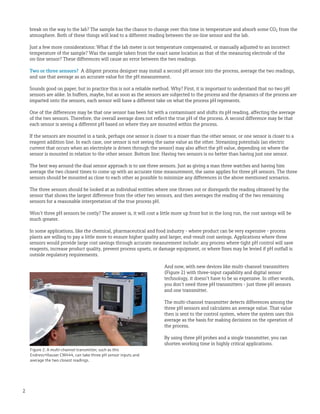
And now, with new devices like multi-channel transmitters
(Figure 2) with three-input capability and digital sensor
technology, it doesn’t have to be so expensive. In other words,
you don’t need three pH transmitters - just three pH sensors
and one transmitter.
The multi-channel transmitter detects differences among the
three pH sensors and calculates an average value. That value
then is sent to the control system, where the system uses this
average as the basis for making decisions on the operation of
the process.
By using three pH probes and a single transmitter, you can
shorten working time in highly critical applications.
Figure 2: A multi-channel transmitter, such as this
Endress+Hauser CM444, can take three pH sensor inputs and
average the two closest readings.
WP01001C/24/EN/01.13
Endress+Hauser, Inc.
2350 Endress Place
Greenwood, IN 46143
Tel: 317-535-7138
Sales: 888-ENDRESS (888-363-7377)
Service: 800-642-8737
Fax: 317-535-8498
inquiry@us.endress.com
www.us.endress.com
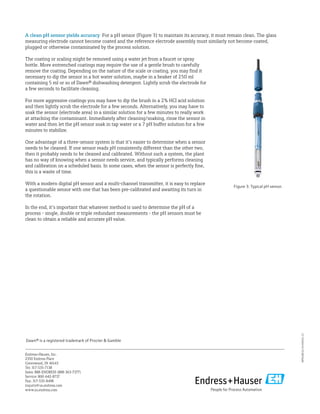
A clean pH sensor yields accuracy For a pH sensor (Figure 3) to maintain its accuracy, it must remain clean. The glass
measuring electrode cannot become coated and the reference electrode assembly must similarly not become coated,
plugged or otherwise contaminated by the process solution.
The coating or scaling might be removed using a water jet from a faucet or spray
bottle. More entrenched coatings may require the use of a gentle brush to carefully
remove the coating. Depending on the nature of the scale or coating, you may find it
necessary to dip the sensor in a hot water solution, maybe in a beaker of 250 ml
containing 5 ml or so of Dawn® dishwashing detergent. Lightly scrub the electrode for
a few seconds to facilitate cleaning.
For more aggressive coatings you may have to dip the brush in a 2% HCI acid solution
and then lightly scrub the electrode for a few seconds. Alternatively, you may have to
soak the sensor (electrode area) in a similar solution for a few minutes to really work
at attacking the contaminant. Immediately after cleaning/soaking, rinse the sensor in
water and then let the pH sensor soak in tap water or a 7 pH buffer solution for a few
minutes to stabilize.
One advantage of a three-sensor system is that it’s easier to determine when a sensor
needs to be cleaned. If one sensor reads pH consistently different than the other two,
then it probably needs to be cleaned and calibrated. Without such a system, the plant
has no way of knowing when a sensor needs service, and typically performs cleaning
and calibration on a scheduled basis. In some cases, when the sensor is perfectly fine,
this is a waste of time.
With a modern digital pH sensor and a multi-channel transmitter, it is easy to replace
a questionable sensor with one that has been pre-calibrated and awaiting its turn in
the rotation.
In the end, it’s important that whatever method is used to determine the pH of a
process - single, double or triple redundant measurements - the pH sensors must be
clean to obtain a reliable and accurate pH value.
Figure 3: Typical pH sensor.
Dawn® is a registered trademark of Procter & Gamble

E+H - Making accurate PH measurements

  • 1.
    About the Author FredKohlmann is a Product Business Manager for Analytical Products with Endress+Hauser. Since 1976, he has been involved in engineering, design service, marketing, and sales of online analytical water quality and process control instrumentation. Fred has taught accredited course work and authored numerous articles relating to pH, ORP and conductivity measurements. Past publications include “What Is pH and How Is It Measured?”, a primer on the use of pH instrumentation, and “Electrical Conductivity Measurements” in the “Process/Industrial Instruments and Controls Handbook”, Fourth Edition, by McGraw Hill, Douglas M. Considine Editor. Making accurate pH measurements When it comes to obtaining accurate pH measurements, three’s the charm By Frederick Kohlmann, Analytical Product Business Manager, Endress+Hauser Like the old saying goes, give a man a watch and he always knows what time it is. Give him two watches and he never knows the correct time. Ah, but give him three watches, let him average the two closest times, and he will be fairly close to a correct time. What do watches have to do with pH? In this article, we will tie the analogy of accurate time to pH measurement and show how to make more accurate, dependable and believable pH measurements by using three pH sensors. So how do we measure a pH process accurately? pH buffers and labs The first thing needed for accurate pH measurements is an accurate reference or starting point, and that is the pH buffer. This is the standard by which a pH sensor is calibrated. Sensors are cleaned (hopefully) and immersed into buffer solutions of 7 and 4 pH to set the zero and slope of the sensor. When this is set and accurate, the sensor is calibrated and will be able to measure correctly. But what happens when the process does what it does so well, and starts to coat or otherwise add error to the sensor measurement? What about potential ground loops that may or may not be present on any given day? How do you ensure that the pH value you are seeing is correct? Some will take a grab sample (Figure 1) and run it to the lab for a quick comparison. What if they take a bathroom or cigarette Figure 1: Technician taking a sample for comparison in the lab. She better hurry, because if it cools off the pH reading may change.
  • 2.
    2 break on theway to the lab? The sample has the chance to change over this time in temperature and absorb some CO2 from the atmosphere. Both of these things will lead to a different reading between the on-line sensor and the lab. Just a few more considerations: What if the lab meter is not temperature compensated, or manually adjusted to an incorrect temperature of the sample? Was the sample taken from the exact same location as that of the measuring electrode of the on-line sensor? These differences will cause an error between the two readings. Two or three sensors? A diligent process designer may install a second pH sensor into the process, average the two readings, and use that average as an accurate value for the pH measurement. Sounds good on paper, but in practice this is not a reliable method. Why? First, it is important to understand that no two pH sensors are alike. In buffers, maybe, but as soon as the sensors are subjected to the process and the dynamics of the process are imparted onto the sensors, each sensor will have a different take on what the process pH represents. One of the differences may be that one sensor has been hit with a contaminant and shifts its pH reading, affecting the average of the two sensors. Therefore, the overall average does not reflect the true pH of the process. A second difference may be that each sensor is seeing a different pH based on where they are mounted within the process. If the sensors are mounted in a tank, perhaps one sensor is closer to a mixer than the other sensor, or one sensor is closer to a reagent addition line. In each case, one sensor is not seeing the same value as the other. Streaming potentials (an electric current that occurs when an electrolyte is driven through the sensor) may also affect the pH value, depending on where the sensor is mounted in relation to the other sensor. Bottom line: Having two sensors is no better than having just one sensor. The best way around the dual sensor approach is to use three sensors. Just as giving a man three watches and having him average the two closest times to come up with an accurate time measurement, the same applies for three pH sensors. The three sensors should be mounted as close to each other as possible to minimize any differences in the above mentioned scenarios. The three sensors should be looked at as individual entities where one throws out or disregards the reading obtained by the sensor that shows the largest difference from the other two sensors, and then averages the reading of the two remaining sensors for a reasonable interpretation of the true process pH. Won’t three pH sensors be costly? The answer is, it will cost a little more up front but in the long run, the cost savings will be much greater. In some applications, like the chemical, pharmaceutical and food industry - where product can be very expensive - process plants are willing to pay a little more to ensure higher quality and larger, end-result cost savings. Applications where three sensors would provide large cost savings through accurate measurement include: any process where tight pH control will save reagents, increase product quality, prevent process upsets, or damage equipment, or where fines may be levied if pH outfall is outside regulatory requirements. And now, with new devices like multi-channel transmitters (Figure 2) with three-input capability and digital sensor technology, it doesn’t have to be so expensive. In other words, you don’t need three pH transmitters - just three pH sensors and one transmitter. The multi-channel transmitter detects differences among the three pH sensors and calculates an average value. That value then is sent to the control system, where the system uses this average as the basis for making decisions on the operation of the process. By using three pH probes and a single transmitter, you can shorten working time in highly critical applications. Figure 2: A multi-channel transmitter, such as this Endress+Hauser CM444, can take three pH sensor inputs and average the two closest readings.
  • 3.
    WP01001C/24/EN/01.13 Endress+Hauser, Inc. 2350 EndressPlace Greenwood, IN 46143 Tel: 317-535-7138 Sales: 888-ENDRESS (888-363-7377) Service: 800-642-8737 Fax: 317-535-8498 inquiry@us.endress.com www.us.endress.com A clean pH sensor yields accuracy For a pH sensor (Figure 3) to maintain its accuracy, it must remain clean. The glass measuring electrode cannot become coated and the reference electrode assembly must similarly not become coated, plugged or otherwise contaminated by the process solution. The coating or scaling might be removed using a water jet from a faucet or spray bottle. More entrenched coatings may require the use of a gentle brush to carefully remove the coating. Depending on the nature of the scale or coating, you may find it necessary to dip the sensor in a hot water solution, maybe in a beaker of 250 ml containing 5 ml or so of Dawn® dishwashing detergent. Lightly scrub the electrode for a few seconds to facilitate cleaning. For more aggressive coatings you may have to dip the brush in a 2% HCI acid solution and then lightly scrub the electrode for a few seconds. Alternatively, you may have to soak the sensor (electrode area) in a similar solution for a few minutes to really work at attacking the contaminant. Immediately after cleaning/soaking, rinse the sensor in water and then let the pH sensor soak in tap water or a 7 pH buffer solution for a few minutes to stabilize. One advantage of a three-sensor system is that it’s easier to determine when a sensor needs to be cleaned. If one sensor reads pH consistently different than the other two, then it probably needs to be cleaned and calibrated. Without such a system, the plant has no way of knowing when a sensor needs service, and typically performs cleaning and calibration on a scheduled basis. In some cases, when the sensor is perfectly fine, this is a waste of time. With a modern digital pH sensor and a multi-channel transmitter, it is easy to replace a questionable sensor with one that has been pre-calibrated and awaiting its turn in the rotation. In the end, it’s important that whatever method is used to determine the pH of a process - single, double or triple redundant measurements - the pH sensors must be clean to obtain a reliable and accurate pH value. Figure 3: Typical pH sensor. Dawn® is a registered trademark of Procter & Gamble