Heart sounds
• Sounds produced by mechanical activities of heart during each
cardiac cycle.
• Produced by:
1. Flow of blood through cardiac chambers.
2. Contraction of cardiac muscles.
3. Closure of valves of heart.
• Can be heard by placing ear on chest or by using stethoscope
or microphone and can also record them graphically.
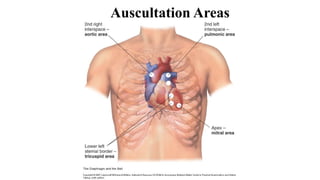
Auscultation Areas
Different heart sounds
• 4 sounds during cardiac cycle:
1. First heart sound.
2. Second heart sound.
3. Third heart sound.
4. Fourth heart sound.
• First and second are classical heart sounds & can be heard by
stethoscope.
• More prominent & resemble the words ‘LUBB’ & ‘DUBB’.
• Third sound is mild sound & it is not heard by using
stethoscope in normal condition but can be heard by using
microphone.
• Fourth sound is an inaudible sound, becomes audible only in
pathological conditions. It is only studied by graphical
presentation i.e. phonocardiogram
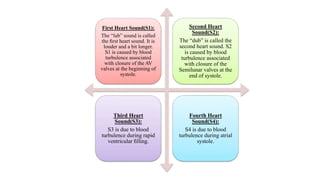
First Heart Sound(S1):
The “lub” sound is called
the first heart sound. It is
louder and a bit longer.
S1 is caused by blood
turbulence associated
with closure of the AV
valves at the beginning of
systole.
Second Heart
Sound(S2):
The “dub” is called the
second heart sound. S2
is caused by blood
turbulence associated
with closure of the
Semilunar valves at the
end of systole.
Third Heart
Sound(S3):
S3 is due to blood
turbulence during rapid
ventricular filling.
Fourth Heart
Sound(S4):
S4 is due to blood
turbulence during atrial
systole.
Features 1st sound 2nd sound 3rd sound 4th sound
Occurs during Isometric contraction
& part of ejection
period
Protodiastole & part
of isometric
relaxation
rapid filling phase Atrial systole
Characteristics Long, soft & low
pitched
Short, sharp & high
pitched
Low pitched In audible sound
Cause Closure of AV valves Closure of semilunar
valves
Rushing of blood in
ventricles
Contraction of atria
Duration (sec) 0.10 – 0.17 0.10 – 0.14 0.07 - 0.10 0.02 – 0.04
Frequency
(cycles/sec)
25 – 45 50 1 – 6 1 – 4
Relation with ECG Coincides with ‘R’
peak
Appear 0.09 sec a/f
peak of ‘T’ wave
b/w ‘T’ & ‘P’ wave b/w ‘P’ & ‘Q’ wave
# of vibration in
phonocardiogram
9 – 13 4 – 6 1 – 4 1 – 2
Cardiac Murmur
• Also called abnormal heart sound or cardiac bruit.
• Can be heard by stethoscope.
• It is cause by the change in flow pattern of blood.
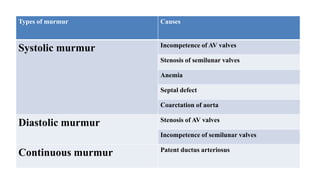
Types of murmur Causes
Systolic murmur Incompetence of AV valves
Stenosis of semilunar valves
Anemia
Septal defect
Coarctation of aorta
Diastolic murmur Stenosis of AV valves
Incompetence of semilunar valves
Continuous murmur Patent ductus arteriosus
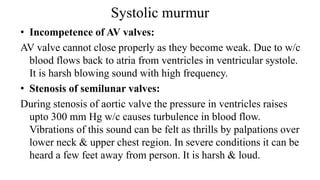
Systolic murmur
• Incompetence of AV valves:
AV valve cannot close properly as they become weak. Due to w/c
blood flows back to atria from ventricles in ventricular systole.
It is harsh blowing sound with high frequency.
• Stenosis of semilunar valves:
During stenosis of aortic valve the pressure in ventricles raises
upto 300 mm Hg w/c causes turbulence in blood flow.
Vibrations of this sound can be felt as thrills by palpations over
lower neck & upper chest region. In severe conditions it can be
heard a few feet away from person. It is harsh & loud.
• Murmur due to Anemia:
In severe anemia due to reduced viscosity & accelerated flow of
blood.
• Septal defect:
During interventricular septal defect, blood flows from LT
ventricles to RT ventricles. It is a rare disease.
• Coarctation of aorta:
Congenital disease. Characterized by narrowing of a part of
aorta.
Diastolic murmur
• 2 types:
1. Stenosis of AV valves:
Narrowing of heart valve.
2. Incompetence of semilunar valves:
Weakening of heart valves.
Continuous murmur
• Patent ductus arteriosus:
• consists of two components: a crescendo systolic one and a
decrescendo diastolic one, with a peak of intensity around
second sound. It is best heard at second left intercostals space
or immediately left infraclavicular.

Heart sounds

  • 1.
  • 2.
    • Sounds producedby mechanical activities of heart during each cardiac cycle. • Produced by: 1. Flow of blood through cardiac chambers. 2. Contraction of cardiac muscles. 3. Closure of valves of heart. • Can be heard by placing ear on chest or by using stethoscope or microphone and can also record them graphically.
  • 3.
  • 4.
    Different heart sounds •4 sounds during cardiac cycle: 1. First heart sound. 2. Second heart sound. 3. Third heart sound. 4. Fourth heart sound.
  • 5.
    • First andsecond are classical heart sounds & can be heard by stethoscope. • More prominent & resemble the words ‘LUBB’ & ‘DUBB’. • Third sound is mild sound & it is not heard by using stethoscope in normal condition but can be heard by using microphone. • Fourth sound is an inaudible sound, becomes audible only in pathological conditions. It is only studied by graphical presentation i.e. phonocardiogram
  • 6.
    First Heart Sound(S1): The“lub” sound is called the first heart sound. It is louder and a bit longer. S1 is caused by blood turbulence associated with closure of the AV valves at the beginning of systole. Second Heart Sound(S2): The “dub” is called the second heart sound. S2 is caused by blood turbulence associated with closure of the Semilunar valves at the end of systole. Third Heart Sound(S3): S3 is due to blood turbulence during rapid ventricular filling. Fourth Heart Sound(S4): S4 is due to blood turbulence during atrial systole.
  • 7.
    Features 1st sound2nd sound 3rd sound 4th sound Occurs during Isometric contraction & part of ejection period Protodiastole & part of isometric relaxation rapid filling phase Atrial systole Characteristics Long, soft & low pitched Short, sharp & high pitched Low pitched In audible sound Cause Closure of AV valves Closure of semilunar valves Rushing of blood in ventricles Contraction of atria Duration (sec) 0.10 – 0.17 0.10 – 0.14 0.07 - 0.10 0.02 – 0.04 Frequency (cycles/sec) 25 – 45 50 1 – 6 1 – 4 Relation with ECG Coincides with ‘R’ peak Appear 0.09 sec a/f peak of ‘T’ wave b/w ‘T’ & ‘P’ wave b/w ‘P’ & ‘Q’ wave # of vibration in phonocardiogram 9 – 13 4 – 6 1 – 4 1 – 2
  • 8.
    Cardiac Murmur • Alsocalled abnormal heart sound or cardiac bruit. • Can be heard by stethoscope. • It is cause by the change in flow pattern of blood.
  • 9.
    Types of murmurCauses Systolic murmur Incompetence of AV valves Stenosis of semilunar valves Anemia Septal defect Coarctation of aorta Diastolic murmur Stenosis of AV valves Incompetence of semilunar valves Continuous murmur Patent ductus arteriosus
  • 10.
    Systolic murmur • Incompetenceof AV valves: AV valve cannot close properly as they become weak. Due to w/c blood flows back to atria from ventricles in ventricular systole. It is harsh blowing sound with high frequency. • Stenosis of semilunar valves: During stenosis of aortic valve the pressure in ventricles raises upto 300 mm Hg w/c causes turbulence in blood flow. Vibrations of this sound can be felt as thrills by palpations over lower neck & upper chest region. In severe conditions it can be heard a few feet away from person. It is harsh & loud.
  • 11.
    • Murmur dueto Anemia: In severe anemia due to reduced viscosity & accelerated flow of blood. • Septal defect: During interventricular septal defect, blood flows from LT ventricles to RT ventricles. It is a rare disease. • Coarctation of aorta: Congenital disease. Characterized by narrowing of a part of aorta.
  • 12.
    Diastolic murmur • 2types: 1. Stenosis of AV valves: Narrowing of heart valve. 2. Incompetence of semilunar valves: Weakening of heart valves.
  • 13.
    Continuous murmur • Patentductus arteriosus: • consists of two components: a crescendo systolic one and a decrescendo diastolic one, with a peak of intensity around second sound. It is best heard at second left intercostals space or immediately left infraclavicular.