Health Promotion & Wellness
From Infancy to Adolescence
By: Caitlin Blum
Instructor: Jesse Martin
November 4, 2015
PSY1170
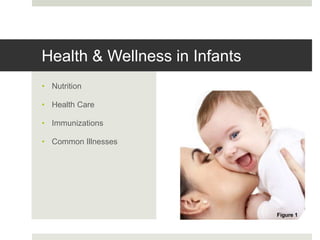
Health & Wellness in Infants
• Nutrition
• Health Care
• Immunizations
• Common Illnesses
Figure 1
Health & Wellness in Infants
Nutrition
• Breastfeeding
• Colostrum:
• First milk produced within 72 hours
after childbirth, before a woman’s
milk comes in.
• Rich in vital nutrients for infants
such as protein, vitamins, and
important antibodies for fighting
infection (“Breastfeeding,” 2012).
• Breast milk is the best source of
essential nutrients (Boyd et al., 2012).
• Recommended by the Canadian
Pediatric Society that infants be
exclusively breastfed for the first 6
months of life (“Breastfeeding,” 2014).
• Infants who are fed breast milk have
been shown to gain weight and size
more rapidly and have stronger immune
systems than those who are not (Boyd
et al., 2012).
• Nutrition for Breastfeeding Mothers
• Breastfeeding mothers should be sure
to eat plenty of nutritious foods.
• A helpful resource to follow is
Canada’s Food Guide (Boyd et al.,
2012).
• As breastfeeding burns a lot of calories,
it is important not to diet while
breastfeeding (“Breastfeeding,” 2014).
• Studies have shown that avoiding
certain foods such as peanuts or dairy
products while breastfeeding has no
effect on preventing an allergy in the
infant (“Breastfeeding,” 2014).
Health & Wellness in Infants
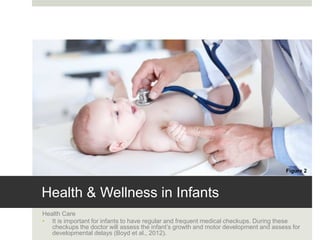
Health Care
• It is important for infants to have regular and frequent medical checkups. During these
checkups the doctor will assess the infant’s growth and motor development and assess for
developmental delays (Boyd et al., 2012).
Figure 2
Health & Wellness in Infants
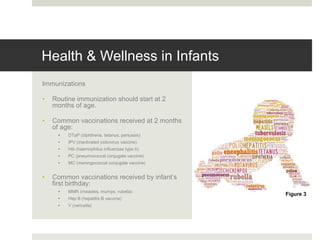
Immunizations
• Routine immunization should start at 2
months of age.
• Common vaccinations received at 2 months
of age:
• DTaP (diphtheria, tetanus, pertussis)
• IPV (inactivated poliovirus vaccine)
• Hib (haemophilus influenzae type b)
• PC (pneumococcal conjugate vaccine)
• MC (meningococcal conjugate vaccine)
• Common vaccinations received by infant’s
first birthday:
• MMR (measles, mumps, rubella)
• Hep B (hepatitis B vaccine)
• V (varicella)
Figure 3
Health & Wellness in Infants
Common Illnesses
• Most common illness in first year of life is in the respiratory tract, with the
average infant having seven respiratory illnesses before one year of age
(Boyd et al., 2012).
• Infants in day care are more at risk of contracting respiratory illness (Boyd
et al., 2012).
• Respiratory illness can cause chronic ear infections.
• Because chronic ear infections may disrupt development in areas of the
brain essential for learning language, infants who suffer from chronic ear
infections are at greater risk of developing learning disabilities and
language deficits once they reach school age (Boyd et al., 2012).
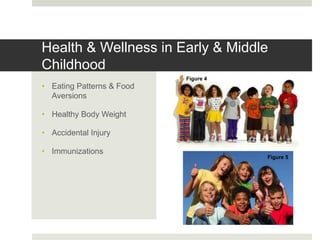
Health & Wellness in Early & Middle
Childhood
• Eating Patterns & Food
Aversions
• Healthy Body Weight
• Accidental Injury
• Immunizations
Figure 4
Figure 5
Health & Wellness in Early & Middle Childhood
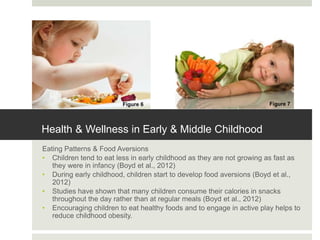
Eating Patterns & Food Aversions
• Children tend to eat less in early childhood as they are not growing as fast as
they were in infancy (Boyd et al., 2012)
• During early childhood, children start to develop food aversions (Boyd et al.,
2012)
• Studies have shown that many children consume their calories in snacks
throughout the day rather than at regular meals (Boyd et al., 2012)
• Encouraging children to eat healthy foods and to engage in active play helps to
reduce childhood obesity.
Figure 6 Figure 7
Health & Wellness in Early & Middle
Childhood
Healthy Body Weight
• Due to sedentary lifestyles and poor nutrition there has been a rise in unhealthy body
weights in children over the last couple of decades (Boyd et al., 2012).
• Children who are overweight for a longer period of time are more likely to be overweight
adults (Boyd et al., 2012).
• Overweight children are more likely to develop chronic illnesses later in life such as type II
diabetes and cardiovascular disease (Boyd et al., 2012).
• Developing healthy eating habits and encouraging physical activity without focusing on
physical appearance is important for future mental and physical health and helps to
encourage a positive body image (Boyd et al., 2012).
• Before lifestyle changes can be made, it is important that parents be aware of and
recognize that their child has a body weight issue (Boyd et al., 2012).
Health & Wellness in Early & Middle
Childhood
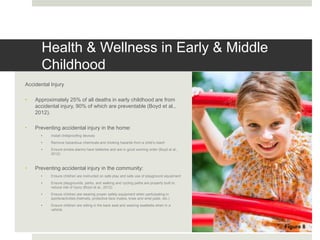
Accidental Injury
• Approximately 25% of all deaths in early childhood are from
accidental injury, 90% of which are preventable (Boyd et al.,
2012).
• Preventing accidental injury in the home:
• Install childproofing devices
• Remove hazardous chemicals and choking hazards from a child’s reach
• Ensure smoke alarms have batteries and are in good working order (Boyd et al.,
2012)
• Preventing accidental injury in the community:
• Ensure children are instructed on safe play and safe use of playground equipment
• Ensure playgrounds, parks, and walking and cycling paths are properly built to
reduce risk of injury (Boyd et al., 2012)
• Ensure children are wearing proper safety equipment when participating in
sports/activities (helmets, protective face masks, knee and wrist pads, etc.)
• Ensure children are sitting in the back seat and wearing seatbelts when in a
vehicle
Figure 8
Health & Wellness in Early & Middle
Childhood
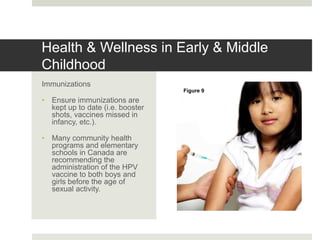
Immunizations
• Ensure immunizations are
kept up to date (i.e. booster
shots, vaccines missed in
infancy, etc.).
• Many community health
programs and elementary
schools in Canada are
recommending the
administration of the HPV
vaccine to both boys and
girls before the age of
sexual activity.
Figure 9
Health & Wellness in Adolescence
Sexuality, Sexually
Transmitted Infections &
Teenage Pregnancy
Drugs, Alcohol & Tobacco
Eating Disorders
Depression & Suicide
Figure
10
Health & Wellness in Adolescence
Sexuality, STIs, and Teenage
Pregnancy
• Teens experience hormonal
changes which brings about
sexual behaviour (Boyd et al.,
2012).
• Rates of preventable STIs are
higher in teens due to lack of
condom use (Boyd et al., 2012).
• Studies show that making
condoms more available to teens
helps prevent STIs and
pregnancy in those teens who are
already sexually active (Boyd et
al., 2012).
Drugs, Alcohol & Tobacco
• Teens who display risk-seeking
behaviours are more likely to
partake in drugs, alcohol &
tobacco use (Boyd et al., 2012).
• Marijuana use by teens is on the
rise, but alcohol use is most
prevalent (Boyd et al., 2012)
• Teens aged 15-19 engage in
drunk driving more than almost
any other age group (second only
to 20-24 year olds) (Boyd et al.,
2012).
• Tobacco use in teens has seen a
steady decline since the 1990s
(Boyd et al., 2012).
Health & Wellness in Adolescence
Eating Disorders
• Eating disorders such as bulimia and anorexia nervosa are among the most common mental
health issues in teens (Boyd et al., 2012).
• Rates of eating disorders have increased as the social and societal pressures to be thin have
increased (Boyd et al., 2012).
• Eating disorders affect more girls than boys, tend to affect gay and lesbian teens at a higher rate
than heterosexual teens, and are more common in western societies (Boyd et al., 2012).
• Symptoms and consequences include: tooth decay (bulimia), hair loss, reduced body
temperature, sleep disturbances, cardiovascular issues (anorexia), and loss of menstrual cycle.
Between 10 and 15% of those suffering from anorexia starve to death (Boyd et al., 2012).
Depression & Suicide
• Pituitary deficiency, genetic factors, family stressors, teen smoking, and low self esteem have
been linked to higher rates of depression in adolescence (Boyd et al., 2012).
• Depression affects the memory, and thus can interfere with academic abilities (Boyd et al.,
2012).
• In some teenagers, depression can sometimes lead to suicide, and in fact, suicide is the second
leading cause of death among teens aged 15-19 (Boyd et al., 2012).
• Suicide attempts are more common in girls, but successful suicide rates are more prevalent
among teenage boys. The exception to this trend being the high suicide rates among First
Nations girls (Boyd et al., 2012).
• Medical treatments such as the use of SSRIs have been effective in treating depression in teens,
however, a side effect of many SSRIs is increased thoughts of suicide in adolescents (Boyd et
al., 2012)
Health Promotion & Wellness
How is health promotion & wellness
from infancy to adolescence of use to
me professionally?
• Professionally, in my nursing
practice, this information will assist
me in patient teaching to parents,
children, adolescents, and other
family members.
• Knowledge of health promotion &
wellness will assist me in
advocating for my patients, and
possibly against funding cuts to
school and community programs
that are essential to encouraging
healthy growth in infants, children,
and adolescents.
How does health promotion &
wellness from infancy to
adolescence affect me personally?
• This topic affects me personally
in that I can use this information
when it comes time to raise my
own children.
• This information will help me to
think critically, offer advice, and
back up my decision making in
my next clinical rotation in
maternity and pediatrics.
References
Boyd, D. R., Johnson, P., Bee, H. (2012). Lifespan development (4th Can. ed.). Upper Saddle River, NJ: Pearson Education
Inc.
Breastfeeding. (2014, April). Retrieved November 2, 2015, from http://www.caringforkids.cps.ca/handouts/breastfeeding
Figure 1: Retrieved November 2, 2015, from http://www.acidrefluxpedia.com/tag/acid-reflux-in-infants/
Figure 2: Retrieved November 2, 2015, from http://www.huffingtonpost.com/2013/10/06/pulse-oximetry-
legislation_n_4047325.html
Figure 3: Retrieved November 2, 2015, from http://blog.childrens.com/mom-thinks-every-child-should-be-vaccinated/
Figure 4: Retrieved November 2, 2015, from http://cmapspublic2.ihmc.us/rid=1LNH5X3HP-21FFC9P-
6G/MRochaAdams.cmap
Figure 5: Retrieved November 2, 2015, from http://micheleborba.com/blog/mobilizing-bystanders-to-stand-up-to-bullies/
Figure 6: Retrieved November 2, 2015, from http://childventures.ca/blog/2014/11/childhood-diet-habits/
Figure 7: Retrieved November 2, 2015, from http://www.oxfordcounty.ca/Healthy-lifestyles/Nutrition/Child-nutrition
Figure 8: Retrieved November 2, 2015, from http://www.buildingfamilies.net/educators/playground-safety/
Figure 9: Retrieved November 2, 2015, from http://haltonparentsblog.ca/2014/05/12/what-immunizations-are-needed-to-
attend-school-its-changing-be-in-the-know/
Figure 10: Retrieved November 2, 2015, from http://www.immunize-
utah.org/information%20for%20the%20public/adolescent%20immunization/index.html

psy1170 - Health Promotion & Wellness

  • 1.
    Health Promotion &Wellness From Infancy to Adolescence By: Caitlin Blum Instructor: Jesse Martin November 4, 2015 PSY1170
  • 2.
    Health & Wellnessin Infants • Nutrition • Health Care • Immunizations • Common Illnesses Figure 1
  • 3.
    Health & Wellnessin Infants Nutrition • Breastfeeding • Colostrum: • First milk produced within 72 hours after childbirth, before a woman’s milk comes in. • Rich in vital nutrients for infants such as protein, vitamins, and important antibodies for fighting infection (“Breastfeeding,” 2012). • Breast milk is the best source of essential nutrients (Boyd et al., 2012). • Recommended by the Canadian Pediatric Society that infants be exclusively breastfed for the first 6 months of life (“Breastfeeding,” 2014). • Infants who are fed breast milk have been shown to gain weight and size more rapidly and have stronger immune systems than those who are not (Boyd et al., 2012). • Nutrition for Breastfeeding Mothers • Breastfeeding mothers should be sure to eat plenty of nutritious foods. • A helpful resource to follow is Canada’s Food Guide (Boyd et al., 2012). • As breastfeeding burns a lot of calories, it is important not to diet while breastfeeding (“Breastfeeding,” 2014). • Studies have shown that avoiding certain foods such as peanuts or dairy products while breastfeeding has no effect on preventing an allergy in the infant (“Breastfeeding,” 2014).
  • 4.
    Health & Wellnessin Infants Health Care • It is important for infants to have regular and frequent medical checkups. During these checkups the doctor will assess the infant’s growth and motor development and assess for developmental delays (Boyd et al., 2012). Figure 2
  • 5.
    Health & Wellnessin Infants Immunizations • Routine immunization should start at 2 months of age. • Common vaccinations received at 2 months of age: • DTaP (diphtheria, tetanus, pertussis) • IPV (inactivated poliovirus vaccine) • Hib (haemophilus influenzae type b) • PC (pneumococcal conjugate vaccine) • MC (meningococcal conjugate vaccine) • Common vaccinations received by infant’s first birthday: • MMR (measles, mumps, rubella) • Hep B (hepatitis B vaccine) • V (varicella) Figure 3
  • 6.
    Health & Wellnessin Infants Common Illnesses • Most common illness in first year of life is in the respiratory tract, with the average infant having seven respiratory illnesses before one year of age (Boyd et al., 2012). • Infants in day care are more at risk of contracting respiratory illness (Boyd et al., 2012). • Respiratory illness can cause chronic ear infections. • Because chronic ear infections may disrupt development in areas of the brain essential for learning language, infants who suffer from chronic ear infections are at greater risk of developing learning disabilities and language deficits once they reach school age (Boyd et al., 2012).
  • 7.
    Health & Wellnessin Early & Middle Childhood • Eating Patterns & Food Aversions • Healthy Body Weight • Accidental Injury • Immunizations Figure 4 Figure 5
  • 8.
    Health & Wellnessin Early & Middle Childhood Eating Patterns & Food Aversions • Children tend to eat less in early childhood as they are not growing as fast as they were in infancy (Boyd et al., 2012) • During early childhood, children start to develop food aversions (Boyd et al., 2012) • Studies have shown that many children consume their calories in snacks throughout the day rather than at regular meals (Boyd et al., 2012) • Encouraging children to eat healthy foods and to engage in active play helps to reduce childhood obesity. Figure 6 Figure 7
  • 9.
    Health & Wellnessin Early & Middle Childhood Healthy Body Weight • Due to sedentary lifestyles and poor nutrition there has been a rise in unhealthy body weights in children over the last couple of decades (Boyd et al., 2012). • Children who are overweight for a longer period of time are more likely to be overweight adults (Boyd et al., 2012). • Overweight children are more likely to develop chronic illnesses later in life such as type II diabetes and cardiovascular disease (Boyd et al., 2012). • Developing healthy eating habits and encouraging physical activity without focusing on physical appearance is important for future mental and physical health and helps to encourage a positive body image (Boyd et al., 2012). • Before lifestyle changes can be made, it is important that parents be aware of and recognize that their child has a body weight issue (Boyd et al., 2012).
  • 10.
    Health & Wellnessin Early & Middle Childhood Accidental Injury • Approximately 25% of all deaths in early childhood are from accidental injury, 90% of which are preventable (Boyd et al., 2012). • Preventing accidental injury in the home: • Install childproofing devices • Remove hazardous chemicals and choking hazards from a child’s reach • Ensure smoke alarms have batteries and are in good working order (Boyd et al., 2012) • Preventing accidental injury in the community: • Ensure children are instructed on safe play and safe use of playground equipment • Ensure playgrounds, parks, and walking and cycling paths are properly built to reduce risk of injury (Boyd et al., 2012) • Ensure children are wearing proper safety equipment when participating in sports/activities (helmets, protective face masks, knee and wrist pads, etc.) • Ensure children are sitting in the back seat and wearing seatbelts when in a vehicle Figure 8
  • 11.
    Health & Wellnessin Early & Middle Childhood Immunizations • Ensure immunizations are kept up to date (i.e. booster shots, vaccines missed in infancy, etc.). • Many community health programs and elementary schools in Canada are recommending the administration of the HPV vaccine to both boys and girls before the age of sexual activity. Figure 9
  • 12.
    Health & Wellnessin Adolescence Sexuality, Sexually Transmitted Infections & Teenage Pregnancy Drugs, Alcohol & Tobacco Eating Disorders Depression & Suicide Figure 10
  • 13.
    Health & Wellnessin Adolescence Sexuality, STIs, and Teenage Pregnancy • Teens experience hormonal changes which brings about sexual behaviour (Boyd et al., 2012). • Rates of preventable STIs are higher in teens due to lack of condom use (Boyd et al., 2012). • Studies show that making condoms more available to teens helps prevent STIs and pregnancy in those teens who are already sexually active (Boyd et al., 2012). Drugs, Alcohol & Tobacco • Teens who display risk-seeking behaviours are more likely to partake in drugs, alcohol & tobacco use (Boyd et al., 2012). • Marijuana use by teens is on the rise, but alcohol use is most prevalent (Boyd et al., 2012) • Teens aged 15-19 engage in drunk driving more than almost any other age group (second only to 20-24 year olds) (Boyd et al., 2012). • Tobacco use in teens has seen a steady decline since the 1990s (Boyd et al., 2012).
  • 14.
    Health & Wellnessin Adolescence Eating Disorders • Eating disorders such as bulimia and anorexia nervosa are among the most common mental health issues in teens (Boyd et al., 2012). • Rates of eating disorders have increased as the social and societal pressures to be thin have increased (Boyd et al., 2012). • Eating disorders affect more girls than boys, tend to affect gay and lesbian teens at a higher rate than heterosexual teens, and are more common in western societies (Boyd et al., 2012). • Symptoms and consequences include: tooth decay (bulimia), hair loss, reduced body temperature, sleep disturbances, cardiovascular issues (anorexia), and loss of menstrual cycle. Between 10 and 15% of those suffering from anorexia starve to death (Boyd et al., 2012). Depression & Suicide • Pituitary deficiency, genetic factors, family stressors, teen smoking, and low self esteem have been linked to higher rates of depression in adolescence (Boyd et al., 2012). • Depression affects the memory, and thus can interfere with academic abilities (Boyd et al., 2012). • In some teenagers, depression can sometimes lead to suicide, and in fact, suicide is the second leading cause of death among teens aged 15-19 (Boyd et al., 2012). • Suicide attempts are more common in girls, but successful suicide rates are more prevalent among teenage boys. The exception to this trend being the high suicide rates among First Nations girls (Boyd et al., 2012). • Medical treatments such as the use of SSRIs have been effective in treating depression in teens, however, a side effect of many SSRIs is increased thoughts of suicide in adolescents (Boyd et al., 2012)
  • 15.
    Health Promotion &Wellness How is health promotion & wellness from infancy to adolescence of use to me professionally? • Professionally, in my nursing practice, this information will assist me in patient teaching to parents, children, adolescents, and other family members. • Knowledge of health promotion & wellness will assist me in advocating for my patients, and possibly against funding cuts to school and community programs that are essential to encouraging healthy growth in infants, children, and adolescents. How does health promotion & wellness from infancy to adolescence affect me personally? • This topic affects me personally in that I can use this information when it comes time to raise my own children. • This information will help me to think critically, offer advice, and back up my decision making in my next clinical rotation in maternity and pediatrics.
  • 16.
    References Boyd, D. R.,Johnson, P., Bee, H. (2012). Lifespan development (4th Can. ed.). Upper Saddle River, NJ: Pearson Education Inc. Breastfeeding. (2014, April). Retrieved November 2, 2015, from http://www.caringforkids.cps.ca/handouts/breastfeeding Figure 1: Retrieved November 2, 2015, from http://www.acidrefluxpedia.com/tag/acid-reflux-in-infants/ Figure 2: Retrieved November 2, 2015, from http://www.huffingtonpost.com/2013/10/06/pulse-oximetry- legislation_n_4047325.html Figure 3: Retrieved November 2, 2015, from http://blog.childrens.com/mom-thinks-every-child-should-be-vaccinated/ Figure 4: Retrieved November 2, 2015, from http://cmapspublic2.ihmc.us/rid=1LNH5X3HP-21FFC9P- 6G/MRochaAdams.cmap Figure 5: Retrieved November 2, 2015, from http://micheleborba.com/blog/mobilizing-bystanders-to-stand-up-to-bullies/ Figure 6: Retrieved November 2, 2015, from http://childventures.ca/blog/2014/11/childhood-diet-habits/ Figure 7: Retrieved November 2, 2015, from http://www.oxfordcounty.ca/Healthy-lifestyles/Nutrition/Child-nutrition Figure 8: Retrieved November 2, 2015, from http://www.buildingfamilies.net/educators/playground-safety/ Figure 9: Retrieved November 2, 2015, from http://haltonparentsblog.ca/2014/05/12/what-immunizations-are-needed-to- attend-school-its-changing-be-in-the-know/ Figure 10: Retrieved November 2, 2015, from http://www.immunize- utah.org/information%20for%20the%20public/adolescent%20immunization/index.html