People of Chinese Heritage (Wang Y., Purnell L.D, 2008) Presented by:    Mariel Gonzalez, RN, BSN Sun Nguyen RN, BSN, CCRN Nurs 608: Spring 2011
To View This Presentation Please Launch Self-Running Slide Show
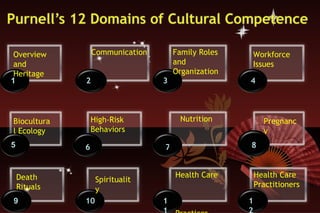
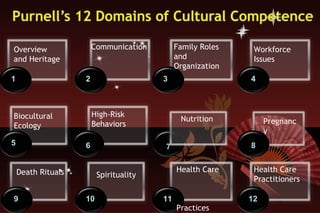
12 Health Care Practitioners 4 Workforce Issues 3 Family Roles and Organization 2 Communication 7 Nutrition 6 High-Risk Behaviors 9 Death Rituals 5 Biocultural Ecology 1 Overview and Heritage 11 Health Care  Practices 10 Spirituality Pregnancy 8 8 8
Overview and  Heritage The Chinese culture dates back  as far as 2200 B.C. Ideals and values based on Confucius teachings Importance in relationships (family and neighbors) Values family, elders, and higher education 1
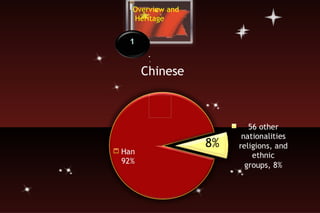
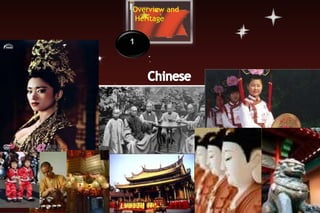
Overview and  Heritage 1
9.6 million square kilometers 23 provinces 5 regions 3 municipalities 1 1.31 billion people
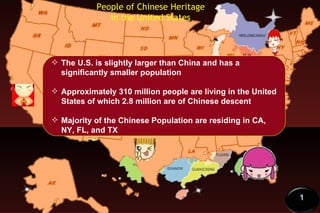
People of Chinese Heritage in the United States The U.S. is slightly larger than China and has a significantly smaller population Approximately 310 million people are living in the United States of which 2.8 million are of Chinese descent Majority of the Chinese Population are residing in CA, NY, FL, and TX 1
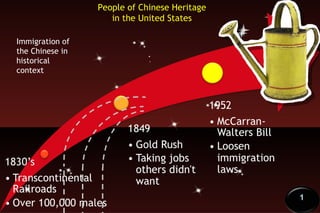
Immigration of the Chinese in historical context People of Chinese Heritage in the United States 1
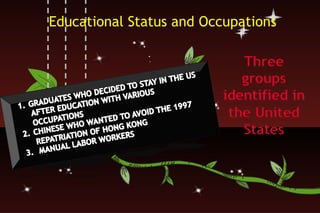
Educational Status and Occupations
Communication 2
Communication 2
 
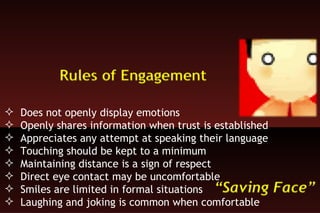
Does not openly display emotions Openly shares information when trust is established Appreciates any attempt at speaking their language Touching should be kept to a minimum Maintaining distance is a sign of respect Direct eye contact may be uncomfortable Smiles are limited in formal situations Laughing and joking is common when comfortable
May say yes even if they don’t understand (to save themselves from embarrassment) Reputation of the family is very important The Chinese American may feel that they are always being evaluated
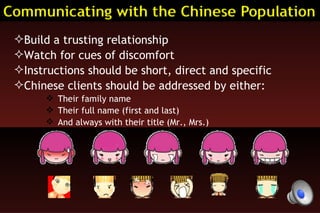
Build a trusting relationship Watch for cues of discomfort Instructions should be short, direct and specific Chinese clients should be addressed by either: Their family name Their full name (first and last) And always with their title (Mr., Mrs.)
3
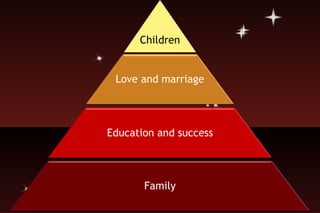
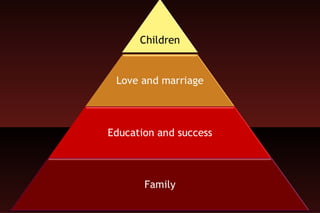
Education and success Family Love and marriage Children
The average family size is 3.46 in 2006  (One child per couple law) Male headed households Women beginning to fill more than ½  of the workforce  (i.e. engineering, aviation) Children are valued by parents who often sacrifice and are willing to work harder if it would benefit the child’s future Younger generations adopt “double income, no kids” lifestyle because of a want in a higher standard of living More elderly parents are cared by society as children are focused on careers often in other countries The whole is greater than its part Group support is greater than privacy Personal independence not valued “ Re-education camps”  “ Guan Xi” societal bank where funds are withdrawn that “demands payback” Chinese mothers (emotional atmosphere of the family) Chinese fathers (leaders) Chinese elders (wisdom)
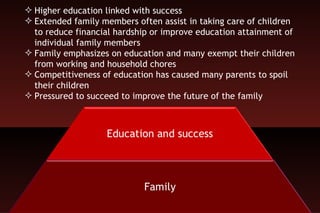
Higher education linked with success Extended family members often assist in taking care of children to reduce financial hardship or improve education attainment of individual family members  Family emphasizes on education and many exempt their children from working and household chores Competitiveness of education has caused many parents to spoil their children Pressured to succeed to improve the future of the family
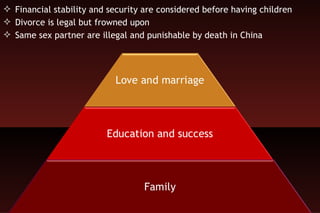
Financial stability and security are considered before having children Divorce is legal but frowned upon Same sex partner are illegal and punishable by death in China
 
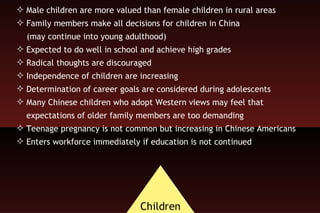
Male children are more valued than female children in rural areas Family members make all decisions for children in China  (may continue into young adulthood) Expected to do well in school and achieve high grades Radical thoughts are discouraged Independence of children are increasing  Determination of career goals are considered during adolescents Many Chinese children who adopt Western views may feel that expectations of older family members are too demanding Teenage pregnancy is not common but increasing in Chinese Americans Enters workforce immediately if education is not continued
Male children are more valued than female children in rural areas Family members make all decisions for children in China (may continue into young adulthood) Expected to do well in school and achieve high grades Radical thoughts are discouraged Independence of children are increasing  Determination of career goals are considered during adolescents Many Chinese children who adopt Western views may feel that expectations of older family members are too demanding. Teenage pregnancy is not common but increasing in Chinese Americans Enters workforce immediately if education is not continued 4 1 2 3
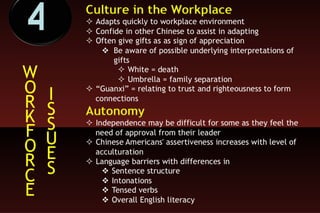
4
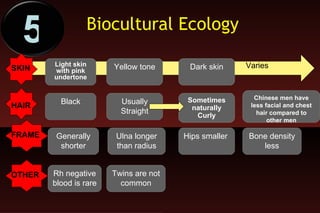
SKIN HAIR FRAME OTHER Generally shorter Light skin with pink undertone Black Dark skin Yellow tone Varies Usually Straight Sometimes naturally Curly Ulna longer than radius Bone density less Hips smaller  Chinese men have less facial and chest hair compared to other men Twins are not common Rh negative blood is rare Biocultural Ecology 5
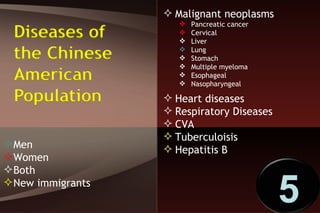
Malignant neoplasms Pancreatic cancer Cervical Liver Lung Stomach Multiple myeloma Esophageal Nasopharyngeal  Heart diseases Respiratory Diseases CVA Tuberculoisis Hepatitis B 5 Men Women Both New immigrants
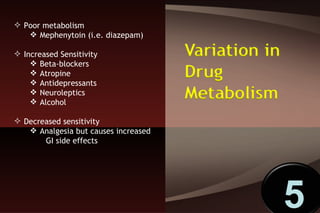
5 5 Poor metabolism Mephenytoin (i.e. diazepam) Increased Sensitivity Beta-blockers  Atropine Antidepressants Neuroleptics Alcohol Decreased sensitivity  Analgesia but causes increased  GI side effects
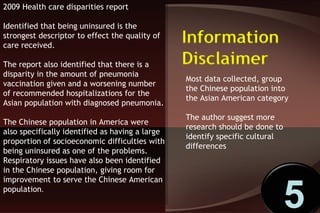
5 5 Most data collected, group the Chinese population into the Asian American category The author suggest more research should be done to identify specific cultural  differences 2009 Health care disparities report Identified that being uninsured is the strongest descriptor to effect the quality of care received.  The report also identified that there is a disparity in the amount of pneumonia vaccination given and a worsening number of recommended hospitalizations for the Asian population with diagnosed pneumonia.  The Chinese population in America were also specifically identified as having a large proportion of socioeconomic difficulties with being uninsured as one of the problems.  Respiratory issues have also been identified in the Chinese population, giving room for improvement to serve the Chinese American population .
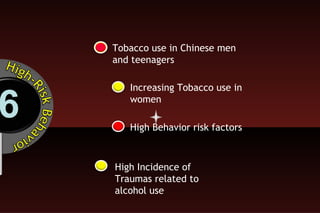
Tobacco use in Chinese men and teenagers Increasing Tobacco use in women High Behavior risk factors High Incidence of  Traumas related to alcohol use 6
12 Health Care Practitioners 4 Workforce Issues 3 Family Roles and Organization 2 Communication 6 High-Risk Behaviors 9 Death Rituals 5 Biocultural Ecology 1 Overview and Heritage 11 Health Care  Practices 10 Spirituality 8 8 7 Nutrition Pregnancy  8
Nutrition Food is meaningful  Celebrations centered around food Well balanced diet to promote health and well being Yang, “hot” & yin, “cold” style of eating Warm or hot drinks at meal times to maintain balance within body and promote healing Cold drinks thought to shock body 7
Nutrition Common foods Peanuts, soybeans, wheat, sorghum, maize, rice, beans, noodles, vegetables Meats: pork most common, chicken, beef, duck, shrimp, fish, scallops, mussels and tofu  Foods high in fat and salt Lack of dairy products in diet due to genetic  tendency of lactose intolerance Obtain Calcium from wide variety of green vegetables 7
Pregnancy  Enforcement of one-child law Intrauterine device most common birth control  Sterilization common Oral contraceptives free in China Abortions common Not ready for child or gender specific Boys still favored over girls 8
Pregnancy Pregnancy seen as a  blessing  Women modest Prefer female midwife/obstetrician Consume more meat to strengthen blood May refuse Iron; thought  to make delivery difficult Postpartum practices: Only cooked warm meals Taboo to drink or touch cold water Prevent cold air from body Dressed head to toe Won’t bathe for first month Breastfeeding important   Encouraged to drink rice wine to promote milk production 8
Death Rituals Stoic acceptance of death  as part of life   Worship Ancestors   Form of respect Dead visited at hospital or  family’s house Dead honored by  surrounding  coffin with  items that symbolized  deceased life Black armband worn on left  arm and white cloth tied  around head to symbolize mourning Fear death Avoid mentioning it or words that sound like it in Chinese No life insurance – seen as inviting death Colors white and black  associated with death;  considered bad luck 9
10
Spirituality Minimal religious services Ideas and values practiced alone Main practices are Buddhism, Catholicism,  Protestantism, Taoism and Islam Churches in Chinese community important Provide support and services for immigrants Comforted through prayer Goal is to live a happy and healthy life 10
Spirituality “ Life forces” are interconnected and provide  strength Individual, environment, past and future of individuals and society Call upon ancestors  Dependence on family Practices that provide strength Meditation, exercise, massage and prayer Drugs, herbs, food, good air and artistic expression 10
Health-care practices Use of Western medicine and traditional Chinese medicine Younger generations seek care when necessary; usually  seek Western medicine first then traditional Chinese  medicine Older Chinese generations use traditional Chinese  remedies and only seek Western medicine when not  responding to treatment  Value stoicism May not discuss all ailments or alternative medicines being used 11
Health-care practices in China Centered on preventative care Focusing on Infectious diseases i.e. Schistosomiasis, TB, childhood diseases, cancer, heart disease, malaria, and maternal-infant care Regulation on AIDS prevention and control plan Free HIV testing HIV carriers and AIDS patients encouraged to inform spouses/sexual partners Local prevention authorities will inform spouses/sexual partners of patients’ statuses if not done so by patient 11
Health-care practices Language barrier prevents the seek of medical  care  Frustration of not being able to freely express/explain symptoms Do not trust healthcare providers Self medicate and share medicine  Accept blood transfusion and organ donations  when necessary 11
Traditional Chinese Medicine Practices  Acupuncture and Moxibustion are used to restore imbalances in the body system Acupuncture – use of needles inserted into various pressure points to restore the balance of the bodies energy flow Moxibustion – application of heat to various points to draw out illness (i.e. cupping) Herbal therapy  Depending on the illness herbs are drank, eaten, applied topically or worn on the body Herbs may also be given cold, hot, warm or cool Sense of interconnectiveness of the body systems One systems effects the other Must maintain the balance for good health and happiness Dao = balance of yin and yang 11
Health-care Providers Practice Western medicine and traditional Chinese medicine Education is similar to Western for physicians,  nurses and pharmacists Practice Mid-wifery Physicians trained in universities  Physicians use traditional Chinese pharmacies Chinese physicians are well respected Men respected more than women providers Women prefer female providers due to modesty 12
The Role of the Advanced Practice Nurse
CULTIVATE Role of the APN e
Health related issues in the Chinese American population The Chinese American population frequently alternates and at times incorporate both traditional Chinese medicine with Western medicine without fully understanding the implications for choosing one method over the other. With language and cultural barriers, distrust in Western medicine may have deterred Chinese American patients from receiving care until symptoms worsen and disease are in advanced stages, leading to poorer prognosis.
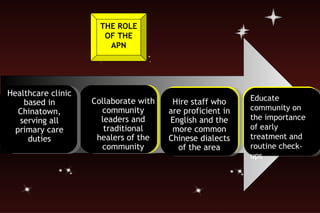
To identify and address what needs are (i.e. healthcare funds) and to gain acceptance of the community  Increase comfort of patient and decrease language barriers  Decrease the number of preventative diseases while improving in outcomes due to early interventions Increasing access and providing convenient and community based care THE ROLE OF THE APN Collaborate with community leaders and traditional healers of the community Hire staff who are proficient in English and the more common Chinese dialects of the area Educate community on the importance of early treatment and routine check-ups Healthcare clinic based in Chinatown, serving all primary care duties
Focus of the Nurse Practitioner's Role Improve health outcomes related to improved health-seeking beliefs and behaviors Build and strengthen community trust Patients will seek care sooner Patient will be more open with sharing information (especially about self-medication) Patient will be more open to education. Health outcome will ultimately improve and preventive diseases will decreases with patients more willing and open to seek care Improve healthcare disparities related to received vaccinations and appropriate hospitalization recommendations Clinic Improves access
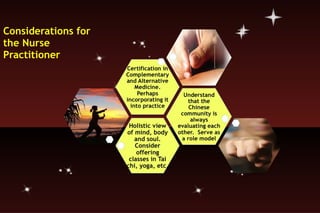
Considerations for the Nurse Practitioner
The End Thank  You    [email_address] [email_address] References Wang, Y. & Purnell, L.D., (2008). People of Chinese heritage. In L. Purnell  & B. Paulanka (3 rd   Ed.),  Transcultural health care:  A culturally competent approach  (pp. 129-144).  Philadelphia:  Davis Agency for Healthcare Research and Quality. (2009).  National healthcare disparities report.   Retrieved from  http://www.ahrq.gov/qual/nhdr09/nhdr09.pdf

Chinese culture compressed file

  • 1.
    People of ChineseHeritage (Wang Y., Purnell L.D, 2008) Presented by: Mariel Gonzalez, RN, BSN Sun Nguyen RN, BSN, CCRN Nurs 608: Spring 2011
  • 2.
    To View ThisPresentation Please Launch Self-Running Slide Show
  • 3.
    12 Health CarePractitioners 4 Workforce Issues 3 Family Roles and Organization 2 Communication 7 Nutrition 6 High-Risk Behaviors 9 Death Rituals 5 Biocultural Ecology 1 Overview and Heritage 11 Health Care Practices 10 Spirituality Pregnancy 8 8 8
  • 4.
    Overview and Heritage The Chinese culture dates back as far as 2200 B.C. Ideals and values based on Confucius teachings Importance in relationships (family and neighbors) Values family, elders, and higher education 1
  • 5.
    Overview and Heritage 1
  • 6.
    Overview and Heritage 1
  • 7.
    9.6 million squarekilometers 23 provinces 5 regions 3 municipalities 1 1.31 billion people
  • 8.
    People of ChineseHeritage in the United States The U.S. is slightly larger than China and has a significantly smaller population Approximately 310 million people are living in the United States of which 2.8 million are of Chinese descent Majority of the Chinese Population are residing in CA, NY, FL, and TX 1
  • 9.
    Immigration of theChinese in historical context People of Chinese Heritage in the United States 1
  • 10.
  • 11.
  • 12.
  • 13.
  • 14.
    Does not openlydisplay emotions Openly shares information when trust is established Appreciates any attempt at speaking their language Touching should be kept to a minimum Maintaining distance is a sign of respect Direct eye contact may be uncomfortable Smiles are limited in formal situations Laughing and joking is common when comfortable
  • 15.
    May say yeseven if they don’t understand (to save themselves from embarrassment) Reputation of the family is very important The Chinese American may feel that they are always being evaluated
  • 16.
    Build a trustingrelationship Watch for cues of discomfort Instructions should be short, direct and specific Chinese clients should be addressed by either: Their family name Their full name (first and last) And always with their title (Mr., Mrs.)
  • 17.
  • 18.
    Education and successFamily Love and marriage Children
  • 19.
    The average familysize is 3.46 in 2006 (One child per couple law) Male headed households Women beginning to fill more than ½ of the workforce (i.e. engineering, aviation) Children are valued by parents who often sacrifice and are willing to work harder if it would benefit the child’s future Younger generations adopt “double income, no kids” lifestyle because of a want in a higher standard of living More elderly parents are cared by society as children are focused on careers often in other countries The whole is greater than its part Group support is greater than privacy Personal independence not valued “ Re-education camps” “ Guan Xi” societal bank where funds are withdrawn that “demands payback” Chinese mothers (emotional atmosphere of the family) Chinese fathers (leaders) Chinese elders (wisdom)
  • 20.
    Higher education linkedwith success Extended family members often assist in taking care of children to reduce financial hardship or improve education attainment of individual family members Family emphasizes on education and many exempt their children from working and household chores Competitiveness of education has caused many parents to spoil their children Pressured to succeed to improve the future of the family
  • 21.
    Financial stability andsecurity are considered before having children Divorce is legal but frowned upon Same sex partner are illegal and punishable by death in China
  • 22.
  • 23.
    Male children aremore valued than female children in rural areas Family members make all decisions for children in China (may continue into young adulthood) Expected to do well in school and achieve high grades Radical thoughts are discouraged Independence of children are increasing Determination of career goals are considered during adolescents Many Chinese children who adopt Western views may feel that expectations of older family members are too demanding Teenage pregnancy is not common but increasing in Chinese Americans Enters workforce immediately if education is not continued
  • 24.
    Male children aremore valued than female children in rural areas Family members make all decisions for children in China (may continue into young adulthood) Expected to do well in school and achieve high grades Radical thoughts are discouraged Independence of children are increasing Determination of career goals are considered during adolescents Many Chinese children who adopt Western views may feel that expectations of older family members are too demanding. Teenage pregnancy is not common but increasing in Chinese Americans Enters workforce immediately if education is not continued 4 1 2 3
  • 25.
  • 26.
    SKIN HAIR FRAMEOTHER Generally shorter Light skin with pink undertone Black Dark skin Yellow tone Varies Usually Straight Sometimes naturally Curly Ulna longer than radius Bone density less Hips smaller Chinese men have less facial and chest hair compared to other men Twins are not common Rh negative blood is rare Biocultural Ecology 5
  • 27.
    Malignant neoplasms Pancreaticcancer Cervical Liver Lung Stomach Multiple myeloma Esophageal Nasopharyngeal Heart diseases Respiratory Diseases CVA Tuberculoisis Hepatitis B 5 Men Women Both New immigrants
  • 28.
    5 5 Poormetabolism Mephenytoin (i.e. diazepam) Increased Sensitivity Beta-blockers Atropine Antidepressants Neuroleptics Alcohol Decreased sensitivity Analgesia but causes increased GI side effects
  • 29.
    5 5 Mostdata collected, group the Chinese population into the Asian American category The author suggest more research should be done to identify specific cultural differences 2009 Health care disparities report Identified that being uninsured is the strongest descriptor to effect the quality of care received. The report also identified that there is a disparity in the amount of pneumonia vaccination given and a worsening number of recommended hospitalizations for the Asian population with diagnosed pneumonia. The Chinese population in America were also specifically identified as having a large proportion of socioeconomic difficulties with being uninsured as one of the problems. Respiratory issues have also been identified in the Chinese population, giving room for improvement to serve the Chinese American population .
  • 30.
    Tobacco use inChinese men and teenagers Increasing Tobacco use in women High Behavior risk factors High Incidence of Traumas related to alcohol use 6
  • 31.
    12 Health CarePractitioners 4 Workforce Issues 3 Family Roles and Organization 2 Communication 6 High-Risk Behaviors 9 Death Rituals 5 Biocultural Ecology 1 Overview and Heritage 11 Health Care Practices 10 Spirituality 8 8 7 Nutrition Pregnancy 8
  • 32.
    Nutrition Food ismeaningful Celebrations centered around food Well balanced diet to promote health and well being Yang, “hot” & yin, “cold” style of eating Warm or hot drinks at meal times to maintain balance within body and promote healing Cold drinks thought to shock body 7
  • 33.
    Nutrition Common foodsPeanuts, soybeans, wheat, sorghum, maize, rice, beans, noodles, vegetables Meats: pork most common, chicken, beef, duck, shrimp, fish, scallops, mussels and tofu Foods high in fat and salt Lack of dairy products in diet due to genetic tendency of lactose intolerance Obtain Calcium from wide variety of green vegetables 7
  • 34.
    Pregnancy Enforcementof one-child law Intrauterine device most common birth control Sterilization common Oral contraceptives free in China Abortions common Not ready for child or gender specific Boys still favored over girls 8
  • 35.
    Pregnancy Pregnancy seenas a blessing Women modest Prefer female midwife/obstetrician Consume more meat to strengthen blood May refuse Iron; thought to make delivery difficult Postpartum practices: Only cooked warm meals Taboo to drink or touch cold water Prevent cold air from body Dressed head to toe Won’t bathe for first month Breastfeeding important Encouraged to drink rice wine to promote milk production 8
  • 36.
    Death Rituals Stoicacceptance of death as part of life Worship Ancestors Form of respect Dead visited at hospital or family’s house Dead honored by surrounding coffin with items that symbolized deceased life Black armband worn on left arm and white cloth tied around head to symbolize mourning Fear death Avoid mentioning it or words that sound like it in Chinese No life insurance – seen as inviting death Colors white and black associated with death; considered bad luck 9
  • 37.
  • 38.
    Spirituality Minimal religiousservices Ideas and values practiced alone Main practices are Buddhism, Catholicism, Protestantism, Taoism and Islam Churches in Chinese community important Provide support and services for immigrants Comforted through prayer Goal is to live a happy and healthy life 10
  • 39.
    Spirituality “ Lifeforces” are interconnected and provide strength Individual, environment, past and future of individuals and society Call upon ancestors Dependence on family Practices that provide strength Meditation, exercise, massage and prayer Drugs, herbs, food, good air and artistic expression 10
  • 40.
    Health-care practices Useof Western medicine and traditional Chinese medicine Younger generations seek care when necessary; usually seek Western medicine first then traditional Chinese medicine Older Chinese generations use traditional Chinese remedies and only seek Western medicine when not responding to treatment Value stoicism May not discuss all ailments or alternative medicines being used 11
  • 41.
    Health-care practices inChina Centered on preventative care Focusing on Infectious diseases i.e. Schistosomiasis, TB, childhood diseases, cancer, heart disease, malaria, and maternal-infant care Regulation on AIDS prevention and control plan Free HIV testing HIV carriers and AIDS patients encouraged to inform spouses/sexual partners Local prevention authorities will inform spouses/sexual partners of patients’ statuses if not done so by patient 11
  • 42.
    Health-care practices Languagebarrier prevents the seek of medical care Frustration of not being able to freely express/explain symptoms Do not trust healthcare providers Self medicate and share medicine Accept blood transfusion and organ donations when necessary 11
  • 43.
    Traditional Chinese MedicinePractices Acupuncture and Moxibustion are used to restore imbalances in the body system Acupuncture – use of needles inserted into various pressure points to restore the balance of the bodies energy flow Moxibustion – application of heat to various points to draw out illness (i.e. cupping) Herbal therapy Depending on the illness herbs are drank, eaten, applied topically or worn on the body Herbs may also be given cold, hot, warm or cool Sense of interconnectiveness of the body systems One systems effects the other Must maintain the balance for good health and happiness Dao = balance of yin and yang 11
  • 44.
    Health-care Providers PracticeWestern medicine and traditional Chinese medicine Education is similar to Western for physicians, nurses and pharmacists Practice Mid-wifery Physicians trained in universities Physicians use traditional Chinese pharmacies Chinese physicians are well respected Men respected more than women providers Women prefer female providers due to modesty 12
  • 45.
    The Role ofthe Advanced Practice Nurse
  • 46.
  • 47.
    Health related issuesin the Chinese American population The Chinese American population frequently alternates and at times incorporate both traditional Chinese medicine with Western medicine without fully understanding the implications for choosing one method over the other. With language and cultural barriers, distrust in Western medicine may have deterred Chinese American patients from receiving care until symptoms worsen and disease are in advanced stages, leading to poorer prognosis.
  • 48.
    To identify andaddress what needs are (i.e. healthcare funds) and to gain acceptance of the community Increase comfort of patient and decrease language barriers Decrease the number of preventative diseases while improving in outcomes due to early interventions Increasing access and providing convenient and community based care THE ROLE OF THE APN Collaborate with community leaders and traditional healers of the community Hire staff who are proficient in English and the more common Chinese dialects of the area Educate community on the importance of early treatment and routine check-ups Healthcare clinic based in Chinatown, serving all primary care duties
  • 49.
    Focus of theNurse Practitioner's Role Improve health outcomes related to improved health-seeking beliefs and behaviors Build and strengthen community trust Patients will seek care sooner Patient will be more open with sharing information (especially about self-medication) Patient will be more open to education. Health outcome will ultimately improve and preventive diseases will decreases with patients more willing and open to seek care Improve healthcare disparities related to received vaccinations and appropriate hospitalization recommendations Clinic Improves access
  • 50.
    Considerations for theNurse Practitioner
  • 51.
    The End Thank You   [email_address] [email_address] References Wang, Y. & Purnell, L.D., (2008). People of Chinese heritage. In L. Purnell & B. Paulanka (3 rd Ed.), Transcultural health care: A culturally competent approach (pp. 129-144). Philadelphia: Davis Agency for Healthcare Research and Quality. (2009). National healthcare disparities report. Retrieved from http://www.ahrq.gov/qual/nhdr09/nhdr09.pdf

Editor's Notes

  • #5 Oldest civiliziation It is a complex system of moral, social, political, philosophical Feels a sense of accountability
  • #7 Oldest civiliziation One of the most richest culture, inspiring music, beautiful scenerias and most fascinating history
  • #8 map
  • #9 Timeline
  • #10 Timeline
  • #11 … global causes.
  • #13 Along the way we’ve discovered…
  • #14 Animated pictures fly in from gray to full color (Advanced) Tip : For the effects on this slide, it is recommended to use pictures with a “portrait” (vertical) orientation. To reproduce the text effects on this slide, do the following: On the Home tab, in the Slides group, click Layout , and then click Blank . On the Insert tab, in the Text group, click Text Box , and then on the slide, drag to draw the text box. Enter text in the text box, and then select the text. On the Home tab, in the Font group, select Georgia from the Font list, enter 34 in the Font Size box, click Italic , click the arrow next to Font Color , and then under Theme Colors click Aqua, Accent 5, Darker 25% (fifth row, ninth option from the left). Drag the text box into the upper half of the slide, slightly left of the center. To reproduce the first picture with animation effects on this slide, do the following: On the Insert tab , in the Images group, click Picture . In the Insert Picture dialog box, select a picture and then click Insert . On the slide, select the picture. Under Picture Tools , on the Format tab, in the bottom right corner of the Size group, click the Size and Position dialog box launcher. In the Format Picture dialog box, resize or crop the picture as needed so that the height is set to 3.81” and the width is set to 2.54 ” . To crop the picture, click Crop in the left pane, and in the Crop pane, under Crop position , enter values into the Height , Width , Left , and Top boxes. To resize the picture, click Size in the left pane, and in the Size pane, under Size and rotate , enter values into the Height and Width boxes. Drag the picture into the into the top left corner of the slide. (Note: Align the left edge of the picture with the left edge of the slide, and leave a small margin between the top edge of the picture and the top edge of the slide.) Select the picture. Under Picture Tools , on the Format tab, in the bottom right corner of the Picture Styles group, click the Format Picture dialog box launcher. In the Format Picture dialog box, in the left pane click Picture Correction , in the Picture Correction pane, under Brightness and Contrast , in the Brightness box, enter 50% . Also in the Format Picture dialog box, in the left pane click Picture Color , in the Picture Color pane, under Recolor , click the button next to Presets and click Grayscale . On the Animations tab, in the Advanced Animation group, click Add Animation , and then under Entrance click Fly In . Also on the Animations tab, in the Animation group, click Effect Option , and then click From Left . Also on the Animations tab, in the Timing group, do the following: In the Start list, select With Previous . In the Duration box, enter 1.00 seconds . Also on the Animations tab, in the Advanced Animation group, click Add Animation , and then click More Entrance Effects . In the Add Entrance Effect dialog box, under Subtle , click Expand , and then click OK . Also on the Animations tab, in the Timing group, do the following: In the Start list, select With Previous . In the Duration box, enter 1.00 seconds . To reproduce the second picture with animation effects on this slide, do the following: On the slide, select the picture. On the Home tab, in the Clipboard group, click the arrow to the right of Copy , and then click Duplicate . Drag the second picture until its left side slightly overlaps the right side of the first picture. Select the second picture. Under Picture Tools , on the Format tab, in the bottom right corner of the Picture Styles group, click the Format Picture dialog box launcher. In the Format Picture dialog box, in the left pane click Picture Corrections , in the Picture Correction pane, under Brightness and Contrast , in the Brightness box, enter 40% . On the Animations tab, in the Advanced Animation group, click Animation Pane . Press and hold CTRL, and then select the third and fourth animation effects (fly-in and expand effects for the second picture) in the Animation Pane . On the Animations tab, in the Timing group, in the Delay box, enter 0.2 . To reproduce the third picture with animation effects on this slide, do the following: On the slide, select the second picture. On the Home tab, in the Clipboard group, click the arrow to the right of Copy , and then click Duplicate . Drag the third picture until its left side slightly overlaps the right side of the second picture. Select the third picture. Under Picture Tools , on the Format tab, in the bottom right corner of the Picture Styles group, click the Format Picture dialog box launcher. In the Format Picture dialog box, in the left pane click Picture Corrections , in the Picture Corrections pane, under Brightness and Contrast , in the Brightness box, enter 20% . Press and hold CTRL, and then select the fifth and sixth animation effects (fly-in and expand effects for the third picture) in the Animation Pane . On the Animations tab, in the Timing group, in the Delay box, enter 0.4 . To reproduce the fourth picture with animation effects on this slide, do the following: On the slide, select the third picture. On the Home tab, in the Clipboard group, click the arrow to the right of Copy , and then click Duplicate . Drag the fourth picture until its left side slightly overlaps the right side of the third picture. Select the fourth picture. Under Picture Tools , on the Format tab, in the bottom right corner of the Picture Styles group, click the Format Picture dialog box launcher. In the Format Picture dialog box, in the left pane click Picture Corrections , in the Picture Corrections pane, under Brightness and Contrast , in the Brightness box, enter 0% . Press and hold CTRL, and then select the seventh and eighth animation effects (fly-in and expand effects for the fourth picture) in the Animation Pane . On the Animations tab, in the Timing group, in the Delay box, enter 0.6 . To reproduce the fifth picture with animation effects on this slide, do the following: On the slide, select the fourth picture. On the Home tab, in the Clipboard group, click the arrow to the right of Copy , and then click Duplicate . Drag the fifth picture until its left side slightly overlaps the right side of the fourth picture. Select the fifth picture. Under Picture Tools , on the Format tab, in the bottom right corner of the Picture Styles group, click the Format Shape dialog box launcher. Also in the Format Picture dialog box, in the left pane click Picture Color , in the Picture Color pane, under Recolor , click the button next to Presets and click No Recolor . Press and hold CTRL, and then select the ninth and 10th animation effects (fly-in and expand effects for the fifth picture) in the Animation Pane . On the Animations tab, in the Timing group, in the Delay box, enter 0.8 . To reproduce the animation effects for the text box on this slide, do the following: On the Home tab, in the Editing group, click Select , and then click Selection Pane . In the Selection and Visibility pane, select the text box. On the Animations tab, in the Advanced Animation group, click Add Animation , and then under Entrance click Fade . Also on the Animations tab, in the Timing group, do the following: In the Start list, select With Previous . In the Duration box, enter 0.50 seconds . In the Delay box, enter 1.30 seconds . In the Selection and Visibility pane, press and hold CTRL, and then select the first, second, third, and fourth pictures. On the Animations tab, in the Advanced Animation group, click Add Animation , and then under Exit click Fade . Also on the Animations tab, in the Timing group, do the following: In the Start list, select With Previous . In the Duration list, select 1.00 second . In the Animation Pane , select the 12 th animation effect (first fade effect). On the Animations tab, in the Timing group, in the Delay box enter 1.40 seconds . In the Animation Pane , select the 13 th animation effect (second fade effect). On the Animations tab, in the Timing group, in the Delay box enter 1.60 seconds . In the Animation Pane , select the 14 th animation effect (third fade effect). On the Animations tab, in the Timing group, in the Delay box enter 1.80 seconds . In the Animation Pane , select the 15 th animation effect (fourth fade effect). On the Animations tab, in the Timing group, in the Delay box enter 2.00 seconds . To reproduce the background effects on this slide, do the following: Right-click the slide background area, and then click Format Background . In the Format Background dialog box, click Fill in the left pane, select Gradient fill in the right pane, and then do the following: In the Type list, select Radial . Click the button next to Direction , and then click From Center (third option from the left). Under Gradient stops , click Add gradient stops or Remove gradient stops until three stops appear in the drop-down list. Also under Gradient stops , customize the gradient stops as follows: Select the first stop in the slider, and then do the following: In the Position box, enter 0% . Click the button next to Color , and then under Theme Colors click White, Background 1, Darker 5% (second row, first option from the left). Select the next stop in the slider, and then do the following: In the Position box, enter 34% . Click the button next to Color , and then under Theme Colors click White, Background 1, Darker 15% (third row, first option from the left). Select the last stop in the slider, and then do the following: In the Position box, enter 100% . Click the button next to Color , and then under Theme Colors click White, Background 1, Darker 50% (sixth row, first option from the left).
  • #15 Animated pictures fly in from gray to full color (Advanced) Tip : For the effects on this slide, it is recommended to use pictures with a “portrait” (vertical) orientation. To reproduce the text effects on this slide, do the following: On the Home tab, in the Slides group, click Layout , and then click Blank . On the Insert tab, in the Text group, click Text Box , and then on the slide, drag to draw the text box. Enter text in the text box, and then select the text. On the Home tab, in the Font group, select Georgia from the Font list, enter 34 in the Font Size box, click Italic , click the arrow next to Font Color , and then under Theme Colors click Aqua, Accent 5, Darker 25% (fifth row, ninth option from the left). Drag the text box into the upper half of the slide, slightly left of the center. To reproduce the first picture with animation effects on this slide, do the following: On the Insert tab , in the Images group, click Picture . In the Insert Picture dialog box, select a picture and then click Insert . On the slide, select the picture. Under Picture Tools , on the Format tab, in the bottom right corner of the Size group, click the Size and Position dialog box launcher. In the Format Picture dialog box, resize or crop the picture as needed so that the height is set to 3.81” and the width is set to 2.54 ” . To crop the picture, click Crop in the left pane, and in the Crop pane, under Crop position , enter values into the Height , Width , Left , and Top boxes. To resize the picture, click Size in the left pane, and in the Size pane, under Size and rotate , enter values into the Height and Width boxes. Drag the picture into the into the top left corner of the slide. (Note: Align the left edge of the picture with the left edge of the slide, and leave a small margin between the top edge of the picture and the top edge of the slide.) Select the picture. Under Picture Tools , on the Format tab, in the bottom right corner of the Picture Styles group, click the Format Picture dialog box launcher. In the Format Picture dialog box, in the left pane click Picture Correction , in the Picture Correction pane, under Brightness and Contrast , in the Brightness box, enter 50% . Also in the Format Picture dialog box, in the left pane click Picture Color , in the Picture Color pane, under Recolor , click the button next to Presets and click Grayscale . On the Animations tab, in the Advanced Animation group, click Add Animation , and then under Entrance click Fly In . Also on the Animations tab, in the Animation group, click Effect Option , and then click From Left . Also on the Animations tab, in the Timing group, do the following: In the Start list, select With Previous . In the Duration box, enter 1.00 seconds . Also on the Animations tab, in the Advanced Animation group, click Add Animation , and then click More Entrance Effects . In the Add Entrance Effect dialog box, under Subtle , click Expand , and then click OK . Also on the Animations tab, in the Timing group, do the following: In the Start list, select With Previous . In the Duration box, enter 1.00 seconds . To reproduce the second picture with animation effects on this slide, do the following: On the slide, select the picture. On the Home tab, in the Clipboard group, click the arrow to the right of Copy , and then click Duplicate . Drag the second picture until its left side slightly overlaps the right side of the first picture. Select the second picture. Under Picture Tools , on the Format tab, in the bottom right corner of the Picture Styles group, click the Format Picture dialog box launcher. In the Format Picture dialog box, in the left pane click Picture Corrections , in the Picture Correction pane, under Brightness and Contrast , in the Brightness box, enter 40% . On the Animations tab, in the Advanced Animation group, click Animation Pane . Press and hold CTRL, and then select the third and fourth animation effects (fly-in and expand effects for the second picture) in the Animation Pane . On the Animations tab, in the Timing group, in the Delay box, enter 0.2 . To reproduce the third picture with animation effects on this slide, do the following: On the slide, select the second picture. On the Home tab, in the Clipboard group, click the arrow to the right of Copy , and then click Duplicate . Drag the third picture until its left side slightly overlaps the right side of the second picture. Select the third picture. Under Picture Tools , on the Format tab, in the bottom right corner of the Picture Styles group, click the Format Picture dialog box launcher. In the Format Picture dialog box, in the left pane click Picture Corrections , in the Picture Corrections pane, under Brightness and Contrast , in the Brightness box, enter 20% . Press and hold CTRL, and then select the fifth and sixth animation effects (fly-in and expand effects for the third picture) in the Animation Pane . On the Animations tab, in the Timing group, in the Delay box, enter 0.4 . To reproduce the fourth picture with animation effects on this slide, do the following: On the slide, select the third picture. On the Home tab, in the Clipboard group, click the arrow to the right of Copy , and then click Duplicate . Drag the fourth picture until its left side slightly overlaps the right side of the third picture. Select the fourth picture. Under Picture Tools , on the Format tab, in the bottom right corner of the Picture Styles group, click the Format Picture dialog box launcher. In the Format Picture dialog box, in the left pane click Picture Corrections , in the Picture Corrections pane, under Brightness and Contrast , in the Brightness box, enter 0% . Press and hold CTRL, and then select the seventh and eighth animation effects (fly-in and expand effects for the fourth picture) in the Animation Pane . On the Animations tab, in the Timing group, in the Delay box, enter 0.6 . To reproduce the fifth picture with animation effects on this slide, do the following: On the slide, select the fourth picture. On the Home tab, in the Clipboard group, click the arrow to the right of Copy , and then click Duplicate . Drag the fifth picture until its left side slightly overlaps the right side of the fourth picture. Select the fifth picture. Under Picture Tools , on the Format tab, in the bottom right corner of the Picture Styles group, click the Format Shape dialog box launcher. Also in the Format Picture dialog box, in the left pane click Picture Color , in the Picture Color pane, under Recolor , click the button next to Presets and click No Recolor . Press and hold CTRL, and then select the ninth and 10th animation effects (fly-in and expand effects for the fifth picture) in the Animation Pane . On the Animations tab, in the Timing group, in the Delay box, enter 0.8 . To reproduce the animation effects for the text box on this slide, do the following: On the Home tab, in the Editing group, click Select , and then click Selection Pane . In the Selection and Visibility pane, select the text box. On the Animations tab, in the Advanced Animation group, click Add Animation , and then under Entrance click Fade . Also on the Animations tab, in the Timing group, do the following: In the Start list, select With Previous . In the Duration box, enter 0.50 seconds . In the Delay box, enter 1.30 seconds . In the Selection and Visibility pane, press and hold CTRL, and then select the first, second, third, and fourth pictures. On the Animations tab, in the Advanced Animation group, click Add Animation , and then under Exit click Fade . Also on the Animations tab, in the Timing group, do the following: In the Start list, select With Previous . In the Duration list, select 1.00 second . In the Animation Pane , select the 12 th animation effect (first fade effect). On the Animations tab, in the Timing group, in the Delay box enter 1.40 seconds . In the Animation Pane , select the 13 th animation effect (second fade effect). On the Animations tab, in the Timing group, in the Delay box enter 1.60 seconds . In the Animation Pane , select the 14 th animation effect (third fade effect). On the Animations tab, in the Timing group, in the Delay box enter 1.80 seconds . In the Animation Pane , select the 15 th animation effect (fourth fade effect). On the Animations tab, in the Timing group, in the Delay box enter 2.00 seconds . To reproduce the background effects on this slide, do the following: Right-click the slide background area, and then click Format Background . In the Format Background dialog box, click Fill in the left pane, select Gradient fill in the right pane, and then do the following: In the Type list, select Radial . Click the button next to Direction , and then click From Center (third option from the left). Under Gradient stops , click Add gradient stops or Remove gradient stops until three stops appear in the drop-down list. Also under Gradient stops , customize the gradient stops as follows: Select the first stop in the slider, and then do the following: In the Position box, enter 0% . Click the button next to Color , and then under Theme Colors click White, Background 1, Darker 5% (second row, first option from the left). Select the next stop in the slider, and then do the following: In the Position box, enter 34% . Click the button next to Color , and then under Theme Colors click White, Background 1, Darker 15% (third row, first option from the left). Select the last stop in the slider, and then do the following: In the Position box, enter 100% . Click the button next to Color , and then under Theme Colors click White, Background 1, Darker 50% (sixth row, first option from the left).
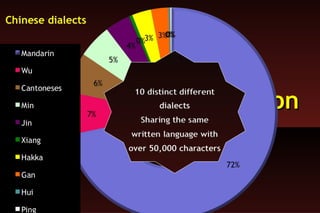
  • #17 May say yes- even if they don’t understand Doesn’t show emotions ( needs to build a trusting relationship Need direct short but specific directions Many different dialects In chinese (characters)- are universal
  • #19 headed household Average family size 3.4 -adults make decisions for young Family goals and priarity -divorce frowned upon
  • #20 headed household Average family size 3.4 -adults make decisions for young Family goals and priarity -divorce frowned upon
  • #21 headed household Average family size 3.4 -adults make decisions for young Family goals and priarity -divorce frowned upon
  • #22 headed household Average family size 3.4 -adults make decisions for young Family goals and priarity -divorce frowned upon
  • #23 headed household Average family size 3.4 -adults make decisions for young Family goals and priarity -divorce frowned upon
  • #47 The last rule is: Cultivate healthy relationships (with your slides and your audience)
  • #51 And please don’t refer to all Asians as Chinese.