In Search of a
Digital Health Compass
My Data, My Decision, Our ePower
Moderator: John Rayner
• Panelist’s introduction
#digitalhealthcompass
• How to co-create a digital health compass ?
– Health Data Standards
– Digital Health Literacy
• Q&A – interaction with you all
Tell me and I forget, Show me and I may remember,
Involve me and I’ll understand
Knowledge is power
• Extensive investments in digital health
technology – however low adoption of
eHealth and persistent health disparities call
for multidisciplinary action.
• Navigating for health online is challenging,
and understanding culture, education, skills,
costs, perceptions of power and role is
essential.
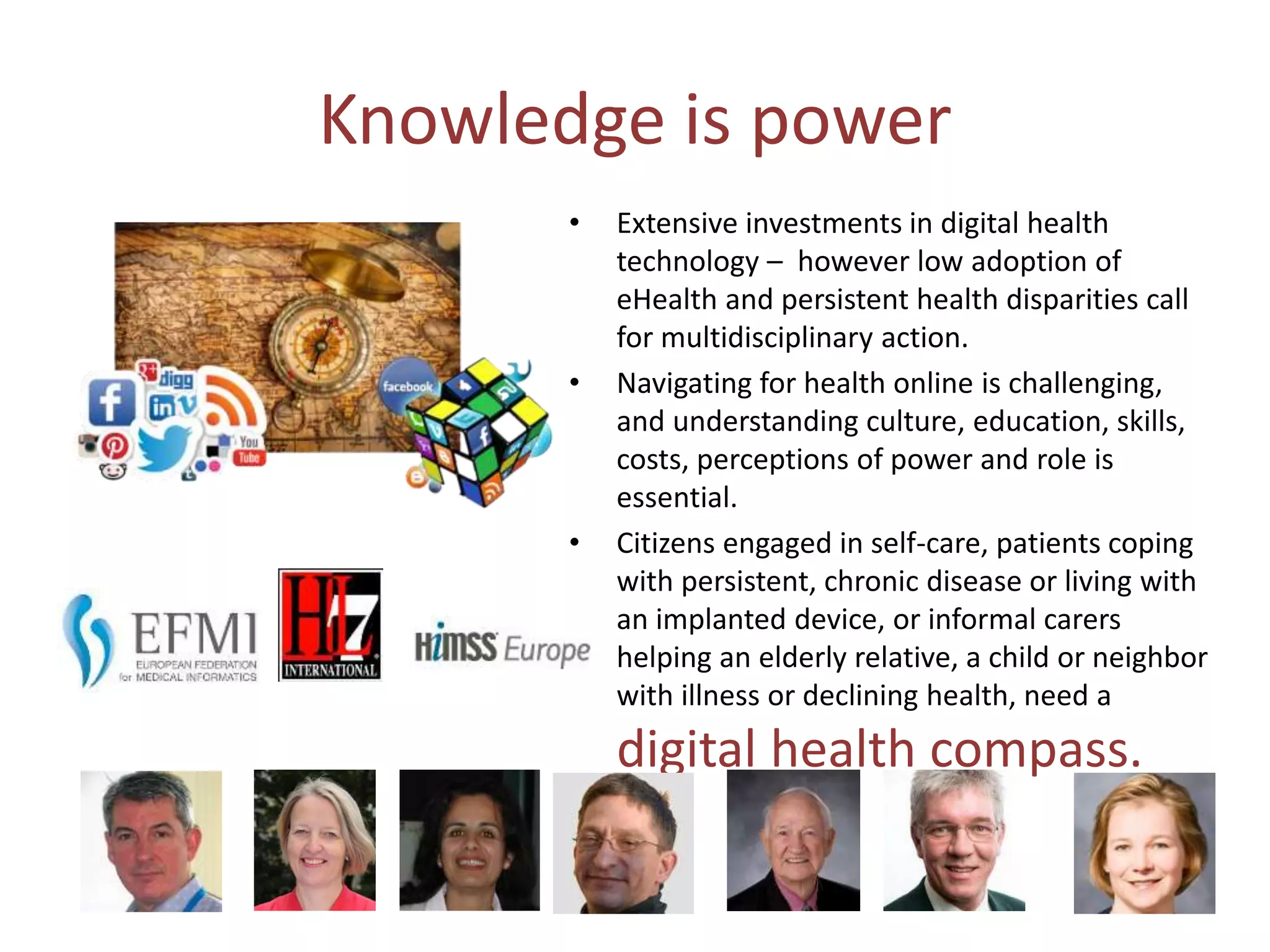
• Citizens engaged in self-care, patients coping
with persistent, chronic disease or living with
an implanted device, or informal carers
helping an elderly relative, a child or neighbor
with illness or declining health, need a
digital health compass.
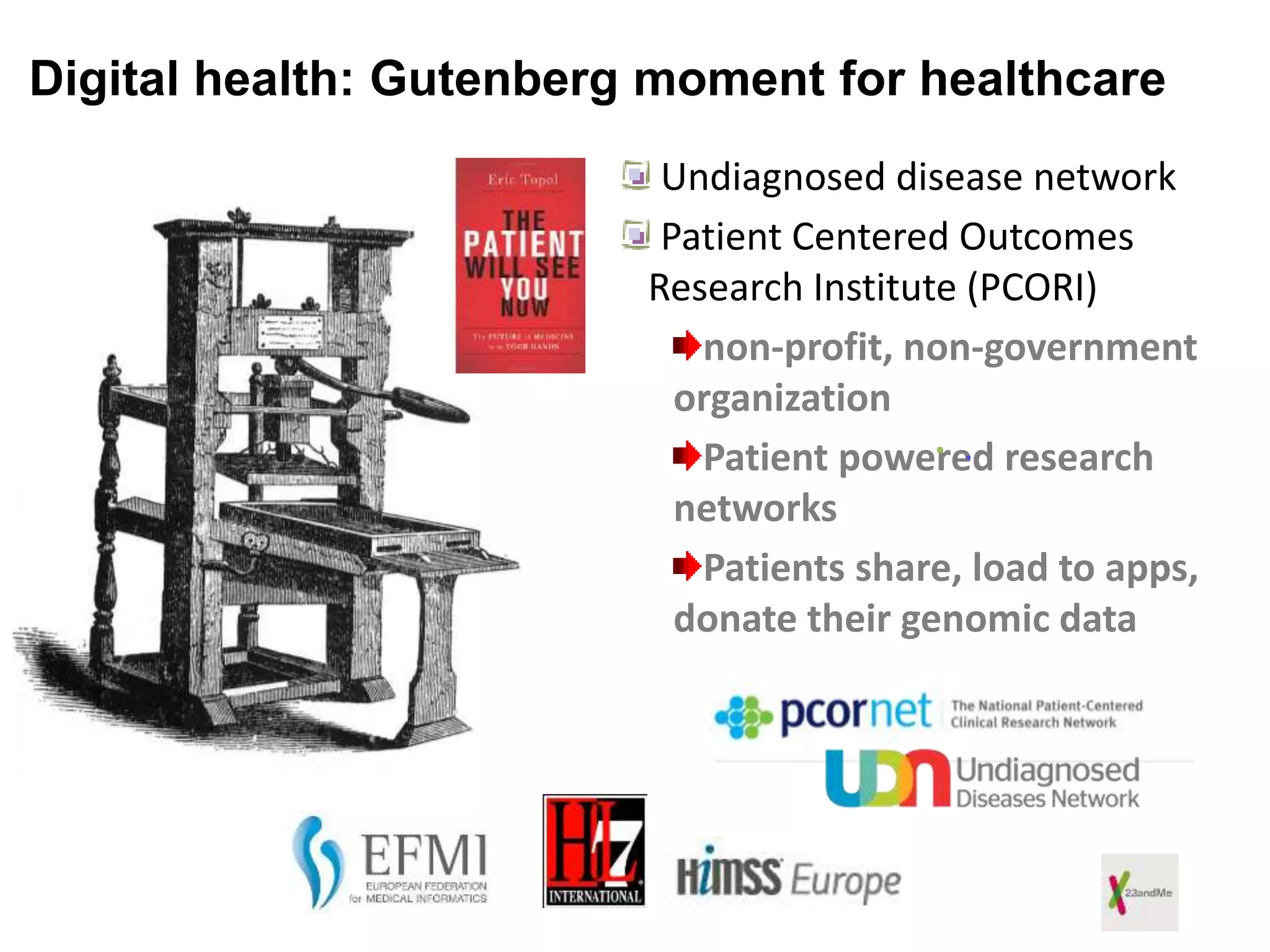
Digital health: Gutenberg moment for healthcare
Undiagnosed disease network
Patient Centered Outcomes
Research Institute (PCORI)
non-profit, non-government
organization
Patient powered research
networks
Patients share, load to apps,
donate their genomic data
• .
Objectives
• How can eHealth investments pay-off?
– Citizens – patients, caregivers and providers come together
with standards, industry and researchers to
co-create a personal digital health compass
• Call for joint actions by health care,
informatics, policy, standards, and industry
– Broad scope of Informatics in service for health
Panelists
Anne Moen
Petra Wilson
Robert Stegwee
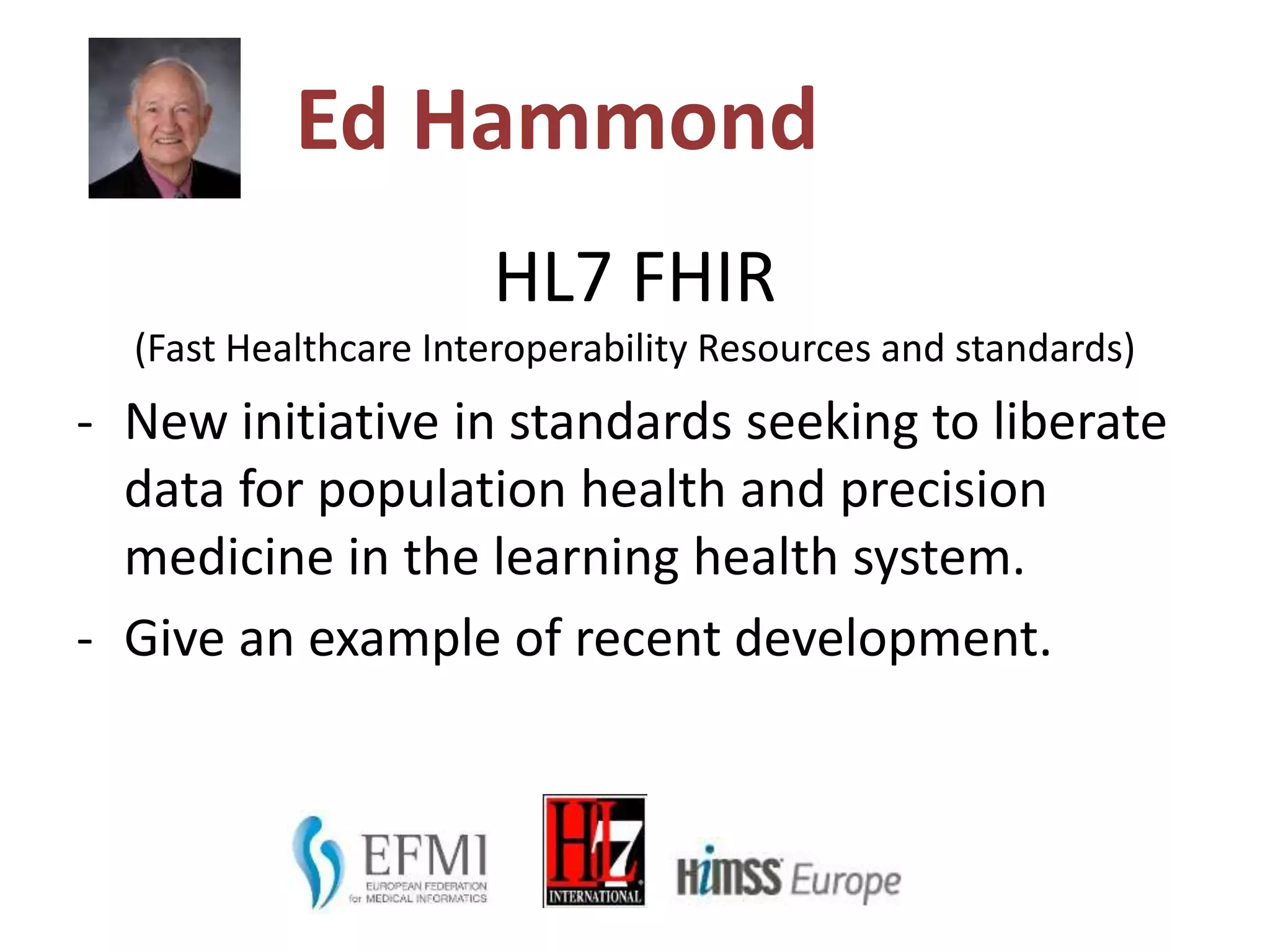
Ed Hammond
Christian Lovis
Catherine Chronaki
Anne Moen
Vision – a digital health compass
- Use myData for knowledge and give me tools
to participate in the transforming society
- Patient & families, health professionals and
health informatics join forces with research
and policy to advance digital health literacy
- Health Data standards and API as catalysts
Examples of storing and organizing health
information artifacts and spaces
Moen A, Brennan PF. Health@Home: the work of Health Information Management in the Household (HIMH)
- implications for Consumer Health Informatics (CHI) innovations. Journal of the American Medical Informatics Association, 2005;12:648-56.
There will be pictures here – omitted for sending
Current situation
• Citizens, patients and caregivers do not use
digital health services to meet their health
and wellness needs for several (good) reasons
• Few models for partnerships and information
sharing between citizens – professionals
• Little integration and interoperability of health
data for collaboration purposes
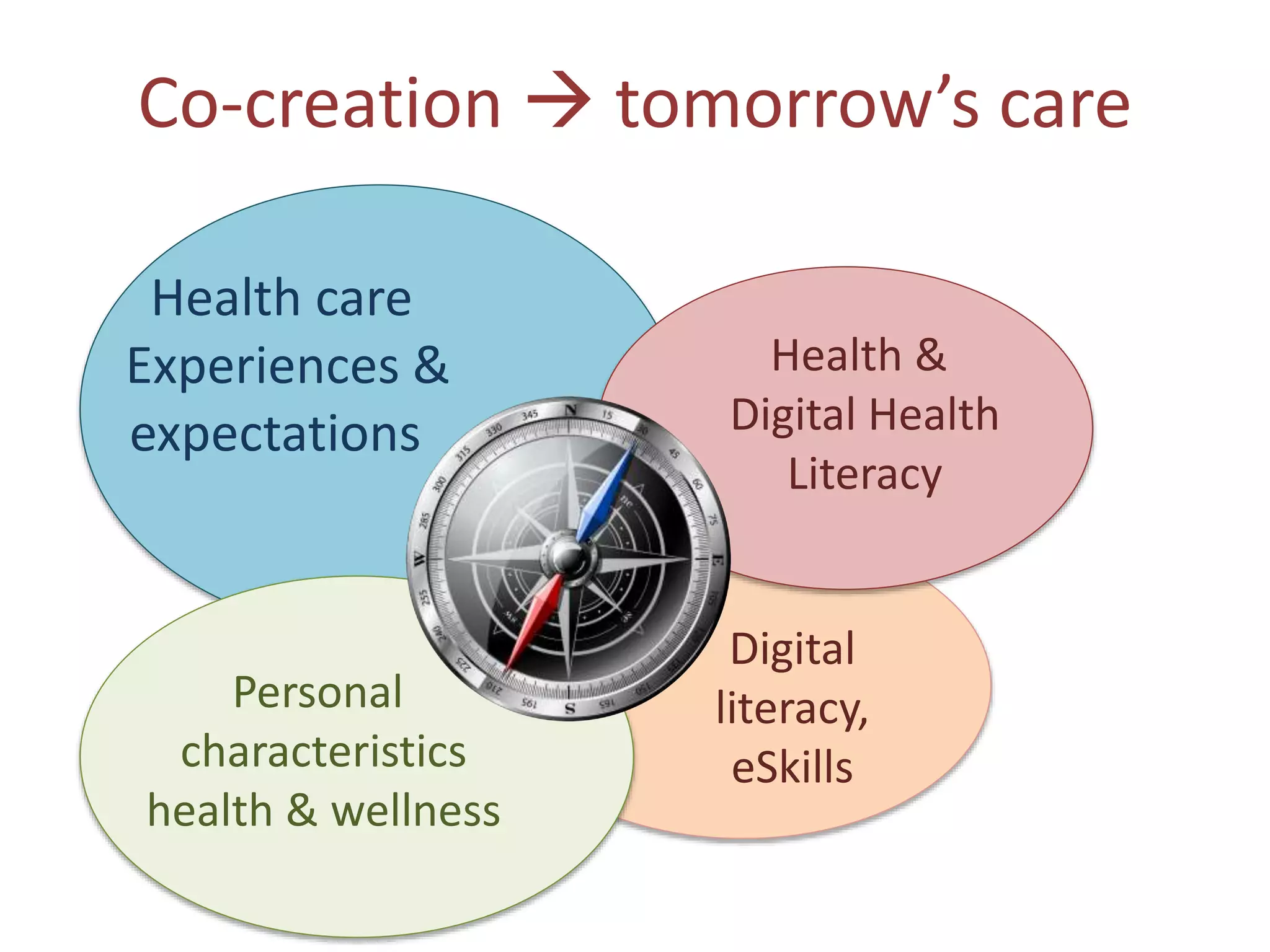
Digital
literacy,
eSkills
Health care
Experiences &
expectations
Co-creation  tomorrow’s care
Health &
Digital Health
Literacy
Personal
characteristics
health & wellness
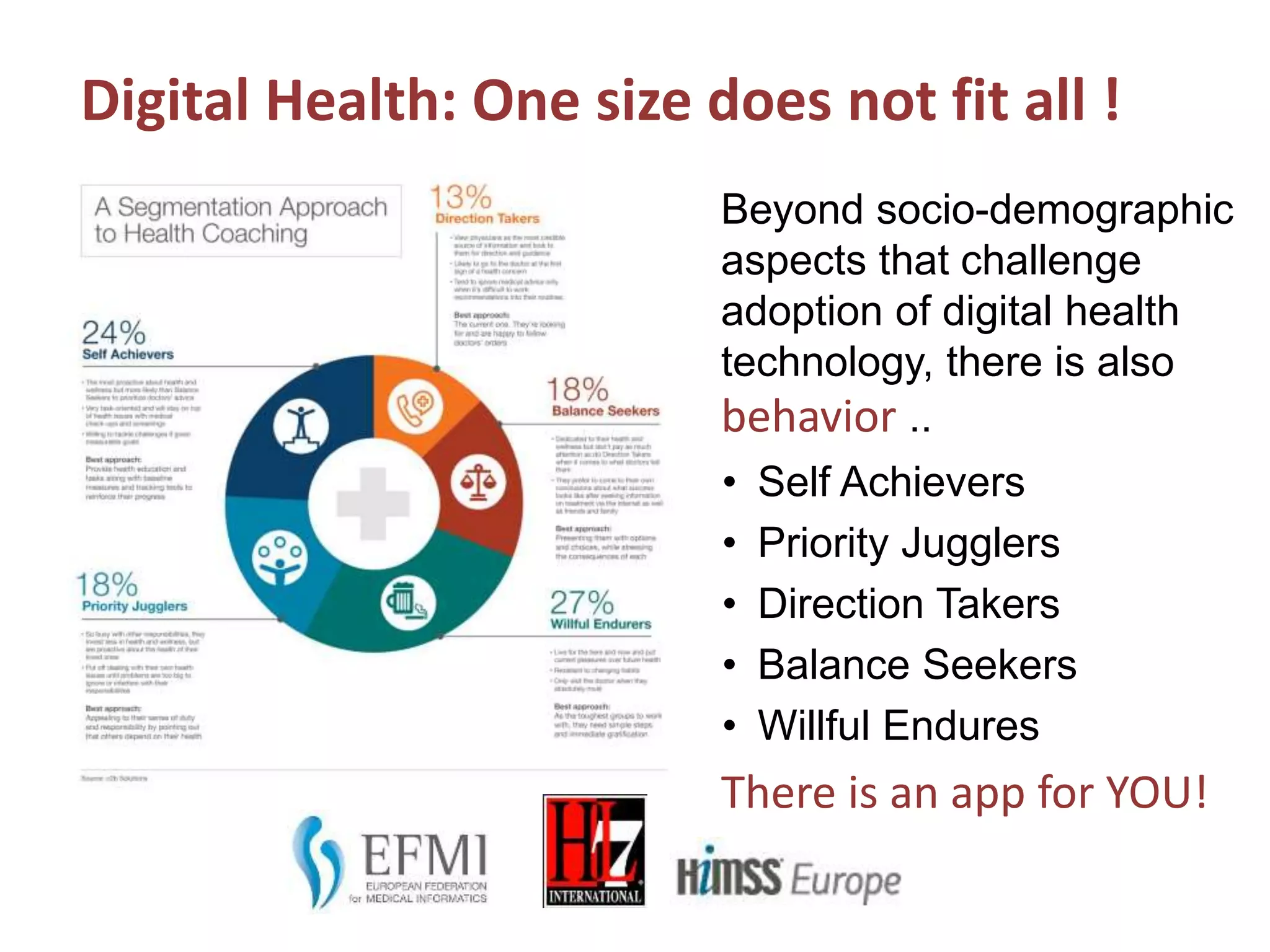
Digital Health: One size does not fit all !
Beyond socio-demographic
aspects that challenge
adoption of digital health
technology, there is also
behavior ..
• Self Achievers
• Priority Jugglers
• Direction Takers
• Balance Seekers
• Willful Endures
There is an app for YOU!
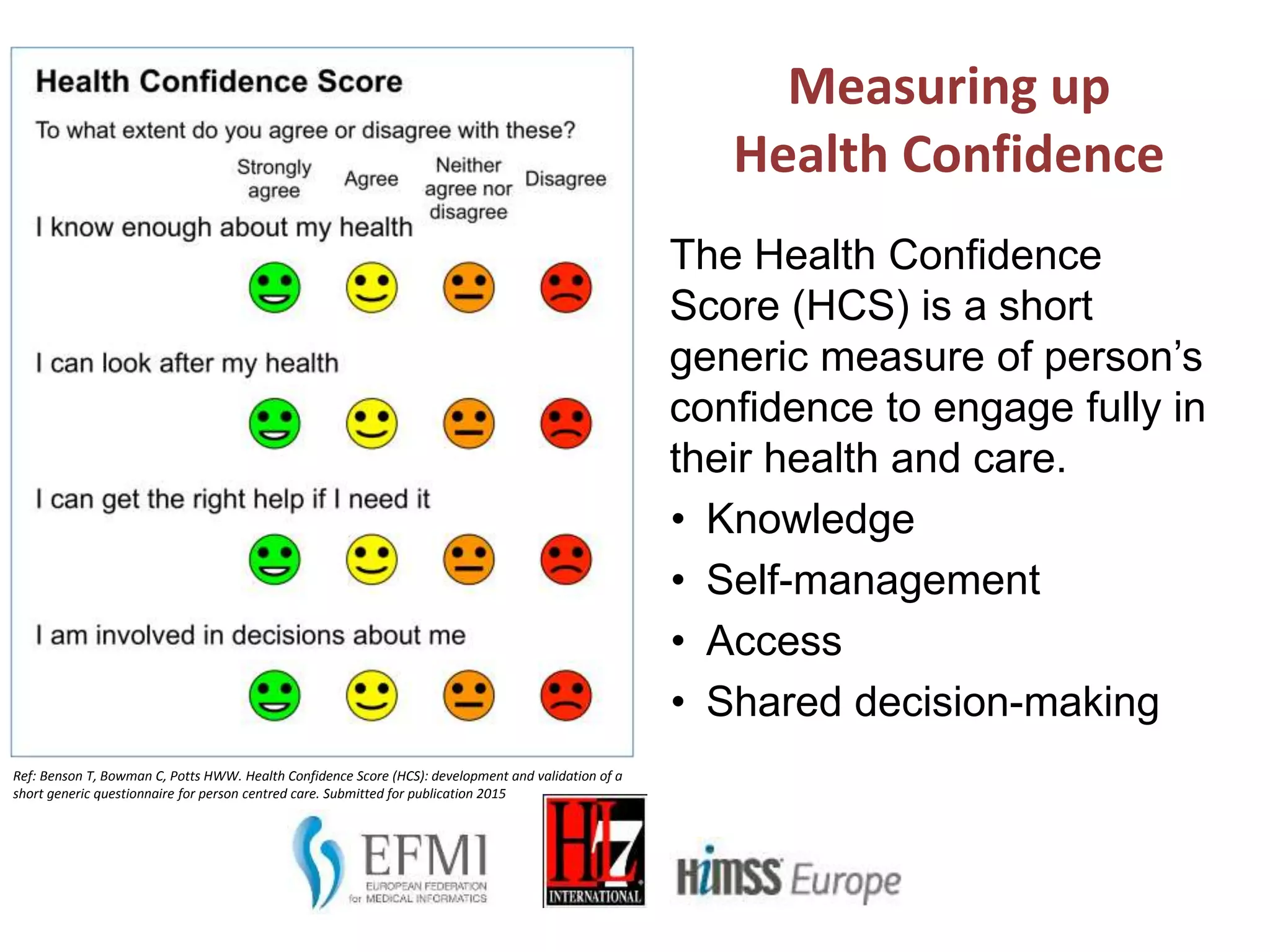
Ref: Benson T, Bowman C, Potts HWW. Health Confidence Score (HCS): development and validation of a
short generic questionnaire for person centred care. Submitted for publication 2015
Measuring up
Health Confidence
The Health Confidence
Score (HCS) is a short
generic measure of person’s
confidence to engage fully in
their health and care.
• Knowledge
• Self-management
• Access
• Shared decision-making
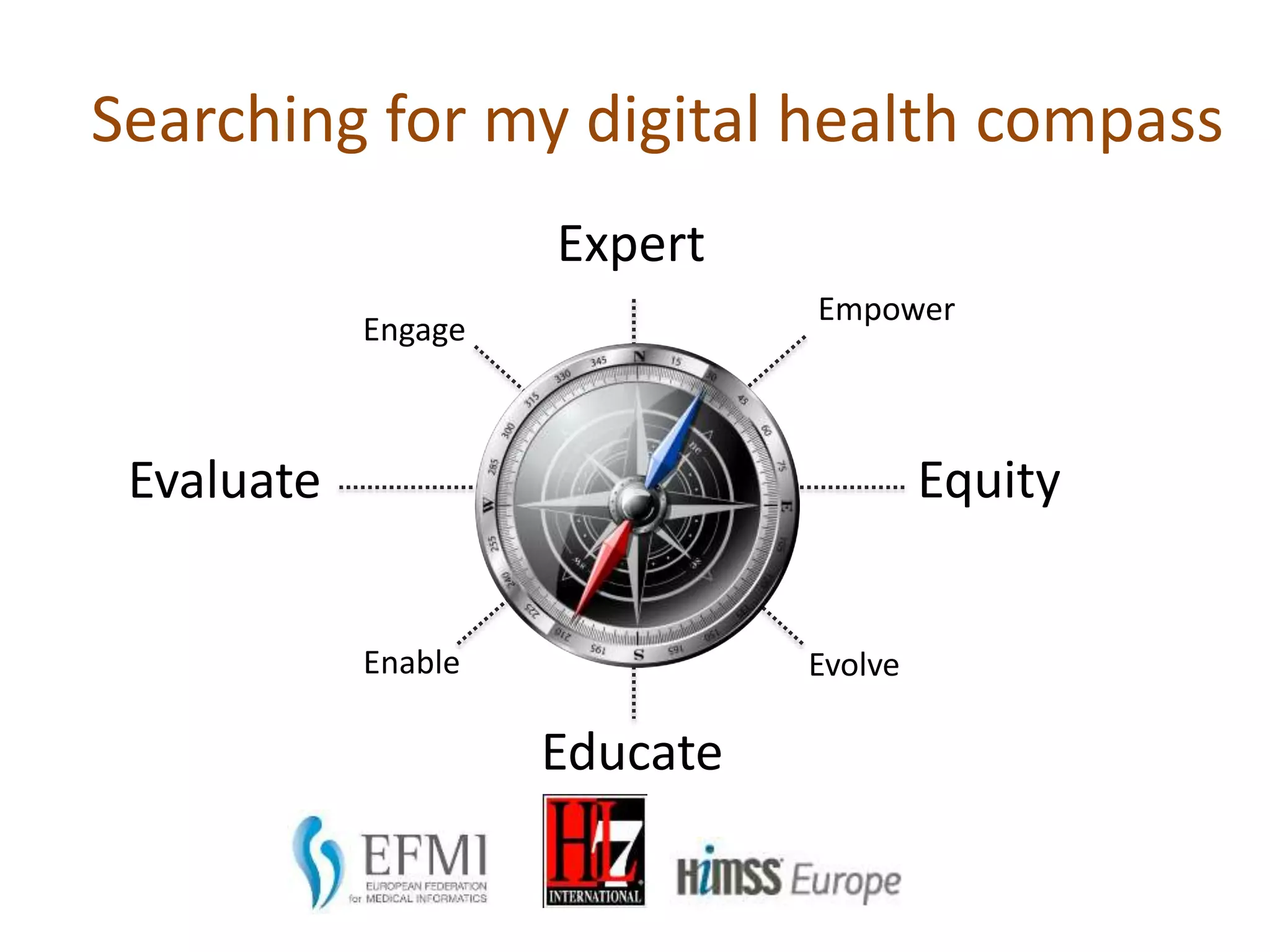
Expert
Empower
EquityEvaluate
Evolve
Educate
Engage
Enable
Searching for my digital health compass
• Knowledge and expertise to us as citizens
– resources that make sense –the relevant data
– Engage – convenient – balance – targets
• Balance what really matters
– Human relationships – empathy – the people
– Complex information collaboration
– Self-care between care – health encounter
Moving forward
Petra Wilson
• perspectives of patients – citizens
• confidence raising a call for action for the
health systems to integrate digital health
literacy interventions every step of the way
Why the Patient Needs a New Compass
Personalisation
- retail, leisure, education
Mobility
- work, communication, money
Complexity
- comorbidity, medication, environment
Scarcity
- resources, HCPs, time
What the compass should provide to
the Patient
Engage me in my own health
and care
- Access to relevant, timely and
understandable information.
Empower me to make
decision and inform others
- Ability to share information and
interact on information
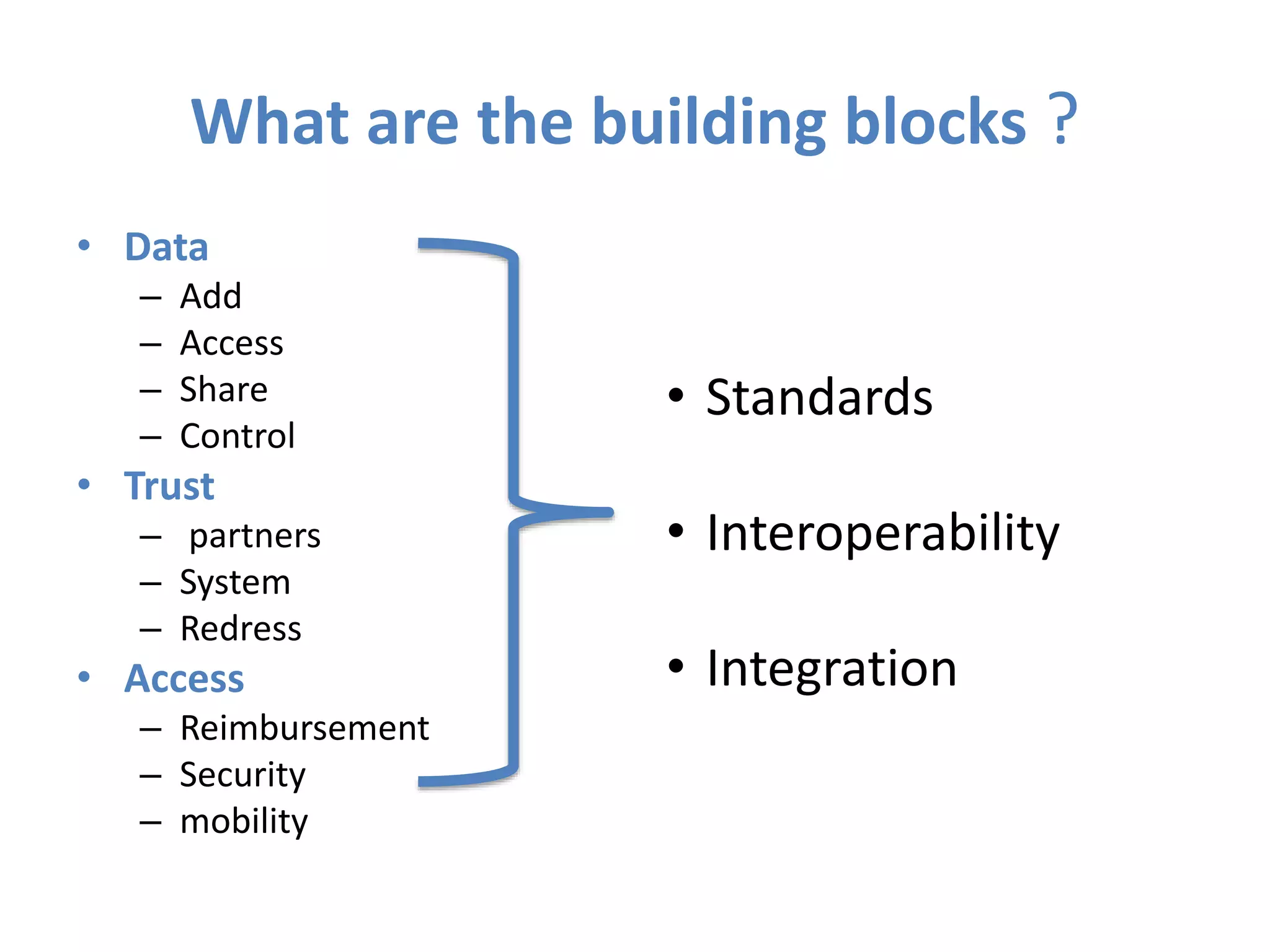
What are the building blocks ?
• Data
– Add
– Access
– Share
– Control
• Trust
– partners
– System
– Redress
• Access
– Reimbursement
– Security
– mobility
• Standards
• Interoperability
• Integration
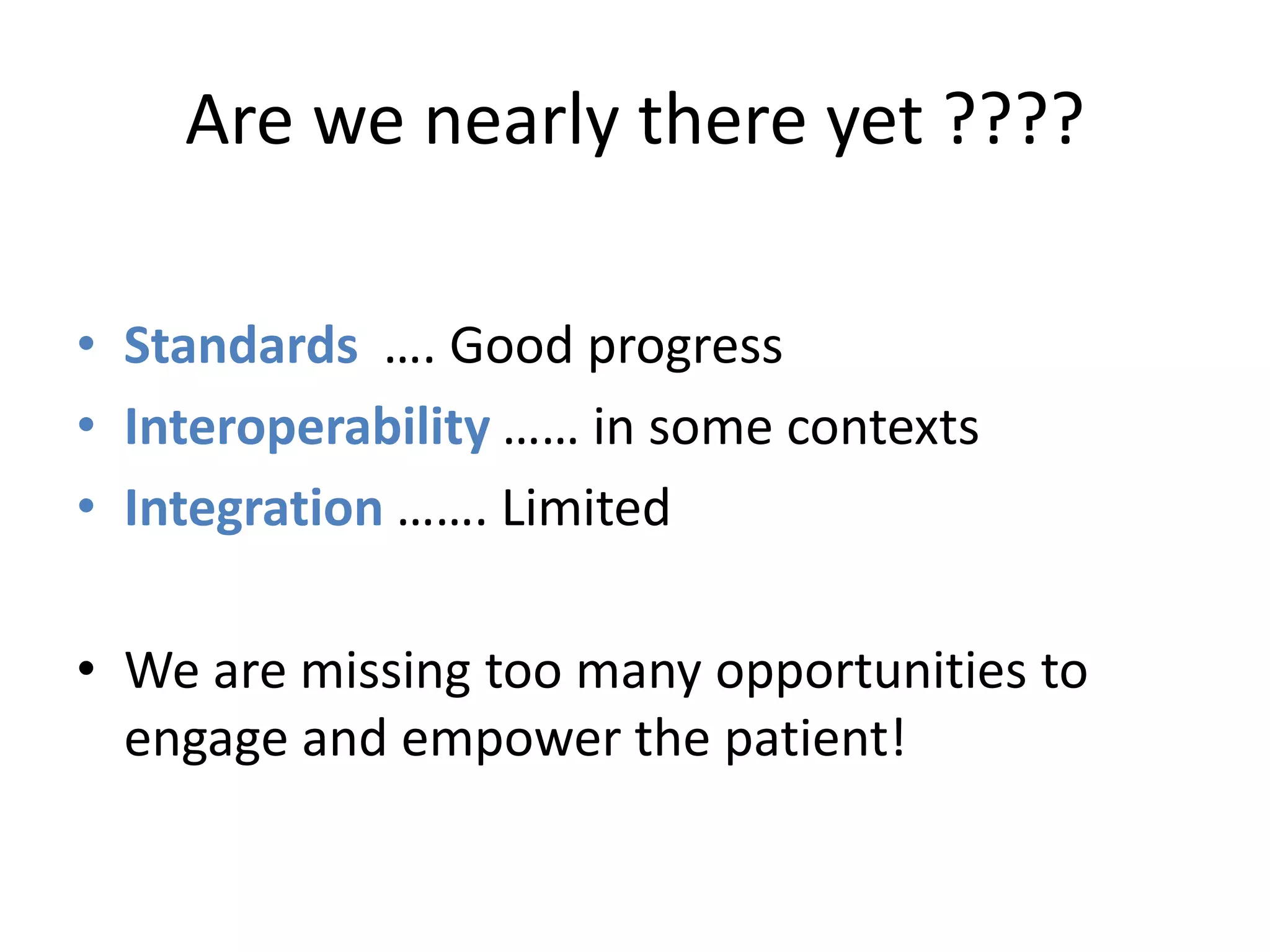
Are we nearly there yet ????
• Standards …. Good progress
• Interoperability …… in some contexts
• Integration ……. Limited
• We are missing too many opportunities to
engage and empower the patient!
Transform to the power of digital
Personal Digital Health
Robert A. Stegwee
Copyright © 2016 Capgemini Consulting. All rights reserved.
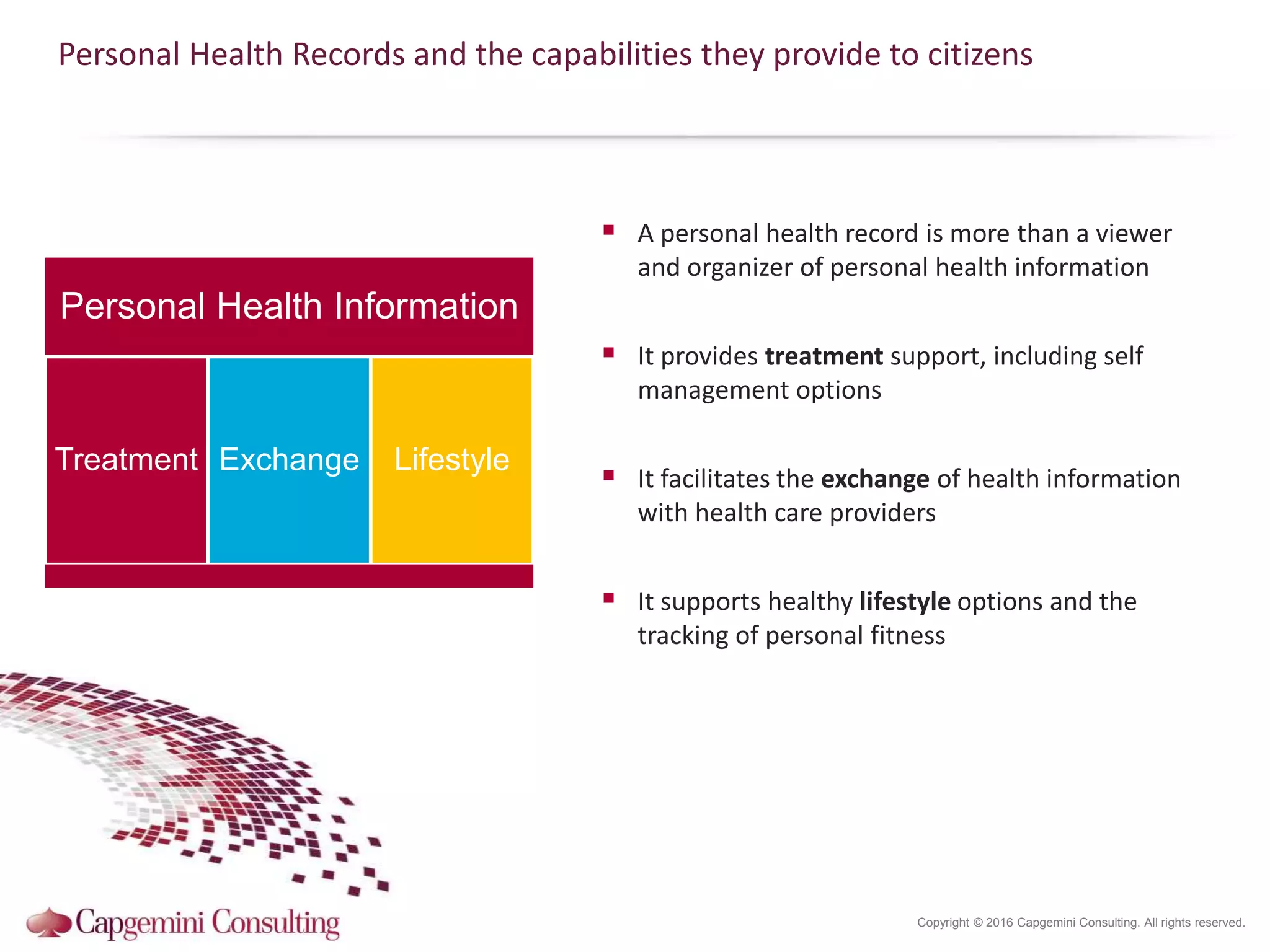
Personal Health Records and the capabilities they provide to citizens
 A personal health record is more than a viewer
and organizer of personal health information
 It provides treatment support, including self
management options
 It facilitates the exchange of health information
with health care providers
 It supports healthy lifestyle options and the
tracking of personal fitness
Personal Health Information
Treatment Exchange Lifestyle
Copyright © 2016 Capgemini Consulting. All rights reserved.
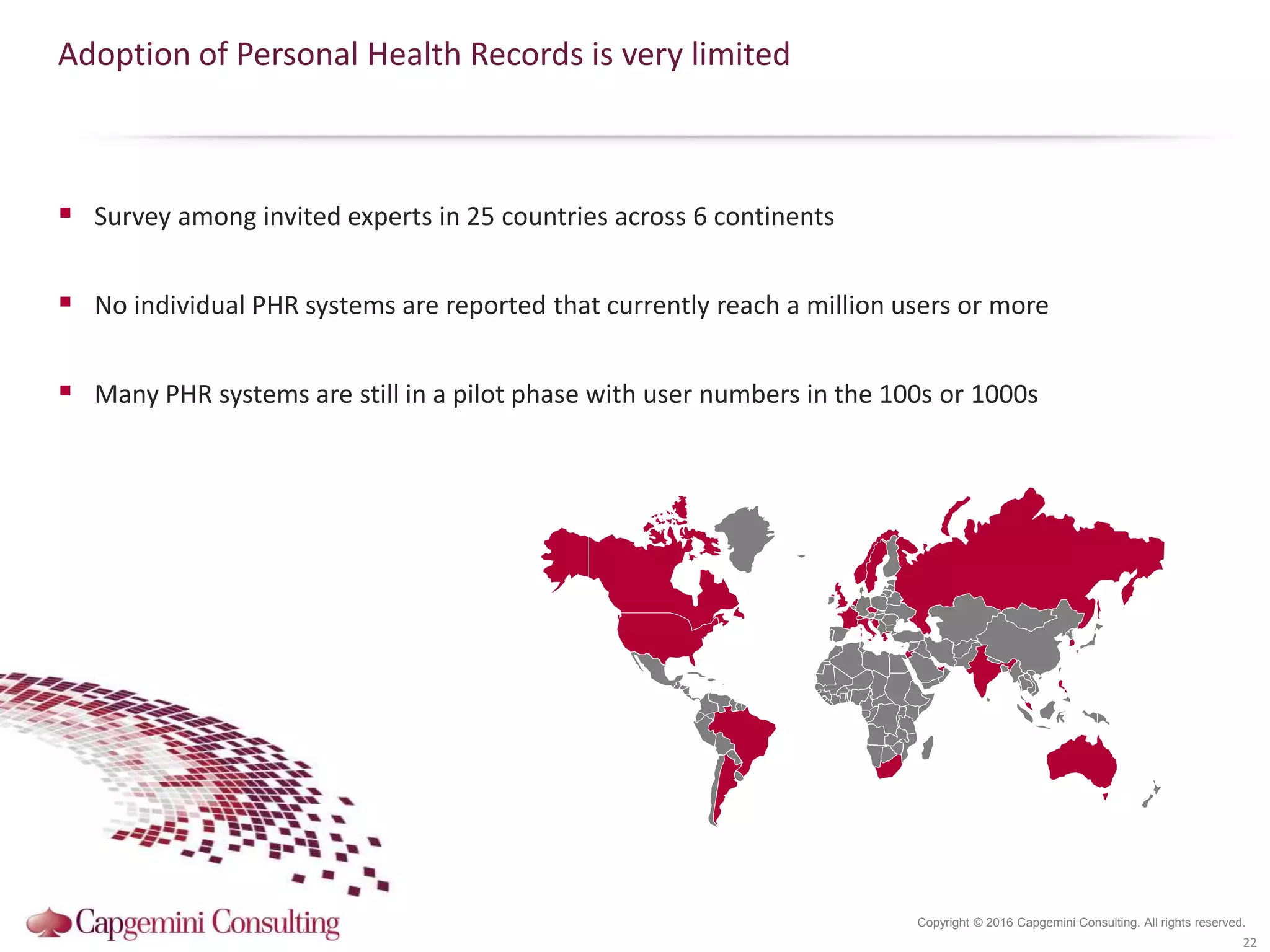
Adoption of Personal Health Records is very limited
 Survey among invited experts in 25 countries across 6 continents
 No individual PHR systems are reported that currently reach a million users or more
 Many PHR systems are still in a pilot phase with user numbers in the 100s or 1000s
22
Copyright © 2016 Capgemini Consulting. All rights reserved.
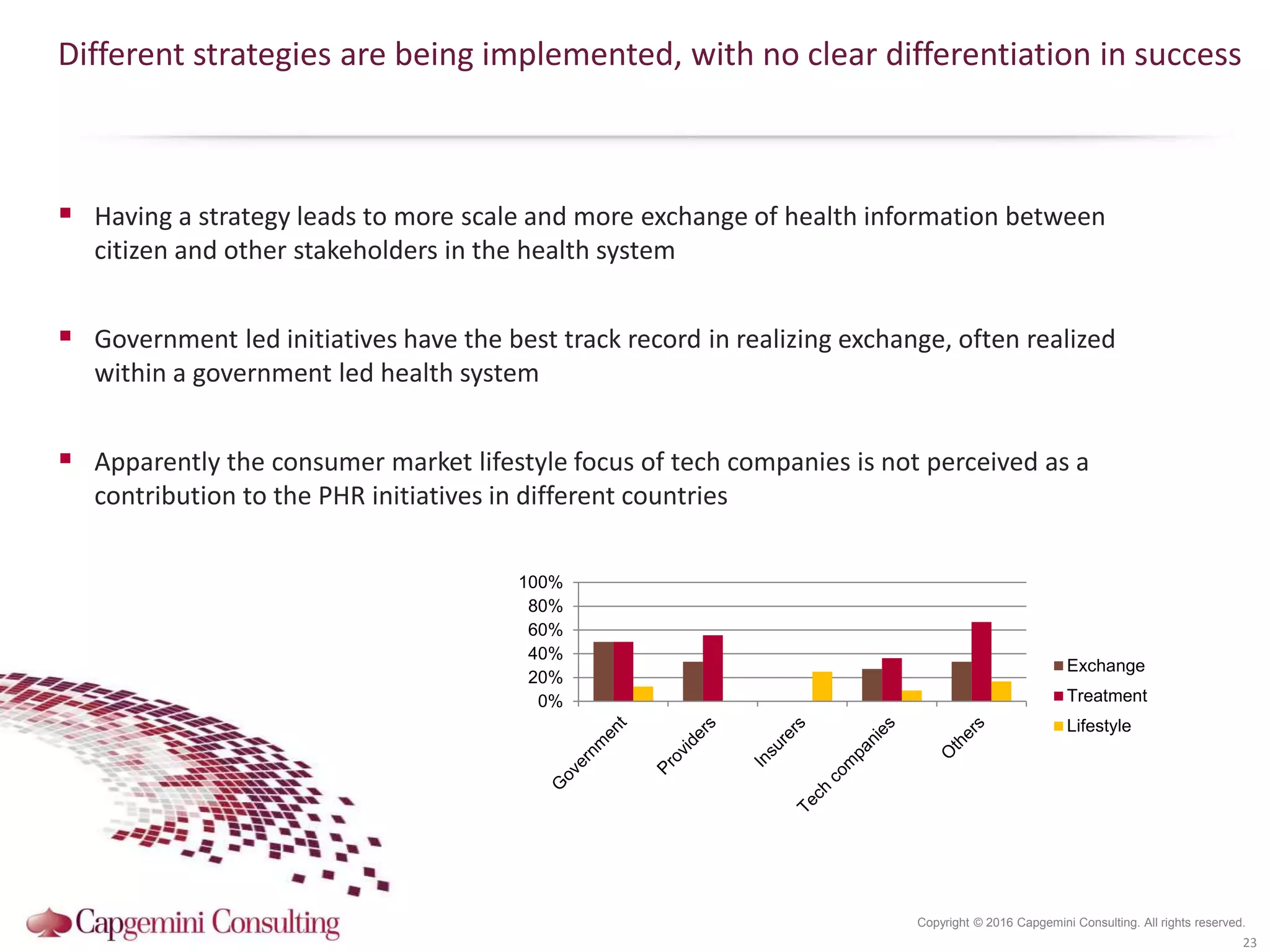
Different strategies are being implemented, with no clear differentiation in success
 Having a strategy leads to more scale and more exchange of health information between
citizen and other stakeholders in the health system
 Government led initiatives have the best track record in realizing exchange, often realized
within a government led health system
 Apparently the consumer market lifestyle focus of tech companies is not perceived as a
contribution to the PHR initiatives in different countries
23
0%
20%
40%
60%
80%
100%
Exchange
Treatment
Lifestyle
Copyright © 2016 Capgemini Consulting. All rights reserved.
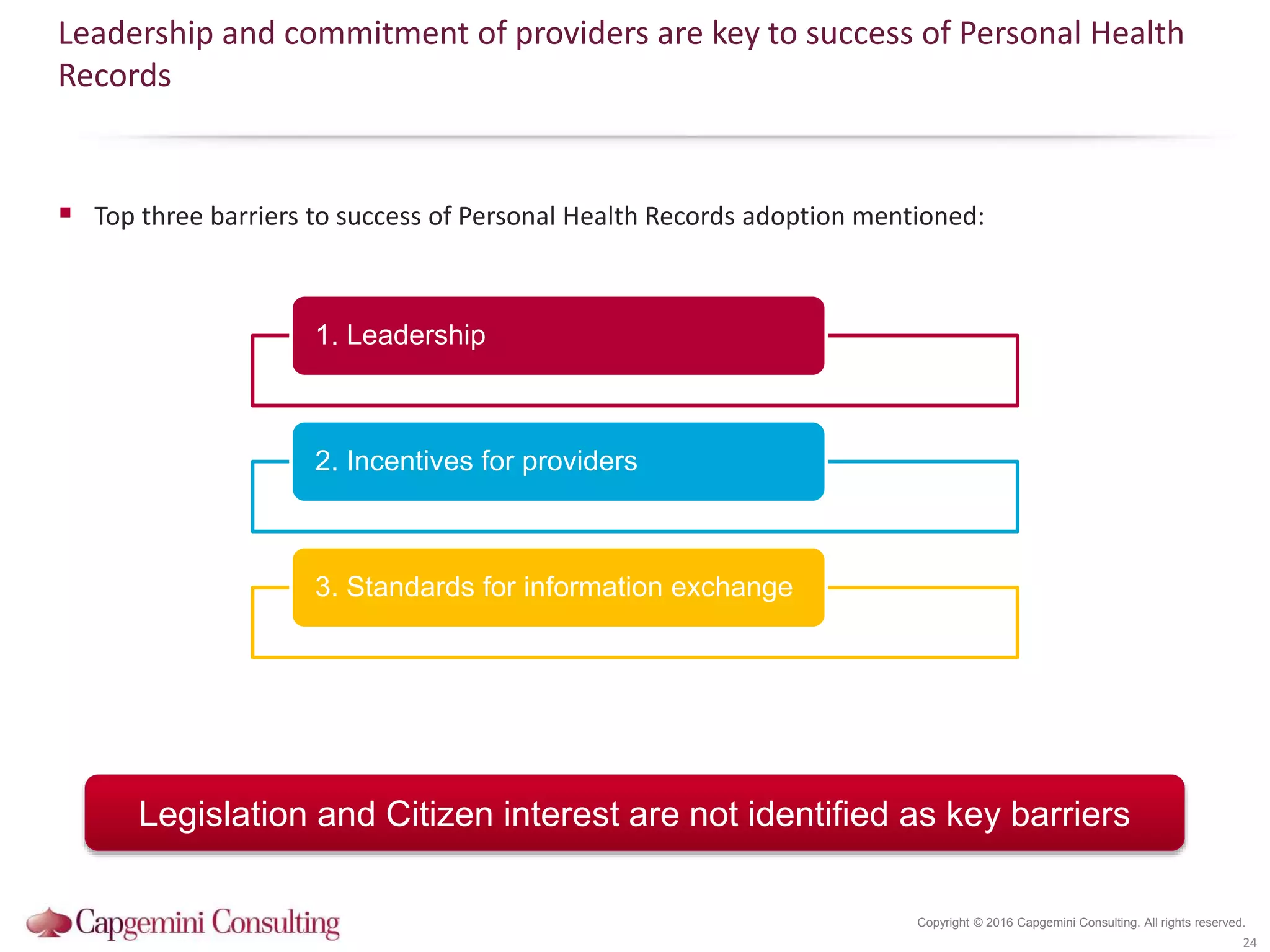
Leadership and commitment of providers are key to success of Personal Health
Records
 Top three barriers to success of Personal Health Records adoption mentioned:
24
1. Leadership
2. Incentives for providers
3. Standards for information exchange
Legislation and Citizen interest are not identified as key barriers
Copyright © 2016 Capgemini Consulting. All rights reserved.
A vision on the role of personal health information for future delivery of health care
 Personal experience is key in understanding
– The perceived impact on a person’s life
– The progression of a disease for an individual patient
– The outcome of different treatment options
– In relation to individual lifestyle choices
 Tools for capturing, analysing, and relating all this data
are becoming available – with the person at the centre!
25
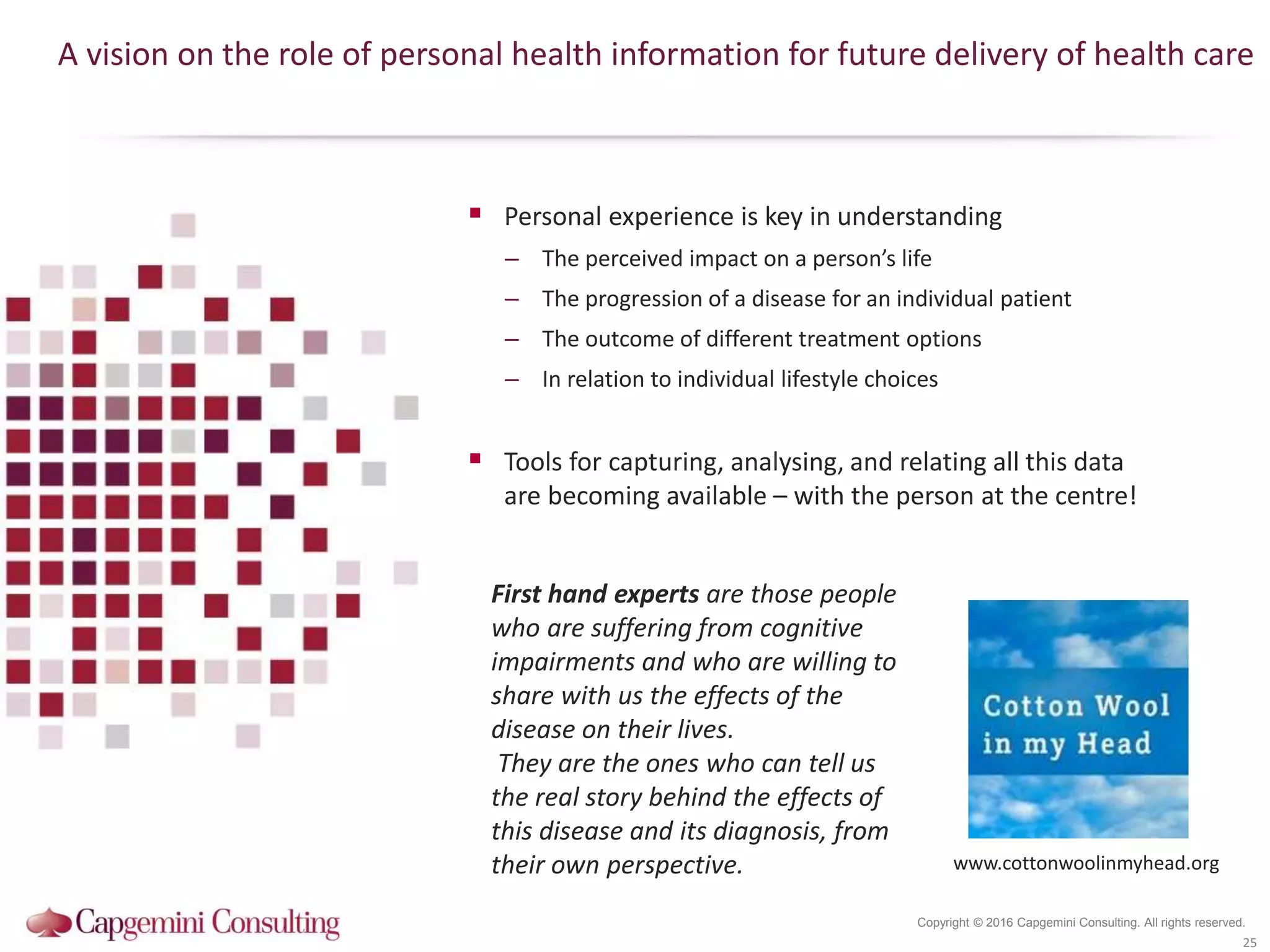
First hand experts are those people
who are suffering from cognitive
impairments and who are willing to
share with us the effects of the
disease on their lives.
They are the ones who can tell us
the real story behind the effects of
this disease and its diagnosis, from
their own perspective. www.cottonwoolinmyhead.org
Ed Hammond
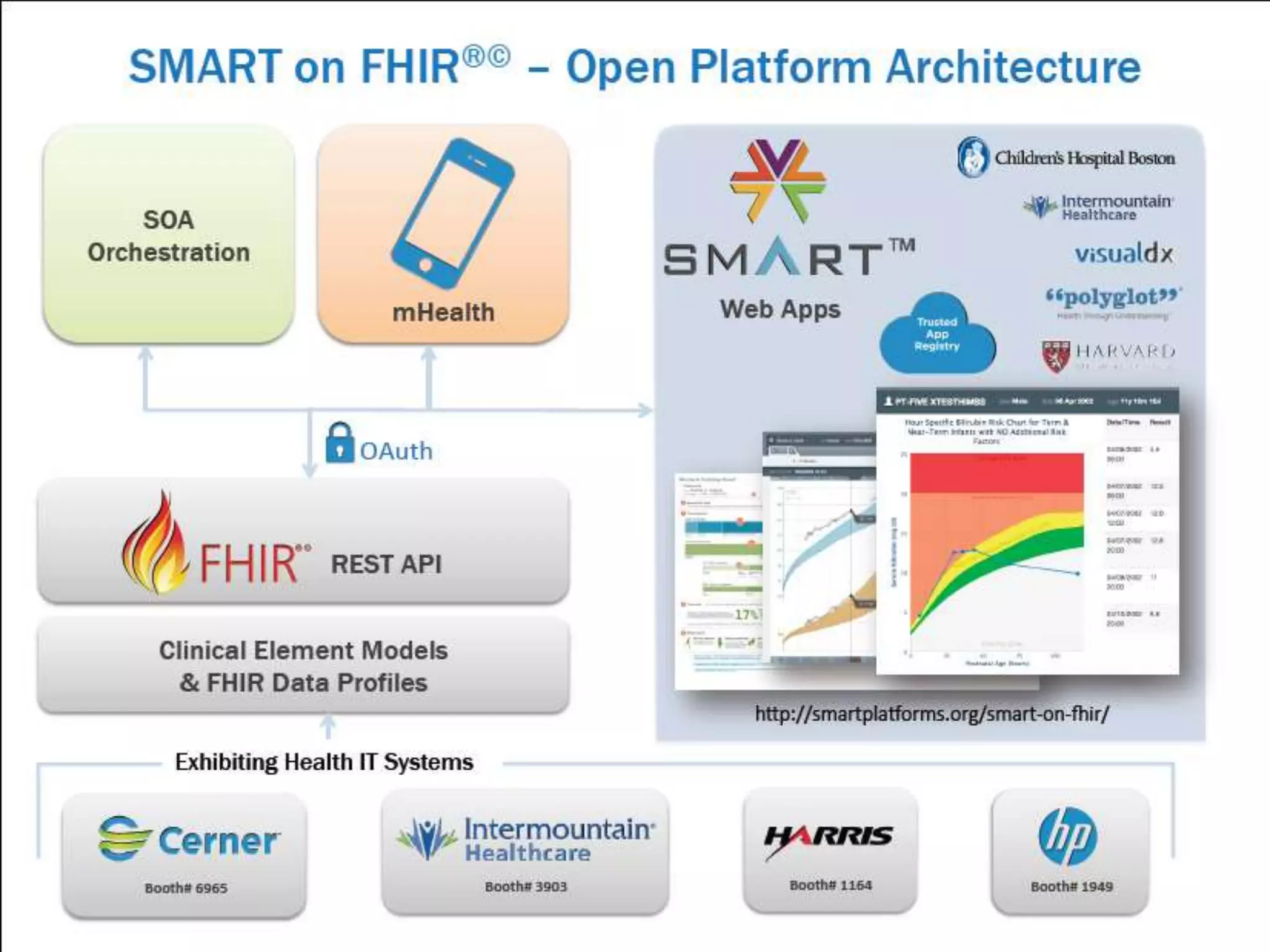
HL7 FHIR
(Fast Healthcare Interoperability Resources and standards)
- New initiative in standards seeking to liberate
data for population health and precision
medicine in the learning health system.
- Give an example of recent development.
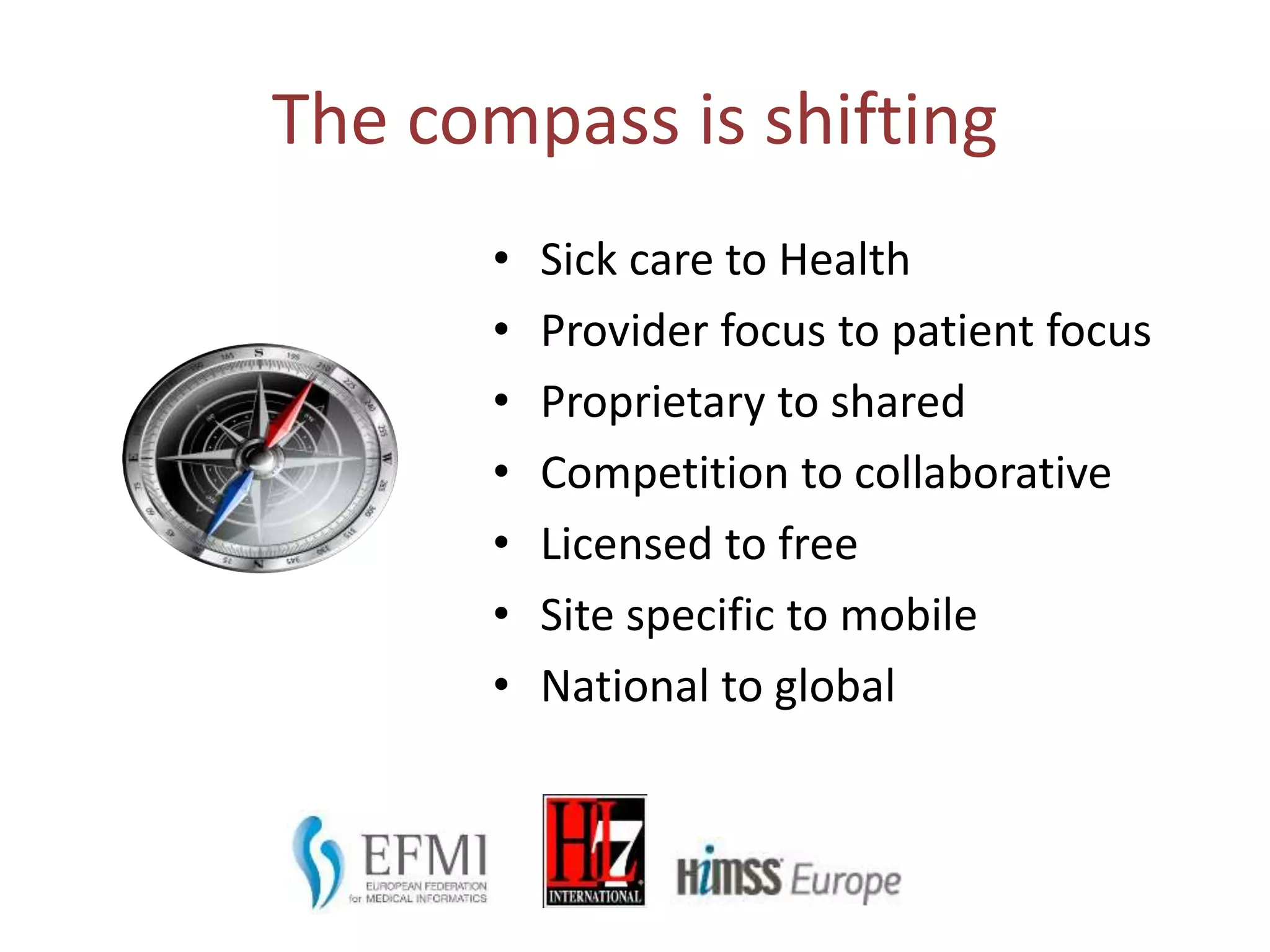
The compass is shifting
• Sick care to Health
• Provider focus to patient focus
• Proprietary to shared
• Competition to collaborative
• Licensed to free
• Site specific to mobile
• National to global
Drivers
• Population Health
• Precision Medicine
• Data Sharing
• Learning Health
• Big Data
• New Media
• Mobile/wearable devices
• Health Analytics
• Translational Medicine
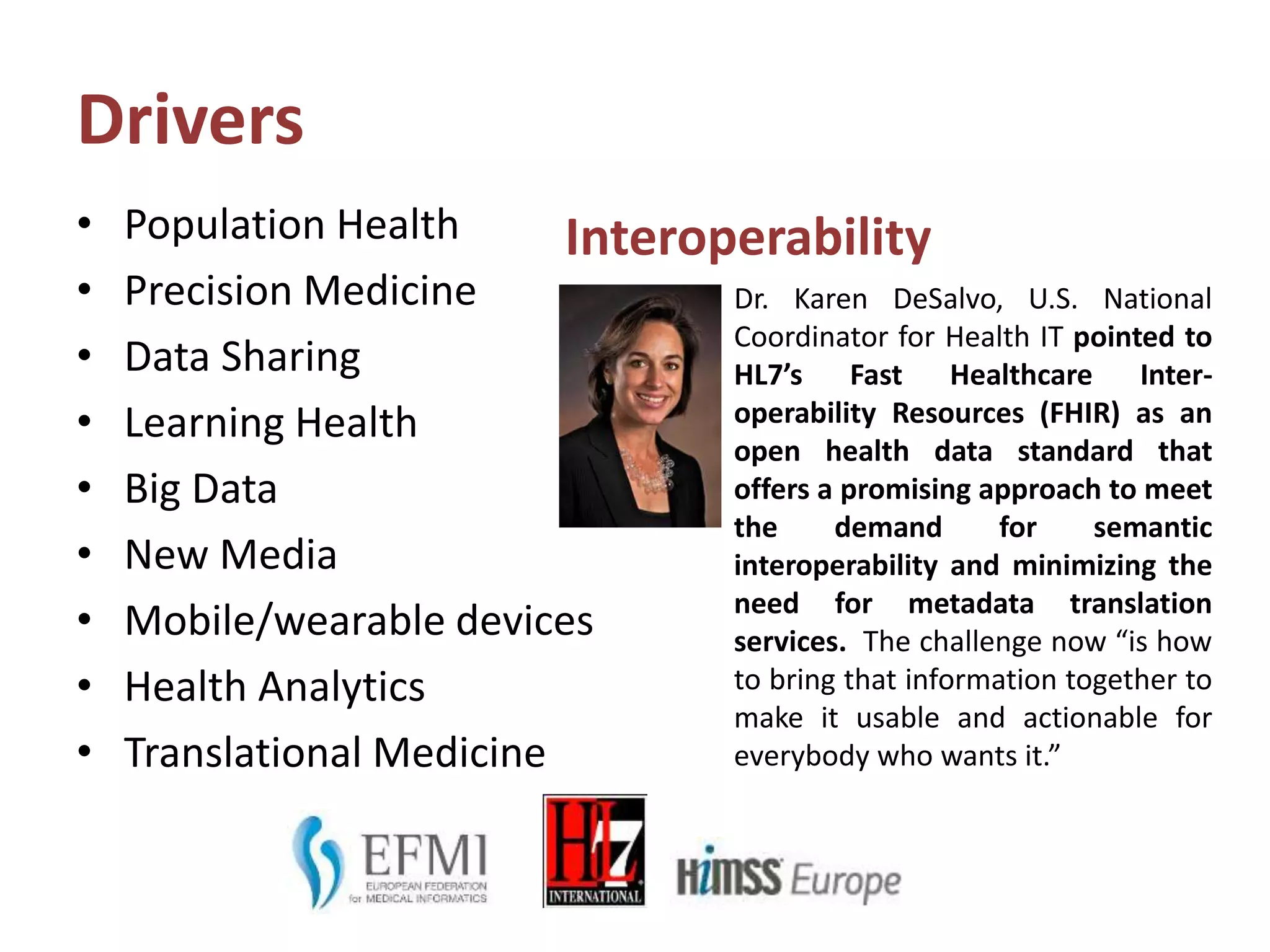
Interoperability
Dr. Karen DeSalvo, U.S. National
Coordinator for Health IT pointed to
HL7’s Fast Healthcare Inter-
operability Resources (FHIR) as an
open health data standard that
offers a promising approach to meet
the demand for semantic
interoperability and minimizing the
need for metadata translation
services. The challenge now “is how
to bring that information together to
make it usable and actionable for
everybody who wants it.”
2
9
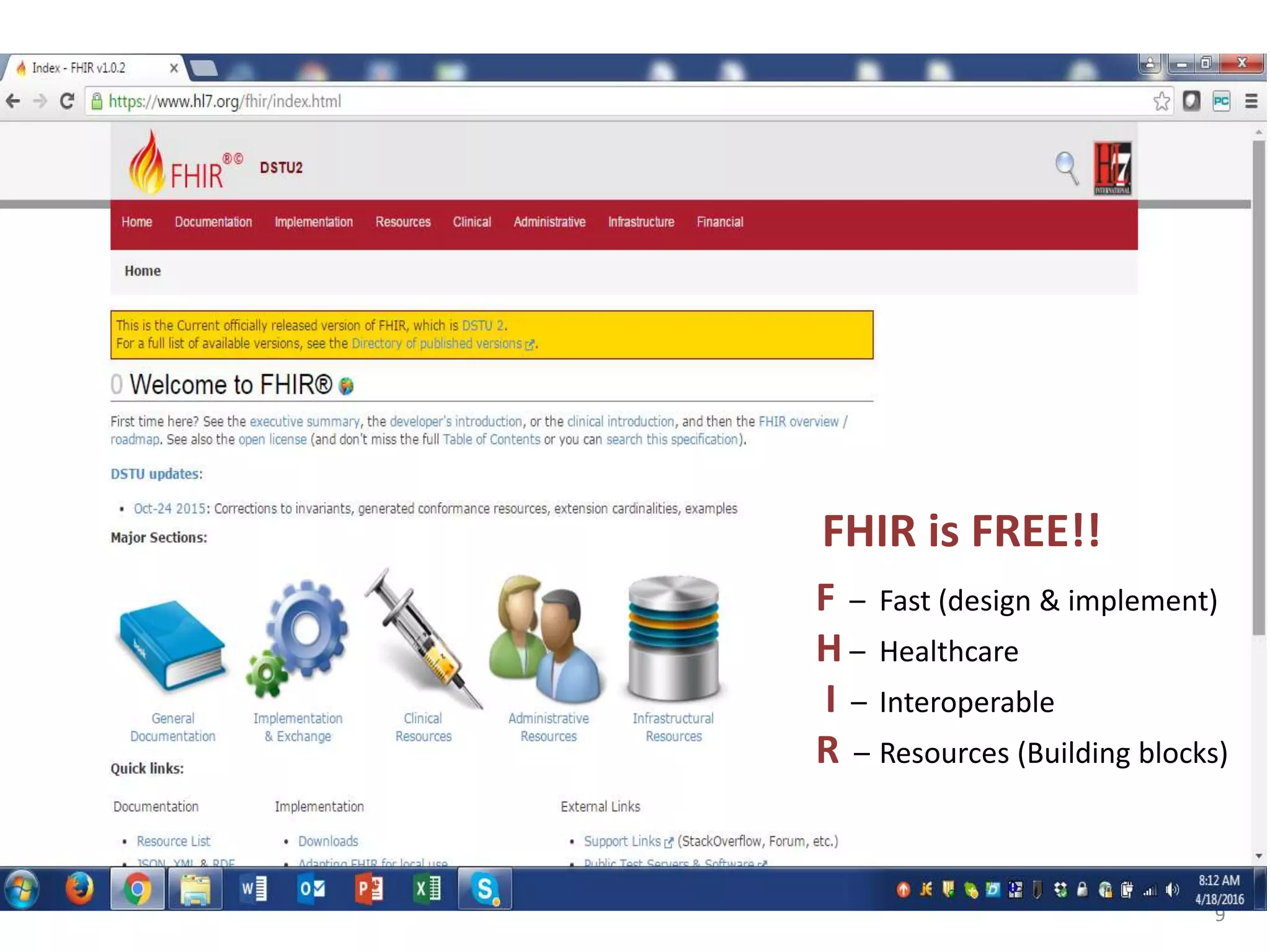
FHIR is FREE!!
F – Fast (design & implement)
H – Healthcare
I – Interoperable
R – Resources (Building blocks)
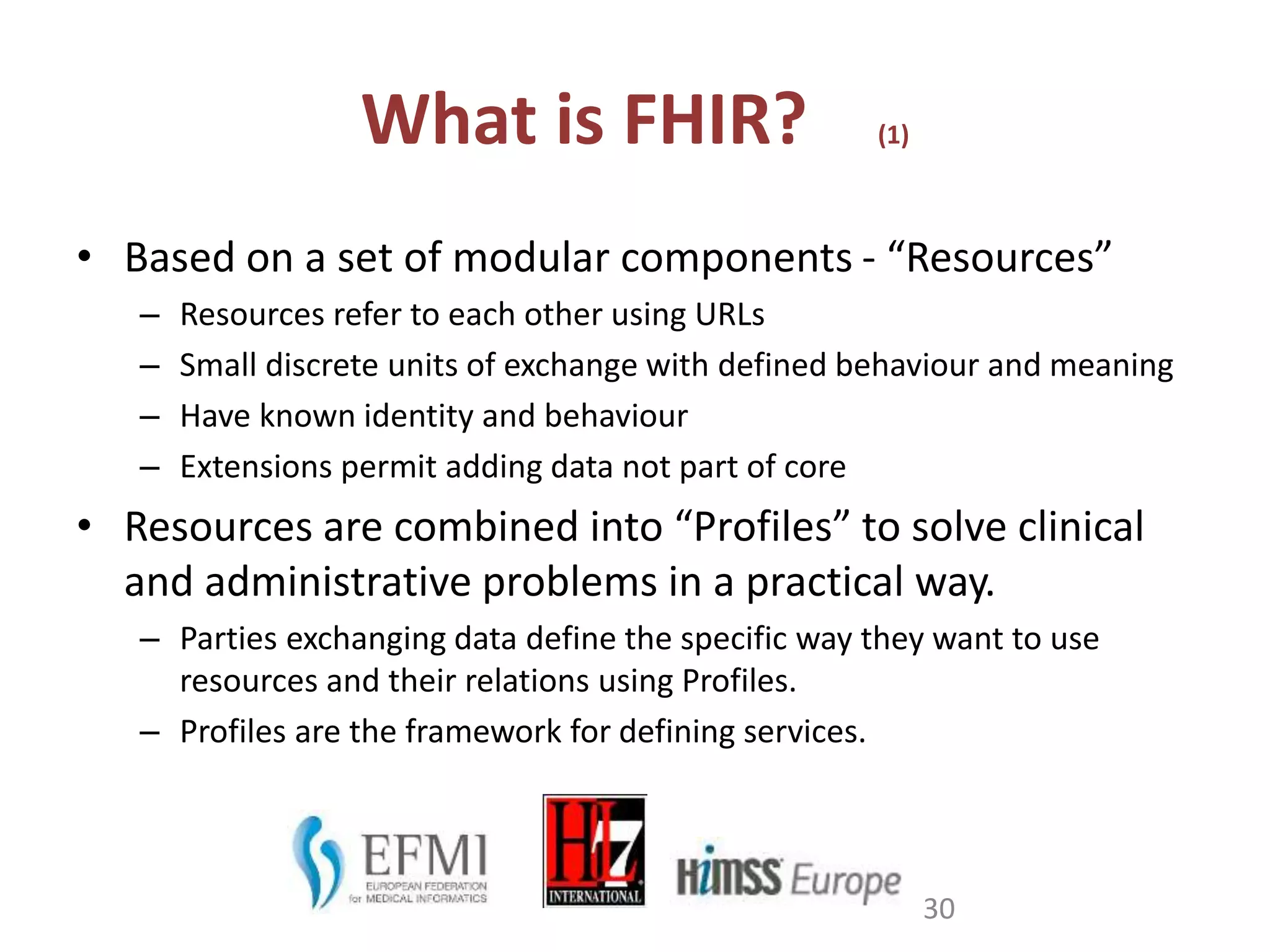
What is FHIR? (1)
• Based on a set of modular components - “Resources”
– Resources refer to each other using URLs
– Small discrete units of exchange with defined behaviour and meaning
– Have known identity and behaviour
– Extensions permit adding data not part of core
• Resources are combined into “Profiles” to solve clinical
and administrative problems in a practical way.
– Parties exchanging data define the specific way they want to use
resources and their relations using Profiles.
– Profiles are the framework for defining services.
30
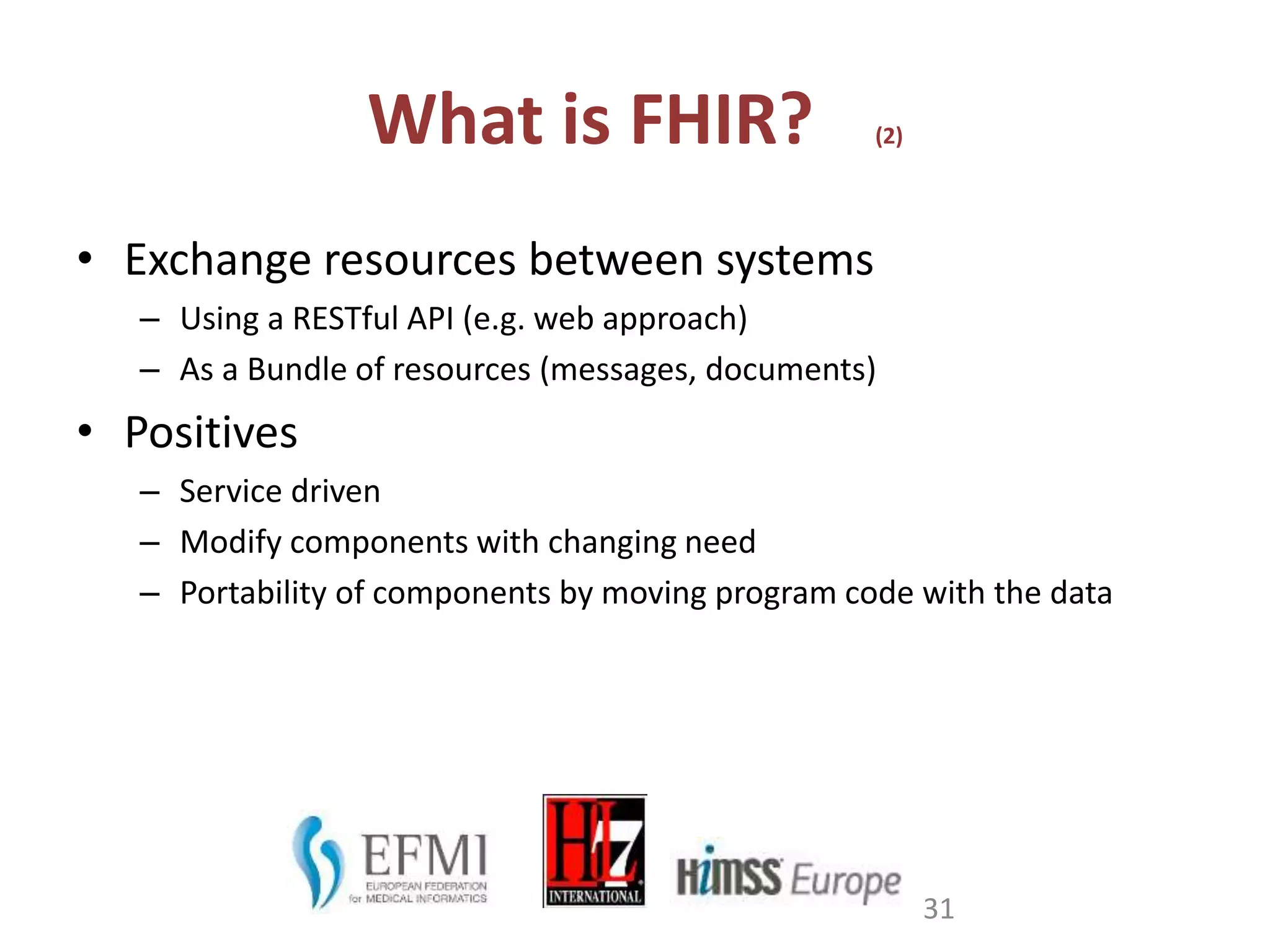
What is FHIR? (2)
• Exchange resources between systems
– Using a RESTful API (e.g. web approach)
– As a Bundle of resources (messages, documents)
• Positives
– Service driven
– Modify components with changing need
– Portability of components by moving program code with the data
31
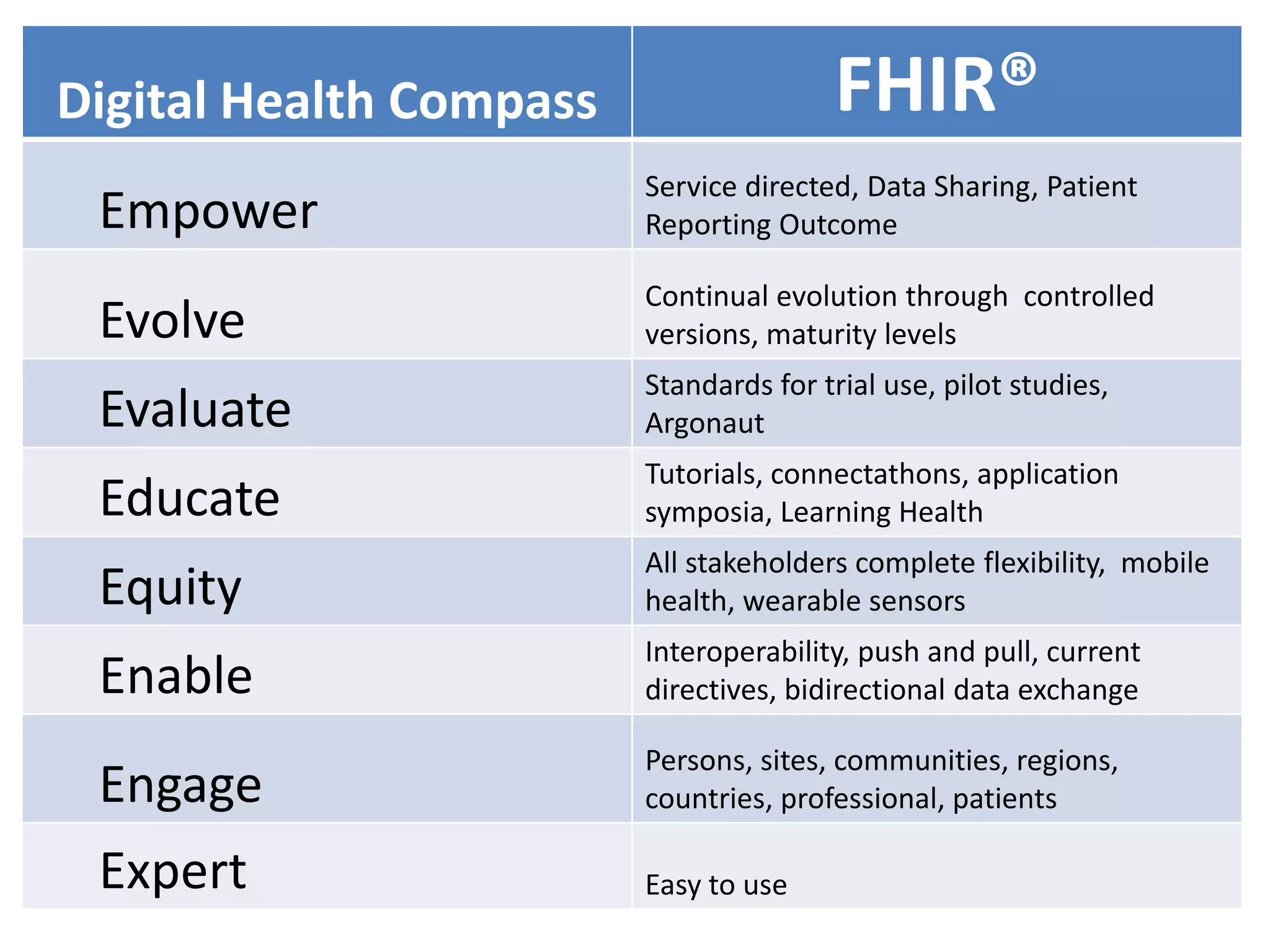
Digital Health Compass FHIR®
Empower
Service directed, Data Sharing, Patient
Reporting Outcome
Evolve
Continual evolution through controlled
versions, maturity levels
Evaluate
Standards for trial use, pilot studies,
Argonaut
Educate
Tutorials, connectathons, application
symposia, Learning Health
Equity
All stakeholders complete flexibility, mobile
health, wearable sensors
Enable
Interoperability, push and pull, current
directives, bidirectional data exchange
Engage
Persons, sites, communities, regions,
countries, professional, patients
Expert Easy to use
Christian Lovis
• Access to knowledge and research strategies
that alleviate health disparities
• Set knowledge free !
• Make it matter for us !
In 1455, Gutenberg completed copies of a beautifully executed folio
Bible (Biblia Sacra), with 42 lines on each page. Copies sold for 30
florins each,[23] which was roughly three years' wages for an average
clerk. Nonetheless, it was significantly cheaper than a manuscript Bible
that could take a single scribe over a year to prepare. After printing,
some copies were rubricated or hand-illuminated in the same elegant
way as manuscript Bibles from the same period.
48 substantially complete copies are known to survive, including two
at the British Library that can be viewed and compared online.[24] The
text lacks modern features such as pagination, indentations, and
paragraph breaks.
An undated 36-line edition of the Bible was printed, probably in
Bamberg in 1458–1460, possibly by Gutenberg. A large part of it was
shown to have been set from a copy of Gutenberg's Bible, thus
disproving earlier speculation that it may have been the earlier of the
two.[25]
1455, first Bible printed by Johannes Gütenberg
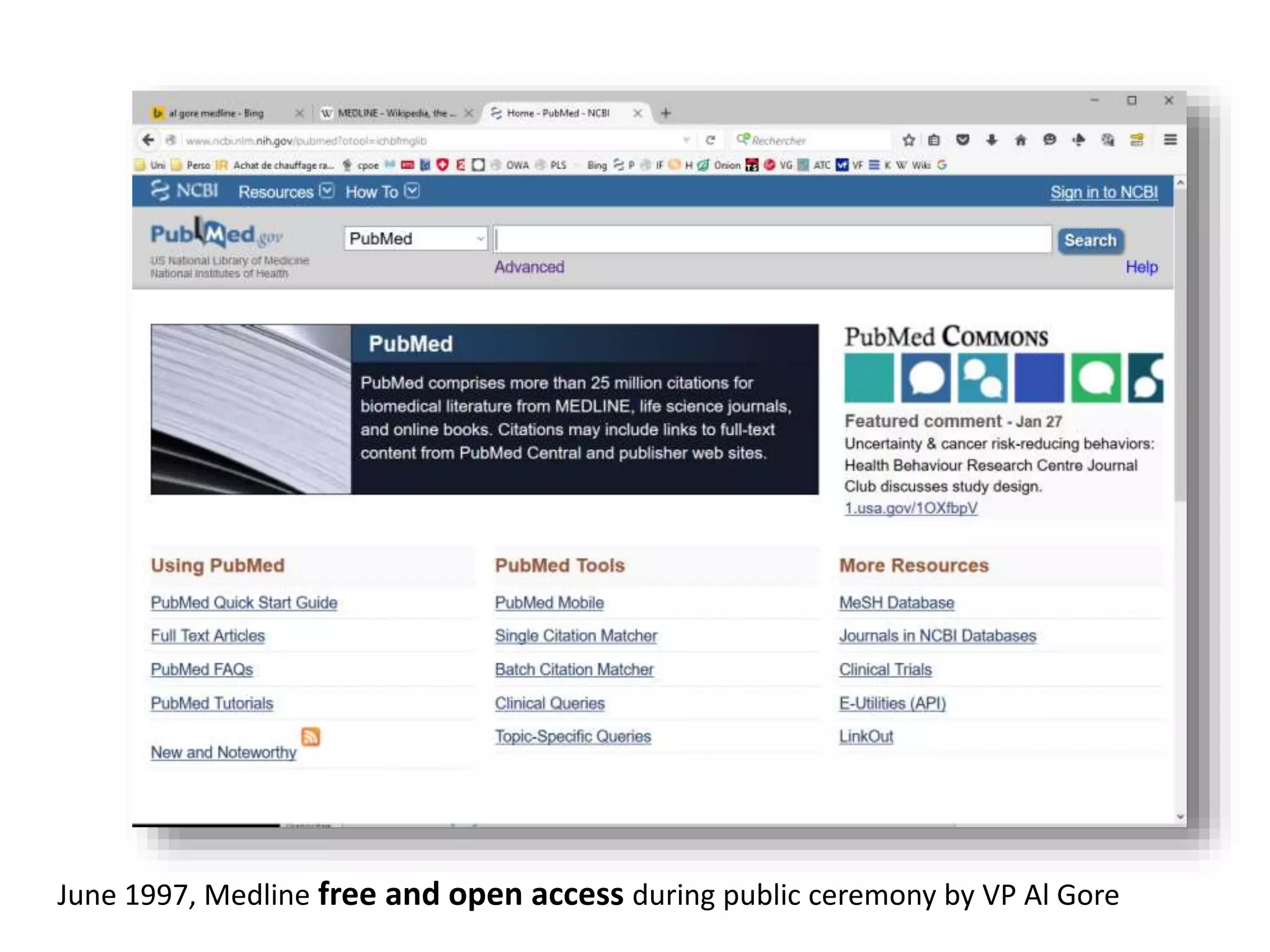
June 1997, Medline free and open access during public ceremony by VP Al Gore
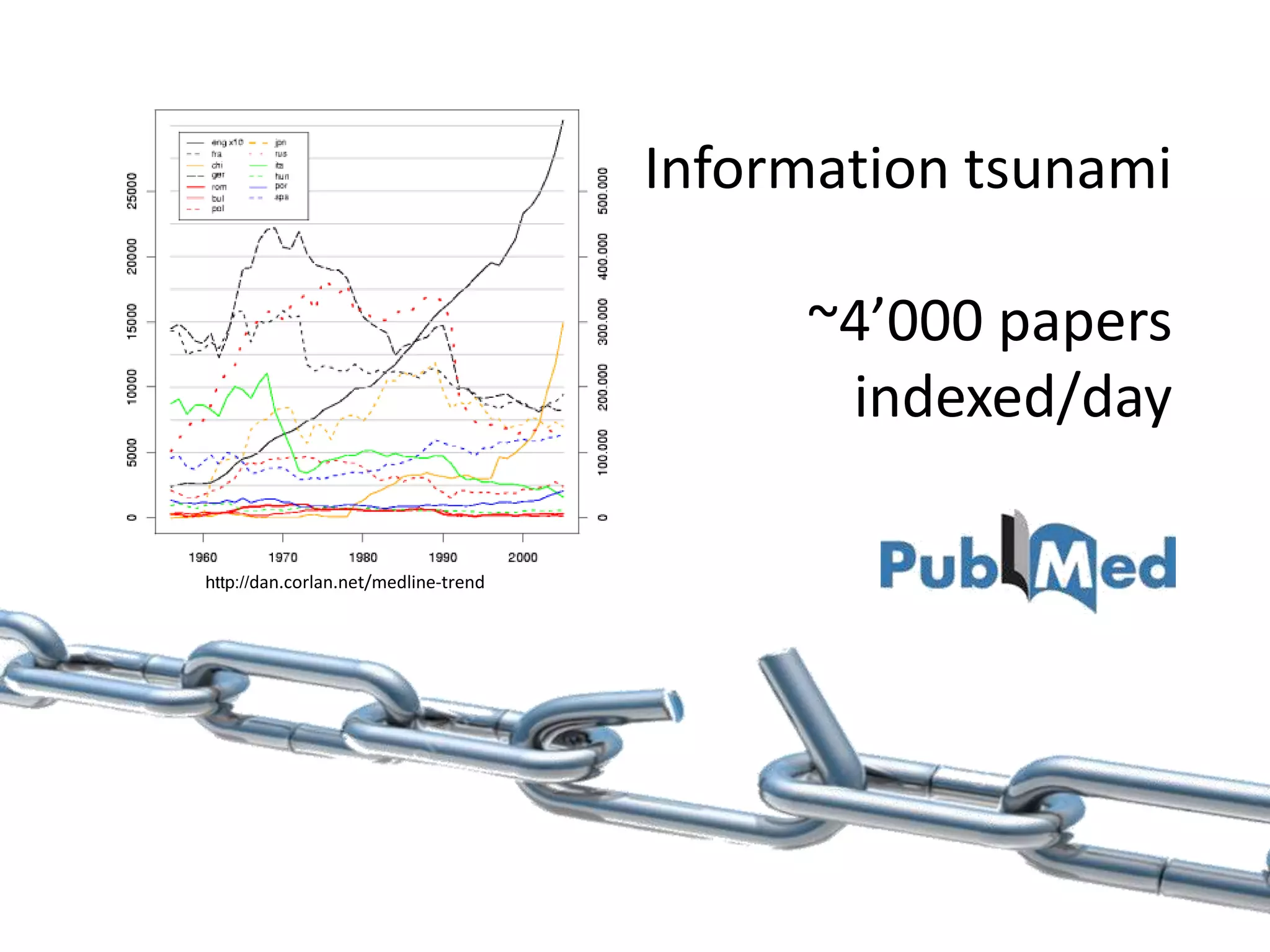
http://dan.corlan.net/medline-trend
Information tsunami
~4’000 papers
indexed/day
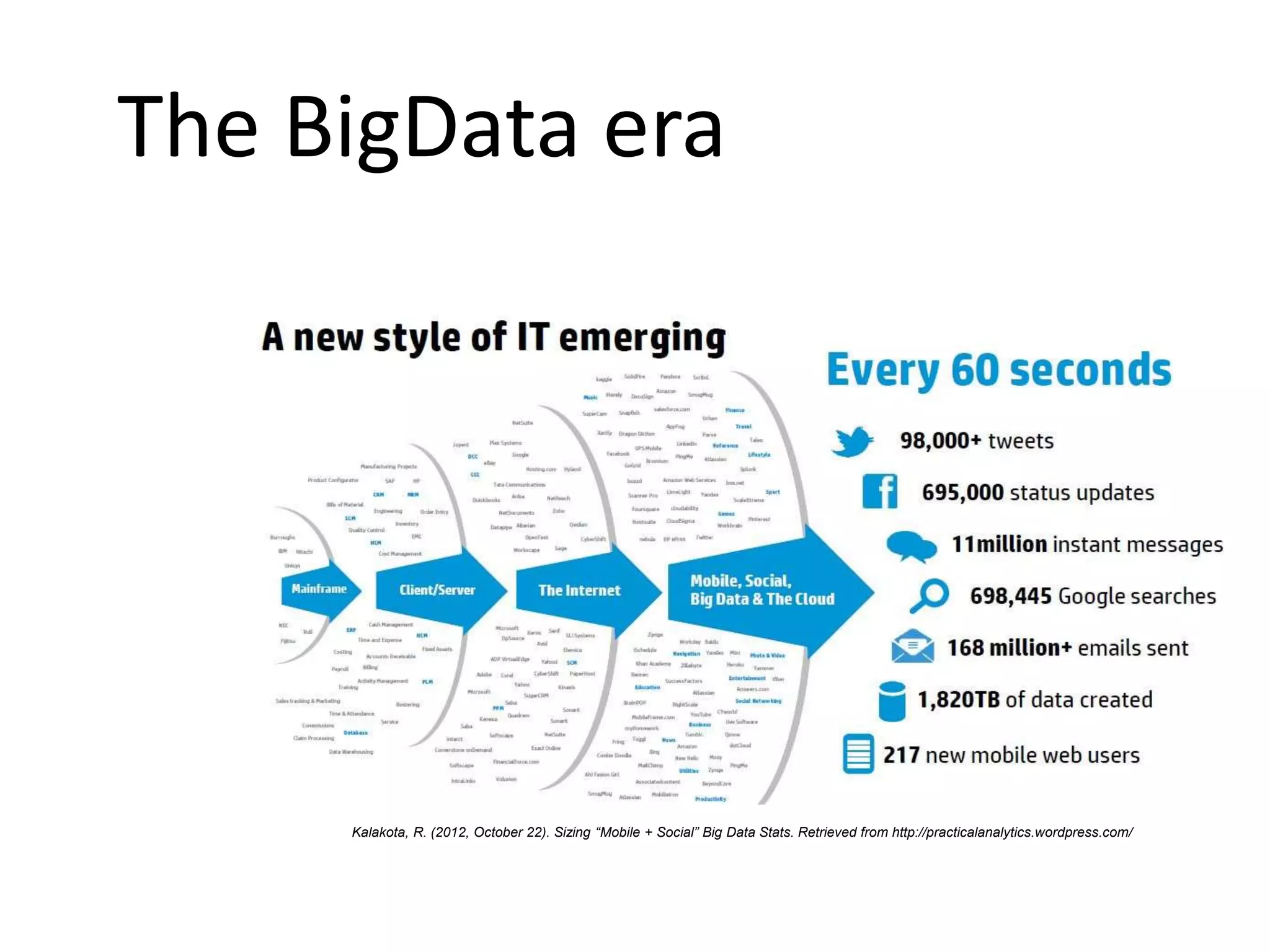
Kalakota, R. (2012, October 22). Sizing “Mobile + Social” Big Data Stats. Retrieved from http://practicalanalytics.wordpress.com/
The BigData era
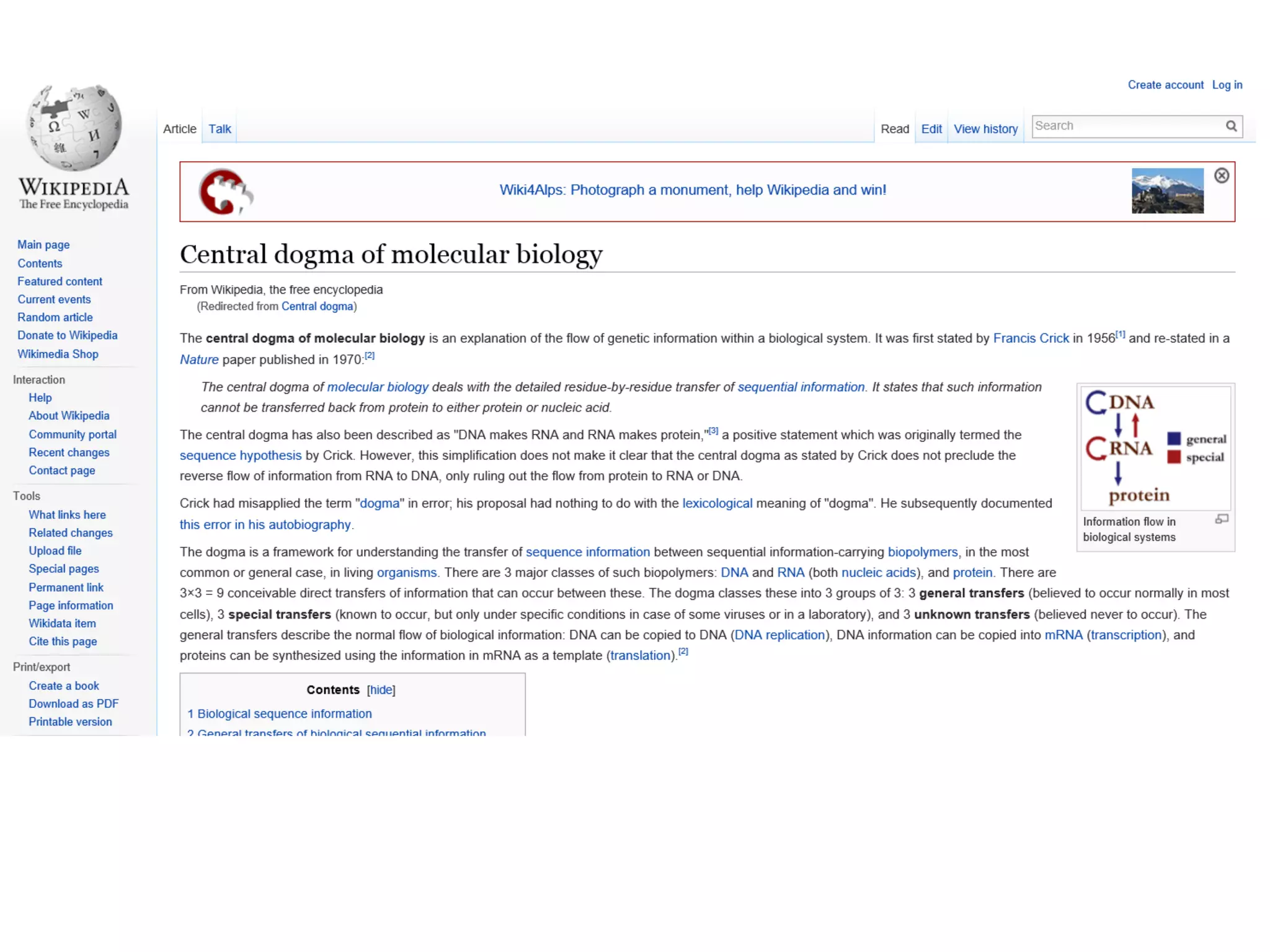
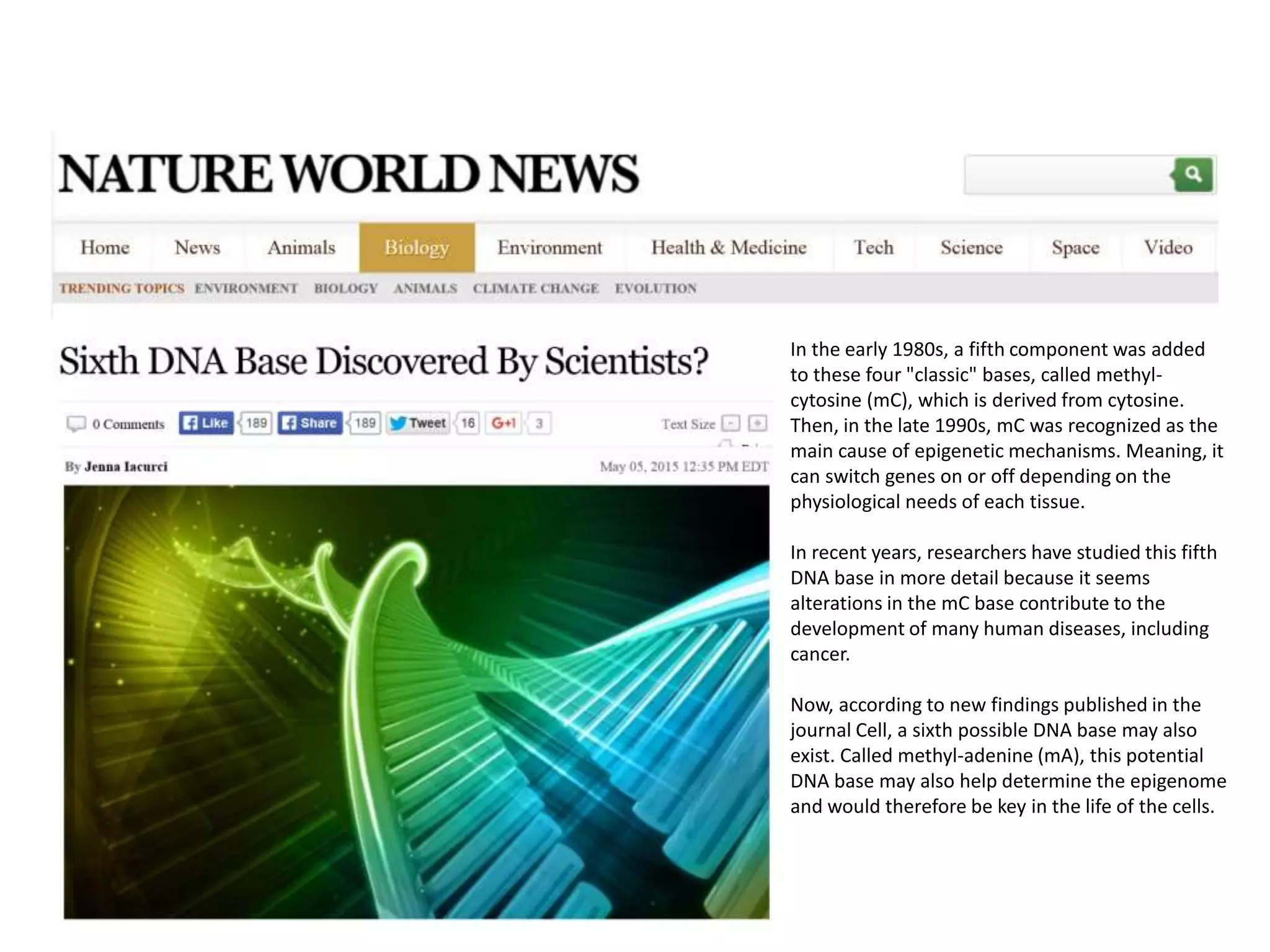
In the early 1980s, a fifth component was added
to these four "classic" bases, called methyl-
cytosine (mC), which is derived from cytosine.
Then, in the late 1990s, mC was recognized as the
main cause of epigenetic mechanisms. Meaning, it
can switch genes on or off depending on the
physiological needs of each tissue.
In recent years, researchers have studied this fifth
DNA base in more detail because it seems
alterations in the mC base contribute to the
development of many human diseases, including
cancer.
Now, according to new findings published in the
journal Cell, a sixth possible DNA base may also
exist. Called methyl-adenine (mA), this potential
DNA base may also help determine the epigenome
and would therefore be key in the life of the cells.
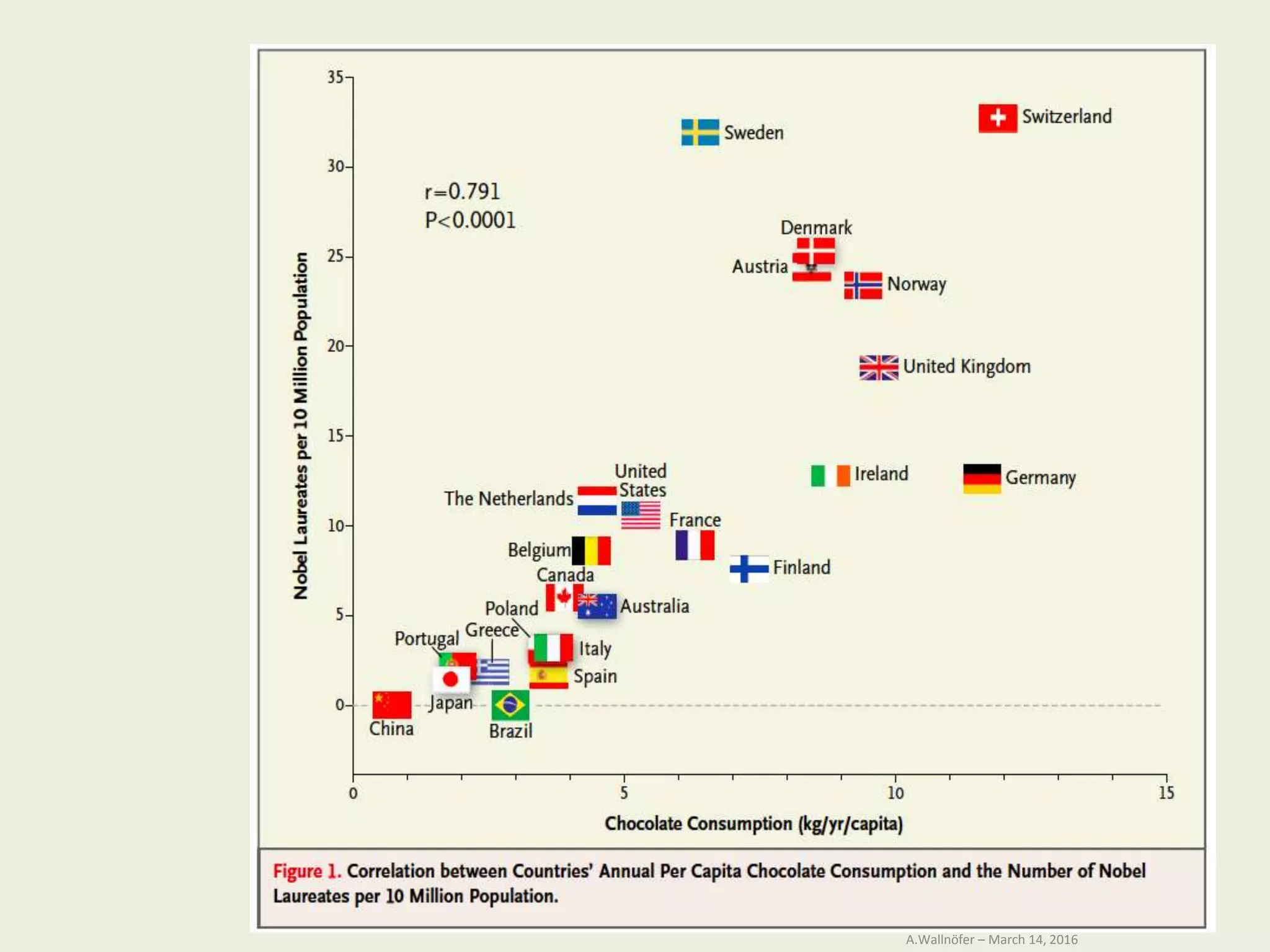
Correlation does not imply Causality
A.Wallnöfer – March 14, 2016
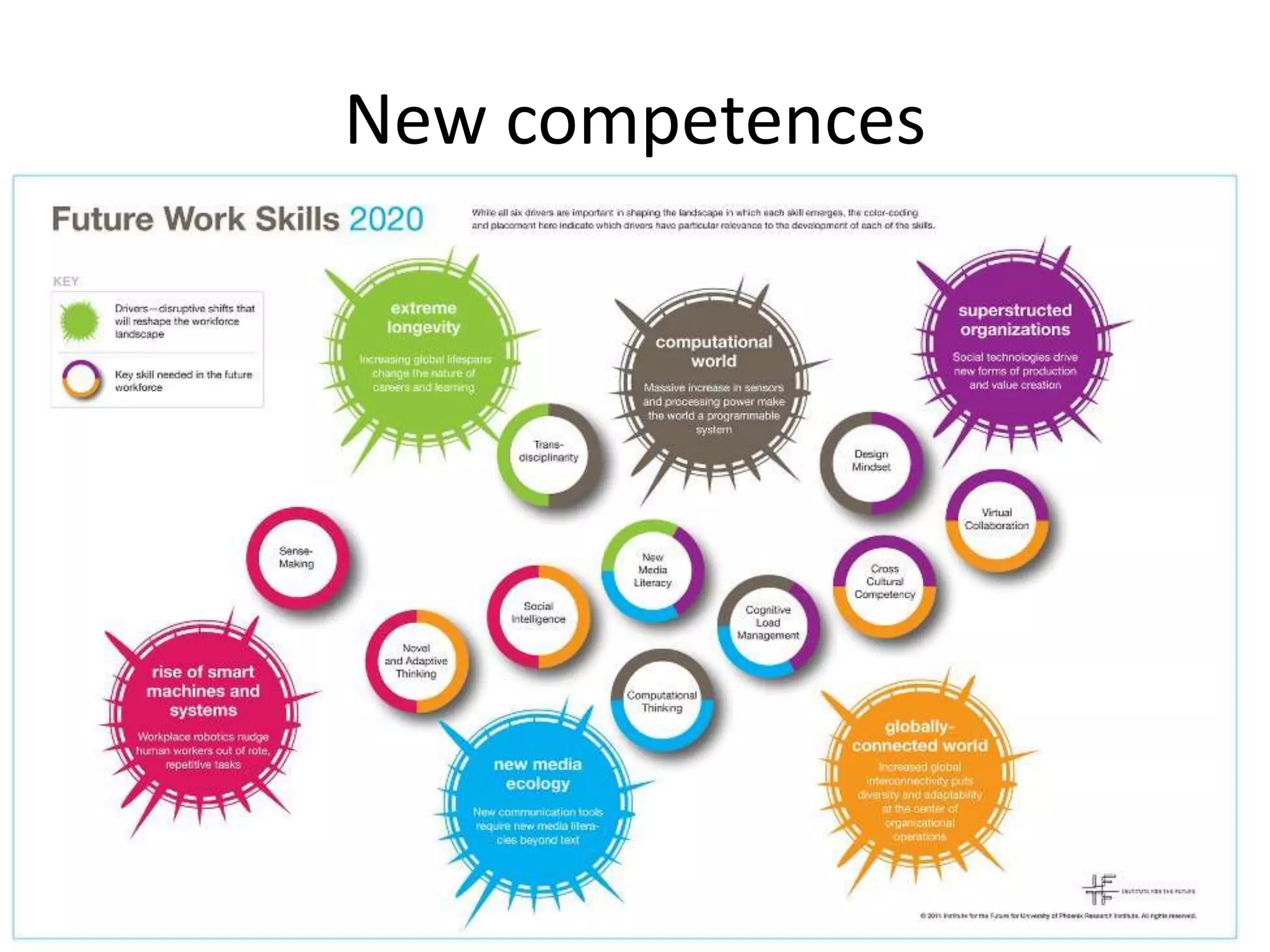
New competences
Catherine Chronaki
My Data - My Decision – our ePower
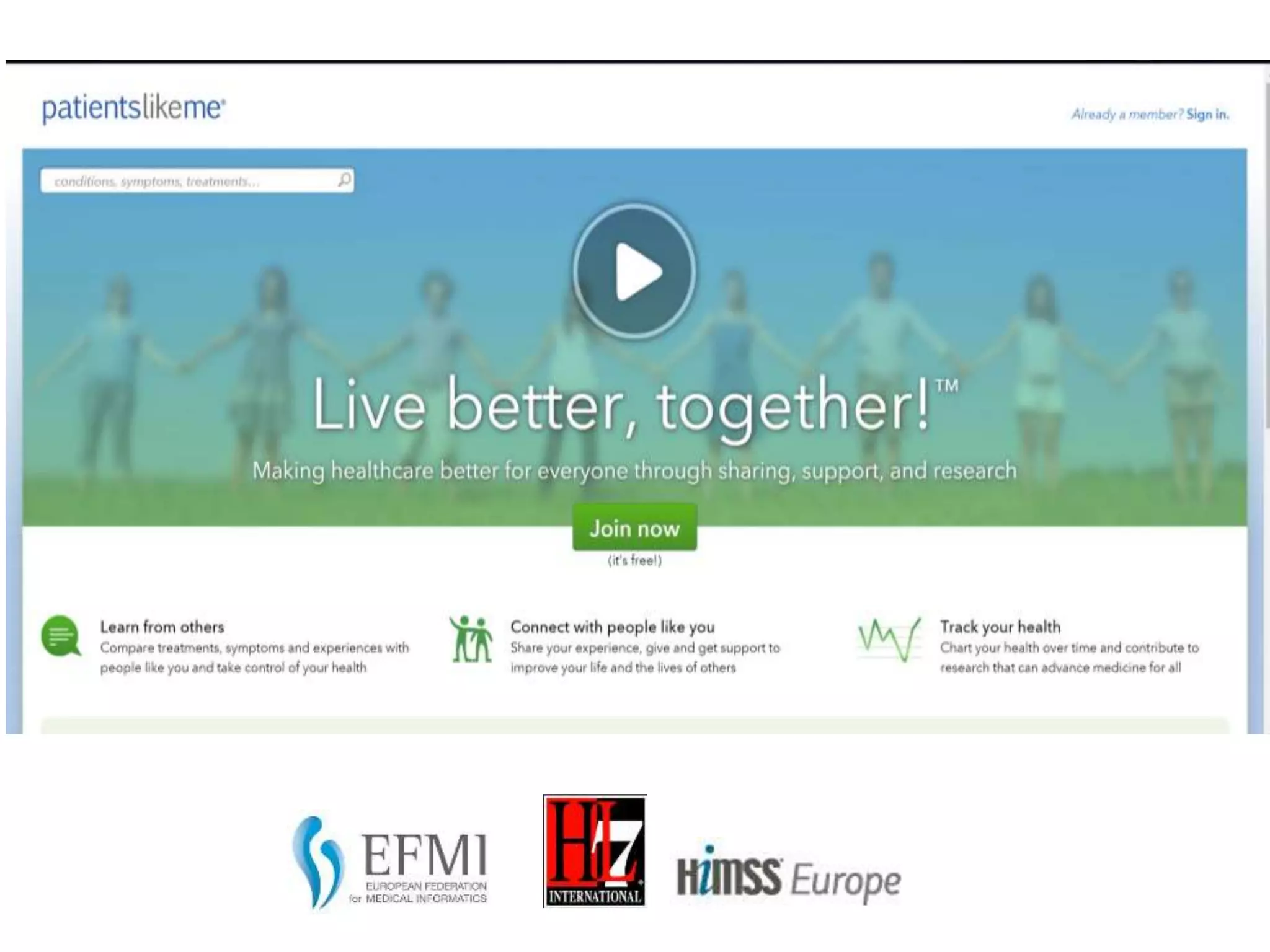
patient engagement, myHealthData,
tailored, adaptive and actionable health
experience for individuals, families and
communities.
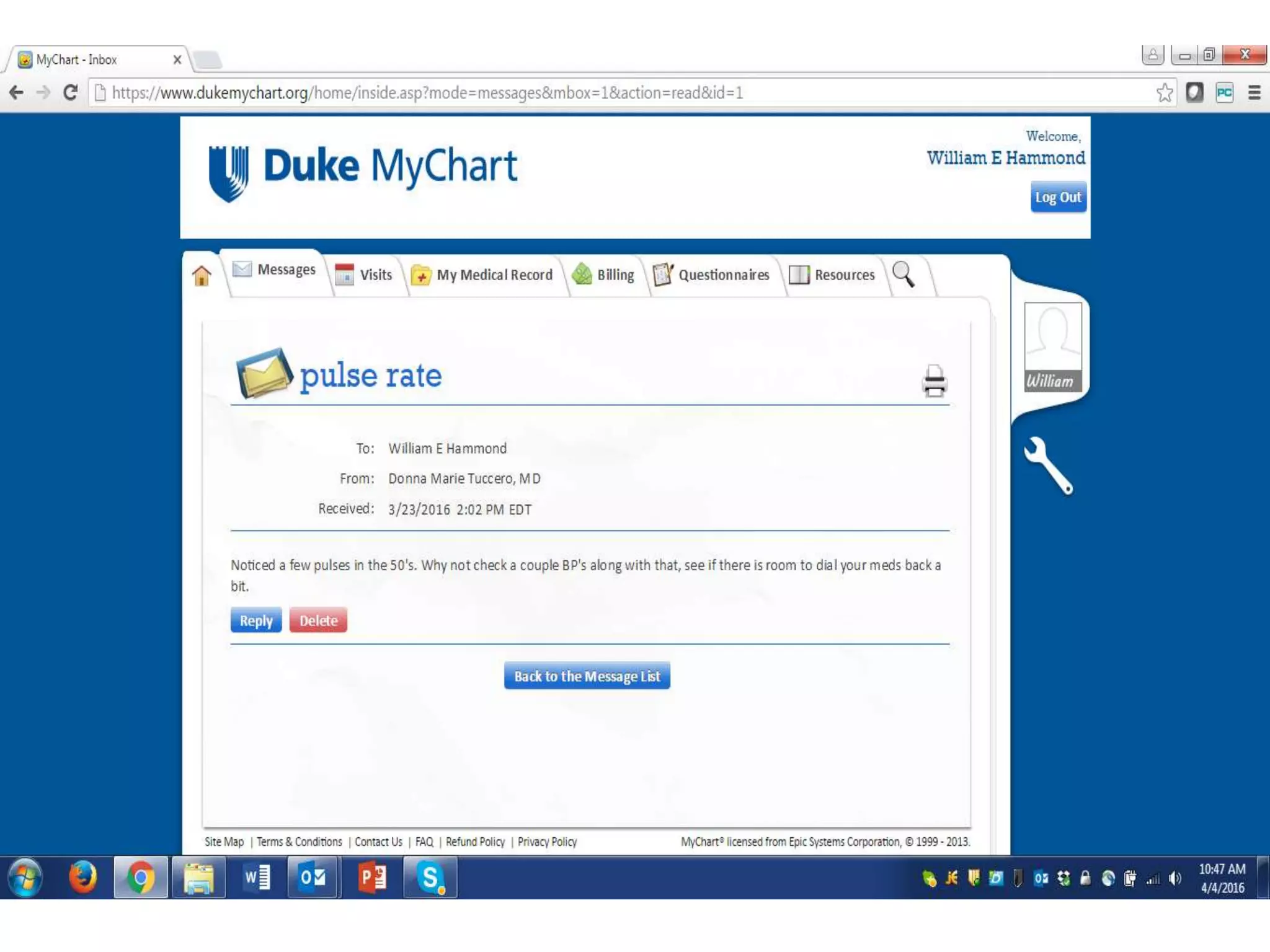
My Data..
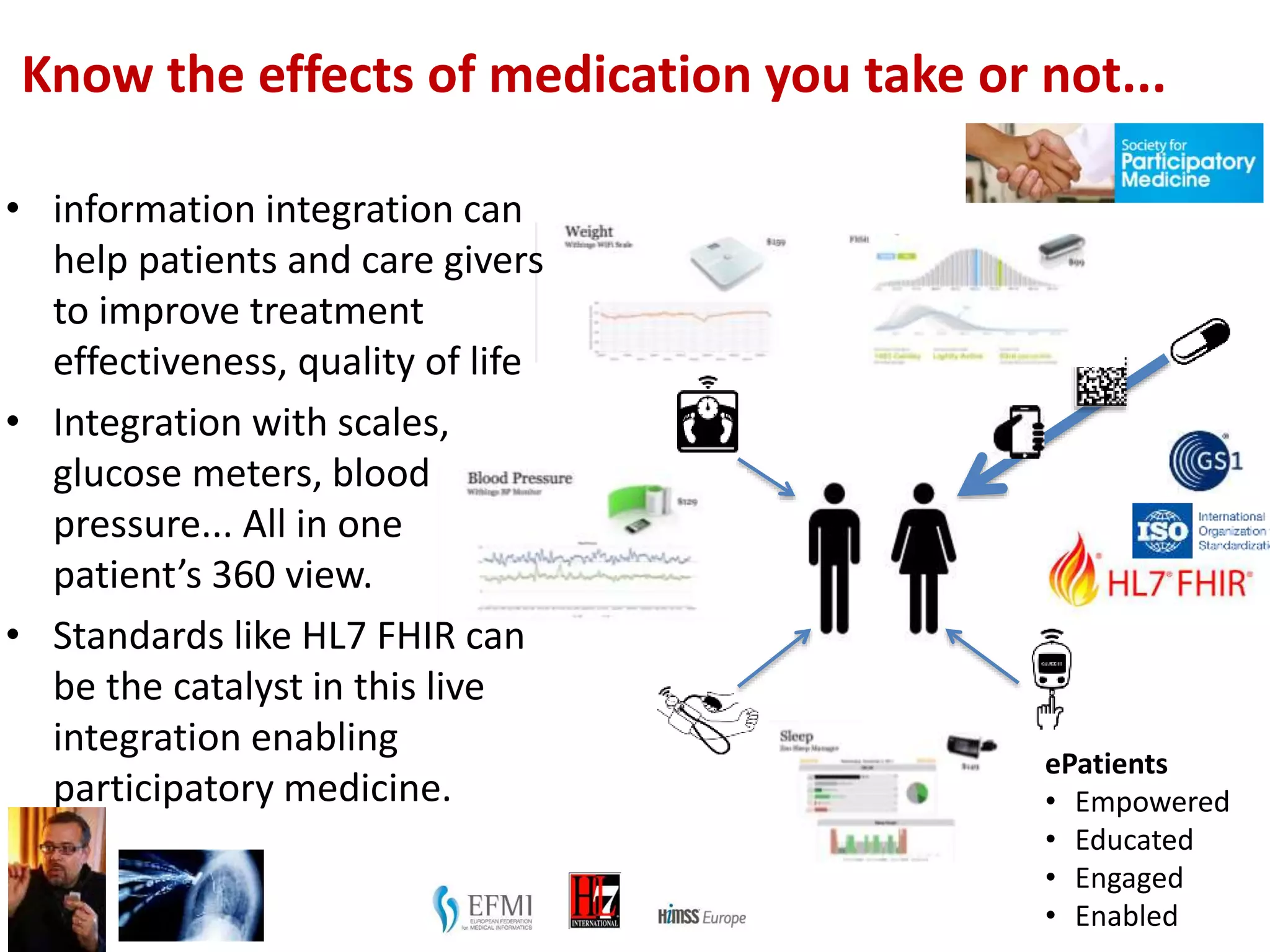
Know the effects of medication you take or not...
ePatients
• Empowered
• Educated
• Engaged
• Enabled
• information integration can
help patients and care givers
to improve treatment
effectiveness, quality of life
• Integration with scales,
glucose meters, blood
pressure... All in one
patient’s 360 view.
• Standards like HL7 FHIR can
be the catalyst in this live
integration enabling
participatory medicine.
My Decision..
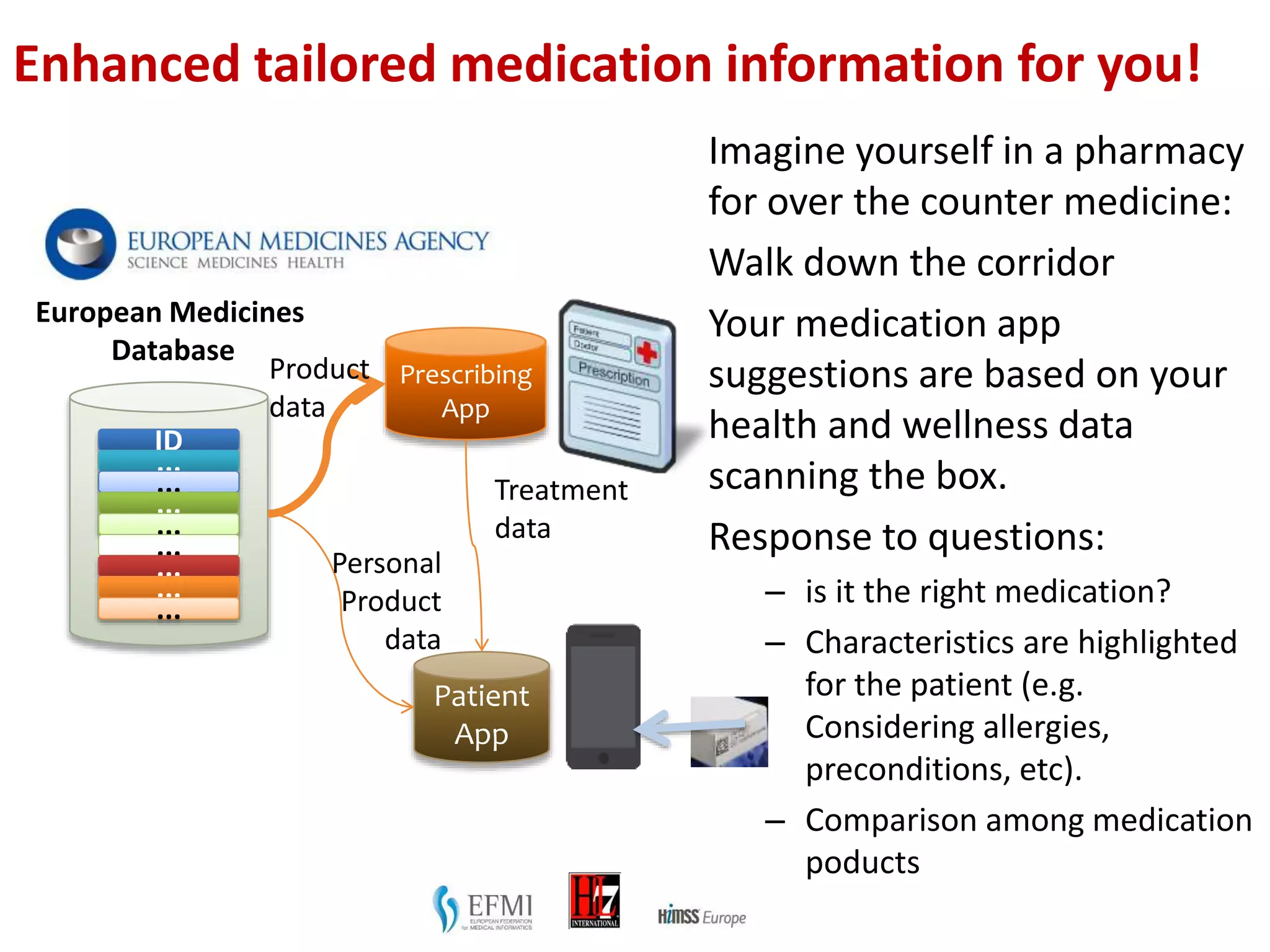
Enhanced tailored medication information for you!
Imagine yourself in a pharmacy
for over the counter medicine:
Walk down the corridor
Your medication app
suggestions are based on your
health and wellness data
scanning the box.
Response to questions:
– is it the right medication?
– Characteristics are highlighted
for the patient (e.g.
Considering allergies,
preconditions, etc).
– Comparison among medication
poducts
ID
...
...
...
...
...
...
...
...
Prescribing
App
Patient
App
European Medicines
Database
Treatment
data
Product
data
Personal
Product
data
Our ePower..
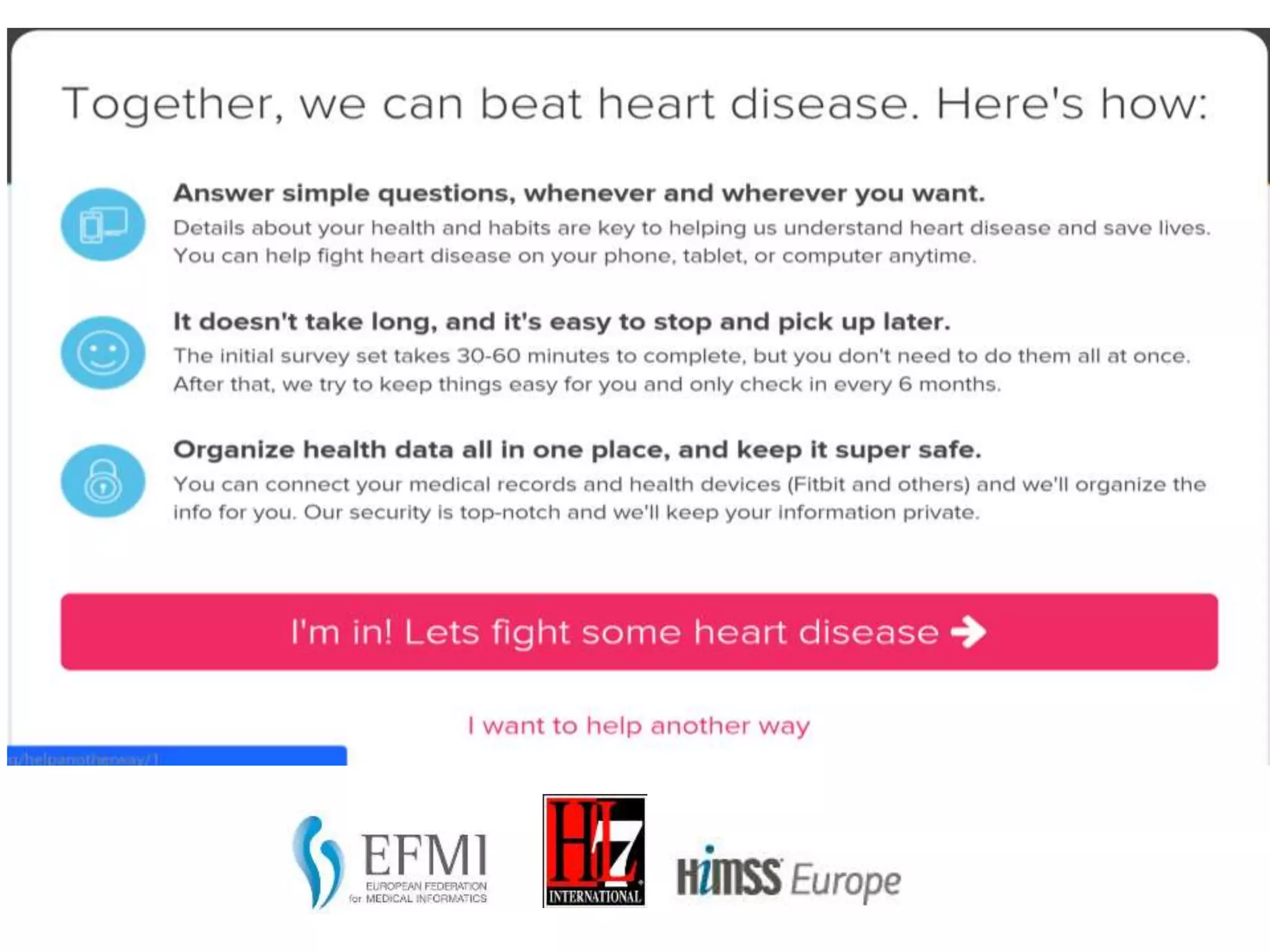
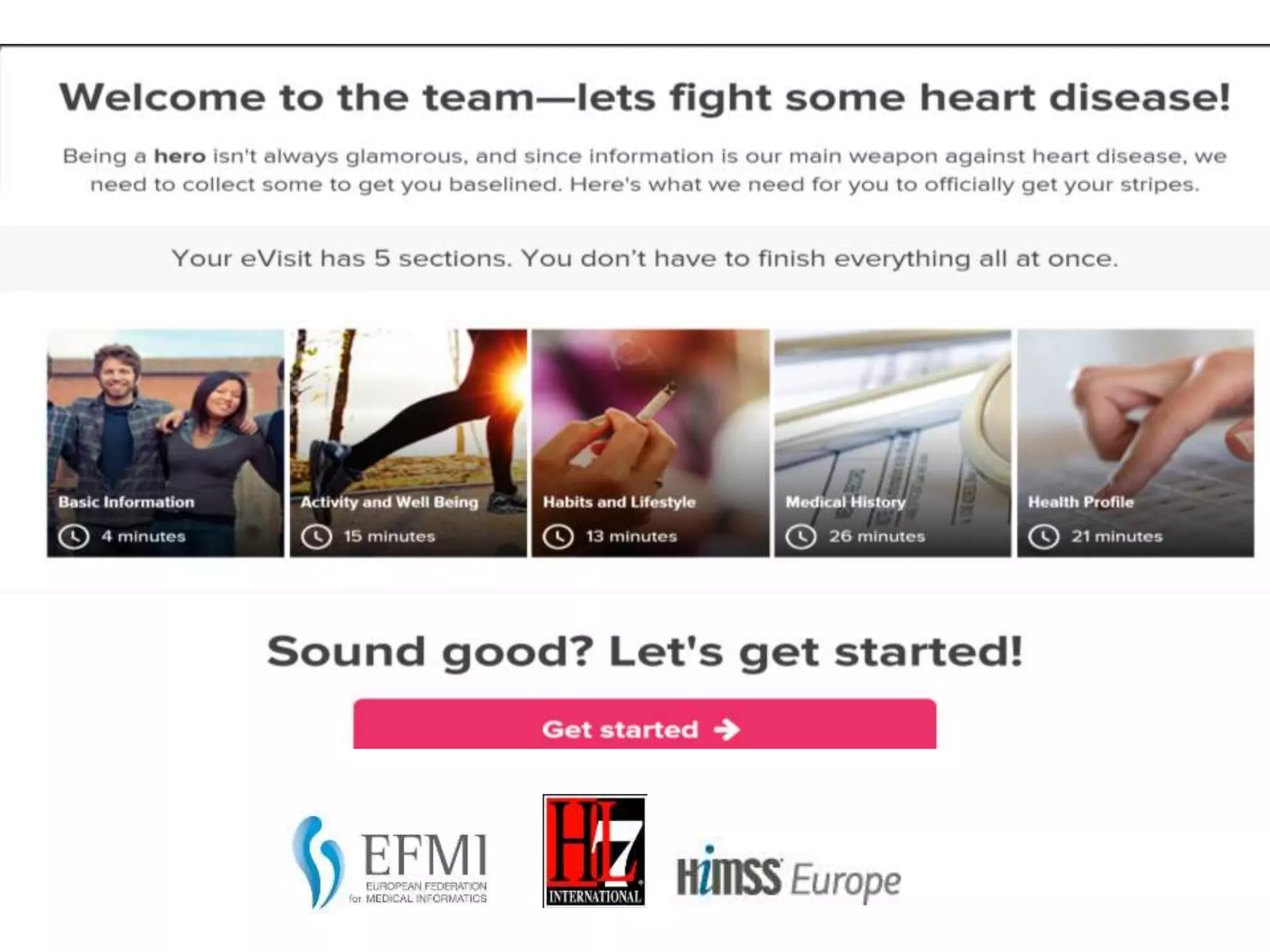
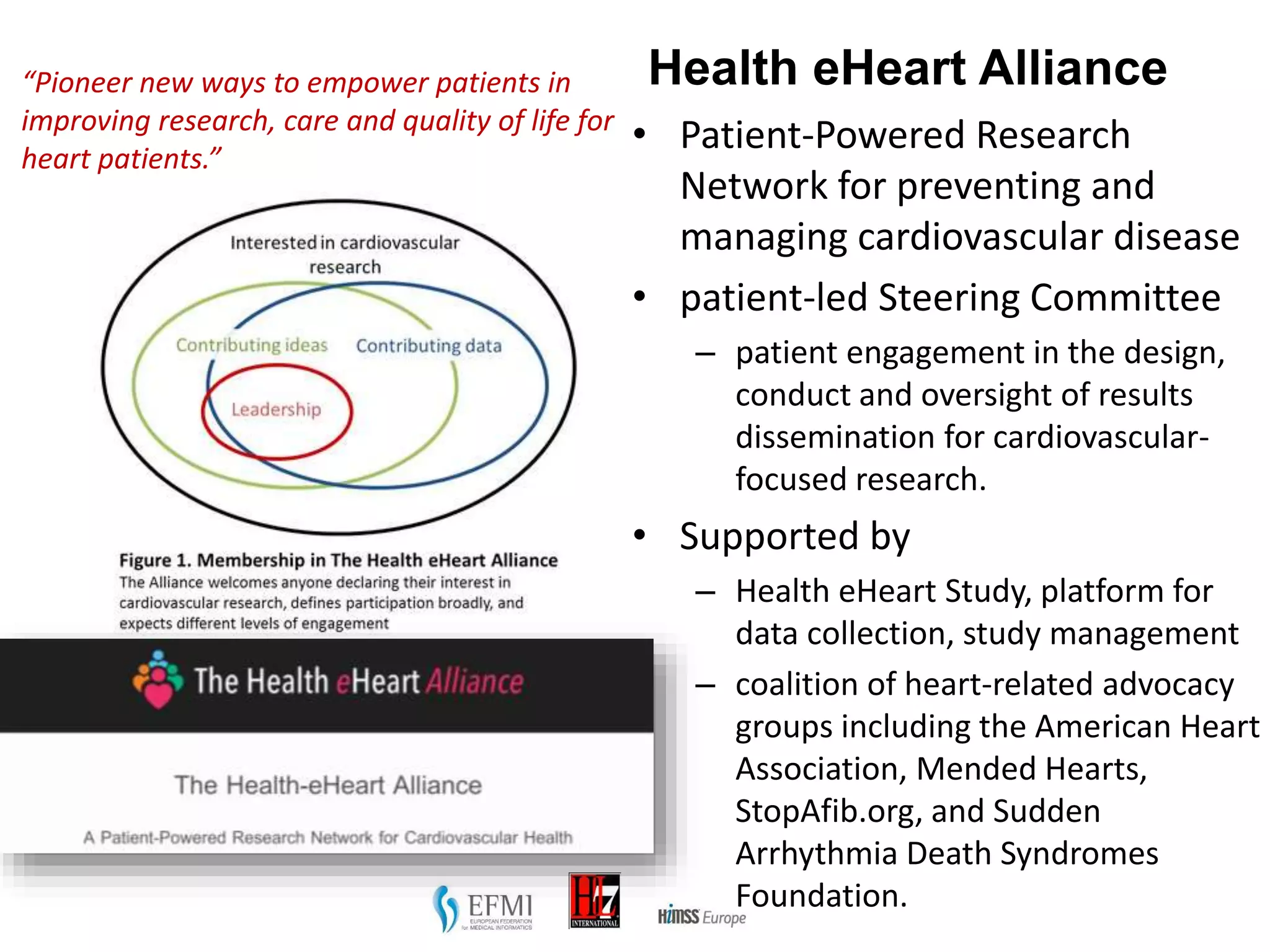
Health eHeart Alliance
• Patient-Powered Research
Network for preventing and
managing cardiovascular disease
• patient-led Steering Committee
– patient engagement in the design,
conduct and oversight of results
dissemination for cardiovascular-
focused research.
• Supported by
– Health eHeart Study, platform for
data collection, study management
– coalition of heart-related advocacy
groups including the American Heart
Association, Mended Hearts,
StopAfib.org, and Sudden
Arrhythmia Death Syndromes
Foundation.
Source: http://health-eheartalliance.org/
“Pioneer new ways to empower patients in
improving research, care and quality of life for
heart patients.”
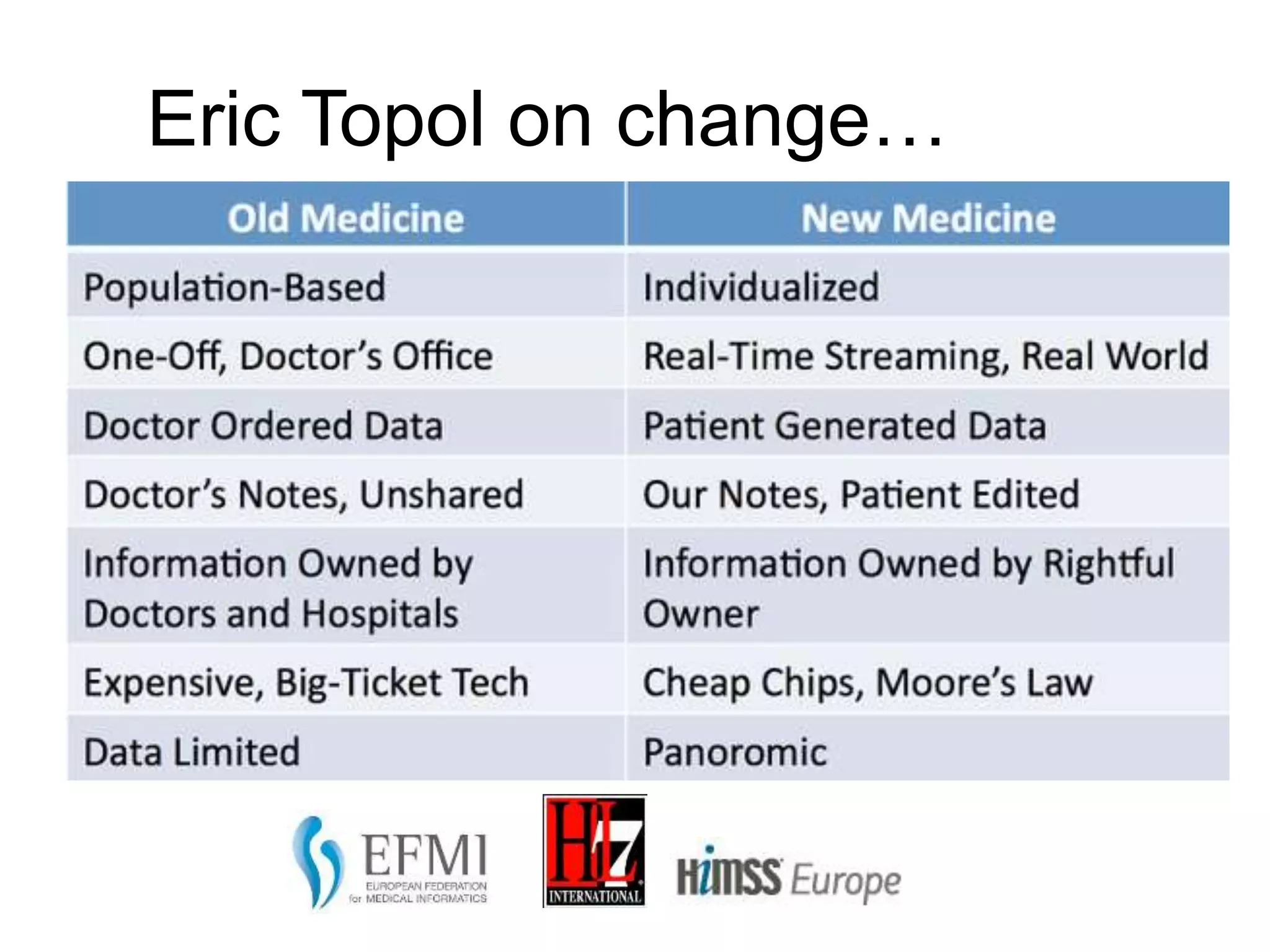
Eric Topol on change…
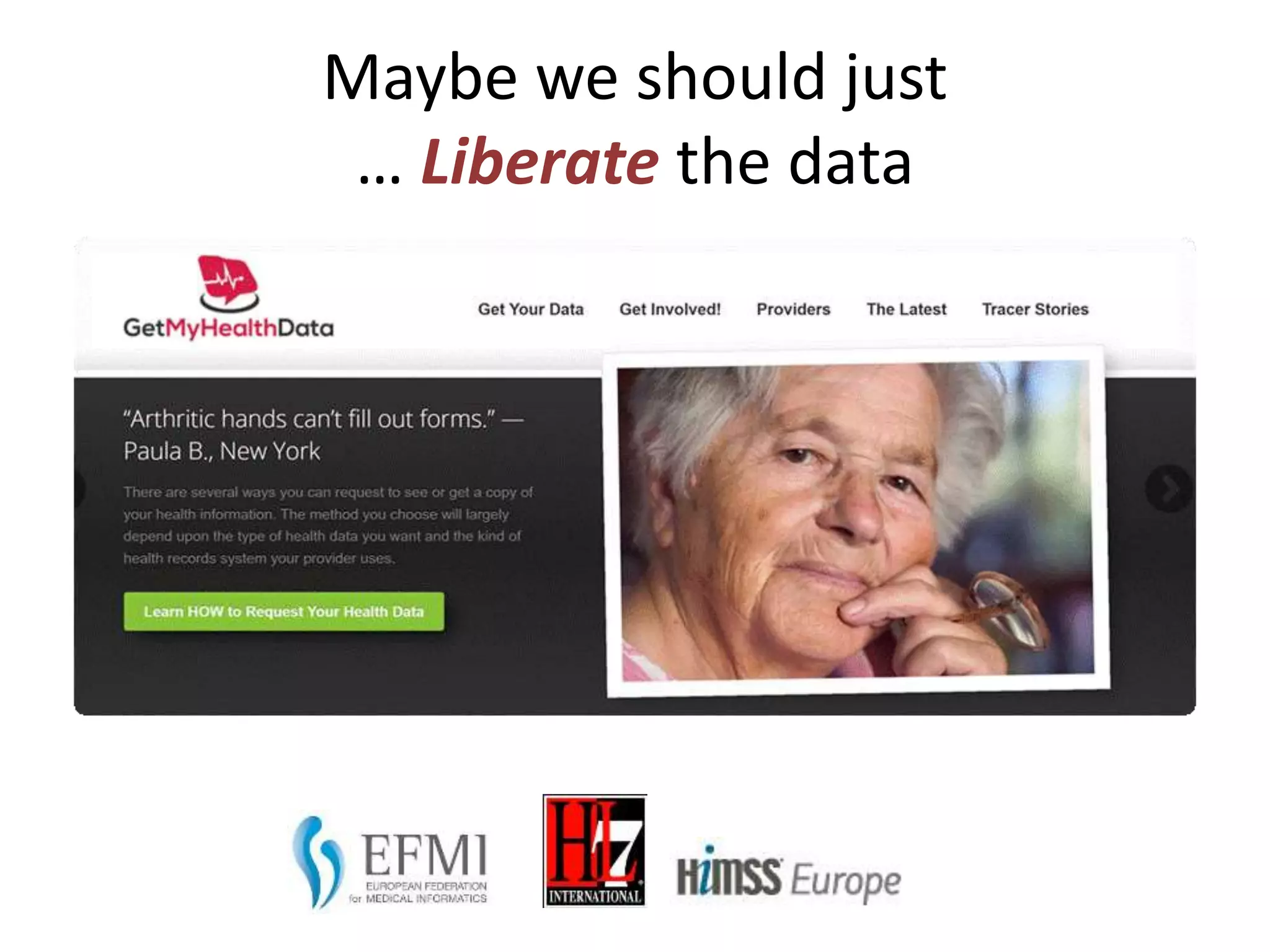
Maybe we should just
… Liberate the data
www.estandards-project.eu
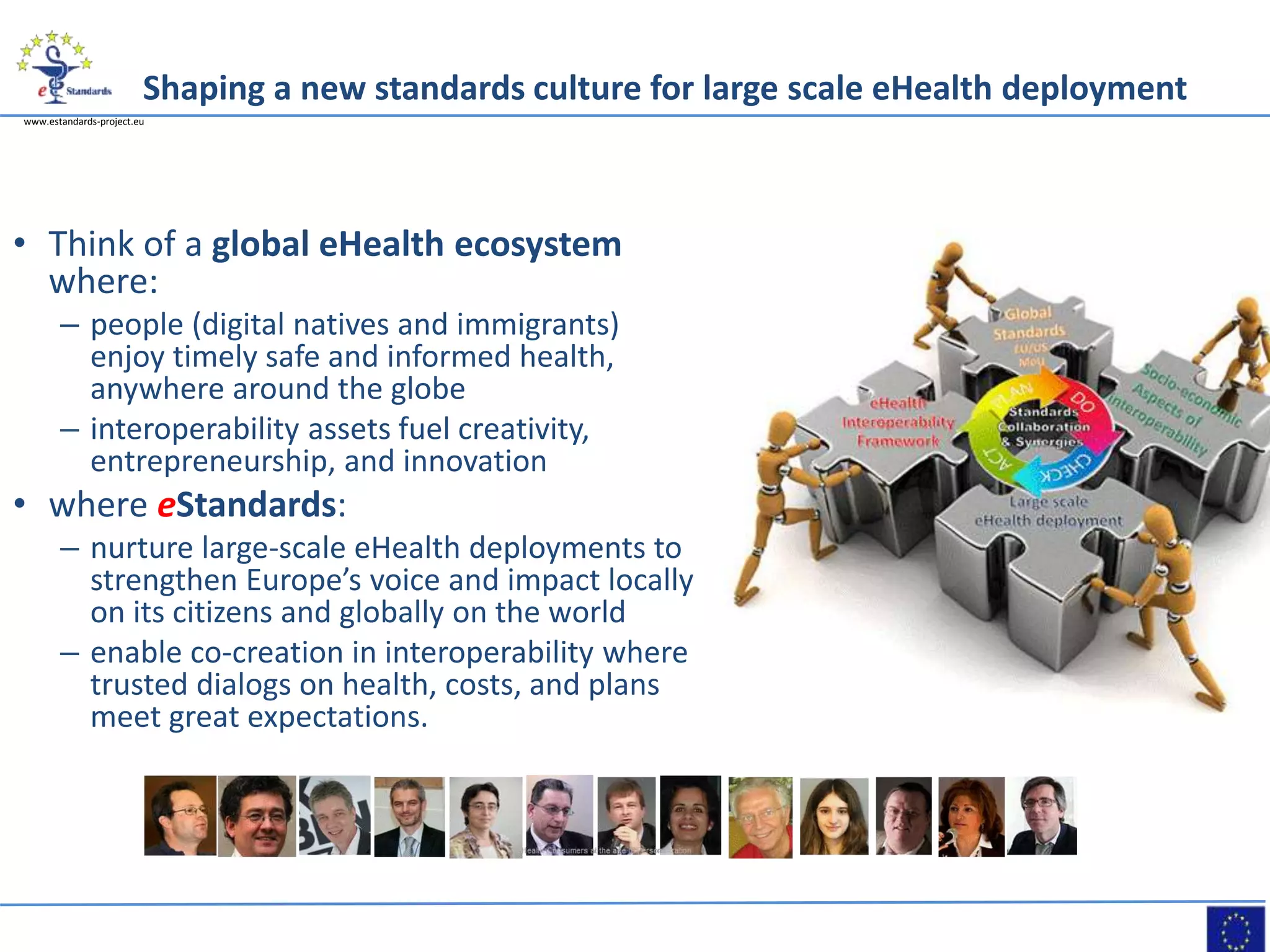
Shaping a new standards culture for large scale eHealth deployment
• Think of a global eHealth ecosystem
where:
– people (digital natives and immigrants)
enjoy timely safe and informed health,
anywhere around the globe
– interoperability assets fuel creativity,
entrepreneurship, and innovation
• where eStandards:
– nurture large-scale eHealth deployments to
strengthen Europe’s voice and impact locally
on its citizens and globally on the world
– enable co-creation in interoperability where
trusted dialogs on health, costs, and plans
meet great expectations.
www.estandards-project.eu
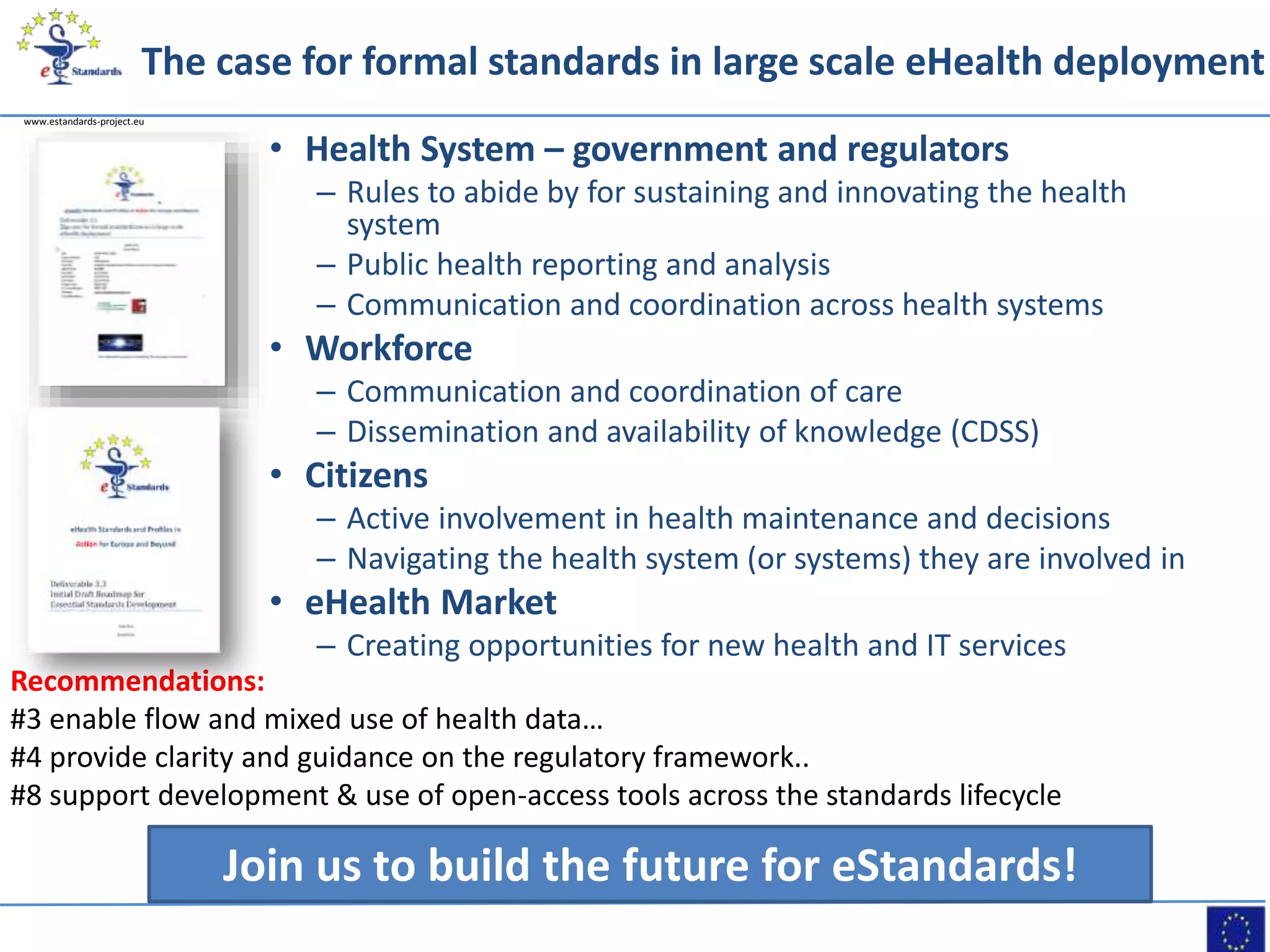
The case for formal standards in large scale eHealth deployment
• Health System – government and regulators
– Rules to abide by for sustaining and innovating the health
system
– Public health reporting and analysis
– Communication and coordination across health systems
• Workforce
– Communication and coordination of care
– Dissemination and availability of knowledge (CDSS)
• Citizens
– Active involvement in health maintenance and decisions
– Navigating the health system (or systems) they are involved in
• eHealth Market
– Creating opportunities for new health and IT services
Join us to build the future for eStandards!
Recommendations:
#3 enable flow and mixed use of health data…
#4 provide clarity and guidance on the regulatory framework..
#8 support development & use of open-access tools across the standards lifecycle
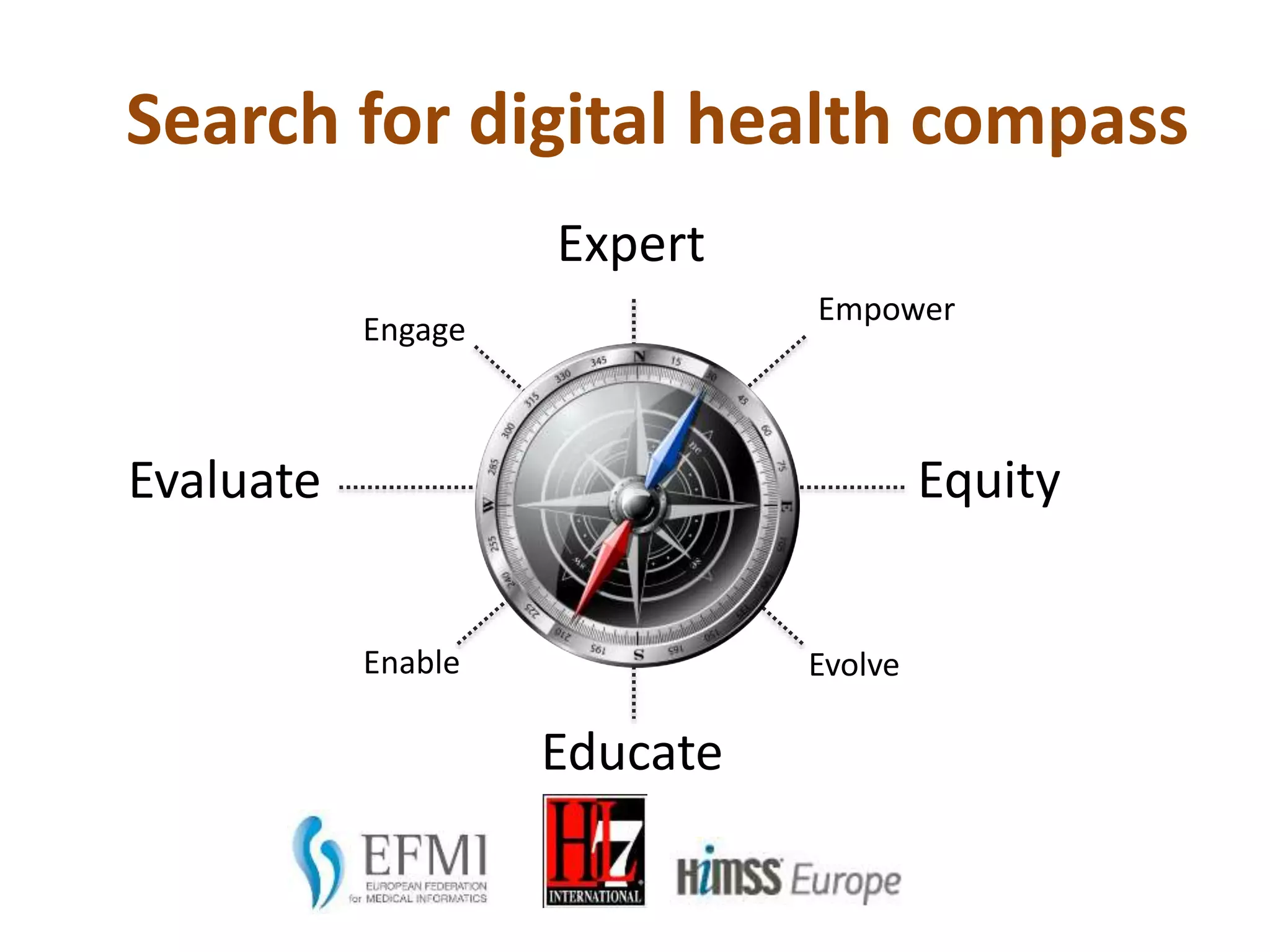
Expert
Empower
EquityEvaluate
Evolve
Educate
Engage
Enable
Search for digital health compass

In search of a digital health compass: My data, my decision, our power

  • 1.
    In Search ofa Digital Health Compass My Data, My Decision, Our ePower
  • 2.
    Moderator: John Rayner •Panelist’s introduction #digitalhealthcompass • How to co-create a digital health compass ? – Health Data Standards – Digital Health Literacy • Q&A – interaction with you all Tell me and I forget, Show me and I may remember, Involve me and I’ll understand
  • 3.
    Knowledge is power •Extensive investments in digital health technology – however low adoption of eHealth and persistent health disparities call for multidisciplinary action. • Navigating for health online is challenging, and understanding culture, education, skills, costs, perceptions of power and role is essential. • Citizens engaged in self-care, patients coping with persistent, chronic disease or living with an implanted device, or informal carers helping an elderly relative, a child or neighbor with illness or declining health, need a digital health compass.
  • 4.
    Digital health: Gutenbergmoment for healthcare Undiagnosed disease network Patient Centered Outcomes Research Institute (PCORI) non-profit, non-government organization Patient powered research networks Patients share, load to apps, donate their genomic data • .
  • 5.
    Objectives • How caneHealth investments pay-off? – Citizens – patients, caregivers and providers come together with standards, industry and researchers to co-create a personal digital health compass • Call for joint actions by health care, informatics, policy, standards, and industry – Broad scope of Informatics in service for health
  • 6.
    Panelists Anne Moen Petra Wilson RobertStegwee Ed Hammond Christian Lovis Catherine Chronaki
  • 7.
    Anne Moen Vision –a digital health compass - Use myData for knowledge and give me tools to participate in the transforming society - Patient & families, health professionals and health informatics join forces with research and policy to advance digital health literacy - Health Data standards and API as catalysts
  • 8.
    Examples of storingand organizing health information artifacts and spaces Moen A, Brennan PF. Health@Home: the work of Health Information Management in the Household (HIMH) - implications for Consumer Health Informatics (CHI) innovations. Journal of the American Medical Informatics Association, 2005;12:648-56. There will be pictures here – omitted for sending
  • 9.
    Current situation • Citizens,patients and caregivers do not use digital health services to meet their health and wellness needs for several (good) reasons • Few models for partnerships and information sharing between citizens – professionals • Little integration and interoperability of health data for collaboration purposes
  • 10.
    Digital literacy, eSkills Health care Experiences & expectations Co-creation tomorrow’s care Health & Digital Health Literacy Personal characteristics health & wellness
  • 11.
    Digital Health: Onesize does not fit all ! Beyond socio-demographic aspects that challenge adoption of digital health technology, there is also behavior .. • Self Achievers • Priority Jugglers • Direction Takers • Balance Seekers • Willful Endures There is an app for YOU!
  • 12.
    Ref: Benson T,Bowman C, Potts HWW. Health Confidence Score (HCS): development and validation of a short generic questionnaire for person centred care. Submitted for publication 2015 Measuring up Health Confidence The Health Confidence Score (HCS) is a short generic measure of person’s confidence to engage fully in their health and care. • Knowledge • Self-management • Access • Shared decision-making
  • 13.
  • 14.
    • Knowledge andexpertise to us as citizens – resources that make sense –the relevant data – Engage – convenient – balance – targets • Balance what really matters – Human relationships – empathy – the people – Complex information collaboration – Self-care between care – health encounter Moving forward
  • 15.
    Petra Wilson • perspectivesof patients – citizens • confidence raising a call for action for the health systems to integrate digital health literacy interventions every step of the way
  • 16.
    Why the PatientNeeds a New Compass Personalisation - retail, leisure, education Mobility - work, communication, money Complexity - comorbidity, medication, environment Scarcity - resources, HCPs, time
  • 17.
    What the compassshould provide to the Patient Engage me in my own health and care - Access to relevant, timely and understandable information. Empower me to make decision and inform others - Ability to share information and interact on information
  • 18.
    What are thebuilding blocks ? • Data – Add – Access – Share – Control • Trust – partners – System – Redress • Access – Reimbursement – Security – mobility • Standards • Interoperability • Integration
  • 19.
    Are we nearlythere yet ???? • Standards …. Good progress • Interoperability …… in some contexts • Integration ……. Limited • We are missing too many opportunities to engage and empower the patient!
  • 20.
    Transform to thepower of digital Personal Digital Health Robert A. Stegwee
  • 21.
    Copyright © 2016Capgemini Consulting. All rights reserved. Personal Health Records and the capabilities they provide to citizens  A personal health record is more than a viewer and organizer of personal health information  It provides treatment support, including self management options  It facilitates the exchange of health information with health care providers  It supports healthy lifestyle options and the tracking of personal fitness Personal Health Information Treatment Exchange Lifestyle
  • 22.
    Copyright © 2016Capgemini Consulting. All rights reserved. Adoption of Personal Health Records is very limited  Survey among invited experts in 25 countries across 6 continents  No individual PHR systems are reported that currently reach a million users or more  Many PHR systems are still in a pilot phase with user numbers in the 100s or 1000s 22
  • 23.
    Copyright © 2016Capgemini Consulting. All rights reserved. Different strategies are being implemented, with no clear differentiation in success  Having a strategy leads to more scale and more exchange of health information between citizen and other stakeholders in the health system  Government led initiatives have the best track record in realizing exchange, often realized within a government led health system  Apparently the consumer market lifestyle focus of tech companies is not perceived as a contribution to the PHR initiatives in different countries 23 0% 20% 40% 60% 80% 100% Exchange Treatment Lifestyle
  • 24.
    Copyright © 2016Capgemini Consulting. All rights reserved. Leadership and commitment of providers are key to success of Personal Health Records  Top three barriers to success of Personal Health Records adoption mentioned: 24 1. Leadership 2. Incentives for providers 3. Standards for information exchange Legislation and Citizen interest are not identified as key barriers
  • 25.
    Copyright © 2016Capgemini Consulting. All rights reserved. A vision on the role of personal health information for future delivery of health care  Personal experience is key in understanding – The perceived impact on a person’s life – The progression of a disease for an individual patient – The outcome of different treatment options – In relation to individual lifestyle choices  Tools for capturing, analysing, and relating all this data are becoming available – with the person at the centre! 25 First hand experts are those people who are suffering from cognitive impairments and who are willing to share with us the effects of the disease on their lives. They are the ones who can tell us the real story behind the effects of this disease and its diagnosis, from their own perspective. www.cottonwoolinmyhead.org
  • 26.
    Ed Hammond HL7 FHIR (FastHealthcare Interoperability Resources and standards) - New initiative in standards seeking to liberate data for population health and precision medicine in the learning health system. - Give an example of recent development.
  • 27.
    The compass isshifting • Sick care to Health • Provider focus to patient focus • Proprietary to shared • Competition to collaborative • Licensed to free • Site specific to mobile • National to global
  • 28.
    Drivers • Population Health •Precision Medicine • Data Sharing • Learning Health • Big Data • New Media • Mobile/wearable devices • Health Analytics • Translational Medicine Interoperability Dr. Karen DeSalvo, U.S. National Coordinator for Health IT pointed to HL7’s Fast Healthcare Inter- operability Resources (FHIR) as an open health data standard that offers a promising approach to meet the demand for semantic interoperability and minimizing the need for metadata translation services. The challenge now “is how to bring that information together to make it usable and actionable for everybody who wants it.”
  • 29.
    2 9 FHIR is FREE!! F– Fast (design & implement) H – Healthcare I – Interoperable R – Resources (Building blocks)
  • 30.
    What is FHIR?(1) • Based on a set of modular components - “Resources” – Resources refer to each other using URLs – Small discrete units of exchange with defined behaviour and meaning – Have known identity and behaviour – Extensions permit adding data not part of core • Resources are combined into “Profiles” to solve clinical and administrative problems in a practical way. – Parties exchanging data define the specific way they want to use resources and their relations using Profiles. – Profiles are the framework for defining services. 30
  • 31.
    What is FHIR?(2) • Exchange resources between systems – Using a RESTful API (e.g. web approach) – As a Bundle of resources (messages, documents) • Positives – Service driven – Modify components with changing need – Portability of components by moving program code with the data 31
  • 34.
    Digital Health CompassFHIR® Empower Service directed, Data Sharing, Patient Reporting Outcome Evolve Continual evolution through controlled versions, maturity levels Evaluate Standards for trial use, pilot studies, Argonaut Educate Tutorials, connectathons, application symposia, Learning Health Equity All stakeholders complete flexibility, mobile health, wearable sensors Enable Interoperability, push and pull, current directives, bidirectional data exchange Engage Persons, sites, communities, regions, countries, professional, patients Expert Easy to use
  • 35.
    Christian Lovis • Accessto knowledge and research strategies that alleviate health disparities • Set knowledge free ! • Make it matter for us !
  • 36.
    In 1455, Gutenbergcompleted copies of a beautifully executed folio Bible (Biblia Sacra), with 42 lines on each page. Copies sold for 30 florins each,[23] which was roughly three years' wages for an average clerk. Nonetheless, it was significantly cheaper than a manuscript Bible that could take a single scribe over a year to prepare. After printing, some copies were rubricated or hand-illuminated in the same elegant way as manuscript Bibles from the same period. 48 substantially complete copies are known to survive, including two at the British Library that can be viewed and compared online.[24] The text lacks modern features such as pagination, indentations, and paragraph breaks. An undated 36-line edition of the Bible was printed, probably in Bamberg in 1458–1460, possibly by Gutenberg. A large part of it was shown to have been set from a copy of Gutenberg's Bible, thus disproving earlier speculation that it may have been the earlier of the two.[25] 1455, first Bible printed by Johannes Gütenberg
  • 37.
    June 1997, Medlinefree and open access during public ceremony by VP Al Gore
  • 38.
  • 39.
    Kalakota, R. (2012,October 22). Sizing “Mobile + Social” Big Data Stats. Retrieved from http://practicalanalytics.wordpress.com/ The BigData era
  • 42.
    In the early1980s, a fifth component was added to these four "classic" bases, called methyl- cytosine (mC), which is derived from cytosine. Then, in the late 1990s, mC was recognized as the main cause of epigenetic mechanisms. Meaning, it can switch genes on or off depending on the physiological needs of each tissue. In recent years, researchers have studied this fifth DNA base in more detail because it seems alterations in the mC base contribute to the development of many human diseases, including cancer. Now, according to new findings published in the journal Cell, a sixth possible DNA base may also exist. Called methyl-adenine (mA), this potential DNA base may also help determine the epigenome and would therefore be key in the life of the cells.
  • 45.
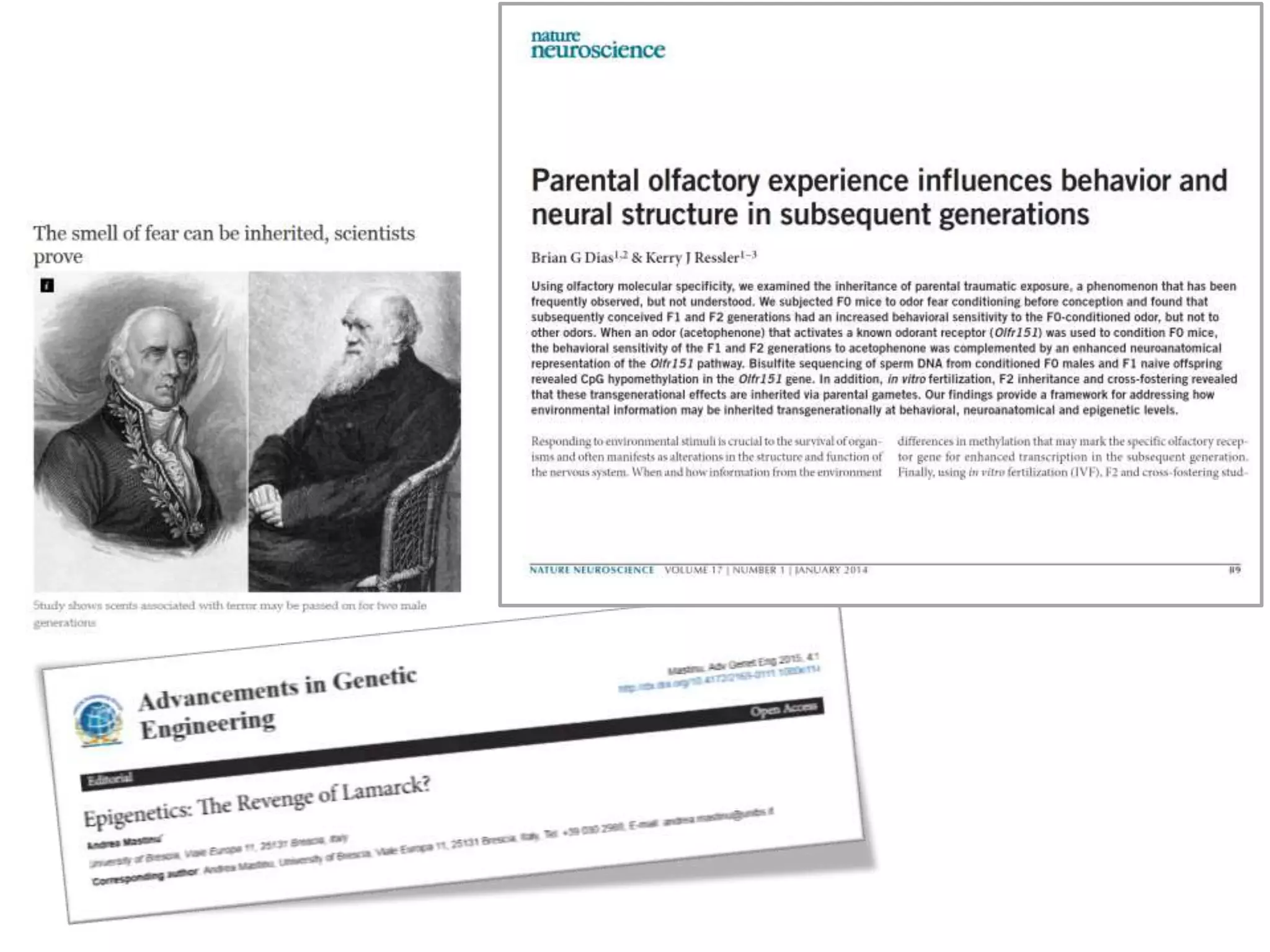
    Correlation does notimply Causality A.Wallnöfer – March 14, 2016
  • 46.
  • 47.
    Catherine Chronaki My Data- My Decision – our ePower patient engagement, myHealthData, tailored, adaptive and actionable health experience for individuals, families and communities.
  • 48.
  • 49.
    Know the effectsof medication you take or not... ePatients • Empowered • Educated • Engaged • Enabled • information integration can help patients and care givers to improve treatment effectiveness, quality of life • Integration with scales, glucose meters, blood pressure... All in one patient’s 360 view. • Standards like HL7 FHIR can be the catalyst in this live integration enabling participatory medicine.
  • 50.
  • 51.
    Enhanced tailored medicationinformation for you! Imagine yourself in a pharmacy for over the counter medicine: Walk down the corridor Your medication app suggestions are based on your health and wellness data scanning the box. Response to questions: – is it the right medication? – Characteristics are highlighted for the patient (e.g. Considering allergies, preconditions, etc). – Comparison among medication poducts ID ... ... ... ... ... ... ... ... Prescribing App Patient App European Medicines Database Treatment data Product data Personal Product data
  • 53.
  • 58.
    Health eHeart Alliance •Patient-Powered Research Network for preventing and managing cardiovascular disease • patient-led Steering Committee – patient engagement in the design, conduct and oversight of results dissemination for cardiovascular- focused research. • Supported by – Health eHeart Study, platform for data collection, study management – coalition of heart-related advocacy groups including the American Heart Association, Mended Hearts, StopAfib.org, and Sudden Arrhythmia Death Syndromes Foundation. Source: http://health-eheartalliance.org/ “Pioneer new ways to empower patients in improving research, care and quality of life for heart patients.”
  • 59.
    Eric Topol onchange…
  • 60.
    Maybe we shouldjust … Liberate the data
  • 61.
    www.estandards-project.eu Shaping a newstandards culture for large scale eHealth deployment • Think of a global eHealth ecosystem where: – people (digital natives and immigrants) enjoy timely safe and informed health, anywhere around the globe – interoperability assets fuel creativity, entrepreneurship, and innovation • where eStandards: – nurture large-scale eHealth deployments to strengthen Europe’s voice and impact locally on its citizens and globally on the world – enable co-creation in interoperability where trusted dialogs on health, costs, and plans meet great expectations.
  • 62.
    www.estandards-project.eu The case forformal standards in large scale eHealth deployment • Health System – government and regulators – Rules to abide by for sustaining and innovating the health system – Public health reporting and analysis – Communication and coordination across health systems • Workforce – Communication and coordination of care – Dissemination and availability of knowledge (CDSS) • Citizens – Active involvement in health maintenance and decisions – Navigating the health system (or systems) they are involved in • eHealth Market – Creating opportunities for new health and IT services Join us to build the future for eStandards! Recommendations: #3 enable flow and mixed use of health data… #4 provide clarity and guidance on the regulatory framework.. #8 support development & use of open-access tools across the standards lifecycle
  • 63.

Editor's Notes

  • #3 Open and change the chain Availability of good medical or social care services and tools online, varies inversely with the need of the population.
  • #6 Our wellbeing, our health ant the factors leading to this is not in the Technology Advanced treatment Active or remote monitoring Per se BUT in how we engage with our health issues, strive for wellbeing and thrive Bring the people – citizen, patients, professionals – worried well and the really ill – must orient themselves in increasingly complex environments of information challenges that are poorly understood, interoperability challenges and the context is messy …
  • #11 In tomorrow’s care we will see more productive interactions and co-creation ! Personal characteristics - personal dimension; socio-demographic factors, health and wellness that spans the full spectrum of WORRIED Well and the REALLY Ill Digital literacy, eSkills covers a person’s digital confidence, skills and capabilities, technology readiness, Health and Digital Health Literacy - experience (tenure) and preferences for engagement and health coaching, and use of digital health information, Health care Requirements & Experience privacy, security, and trust - Digital Health Compass resource providers will be required to provide common metadata about their products, using standardized structure based in a widely adopted standards. Knowledge of a person’s digital health literacy and eHealth resources will help citizens, patients and intermediaries select most relevant resources to foster personal control and empowerment. e.g., the Dublin Core Metadata Initiative (DCMI) headings and the HON Code. person’s knowledge and capability to manage one’s own health, ability to get appropriate help when needed and engage in shared decision-making. Information relevant for the person’s circumstances will help assemble and adapt a suitable learning plan. eP index is a composite measure of, (see Figure 2 below), eSkills, health literacy and traditional measures of eHealth literacy.
  • #14 Digital Health Compass Multiple dimensions that need attention, - opportunities, divides or rifts, Collaboration – co-creation – activation – preference for participation, and engagement Digital native / Digital immigrant / Digital ignorant / Digital refugees / Digital outcast / Digital refuges
  • #15 Our wellbeing, our health ant the factors leading to this is not in the Technology Advanced treatment Active or remote monitoring Per se BUT in how we engage with our health issues, strive for wellbeing and thrive Bring the people – citizen, patients, professionals – worried well and the really ill – must orient themselves in increasingly complex environments of information challenges that are poorly understood, interoperability challenges and the context is messy …
  • #19 Knowledge and experience ?
  • #27 SDO will bring about Digital Health Data - Clinicians wants standards, they want better systems, big problem (20 years) – quality of standards is poor – implementers using standards
  • #63 #3: enable the flow and mixed use of health data across jurisdictions, health record systems, and personal devices (“break down the silos”) to promote safe and effective health management and secondary use of health data. #4 Provide clarity and guidance on the regulatory framework relating to information from personal health and wellness #8: Support the development and usage of open-access tools that facilitate implementation and deployment and increase the accessibility and usability of standards and specifications. A standards set incorporates a use case on the care process layer and references the relevant standards, conformance assessment and implementation guidance on the underlying layers of interoperability. ). Given its global nature, a JIC standards set will not cover the details of local implementations and will not make any assumptions on the overall systems architecture. Those choices are in the realm of realisation scenarios, as detailed in the ReEIF.