Strategic Business Requirements for Master Data
Management Systems

Boris Otto, Martin Ofner
Detroit, IL, August 5, 2011

University of St. Gallen, Institute of Information Management
Tuck School of Business at Dartmouth College
Agenda


1. Motivation and Problem Statement

2. Background

3. Research Approach

4. Design Principles and Business Requirements

5. Evaluation

6. Conclusion


                               Detroit, MI, 08/05/11, B. Otto / 2
The initial situation in practice

          User Uncertainty1                                            Diverging Expectations
■ “What is the proper sequence of                           “We are flooded by invitations from MDM
  activities in support of MDM? Must we                     software vendors to sit together and let
  have solid data integration and data                      them present their solutions, which are
  quality practices and architectures in                    always supposed to be the solution to all
  place before dealing with MDM?”                           our problems. When we meet, it’s always
■ “Most of our current data integration                     the same: They present something we
  requirements are batch-oriented in                        aren’t looking for. Then we tell them our
  nature, as we work to physically                          understanding of the world and what our
  consolidate silos of master data. What                    real requirements are -- what in return they
  types of packaged data integration                        do not want or cannot share. And in the
  tools will be most relevant for our                       end, everybody goes his own way, highly
  purposes?”                                                frustrated because they couldn’t sell their
■ “Has market consolidation already                         product, we didn’t get an answer to our
  reached the point where the advantages                    problems, and both of us spent time in
  of single-vendor stacks for MDM                           vain.”
  outweigh the advantages of a best-of-
  breed strategy?”


■ What are strategic business requirements to be met by MDM systems?
■ How can these requirements be framed to support communication between user companies and
  software vendors?


                                           Detroit, MI, 08/05/11, B. Otto / 3
Background: Master Data and MDM


Master Data
Essential business entities a company’s business activities are based on
(customers, suppliers, employees, products etc.)2

Master Data Management (MDM)
All activities for creating, modifying or deleting a master data class, a master
attribute, or a master data object.3
Aiming at providing master data of good quality (i.e. master data that is
complete, accurate, timely, and well structured) for being used in business
processes.4,5


                                    Detroit, MI, 08/05/11, B. Otto / 4
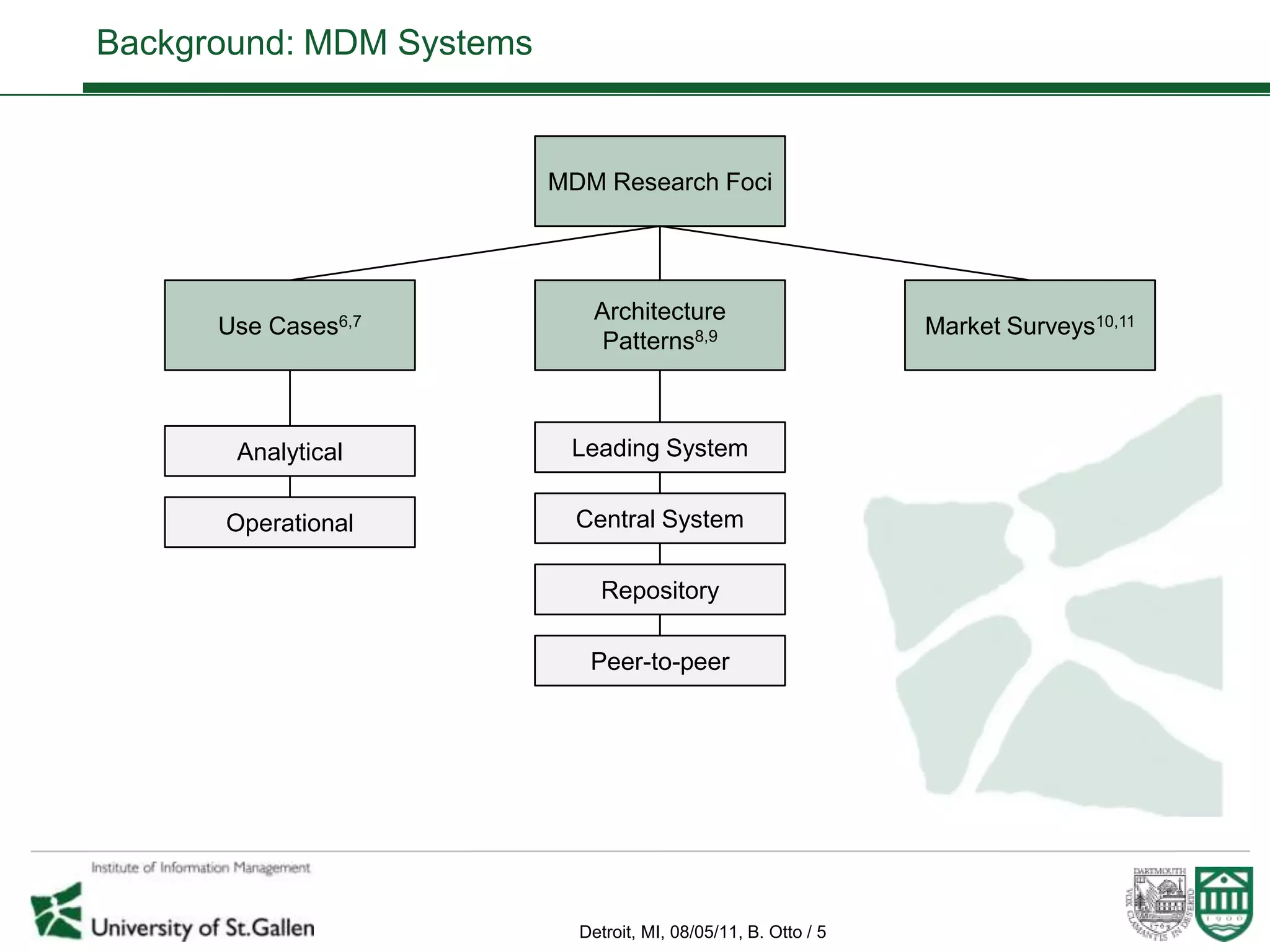
Background: MDM Systems


                          MDM Research Foci


                              Architecture
      Use Cases6,7                                               Market Surveys10,11
                               Patterns8,9


       Analytical          Leading System


      Operational           Central System

                              Repository

                             Peer-to-peer


                            Detroit, MI, 08/05/11, B. Otto / 5
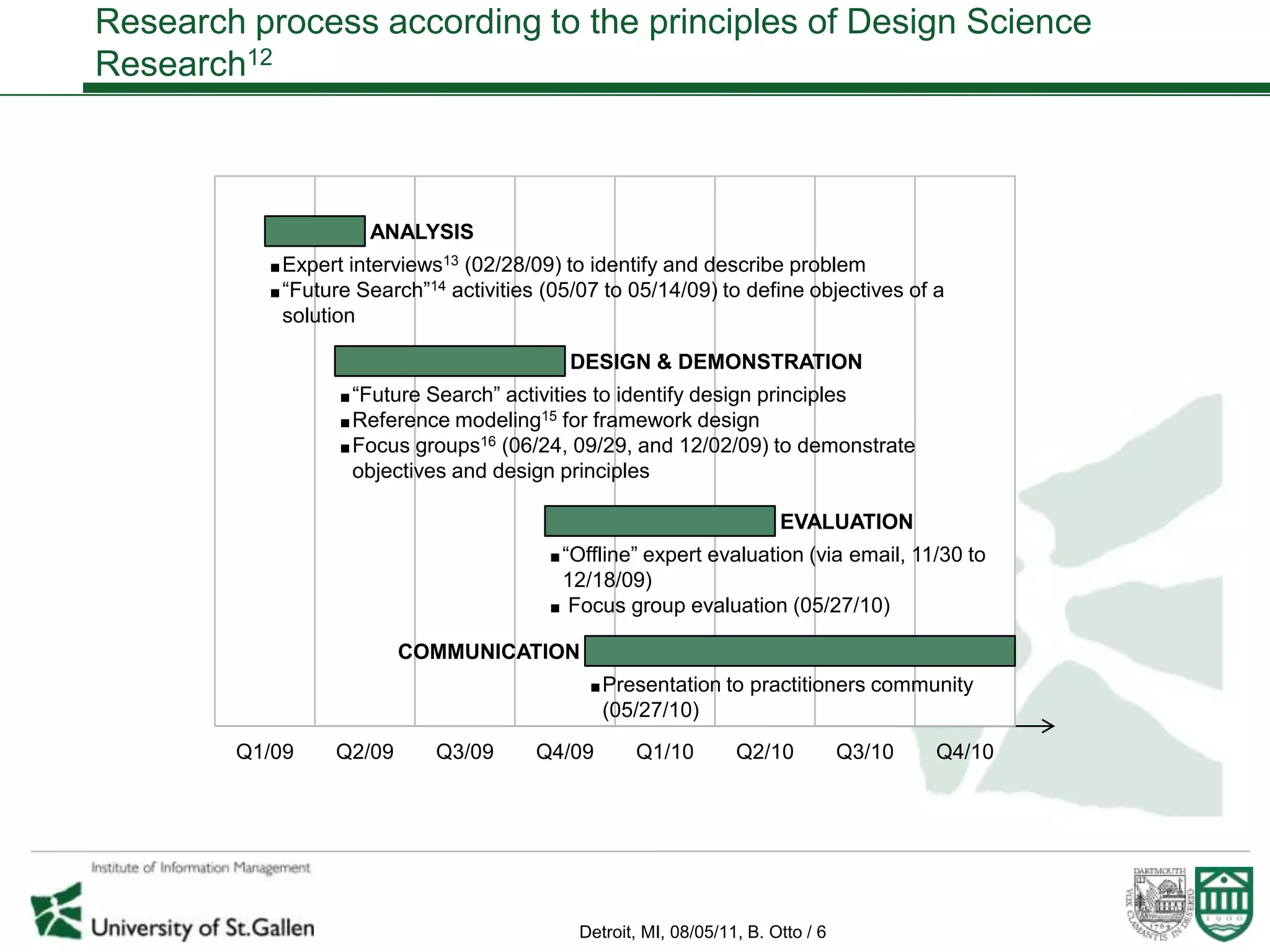
Research process according to the principles of Design Science
Research12


                      ANALYSIS
          ■ Expert interviews13 (02/28/09) to identify and describe problem
          ■ “Future Search”14 activities (05/07 to 05/14/09) to define objectives        of a
           solution

                                           DESIGN & DEMONSTRATION
                 ■ “Future Search” activities to identify design principles
                 ■ Reference modeling15 for framework design
                 ■ Focus groups16 (06/24, 09/29, and 12/02/09) to demonstrate
                   objectives and design principles

                                                                       EVALUATION
                                         ■ “Offline”
                                                  expert evaluation (via email, 11/30 to
                                          12/18/09)
                                         ■ Focus group evaluation (05/27/10)

                         COMMUNICATION
                                              ■ Presentation to    practitioners community
                                               (05/27/10)
        Q1/09    Q2/09      Q3/09      Q4/09       Q1/10         Q2/10           Q3/10      Q4/10


                                            Detroit, MI, 08/05/11, B. Otto / 6
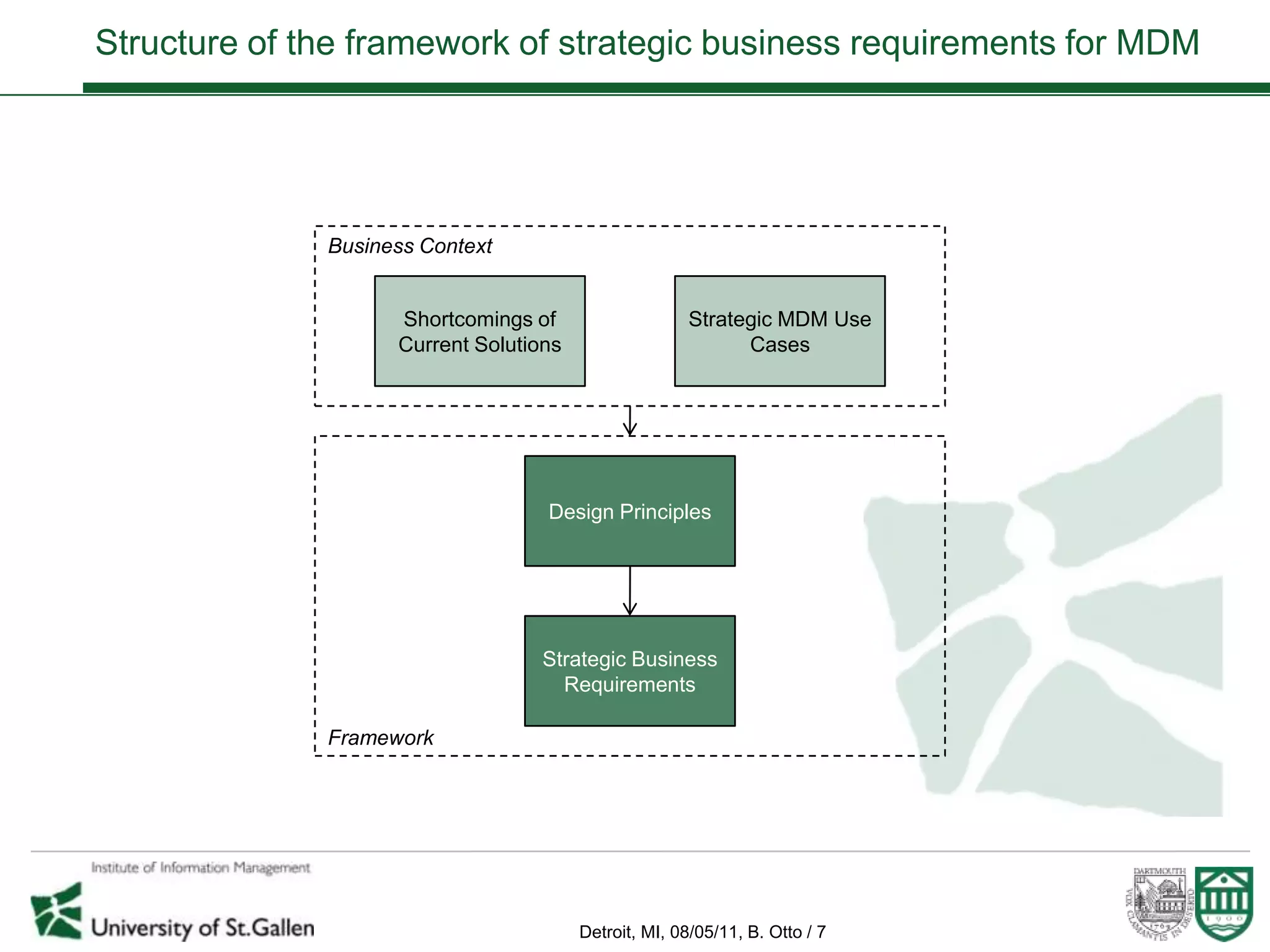
Structure of the framework of strategic business requirements for MDM


              Business Context


                    Shortcomings of                    Strategic MDM Use
                    Current Solutions                        Cases


                                   Design Principles


                                   Strategic Business
                                     Requirements

              Framework


                                        Detroit, MI, 08/05/11, B. Otto / 7
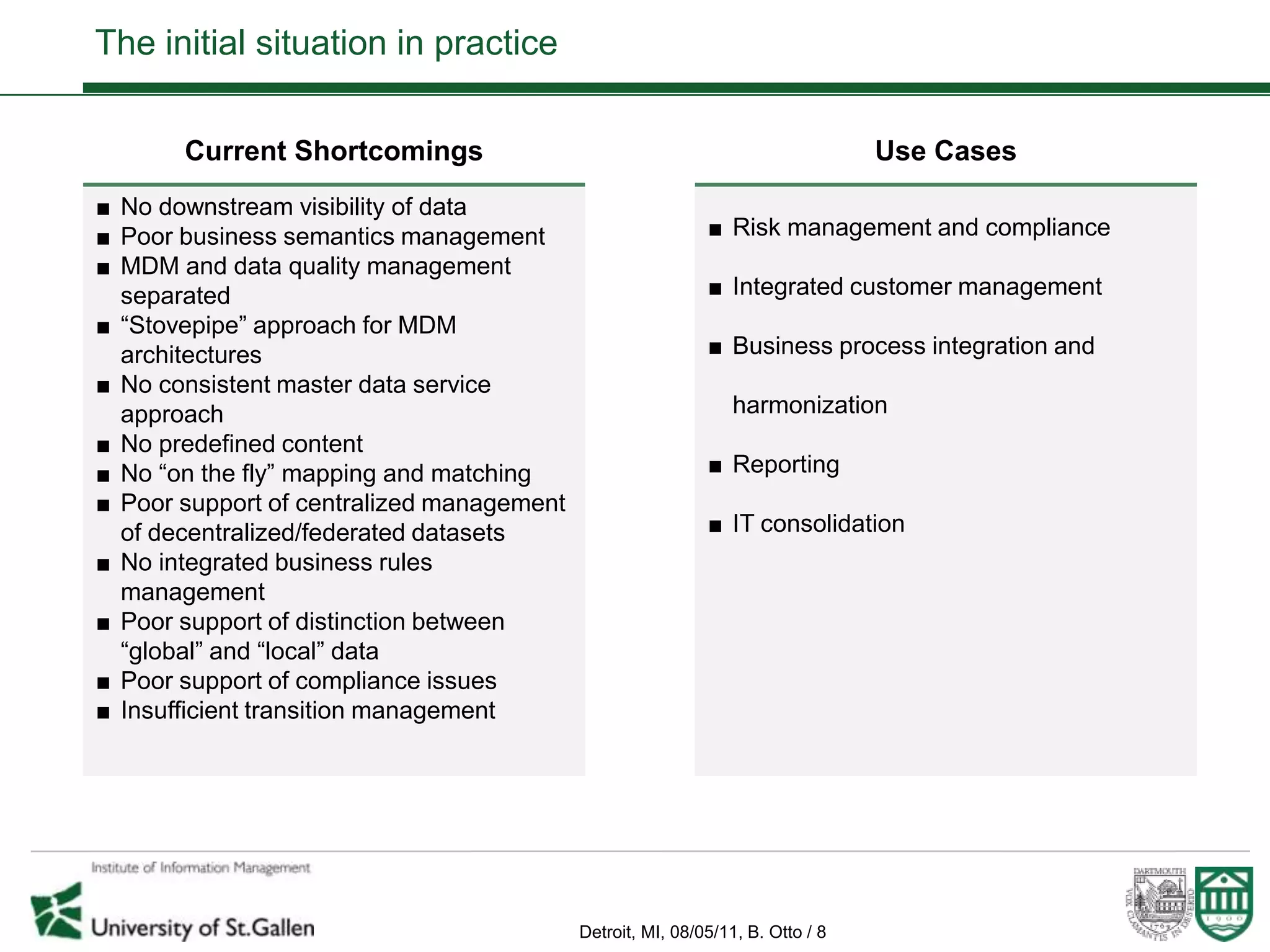
The initial situation in practice

       Current Shortcomings                                                     Use Cases
■ No downstream visibility of data
■ Poor business semantics management                        ■ Risk management and compliance
■ MDM and data quality management
  separated                                                 ■ Integrated customer management
■ “Stovepipe” approach for MDM
  architectures                                             ■ Business process integration and
■ No consistent master data service
  approach                                                      harmonization
■ No predefined content
■ No “on the fly” mapping and matching                      ■ Reporting
■ Poor support of centralized management
  of decentralized/federated datasets                       ■ IT consolidation
■ No integrated business rules
  management
■ Poor support of distinction between
  “global” and “local” data
■ Poor support of compliance issues
■ Insufficient transition management


                                           Detroit, MI, 08/05/11, B. Otto / 8
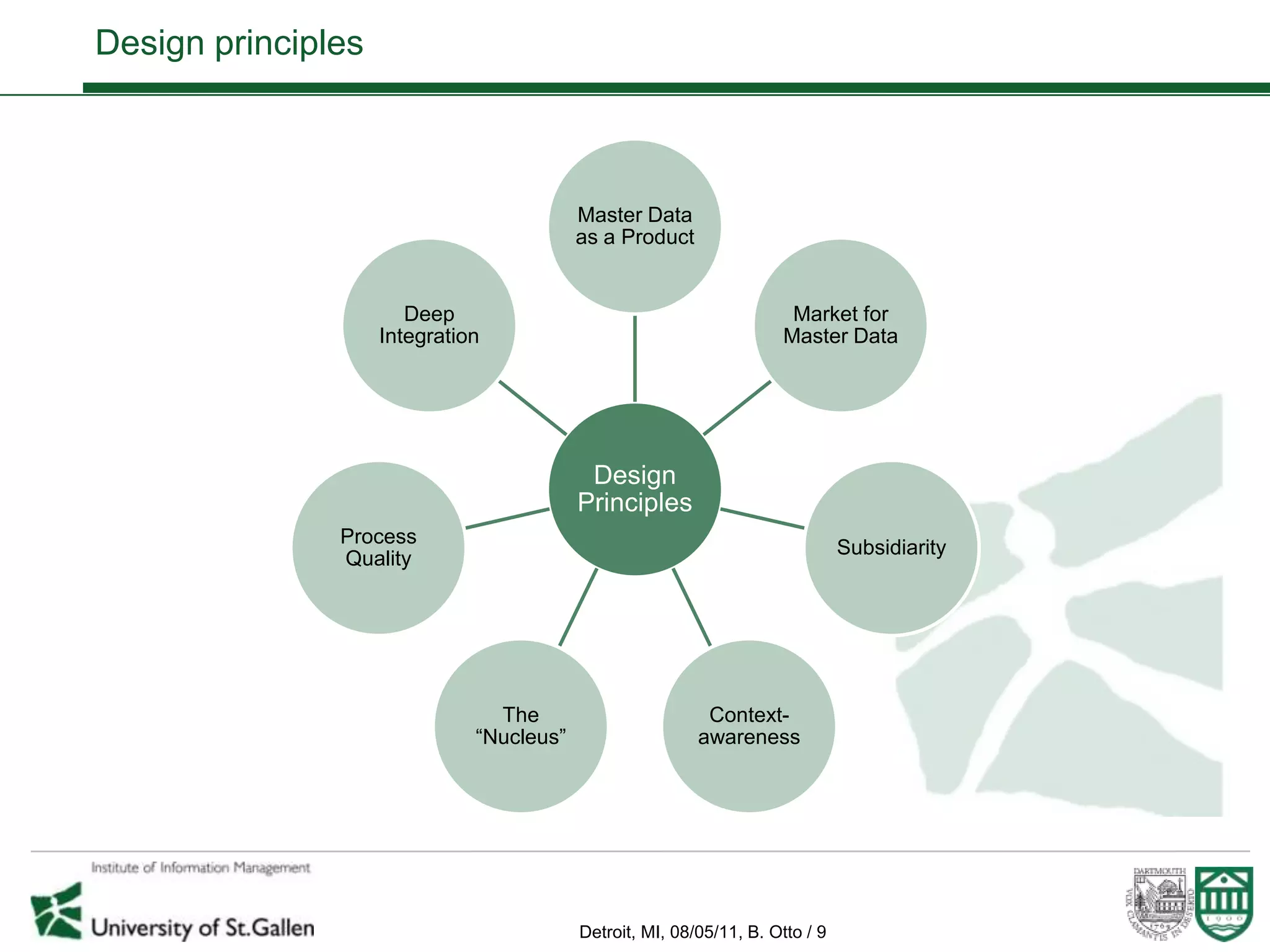
Design principles


                                          Master Data
                                          as a Product


                       Deep                                            Market for
                    Integration                                       Master Data


                                           Design
                                          Principles
               Process
                                                                               Subsidiarity
               Quality


                                The                        Context-
                              “Nucleus”                   awareness


                                          Detroit, MI, 08/05/11, B. Otto / 9
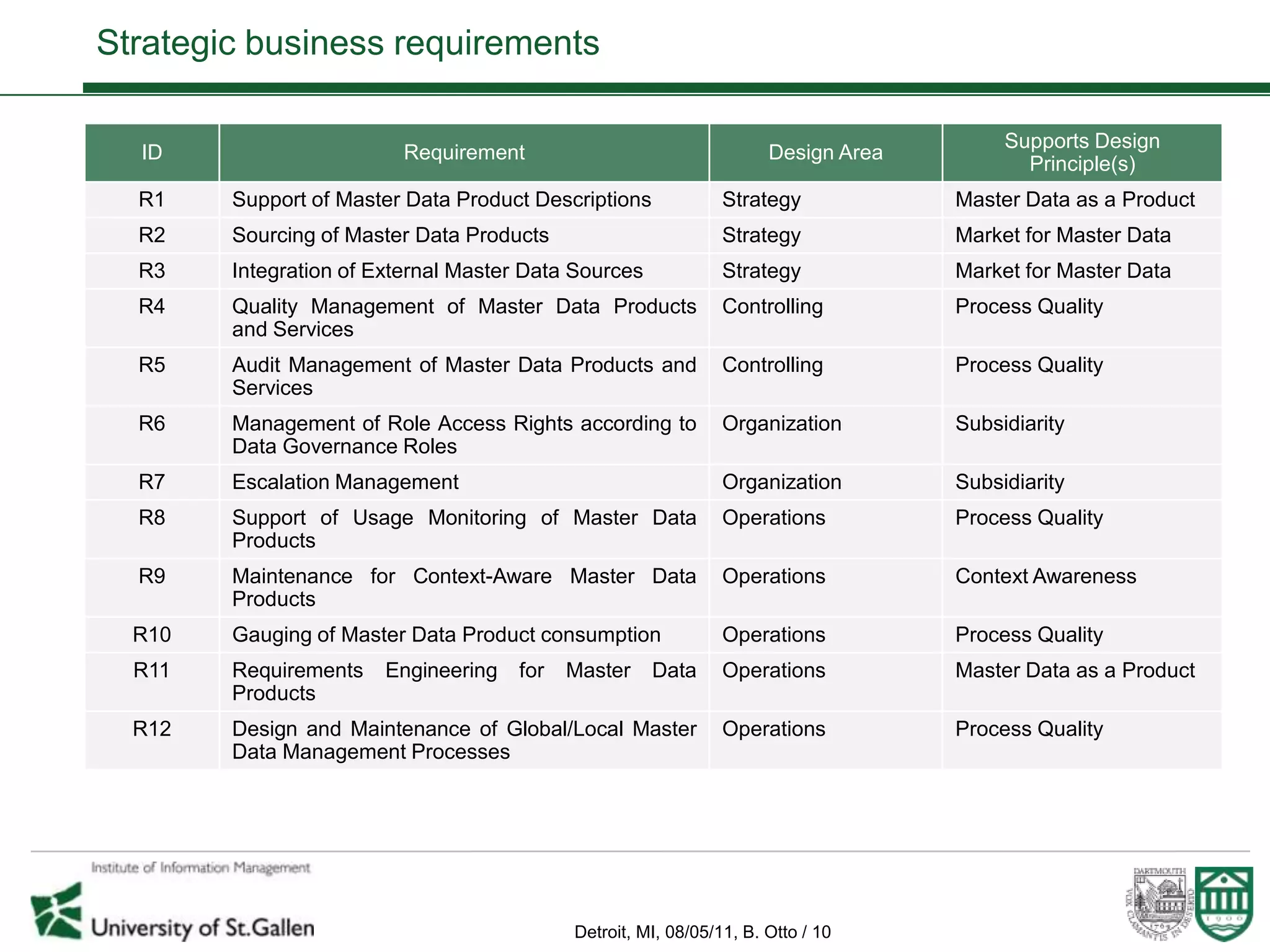
Strategic business requirements

                                                                                         Supports Design
  ID                     Requirement                                  Design Area
                                                                                           Principle(s)
  R1    Support of Master Data Product Descriptions             Strategy            Master Data as a Product
  R2    Sourcing of Master Data Products                        Strategy            Market for Master Data
  R3    Integration of External Master Data Sources             Strategy            Market for Master Data
  R4    Quality Management of Master Data Products              Controlling         Process Quality
        and Services
  R5    Audit Management of Master Data Products and            Controlling         Process Quality
        Services
  R6    Management of Role Access Rights according to           Organization        Subsidiarity
        Data Governance Roles
  R7    Escalation Management                                   Organization        Subsidiarity
  R8    Support of Usage Monitoring of Master Data              Operations          Process Quality
        Products
  R9    Maintenance for Context-Aware Master Data               Operations          Context Awareness
        Products
  R10   Gauging of Master Data Product consumption              Operations          Process Quality
  R11   Requirements    Engineering   for   Master    Data      Operations          Master Data as a Product
        Products
  R12   Design and Maintenance of Global/Local Master           Operations          Process Quality
        Data Management Processes


                                            Detroit, MI, 08/05/11, B. Otto / 10
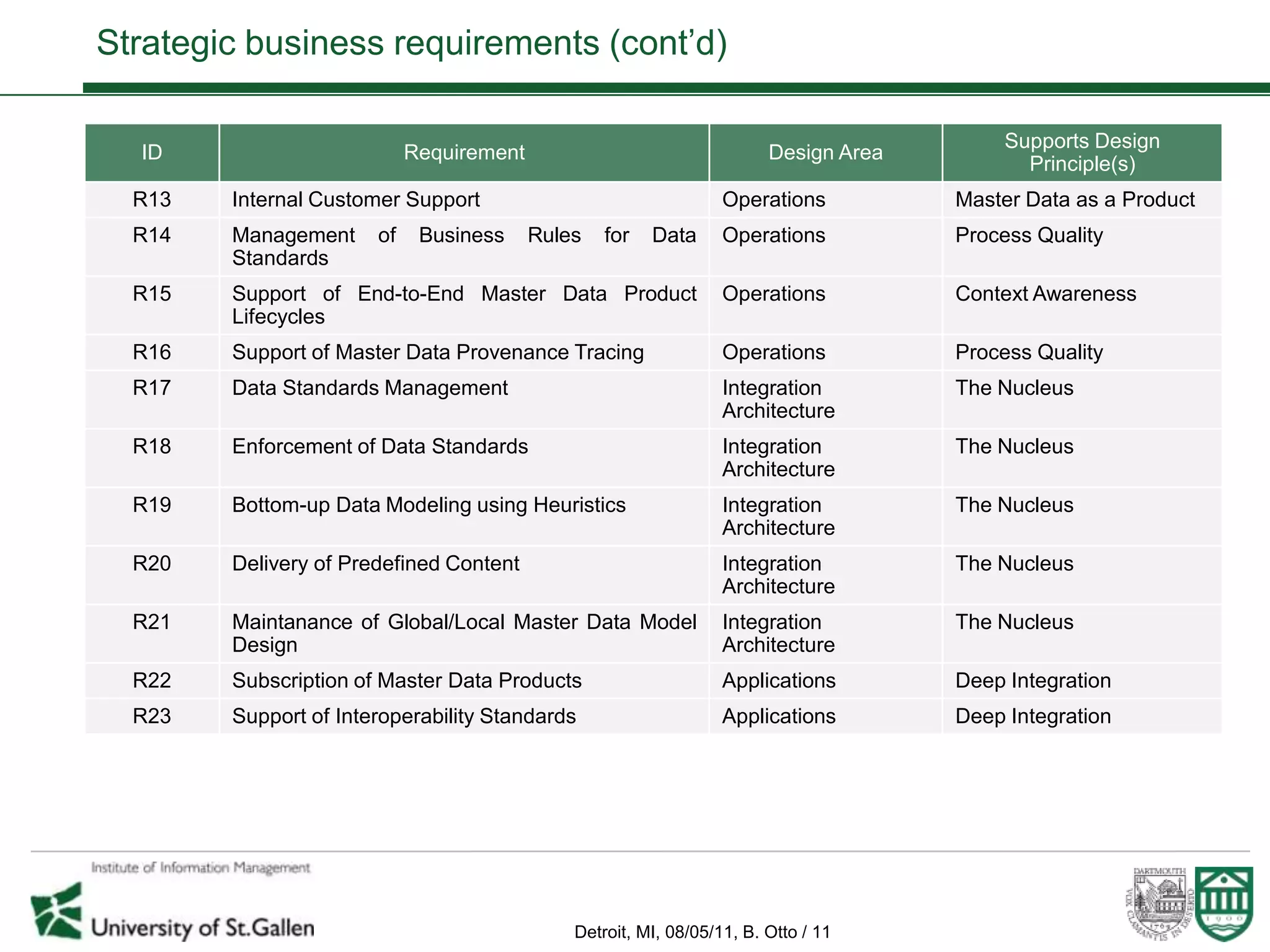
Strategic business requirements (cont’d)

                                                                                           Supports Design
  ID                        Requirement                                 Design Area
                                                                                             Principle(s)
  R13   Internal Customer Support                                 Operations          Master Data as a Product
  R14   Management     of    Business     Rules   for   Data      Operations          Process Quality
        Standards
  R15   Support of End-to-End Master Data Product                 Operations          Context Awareness
        Lifecycles
  R16   Support of Master Data Provenance Tracing                 Operations          Process Quality
  R17   Data Standards Management                                 Integration         The Nucleus
                                                                  Architecture
  R18   Enforcement of Data Standards                             Integration         The Nucleus
                                                                  Architecture
  R19   Bottom-up Data Modeling using Heuristics                  Integration         The Nucleus
                                                                  Architecture
  R20   Delivery of Predefined Content                            Integration         The Nucleus
                                                                  Architecture
  R21   Maintanance of Global/Local Master Data Model             Integration         The Nucleus
        Design                                                    Architecture
  R22   Subscription of Master Data Products                      Applications        Deep Integration
  R23   Support of Interoperability Standards                     Applications        Deep Integration


                                              Detroit, MI, 08/05/11, B. Otto / 11
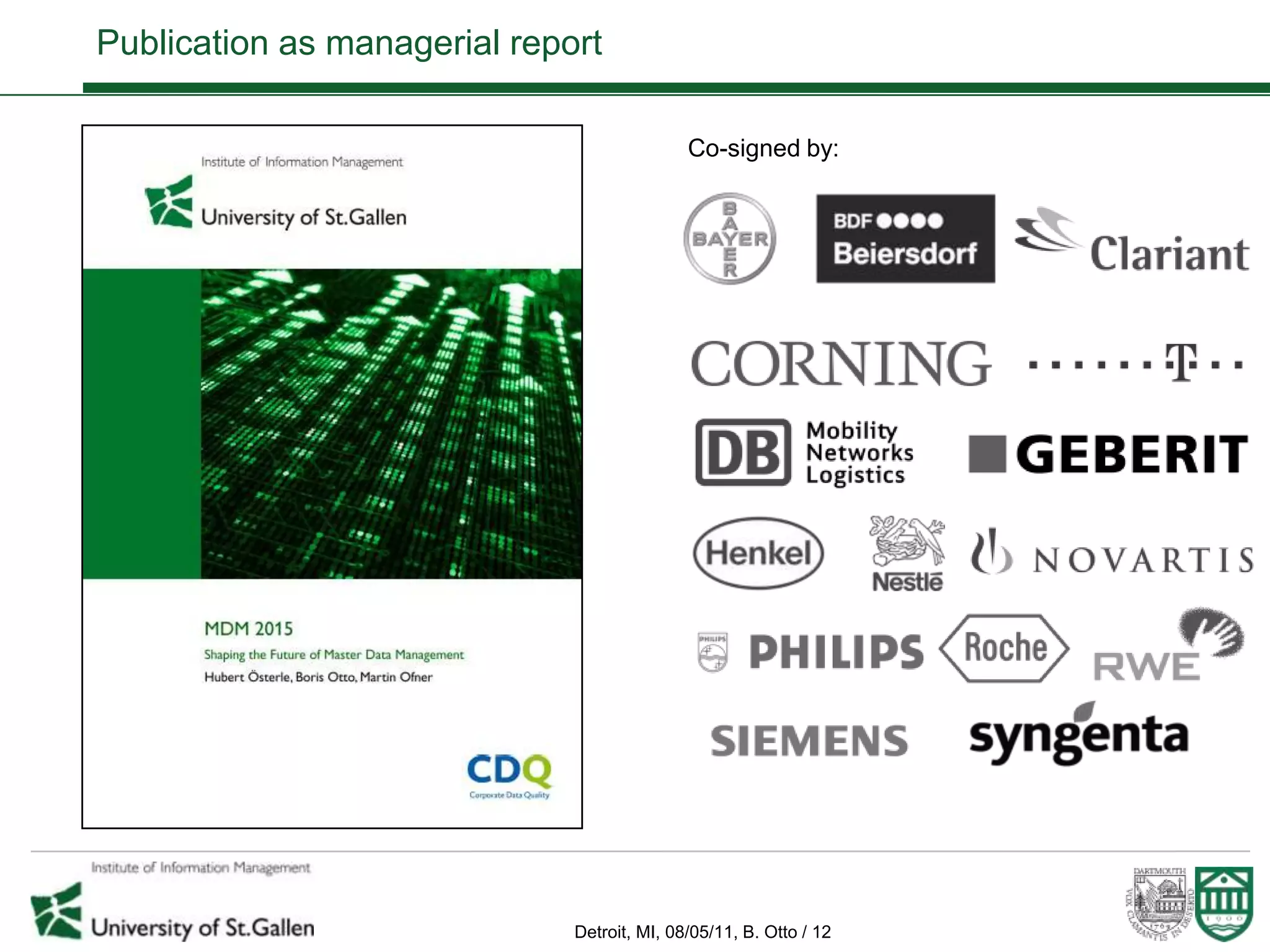
Publication as managerial report

                                             Co-signed by:


                              Detroit, MI, 08/05/11, B. Otto / 12
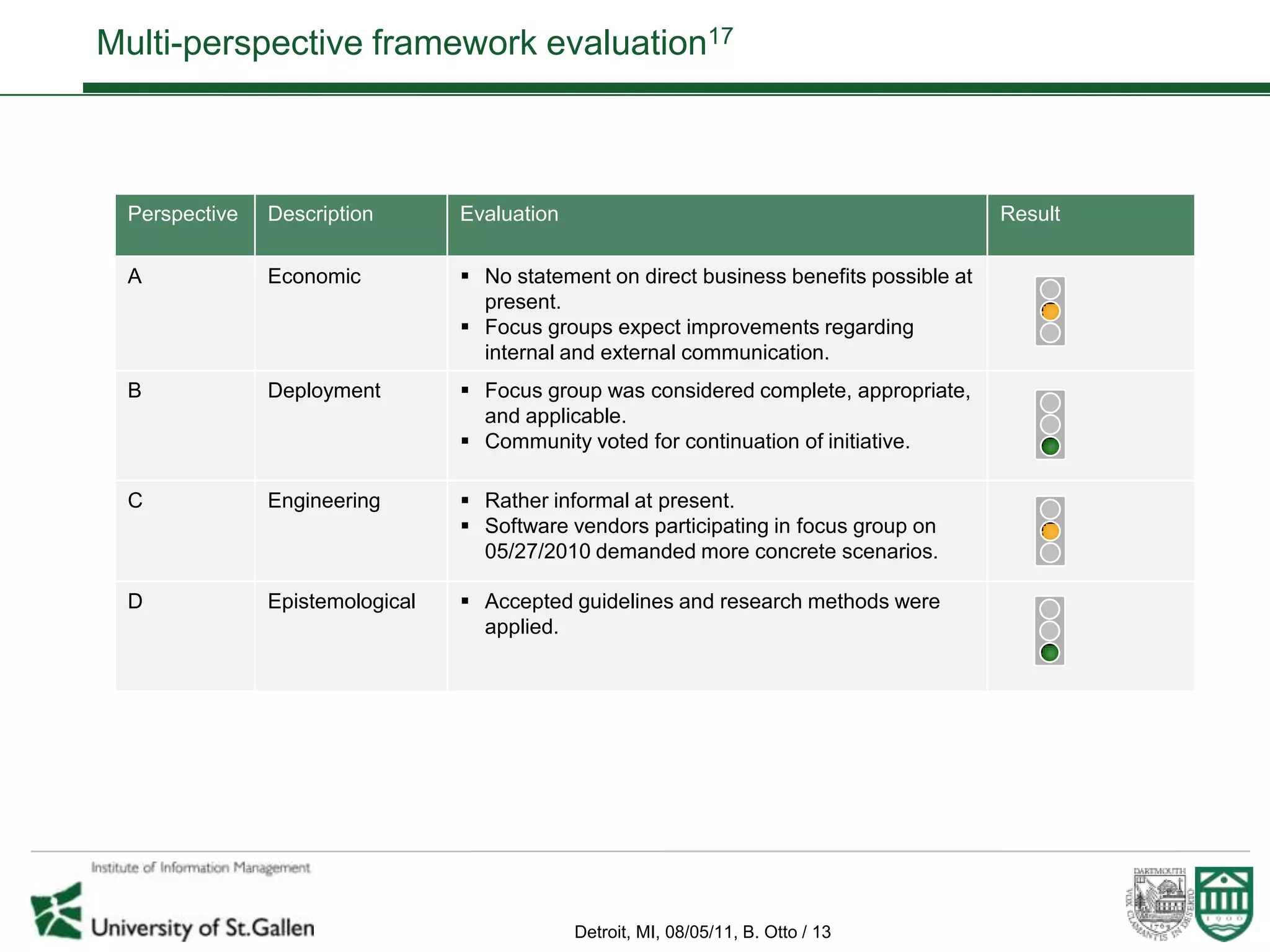
Multi-perspective framework evaluation17


 Perspective   Description       Evaluation                                               Result

 A             Economic           No statement on direct business benefits possible at
                                   present.
                                  Focus groups expect improvements regarding
                                   internal and external communication.
 B             Deployment         Focus group was considered complete, appropriate,
                                   and applicable.
                                  Community voted for continuation of initiative.

 C             Engineering        Rather informal at present.
                                  Software vendors participating in focus group on
                                   05/27/2010 demanded more concrete scenarios.

 D             Epistemological    Accepted guidelines and research methods were
                                   applied.


                                              Detroit, MI, 08/05/11, B. Otto / 13
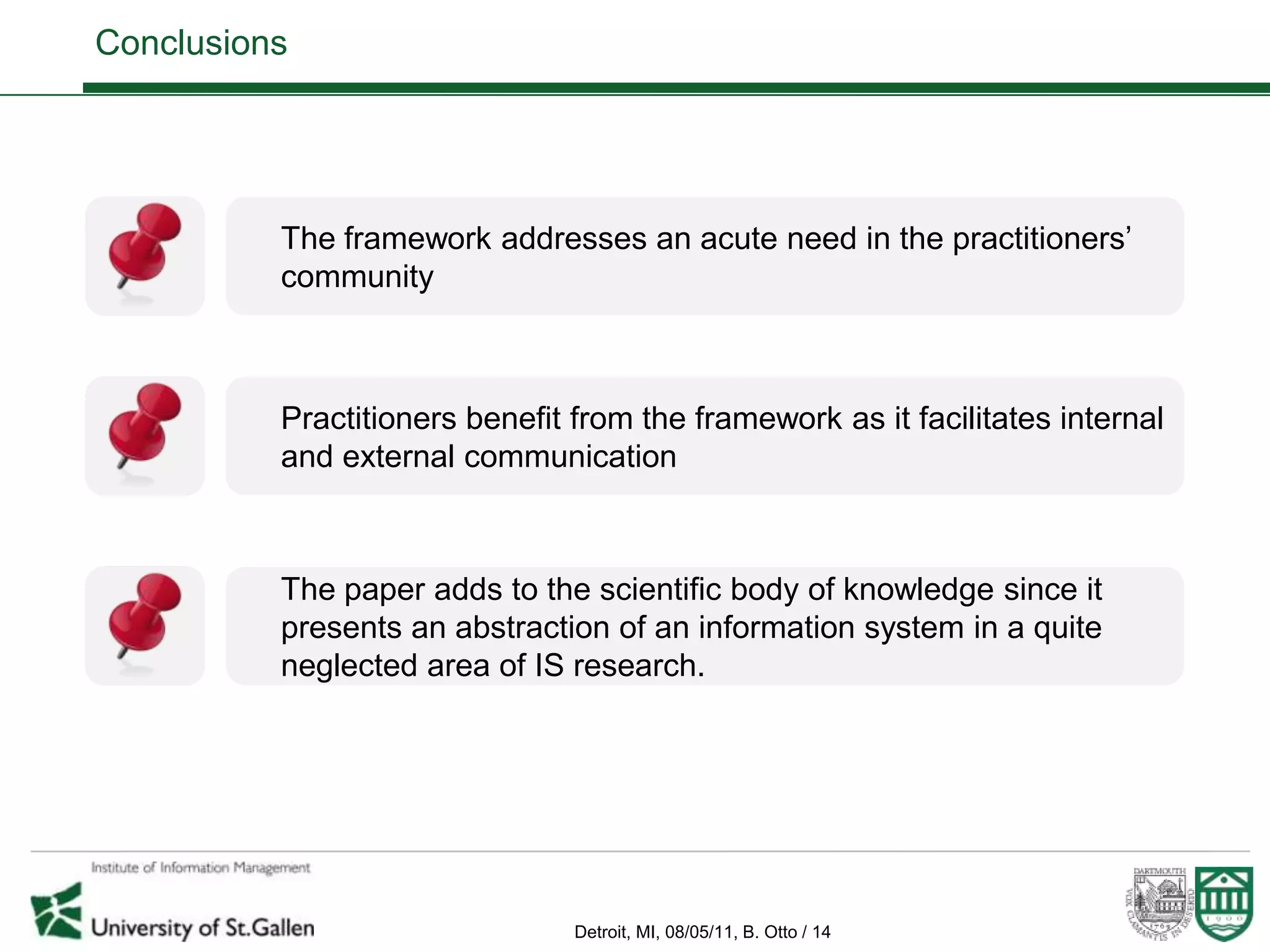
Conclusions


          The framework addresses an acute need in the practitioners’
          community


          Practitioners benefit from the framework as it facilitates internal
          and external communication


          The paper adds to the scientific body of knowledge since it
          presents an abstraction of an information system in a quite
          neglected area of IS research.


                                Detroit, MI, 08/05/11, B. Otto / 14
Contact


Dr.-Ing. Boris Otto

University of St. Gallen, Institute of Information Management
Tuck School of Business at Dartmouth College

Boris.Otto@unisg.ch
Boris.Otto@tuck.dartmouth.edu

+1 603 646 8991


                                  Detroit, MI, 08/05/11, B. Otto / 15
Appendix


   Endnotes


               Detroit, MI, 08/05/11, B. Otto / 16
Endnotes


1)    Friedman, T. "Q&A: Common Questions on Data Integration and Data Quality From Gartner's MDM Summit",
      Gartner, Inc., Stamford, CT.
2)    Smith, H.A. and McKeen, J.D. "Developments in Practice XXX: Master Data Management: Salvation or Snake Oil?”
      Communications of the AIS (23:4) 2008, pp 63-72.
3)    Ibid.
4)    Karel, R. "Introducing Master Data Management", Forester Research, Cambridge, MA.
5)    Loshin, D. Master Data Management Morgan Kaufmann, Burlington, MA, 2008.
6)    Dreibelbis, A., Hechler, E., Milman, I., Oberhofer, M., van Run, P., and Wolfson, D. Enterprise Master Data
      Management: An SOA Approach to Managing Core Information Pearson Education, Boston, MA, 2008.
7)    Loshin, D. Master Data Management Morgan Kaufmann, Burlington, MA, 2008.
8)    Loser, C., Legner, C., and Gizanis, D. "Master Data Management for Collaborative Service Processes", International
      Conference on Service Systems and Service Management, Research Center for Contemporary Management,
      Tsinghua University, 2004.
9)    Otto, B. and Schmidt, A. "Enterprise Master Data Architecture: Design Decisions and Options", in: Proceedings of
      the 15th International Conference on Information Quality (ICIQ-2010), Little Rock, USA, 2010.
10)   Radcliffe, J. "Magic Quadrant for Master Data Management of Customer Data", G00206031, Gartner, Inc., Stamford,
      CT.
11)   White, A. "Magic Quadrant for Master Data Management of Product Data", G00205921, Gartner, Inc., Stamford, CT.
12)   Peffers, K., Tuunanen, T., Rothenberger, M.A., and Chatterjee, S. "A Design Science Research Methodology for
      Information Systems Research", Journal of Management Information Systems (24:3) 2008, pp 45-77.
13)   Meuser, M. and Nagel, U. "Expertenwissen und Experteninterview", in: Expertenwissen. Die institutionelle
      Kompetenz zur Konstruktion von Wirklichkeit, R. Hitzler, A. Honer and C. Maeder (eds.), Westdeutscher Verlag,
      Opladen, 1994, pp. 180-192.


                                                   Detroit, MI, 08/05/11, B. Otto / 17
Endnotes


14) Weisbord, M. Discovering Common Ground: How Future Search Conferences Bring People Together to Achieve
    Breakthrough Innovation, Empowerment, Shared Vision, and Collaborative Action Berrett-Koehler, San Francisco,
    1992.
15) Schütte, R. Grundsätze ordnungsmässiger Referenzmodellierung: Konstruktion konfigurations- und
    anpassungsorientierter Modelle Gabler, Wiesbaden, Germany, 1998.
16) Morgan, D.L. and Krueger, R.A. "When to use Focus Groups and why?" in: Successful Focus Groups, D.L. Morgan
    (ed.), Sage, Newbury Park, California, 1993, pp. 3-19.
17) Frank, U. "Evaluation of Reference Models", in: Reference Modeling for Business Systems Analysis, P. Fettke and
    P. Loos (eds.), Idea Group, Hershey, Pennsylvania et al., 2007, pp. 118-139.


                                                 Detroit, MI, 08/05/11, B. Otto / 18

Strategic Business Requirements for Master Data Management Systems

  • 1.
    Strategic Business Requirementsfor Master Data Management Systems Boris Otto, Martin Ofner Detroit, IL, August 5, 2011 University of St. Gallen, Institute of Information Management Tuck School of Business at Dartmouth College
  • 2.
    Agenda 1. Motivation andProblem Statement 2. Background 3. Research Approach 4. Design Principles and Business Requirements 5. Evaluation 6. Conclusion Detroit, MI, 08/05/11, B. Otto / 2
  • 3.
    The initial situationin practice User Uncertainty1 Diverging Expectations ■ “What is the proper sequence of “We are flooded by invitations from MDM activities in support of MDM? Must we software vendors to sit together and let have solid data integration and data them present their solutions, which are quality practices and architectures in always supposed to be the solution to all place before dealing with MDM?” our problems. When we meet, it’s always ■ “Most of our current data integration the same: They present something we requirements are batch-oriented in aren’t looking for. Then we tell them our nature, as we work to physically understanding of the world and what our consolidate silos of master data. What real requirements are -- what in return they types of packaged data integration do not want or cannot share. And in the tools will be most relevant for our end, everybody goes his own way, highly purposes?” frustrated because they couldn’t sell their ■ “Has market consolidation already product, we didn’t get an answer to our reached the point where the advantages problems, and both of us spent time in of single-vendor stacks for MDM vain.” outweigh the advantages of a best-of- breed strategy?” ■ What are strategic business requirements to be met by MDM systems? ■ How can these requirements be framed to support communication between user companies and software vendors? Detroit, MI, 08/05/11, B. Otto / 3
  • 4.
    Background: Master Dataand MDM Master Data Essential business entities a company’s business activities are based on (customers, suppliers, employees, products etc.)2 Master Data Management (MDM) All activities for creating, modifying or deleting a master data class, a master attribute, or a master data object.3 Aiming at providing master data of good quality (i.e. master data that is complete, accurate, timely, and well structured) for being used in business processes.4,5 Detroit, MI, 08/05/11, B. Otto / 4
  • 5.
    Background: MDM Systems MDM Research Foci Architecture Use Cases6,7 Market Surveys10,11 Patterns8,9 Analytical Leading System Operational Central System Repository Peer-to-peer Detroit, MI, 08/05/11, B. Otto / 5
  • 6.
    Research process accordingto the principles of Design Science Research12 ANALYSIS ■ Expert interviews13 (02/28/09) to identify and describe problem ■ “Future Search”14 activities (05/07 to 05/14/09) to define objectives of a solution DESIGN & DEMONSTRATION ■ “Future Search” activities to identify design principles ■ Reference modeling15 for framework design ■ Focus groups16 (06/24, 09/29, and 12/02/09) to demonstrate objectives and design principles EVALUATION ■ “Offline” expert evaluation (via email, 11/30 to 12/18/09) ■ Focus group evaluation (05/27/10) COMMUNICATION ■ Presentation to practitioners community (05/27/10) Q1/09 Q2/09 Q3/09 Q4/09 Q1/10 Q2/10 Q3/10 Q4/10 Detroit, MI, 08/05/11, B. Otto / 6
  • 7.
    Structure of theframework of strategic business requirements for MDM Business Context Shortcomings of Strategic MDM Use Current Solutions Cases Design Principles Strategic Business Requirements Framework Detroit, MI, 08/05/11, B. Otto / 7
  • 8.
    The initial situationin practice Current Shortcomings Use Cases ■ No downstream visibility of data ■ Poor business semantics management ■ Risk management and compliance ■ MDM and data quality management separated ■ Integrated customer management ■ “Stovepipe” approach for MDM architectures ■ Business process integration and ■ No consistent master data service approach harmonization ■ No predefined content ■ No “on the fly” mapping and matching ■ Reporting ■ Poor support of centralized management of decentralized/federated datasets ■ IT consolidation ■ No integrated business rules management ■ Poor support of distinction between “global” and “local” data ■ Poor support of compliance issues ■ Insufficient transition management Detroit, MI, 08/05/11, B. Otto / 8
  • 9.
    Design principles Master Data as a Product Deep Market for Integration Master Data Design Principles Process Subsidiarity Quality The Context- “Nucleus” awareness Detroit, MI, 08/05/11, B. Otto / 9
  • 10.
    Strategic business requirements Supports Design ID Requirement Design Area Principle(s) R1 Support of Master Data Product Descriptions Strategy Master Data as a Product R2 Sourcing of Master Data Products Strategy Market for Master Data R3 Integration of External Master Data Sources Strategy Market for Master Data R4 Quality Management of Master Data Products Controlling Process Quality and Services R5 Audit Management of Master Data Products and Controlling Process Quality Services R6 Management of Role Access Rights according to Organization Subsidiarity Data Governance Roles R7 Escalation Management Organization Subsidiarity R8 Support of Usage Monitoring of Master Data Operations Process Quality Products R9 Maintenance for Context-Aware Master Data Operations Context Awareness Products R10 Gauging of Master Data Product consumption Operations Process Quality R11 Requirements Engineering for Master Data Operations Master Data as a Product Products R12 Design and Maintenance of Global/Local Master Operations Process Quality Data Management Processes Detroit, MI, 08/05/11, B. Otto / 10
  • 11.
    Strategic business requirements(cont’d) Supports Design ID Requirement Design Area Principle(s) R13 Internal Customer Support Operations Master Data as a Product R14 Management of Business Rules for Data Operations Process Quality Standards R15 Support of End-to-End Master Data Product Operations Context Awareness Lifecycles R16 Support of Master Data Provenance Tracing Operations Process Quality R17 Data Standards Management Integration The Nucleus Architecture R18 Enforcement of Data Standards Integration The Nucleus Architecture R19 Bottom-up Data Modeling using Heuristics Integration The Nucleus Architecture R20 Delivery of Predefined Content Integration The Nucleus Architecture R21 Maintanance of Global/Local Master Data Model Integration The Nucleus Design Architecture R22 Subscription of Master Data Products Applications Deep Integration R23 Support of Interoperability Standards Applications Deep Integration Detroit, MI, 08/05/11, B. Otto / 11
  • 12.
    Publication as managerialreport Co-signed by: Detroit, MI, 08/05/11, B. Otto / 12
  • 13.
    Multi-perspective framework evaluation17 Perspective Description Evaluation Result A Economic  No statement on direct business benefits possible at present.  Focus groups expect improvements regarding internal and external communication. B Deployment  Focus group was considered complete, appropriate, and applicable.  Community voted for continuation of initiative. C Engineering  Rather informal at present.  Software vendors participating in focus group on 05/27/2010 demanded more concrete scenarios. D Epistemological  Accepted guidelines and research methods were applied. Detroit, MI, 08/05/11, B. Otto / 13
  • 14.
    Conclusions The framework addresses an acute need in the practitioners’ community Practitioners benefit from the framework as it facilitates internal and external communication The paper adds to the scientific body of knowledge since it presents an abstraction of an information system in a quite neglected area of IS research. Detroit, MI, 08/05/11, B. Otto / 14
  • 15.
    Contact Dr.-Ing. Boris Otto Universityof St. Gallen, Institute of Information Management Tuck School of Business at Dartmouth College Boris.Otto@unisg.ch Boris.Otto@tuck.dartmouth.edu +1 603 646 8991 Detroit, MI, 08/05/11, B. Otto / 15
  • 16.
    Appendix  Endnotes Detroit, MI, 08/05/11, B. Otto / 16
  • 17.
    Endnotes 1) Friedman, T. "Q&A: Common Questions on Data Integration and Data Quality From Gartner's MDM Summit", Gartner, Inc., Stamford, CT. 2) Smith, H.A. and McKeen, J.D. "Developments in Practice XXX: Master Data Management: Salvation or Snake Oil?” Communications of the AIS (23:4) 2008, pp 63-72. 3) Ibid. 4) Karel, R. "Introducing Master Data Management", Forester Research, Cambridge, MA. 5) Loshin, D. Master Data Management Morgan Kaufmann, Burlington, MA, 2008. 6) Dreibelbis, A., Hechler, E., Milman, I., Oberhofer, M., van Run, P., and Wolfson, D. Enterprise Master Data Management: An SOA Approach to Managing Core Information Pearson Education, Boston, MA, 2008. 7) Loshin, D. Master Data Management Morgan Kaufmann, Burlington, MA, 2008. 8) Loser, C., Legner, C., and Gizanis, D. "Master Data Management for Collaborative Service Processes", International Conference on Service Systems and Service Management, Research Center for Contemporary Management, Tsinghua University, 2004. 9) Otto, B. and Schmidt, A. "Enterprise Master Data Architecture: Design Decisions and Options", in: Proceedings of the 15th International Conference on Information Quality (ICIQ-2010), Little Rock, USA, 2010. 10) Radcliffe, J. "Magic Quadrant for Master Data Management of Customer Data", G00206031, Gartner, Inc., Stamford, CT. 11) White, A. "Magic Quadrant for Master Data Management of Product Data", G00205921, Gartner, Inc., Stamford, CT. 12) Peffers, K., Tuunanen, T., Rothenberger, M.A., and Chatterjee, S. "A Design Science Research Methodology for Information Systems Research", Journal of Management Information Systems (24:3) 2008, pp 45-77. 13) Meuser, M. and Nagel, U. "Expertenwissen und Experteninterview", in: Expertenwissen. Die institutionelle Kompetenz zur Konstruktion von Wirklichkeit, R. Hitzler, A. Honer and C. Maeder (eds.), Westdeutscher Verlag, Opladen, 1994, pp. 180-192. Detroit, MI, 08/05/11, B. Otto / 17
  • 18.
    Endnotes 14) Weisbord, M.Discovering Common Ground: How Future Search Conferences Bring People Together to Achieve Breakthrough Innovation, Empowerment, Shared Vision, and Collaborative Action Berrett-Koehler, San Francisco, 1992. 15) Schütte, R. Grundsätze ordnungsmässiger Referenzmodellierung: Konstruktion konfigurations- und anpassungsorientierter Modelle Gabler, Wiesbaden, Germany, 1998. 16) Morgan, D.L. and Krueger, R.A. "When to use Focus Groups and why?" in: Successful Focus Groups, D.L. Morgan (ed.), Sage, Newbury Park, California, 1993, pp. 3-19. 17) Frank, U. "Evaluation of Reference Models", in: Reference Modeling for Business Systems Analysis, P. Fettke and P. Loos (eds.), Idea Group, Hershey, Pennsylvania et al., 2007, pp. 118-139. Detroit, MI, 08/05/11, B. Otto / 18