ALI RAZA (MC14-303)
LIAQAT ALI (MC14-282)
RAZA AHMAD (MC14-)
MALIK AZEEM(MC14-279)
AHMAD RAZA(MC14-)
GROUP
FELLOWS
Health & Safety
Analysis
What Is Human Resource Management …??
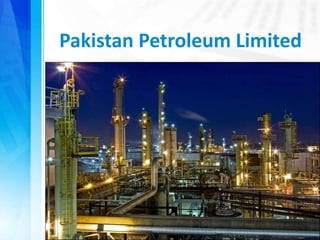
Pakistan Petroleum Limited
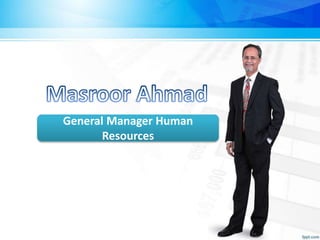
General Manager Human
Resources
Occupational safety and
health accidents are both
numerous and costly to
employer .as one important
example ,workplace violence
data show that more than 2
million nonfatal workplace
violence incidents are
reported annually in the
form of assaults ,robberies
,additionally ,some 13000
acts of domestic related
violence against women
occur in the workplace
annually
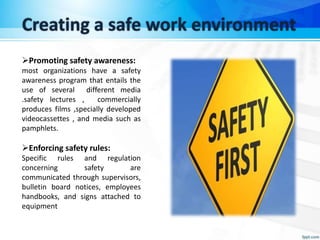
Creating a safe work environment
Promoting safety awareness:
most organizations have a safety
awareness program that entails the
use of several different media
.safety lectures , commercially
produces films ,specially developed
videocassettes , and media such as
pamphlets.
Enforcing safety rules:
Specific rules and regulation
concerning safety are
communicated through supervisors,
bulletin board notices, employees
handbooks, and signs attached to
equipment
Investigating and recording accidents:
Every accident , even those considered minor ,should be investigated by the
supervisor and a member of the safety committee .such an investigation may
determine the factor contributing to the accident and reveal what corrections are
needed to prevent it from happening again
Information technology and safety awareness and training
First aid, defensive driving, accident prevention techniques,
hazardous materials and emergency procedures.
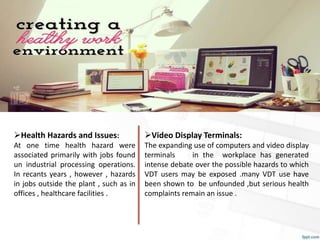
Creating A Healthy Work Environment
Health Hazards and Issues:
At one time health hazard were
associated primarily with jobs found
un industrial processing operations.
In recants years , however , hazards
in jobs outside the plant , such as in
offices , healthcare facilities .
Video Display Terminals:
The expanding use of computers and video display
terminals in the workplace has generated
intense debate over the possible hazards to which
VDT users may be exposed .many VDT use have
been shown to be unfounded ,but serious health
complaints remain an issue .
Chemical Hazard:
All hazardous chemical containers must be
labeled with the identity of the contents and
must be state any appropriate hazard waning
.The labels must be in English and employees
must be able to cross reference the label to the
Material Safety Data for the hazardous chemical.
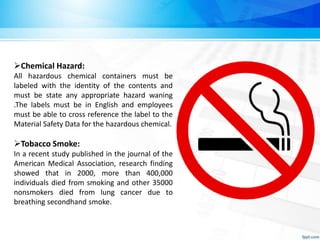
Tobacco Smoke:
In a recent study published in the journal of the
American Medical Association, research finding
showed that in 2000, more than 400,000
individuals died from smoking and other 35000
nonsmokers died from lung cancer due to
breathing secondhand smoke.
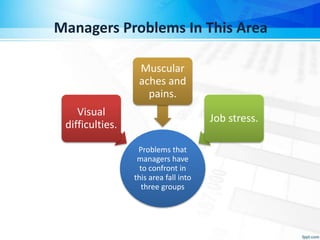
Managers Problems In This Area
Problems that
managers have
to confront in
this area fall into
three groups
Visual
difficulties.
Muscular
aches and
pains.
Job stress.
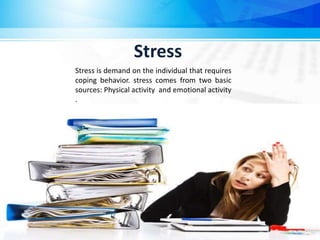
Stress is demand on the individual that requires
coping behavior. stress comes from two basic
sources: Physical activity and emotional activity
.
Stress
Easters:
• Positive stress that accompanies
achievement and exhilaration
Distress:
• Harmful stress characterized by a
loss of feelings of security and
adequacy.
Type Of Stress
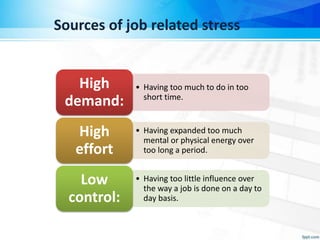
Sources of job related stress
• Having too much to do in too
short time.
High
demand:
• Having expanded too much
mental or physical energy over
too long a period.
High
effort
• Having too little influence over
the way a job is done on a day to
day basis.
Low
control:
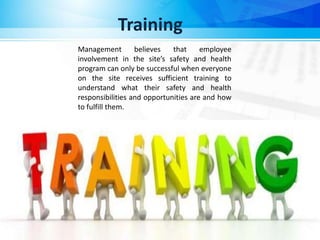
Training
Management believes that employee
involvement in the site’s safety and health
program can only be successful when everyone
on the site receives sufficient training to
understand what their safety and health
responsibilities and opportunities are and how
to fulfill them.
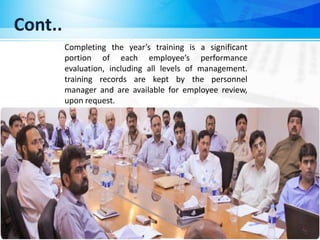
Completing the year’s training is a significant
portion of each employee’s performance
evaluation, including all levels of management.
training records are kept by the personnel
manager and are available for employee review,
upon request.
Cont..
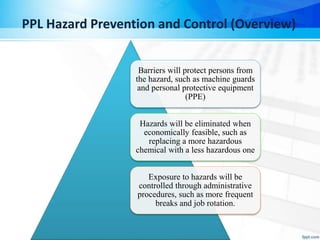
PPL Hazard Prevention and Control (Overview)
Barriers will protect persons from
the hazard, such as machine guards
and personal protective equipment
(PPE)
Hazards will be eliminated when
economically feasible, such as
replacing a more hazardous
chemical with a less hazardous one
Exposure to hazards will be
controlled through administrative
procedures, such as more frequent
breaks and job rotation.
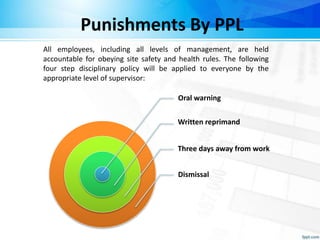
All employees, including all levels of management, are held
accountable for obeying site safety and health rules. The following
four step disciplinary policy will be applied to everyone by the
appropriate level of supervisor:
Punishments By PPL
Oral warning
Written reprimand
Three days away from work
Dismissal
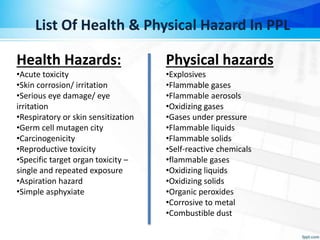
List Of Health & Physical Hazard In PPL
Health Hazards:
•Acute toxicity
•Skin corrosion/ irritation
•Serious eye damage/ eye
irritation
•Respiratory or skin sensitization
•Germ cell mutagen city
•Carcinogenicity
•Reproductive toxicity
•Specific target organ toxicity –
single and repeated exposure
•Aspiration hazard
•Simple asphyxiate
Physical hazards
•Explosives
•Flammable gases
•Flammable aerosols
•Oxidizing gases
•Gases under pressure
•Flammable liquids
•Flammable solids
•Self-reactive chemicals
•flammable gases
•Oxidizing liquids
•Oxidizing solids
•Organic peroxides
•Corrosive to metal
•Combustible dust
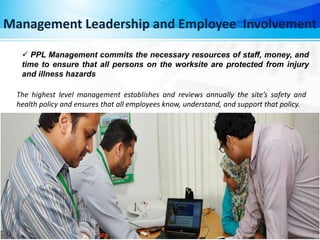
Management Leadership and Employee Involvement
 PPL Management commits the necessary resources of staff, money, and
time to ensure that all persons on the worksite are protected from injury
and illness hazards
The highest level management establishes and reviews annually the site’s safety and
health policy and ensures that all employees know, understand, and support that policy.
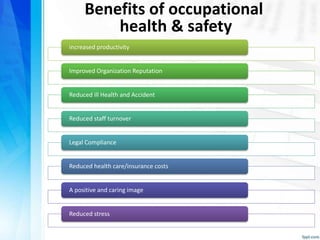
Benefits of occupational
health & safety
increased productivity
Improved Organization Reputation
Reduced ill Health and Accident
Reduced staff turnover
Legal Compliance
Reduced health care/insurance costs
A positive and caring image
Reduced stress
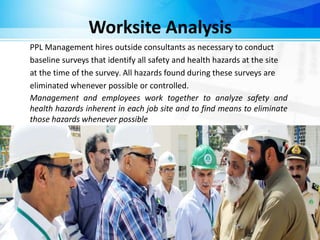
Worksite Analysis
PPL Management hires outside consultants as necessary to conduct
baseline surveys that identify all safety and health hazards at the site
at the time of the survey. All hazards found during these surveys are
eliminated whenever possible or controlled.
Management and employees work together to analyze safety and
health hazards inherent in each job site and to find means to eliminate
those hazards whenever possible
Medical services:
The objectives of the Medical Services Department are:
 To ensure employees are assigned appropriate duties.
 To provide medical care to occupationally injured.
 To provide emergency treatment.
 To assist in maintaining a healthful and safe work
environment.
 To provide free-of-cost quality healthcare.
Employee Health Services Provides By PPL
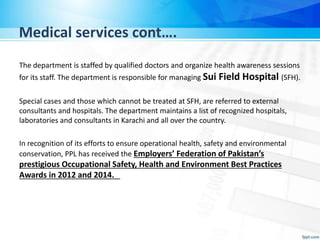
Medical services cont….
The department is staffed by qualified doctors and organize health awareness sessions
for its staff. The department is responsible for managing Sui Field Hospital (SFH).
Special cases and those which cannot be treated at SFH, are referred to external
consultants and hospitals. The department maintains a list of recognized hospitals,
laboratories and consultants in Karachi and all over the country.
In recognition of its efforts to ensure operational health, safety and environmental
conservation, PPL has received the Employers’ Federation of Pakistan’s
prestigious Occupational Safety, Health and Environment Best Practices
Awards in 2012 and 2014.
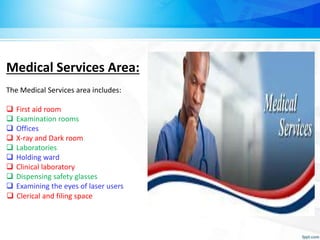
Medical Services Area:
The Medical Services area includes:
 First aid room
 Examination rooms
 Offices
 X-ray and Dark room
 Laboratories
 Holding ward
 Clinical laboratory
 Dispensing safety glasses
 Examining the eyes of laser users
 clerical and filing space Clerical and filing space
On Site Medical Aid:
The On Site Medical Services Program is under the leadership of physicians, who are available to
respond to medical emergencies. First aid is available all the time from fire department. The
clinical laboratory is staffed by licensed medical technologists. Physical examinations are
done by contract physicians and [Company] physicians. The contract physicians are not
employees of the Company. Nurses are on duty from 7:30 a.m. until 5:00p.m on workdays.
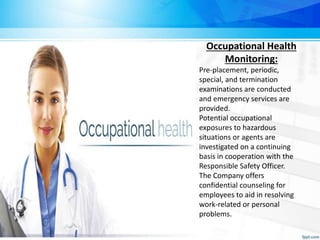
Occupational Health
Monitoring:
Pre-placement, periodic,
special, and termination
examinations are conducted
and emergency services are
provided.
Potential occupational
exposures to hazardous
situations or agents are
investigated on a continuing
basis in cooperation with the
Responsible Safety Officer.
The Company offers
confidential counseling for
employees to aid in resolving
work-related or personal
problems.
Safety Examinations:
A complete medical examination is required of all new and temporary employees hired for
periods exceeding 3 months.. The purpose of this examination is to ascertain whether the
physical and mental fitness of the employee is adequate for the requirements of the specific
position.
A complete examination include:
 Family and personal medical history
 Physical examination
 Vision tests
 Hearing tests
 Measurement of pulmonary function
 Electrocardiograms for employees 40 years of age or older,
 Chest x-ray
 blood count
 Blood chemistries
 Urinalysis
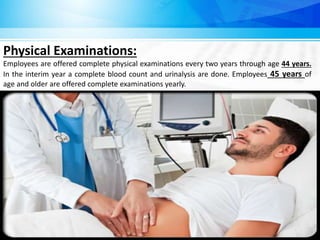
Physical Examinations:
Employees are offered complete physical examinations every two years through age 44 years.
In the interim year a complete blood count and urinalysis are done. Employees 45 years of
age and older are offered complete examinations yearly.
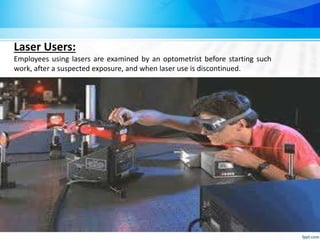
Laser Users:
Employees using lasers are examined by an optometrist before starting such
work, after a suspected exposure, and when laser use is discontinued.
General Safety Precautions
Sample radiation scanning will be required
Smoking will not be permitted on project property
Eating and drinking will be restricted to areas that are
designated.
Work boots with steel toe and shank shall be worn during all
field work activities
Layers of clothing are recommended to prevent hypothermia.
Wearing loose clothing around operating machinery
Health and Safety Analysis

Health and Safety Analysis

  • 3.
    ALI RAZA (MC14-303) LIAQATALI (MC14-282) RAZA AHMAD (MC14-) MALIK AZEEM(MC14-279) AHMAD RAZA(MC14-) GROUP FELLOWS
  • 4.
  • 5.
    What Is HumanResource Management …??
  • 6.
  • 7.
  • 8.
    Occupational safety and healthaccidents are both numerous and costly to employer .as one important example ,workplace violence data show that more than 2 million nonfatal workplace violence incidents are reported annually in the form of assaults ,robberies ,additionally ,some 13000 acts of domestic related violence against women occur in the workplace annually
  • 9.
    Creating a safework environment Promoting safety awareness: most organizations have a safety awareness program that entails the use of several different media .safety lectures , commercially produces films ,specially developed videocassettes , and media such as pamphlets. Enforcing safety rules: Specific rules and regulation concerning safety are communicated through supervisors, bulletin board notices, employees handbooks, and signs attached to equipment
  • 10.
    Investigating and recordingaccidents: Every accident , even those considered minor ,should be investigated by the supervisor and a member of the safety committee .such an investigation may determine the factor contributing to the accident and reveal what corrections are needed to prevent it from happening again Information technology and safety awareness and training First aid, defensive driving, accident prevention techniques, hazardous materials and emergency procedures.
  • 11.
    Creating A HealthyWork Environment Health Hazards and Issues: At one time health hazard were associated primarily with jobs found un industrial processing operations. In recants years , however , hazards in jobs outside the plant , such as in offices , healthcare facilities . Video Display Terminals: The expanding use of computers and video display terminals in the workplace has generated intense debate over the possible hazards to which VDT users may be exposed .many VDT use have been shown to be unfounded ,but serious health complaints remain an issue .
  • 12.
    Chemical Hazard: All hazardouschemical containers must be labeled with the identity of the contents and must be state any appropriate hazard waning .The labels must be in English and employees must be able to cross reference the label to the Material Safety Data for the hazardous chemical. Tobacco Smoke: In a recent study published in the journal of the American Medical Association, research finding showed that in 2000, more than 400,000 individuals died from smoking and other 35000 nonsmokers died from lung cancer due to breathing secondhand smoke.
  • 13.
    Managers Problems InThis Area Problems that managers have to confront in this area fall into three groups Visual difficulties. Muscular aches and pains. Job stress.
  • 14.
    Stress is demandon the individual that requires coping behavior. stress comes from two basic sources: Physical activity and emotional activity . Stress
  • 15.
    Easters: • Positive stressthat accompanies achievement and exhilaration Distress: • Harmful stress characterized by a loss of feelings of security and adequacy. Type Of Stress
  • 16.
    Sources of jobrelated stress • Having too much to do in too short time. High demand: • Having expanded too much mental or physical energy over too long a period. High effort • Having too little influence over the way a job is done on a day to day basis. Low control:
  • 17.
    Training Management believes thatemployee involvement in the site’s safety and health program can only be successful when everyone on the site receives sufficient training to understand what their safety and health responsibilities and opportunities are and how to fulfill them.
  • 18.
    Completing the year’straining is a significant portion of each employee’s performance evaluation, including all levels of management. training records are kept by the personnel manager and are available for employee review, upon request. Cont..
  • 19.
    PPL Hazard Preventionand Control (Overview) Barriers will protect persons from the hazard, such as machine guards and personal protective equipment (PPE) Hazards will be eliminated when economically feasible, such as replacing a more hazardous chemical with a less hazardous one Exposure to hazards will be controlled through administrative procedures, such as more frequent breaks and job rotation.
  • 20.
    All employees, includingall levels of management, are held accountable for obeying site safety and health rules. The following four step disciplinary policy will be applied to everyone by the appropriate level of supervisor: Punishments By PPL Oral warning Written reprimand Three days away from work Dismissal
  • 21.
    List Of Health& Physical Hazard In PPL Health Hazards: •Acute toxicity •Skin corrosion/ irritation •Serious eye damage/ eye irritation •Respiratory or skin sensitization •Germ cell mutagen city •Carcinogenicity •Reproductive toxicity •Specific target organ toxicity – single and repeated exposure •Aspiration hazard •Simple asphyxiate Physical hazards •Explosives •Flammable gases •Flammable aerosols •Oxidizing gases •Gases under pressure •Flammable liquids •Flammable solids •Self-reactive chemicals •flammable gases •Oxidizing liquids •Oxidizing solids •Organic peroxides •Corrosive to metal •Combustible dust
  • 22.
    Management Leadership andEmployee Involvement  PPL Management commits the necessary resources of staff, money, and time to ensure that all persons on the worksite are protected from injury and illness hazards The highest level management establishes and reviews annually the site’s safety and health policy and ensures that all employees know, understand, and support that policy.
  • 23.
    Benefits of occupational health& safety increased productivity Improved Organization Reputation Reduced ill Health and Accident Reduced staff turnover Legal Compliance Reduced health care/insurance costs A positive and caring image Reduced stress
  • 24.
    Worksite Analysis PPL Managementhires outside consultants as necessary to conduct baseline surveys that identify all safety and health hazards at the site at the time of the survey. All hazards found during these surveys are eliminated whenever possible or controlled. Management and employees work together to analyze safety and health hazards inherent in each job site and to find means to eliminate those hazards whenever possible
  • 25.
    Medical services: The objectivesof the Medical Services Department are:  To ensure employees are assigned appropriate duties.  To provide medical care to occupationally injured.  To provide emergency treatment.  To assist in maintaining a healthful and safe work environment.  To provide free-of-cost quality healthcare. Employee Health Services Provides By PPL
  • 26.
    Medical services cont…. Thedepartment is staffed by qualified doctors and organize health awareness sessions for its staff. The department is responsible for managing Sui Field Hospital (SFH). Special cases and those which cannot be treated at SFH, are referred to external consultants and hospitals. The department maintains a list of recognized hospitals, laboratories and consultants in Karachi and all over the country. In recognition of its efforts to ensure operational health, safety and environmental conservation, PPL has received the Employers’ Federation of Pakistan’s prestigious Occupational Safety, Health and Environment Best Practices Awards in 2012 and 2014.
  • 27.
    Medical Services Area: TheMedical Services area includes:  First aid room  Examination rooms  Offices  X-ray and Dark room  Laboratories  Holding ward  Clinical laboratory  Dispensing safety glasses  Examining the eyes of laser users  clerical and filing space Clerical and filing space
  • 28.
    On Site MedicalAid: The On Site Medical Services Program is under the leadership of physicians, who are available to respond to medical emergencies. First aid is available all the time from fire department. The clinical laboratory is staffed by licensed medical technologists. Physical examinations are done by contract physicians and [Company] physicians. The contract physicians are not employees of the Company. Nurses are on duty from 7:30 a.m. until 5:00p.m on workdays.
  • 29.
    Occupational Health Monitoring: Pre-placement, periodic, special,and termination examinations are conducted and emergency services are provided. Potential occupational exposures to hazardous situations or agents are investigated on a continuing basis in cooperation with the Responsible Safety Officer. The Company offers confidential counseling for employees to aid in resolving work-related or personal problems.
  • 30.
    Safety Examinations: A completemedical examination is required of all new and temporary employees hired for periods exceeding 3 months.. The purpose of this examination is to ascertain whether the physical and mental fitness of the employee is adequate for the requirements of the specific position. A complete examination include:  Family and personal medical history  Physical examination  Vision tests  Hearing tests  Measurement of pulmonary function  Electrocardiograms for employees 40 years of age or older,  Chest x-ray  blood count  Blood chemistries  Urinalysis
  • 31.
    Physical Examinations: Employees areoffered complete physical examinations every two years through age 44 years. In the interim year a complete blood count and urinalysis are done. Employees 45 years of age and older are offered complete examinations yearly.
  • 32.
    Laser Users: Employees usinglasers are examined by an optometrist before starting such work, after a suspected exposure, and when laser use is discontinued.
  • 33.
    General Safety Precautions Sampleradiation scanning will be required Smoking will not be permitted on project property Eating and drinking will be restricted to areas that are designated. Work boots with steel toe and shank shall be worn during all field work activities Layers of clothing are recommended to prevent hypothermia. Wearing loose clothing around operating machinery