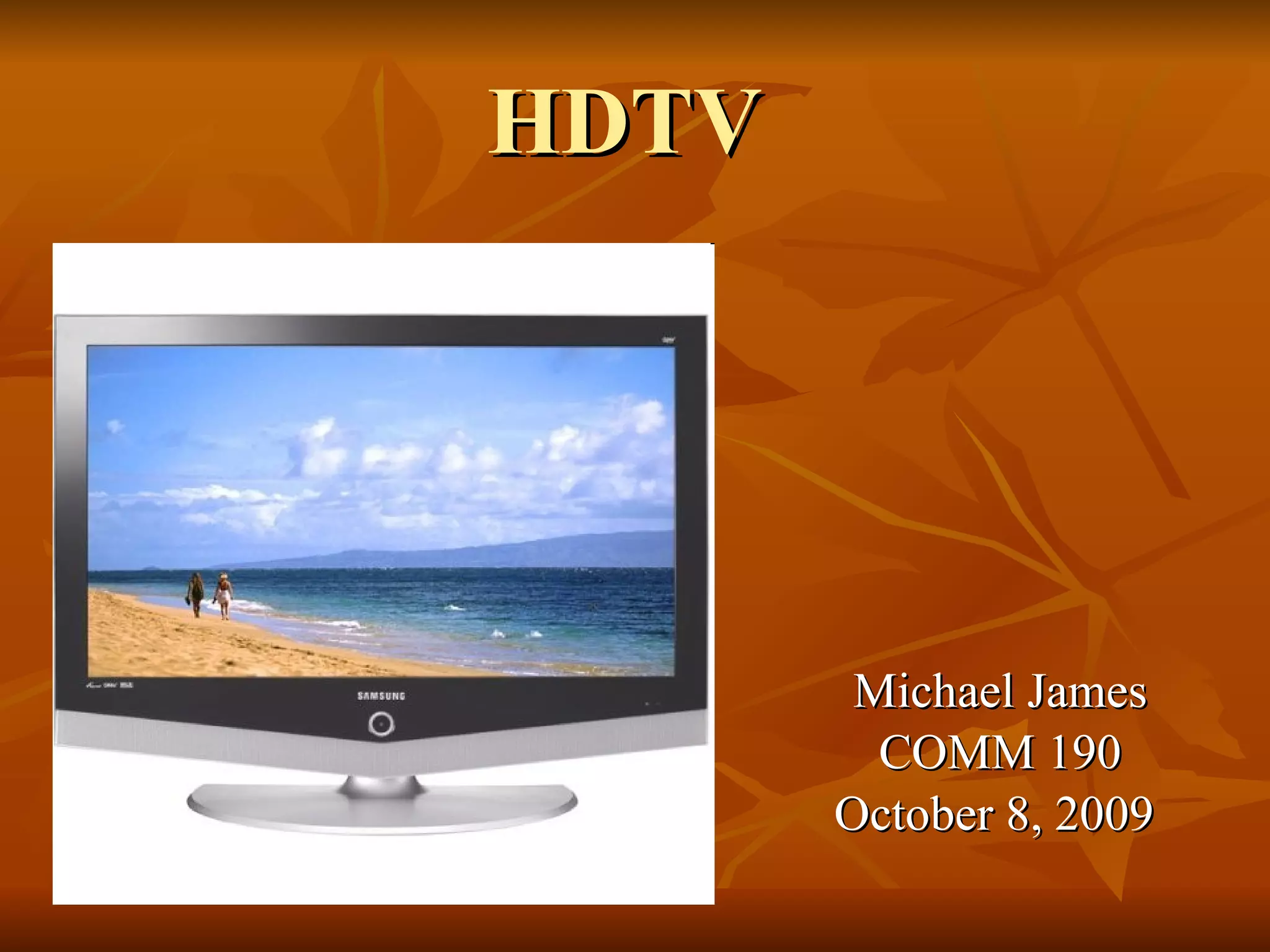
HDTV Michael James COMM 190 October 8, 2009
Brief History HDTV technology was introduced in the United States in the 1990s by the Digital HDTV Grand Alliance, a group of television companies and MIT. Field testing of HDTV at 199 sites in the United States was completed August 14, 1994.  The first public HDTV broadcast in the United States occurred on July 23, 1996 when the Raleigh, NC television station WRAL-HD began broadcasting from the existing tower of WRAL-TV south-east of Raleigh, winning a race to be first with the HD Model Station in Washington, D.C., which began broadcasting July 31, 1996.
Notation HDTV broadcast systems are identified with three major parameters: Frame size  in pixels is defined as  number of horizontal pixels × number of vertical pixels , for example  1280 × 720  or  1920 × 1080 . Often the number of horizontal pixels is implied from context and is omitted.  Scanning system  is identified with the letter  p  for progressive scanning or  i  for interlaced scanning.  Frame rate  is identified as number of video frames per second. For interlaced systems an alternative form of specifying number of fields per second is often used.
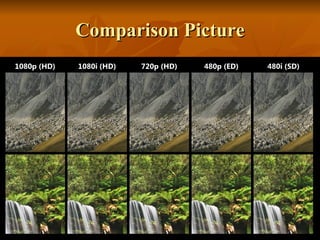
Comparison Picture
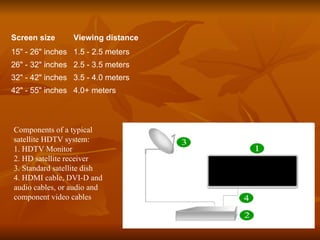
Components of a typical satellite HDTV system: 1. HDTV Monitor 2. HD satellite receiver 3. Standard satellite dish 4. HDMI cable, DVI-D and audio cables, or audio and component video cables  4.0+ meters 42" - 55" inches 3.5 - 4.0 meters 32" - 42" inches 2.5 - 3.5 meters 26" - 32" inches 1.5 - 2.5 meters 15" - 26" inches Viewing distance Screen size
HDTV in Sports Vizio is one of the leading LCD/HDTV brands, and their relationship with ESPN has launched them into the forefront of putting sports events in HDTV http://www.youtube.com/watch?v=IYkcjiWV0Z4 YouTube now allows users to post videos in high quality, similar to high definition, making it possible to watch highlights and other clips with more clarity than ever http://www.hdsportsguide.com/  posts a daily schedule of games/matches you can find in HD
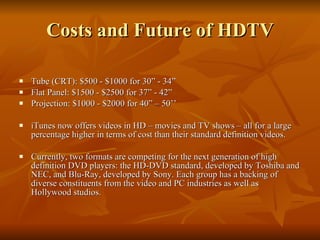
Costs and Future of HDTV Tube (CRT): $500 - $1000 for 30” - 34”  Flat Panel: $1500 - $2500 for 37” - 42”  Projection: $1000 - $2000 for 40” – 50’’ iTunes now offers videos in HD – movies and TV shows – all for a large percentage higher in terms of cost than their standard definition videos. Currently, two formats are competing for the next generation of high definition DVD players: the HD-DVD standard, developed by Toshiba and NEC, and Blu-Ray, developed by Sony. Each group has a backing of diverse constituents from the video and PC industries as well as Hollywood studios.
 

HDTV PP

  • 1.
    HDTV Michael JamesCOMM 190 October 8, 2009
  • 2.
    Brief History HDTVtechnology was introduced in the United States in the 1990s by the Digital HDTV Grand Alliance, a group of television companies and MIT. Field testing of HDTV at 199 sites in the United States was completed August 14, 1994. The first public HDTV broadcast in the United States occurred on July 23, 1996 when the Raleigh, NC television station WRAL-HD began broadcasting from the existing tower of WRAL-TV south-east of Raleigh, winning a race to be first with the HD Model Station in Washington, D.C., which began broadcasting July 31, 1996.
  • 3.
    Notation HDTV broadcastsystems are identified with three major parameters: Frame size in pixels is defined as number of horizontal pixels × number of vertical pixels , for example 1280 × 720 or 1920 × 1080 . Often the number of horizontal pixels is implied from context and is omitted. Scanning system is identified with the letter p for progressive scanning or i for interlaced scanning. Frame rate is identified as number of video frames per second. For interlaced systems an alternative form of specifying number of fields per second is often used.
  • 4.
  • 5.
    Components of atypical satellite HDTV system: 1. HDTV Monitor 2. HD satellite receiver 3. Standard satellite dish 4. HDMI cable, DVI-D and audio cables, or audio and component video cables 4.0+ meters 42" - 55" inches 3.5 - 4.0 meters 32" - 42" inches 2.5 - 3.5 meters 26" - 32" inches 1.5 - 2.5 meters 15" - 26" inches Viewing distance Screen size
  • 6.
    HDTV in SportsVizio is one of the leading LCD/HDTV brands, and their relationship with ESPN has launched them into the forefront of putting sports events in HDTV http://www.youtube.com/watch?v=IYkcjiWV0Z4 YouTube now allows users to post videos in high quality, similar to high definition, making it possible to watch highlights and other clips with more clarity than ever http://www.hdsportsguide.com/ posts a daily schedule of games/matches you can find in HD
  • 7.
    Costs and Futureof HDTV Tube (CRT): $500 - $1000 for 30” - 34” Flat Panel: $1500 - $2500 for 37” - 42” Projection: $1000 - $2000 for 40” – 50’’ iTunes now offers videos in HD – movies and TV shows – all for a large percentage higher in terms of cost than their standard definition videos. Currently, two formats are competing for the next generation of high definition DVD players: the HD-DVD standard, developed by Toshiba and NEC, and Blu-Ray, developed by Sony. Each group has a backing of diverse constituents from the video and PC industries as well as Hollywood studios.
  • 8.