Ultra HD and 4K
Outline










What is 4K?
How big is an Ultra HD TV?
Do I need an Ultra HD TV?
Can I buy an Ultra HD home cinema projector?
What is Super Hi-Vision?
Will Ultra HD ever be broadcast on TV?
Will Blu-ray support Ultra HD discs?
When will Ultra HD become standard?
What about Ultra HD for photographers?
What is 4K?




Technically speaking, 4K denotes a very specific
display resolution of 4096 x 2160. This is the
resolution of all 4K recordings, though many
people use 4K to refer to any display resolution
that has roughly 4000 horizontal pixels.
ltra HD TVs have a resolution slightly lower
than that - 3840 x 2160. That's exactly four times
higher than the full HD resolution of 1920 x
1080.
How big is an Ultra HD TV?


So far it's been monster Ultra HD TVs all the
way, with Sony's 84-inch 84X9005 and LG's
84-inch 84LM960V leading the way alongside
the now-a-bit-old Toshiba 55ZL2, a 55-inch
TV whose real claim is glasses-free 3D TV
(though there's more where that came from, this
time from Philips).
Do I need an Ultra HD TV?




High definition comes in two flavours: 720p (HD
ready) and 1080p (Full HD), both of which offer more
picture information than the standard definition
formats. The more pixels that make up an image, the
more detail you see - and the smoother the appearance
of curved and diagonal lines. Ultra HD just takes that
on to the next level.
A high pixel count also enables images to go larger
before they break up, which suits the trend to bigger
TVs. Ultra HD is already making big inroads into the
world of digital cinema; almost all major Hollywood
movies and TV shows are filmed in 4K - or even 5K.
Can I buy an Ultra HD home cinema
projector?


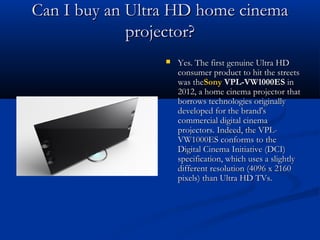
Yes. The first genuine Ultra HD
consumer product to hit the streets
was theSony VPL-VW1000ES in
2012, a home cinema projector that
borrows technologies originally
developed for the brand's
commercial digital cinema
projectors. Indeed, the VPLVW1000ES conforms to the
Digital Cinema Initiative (DCI)
specification, which uses a slightly
different resolution (4096 x 2160
pixels) than Ultra HD TVs.
What is Super Hi-Vision?


There's another spanner in the works in the shape of
Super Hi-Vision, an 8K format created by Japan's
national broadcaster NHK. It was trialled extensively at
the London 2012 Olympics by the BBC, but doesn't
appear to have much chance of becoming a bona fide
format just yet. It's certainly one to watch; at double the
frame rate of HD (at 120fps) and with a 7680 x 4320
pixel resolution (that's around 32 megapixels), Super
Hi-Vision demos have featured stunning 22.2 surround
sound, too, thanks to twin subwoofers each the size of
a small car.
Will Ultra HD ever be broadcast on
TV?




Technically it already is; Eutelsat
Communications launched the first
Ultra HD demo channel in Europe
in January 2013, on its
EUTELSAT 10A satellite. In the
UK, the BBC has plans to film
some documentaries with 4K
equipment in 2013, though it's
actually trialled Super Hi-Vision or 8K - broadcasting as recently as
the London Olympics.
Just as Planet Earth was one of the
first programmes to be shown in
HD, the BBC's Natural History
Unit have been handed the task of
filmingSurvival in Ultra HD.
Will Blu-ray support Ultra HD discs?





Probably, yes, thanks to that new compression codec called HEVC, though
the Blu-ray Disc Association (BDA) has yet to ratify anything.
The good news is that there is Ultra HD content already available in the
vaults of the Hollywood majors. Increasingly movies are mastered at 4K
resolution, both for commercial distribution and restoration projects.
Hollywood has also begun shooting movies in Ultra HD and beyond.
Peter Jackson's The Hobbit: An Unexpected Journey was shot on RED Epic
digital cameras that are capable of 5K resolution, while Sony's 4K-capable
F65 camera is commonly used in film and TV, too. Many US TV dramas are
already filmed with one of these cameras, including  Made In Jersey, Justified, Save
Me and Masters of Sex, according to The Hollywood Reporter, as well as ER,
Criminal Minds and Justified.
When will Ultra HD become standard?


The floors of CES 2013 were packed with
them, but it could be a difficult birth. With
arguments and a lack of industry standards on
displays, broadcast and playback of Ultra HD
material, the introduction of these cutting-edge
TVs will prove complex in the extreme.
What about Ultra HD for
photographers?




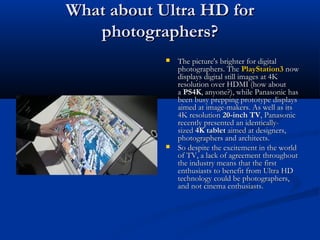
The picture's brighter for digital
photographers. The PlayStation3 now
displays digital still images at 4K
resolution over HDMI (how about
a PS4K, anyone?), while Panasonic has
been busy prepping prototype displays
aimed at image-makers. As well as its
4K resolution 20-inch TV, Panasonic
recently presented an identicallysized 4K tablet aimed at designers,
photographers and architects.
So despite the excitement in the world
of TV, a lack of agreement throughout
the industry means that the first
enthusiasts to benefit from Ultra HD
technology could be photographers,
and not cinema enthusiasts.
References



http://www.techradar.com
http://en.wikipedia.org/wiki/Ultra_hd

4k&ultra hd

  • 1.
  • 2.
    Outline          What is 4K? Howbig is an Ultra HD TV? Do I need an Ultra HD TV? Can I buy an Ultra HD home cinema projector? What is Super Hi-Vision? Will Ultra HD ever be broadcast on TV? Will Blu-ray support Ultra HD discs? When will Ultra HD become standard? What about Ultra HD for photographers?
  • 3.
    What is 4K?   Technicallyspeaking, 4K denotes a very specific display resolution of 4096 x 2160. This is the resolution of all 4K recordings, though many people use 4K to refer to any display resolution that has roughly 4000 horizontal pixels. ltra HD TVs have a resolution slightly lower than that - 3840 x 2160. That's exactly four times higher than the full HD resolution of 1920 x 1080.
  • 4.
    How big isan Ultra HD TV?  So far it's been monster Ultra HD TVs all the way, with Sony's 84-inch 84X9005 and LG's 84-inch 84LM960V leading the way alongside the now-a-bit-old Toshiba 55ZL2, a 55-inch TV whose real claim is glasses-free 3D TV (though there's more where that came from, this time from Philips).
  • 5.
    Do I needan Ultra HD TV?   High definition comes in two flavours: 720p (HD ready) and 1080p (Full HD), both of which offer more picture information than the standard definition formats. The more pixels that make up an image, the more detail you see - and the smoother the appearance of curved and diagonal lines. Ultra HD just takes that on to the next level. A high pixel count also enables images to go larger before they break up, which suits the trend to bigger TVs. Ultra HD is already making big inroads into the world of digital cinema; almost all major Hollywood movies and TV shows are filmed in 4K - or even 5K.
  • 6.
    Can I buyan Ultra HD home cinema projector?  Yes. The first genuine Ultra HD consumer product to hit the streets was theSony VPL-VW1000ES in 2012, a home cinema projector that borrows technologies originally developed for the brand's commercial digital cinema projectors. Indeed, the VPLVW1000ES conforms to the Digital Cinema Initiative (DCI) specification, which uses a slightly different resolution (4096 x 2160 pixels) than Ultra HD TVs.
  • 7.
    What is SuperHi-Vision?  There's another spanner in the works in the shape of Super Hi-Vision, an 8K format created by Japan's national broadcaster NHK. It was trialled extensively at the London 2012 Olympics by the BBC, but doesn't appear to have much chance of becoming a bona fide format just yet. It's certainly one to watch; at double the frame rate of HD (at 120fps) and with a 7680 x 4320 pixel resolution (that's around 32 megapixels), Super Hi-Vision demos have featured stunning 22.2 surround sound, too, thanks to twin subwoofers each the size of a small car.
  • 8.
    Will Ultra HDever be broadcast on TV?   Technically it already is; Eutelsat Communications launched the first Ultra HD demo channel in Europe in January 2013, on its EUTELSAT 10A satellite. In the UK, the BBC has plans to film some documentaries with 4K equipment in 2013, though it's actually trialled Super Hi-Vision or 8K - broadcasting as recently as the London Olympics. Just as Planet Earth was one of the first programmes to be shown in HD, the BBC's Natural History Unit have been handed the task of filmingSurvival in Ultra HD.
  • 9.
    Will Blu-ray supportUltra HD discs?    Probably, yes, thanks to that new compression codec called HEVC, though the Blu-ray Disc Association (BDA) has yet to ratify anything. The good news is that there is Ultra HD content already available in the vaults of the Hollywood majors. Increasingly movies are mastered at 4K resolution, both for commercial distribution and restoration projects. Hollywood has also begun shooting movies in Ultra HD and beyond. Peter Jackson's The Hobbit: An Unexpected Journey was shot on RED Epic digital cameras that are capable of 5K resolution, while Sony's 4K-capable F65 camera is commonly used in film and TV, too. Many US TV dramas are already filmed with one of these cameras, including  Made In Jersey, Justified, Save Me and Masters of Sex, according to The Hollywood Reporter, as well as ER, Criminal Minds and Justified.
  • 10.
    When will UltraHD become standard?  The floors of CES 2013 were packed with them, but it could be a difficult birth. With arguments and a lack of industry standards on displays, broadcast and playback of Ultra HD material, the introduction of these cutting-edge TVs will prove complex in the extreme.
  • 11.
    What about UltraHD for photographers?   The picture's brighter for digital photographers. The PlayStation3 now displays digital still images at 4K resolution over HDMI (how about a PS4K, anyone?), while Panasonic has been busy prepping prototype displays aimed at image-makers. As well as its 4K resolution 20-inch TV, Panasonic recently presented an identicallysized 4K tablet aimed at designers, photographers and architects. So despite the excitement in the world of TV, a lack of agreement throughout the industry means that the first enthusiasts to benefit from Ultra HD technology could be photographers, and not cinema enthusiasts.
  • 13.