K.S.R College Of Engineering
Department - Computer Science and Engineering
Subject - Digital principles and computer design
Subject code - 20EE231
Name - Varsha.S.K
Register no. - 73152213101
Semester - 02
Section - CSE-’B’
Date - 11.07.2023
Hardware Description Language (HDL)
• HDL stands for Hardware Description Language.
• It is a programming language that is used to describe, simulate, and
create hardware like digital circuits (ICS).
• HDL is mainly used to discover the faults in the design before
implementing it in the hardware.
• The main advantage of HDLs is that it provides flexible modeling
capabilities can express the large complex designs (>107gates).
• Today, there are many HDLs available in the market, but VHDL and
Verilog are the most popular HDLs.
VHDL(Very High-Speed Integration Circuit HDL
(Hardware Description Language))
• VHDL stands for Very High-Speed Integration Circuit HDL (Hardware
Description Language).
• It is an IEEE (Institute of Electrical and Electronics Engineers)
standard hardware description language that is used to describe and
simulate the behavior of complex digital circuits.
• The most popular examples of VHDL are Odd Parity Generator, Pulse
Generator, Priority Encoder, Behavioral Model for 16 words, 8bit
RAM, etc.
Advantages of VHDL
• It supports various design methodologies like Top-down approach and
Bottom-up approach.
• It provides a flexible design language.
• It allows better design management.
• It allows detailed implementations.
• It supports a multi-level abstraction.
Disadvantages of VHDL:
• It requires specific knowledge of the structure and syntax of the
language.
• It is more difficult to visualize and troubleshoot a design.
• Some VHDL programs cannot be synthesized.
• VHDL is more difficult to learn.
Basic Elements of VHDL
• These are the following three basic elements of VHDL:
1) Entity
2) Architecture
3) Configuration
Entity:
• The Entity is used to specify the input and output ports of the circuit.
An Entity usually has one or more ports that can be inputs (in),
outputs (out), input-outputs (inout), or buffer.
• An Entity may also include a set of generic values that are used to
declare properties of the circuit.
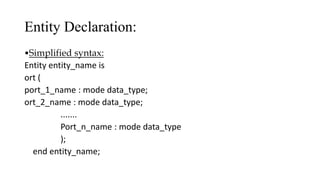
Entity Declaration:
•Simplified syntax:
Entity entity_name is
ort (
port_1_name : mode data_type;
ort_2_name : mode data_type;
.......
Port_n_name : mode data_type
);
end entity_name;
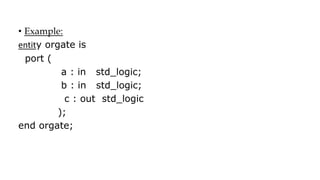
• Example:
entity orgate is
port (
a : in std_logic;
b : in std_logic;
c : out std_logic
);
end orgate;
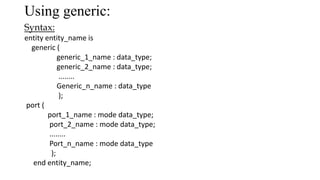
Using generic:
Syntax:
entity entity_name is
generic (
generic_1_name : data_type;
generic_2_name : data_type;
........
Generic_n_name : data_type
);
port (
port_1_name : mode data_type;
port_2_name : mode data_type;
........
Port_n_name : mode data_type
);
end entity_name;
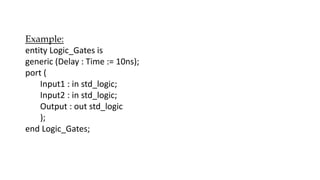
Example:
entity Logic_Gates is
generic (Delay : Time := 10ns);
port (
Input1 : in std_logic;
Input2 : in std_logic;
Output : out std_logic
);
end Logic_Gates;
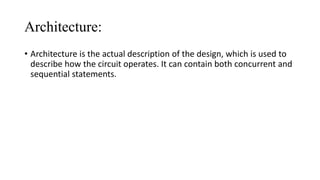
Architecture:
• Architecture is the actual description of the design, which is used to
describe how the circuit operates. It can contain both concurrent and
sequential statements.
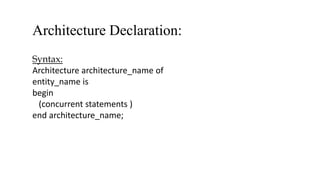
Architecture Declaration:
Syntax:
Architecture architecture_name of
entity_name is
begin
(concurrent statements )
end architecture_name;
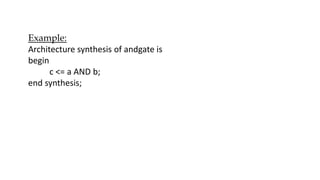
Example:
Architecture synthesis of andgate is
begin
c <= a AND b;
end synthesis;
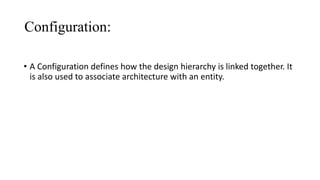
Configuration:
• A Configuration defines how the design hierarchy is linked together. It
is also used to associate architecture with an entity.
Configuration Declaration:
Syntax:
configuration configuration_name of entity_name is
--configuration declarations
for architecture_name
for instance_label : component_name
use entity library_name.entity_name(architecture_name);
end for;
--
end for;
end [configuration] [configuration_name];
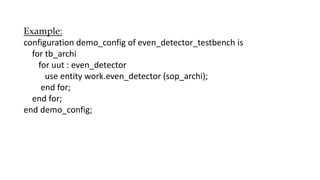
Example:
configuration demo_config of even_detector_testbench is
for tb_archi
for uut : even_detector
use entity work.even_detector (sop_archi);
end for;
end for;
end demo_config;
Types of Modeling styles in VHDL:
1.Data flow modeling (Design Equations)
2.Behavioral modeling (Explains Behaviour)
3.Structural modeling (Connection of sub modules)
VHDL objects:
• VHDL uses the following three types of objects:
1)Constant:
•Constant is an object which can only hold a single value that
cannot be changed during the whole code.
Example:
constant number_of_bytes integer:=8;
2)Variables:
•A variable also holds a single value of a given type. The value of
the variable may be changed during the simulation by using variable
assignment operator.
• Variables are used in the processes and subprograms.
•Variables are assigned by the assignment operator “:=“.
Example:
variable index: integer :=0;
3) Signals:
•Signals can be declared in architecture and used anywhere
within the architecture. Signals are assigned by the assignment
operator “<=“.
Example:
Signal sig1: std_logic;
Sig1 <= ‘1’
Thank you...!

Digital principle and computer design Presentation (1).pptx

  • 1.
    K.S.R College OfEngineering Department - Computer Science and Engineering Subject - Digital principles and computer design Subject code - 20EE231 Name - Varsha.S.K Register no. - 73152213101 Semester - 02 Section - CSE-’B’ Date - 11.07.2023
  • 2.
    Hardware Description Language(HDL) • HDL stands for Hardware Description Language. • It is a programming language that is used to describe, simulate, and create hardware like digital circuits (ICS). • HDL is mainly used to discover the faults in the design before implementing it in the hardware. • The main advantage of HDLs is that it provides flexible modeling capabilities can express the large complex designs (>107gates). • Today, there are many HDLs available in the market, but VHDL and Verilog are the most popular HDLs.
  • 3.
    VHDL(Very High-Speed IntegrationCircuit HDL (Hardware Description Language)) • VHDL stands for Very High-Speed Integration Circuit HDL (Hardware Description Language). • It is an IEEE (Institute of Electrical and Electronics Engineers) standard hardware description language that is used to describe and simulate the behavior of complex digital circuits. • The most popular examples of VHDL are Odd Parity Generator, Pulse Generator, Priority Encoder, Behavioral Model for 16 words, 8bit RAM, etc.
  • 4.
    Advantages of VHDL •It supports various design methodologies like Top-down approach and Bottom-up approach. • It provides a flexible design language. • It allows better design management. • It allows detailed implementations. • It supports a multi-level abstraction.
  • 5.
    Disadvantages of VHDL: •It requires specific knowledge of the structure and syntax of the language. • It is more difficult to visualize and troubleshoot a design. • Some VHDL programs cannot be synthesized. • VHDL is more difficult to learn.
  • 6.
    Basic Elements ofVHDL • These are the following three basic elements of VHDL: 1) Entity 2) Architecture 3) Configuration
  • 7.
    Entity: • The Entityis used to specify the input and output ports of the circuit. An Entity usually has one or more ports that can be inputs (in), outputs (out), input-outputs (inout), or buffer. • An Entity may also include a set of generic values that are used to declare properties of the circuit.
  • 8.
    Entity Declaration: •Simplified syntax: Entityentity_name is ort ( port_1_name : mode data_type; ort_2_name : mode data_type; ....... Port_n_name : mode data_type ); end entity_name;
  • 9.
    • Example: entity orgateis port ( a : in std_logic; b : in std_logic; c : out std_logic ); end orgate;
  • 10.
    Using generic: Syntax: entity entity_nameis generic ( generic_1_name : data_type; generic_2_name : data_type; ........ Generic_n_name : data_type ); port ( port_1_name : mode data_type; port_2_name : mode data_type; ........ Port_n_name : mode data_type ); end entity_name;
  • 11.
    Example: entity Logic_Gates is generic(Delay : Time := 10ns); port ( Input1 : in std_logic; Input2 : in std_logic; Output : out std_logic ); end Logic_Gates;
  • 12.
    Architecture: • Architecture isthe actual description of the design, which is used to describe how the circuit operates. It can contain both concurrent and sequential statements.
  • 13.
    Architecture Declaration: Syntax: Architecture architecture_nameof entity_name is begin (concurrent statements ) end architecture_name;
  • 14.
    Example: Architecture synthesis ofandgate is begin c <= a AND b; end synthesis;
  • 15.
    Configuration: • A Configurationdefines how the design hierarchy is linked together. It is also used to associate architecture with an entity.
  • 16.
    Configuration Declaration: Syntax: configuration configuration_nameof entity_name is --configuration declarations for architecture_name for instance_label : component_name use entity library_name.entity_name(architecture_name); end for; -- end for; end [configuration] [configuration_name];
  • 17.
    Example: configuration demo_config ofeven_detector_testbench is for tb_archi for uut : even_detector use entity work.even_detector (sop_archi); end for; end for; end demo_config;
  • 18.
    Types of Modelingstyles in VHDL: 1.Data flow modeling (Design Equations) 2.Behavioral modeling (Explains Behaviour) 3.Structural modeling (Connection of sub modules)
  • 19.
    VHDL objects: • VHDLuses the following three types of objects: 1)Constant: •Constant is an object which can only hold a single value that cannot be changed during the whole code. Example: constant number_of_bytes integer:=8;
  • 20.
    2)Variables: •A variable alsoholds a single value of a given type. The value of the variable may be changed during the simulation by using variable assignment operator. • Variables are used in the processes and subprograms. •Variables are assigned by the assignment operator “:=“. Example: variable index: integer :=0;
  • 21.
    3) Signals: •Signals canbe declared in architecture and used anywhere within the architecture. Signals are assigned by the assignment operator “<=“. Example: Signal sig1: std_logic; Sig1 <= ‘1’
  • 22.