


Creativity Meets Rationale:
Collaboration Patterns for
Social Innovation
Aldo de Moor
CommunitySense
WWW.COMMUNITYSENSE.NL
FARG Seminar
University of Alabama in Huntsville
30 August 2013
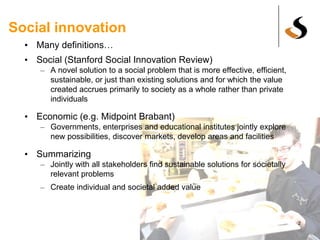
Social innovation
• Many definitions…
• Social (Stanford Social Innovation Review)
– A novel solution to a social problem that is more effective, efficient,
sustainable, or just than existing solutions and for which the value
created accrues primarily to society as a whole rather than private
individuals
• Economic (e.g. Midpoint Brabant)
– Governments, enterprises and educational institutes jointly explore
new possibilities, discover markets, develop areas and facilities
• Summarizing
– Jointly with all stakeholders find sustainable solutions for societally
relevant problems
– Create individual and societal added value
2
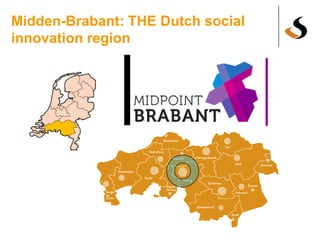
Midden-Brabant: THE Dutch social
innovation region
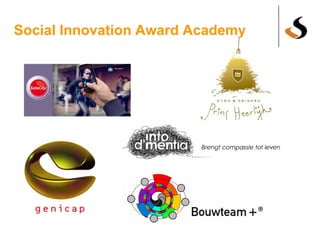
Social Innovation Award Academy
Transforming education: Prins Heerlijk
Transforming healthcare: Into D’Mentia
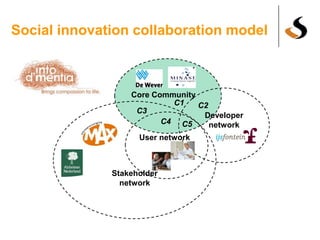
Social innovation collaboration model
Developer
network
Stakeholder
network
C1 C2
C4 C5
User network
C3
Core Community
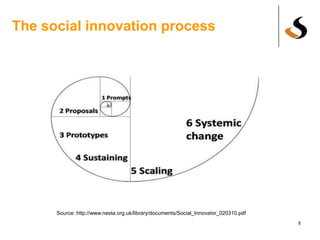
The social innovation process
8
Source: http://www.nesta.org.uk/library/documents/Social_Innovator_020310.pdf
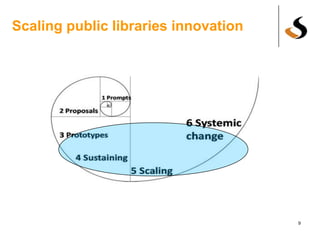
Scaling public libraries innovation
9
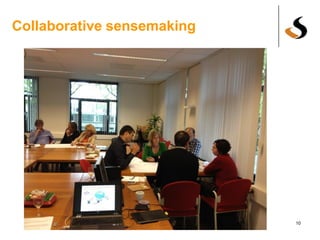
Collaborative sensemaking
10
Source: BNB/Cubiss public library sensemaking session, May 2013
Collaboration patterns –
sharing lessons learnt
• Creativity & rationale are co-dependent in design
• Patterns: relatively stable solutions to recurring problems at
the right level of abstraction
• Collaboration patterns: reusable lessons learnt on how best
to use specific functionalities for particular collaborative
purposes
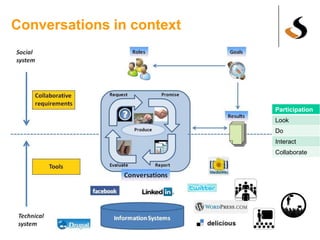
• Root ontology of collaboration patterns is the socio-technical
conversation context framework
11
Conversations in context
Participation
Look
Do
Interact
Collaborate
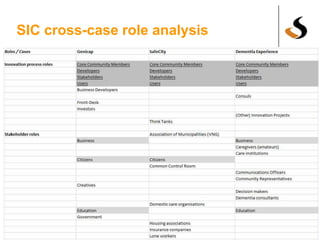
SIC cross-case role analysis
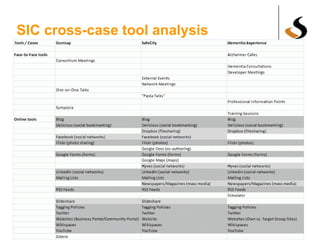
SIC cross-case tool analysis
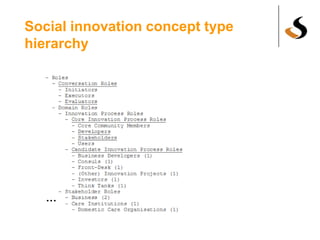
Social innovation concept type
hierarchy
…
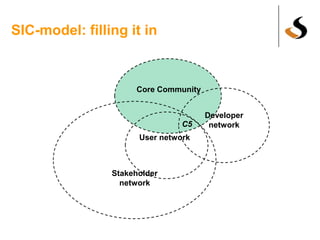
SIC-model: filling it in
Developer
network
Stakeholder
network
C5
User network
Core Community
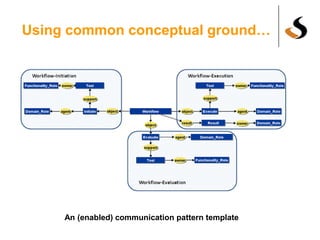
Using common conceptual ground…
An (enabled) communication pattern template
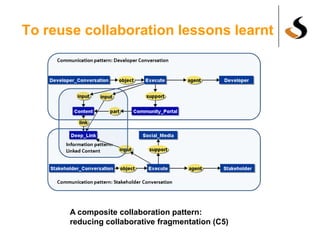
To reuse collaboration lessons learnt
A composite collaboration pattern:
reducing collaborative fragmentation (C5)
Many applications of
collaboration patterns
• Collaborative sensemaking
• Analyzing differences between requirements & functionalities;
existing and good/best practices
• Configuring collaboration systems
• Growing “collaborative landscapes” by linking “collaborative
islands”
• Activating and scaling collaboration
• Bridging theory and practice by acting as socio-technical design
hypotheses
• ….
19
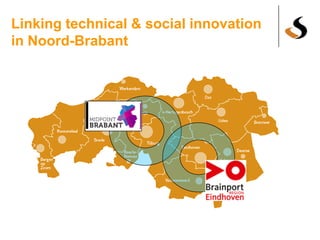
Linking technical & social innovation
in Noord-Brabant
And in Alabama?
Conclusions
• Social innovation is a fuzzy, intricate process
• Involves very complex collaboration networks, evolving over time
• Social innovation collaboration requires careful socio-technical
systems analysis & design
• Collaboration patterns capture reusable lessons learnt
• Working on a
– Social innovation collaboration pattern language
– hands-on methodology to describe, analyze, compare, (re)use, and
evolve social innovation collaboration patterns
• Towards more scalable and sustainable social innovation,
having deep impact on society
22
Reference: A. de Moor (2012). Creativity Meets Rationale - Collaboration Patterns for Social Innovation. In
J. Carroll (ed.), Creativity and Rationale: Enhancing Human Experience by Design, Springer, Berlin. ISBN
978-1-4471-4110-5 - http://communitysense.nl/papers/2012_De%20Moor_Creativity_Meets_Rationale-
Collaboration_Patterns_for_Social_Innovation.pdf

Creativity Meets Rationale - Collaboration Patterns for Social Innovation

  • 1.
    Creativity Meets Rationale: CollaborationPatterns for Social Innovation Aldo de Moor CommunitySense WWW.COMMUNITYSENSE.NL FARG Seminar University of Alabama in Huntsville 30 August 2013
  • 2.
    Social innovation • Manydefinitions… • Social (Stanford Social Innovation Review) – A novel solution to a social problem that is more effective, efficient, sustainable, or just than existing solutions and for which the value created accrues primarily to society as a whole rather than private individuals • Economic (e.g. Midpoint Brabant) – Governments, enterprises and educational institutes jointly explore new possibilities, discover markets, develop areas and facilities • Summarizing – Jointly with all stakeholders find sustainable solutions for societally relevant problems – Create individual and societal added value 2
  • 3.
    Midden-Brabant: THE Dutchsocial innovation region
  • 4.
  • 5.
  • 6.
  • 7.
    Social innovation collaborationmodel Developer network Stakeholder network C1 C2 C4 C5 User network C3 Core Community
  • 8.
    The social innovationprocess 8 Source: http://www.nesta.org.uk/library/documents/Social_Innovator_020310.pdf
  • 9.
  • 10.
    Collaborative sensemaking 10 Source: BNB/Cubisspublic library sensemaking session, May 2013
  • 11.
    Collaboration patterns – sharinglessons learnt • Creativity & rationale are co-dependent in design • Patterns: relatively stable solutions to recurring problems at the right level of abstraction • Collaboration patterns: reusable lessons learnt on how best to use specific functionalities for particular collaborative purposes • Root ontology of collaboration patterns is the socio-technical conversation context framework 11
  • 12.
  • 13.
  • 14.
  • 15.
    Social innovation concepttype hierarchy …
  • 16.
    SIC-model: filling itin Developer network Stakeholder network C5 User network Core Community
  • 17.
    Using common conceptualground… An (enabled) communication pattern template
  • 18.
    To reuse collaborationlessons learnt A composite collaboration pattern: reducing collaborative fragmentation (C5)
  • 19.
    Many applications of collaborationpatterns • Collaborative sensemaking • Analyzing differences between requirements & functionalities; existing and good/best practices • Configuring collaboration systems • Growing “collaborative landscapes” by linking “collaborative islands” • Activating and scaling collaboration • Bridging theory and practice by acting as socio-technical design hypotheses • …. 19
  • 20.
    Linking technical &social innovation in Noord-Brabant
  • 21.
  • 22.
    Conclusions • Social innovationis a fuzzy, intricate process • Involves very complex collaboration networks, evolving over time • Social innovation collaboration requires careful socio-technical systems analysis & design • Collaboration patterns capture reusable lessons learnt • Working on a – Social innovation collaboration pattern language – hands-on methodology to describe, analyze, compare, (re)use, and evolve social innovation collaboration patterns • Towards more scalable and sustainable social innovation, having deep impact on society 22 Reference: A. de Moor (2012). Creativity Meets Rationale - Collaboration Patterns for Social Innovation. In J. Carroll (ed.), Creativity and Rationale: Enhancing Human Experience by Design, Springer, Berlin. ISBN 978-1-4471-4110-5 - http://communitysense.nl/papers/2012_De%20Moor_Creativity_Meets_Rationale- Collaboration_Patterns_for_Social_Innovation.pdf