HAZCOM
Safety on the Job
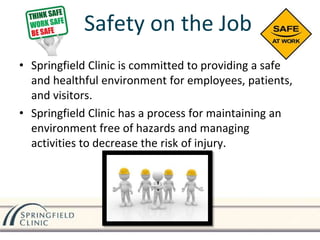
• Springfield Clinic is committed to providing a safe
and healthful environment for employees, patients,
and visitors.
• Springfield Clinic has a process for maintaining an
environment free of hazards and managing
activities to decrease the risk of injury.
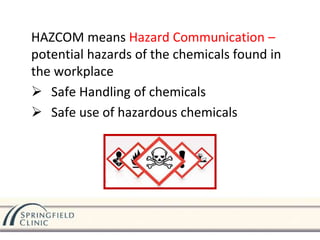
HAZCOM means Hazard Communication –
potential hazards of the chemicals found in
the workplace
 Safe Handling of chemicals
 Safe use of hazardous chemicals
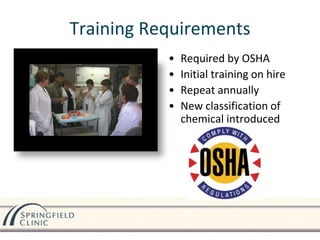
Training Requirements
• Required by OSHA
• Initial training on hire
• Repeat annually
• New classification of
chemical introduced
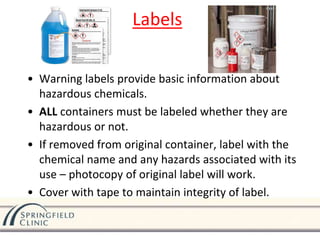
• Warning labels provide basic information about
hazardous chemicals.
• ALL containers must be labeled whether they are
hazardous or not.
• If removed from original container, label with the
chemical name and any hazards associated with its
use – photocopy of original label will work.
• Cover with tape to maintain integrity of label.
Labels
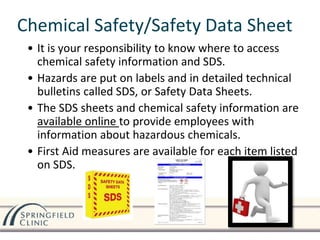
Chemical Safety/Safety Data Sheet
• It is your responsibility to know where to access
chemical safety information and SDS.
• Hazards are put on labels and in detailed technical
bulletins called SDS, or Safety Data Sheets.
• The SDS sheets and chemical safety information are
available online to provide employees with
information about hazardous chemicals.
• First Aid measures are available for each item listed
on SDS.
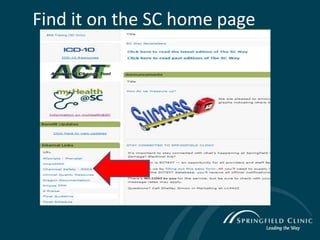
Find it on the SC home page
HazCom
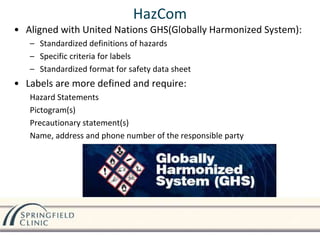
• Aligned with United Nations GHS(Globally Harmonized System):
– Standardized definitions of hazards
– Specific criteria for labels
– Standardized format for safety data sheet
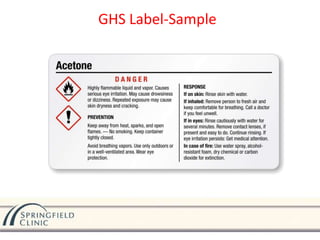
• Labels are more defined and require:
Hazard Statements
Pictogram(s)
Precautionary statement(s)
Name, address and phone number of the responsible party
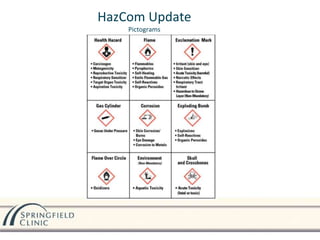
HazCom Update
Pictograms
GHS Label-Sample
HazCom Update
16-Section Safety Data Sheet Contents
1. Identification of the substance or
mixture & of the supplier
2. Hazards identification
3. Composition/info on
ingredients/substance/mixture
4. First aid measures
5. Firefighting measures
6. Accidental release measures
7. Handling and Storage
8. Exposure controls/personal
protection
9. Physical & chemical properties
10. Stability & reactivity
11. Toxicological
12. Ecological information (non-mandatory)
13. Disposal considerations (non-mandatory)
14. Transport information (non-mandatory)
15. Regulatory information (non-mandatory)
16. Other information including information
on preparation & revision of the SDS
• Chemical distributors/manufacturers must
provide a SDS with initial shipment of the
product.
• An inventory of all hazardous materials used in
the Clinic will be maintained by the Purchasing
department.
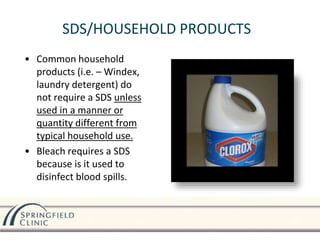
SDS/HOUSEHOLD PRODUCTS
• Common household
products (i.e. – Windex,
laundry detergent) do
not require a SDS unless
used in a manner or
quantity different from
typical household use.
• Bleach requires a SDS
because is it used to
disinfect blood spills.
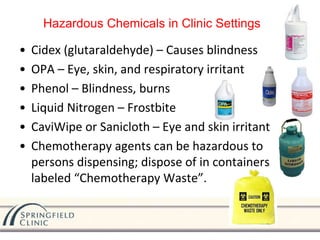
• Cidex (glutaraldehyde) – Causes blindness
• OPA – Eye, skin, and respiratory irritant
• Phenol – Blindness, burns
• Liquid Nitrogen – Frostbite
• CaviWipe or Sanicloth – Eye and skin irritant
• Chemotherapy agents can be hazardous to
persons dispensing; dispose of in containers
labeled “Chemotherapy Waste”.
Hazardous Chemicals in Clinic Settings
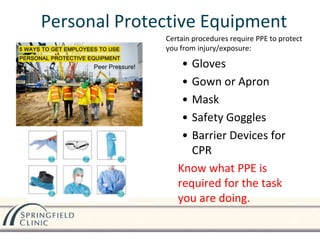
Personal Protective Equipment
Certain procedures require PPE to protect
you from injury/exposure:
• Gloves
• Gown or Apron
• Mask
• Safety Goggles
• Barrier Devices for
CPR
Know what PPE is
required for the task
you are doing.
Peer Pressure!
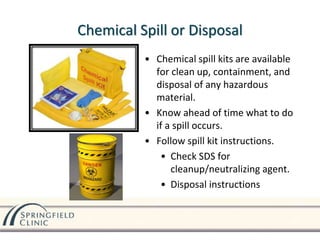
Chemical Spill or Disposal
• Chemical spill kits are available
for clean up, containment, and
disposal of any hazardous
material.
• Know ahead of time what to do
if a spill occurs.
• Follow spill kit instructions.
• Check SDS for
cleanup/neutralizing agent.
• Disposal instructions
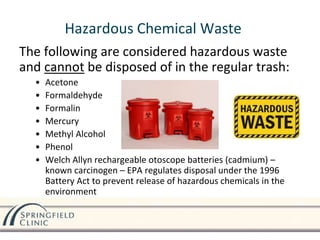
Hazardous Chemical Waste
The following are considered hazardous waste
and cannot be disposed of in the regular trash:
• Acetone
• Formaldehyde
• Formalin
• Mercury
• Methyl Alcohol
• Phenol
• Welch Allyn rechargeable otoscope batteries (cadmium) –
known carcinogen – EPA regulates disposal under the 1996
Battery Act to prevent release of hazardous chemicals in the
environment
Call Facilities
Management to pick
up for disposal
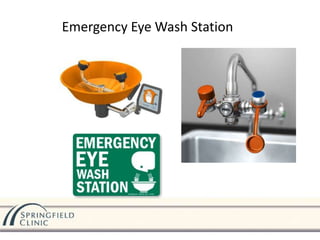
Emergency Eye Wash Station
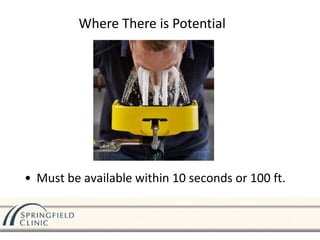
Where There is Potential
• Must be available within 10 seconds or 100 ft.
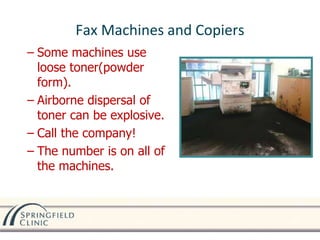
Fax Machines and Copiers
– Some machines use
loose toner(powder
form).
– Airborne dispersal of
toner can be explosive.
– Call the company!
– The number is on all of
the machines.
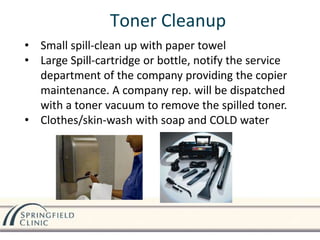
Toner Cleanup
• Small spill-clean up with paper towel
• Large Spill-cartridge or bottle, notify the service
department of the company providing the copier
maintenance. A company rep. will be dispatched
with a toner vacuum to remove the spilled toner.
• Clothes/skin-wash with soap and COLD water
Communicable
Disease
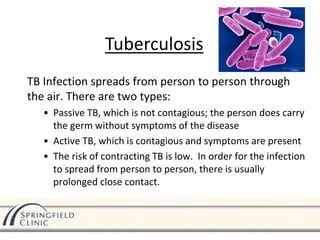
TB Infection spreads from person to person through
the air. There are two types:
• Passive TB, which is not contagious; the person does carry
the germ without symptoms of the disease
• Active TB, which is contagious and symptoms are present
• The risk of contracting TB is low. In order for the infection
to spread from person to person, there is usually
prolonged close contact.
Tuberculosis
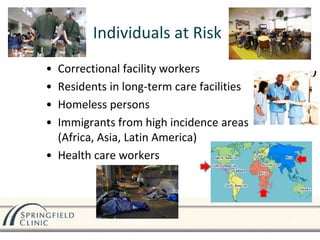
Individuals at Risk
• Correctional facility workers
• Residents in long-term care facilities
• Homeless persons
• Immigrants from high incidence areas
(Africa, Asia, Latin America)
• Health care workers
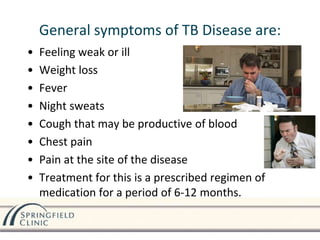
General symptoms of TB Disease are:
• Feeling weak or ill
• Weight loss
• Fever
• Night sweats
• Cough that may be productive of blood
• Chest pain
• Pain at the site of the disease
• Treatment for this is a prescribed regimen of
medication for a period of 6-12 months.
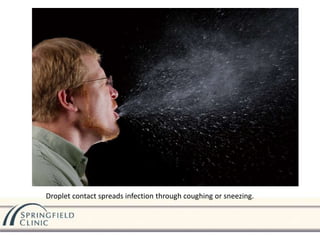
Droplet contact spreads infection through coughing or sneezing.
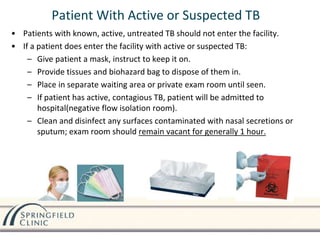
Patient With Active or Suspected TB
• Patients with known, active, untreated TB should not enter the facility.
• If a patient does enter the facility with active or suspected TB:
– Give patient a mask, instruct to keep it on.
– Provide tissues and biohazard bag to dispose of them in.
– Place in separate waiting area or private exam room until seen.
– If patient has active, contagious TB, patient will be admitted to
hospital(negative flow isolation room).
– Clean and disinfect any surfaces contaminated with nasal secretions or
sputum; exam room should remain vacant for generally 1 hour.
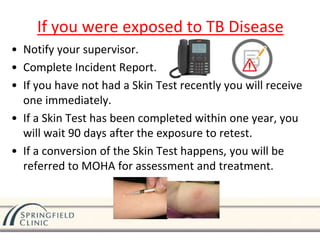
If you were exposed to TB Disease
• Notify your supervisor.
• Complete Incident Report.
• If you have not had a Skin Test recently you will receive
one immediately.
• If a Skin Test has been completed within one year, you
will wait 90 days after the exposure to retest.
• If a conversion of the Skin Test happens, you will be
referred to MOHA for assessment and treatment.
Multi-drug Resistant Organisms (MDRO)
29
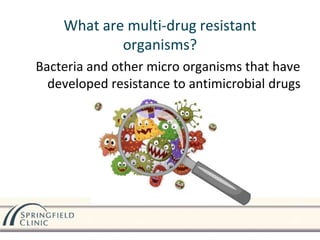
What are multi-drug resistant
organisms?
Bacteria and other micro organisms that have
developed resistance to antimicrobial drugs
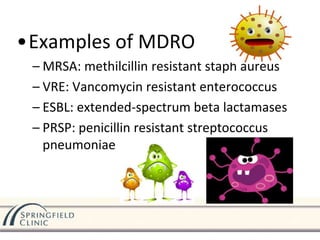
•Examples of MDRO
– MRSA: methilcillin resistant staph aureus
– VRE: Vancomycin resistant enterococcus
– ESBL: extended-spectrum beta lactamases
– PRSP: penicillin resistant streptococcus
pneumoniae
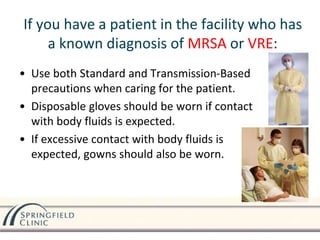
If you have a patient in the facility who has
a known diagnosis of MRSA or VRE:
• Use both Standard and Transmission-Based
precautions when caring for the patient.
• Disposable gloves should be worn if contact
with body fluids is expected.
• If excessive contact with body fluids is
expected, gowns should also be worn.
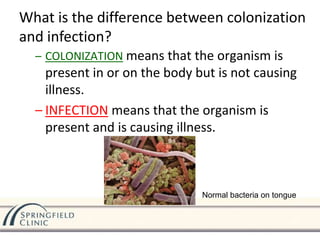
– COLONIZATION means that the organism is
present in or on the body but is not causing
illness.
– INFECTION means that the organism is
present and is causing illness.
What is the difference between colonization
and infection?
Normal bacteria on tongue
• Healthcare workers must
voluntarily report known
personal MRSA or other MDRO
infection. If proven to have an
active, symptomatic infection,
the employee will be removed
from direct patient care and will
report to MOHA for a “fit for
duty” evaluation.
• The employee may return to
patient care only after clearance
from treating physician that the
active infection is resolved.
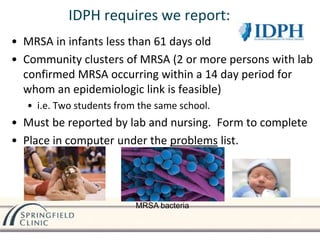
IDPH requires we report:
• MRSA in infants less than 61 days old
• Community clusters of MRSA (2 or more persons with lab
confirmed MRSA occurring within a 14 day period for
whom an epidemiologic link is feasible)
• i.e. Two students from the same school.
• Must be reported by lab and nursing. Form to complete
• Place in computer under the problems list.
MRSA bacteria
• While it is important for schools and employers to
have information to prevent the transmission of
MRSA, you cannot give school nurses or employers
information directly without the patient’s or parent’s
written permission.
• The patient or parent should inform the employer or
school.
Privacy Protection
Click here to take quiz

Hazcom Training

  • 1.
  • 2.
    Safety on theJob • Springfield Clinic is committed to providing a safe and healthful environment for employees, patients, and visitors. • Springfield Clinic has a process for maintaining an environment free of hazards and managing activities to decrease the risk of injury.
  • 3.
    HAZCOM means HazardCommunication – potential hazards of the chemicals found in the workplace  Safe Handling of chemicals  Safe use of hazardous chemicals
  • 4.
    Training Requirements • Requiredby OSHA • Initial training on hire • Repeat annually • New classification of chemical introduced
  • 5.
    • Warning labelsprovide basic information about hazardous chemicals. • ALL containers must be labeled whether they are hazardous or not. • If removed from original container, label with the chemical name and any hazards associated with its use – photocopy of original label will work. • Cover with tape to maintain integrity of label. Labels
  • 6.
    Chemical Safety/Safety DataSheet • It is your responsibility to know where to access chemical safety information and SDS. • Hazards are put on labels and in detailed technical bulletins called SDS, or Safety Data Sheets. • The SDS sheets and chemical safety information are available online to provide employees with information about hazardous chemicals. • First Aid measures are available for each item listed on SDS.
  • 7.
    Find it onthe SC home page
  • 8.
    HazCom • Aligned withUnited Nations GHS(Globally Harmonized System): – Standardized definitions of hazards – Specific criteria for labels – Standardized format for safety data sheet • Labels are more defined and require: Hazard Statements Pictogram(s) Precautionary statement(s) Name, address and phone number of the responsible party
  • 9.
  • 10.
  • 11.
    HazCom Update 16-Section SafetyData Sheet Contents 1. Identification of the substance or mixture & of the supplier 2. Hazards identification 3. Composition/info on ingredients/substance/mixture 4. First aid measures 5. Firefighting measures 6. Accidental release measures 7. Handling and Storage 8. Exposure controls/personal protection 9. Physical & chemical properties 10. Stability & reactivity 11. Toxicological 12. Ecological information (non-mandatory) 13. Disposal considerations (non-mandatory) 14. Transport information (non-mandatory) 15. Regulatory information (non-mandatory) 16. Other information including information on preparation & revision of the SDS
  • 12.
    • Chemical distributors/manufacturersmust provide a SDS with initial shipment of the product. • An inventory of all hazardous materials used in the Clinic will be maintained by the Purchasing department.
  • 13.
    SDS/HOUSEHOLD PRODUCTS • Commonhousehold products (i.e. – Windex, laundry detergent) do not require a SDS unless used in a manner or quantity different from typical household use. • Bleach requires a SDS because is it used to disinfect blood spills.
  • 14.
    • Cidex (glutaraldehyde)– Causes blindness • OPA – Eye, skin, and respiratory irritant • Phenol – Blindness, burns • Liquid Nitrogen – Frostbite • CaviWipe or Sanicloth – Eye and skin irritant • Chemotherapy agents can be hazardous to persons dispensing; dispose of in containers labeled “Chemotherapy Waste”. Hazardous Chemicals in Clinic Settings
  • 15.
    Personal Protective Equipment Certainprocedures require PPE to protect you from injury/exposure: • Gloves • Gown or Apron • Mask • Safety Goggles • Barrier Devices for CPR Know what PPE is required for the task you are doing. Peer Pressure!
  • 16.
    Chemical Spill orDisposal • Chemical spill kits are available for clean up, containment, and disposal of any hazardous material. • Know ahead of time what to do if a spill occurs. • Follow spill kit instructions. • Check SDS for cleanup/neutralizing agent. • Disposal instructions
  • 17.
    Hazardous Chemical Waste Thefollowing are considered hazardous waste and cannot be disposed of in the regular trash: • Acetone • Formaldehyde • Formalin • Mercury • Methyl Alcohol • Phenol • Welch Allyn rechargeable otoscope batteries (cadmium) – known carcinogen – EPA regulates disposal under the 1996 Battery Act to prevent release of hazardous chemicals in the environment Call Facilities Management to pick up for disposal
  • 18.
  • 19.
    Where There isPotential • Must be available within 10 seconds or 100 ft.
  • 20.
    Fax Machines andCopiers – Some machines use loose toner(powder form). – Airborne dispersal of toner can be explosive. – Call the company! – The number is on all of the machines.
  • 21.
    Toner Cleanup • Smallspill-clean up with paper towel • Large Spill-cartridge or bottle, notify the service department of the company providing the copier maintenance. A company rep. will be dispatched with a toner vacuum to remove the spilled toner. • Clothes/skin-wash with soap and COLD water
  • 22.
  • 23.
    TB Infection spreadsfrom person to person through the air. There are two types: • Passive TB, which is not contagious; the person does carry the germ without symptoms of the disease • Active TB, which is contagious and symptoms are present • The risk of contracting TB is low. In order for the infection to spread from person to person, there is usually prolonged close contact. Tuberculosis
  • 24.
    Individuals at Risk •Correctional facility workers • Residents in long-term care facilities • Homeless persons • Immigrants from high incidence areas (Africa, Asia, Latin America) • Health care workers
  • 25.
    General symptoms ofTB Disease are: • Feeling weak or ill • Weight loss • Fever • Night sweats • Cough that may be productive of blood • Chest pain • Pain at the site of the disease • Treatment for this is a prescribed regimen of medication for a period of 6-12 months.
  • 26.
    Droplet contact spreadsinfection through coughing or sneezing.
  • 27.
    Patient With Activeor Suspected TB • Patients with known, active, untreated TB should not enter the facility. • If a patient does enter the facility with active or suspected TB: – Give patient a mask, instruct to keep it on. – Provide tissues and biohazard bag to dispose of them in. – Place in separate waiting area or private exam room until seen. – If patient has active, contagious TB, patient will be admitted to hospital(negative flow isolation room). – Clean and disinfect any surfaces contaminated with nasal secretions or sputum; exam room should remain vacant for generally 1 hour.
  • 28.
    If you wereexposed to TB Disease • Notify your supervisor. • Complete Incident Report. • If you have not had a Skin Test recently you will receive one immediately. • If a Skin Test has been completed within one year, you will wait 90 days after the exposure to retest. • If a conversion of the Skin Test happens, you will be referred to MOHA for assessment and treatment.
  • 29.
  • 30.
    What are multi-drugresistant organisms? Bacteria and other micro organisms that have developed resistance to antimicrobial drugs
  • 31.
    •Examples of MDRO –MRSA: methilcillin resistant staph aureus – VRE: Vancomycin resistant enterococcus – ESBL: extended-spectrum beta lactamases – PRSP: penicillin resistant streptococcus pneumoniae
  • 32.
    If you havea patient in the facility who has a known diagnosis of MRSA or VRE: • Use both Standard and Transmission-Based precautions when caring for the patient. • Disposable gloves should be worn if contact with body fluids is expected. • If excessive contact with body fluids is expected, gowns should also be worn.
  • 33.
    – COLONIZATION meansthat the organism is present in or on the body but is not causing illness. – INFECTION means that the organism is present and is causing illness. What is the difference between colonization and infection? Normal bacteria on tongue
  • 34.
    • Healthcare workersmust voluntarily report known personal MRSA or other MDRO infection. If proven to have an active, symptomatic infection, the employee will be removed from direct patient care and will report to MOHA for a “fit for duty” evaluation. • The employee may return to patient care only after clearance from treating physician that the active infection is resolved.
  • 35.
    IDPH requires wereport: • MRSA in infants less than 61 days old • Community clusters of MRSA (2 or more persons with lab confirmed MRSA occurring within a 14 day period for whom an epidemiologic link is feasible) • i.e. Two students from the same school. • Must be reported by lab and nursing. Form to complete • Place in computer under the problems list. MRSA bacteria
  • 36.
    • While itis important for schools and employers to have information to prevent the transmission of MRSA, you cannot give school nurses or employers information directly without the patient’s or parent’s written permission. • The patient or parent should inform the employer or school. Privacy Protection
  • 37.
    Click here totake quiz

Editor's Notes