Labor Relations Office


Right-to-Know / Hazard Communication
Bloodborne Pathogens / Exposure Control


                                 On-Line
                              Training Center

   Presented by: David L. Daignault, CSP, Coordinator
          Health, Safety and Risk Management
Learning Objectives

       • Chemical Awareness
            and Safety
       • PPE, 1st Aid
       • Labels
       • MSDS
Your Right-To-Know

Employer                 Employee
Responsibilities         Responsibilities
• Communicate Name of    • Be Familiar with
 Contact Person           Chemical Products
                          Used
• Develop Written Plan
                         • Know Where To Go
• Maintain and Provide
                           For More Information
  Access to MSDS
                         • Conduct Work Safely
• Provide Training
Sources of Information

   Labels
   Material Safety Data Sheets (MSDS)
   Your supervisor
   Your district’s RTK contact
   Websites (www.hazard.com)
    and company/MFG websites
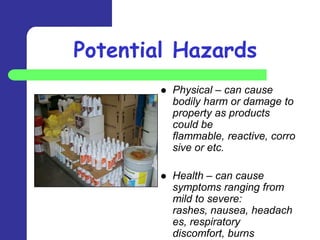
Potential Hazards
           Physical – can cause
            bodily harm or damage to
            property as products
            could be
            flammable, reactive, corro
            sive or etc.

           Health – can cause
            symptoms ranging from
            mild to severe:
            rashes, nausea, headach
            es, respiratory
            discomfort, burns
Routes of Entry
   Absorption
    (prevention by use of
    gloves)

   Ingestion
    (prevention by hand
    washing)

   Inhalation
    (prevention by good
    work practice and
    ventilation)

   Injection
    (prevention by proper
    handling of broken
    glass and sharps)
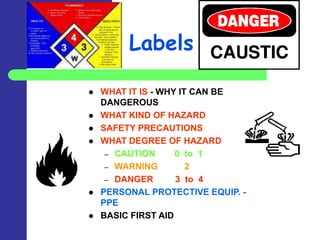
Labels

   WHAT IT IS - WHY IT CAN BE
    DANGEROUS
   WHAT KIND OF HAZARD
   SAFETY PRECAUTIONS
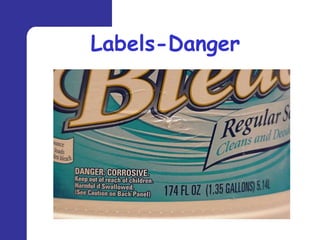
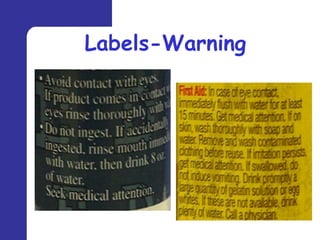
   WHAT DEGREE OF HAZARD
     – CAUTION      0 to 1
     – WARNING         2
     – DANGER       3 to 4
   PERSONAL PROTECTIVE EQUIP. -
    PPE
   BASIC FIRST AID
Labels-Signal Words
              CAUTION


              WARNING


              DANGER
Labels-Danger
Labels-Warning
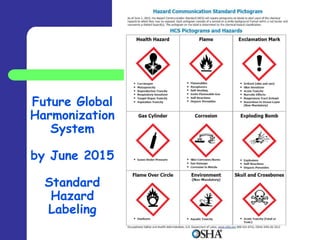
Future Global
Harmonization
   System

by June 2015

  Standard
   Hazard
  Labeling
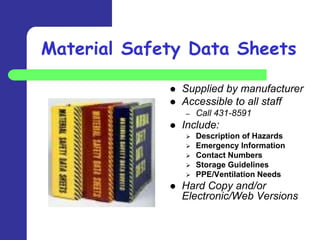
Material Safety Data Sheets

                Supplied by manufacturer
                Accessible to all staff
                 –   Call 431-8591
                Include:
                    Description of Hazards
                    Emergency Information
                    Contact Numbers
                    Storage Guidelines
                    PPE/Ventilation Needs
                Hard Copy and/or
                 Electronic/Web Versions
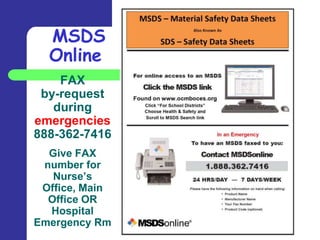
MSDS
  Online
    FAX
 by-request
   during
emergencies
888-362-7416
  Give FAX
 number for
   Nurse’s
 Office, Main
  Office OR
  Hospital
Emergency Rm
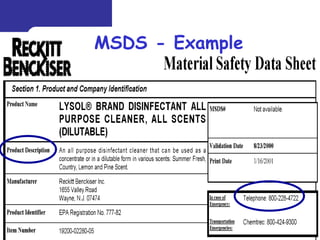
MSDS - Example
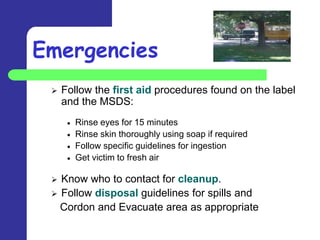
Emergencies
    Follow the first aid procedures found on the label
     and the MSDS:
       Rinse eyes for 15 minutes
       Rinse skin thoroughly using soap if required
       Follow specific guidelines for ingestion
       Get victim to fresh air

  Know who to contact for cleanup.
  Follow disposal guidelines for spills and
   Cordon and Evacuate area as appropriate
Prevention

   Control the physical hazards by storing
    products carefully

   Substitution – Avoid the health hazards by
    using safer products

   Minimize/Reduce your exposure by wearing
    PPE and ventilating the work area
Summary

 Be   familiar with the products in your area.
 Consult   labels and MSDSs.
 Choose   the right product for the job…and the
  safest product available.
 Don’t   bring in products from home.
 Don’t   hesitate to ask questions.
EMERGENCY PHONE
                       NUMBERS

 Supervisor, School Nurse
 9-1-1 OR 9 9-1-1
Poison Control Center:
    1-800-252-5655
Questions?
   Please contact your District Right-to-Know
   Officer or your OCM BOCES Safety Officer


OCM BOCES Health & Safety:
    (315) 431-8591
 Identify the district you are calling from for
      immediate referral to your OCM BOCES
      Safety Officer.
Bloodborne
    Pathogens
 Exposure Control
     Training

Health, Safety and Risk Management
      David L. Daignault, CSP
            Coordinator
Learning Objectives
   What is an Exposure
   Exposure Risks
   How to Protect Yourself
   Clean Up Procedure and Proper
    Disinfectants
   Reporting an Exposure and Follow Up
Exposure Determination

   Persons at risk of exposure based upon
    expectation to:
       administer first aid
       clean up blood or other OPIM*

              *other potentially infectious materials
                      i.e. internal fluids of the body
Bloodborne Pathogens
Diseases that can be transmitted through
contact with blood and OPIM include:
 –   Hepatitis B
         Did you know that all K-12 students in NYS are
          required to be vaccinated against Hepatitis B
 –   Hepatitis C
 –   HIV/Aids
Of these, hepatitis C is the least likely to
result from a workplace exposure.
“What are my chances of being
exposed to a Bloodborne Pathogen?”

Outside of the medical
 profession ….
Your exposure risk is
 extremely low when
 following basic precautions!
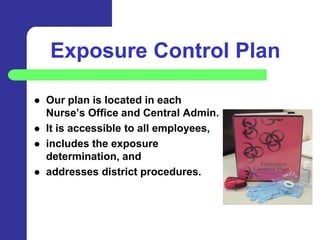
Exposure Control Plan

   Our plan is located in each
    Nurse’s Office and Central Admin.
   It is accessible to all employees,
   includes the exposure
    determination, and
   addresses district procedures.
Means of Transmission
       in the Workplace Setting
   accidental cut with a sharp object
    contaminated with blood.
   skin contact with blood when skin has open
    cuts, sores or abrasions (unprotected hands)
   getting infected blood in eyes, nose, or mouth
    (mucous membranes)

            (Virus must be present in blood/body fluids.)
Means of Transmission

   Saliva, tears, urine, feces, and sweat are not
    considered potentially infectious fluids for
    bloodborne pathogens, unless “visible
    amounts of blood are present.”

   NOT spread by „casual‟ contact,
      i.e. handshake, doorknobs and etc.
Universal Precautions

Universal precautions will be observed in all
school programs in order to prevent contact
with blood or other potentially infectious
materials.

All blood will be considered infectious
regardless of the perceived status of the
source individual.
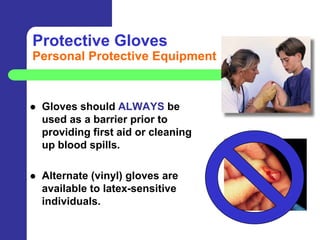
Protective Gloves
Personal Protective Equipment


   Gloves should ALWAYS be
    used as a barrier prior to
    providing first aid or cleaning
    up blood spills.

   Alternate (vinyl) gloves are
    available to latex-sensitive
    individuals.
Exposure Incident
     If you are exposed to blood or other body fluid,
             follow these steps immediately :
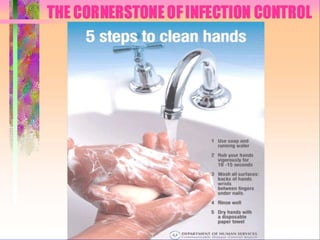
Wash hands/affected area with soap & water
   If in eyes, nose or mouth; flush with water
   ALWAYS Report the incident to your
     Supervisor and the school nurse, if available.
   Immediately seek medical treatment –
       School Nurse, family Dr., Clinic,
            after hours Urgent Care
Hepatitis B Vaccine

   The vaccine is offered to school
    nurses, custodial staff and other
    employee groups. If you are in a
    designated group you will be
    notified.
   Three shot series – MUST take
    all 3 to be effective.
   Initial, one month, 6-months
   Boosters are not currently
    recommended for those who
    previously received the vaccine.
Proper Clean Up Procedures


               Always restrict
               area so others
               won’t come into
               contact with spill.
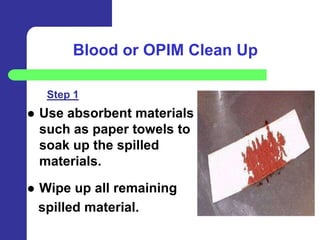
Blood or OPIM Clean Up

     Step 1
   Use absorbent materials
    such as paper towels to
    soak up the spilled
    materials.

   Wipe up all remaining
    spilled material.
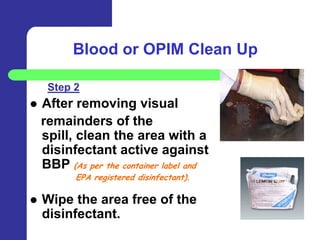
Blood or OPIM Clean Up

     Step 2
   After removing visual
    remainders of the
    spill, clean the area with a
    disinfectant active against
    BBP (As per the container label and
           EPA registered disinfectant).

   Wipe the area free of the
    disinfectant.
Blood or OPIM Clean Up

       Step 3
   Apply disinfectant a final
    time, allowing agent to set
    for prescribed “dwell
    time” or to air dry.

   Dispose of gloves and
    other materials in leak
    proof bag.
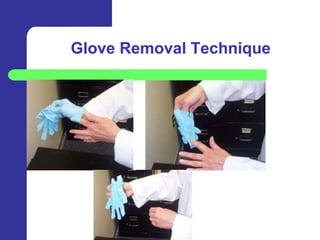
Glove Removal Technique
BE SAFE FROM
  THE START

Click on the Link Below To Take the On-line
    Quiz and Print the Participation Form
http://www.ocmboces.org/safetytraining/survey.cfm

Rtk bbp boces on-line 2013

  • 1.
    Labor Relations Office Right-to-Know/ Hazard Communication Bloodborne Pathogens / Exposure Control On-Line Training Center Presented by: David L. Daignault, CSP, Coordinator Health, Safety and Risk Management
  • 2.
    Learning Objectives • Chemical Awareness and Safety • PPE, 1st Aid • Labels • MSDS
  • 3.
    Your Right-To-Know Employer Employee Responsibilities Responsibilities • Communicate Name of • Be Familiar with Contact Person Chemical Products Used • Develop Written Plan • Know Where To Go • Maintain and Provide For More Information Access to MSDS • Conduct Work Safely • Provide Training
  • 4.
    Sources of Information  Labels  Material Safety Data Sheets (MSDS)  Your supervisor  Your district’s RTK contact  Websites (www.hazard.com) and company/MFG websites
  • 5.
    Potential Hazards  Physical – can cause bodily harm or damage to property as products could be flammable, reactive, corro sive or etc.  Health – can cause symptoms ranging from mild to severe: rashes, nausea, headach es, respiratory discomfort, burns
  • 6.
    Routes of Entry  Absorption (prevention by use of gloves)  Ingestion (prevention by hand washing)  Inhalation (prevention by good work practice and ventilation)  Injection (prevention by proper handling of broken glass and sharps)
  • 7.
    Labels  WHAT IT IS - WHY IT CAN BE DANGEROUS  WHAT KIND OF HAZARD  SAFETY PRECAUTIONS  WHAT DEGREE OF HAZARD – CAUTION 0 to 1 – WARNING 2 – DANGER 3 to 4  PERSONAL PROTECTIVE EQUIP. - PPE  BASIC FIRST AID
  • 8.
    Labels-Signal Words  CAUTION  WARNING  DANGER
  • 9.
  • 10.
  • 11.
    Future Global Harmonization System by June 2015 Standard Hazard Labeling
  • 12.
    Material Safety DataSheets  Supplied by manufacturer  Accessible to all staff – Call 431-8591  Include:  Description of Hazards  Emergency Information  Contact Numbers  Storage Guidelines  PPE/Ventilation Needs  Hard Copy and/or Electronic/Web Versions
  • 13.
    MSDS Online FAX by-request during emergencies 888-362-7416 Give FAX number for Nurse’s Office, Main Office OR Hospital Emergency Rm
  • 14.
  • 15.
    Emergencies  Follow the first aid procedures found on the label and the MSDS: Rinse eyes for 15 minutes Rinse skin thoroughly using soap if required Follow specific guidelines for ingestion Get victim to fresh air  Know who to contact for cleanup.  Follow disposal guidelines for spills and Cordon and Evacuate area as appropriate
  • 16.
    Prevention  Control the physical hazards by storing products carefully  Substitution – Avoid the health hazards by using safer products  Minimize/Reduce your exposure by wearing PPE and ventilating the work area
  • 17.
    Summary  Be familiar with the products in your area.  Consult labels and MSDSs.  Choose the right product for the job…and the safest product available.  Don’t bring in products from home.  Don’t hesitate to ask questions.
  • 18.
    EMERGENCY PHONE NUMBERS  Supervisor, School Nurse  9-1-1 OR 9 9-1-1 Poison Control Center: 1-800-252-5655
  • 19.
    Questions? Please contact your District Right-to-Know Officer or your OCM BOCES Safety Officer OCM BOCES Health & Safety: (315) 431-8591  Identify the district you are calling from for immediate referral to your OCM BOCES Safety Officer.
  • 20.
    Bloodborne Pathogens Exposure Control Training Health, Safety and Risk Management David L. Daignault, CSP Coordinator
  • 21.
    Learning Objectives  What is an Exposure  Exposure Risks  How to Protect Yourself  Clean Up Procedure and Proper Disinfectants  Reporting an Exposure and Follow Up
  • 22.
    Exposure Determination  Persons at risk of exposure based upon expectation to:  administer first aid  clean up blood or other OPIM* *other potentially infectious materials i.e. internal fluids of the body
  • 23.
    Bloodborne Pathogens Diseases thatcan be transmitted through contact with blood and OPIM include: – Hepatitis B  Did you know that all K-12 students in NYS are required to be vaccinated against Hepatitis B – Hepatitis C – HIV/Aids Of these, hepatitis C is the least likely to result from a workplace exposure.
  • 24.
    “What are mychances of being exposed to a Bloodborne Pathogen?” Outside of the medical profession …. Your exposure risk is extremely low when following basic precautions!
  • 25.
    Exposure Control Plan  Our plan is located in each Nurse’s Office and Central Admin.  It is accessible to all employees,  includes the exposure determination, and  addresses district procedures.
  • 26.
    Means of Transmission in the Workplace Setting  accidental cut with a sharp object contaminated with blood.  skin contact with blood when skin has open cuts, sores or abrasions (unprotected hands)  getting infected blood in eyes, nose, or mouth (mucous membranes) (Virus must be present in blood/body fluids.)
  • 27.
    Means of Transmission  Saliva, tears, urine, feces, and sweat are not considered potentially infectious fluids for bloodborne pathogens, unless “visible amounts of blood are present.”  NOT spread by „casual‟ contact, i.e. handshake, doorknobs and etc.
  • 28.
    Universal Precautions Universal precautionswill be observed in all school programs in order to prevent contact with blood or other potentially infectious materials. All blood will be considered infectious regardless of the perceived status of the source individual.
  • 29.
    Protective Gloves Personal ProtectiveEquipment  Gloves should ALWAYS be used as a barrier prior to providing first aid or cleaning up blood spills.  Alternate (vinyl) gloves are available to latex-sensitive individuals.
  • 31.
    Exposure Incident If you are exposed to blood or other body fluid, follow these steps immediately : Wash hands/affected area with soap & water  If in eyes, nose or mouth; flush with water  ALWAYS Report the incident to your Supervisor and the school nurse, if available.  Immediately seek medical treatment – School Nurse, family Dr., Clinic, after hours Urgent Care
  • 32.
    Hepatitis B Vaccine  The vaccine is offered to school nurses, custodial staff and other employee groups. If you are in a designated group you will be notified.  Three shot series – MUST take all 3 to be effective.  Initial, one month, 6-months  Boosters are not currently recommended for those who previously received the vaccine.
  • 33.
    Proper Clean UpProcedures Always restrict area so others won’t come into contact with spill.
  • 34.
    Blood or OPIMClean Up Step 1  Use absorbent materials such as paper towels to soak up the spilled materials.  Wipe up all remaining spilled material.
  • 35.
    Blood or OPIMClean Up Step 2  After removing visual remainders of the spill, clean the area with a disinfectant active against BBP (As per the container label and EPA registered disinfectant).  Wipe the area free of the disinfectant.
  • 36.
    Blood or OPIMClean Up Step 3  Apply disinfectant a final time, allowing agent to set for prescribed “dwell time” or to air dry.  Dispose of gloves and other materials in leak proof bag.
  • 37.
  • 38.
    BE SAFE FROM THE START Click on the Link Below To Take the On-line Quiz and Print the Participation Form http://www.ocmboces.org/safetytraining/survey.cfm