 Course : HSS F363: Disaster and Development
 Instructor: Mohan Kumar Bera
Lecture 7
Date: 19th September, 2022
What is the impact of Hazard?
12/9/2022 2
@ Mohan Kumar Bera
What is hazard?
 Hazard is a natural or human-driven event that could lead
to a particular level of loss, damage and disruption
 A hazard becomes a disaster when it strikes certain
elements that are at risk.
 Elements at risk are attributed by physical location, socio-
economic structure and political situation and market and policy
 Hazard can be natural, biological and social
 Is hazard = Disaster ?
12/9/2022 3
@ Mohan Kumar Bera, PhD, India
Hazard profile
 A hazard profile is a description and analysis of a specific
type of local hazard
 It is based on frequency, duration, and speed of onset of a
hazard
Purpose of hazard profile
 First to know what hazards exist and where they exist
 Describes the hazard in its local context
 Identify those hazards that are most likely to occur and that are most
devastating should they occur
 To plan for or prevent every possible contingency, so most government and
other organized emergency management entities will focus their efforts upon
those hazards
 to identify every scenario that could possibly occur within a given community
or country as result of its geologic, meteorological, hydrologic, biological,
economic, technological, political, and social factors
12/9/2022 @ Mohan Kumar Bera 5
Why is hazard profiling important?
 The traditional strategy for hazard planning has been on a
hazard-by-hazard basis.
 It was thought that each hazard was unique and therefore
mitigation strategies should also be unique
 A hazard profile compares the physical processes that all
hazards share
 By comparing the characteristics of hazard events decision
makers are able to identify and rank the hazards that should
be given the most attention and funding
 For example, earthquakes, tsunamis and volcanic eruptions
all occur with little warning time. Therefore a mitigation
and response plan could be created for rapid onset hazards.
 Hazard assessment the actual physical hazards
the expected secondary hazards
 All hazards or understanding specific hazards?
 Resources may be limited
 Hazard specific expertise and equipment (capabilities) to
address the unique response needs of certain hazards
12/9/2022 @ Mohan Kumar Bera 7
 Hazard analysis
 Identification methods of hazard profiling
 Brainstorming : using own knowledge and experience to develop a
list of possible hazards and effectiveness
 Research of the country’s disaster and emergency history
 Reviews of existing plans
 Investigation of similar hazard identification efforts in
neighboring countries
 Using map
 Interview with representatives from different communities and
organisations
 Site visit
12/9/2022 @ Mohan Kumar Bera 8
 Hazard profiling
 To analyze a hazard,
 disaster managers must determine exactly how a hazard exists
within the specific community or country
 Each hazard is different in respect to climate, geography,
settlement patterns, regional and local political factors.
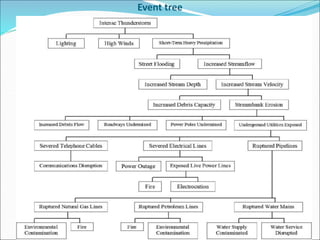
 Determine the secondary hazards
12/9/2022 @ Mohan Kumar Bera 9
Event tree
12/9/2022 @ Mohan Kumar Bera 10
How to prepare hazard profile?
 Hazard profile was designed by examining the physical
characteristics that natural hazards
 (Natural Hazards: Explanation and Integration by Graham A.
Tobin and Burrell E. Montz (1997)
 Hazard profile has grouped the various hazards into primary
and secondary hazards
 The hazards were classified on physical mechanisms, and
temporal and spatial distribution.
 Geographic area affected- measured in terms of magnitude.
 Previous occurrences within the state-measured in terms of
frequency
 Duration of event
 Countdown interval: measured by speed of onset
How to prepare hazard profile?
 Primary Hazards include: earthquakes, floods, and
wildfires
 Secondary Hazards include: Landslides, Tsunamis and
other human caused hazards
 To create the hazard profile some generalizations were made
about the hazards
 We need to group the hazards into broad categories to
simplify the profiling process
 For some hazards little information could be found on
specific physical processes. Therefore this profile should be
used as a guideline rather than an authority.
How to prepare hazard profile?
 For example, we grouped all types of landslides into one category, even
though the physical processes and impacts of a creep versus an avalanche can
be significantly different. However, by addressing landslides as an important
hazard, landslide specialists can then create a specific profile for each type of
landslide and consequent mitigation plans.
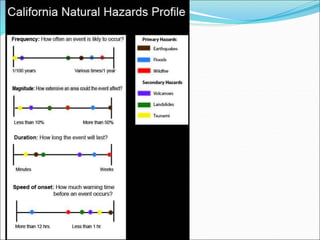
 For frequency, need to look at the average return period for the hazards
 Wildfires, floods and earthquakes have historically been the most frequent
hazards and happen on an annual basis. Tsunamis and volcanic eruptions are
far less frequent.
 For magnitude, need to use extent of area affected as a gauge of overall
power/energy of the event. Deaths and estimated costs are another way to
compare magnitudes however, since we grouped hazards into overall
categories these assumptions could not be made.
 Some generalizations need to make for speed of onset and duration of the
events.
 We no need to distinguish between river floods and flash floods or creeps and
avalanches. Volcanic eruptions can also vary significantly in their duration.
Challenges with Hazard Profiling
 Its easy to compare an earthquake in Japan to an
earthquake in California because they are measured using
similar metrics
 However, it is much more difficult to compare an
earthquake to a flood to a volcanic eruption as they all
have different impacts on society and have varying spatial
and temporal distributions
 In order to accurately rank multiple hazards on one scale
certain elements of the hazard become inaccurately
displayed or simply left out

hazard profile.ppt

  • 1.
     Course :HSS F363: Disaster and Development  Instructor: Mohan Kumar Bera Lecture 7 Date: 19th September, 2022
  • 2.
    What is theimpact of Hazard? 12/9/2022 2 @ Mohan Kumar Bera
  • 3.
    What is hazard? Hazard is a natural or human-driven event that could lead to a particular level of loss, damage and disruption  A hazard becomes a disaster when it strikes certain elements that are at risk.  Elements at risk are attributed by physical location, socio- economic structure and political situation and market and policy  Hazard can be natural, biological and social  Is hazard = Disaster ? 12/9/2022 3 @ Mohan Kumar Bera, PhD, India
  • 4.
    Hazard profile  Ahazard profile is a description and analysis of a specific type of local hazard  It is based on frequency, duration, and speed of onset of a hazard
  • 5.
    Purpose of hazardprofile  First to know what hazards exist and where they exist  Describes the hazard in its local context  Identify those hazards that are most likely to occur and that are most devastating should they occur  To plan for or prevent every possible contingency, so most government and other organized emergency management entities will focus their efforts upon those hazards  to identify every scenario that could possibly occur within a given community or country as result of its geologic, meteorological, hydrologic, biological, economic, technological, political, and social factors 12/9/2022 @ Mohan Kumar Bera 5
  • 6.
    Why is hazardprofiling important?  The traditional strategy for hazard planning has been on a hazard-by-hazard basis.  It was thought that each hazard was unique and therefore mitigation strategies should also be unique  A hazard profile compares the physical processes that all hazards share  By comparing the characteristics of hazard events decision makers are able to identify and rank the hazards that should be given the most attention and funding  For example, earthquakes, tsunamis and volcanic eruptions all occur with little warning time. Therefore a mitigation and response plan could be created for rapid onset hazards.
  • 7.
     Hazard assessmentthe actual physical hazards the expected secondary hazards  All hazards or understanding specific hazards?  Resources may be limited  Hazard specific expertise and equipment (capabilities) to address the unique response needs of certain hazards 12/9/2022 @ Mohan Kumar Bera 7
  • 8.
     Hazard analysis Identification methods of hazard profiling  Brainstorming : using own knowledge and experience to develop a list of possible hazards and effectiveness  Research of the country’s disaster and emergency history  Reviews of existing plans  Investigation of similar hazard identification efforts in neighboring countries  Using map  Interview with representatives from different communities and organisations  Site visit 12/9/2022 @ Mohan Kumar Bera 8
  • 9.
     Hazard profiling To analyze a hazard,  disaster managers must determine exactly how a hazard exists within the specific community or country  Each hazard is different in respect to climate, geography, settlement patterns, regional and local political factors.  Determine the secondary hazards 12/9/2022 @ Mohan Kumar Bera 9
  • 10.
    Event tree 12/9/2022 @Mohan Kumar Bera 10
  • 11.
    How to preparehazard profile?  Hazard profile was designed by examining the physical characteristics that natural hazards  (Natural Hazards: Explanation and Integration by Graham A. Tobin and Burrell E. Montz (1997)  Hazard profile has grouped the various hazards into primary and secondary hazards  The hazards were classified on physical mechanisms, and temporal and spatial distribution.  Geographic area affected- measured in terms of magnitude.  Previous occurrences within the state-measured in terms of frequency  Duration of event  Countdown interval: measured by speed of onset
  • 12.
    How to preparehazard profile?  Primary Hazards include: earthquakes, floods, and wildfires  Secondary Hazards include: Landslides, Tsunamis and other human caused hazards  To create the hazard profile some generalizations were made about the hazards  We need to group the hazards into broad categories to simplify the profiling process  For some hazards little information could be found on specific physical processes. Therefore this profile should be used as a guideline rather than an authority.
  • 13.
    How to preparehazard profile?  For example, we grouped all types of landslides into one category, even though the physical processes and impacts of a creep versus an avalanche can be significantly different. However, by addressing landslides as an important hazard, landslide specialists can then create a specific profile for each type of landslide and consequent mitigation plans.  For frequency, need to look at the average return period for the hazards  Wildfires, floods and earthquakes have historically been the most frequent hazards and happen on an annual basis. Tsunamis and volcanic eruptions are far less frequent.  For magnitude, need to use extent of area affected as a gauge of overall power/energy of the event. Deaths and estimated costs are another way to compare magnitudes however, since we grouped hazards into overall categories these assumptions could not be made.  Some generalizations need to make for speed of onset and duration of the events.  We no need to distinguish between river floods and flash floods or creeps and avalanches. Volcanic eruptions can also vary significantly in their duration.
  • 15.
    Challenges with HazardProfiling  Its easy to compare an earthquake in Japan to an earthquake in California because they are measured using similar metrics  However, it is much more difficult to compare an earthquake to a flood to a volcanic eruption as they all have different impacts on society and have varying spatial and temporal distributions  In order to accurately rank multiple hazards on one scale certain elements of the hazard become inaccurately displayed or simply left out