• The objective of collaborative
research agreement is to clarify
for both parties what they are
trying to accomplish together
and to clearly set forth the rules
that will govern the collaborative
effort.
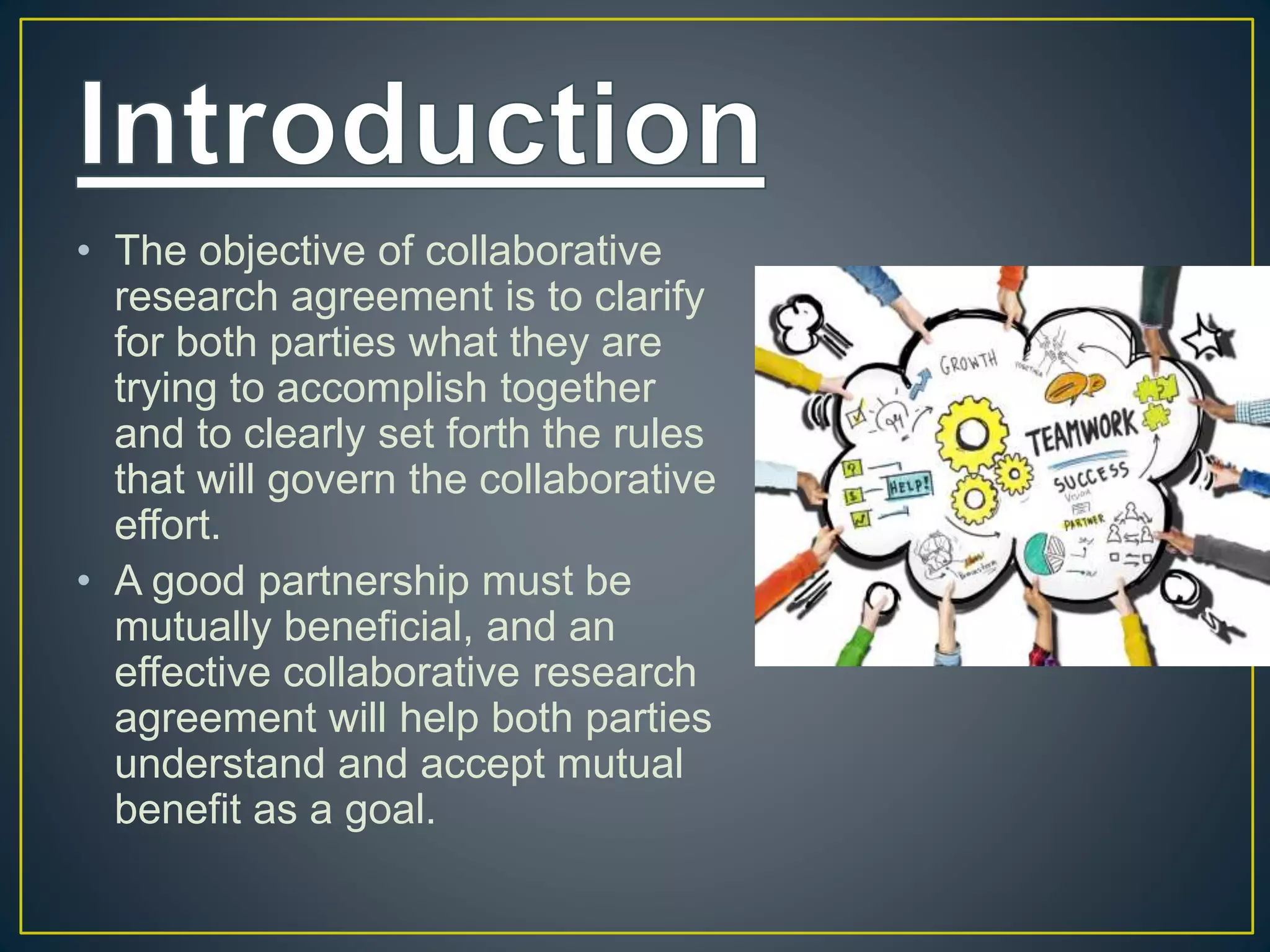
• A good partnership must be
mutually beneficial, and an
effective collaborative research
agreement will help both parties
understand and accept mutual
benefit as a goal.
• Of course, simply writing that an agreement is
mutually beneficial does not make it so. An
effective agreement must be based on an actual
win-win relationship, one that is truly mutually
beneficial. So to start with, the concept of the
collaborative research project must involve a
research project through which both parties
benefit from the work that will be done
(1) statement of objectives,
(2) statement of work,
(3) general provisions,
(4) budget, and
(5) list of materials..
• should be concise and clear.
• Use terms that nonscientists will readily understand and avoid
the excessive use of scientific jargon.
• explain the real-world issues that the collaborative research
agreement will address.
• should articulate both the what and the why of the
collaboration.
• When someone outside of the science community reads the
agreement, they should be able to tell why the parties believe
it is important to undertake the collaboration.
• should clearly specify the scientific goals of the collaboration.
.
• statement of work is attached to the agreement as an
appendix. In drafting this section of a collaborative
research agreement, the parties must work together
closely.
• The statement of work contains the scientific objectives,
methodologies, and approaches.
• It should be broken down into subsections, with each
section explaining what “partner A” will do and what
“partner B” will do, with the time frames and benchmarks
specifically laid out.
• should be followed by a description of the methodologies
and approaches to be used to address the scientific
questions involved.
• consider is to quantify the work that is to be done
• is the body of the agreement that covers the how of
working together and provides mechanistic guidance to
the scientists at the institute and at the company, as well
as to managers.
• Normally, an institute or an entity has a standardized set
of general provisions that has been reviewed by their
legal counsel and that can serve as a starting point for
negotiating agreements.
• a person can often begin to fully understand which
points are negotiable and which legal provisions are
required by organization policy or law. At the same time,
collaborative research agreements should be as user-
friendly as possible and avoid unnecessary stipulations.
• There are a wide range of typical
general provisions. These include a
public disclosure/ publication policy,
which addresses how the parties will
communicate with each other and the
outside world; reports; confidentiality
issues;
the important issues of intellectual property management and
technology transfer from the institute to the company;
regulatory approvals; indemnity and liability statements;
dispute resolution plans; and provisions for termination. This
part of the agreement should also spell out an amendment
procedure and name the persons responsible for the
agreement, both managerially and scientifically, at the
institute and the company.
• Public disclosure is a crucial part of any research
agreement. Science is driven by the need to publish, and
scientific careers depend on such publications. Public
disclosure, including publication in patent literature, keeps
innovation going. The phrase public disclosure is a broad
term that includes many types of disclosure of research
results. Public disclosure can include any form of public
dissemination of research results: articles, abstracts, poster
sessions, both informal and formal seminars, talks,
information posted on the Internet, and grant applications.
Most organizations that enter into collaborative research
agreements will want to put some limitations on the right to
public disclosure. Such a delay in public disclosure may be
necessary to ensure that patent applications can be filed for
• Confidential information, sometimes called confidential business
information, or CBI.
• It is important for the collaborative research agreement to
differentiate between two types:
• (1) confidential information that a party brings into the project and
that predates the agreement,
• (2) confidential information that is generated under the agreement
and that the parties generated while working together and
conducting project experiments. A collaborative research
agreement should specify how both types of information are to be
handled by the parties.
• The confidential treatment of information generated under the
project will be closely tied to the treatment of intellectual property
(ip) and tangible property
• Intellectual property and tangible property (TP) provisions.
• Motivates most collaborative research is the potential for
gaining access to such ip/tp as may be created under the
collaborative research agreement.
• For an institute, working with a company is an effective way to
transfer technology. Many believe that it is the most effective
and efficient way for research results to move from the
laboratory, through a development process by the company
partner, and finally into the marketplace. Without such
provisions, the benefits of collaboration may be lost.
• It is not unusual for a collaborative research agreement to be
amended as often as every six months or every year. This is because
the researchers often identify dynamic, new opportunities that the
partners want to explore together.
• Thus, a well-written agreement can be amended so that the
statement of objectives, the statement of work, and the budget reflect
the new needs.
All amendments should in writing and signed by the proper
authorities as an appendix to the agreement. Guard against informal
amendments that may sneak in as the project gains momentum and
the researchers become excited. If they are not written down, such
amendments can lead to disputes and litigation. So make it clear to
everyone that all significant changes in the research must be written
Strong partnerships grow and change; therefore,
agreements need to be amended.
In fact, many of the best collaborative research
agreements need constant amendments.
• All agreements should have a specific date upon which
the cooporation ends. Termination clauses may be added
that stipulate when and under what conditions each party
may elect to terminate the agreement before the end
date. The end date may be extended through the
amendment process, if both parties agree. This is
common in successful collaborations.
• There is a tendency to view this as the most important
section because it documents the funding that the parties
contribute. This, however, is an improper emphasis.
• Concentrating only on research funding overlooks both the
use of the agreement as a means of technology transfer and
as a way to build an intellectual synergism that can result
when researchers collaborate.
• Developing the budget must begin with a clear statement of
work. This will help determine for the collaborators the
amount and the timing of the resources required for the
collaborative project. This is the starting point. There must be
enough funding to undertake the project without detracting
from other projects that are already underway.
• They are not new TP that will be divided according to the
granting clauses. Rather, materials that are included in the
list of materials are fully owned by one of the
collaborators. Sometimes items listed in the list of
materials have IP rights associated with them; sometimes
they do not.
• In truly collaborative research, the list of materials may
have to be amended on a regular basis. This will require
the agreement to be amended easily (as noted above). A
well-written collaborative research agreement, the list of
As with the budget, this section provides a clear listing
of the TP that each party provides to the project. This is
critical because all such materials were developed
outside of the project and are owned by one partner or
the other.
• Collaborative research agreements can be extremely
beneficial to both partners. No single entity ever has
adequate money, resources, and intellectual capacity to
do all the research it might want to do. Forming
partnerships can be an effective and economical way of
accessing resources. Collaborative research
agreements, moreover, are often the first step in
establishing longer-term partnerships. They can be
effective technology transfer tools, as well. The benefits
are much more than monetary. Taking the time to think
through and discuss the terms of the collaborative
research agreement helps foster communication between
partners and sets the project on a path for success.
Indeed, good partnerships spur creativity and help
innovation to serve the public welfare.

Collabarative research agreement

  • 2.
    • The objectiveof collaborative research agreement is to clarify for both parties what they are trying to accomplish together and to clearly set forth the rules that will govern the collaborative effort. • A good partnership must be mutually beneficial, and an effective collaborative research agreement will help both parties understand and accept mutual benefit as a goal.
  • 3.
    • Of course,simply writing that an agreement is mutually beneficial does not make it so. An effective agreement must be based on an actual win-win relationship, one that is truly mutually beneficial. So to start with, the concept of the collaborative research project must involve a research project through which both parties benefit from the work that will be done
  • 6.
    (1) statement ofobjectives, (2) statement of work, (3) general provisions, (4) budget, and (5) list of materials..
  • 7.
    • should beconcise and clear. • Use terms that nonscientists will readily understand and avoid the excessive use of scientific jargon. • explain the real-world issues that the collaborative research agreement will address. • should articulate both the what and the why of the collaboration. • When someone outside of the science community reads the agreement, they should be able to tell why the parties believe it is important to undertake the collaboration. • should clearly specify the scientific goals of the collaboration. .
  • 8.
    • statement ofwork is attached to the agreement as an appendix. In drafting this section of a collaborative research agreement, the parties must work together closely. • The statement of work contains the scientific objectives, methodologies, and approaches. • It should be broken down into subsections, with each section explaining what “partner A” will do and what “partner B” will do, with the time frames and benchmarks specifically laid out. • should be followed by a description of the methodologies and approaches to be used to address the scientific questions involved. • consider is to quantify the work that is to be done
  • 9.
    • is thebody of the agreement that covers the how of working together and provides mechanistic guidance to the scientists at the institute and at the company, as well as to managers. • Normally, an institute or an entity has a standardized set of general provisions that has been reviewed by their legal counsel and that can serve as a starting point for negotiating agreements. • a person can often begin to fully understand which points are negotiable and which legal provisions are required by organization policy or law. At the same time, collaborative research agreements should be as user- friendly as possible and avoid unnecessary stipulations.
  • 10.
    • There area wide range of typical general provisions. These include a public disclosure/ publication policy, which addresses how the parties will communicate with each other and the outside world; reports; confidentiality issues; the important issues of intellectual property management and technology transfer from the institute to the company; regulatory approvals; indemnity and liability statements; dispute resolution plans; and provisions for termination. This part of the agreement should also spell out an amendment procedure and name the persons responsible for the agreement, both managerially and scientifically, at the institute and the company.
  • 11.
    • Public disclosureis a crucial part of any research agreement. Science is driven by the need to publish, and scientific careers depend on such publications. Public disclosure, including publication in patent literature, keeps innovation going. The phrase public disclosure is a broad term that includes many types of disclosure of research results. Public disclosure can include any form of public dissemination of research results: articles, abstracts, poster sessions, both informal and formal seminars, talks, information posted on the Internet, and grant applications. Most organizations that enter into collaborative research agreements will want to put some limitations on the right to public disclosure. Such a delay in public disclosure may be necessary to ensure that patent applications can be filed for
  • 12.
    • Confidential information,sometimes called confidential business information, or CBI. • It is important for the collaborative research agreement to differentiate between two types: • (1) confidential information that a party brings into the project and that predates the agreement, • (2) confidential information that is generated under the agreement and that the parties generated while working together and conducting project experiments. A collaborative research agreement should specify how both types of information are to be handled by the parties. • The confidential treatment of information generated under the project will be closely tied to the treatment of intellectual property (ip) and tangible property
  • 13.
    • Intellectual propertyand tangible property (TP) provisions. • Motivates most collaborative research is the potential for gaining access to such ip/tp as may be created under the collaborative research agreement. • For an institute, working with a company is an effective way to transfer technology. Many believe that it is the most effective and efficient way for research results to move from the laboratory, through a development process by the company partner, and finally into the marketplace. Without such provisions, the benefits of collaboration may be lost.
  • 14.
    • It isnot unusual for a collaborative research agreement to be amended as often as every six months or every year. This is because the researchers often identify dynamic, new opportunities that the partners want to explore together. • Thus, a well-written agreement can be amended so that the statement of objectives, the statement of work, and the budget reflect the new needs. All amendments should in writing and signed by the proper authorities as an appendix to the agreement. Guard against informal amendments that may sneak in as the project gains momentum and the researchers become excited. If they are not written down, such amendments can lead to disputes and litigation. So make it clear to everyone that all significant changes in the research must be written Strong partnerships grow and change; therefore, agreements need to be amended. In fact, many of the best collaborative research agreements need constant amendments.
  • 15.
    • All agreementsshould have a specific date upon which the cooporation ends. Termination clauses may be added that stipulate when and under what conditions each party may elect to terminate the agreement before the end date. The end date may be extended through the amendment process, if both parties agree. This is common in successful collaborations.
  • 16.
    • There isa tendency to view this as the most important section because it documents the funding that the parties contribute. This, however, is an improper emphasis. • Concentrating only on research funding overlooks both the use of the agreement as a means of technology transfer and as a way to build an intellectual synergism that can result when researchers collaborate. • Developing the budget must begin with a clear statement of work. This will help determine for the collaborators the amount and the timing of the resources required for the collaborative project. This is the starting point. There must be enough funding to undertake the project without detracting from other projects that are already underway.
  • 17.
    • They arenot new TP that will be divided according to the granting clauses. Rather, materials that are included in the list of materials are fully owned by one of the collaborators. Sometimes items listed in the list of materials have IP rights associated with them; sometimes they do not. • In truly collaborative research, the list of materials may have to be amended on a regular basis. This will require the agreement to be amended easily (as noted above). A well-written collaborative research agreement, the list of As with the budget, this section provides a clear listing of the TP that each party provides to the project. This is critical because all such materials were developed outside of the project and are owned by one partner or the other.
  • 19.
    • Collaborative researchagreements can be extremely beneficial to both partners. No single entity ever has adequate money, resources, and intellectual capacity to do all the research it might want to do. Forming partnerships can be an effective and economical way of accessing resources. Collaborative research agreements, moreover, are often the first step in establishing longer-term partnerships. They can be effective technology transfer tools, as well. The benefits are much more than monetary. Taking the time to think through and discuss the terms of the collaborative research agreement helps foster communication between partners and sets the project on a path for success. Indeed, good partnerships spur creativity and help innovation to serve the public welfare.