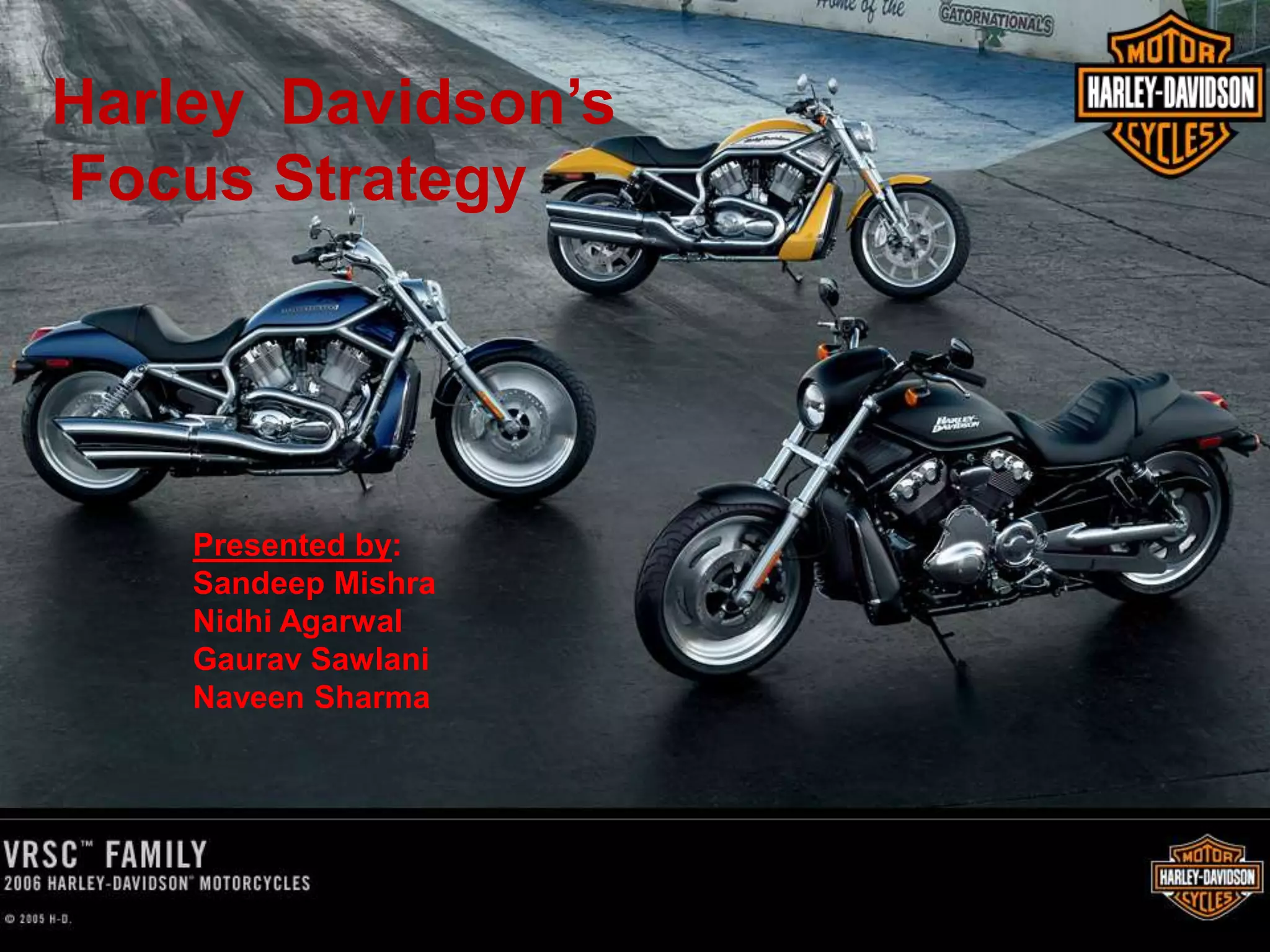
Harley Davidson’s
Focus Strategy
Presented by:
Sandeep Mishra
Nidhi Agarwal
Gaurav Sawlani
Naveen Sharma
Vision
• “We fulfil dreams inspired by the many roads of the
world by providing extraordinary motorcycles and
customer experiences. We fuel the passion for freedom
in our customers to express their own individuality.”
Mission
• We ride with our customers and apply this deep
connection in every market we serve to create superior
value for all of our stakeholders.”
Focused differentiation
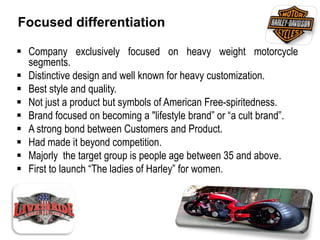
 Company exclusively focused on heavy weight motorcycle
segments.
 Distinctive design and well known for heavy customization.
 Best style and quality.
 Not just a product but symbols of American Free-spiritedness.
 Brand focused on becoming a "lifestyle brand” or “a cult brand”.
 A strong bond between Customers and Product.
 Had made it beyond competition.
 Majorly the target group is people age between 35 and above.
 First to launch “The ladies of Harley” for women.
SWOT Analysis
Strength
Strong marketing
Product Quality
Brand Recognition
Trademark Licensing
Supplier relationship
Designer Store
Service
Distribution Channel
Wow Biking experience
Weakness
Price factor
Brain drain
Reliant on few
suppliers
Market share
Ongoing capacity
constraints
Lengthy lead time
Threats
Harleys ongoing
capacity
restraints
Loss in domestic
market share in
recent years
Competitors of
Harley Davidson
Environmental
protection laws
Higher production
Opportunities
The international
market is now
larger than the U.
S.
Customers value
quality parts.
Women and
younger riders are
increasing
becoming
interested in
Trouble Ride
• 2008 Global recession sales fell by 29.9%.
• Tough competition from Japanese side.
• Losing aging customers i.e Baby Boomers
• Revenue fell by 17.1% i.e US$ 3.57 billon
Delivering Results Through Focus
• For Productivity and Profitability.
• Plan for sustained long-term growth.
Basic pillars of this strategy
 Continuous improvement
 Leadership development
 Sustainability
Objective
“To increase sales to its core customers and expand
strength”.
Intensıve Strategıes
Market Development
• Harley-Davidson can bring in
their vehicle to Asian countries
(India, China), because these
countries have a high
population and the market
potential is also high.
• The cost to bring in the old
vehicles (old product) to India
is so much difficult:
- There are so much
environmental laws
-Taxes are problems
-Levis are high in India
• So starting new plant in
India can solve this problem.
Negotiations with the
Government can solve these
problems
Product Development
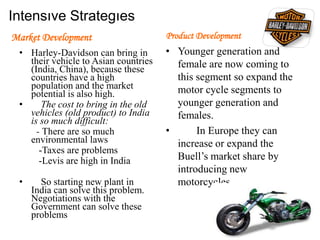
• Younger generation and
female are now coming to
this segment so expand the
motor cycle segments to
younger generation and
females.
• In Europe they can
increase or expand the
Buell’s market share by
introducing new
motorcycles.
Expanding Global footprints
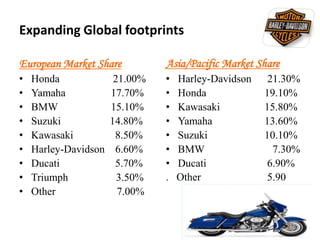
European Market Share
• Honda 21.00%
• Yamaha 17.70%
• BMW 15.10%
• Suzuki 14.80%
• Kawasaki 8.50%
• Harley-Davidson 6.60%
• Ducati 5.70%
• Triumph 3.50%
• Other 7.00%
Asia/Pacific Market Share
• Harley-Davidson 21.30%
• Honda 19.10%
• Kawasaki 15.80%
• Yamaha 13.60%
• Suzuki 10.10%
• BMW 7.30%
• Ducati 6.90%
. Other 5.90
Conclusion
• Harley- Davidson have to change American culture and helped the future of
motorized vehicles.
• Must implement latest technology & facilities.
• Loyal customers are not sufficient for company to survive.
• “it’’s a journey but not a destination”
Possible strategies
Expand into Foreign Markets
• Asia
• Europe
Product Development
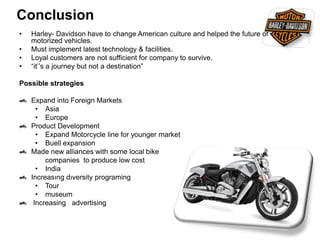
• Expand Motorcycle line for younger market
• Buell expansion
Made new alliances with some local bike
companies to produce low cost
• India
Increasıng dıversity programing
• Tour
• museum
Increasing advertising
Harley davidson case

Harley davidson case

  • 1.
    Harley Davidson’s Focus Strategy Presentedby: Sandeep Mishra Nidhi Agarwal Gaurav Sawlani Naveen Sharma
  • 2.
    Vision • “We fulfildreams inspired by the many roads of the world by providing extraordinary motorcycles and customer experiences. We fuel the passion for freedom in our customers to express their own individuality.” Mission • We ride with our customers and apply this deep connection in every market we serve to create superior value for all of our stakeholders.”
  • 3.
    Focused differentiation  Companyexclusively focused on heavy weight motorcycle segments.  Distinctive design and well known for heavy customization.  Best style and quality.  Not just a product but symbols of American Free-spiritedness.  Brand focused on becoming a "lifestyle brand” or “a cult brand”.  A strong bond between Customers and Product.  Had made it beyond competition.  Majorly the target group is people age between 35 and above.  First to launch “The ladies of Harley” for women.
  • 4.
    SWOT Analysis Strength Strong marketing ProductQuality Brand Recognition Trademark Licensing Supplier relationship Designer Store Service Distribution Channel Wow Biking experience Weakness Price factor Brain drain Reliant on few suppliers Market share Ongoing capacity constraints Lengthy lead time
  • 5.
    Threats Harleys ongoing capacity restraints Loss indomestic market share in recent years Competitors of Harley Davidson Environmental protection laws Higher production Opportunities The international market is now larger than the U. S. Customers value quality parts. Women and younger riders are increasing becoming interested in
  • 6.
    Trouble Ride • 2008Global recession sales fell by 29.9%. • Tough competition from Japanese side. • Losing aging customers i.e Baby Boomers • Revenue fell by 17.1% i.e US$ 3.57 billon
  • 7.
    Delivering Results ThroughFocus • For Productivity and Profitability. • Plan for sustained long-term growth. Basic pillars of this strategy  Continuous improvement  Leadership development  Sustainability Objective “To increase sales to its core customers and expand strength”.
  • 8.
    Intensıve Strategıes Market Development •Harley-Davidson can bring in their vehicle to Asian countries (India, China), because these countries have a high population and the market potential is also high. • The cost to bring in the old vehicles (old product) to India is so much difficult: - There are so much environmental laws -Taxes are problems -Levis are high in India • So starting new plant in India can solve this problem. Negotiations with the Government can solve these problems Product Development • Younger generation and female are now coming to this segment so expand the motor cycle segments to younger generation and females. • In Europe they can increase or expand the Buell’s market share by introducing new motorcycles.
  • 9.
    Expanding Global footprints EuropeanMarket Share • Honda 21.00% • Yamaha 17.70% • BMW 15.10% • Suzuki 14.80% • Kawasaki 8.50% • Harley-Davidson 6.60% • Ducati 5.70% • Triumph 3.50% • Other 7.00% Asia/Pacific Market Share • Harley-Davidson 21.30% • Honda 19.10% • Kawasaki 15.80% • Yamaha 13.60% • Suzuki 10.10% • BMW 7.30% • Ducati 6.90% . Other 5.90
  • 11.
    Conclusion • Harley- Davidsonhave to change American culture and helped the future of motorized vehicles. • Must implement latest technology & facilities. • Loyal customers are not sufficient for company to survive. • “it’’s a journey but not a destination” Possible strategies Expand into Foreign Markets • Asia • Europe Product Development • Expand Motorcycle line for younger market • Buell expansion Made new alliances with some local bike companies to produce low cost • India Increasıng dıversity programing • Tour • museum Increasing advertising