NABEEL AKRAM
JIBIN BALACHANDRAN
AATHIRA MOHANDAS
VAISAKH VTR
JOSHEME JOSE Live to Ride, Ride to Live
HARLEY DAVIDSON - HISTORY
1901
Arthur Davidson and William.S. Harley developed their
own motorcycle.
They fixed two-horsepower engines on a modified bicycle
frame.
They were able to produce and sell three of their
motorcycles, at the end of that year.
Walter Davidson joined his brother and Harley to help
assemble and race company’s motorcycles.
•1907
• The company developed pretty good reputation in motorcycle racing with
many wins in Milwaukee races.
•1909
• Harley-Davidson developed more powerful seven-horse power motorcycle
engine
• 17,000 motorcycles were produced for U.S. Military, as is had
stronger engine and it became the largest motorcycle producer in the
World.
• Harley-Davidson continued
to win races but its reputation
began to erode after its
acquisition by AMF
• There was no buyers after that and Harley-Davidson struggled under a
heavy debt load and was bankrupt within four hours in 1985.
• The new capacity allowed Harley-Davidson to set production records
each year during the
early 2000s
PESTLE ANALYSIS
Political
• Impact of World War 1: US military required a lot of weapons and
vehicles.
• Impact of World War 2: US military demanded Harley Davison’s
motorcycles to be stationed again.
• US also imposed tariffs on imported 650+cc Japanese motorcycles.
PESTLE ANALYSIS
Economy
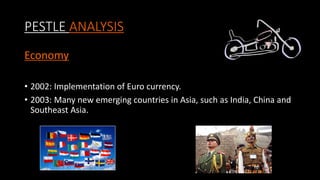
• 2002: Implementation of Euro currency.
• 2003: Many new emerging countries in Asia, such as India, China and
Southeast Asia.
PESTLE ANALYSIS
• Society
• After World War 2, the demand for motorcycles in various developed
countries grew considerably.
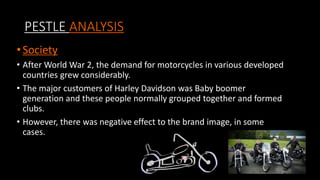
• The major customers of Harley Davidson was Baby boomer
generation and these people normally grouped together and formed
clubs.
• However, there was negative effect to the brand image, in some
cases.
PESTLE ANALYSIS
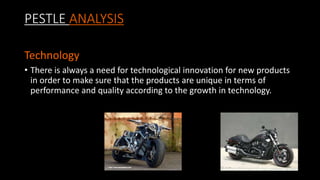
Technology
• There is always a need for technological innovation for new products
in order to make sure that the products are unique in terms of
performance and quality according to the growth in technology.
PESTLE ANALYSIS
Legal
• As concern for environment increases, there would be more laws and
regulations to enforce the producers to develop their products to
reach the standards.
• The difficulty to obtain driving license for motorcycles in many
European nations.
• Harley-Davidson is facing some legal problems in Asian countries. In
India there is 60% tariff and various other taxes will cause the price of
the bike to double.
PESTLE ANALYSIS
Environment
• Motorcycles consume gasoline and release carbon di oxide back to
the atmosphere, which harms the environment. Sometimes, there
would be regulations. And this forces the producers to comply with
them in order to protect environment.
• Noise pollution and some emission standards of Harley-Davidson bike
is not up to the level of some countries across the globe.
SWOTH ANALYSIS
Strengths
• Only major American motorcycle manufacturer
• Operation in two segments
• Strong “ BRAND EQUITY” & “ CUSTOMER LOYALTY BASE”.
• Social Media marketing
• Good Market Division
Weakness
• Dependence on the US Market
• Highly priced compared to other cruiser motorcycles
• Losing market share
• Ineffective marketing campaign
• Lack of opportunity for advancements
Opportunities
• Market share increasing in Europe and Asia
• Increasing demand in US markets for bikes.
• Industry registration of domestic weight motorcycles are increasing.
• Asian economy is booming
• Harley-Davidson have strong R&D
Threats
• The rising input costs
• Relies on suppliers to obtain raw materials
• Hike in oil prices ( Mileage )
• International importing Tax & increase in labour cost
• Competitors have larger financial & marketing resources.
POTTER’S FIVE FORCES - Rivalry
• Four Main Competitors in Heavy weight motorcycle segment:
• Harley Davidson
• Yamaha
• Suzuki
• Honda
• These competitors have there income diversified
• Honda eating up Harleys share in US
• Suzuki – Kawazaki alliance strengthens both company globally
(product development, design, engineering and manufacturing)
POTTER’S FIVE FORCES - New Entrants
• Lot of Capital Requirement
• Economy of scale is low
• Small scale custom made production creating interest among bike
lovers.
POTTER’S FIVE FORCES - Substitute Product
• Passenger car, sports bikes, scooter bikes.
• In India Royal Enfield can pose as a small substitute.
• Harley-Davidson motorcycles are a luxury vehicle, so that there is only
a few close substitutes.
POTTER’S FIVE FORCES - Bargaining power of
supplier
• Steel, basic electrical equipment's and shipping of final motorcycles.
• Harley-Davidson has a wide span of supplier
• Assembly is done within the company
POTTER’S FIVE FORCES - Bargaining power of
buyer
• Consumers of Harley-Davidson motorcycles are individual customers
finance is not an issue.
• The numbers of dealers around the globe are also less and they are
also mainly depended on Single dealer.
• Customers had a lot of choices in the market.
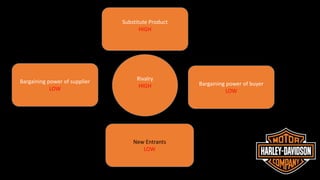
Bargaining power of buyer
LOW
Rivalry
HIGH
New Entrants
LOW
Bargaining power of supplier
LOW
Substitute Product
HIGH
VALUE CHAIN
Supply chain management
• Follows JIT process
• Raw material from nearby sources
• Strategic Sourcing policies were used to prove custom products
Operations
• The famous V-TWIN engine and dual crankpin design gives
exceptional power and sound
• Only produces motor bikes above 651cc
• Do not produce dirt bikes and performance bikes
• The product line is classified mainly in to 5 families- Sportster, Dyna
Glide, Softail, Touring, and the VRSC-Vrod.
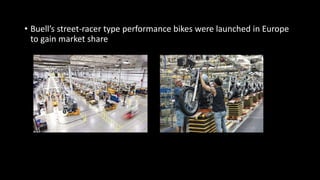
• Buell’s street-racer type performance bikes were launched in Europe
to gain market share
Distribution
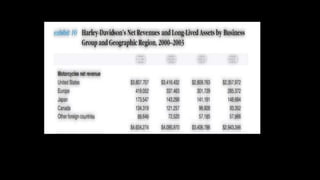
• In 2003, 644 dealers in USA
• 76 dealers in Canada
• 161 dealers in Asia and was sold in 17 Latin American countries
• Showrooms also sold acceries
Sales and marketing
• After LBO they started using Japanese management techniques and
less reliability on advertisements and more emphasis on motorcycle
rallies
• Introduction of HOGs( Harley Owners Group) in 1983
• Increasing the number of dealers to penetrate to new markets
• Harley showrooms offered a large assortment of clothing items and
such accessories
• Around 17000 dealers took training from HDU in 2002
• Online training was given to the staff
• Third parties like eagle rider and dealers also started
renting out bikes
Service
• Service in USA was good but foreign countries lacked in service
quality
• 7% increase in sales to women after introduction of 25% training
program in 2003
Profit margin
• In 2004 the company celebrated record shipment, revenue and profit
• Annual revenue of $4.6 billion and profit of $761 million
5 Generic strategy
• Differentiation strategy
( Harley Davidson is in the business of selling lifestyle , not
transportation )
• Customized Design and Technology
( latest cutting edge equipment )
• Live experience effectively portray Unique selling
feature
• The origins of Harley Davidson bikes and the apparent dreams and
lifestyle that was sold to customers along with their purchase.
Recommendation
• Increase in the no. of market shares in the existing market like US, UK
and Japan.
• Expansion in European & Asian market, introducing their products in
new markets like China, India etc. is a good choice.
• Bringing in new types of recreation vehicles into the market
• Increase in sales of Buell Sport Bike for younger and female
Customer.
• Conducting rallies and other promotional activities
Conclusion
• Harley Davidson remains to be among the market leaders in the
America
• Trend of Heavy weight body is going down
• International Exposure is essential as it will open new sources of cash
flow for the company
THANKS TO ALL

Harley Davidson _ strategy managment

  • 1.
    NABEEL AKRAM JIBIN BALACHANDRAN AATHIRAMOHANDAS VAISAKH VTR JOSHEME JOSE Live to Ride, Ride to Live
  • 2.
    HARLEY DAVIDSON -HISTORY 1901 Arthur Davidson and William.S. Harley developed their own motorcycle. They fixed two-horsepower engines on a modified bicycle frame. They were able to produce and sell three of their motorcycles, at the end of that year. Walter Davidson joined his brother and Harley to help assemble and race company’s motorcycles.
  • 3.
    •1907 • The companydeveloped pretty good reputation in motorcycle racing with many wins in Milwaukee races. •1909 • Harley-Davidson developed more powerful seven-horse power motorcycle engine
  • 4.
    • 17,000 motorcycleswere produced for U.S. Military, as is had stronger engine and it became the largest motorcycle producer in the World. • Harley-Davidson continued to win races but its reputation began to erode after its acquisition by AMF
  • 5.
    • There wasno buyers after that and Harley-Davidson struggled under a heavy debt load and was bankrupt within four hours in 1985. • The new capacity allowed Harley-Davidson to set production records each year during the early 2000s
  • 6.
    PESTLE ANALYSIS Political • Impactof World War 1: US military required a lot of weapons and vehicles. • Impact of World War 2: US military demanded Harley Davison’s motorcycles to be stationed again. • US also imposed tariffs on imported 650+cc Japanese motorcycles.
  • 7.
    PESTLE ANALYSIS Economy • 2002:Implementation of Euro currency. • 2003: Many new emerging countries in Asia, such as India, China and Southeast Asia.
  • 8.
    PESTLE ANALYSIS • Society •After World War 2, the demand for motorcycles in various developed countries grew considerably. • The major customers of Harley Davidson was Baby boomer generation and these people normally grouped together and formed clubs. • However, there was negative effect to the brand image, in some cases.
  • 9.
    PESTLE ANALYSIS Technology • Thereis always a need for technological innovation for new products in order to make sure that the products are unique in terms of performance and quality according to the growth in technology.
  • 10.
    PESTLE ANALYSIS Legal • Asconcern for environment increases, there would be more laws and regulations to enforce the producers to develop their products to reach the standards. • The difficulty to obtain driving license for motorcycles in many European nations. • Harley-Davidson is facing some legal problems in Asian countries. In India there is 60% tariff and various other taxes will cause the price of the bike to double.
  • 11.
    PESTLE ANALYSIS Environment • Motorcyclesconsume gasoline and release carbon di oxide back to the atmosphere, which harms the environment. Sometimes, there would be regulations. And this forces the producers to comply with them in order to protect environment. • Noise pollution and some emission standards of Harley-Davidson bike is not up to the level of some countries across the globe.
  • 12.
  • 13.
    Strengths • Only majorAmerican motorcycle manufacturer • Operation in two segments • Strong “ BRAND EQUITY” & “ CUSTOMER LOYALTY BASE”. • Social Media marketing • Good Market Division
  • 14.
    Weakness • Dependence onthe US Market • Highly priced compared to other cruiser motorcycles • Losing market share • Ineffective marketing campaign • Lack of opportunity for advancements
  • 15.
    Opportunities • Market shareincreasing in Europe and Asia • Increasing demand in US markets for bikes. • Industry registration of domestic weight motorcycles are increasing. • Asian economy is booming • Harley-Davidson have strong R&D
  • 16.
    Threats • The risinginput costs • Relies on suppliers to obtain raw materials • Hike in oil prices ( Mileage ) • International importing Tax & increase in labour cost • Competitors have larger financial & marketing resources.
  • 17.
    POTTER’S FIVE FORCES- Rivalry • Four Main Competitors in Heavy weight motorcycle segment: • Harley Davidson • Yamaha • Suzuki • Honda • These competitors have there income diversified • Honda eating up Harleys share in US • Suzuki – Kawazaki alliance strengthens both company globally (product development, design, engineering and manufacturing)
  • 18.
    POTTER’S FIVE FORCES- New Entrants • Lot of Capital Requirement • Economy of scale is low • Small scale custom made production creating interest among bike lovers.
  • 19.
    POTTER’S FIVE FORCES- Substitute Product • Passenger car, sports bikes, scooter bikes. • In India Royal Enfield can pose as a small substitute. • Harley-Davidson motorcycles are a luxury vehicle, so that there is only a few close substitutes.
  • 20.
    POTTER’S FIVE FORCES- Bargaining power of supplier • Steel, basic electrical equipment's and shipping of final motorcycles. • Harley-Davidson has a wide span of supplier • Assembly is done within the company
  • 21.
    POTTER’S FIVE FORCES- Bargaining power of buyer • Consumers of Harley-Davidson motorcycles are individual customers finance is not an issue. • The numbers of dealers around the globe are also less and they are also mainly depended on Single dealer. • Customers had a lot of choices in the market.
  • 22.
    Bargaining power ofbuyer LOW Rivalry HIGH New Entrants LOW Bargaining power of supplier LOW Substitute Product HIGH
  • 23.
  • 24.
    Supply chain management •Follows JIT process • Raw material from nearby sources • Strategic Sourcing policies were used to prove custom products
  • 25.
    Operations • The famousV-TWIN engine and dual crankpin design gives exceptional power and sound • Only produces motor bikes above 651cc • Do not produce dirt bikes and performance bikes • The product line is classified mainly in to 5 families- Sportster, Dyna Glide, Softail, Touring, and the VRSC-Vrod.
  • 26.
    • Buell’s street-racertype performance bikes were launched in Europe to gain market share
  • 27.
    Distribution • In 2003,644 dealers in USA • 76 dealers in Canada • 161 dealers in Asia and was sold in 17 Latin American countries • Showrooms also sold acceries
  • 29.
    Sales and marketing •After LBO they started using Japanese management techniques and less reliability on advertisements and more emphasis on motorcycle rallies • Introduction of HOGs( Harley Owners Group) in 1983 • Increasing the number of dealers to penetrate to new markets • Harley showrooms offered a large assortment of clothing items and such accessories
  • 30.
    • Around 17000dealers took training from HDU in 2002 • Online training was given to the staff • Third parties like eagle rider and dealers also started renting out bikes
  • 31.
    Service • Service inUSA was good but foreign countries lacked in service quality • 7% increase in sales to women after introduction of 25% training program in 2003
  • 32.
    Profit margin • In2004 the company celebrated record shipment, revenue and profit • Annual revenue of $4.6 billion and profit of $761 million
  • 33.
    5 Generic strategy •Differentiation strategy ( Harley Davidson is in the business of selling lifestyle , not transportation ) • Customized Design and Technology ( latest cutting edge equipment ) • Live experience effectively portray Unique selling feature • The origins of Harley Davidson bikes and the apparent dreams and lifestyle that was sold to customers along with their purchase.
  • 34.
    Recommendation • Increase inthe no. of market shares in the existing market like US, UK and Japan. • Expansion in European & Asian market, introducing their products in new markets like China, India etc. is a good choice. • Bringing in new types of recreation vehicles into the market • Increase in sales of Buell Sport Bike for younger and female Customer. • Conducting rallies and other promotional activities
  • 35.
    Conclusion • Harley Davidsonremains to be among the market leaders in the America • Trend of Heavy weight body is going down • International Exposure is essential as it will open new sources of cash flow for the company
  • 36.

Editor's Notes

  • #18 Yamaha 50% revenue from automobile
  • #20 The people who are thinking of buying a heavy weight motor cycle are not seriously considering one of these options, scooter, sportsbike.