Andre de Mezerville
Craig Domagala
Sonya Frederick
Eddie Stanislawski
Darrick Wesson
James Wood
GROUP TWO
Corporate History
Strategic Overview
Internal Analysis
External Analysis
Strategic Recommendations
Sustainable Competitive Advantage
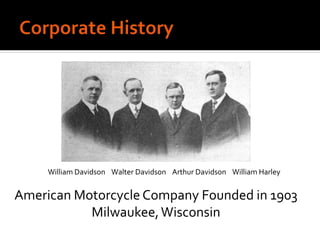
William Davidson Walter Davidson Arthur Davidson William Harley
American Motorcycle Company Founded in 1903
Milwaukee,Wisconsin
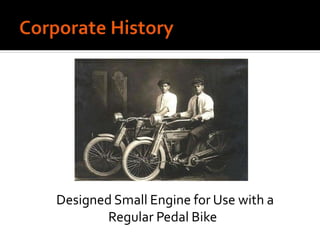
Designed Small Engine for Use with a
Regular Pedal Bike
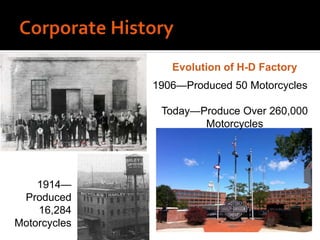
Evolution of H-D Factory
1906—Produced 50 Motorcycles
Today—Produce Over 260,000
Motorcycles
1914—
Produced
16,284
Motorcycles
 1907
 The Harley-Davidson Motor Company Incorporated
 1909
 Developed FirstV-Twin Powered Motorcycle
 1910
 Introduced Bar & Shield Logo
 Dealer Network of 200+ in United States
 1920’s
 Officially Largest Motorcycle Manufacturer inWorld
 2,000 Dealers in 67 Countries
 1953
 H-D Sole American Manufacturer of Heavyweight
Motorcycles When Indian Motorcycle Company
Went out of Business
 Late 1950’s
 Japanese Motorcycle Manufacturers Entered US
Market
 Late 1960’s
 Japanese Motorcycles Grew to 85% of Market
Share
 1970’s
 Purchased by American Machine & Foundry (AMF)
 Labor Strike=Lower Quality bikes
 Changed Marketing Strategy to Focus on Non-
traditional Market AlienatingTraditional
Customers
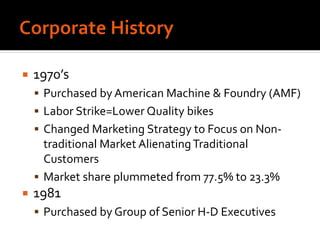
 Market share plummeted from 77.5% to 23.3%
 1981
 Purchased by Group of Senior H-D Executives
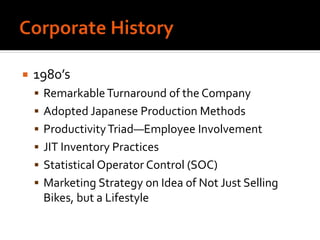
 1980’s
 RemarkableTurnaround of the Company
 Adopted Japanese Production Methods
 ProductivityTriad—Employee Involvement
 JIT Inventory Practices
 Statistical Operator Control (SOC)
 Marketing Strategy on Idea of Not Just Selling
Bikes, but a Lifestyle
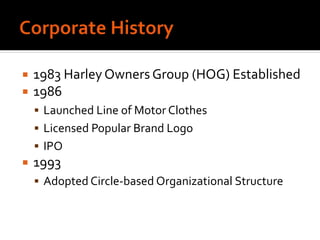
 1983 Harley Owners Group (HOG) Established
 1986
 Launched Line of Motor Clothes
 Licensed Popular Brand Logo
 IPO
 1993
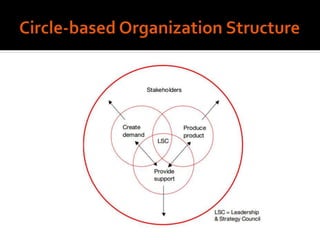
 Adopted Circle-based Organizational Structure
 1988-1995
 Annual Shipments MoreThan Doubled
 1993
 Purchased 40% Interest in Buell Motorcycle Co.
 1998 Purchased Remaining Interest in Buell
 2003 100YearAnniversary
 2008 Purchased MV Agusta Group
 Italian Motorcycle Company to Expand Presence in
Europe
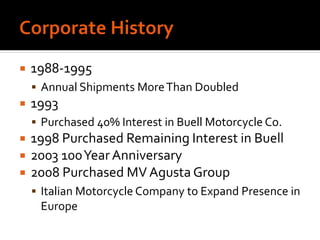
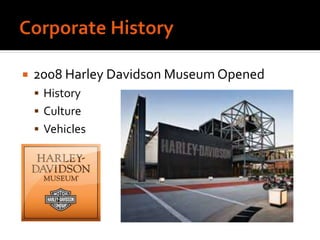
 2008 Harley Davidson Museum Opened
 History
 Culture
 Vehicles
 2009 {FinancialCrisis}
 Current CEO Keith Wandell Hired
 Introduced “Delivering ResultsThrough Focus”
Long-term Business Strategy
▪ Improve Manufacturing, Product Development, Business
Operations
 Discontinued Buell
 2010
 Divested MV Agusta
 Entered India Market
 2013
 110th Anniversary Celebration
 Biggest Launch of New Motorcycle Models in H-D
History
 260,839 Motorcycles Sold
 Revenue $5.9 Billion ($5.6 Billion 2012)
 2014
 Stock Price (NYSE: HOG) $69.21 ($10.10 in 2009)
 Market Share 54.9%
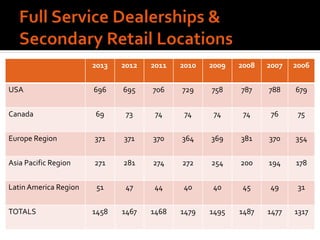
2013 2012 2011 2010 2009 2008 2007 2006
USA 696 695 706 729 758 787 788 679
Canada 69 73 74 74 74 74 76 75
Europe Region 371 371 370 364 369 381 370 354
Asia Pacific Region 271 281 274 272 254 200 194 178
Latin America Region 51 47 44 40 40 45 49 31
TOTALS 1458 1467 1468 1479 1495 1487 1477 1317
Defining Harley Davidson
Corporate Mission
Today
Future
Corporate Culture
Key Result Objectives
Strategic Issues
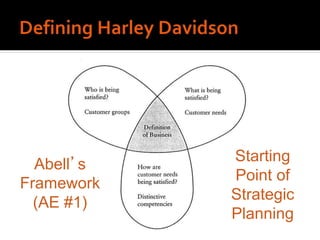
Abell’s
Framework
(AE #1)
Starting
Point of
Strategic
Planning
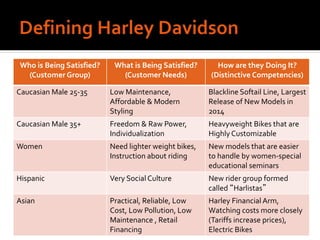
Who is Being Satisfied?
(Customer Group)
What is Being Satisfied?
(Customer Needs)
How are they Doing It?
(Distinctive Competencies)
Caucasian Male 25-35 Low Maintenance,
Affordable & Modern
Styling
Blackline Softail Line, Largest
Release of New Models in
2014
Caucasian Male 35+ Freedom & Raw Power,
Individualization
Heavyweight Bikes that are
HighlyCustomizable
Women Need lighter weight bikes,
Instruction about riding
New models that are easier
to handle by women-special
educational seminars
Hispanic Very Social Culture New rider group formed
called “Harlistas”
Asian Practical, Reliable, Low
Cost, Low Pollution, Low
Maintenance , Retail
Financing
Harley Financial Arm,
Watching costs more closely
(Tariffs increase prices),
Electric Bikes
Fulfilling dreams of personal freedom is more
than a phrase. It’s our purpose and our
passion. We bring a commitment of
exceptional customer experiences to
everything we do—from the innovation of our
products to the precision of our
manufacturing—culminating with our strong
supplier and dealer networks.
We are Harley Davidson.
 At Harley Davidson, we strive to create the
most comprehensive line of motorcycles that
appeal to all motorcycle enthusiasts,
positioning our products as the first choice of
every motorcycle buyer regardless of gender,
nationality or age to help us become the best
motorcycle company in the world and allow
us to maintain the largest global market
share.
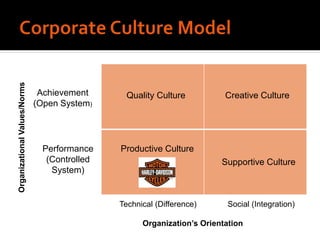
OrganizationalValues/Norms
Technical (Difference) Social (Integration)
Organization’s Orientation
Achievement
(Open System)
Performance
(Controlled
System)
Quality Culture Creative Culture
Supportive Culture
Productive Culture
 The Harley-Davidson culture reflects the bold, rebellious
attitude of our products while providing opportunities for
professional growth and leadership development. We
demonstrate behaviors throughout our organization that
exemplify integrity, accountability, diversity, teamwork
and creativity. We also recognize that great companies
require great leaders to ensure a sustainable future and
strive to build leadership at every level of the company.
 Our culture includes a strong customer influence,
reminding us that our work is informed by our loyal
customers throughout the world – fulfilling their dreams
of personal freedom every minute of every day.
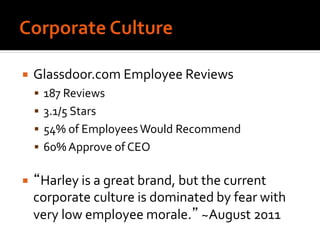
 Glassdoor.com Employee Reviews
 187 Reviews
 3.1/5 Stars
 54% of EmployeesWould Recommend
 60% Approve of CEO
 “Harley is a great brand, but the current
corporate culture is dominated by fear with
very low employee morale.” ~August 2011
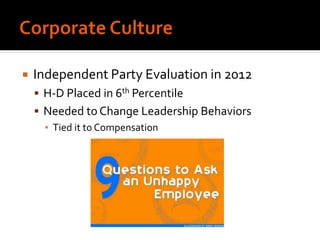
 Independent Party Evaluation in 2012
 H-D Placed in 6th Percentile
 Needed to Change Leadership Behaviors
▪ Tied it to Compensation
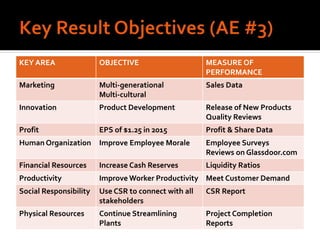
KEY AREA OBJECTIVE MEASURE OF
PERFORMANCE
Marketing Multi-generational
Multi-cultural
Sales Data
Innovation Product Development Release of New Products
Quality Reviews
Profit EPS of $1.25 in 2015 Profit & Share Data
Human Organization Improve Employee Morale Employee Surveys
Reviews on Glassdoor.com
Financial Resources Increase Cash Reserves Liquidity Ratios
Productivity Improve Worker Productivity Meet Customer Demand
Social Responsibility Use CSR to connect with all
stakeholders
CSR Report
Physical Resources Continue Streamlining
Plants
Project Completion
Reports
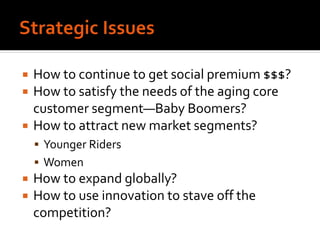
 How to continue to get social premium $$$?
 How to satisfy the needs of the aging core
customer segment—Baby Boomers?
 How to attract new market segments?
 Younger Riders
 Women
 How to expand globally?
 How to use innovation to stave off the
competition?
Company Capability Profile:
Managerial Factors
Competitive Factors
Financial Factors
Technical Factors
Strengths
Weaknesses
Risks
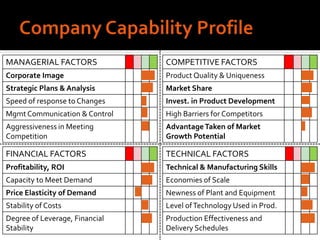
MANAGERIAL FACTORS
Corporate Image
Strategic Plans & Analysis
Speed of response to Changes
Mgmt Communication & Control
Aggressiveness in Meeting
Competition
COMPETITIVE FACTORS
Product Quality & Uniqueness
Market Share
Invest. in Product Development
High Barriers for Competitors
AdvantageTaken of Market
Growth Potential
FINANCIAL FACTORS
Profitability, ROI
Capacity to Meet Demand
Price Elasticity of Demand
Stability of Costs
Degree of Leverage, Financial
Stability
TECHNICAL FACTORS
Technical & Manufacturing Skills
Economies of Scale
Newness of Plant and Equipment
Level ofTechnology Used in Prod.
Production Effectiveness and
Delivery Schedules
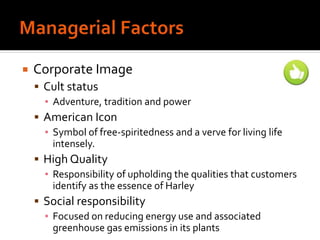
 Corporate Image
 Cult status
▪ Adventure, tradition and power
 American Icon
▪ Symbol of free-spiritedness and a verve for living life
intensely.
 High Quality
▪ Responsibility of upholding the qualities that customers
identify as the essence of Harley
 Social responsibility
▪ Focused on reducing energy use and associated
greenhouse gas emissions in its plants
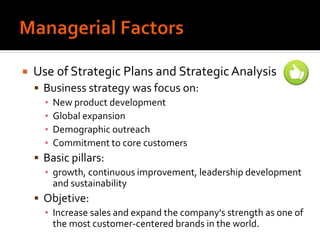
 Use of Strategic Plans and StrategicAnalysis
 Business strategy was focus on:
▪ New product development
▪ Global expansion
▪ Demographic outreach
▪ Commitment to core customers
 Basic pillars:
▪ growth, continuous improvement, leadership development
and sustainability
 Objetive:
▪ Increase sales and expand the company's strength as one of
the most customer-centered brands in the world.
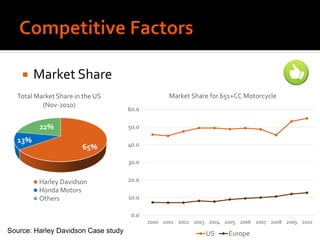
65%
13%
22%
Total Market Share in the US
(Nov-2010)
Harley Davidson
Honda Motors
Others
 Market Share
0.0
10.0
20.0
30.0
40.0
50.0
60.0
2000 2001 2002 2003 2004 2005 2006 2007 2008 2009 2010
Market Share for 651+CC Motorcycle
US EuropeSource: Harley Davidson Case study
 Market Share
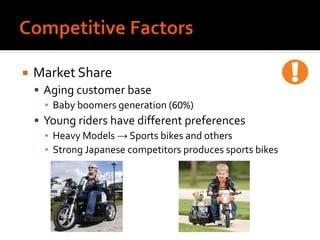
 Aging customer base
▪ Baby boomers generation (60%)
 Young riders have different preferences
▪ Heavy Models → Sports bikes and others
▪ Strong Japanese competitors produces sports bikes
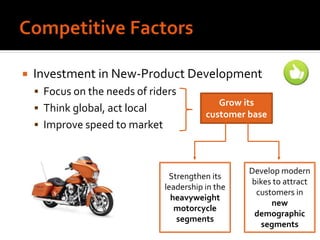
 Investment in New-Product Development
 Focus on the needs of riders
 Think global, act local
 Improve speed to market
Grow its
customer base
Strengthen its
leadership in the
heavyweight
motorcycle
segments
Develop modern
bikes to attract
customers in
new
demographic
segments
 AdvantageTaken of Market Growth Potential
 Expand its presence in the international markets
▪ Europe, Latin America, Japan, China and India
▪ Markets which with rapid growth in disposable incomes and
increase in demand for luxury and foreign brands
 Strengthen its worldwide dealer network
▪ Improve communication with retail customers
▪ Provide a premium retail experience
▪ Strengthen dealer profitability
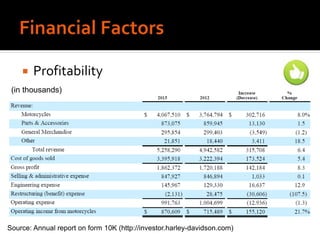
 Profitability
(in thousands)
Source: Annual report on form 10K (http://investor.harley-davidson.com)
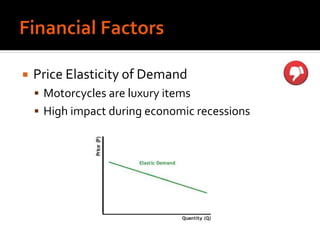
 Price Elasticity of Demand
 Motorcycles are luxury items
 High impact during economic recessions
 Technical and Manufacturing Skills
 Implemented common standards through “Best
Practice Circles”
 Cost savings
 Flexibility (customer led)
 Fluent communication between R&D and
Production
ETOP Chart
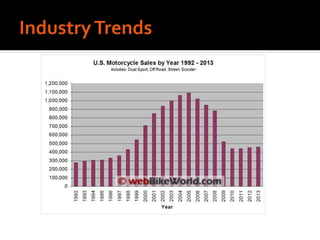
Industry Trends
Environment
Government
External Threats
External Opportunities
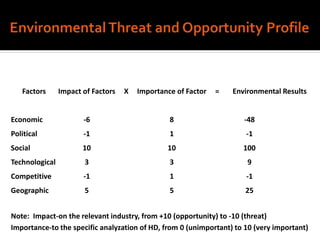
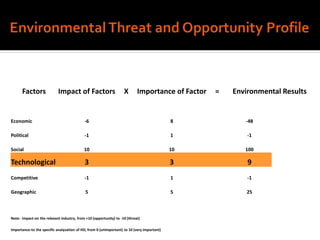
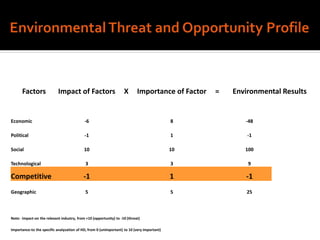
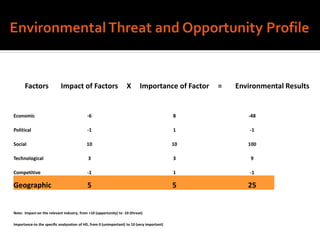
Factors Impact of Factors X Importance of Factor = Environmental Results
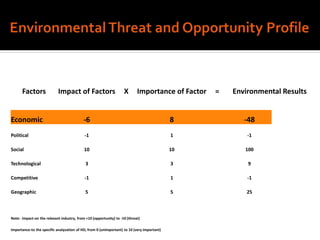
Economic -6 8 -48
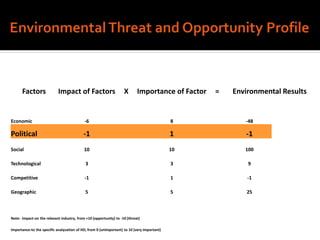
Political -1 1 -1
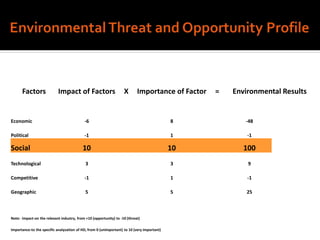
Social 10 10 100
Technological 3 3 9
Competitive -1 1 -1
Geographic 5 5 25
Note: Impact-on the relevant industry, from +10 (opportunity) to -10 (threat)
Importance-to the specific analyzation of HD, from 0 (unimportant) to 10 (very important)
Factors Impact of Factors X Importance of Factor = Environmental Results
Economic -6 8 -48
Political -1 1 -1
Social 10 10 100
Technological 3 3 9
Competitive -1 1 -1
Geographic 5 5 25
Note: Impact-on the relevant industry, from +10 (opportunity) to -10 (threat)
Importance-to the specific analyzation of HD, from 0 (unimportant) to 10 (very important)
Factors Impact of Factors X Importance of Factor = Environmental Results
Economic -6 8 -48
Political -1 1 -1
Social 10 10 100
Technological 3 3 9
Competitive -1 1 -1
Geographic 5 5 25
Note: Impact-on the relevant industry, from +10 (opportunity) to -10 (threat)
Importance-to the specific analyzation of HD, from 0 (unimportant) to 10 (very important)
Factors Impact of Factors X Importance of Factor = Environmental Results
Economic -6 8 -48
Political -1 1 -1
Social 10 10 100
Technological 3 3 9
Competitive -1 1 -1
Geographic 5 5 25
Note: Impact-on the relevant industry, from +10 (opportunity) to -10 (threat)
Importance-to the specific analyzation of HD, from 0 (unimportant) to 10 (very important)
Factors Impact of Factors X Importance of Factor = Environmental Results
Economic -6 8 -48
Political -1 1 -1
Social 10 10 100
Technological 3 3 9
Competitive -1 1 -1
Geographic 5 5 25
Note: Impact-on the relevant industry, from +10 (opportunity) to -10 (threat)
Importance-to the specific analyzation of HD, from 0 (unimportant) to 10 (very important)
Factors Impact of Factors X Importance of Factor = Environmental Results
Economic -6 8 -48
Political -1 1 -1
Social 10 10 100
Technological 3 3 9
Competitive -1 1 -1
Geographic 5 5 25
Note: Impact-on the relevant industry, from +10 (opportunity) to -10 (threat)
Importance-to the specific analyzation of HD, from 0 (unimportant) to 10 (very important)
Factors Impact of Factors X Importance of Factor = Environmental Results
Economic -6 8 -48
Political -1 1 -1
Social 10 10 100
Technological 3 3 9
Competitive -1 1 -1
Geographic 5 5 25
Note: Impact-on the relevant industry, from +10 (opportunity) to -10 (threat)
Importance-to the specific analyzation of HD, from 0 (unimportant) to 10 (very important)
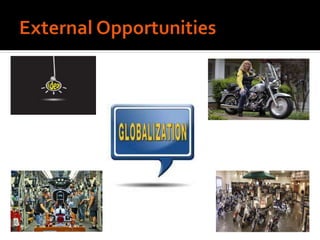
Growing International Markets
Electric motorcycle
Global Marketing
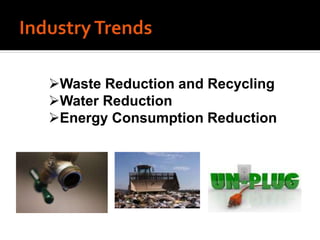
Waste Reduction and Recycling
Water Reduction
Energy Consumption Reduction
Competition
External Changes (government, taxes)
International tariffs and duties
Lower cost competitors or imports
Product substitution
Porter Analysis & Business
Strategy
Miles and Snow
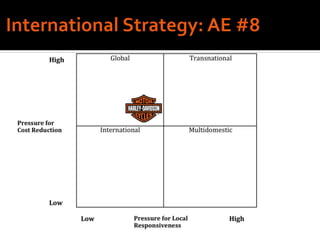
International Strategies
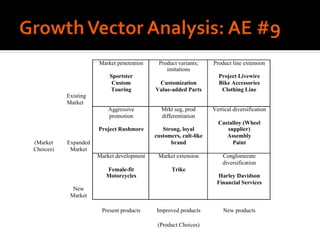
Growth Vector Analysis
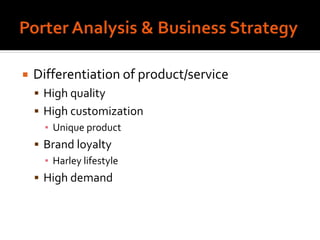
 Differentiation of product/service
 High quality
 High customization
▪ Unique product
 Brand loyalty
▪ Harley lifestyle
 High demand
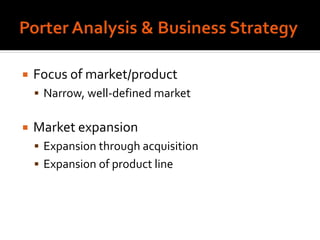
 Focus of market/product
 Narrow, well-defined market
 Market expansion
 Expansion through acquisition
 Expansion of product line
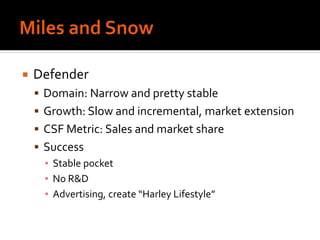
 Defender
 Domain: Narrow and pretty stable
 Growth: Slow and incremental, market extension
 CSF Metric: Sales and market share
 Success
▪ Stable pocket
▪ No R&D
▪ Advertising, create “Harley Lifestyle”
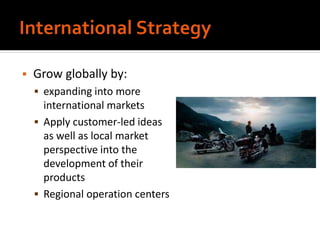
 Grow globally by:
 expanding into more
international markets
 Apply customer-led ideas
as well as local market
perspective into the
development of their
products
 Regional operation centers
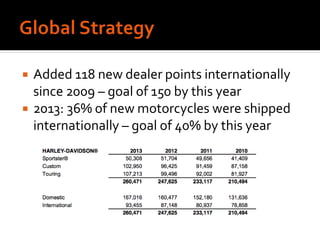
 Added 118 new dealer points internationally
since 2009 – goal of 150 by this year
 2013: 36% of new motorcycles were shipped
internationally – goal of 40% by this year
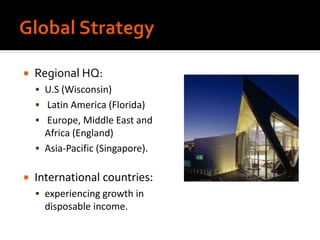
 Regional HQ:
 U.S (Wisconsin)
 Latin America (Florida)
 Europe, Middle East and
Africa (England)
 Asia-Pacific (Singapore).
 International countries:
 experiencing growth in
disposable income.
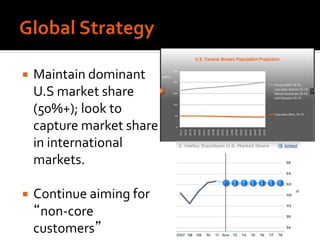
 Maintain dominant
U.S market share
(50%+); look to
capture market share
in international
markets.
 Continue aiming for
“non-core
customers”
Existing
Market
Market penetration
Sportster
Custom
Touring
Product variants;
imitations
Customization
Value-added Parts
Product line extension
Project Livewire
Bike Accessories
Clothing Line
(Market
Choices)
Expanded
Market
Aggressive
promotion
Project Rushmore
Mrkt seg, prod
differentiation
Strong, loyal
customers, cult-like
brand
Vertical diversification
Castalloy (Wheel
supplier)
Assembly
Paint
New
Market
Market development
Female-fit
Motorcycles
Market extension
Trike
Conglomerate
diversification
Harley Davidson
Financial Services
Present products Improved products New products
(Product Choices)
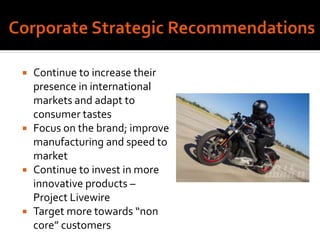
 Continue to increase their
presence in international
markets and adapt to
consumer tastes
 Focus on the brand; improve
manufacturing and speed to
market
 Continue to invest in more
innovative products –
Project Livewire
 Target more towards “non
core” customers
 Resource/Capabilities-Based Model
Perspective
 VRIO Framework
▪ Value
▪ Rarity
▪ Imitation
▪ Organization
 Resources
 Market Share
 Brand
 Dealer network
 Capabilities
 Technological advancements
 New Market penetration
 Multiple Models to reach specific buyers
 Customization
 High level of Interaction between buyer and seller
 Leader inTechnology
 Large national and international bike events
dominated by Harley Davidson
 Strength
 “Cult status”
 Weakness
 Outsourcing parts to reduce cost
 Reemergence of Indian Motorcycles
 Strength
 Buyer experience
 Brand recognition
 Weakness
 Manufacturing capabilities and parts are readily
available
 Similar styling
 Strength
 Managements interactions with customers
 Employee dedication
QUESTIONS?

Harley Presentation--FINAL DRAFT

  • 2.
    Andre de Mezerville CraigDomagala Sonya Frederick Eddie Stanislawski Darrick Wesson James Wood GROUP TWO
  • 3.
    Corporate History Strategic Overview InternalAnalysis External Analysis Strategic Recommendations Sustainable Competitive Advantage
  • 4.
    William Davidson WalterDavidson Arthur Davidson William Harley American Motorcycle Company Founded in 1903 Milwaukee,Wisconsin
  • 5.
    Designed Small Enginefor Use with a Regular Pedal Bike
  • 6.
    Evolution of H-DFactory 1906—Produced 50 Motorcycles Today—Produce Over 260,000 Motorcycles 1914— Produced 16,284 Motorcycles
  • 7.
     1907  TheHarley-Davidson Motor Company Incorporated  1909  Developed FirstV-Twin Powered Motorcycle  1910  Introduced Bar & Shield Logo  Dealer Network of 200+ in United States  1920’s  Officially Largest Motorcycle Manufacturer inWorld  2,000 Dealers in 67 Countries
  • 8.
     1953  H-DSole American Manufacturer of Heavyweight Motorcycles When Indian Motorcycle Company Went out of Business  Late 1950’s  Japanese Motorcycle Manufacturers Entered US Market  Late 1960’s  Japanese Motorcycles Grew to 85% of Market Share
  • 9.
     1970’s  Purchasedby American Machine & Foundry (AMF)  Labor Strike=Lower Quality bikes  Changed Marketing Strategy to Focus on Non- traditional Market AlienatingTraditional Customers  Market share plummeted from 77.5% to 23.3%  1981  Purchased by Group of Senior H-D Executives
  • 10.
     1980’s  RemarkableTurnaroundof the Company  Adopted Japanese Production Methods  ProductivityTriad—Employee Involvement  JIT Inventory Practices  Statistical Operator Control (SOC)  Marketing Strategy on Idea of Not Just Selling Bikes, but a Lifestyle
  • 11.
     1983 HarleyOwners Group (HOG) Established  1986  Launched Line of Motor Clothes  Licensed Popular Brand Logo  IPO  1993  Adopted Circle-based Organizational Structure
  • 13.
     1988-1995  AnnualShipments MoreThan Doubled  1993  Purchased 40% Interest in Buell Motorcycle Co.  1998 Purchased Remaining Interest in Buell  2003 100YearAnniversary  2008 Purchased MV Agusta Group  Italian Motorcycle Company to Expand Presence in Europe
  • 14.
     2008 HarleyDavidson Museum Opened  History  Culture  Vehicles
  • 15.
     2009 {FinancialCrisis} Current CEO Keith Wandell Hired  Introduced “Delivering ResultsThrough Focus” Long-term Business Strategy ▪ Improve Manufacturing, Product Development, Business Operations  Discontinued Buell  2010  Divested MV Agusta  Entered India Market
  • 16.
     2013  110thAnniversary Celebration  Biggest Launch of New Motorcycle Models in H-D History  260,839 Motorcycles Sold  Revenue $5.9 Billion ($5.6 Billion 2012)  2014  Stock Price (NYSE: HOG) $69.21 ($10.10 in 2009)  Market Share 54.9%
  • 17.
    2013 2012 20112010 2009 2008 2007 2006 USA 696 695 706 729 758 787 788 679 Canada 69 73 74 74 74 74 76 75 Europe Region 371 371 370 364 369 381 370 354 Asia Pacific Region 271 281 274 272 254 200 194 178 Latin America Region 51 47 44 40 40 45 49 31 TOTALS 1458 1467 1468 1479 1495 1487 1477 1317
  • 18.
    Defining Harley Davidson CorporateMission Today Future Corporate Culture Key Result Objectives Strategic Issues
  • 19.
  • 20.
    Who is BeingSatisfied? (Customer Group) What is Being Satisfied? (Customer Needs) How are they Doing It? (Distinctive Competencies) Caucasian Male 25-35 Low Maintenance, Affordable & Modern Styling Blackline Softail Line, Largest Release of New Models in 2014 Caucasian Male 35+ Freedom & Raw Power, Individualization Heavyweight Bikes that are HighlyCustomizable Women Need lighter weight bikes, Instruction about riding New models that are easier to handle by women-special educational seminars Hispanic Very Social Culture New rider group formed called “Harlistas” Asian Practical, Reliable, Low Cost, Low Pollution, Low Maintenance , Retail Financing Harley Financial Arm, Watching costs more closely (Tariffs increase prices), Electric Bikes
  • 21.
    Fulfilling dreams ofpersonal freedom is more than a phrase. It’s our purpose and our passion. We bring a commitment of exceptional customer experiences to everything we do—from the innovation of our products to the precision of our manufacturing—culminating with our strong supplier and dealer networks. We are Harley Davidson.
  • 22.
     At HarleyDavidson, we strive to create the most comprehensive line of motorcycles that appeal to all motorcycle enthusiasts, positioning our products as the first choice of every motorcycle buyer regardless of gender, nationality or age to help us become the best motorcycle company in the world and allow us to maintain the largest global market share.
  • 23.
    OrganizationalValues/Norms Technical (Difference) Social(Integration) Organization’s Orientation Achievement (Open System) Performance (Controlled System) Quality Culture Creative Culture Supportive Culture Productive Culture
  • 24.
     The Harley-Davidsonculture reflects the bold, rebellious attitude of our products while providing opportunities for professional growth and leadership development. We demonstrate behaviors throughout our organization that exemplify integrity, accountability, diversity, teamwork and creativity. We also recognize that great companies require great leaders to ensure a sustainable future and strive to build leadership at every level of the company.  Our culture includes a strong customer influence, reminding us that our work is informed by our loyal customers throughout the world – fulfilling their dreams of personal freedom every minute of every day.
  • 25.
     Glassdoor.com EmployeeReviews  187 Reviews  3.1/5 Stars  54% of EmployeesWould Recommend  60% Approve of CEO  “Harley is a great brand, but the current corporate culture is dominated by fear with very low employee morale.” ~August 2011
  • 26.
     Independent PartyEvaluation in 2012  H-D Placed in 6th Percentile  Needed to Change Leadership Behaviors ▪ Tied it to Compensation
  • 27.
    KEY AREA OBJECTIVEMEASURE OF PERFORMANCE Marketing Multi-generational Multi-cultural Sales Data Innovation Product Development Release of New Products Quality Reviews Profit EPS of $1.25 in 2015 Profit & Share Data Human Organization Improve Employee Morale Employee Surveys Reviews on Glassdoor.com Financial Resources Increase Cash Reserves Liquidity Ratios Productivity Improve Worker Productivity Meet Customer Demand Social Responsibility Use CSR to connect with all stakeholders CSR Report Physical Resources Continue Streamlining Plants Project Completion Reports
  • 28.
     How tocontinue to get social premium $$$?  How to satisfy the needs of the aging core customer segment—Baby Boomers?  How to attract new market segments?  Younger Riders  Women  How to expand globally?  How to use innovation to stave off the competition?
  • 29.
    Company Capability Profile: ManagerialFactors Competitive Factors Financial Factors Technical Factors Strengths Weaknesses Risks
  • 30.
    MANAGERIAL FACTORS Corporate Image StrategicPlans & Analysis Speed of response to Changes Mgmt Communication & Control Aggressiveness in Meeting Competition COMPETITIVE FACTORS Product Quality & Uniqueness Market Share Invest. in Product Development High Barriers for Competitors AdvantageTaken of Market Growth Potential FINANCIAL FACTORS Profitability, ROI Capacity to Meet Demand Price Elasticity of Demand Stability of Costs Degree of Leverage, Financial Stability TECHNICAL FACTORS Technical & Manufacturing Skills Economies of Scale Newness of Plant and Equipment Level ofTechnology Used in Prod. Production Effectiveness and Delivery Schedules
  • 31.
     Corporate Image Cult status ▪ Adventure, tradition and power  American Icon ▪ Symbol of free-spiritedness and a verve for living life intensely.  High Quality ▪ Responsibility of upholding the qualities that customers identify as the essence of Harley  Social responsibility ▪ Focused on reducing energy use and associated greenhouse gas emissions in its plants
  • 32.
     Use ofStrategic Plans and StrategicAnalysis  Business strategy was focus on: ▪ New product development ▪ Global expansion ▪ Demographic outreach ▪ Commitment to core customers  Basic pillars: ▪ growth, continuous improvement, leadership development and sustainability  Objetive: ▪ Increase sales and expand the company's strength as one of the most customer-centered brands in the world.
  • 33.
    65% 13% 22% Total Market Sharein the US (Nov-2010) Harley Davidson Honda Motors Others  Market Share 0.0 10.0 20.0 30.0 40.0 50.0 60.0 2000 2001 2002 2003 2004 2005 2006 2007 2008 2009 2010 Market Share for 651+CC Motorcycle US EuropeSource: Harley Davidson Case study
  • 34.
     Market Share Aging customer base ▪ Baby boomers generation (60%)  Young riders have different preferences ▪ Heavy Models → Sports bikes and others ▪ Strong Japanese competitors produces sports bikes
  • 35.
     Investment inNew-Product Development  Focus on the needs of riders  Think global, act local  Improve speed to market Grow its customer base Strengthen its leadership in the heavyweight motorcycle segments Develop modern bikes to attract customers in new demographic segments
  • 36.
     AdvantageTaken ofMarket Growth Potential  Expand its presence in the international markets ▪ Europe, Latin America, Japan, China and India ▪ Markets which with rapid growth in disposable incomes and increase in demand for luxury and foreign brands  Strengthen its worldwide dealer network ▪ Improve communication with retail customers ▪ Provide a premium retail experience ▪ Strengthen dealer profitability
  • 37.
     Profitability (in thousands) Source:Annual report on form 10K (http://investor.harley-davidson.com)
  • 38.
     Price Elasticityof Demand  Motorcycles are luxury items  High impact during economic recessions
  • 39.
     Technical andManufacturing Skills  Implemented common standards through “Best Practice Circles”  Cost savings  Flexibility (customer led)  Fluent communication between R&D and Production
  • 40.
  • 41.
    Factors Impact ofFactors X Importance of Factor = Environmental Results Economic -6 8 -48 Political -1 1 -1 Social 10 10 100 Technological 3 3 9 Competitive -1 1 -1 Geographic 5 5 25 Note: Impact-on the relevant industry, from +10 (opportunity) to -10 (threat) Importance-to the specific analyzation of HD, from 0 (unimportant) to 10 (very important)
  • 42.
    Factors Impact ofFactors X Importance of Factor = Environmental Results Economic -6 8 -48 Political -1 1 -1 Social 10 10 100 Technological 3 3 9 Competitive -1 1 -1 Geographic 5 5 25 Note: Impact-on the relevant industry, from +10 (opportunity) to -10 (threat) Importance-to the specific analyzation of HD, from 0 (unimportant) to 10 (very important)
  • 43.
    Factors Impact ofFactors X Importance of Factor = Environmental Results Economic -6 8 -48 Political -1 1 -1 Social 10 10 100 Technological 3 3 9 Competitive -1 1 -1 Geographic 5 5 25 Note: Impact-on the relevant industry, from +10 (opportunity) to -10 (threat) Importance-to the specific analyzation of HD, from 0 (unimportant) to 10 (very important)
  • 44.
    Factors Impact ofFactors X Importance of Factor = Environmental Results Economic -6 8 -48 Political -1 1 -1 Social 10 10 100 Technological 3 3 9 Competitive -1 1 -1 Geographic 5 5 25 Note: Impact-on the relevant industry, from +10 (opportunity) to -10 (threat) Importance-to the specific analyzation of HD, from 0 (unimportant) to 10 (very important)
  • 45.
    Factors Impact ofFactors X Importance of Factor = Environmental Results Economic -6 8 -48 Political -1 1 -1 Social 10 10 100 Technological 3 3 9 Competitive -1 1 -1 Geographic 5 5 25 Note: Impact-on the relevant industry, from +10 (opportunity) to -10 (threat) Importance-to the specific analyzation of HD, from 0 (unimportant) to 10 (very important)
  • 46.
    Factors Impact ofFactors X Importance of Factor = Environmental Results Economic -6 8 -48 Political -1 1 -1 Social 10 10 100 Technological 3 3 9 Competitive -1 1 -1 Geographic 5 5 25 Note: Impact-on the relevant industry, from +10 (opportunity) to -10 (threat) Importance-to the specific analyzation of HD, from 0 (unimportant) to 10 (very important)
  • 47.
    Factors Impact ofFactors X Importance of Factor = Environmental Results Economic -6 8 -48 Political -1 1 -1 Social 10 10 100 Technological 3 3 9 Competitive -1 1 -1 Geographic 5 5 25 Note: Impact-on the relevant industry, from +10 (opportunity) to -10 (threat) Importance-to the specific analyzation of HD, from 0 (unimportant) to 10 (very important)
  • 49.
  • 50.
    Waste Reduction andRecycling Water Reduction Energy Consumption Reduction
  • 52.
    Competition External Changes (government,taxes) International tariffs and duties Lower cost competitors or imports Product substitution
  • 54.
    Porter Analysis &Business Strategy Miles and Snow International Strategies Growth Vector Analysis
  • 55.
     Differentiation ofproduct/service  High quality  High customization ▪ Unique product  Brand loyalty ▪ Harley lifestyle  High demand
  • 56.
     Focus ofmarket/product  Narrow, well-defined market  Market expansion  Expansion through acquisition  Expansion of product line
  • 57.
     Defender  Domain:Narrow and pretty stable  Growth: Slow and incremental, market extension  CSF Metric: Sales and market share  Success ▪ Stable pocket ▪ No R&D ▪ Advertising, create “Harley Lifestyle”
  • 58.
     Grow globallyby:  expanding into more international markets  Apply customer-led ideas as well as local market perspective into the development of their products  Regional operation centers
  • 60.
     Added 118new dealer points internationally since 2009 – goal of 150 by this year  2013: 36% of new motorcycles were shipped internationally – goal of 40% by this year
  • 61.
     Regional HQ: U.S (Wisconsin)  Latin America (Florida)  Europe, Middle East and Africa (England)  Asia-Pacific (Singapore).  International countries:  experiencing growth in disposable income.
  • 62.
     Maintain dominant U.Smarket share (50%+); look to capture market share in international markets.  Continue aiming for “non-core customers”
  • 63.
    Existing Market Market penetration Sportster Custom Touring Product variants; imitations Customization Value-addedParts Product line extension Project Livewire Bike Accessories Clothing Line (Market Choices) Expanded Market Aggressive promotion Project Rushmore Mrkt seg, prod differentiation Strong, loyal customers, cult-like brand Vertical diversification Castalloy (Wheel supplier) Assembly Paint New Market Market development Female-fit Motorcycles Market extension Trike Conglomerate diversification Harley Davidson Financial Services Present products Improved products New products (Product Choices)
  • 64.
     Continue toincrease their presence in international markets and adapt to consumer tastes  Focus on the brand; improve manufacturing and speed to market  Continue to invest in more innovative products – Project Livewire  Target more towards “non core” customers
  • 66.
     Resource/Capabilities-Based Model Perspective VRIO Framework ▪ Value ▪ Rarity ▪ Imitation ▪ Organization
  • 67.
     Resources  MarketShare  Brand  Dealer network  Capabilities  Technological advancements  New Market penetration
  • 68.
     Multiple Modelsto reach specific buyers  Customization  High level of Interaction between buyer and seller  Leader inTechnology  Large national and international bike events dominated by Harley Davidson
  • 69.
     Strength  “Cultstatus”  Weakness  Outsourcing parts to reduce cost  Reemergence of Indian Motorcycles
  • 70.
     Strength  Buyerexperience  Brand recognition  Weakness  Manufacturing capabilities and parts are readily available  Similar styling
  • 71.
     Strength  Managementsinteractions with customers  Employee dedication
  • 72.

Editor's Notes

  • #2 Thank you for joining us for a presentation about the Harley Davidson Motorcycle Company
  • #3 We are Group Number Two. I am Sonya Frederick and the remaining members of my team are Andre de Mezerville, Craig Domagala, Eddie Stanislawski, Darrick Wesson and James Wood.
  • #4 Today we are going to present an overview of Harley Davidson, Inc. including some information about the company’s history, a strategic overview of the company, an internal and external analysis. We will offer some strategic recommendations and discuss Harley Davidson’s Sustainable Competitive Advantage.
  • #5 In 1901, William Harley and Arthur Davidson collaborated to build the early designs of motorcycles and then Arthur’s two brothers, William and Walter later joined the company. The first 5 production motorcycles were built in 1905 in the backyard shed of the Davidson family. Three of these first motorcycles were sold by the very first Harley Davidson Dealership, Carl H. Lang of Chicago.
  • #6 William Harley and his childhood friend Arthur Davidson designed a small engine designed for use with a regular pedal bike. This first design ended up being too weak to climb the hills of the Milwaukee area without pedal assistance and the first design was considered a failure. But the friends continued to follow their passion and designed a bigger engine that started them on their way to develop what has become the most successful motorcycle company in history.
  • #7 1906—Built first Harley Davidson Factory on Chestnut Street, which was later renamed Juneau Avenue. The company headquarters are still located at this site. 50 Motorcycles were produced the first year of operation. 1907 added space and capacity to factory and built 150 motorcycles. By 1914 Harley Davidson was dominating Motorcycle Racing and produced 16,284 Motorcycles.
  • #8 1907 Officially incorporated the Harley Davidson Motor Company. Began selling Motorcycles to Police Departments, which is still a very valuable market for the company. Developed a prototype V-Twin engine that had a top speed of 60 mph. 1908 Produced 450 motorcycles. 1909 manufactured the first V-twin powered motorcycle. 1,149 Motorcycles Produced. 1917 US Entered World War I and H-D supplied the military with 15,000 motorcycles. By 1920, there were dealers in 67 countries and 28, 1189 motorcycles were manufactured. Famous Teardrop gas tank was introduced in 1925. 1929 21,000 motorcycles were produced, but during the Great Depression, only 3,703 sold in 1933. To survive the depression, Harley Davidson manufactured Industrial Powerplants based on the design of their motorcycle engines. They also built a 3-wheeled delivery vehicle called the “Servi-Car”
  • #9 1940’s WWII Produced 90,000 Motorcycles for Military. 1952 Charged with Restrictive Practices when they applied to the US Tariff Commission for a 40% tax on imported motorcycles. Tarnished the company’s reputation and led to a period of decline.
  • #10 1969 American Machine & Foundry (AMF) purchased the company. They streamlined production and made significant reductions to the workforce which led to a labor strike. Lower quality bikes were manufactured during this time and the market share plummeted from 77.5% to 23.3%! In 1981, AMF sold the company to a group of thirteen investors for $80 million.
  • #11 1983 President Reagan imposed a 45% tariff on imported bikes greater than 700 cc engines after Harley Davidson argued that Japanese were importing so many bikes that it was hurting domestic production. The new management returned to the “retro” look of their motorcycles and improved quality and buyers slowly returned. 1984 Hugely popular Softail Series introduced utilizing a “sub-shock” suspension designed by Bill Davis, an engineer from Missouri.
  • #12 HOG Members spend 30% more than other Harley owners on clothes and events. 1,000,000 Members in 1400 Chapters Worldwide. Benefits: Organized Group Rides, Exclusive Products, Product Discounts, Insurance Discounts, HOG Tales Newsletter Free one year membership included with every new bike purchase Licensing of the Harley-Davidson brand and logo accounted for $40 million (0.8%) of the company's net revenue in 2010
  • #13 Harley's organization is now based on a three-circle ven diagram structure. This method was erected when Harley went through cultural and financial issues during the 1990s. The three circles are titled the Create Demand Circle, the Produce Products Circle, and the Support Circle. The area where the circles intersect represent the Leadership and Strategy Council. President at the time of the changes, Jeff Bleustein, said in an interview with Fast Company that the new organization is simple: "we're applying the concept of self-directed work teams used in the factories to the executive level." Another CEO, Rich Teerlink, also shares how the idea behind this system was to, "get the right people, together at the right time, to do the right work right. We wanted teamwork without the teams and the idea of natural work groups emerged" (Ozley). The circle organization is based around the core processes at Harley--create demand, produce product, and provide support--which are depicted by three interlocking circles. This is a more accurate representation of the shared leadership and cross-functionality at work in Harley-Davidson."   1993 Leadership Circles The circle organization of Harley-Davidson was implemented on July 1, 1993 as a means to uproot the traditional hierarchical infrastructure usually associated with corporate America. Since then, it has served as a means to break down the common barriers to communication and efficiency that exist in large, vertical structures and to promote cross-functional thinking and behaviors amongst members of each circle. The organization is composed of three circles, each representing a key function of the company, intersecting in the center to represent the collaborative nature of its design. The create demand circle depicted above is the first element of the process and is defined as all of the people and activities that create, increase, and sustain the demand for Harley-Davidson products and services (Teerlink & Ozley, 2000). This functional circle includes marketing and sales functions for motorcycles; parts, accessories, and apparel; new business development; customer service; motorcycle styling; government affairs; and the Harley Owners Group (HOG). The produce products circle entails all activities involving the production of Harley-Davidson goods and services, to include engineering; manufacturing operations; materials and cost management; new product development; purchasing; quality functions; and logistics functions. Finally, the provide support circle includes all traditional staff functions of the company including finance and accounting; human resources; strategic planning; information services; and legal (Company Brochure, 2002).
  • #14 1986-1996 Owned and operated luxury motorhome company Holiday Rambler, hoping to appeal to its aging baby boomer customer base 1990-Fat Boy Series was introduced leading Harley Davidson back to sales leader position in heavyweight 750+ cc market 1998 Opened first factory outside of the US in Manaus, Brazil, which is a free economic trade zone 2000-2012 partnered with Ford who offered a Harley-Davidson Trim Package on some of its pickup trucks, mainly the F-150. 2003 250,000 people attended 100 Year Anniversary Celebration 2008 Purchased MV Agusta Group for $109 Million from founder Claudio Castiglioni when it was near bankruptcy.
  • #15 What’s Here More than 450 motorcycles and artifacts, dating back to Serial Number One, the oldest known Harley-Davidson® motorcycle Stories of extraordinary products, people, history, and Harley-Davidson culture Never-before-seen archives you can tour A world-class Museum space and outlying buildings, designed by Pentagram Architects A 20-acre Museum campus on the Milwaukee riverfront, with views of the city skyline Unique Harley-Davidson Museum-inspired gifts at The Shop Distinctive dining at Restaurant Motor® – no Museum admission required
  • #16 Keith Wandell named President & CEO in May 2009. He came to Harley Davidson after a 21 year long career at Johnson Controls, where he served as President & COO from July 2006 until April of 2009. He has an MBA from University of Dayton (1979) and a BS in Business Administration from Ohio University (1972). Introduced the “Delivering Results Through Focus” Business Strategy charting a new direction for Harley-Davidson through the development and implementation of a strategic plan based on the core tenets of growth, continuous improvement, leadership development and sustainability. Strategy has moved rapidly to refocus resources on the Harley-Davidson brand, already one of the strongest in the world, and expand the company's global reach. These initiatives include major transformations underway in product development and manufacturing capabilities for even greater responsiveness in fulfilling the dreams of riders. 2009 FINANCIAL CRISIS Value of Harley Davidson Brand fell by 43% after a 66% drop in company profits during last two quarters of 2008 October 15, 2009 Discontinued the Buell Line of motorcycles to focus on the Harley Davidson Brand. They refused to sell the company, probably because the company had so many loyal riders that it would continue biting into Harley’s marketshare. Very smart strategic move. August 2010 after turning around MV Agusta, Harley Davidson sold it back to original founder Claudio Castiglioni for an undisclosed amount of money. 2010 Entered India Market. Established subsidiary near Delhi and created an Indian Dealer Network.
  • #17 The Harley-Davidson® 110th Anniversary Celebration was a year-long, global celebration connecting millions of Harley-Davidson® fans united by a common bond and shared passion for freedom, self-expression and epic adventure. The events spanned 11 countries on six continents. unveiling a 2014 model lineup that features the largest-scale new product launch in its 110-year history. The Milwaukee-based motorcycle manufacturer released a new suite of features dubbed Project Rushmore. The changes in Harley’s 2014 lineup include better power and braking performance, enhanced rider ergonomics and new styling on eight models: Road King, Street Glide, Street Glide Special, Electra Glide Ultra Classic, Ultra Limited, Tri Glide Ultra, CVO Ultra Limited and CVO Road King. “Project Rushmore is a pure expression of our relationship with our customers and a shared passion for riding motorcycles,” said Mark-Hans Richer, Harley-Davidson senior vice president and chief marketing officer, in a prepared statement. “It’s resulted in some outstanding innovations, but from day one we’ve been focused on taking the total rider and passenger experience to the next level.” Harley-Davidson put in thousands of hours of research and testing for this year’s lineup, including gathering input from dealers, focus groups and informal chats with riders at events, the company said. Among the new features for the touring models: • New powertrains, upgraded brakes with an anti-lock braking system and light-emitting diode and dual halogen lighting. • “Infotainment” systems that mark the first time a motorcycle has offered original-equipment voice recognition and touchscreen for music, GPS navigation and phone, the company said. The systems also feature Bluetooth connectivity, text-to-speech technology and intercom support. • New “Batwing” fairing with split-stream venting that reduces head buffeting by 20 percent. • Wider and deeper seats and new back and arm rests. • New styling with a reshaped Tour-Pak and saddlebags with one-touch latches, sleeker fenders, lighter cast aluminum wheels and intuitive hand control switches. Other changes in the 2014 lineup include a restyled Fat Bob model, a new Harley-Davidson Street Glide Special to complement the popular touring version, and the availability of anti-lock brakes on all five 2014 Sportster models.
  • #18 Secondary Retail Locations (SRLs) are satellites of the main dealership and are developed to meet the service needs of the Company's riding customers. Harley Shops also provide replacement parts and accessories, Motorclothes apparel and collectibles, and are authorized to sell new motorcycles.
  • #19 Strategic Overview: Mission, Issues & Objectives Outstanding discussion of future mission statement, strategic issues relevant to the case, and corporate objectives that are realistic. Well organized and establishing a framework for the whole case presentation. Corporate philosophy and culture are described as relevant to the strategic issues.
  • #20 DEFINITION OF BUSINESS: Harley Davidson, Inc. produces and sells heavyweight motorcycles as well as offers motorcycle parts, accessories and related services. It operates in two segments: Motorcycles and Related Products and Financial Services. Abell’s Framework stresses the importance of defining a business from a consumer-oriented approach rather than a product-oriented approach. Such an approach obscures the company’s function, which is to satisfy consumer needs. A product is only the physical manifestation of applying a particular skill to satisfy a particular need for a particular consumer group. A broad, consumer-oriented business definition can safeguard companies from being caught unawares by major shifts in demand. Help companies anticipate demand shifts, assist companies in capitalizing on the changes in their environment.
  • #21 Aiming at younger riders seeking a motorcycle with barebones styling unveiled a new model in its Softail line, named Blackline. The bike has a suggested retail price of $14,999 Often associated with freedom, open roads, and “raw power,” the Harley-Davidson Motor Co. has been increasing its global motorcycle sales in recent decades. Founded in 1903 and based in Milwaukee, Wisconsin, the company today sells motorcycles through more than 1,300 dealerships in 70 countries. Its recent expansion into countries such as China and India is part of the company’s Asia-Pacific expansion strategy. Because the Asia-Pacific region is home to some of the world’s fastest developing economies, the company believes it has great opportunities to introduce its brand and riding experience to the increasing number of riders in the region. With that in mind, Harley-Davidson sees China as one of the key contributors to its Asia-Pacific growth strategy. A combination of low incomes, over-crowded cities or inadequate public transport increase the practicality of motorcycles over cars in many parts of the region. Women riders are among the most important demographics for Harley as it cultivates the next generation of motorcyclists. About a third of the students enrolled in Harley's rider training classes are female. The company has worked hard to overcome stereotypes that have kept women out of motorcycling, including the notion that a petite female can't handle a big, powerful bike. It's more about technique, skill and confidence than physical strength.
  • #22 2012 Mission Statement was: Mission Statement: We fulfill dreams through the experience of motorcycling, by providing to motorcyclists and to the general public an expanding line of motorcycles and branded products and services in selected market segments.
  • #23 Best Motorcycle Company in the World Largest Market Share Globally New Customer Segments New Products
  • #24 Harley’s corporate culture falls into the category of “Productive Culture,” within the realm of the Organizational Values/Norms of Performance in a controlled system and the Organizations Orientation is technical and hence differentiated. A technical orientation leads to a productive culture that concentrates on efficiency and consistency. The productivity-oriented organization tends to employ many rigid procedures and rules. A productive culture RESISTS CHANGE, as illustrated by the low-levels of employee morale during the changes of 2009 and beyond. It would probably suit Harley very well if they could move into the SUPPORTIVE CULTURE which focuses on Teamwork, cooperation and Growth. This type of culture responds much better to change. Corporate Culture is the sum total of shared values, attitudes, believes, norms, rituals, expectations and assumptions of the people in the organization. The culture is affected by the organization’s structure, power centers, and climate. Culture meets social needs by defining relationships, specifying roles and duties and establishing standards to be followed. Corporate rituals provide a means of demonstrating the values and beliefs of the organization and thus define the culture, the social interaction, the priorities and the way individuals deal with one another. Culture depends on key decision makers as well as on the history of the organization. Defining corporate culture is one thing—making it work is another. Corporate culture may be very different at different levels.
  • #25 According to the potential employee portion of the Harley Davidson Website, The Harley-Davidson culture reflects the bold, rebellious attitude of our products while providing opportunities for professional growth and leadership development. We demonstrate behaviors throughout our organization that exemplify integrity, accountability, diversity, teamwork and creativity. We also recognize that great companies require great leaders to ensure a sustainable future and strive to build leadership at every level of the company. Our culture includes a strong customer influence, reminding us that our work is informed by our loyal customers throughout the world – fulfilling their dreams of personal freedom every minute of every day.
  • #26 A very useful metric that Harley Davidson Human Resources could use is to work to increase the company’s rating on Glassdoor.com. This is a site where employees, past and present can review the company and give advice to company leaders. Only half the employees would recommend the company to a friend as a good place to work and only 60% of the employees who posted on this site approved of the company CEO! Management can say anything they want to on the corporate website, but Glassdoor is a much more objective look at the company’s culture.
  • #27 From information presented by Angie Ziegler, Director of Leadership Development at Harley Davidson. She outlined many changes that occurred at H-D since 2009 when CEO Keith Wandell became CEO. Harley essentially de-unionized in 2012—froze pay for 7 years, laid off 3200 employees, Many changes in short period of time drove Employee Morale to an all time low. Great Article about the 9 things to ask an unhappy employee: http://www.inc.com/multimedia/slideshows/content/unhappy-employee_pagen_1.html If you could change one thing about our company, what would it be? How do you feel the company and your team are doing? How do you feel I am doing as your supporting leader?
  • #28 CRITICAL SUCCESS FACTORS John Rockart (1970) developed a three-step method for determining which factors contribute to meeting organizational goals. He found that many executives tend to think in terms of what it takes to be successful rather than in terms of grand strategy, goals and objectives. STEP 1) Generate Success Factors—what does it take to be successful in this business? STEP 2) Refine Critical Success Factors into Goals and Objectives—what should the organization’s goals and objectives be with respect to this critical success factor? STEP 3) Identify measures of performance—how will we know whether the organization has been successful with respect to this factor? EIGHT KEY AREAS IN WHICH OBJECTIVES MUST BE SET AND MEASURES OF PERFORMANCE REPORTED: Marketing, Innovation, Human Organization, Financial Resources, Physical Resources, Productivity, Social Responsibilities, Profit.
  • #29 These Strategic Issues will be addressed by my teammates. Next Andre will present an internal analysis of Harley Davidson.
  • #30 Internal analysis is used to identify the strengths and weakness of a company. This analysis includes four factors as part of the Company Capability Profile: Managerial, Technical, Competitive, and Financial. Each factor was classified as a strength or a weakness according to the color-code and the symbols that are shown in the slide. The main risks of the company were also identified as shown in slide.
  • #31 This slide shows a 4-panel chart of the Company Capability Profile for Harley Davidson. Each factor category (Managerial, Technical, Competitive, and Financial) contains the main five factors out of the eleven factors usually included in the Company Capability Profile template. The color code at the right corner of each panel represents the strength degree or intensity for strengths (50%-100% with light green and green) or weaknesses (0%-50% with red and light red). It should be noted that Harley Davidson ranks rather strong in most of the factors that were analyzed and it is fairly well-balanced accross the four factor categories. Due to time constraint, only the eight factors that are shown in bold font are explained in the next slides. Those are considered the most relevant factors for the future of the company.
  • #32 Over the years, Harley had established an image of raw power which became its unique selling proposition. The brand adopted a focused differentiation strategy wherein it targeted specific products at niche segments in the market. The Harley brand had achieved a cult status among its loyal customers as it characterized adventure, tradition, and power. Perhaps more than any other 20th century product, the Harley-Davidson motorcycle is revered as an American icon. After all, a Harley-Davidson motorcycle is more than just a mode of transportation or ordinary product. It constitutes a symbol of free-spiritedness and a verve for living life intensely. While this gives Harley marketing advantages, it carries the responsibility of upholding the qualities that customers identify as the essence of Harley. Furthermore, Harley is focused on reducing energy use and associated greenhouse gas emissions in its plants, while building a broader sustainability framework into its strategic thinking.
  • #33 Harley's business strategy focused on new product development, global expansion, demographic outreach, and commitment to core customers. The basic pillars of this strategy were growth, continuous improvement, leadership development, and sustainability. The objective of this strategy was to increase sales to core customers and expand the company's strength as one of the most customer-centered brands in the world.
  • #34 As of November 2010, Harley had a 65% share of the Motorcycle, Bike & Parts Manufacturing industry in the United States. For instance, the 651+CC Motorcycle (heavyweight model) had a market share close to 50% since 2003 until 2007, then it dropped to 45% in 2008 due to the economic recession and achieved 53% and 55% in 2009 and 2010, respectively. On the other hand, this model is not that popular in Europe. But its market share increased from 7.2% in 2000 to 12.7% in 2010. In 2008, to expand the company's presence in Europe, Harley acquired the Italian motorcycle maker, the MV Agusta Group for US$109 million. This company was known in Europe for its premium, high performance sport motorcycles.
  • #35 The motorcycle market in the US is demographically dependent. A major challenge confronting the company was its aging customer base. Reports indicated that over 60% of Harley motorcycle riders were baby boomers aged between 35 and 54. The average age of Harley riders had been consistently increasing by about six months since the early 1990s. To make matters worse for the company, more and more young riders prefers from sports bikes and dual-purpose motorcycles to cruiser and touring bikes rather than the classic heavy models. Moreover, the company's market share was slowly shrinking as Japanese competitors were attracting customers by building sport bikes.
  • #36 In 2011, Harley-Davidson commenced executing a strategy to transform product development, with the objective of ensuring that the Company delivers relevant products for an increasingly diverse customer base while reducing cost and time to market. The key objectives of the strategy include implementing a new product development methodology and organization structure that support greater innovation, flexibility, capacity and focus on consumer insights. The Company incurred research and development expenses of $152.2 million, $137.3 million and $145.4 million during 2013, 2012 and 2011, respectively. As part of the product development process, Harley not only planned to strengthen its leadership in the heavyweight motorcycle segments, but also to develop modern bikes to attract customers in new demographic segments.
  • #37 As part of its long-term business strategy, Harley decided to expand its global presence and reach new demographics in the international markets as slow economic growth had curbed the demand for high-end motorcycles in the US. The company planned to enhance its presence in Latin American regions, Europe, Japan, China, India, and other emerging markets by strengthening its operations and regional teams in these regions. Analysts felt that there was a significant opportunity for Harley to increase its sales in these markets which were witnessing rapid growth in disposable incomes and increase in demand for luxury and foreign brands. Harley also planned to strengthen its worldwide dealer network and offer systems that would improve communication with retail customers, provide a premium retail experience, and strengthen dealer profitability.
  • #38 This table includes the condensed statement of operations for the Motorcycles segment (in thousands). In 2013, Harley reported a broad improvement in income from continuing operations. For the full year, the operating income from motorcycles division was $870.6 million compared to $715.5 million in 2012, which represents an improvement of 21.7%. Since 2009, the Company has significantly improved Motorcycles segment gross margin from 32.3% to 35.4% in 2013. For this year, the Company expects motorcycle fixed costs to be approximately 15% to 20% of total motorcycle manufacturing costs, resulting in gross margin on incremental motorcycle volume of approximately 47%.
  • #39 Harley Davidson motorcycles are considered luxury items, and therefore their demand is elastic. It means that the demand for the product is sensitive to price changes or economic recessions. Having a product with an elastic demand is usually a major concern for a manufacturer that attempts to set product prices based on costs. For instance, if the manufacturer's production and sales have declined and it fails to cut fixed costs, the manufacturer could be worse off by increasing selling prices.
  • #40 The Company’s manufacturing strategy is designed to continuously improve product quality and productivity while reducing costs and increasing flexibility to respond to continuously changing customer expectations and preferences. The company implemented common standards across its manufacturing facilities through groups called Best Practice Circles which comprised hourly and salaried employees from multiple locations and outside suppliers who shared specialized knowledge around a common process. The company had many best-practice circles in areas like safety, fabrication, and machining. Harley transformed its operations to make them more flexible and customer led.
  • #42 Meaning of Environmental Scanning: Environmental scanning can be defined as the process by which organizations monitor their relevant environment to identify opportunities and threats affecting their business for the purpose of taking strategic decisions. Appraising the Environment: In order to draw a clear picture of what opportunities and threats are faced by the organization at a given time. It is necessary to appraise the environment. This is done by being aware of the factors that affect environmental appraisal identifying the environmental factors and structuring the results of this environmental appraisal. Structuring Environmental Appraisal: The identification of environmental issues is helpful in structuring the environmental appraisal so that the strategists have a good idea of where the environmental opportunities and threats lie. There are many techniques to structure the environmental appraisal. One such technique suggested by Gluek is that preparing an ETOP for an organization. The preparation of an ETOP involves dividing the environment into different sectors and then analyzing the impact of each sector on the organization HD is not extremely vulnerable Social recognition is the largest opportunity for HD to capitalize on. Economic environment is the biggest threat facing HD
  • #43 Weakness-poor economy . Strength- economy is turning around. Economic factors affect the purchasing power of potential customers and the firm’s cost of capital. HD has an elastic market because it is considered an luxury item. As the steep global downturn meant consumers were in no shape to spend tens of thousands of dollars on a motorcycle. A weak economy can have adverse action on their product, therefore we determined the impact factor on the industry to be a -6 and the importance to be an 8 having an environmental result of 48 point.
  • #44 Weakness-EPA , government regulations/ import tariffs for International sales . Strength- stiff tariffs on large-engine imported Japanese motorcycles Political factors are how and to what degree government intervenes in the economy. Political factors include: political power, ideologies, interest groups, social stability, legislation, and regulation. Environmental Protection Agency (EPA) Usually governmental intervention is not beneficial to an industry because it can result in legislation or regulation prohibiting current or future actions. Some states do not allow people to operate a motorcycle until they are 18 years-old. The industry needs to monitor changing laws and foresee changes so that they can be ahead of changes for a smooth implementation. Health insurance discrimination Threat: Following the passage of the original HIPAA legislation in 1996, bureaucrats at the Department of Health and Human Services created a loophole that allowed insurance companies to deny benefits (known as "source-of-injury" exclusions) to people who are injured while participating in legal transportation and recreational activities, such as riding motorcycles or off-road vehicles. Mandating ABS on motorcycles could increase the cost of a new bike by $1,000 or more. This is especially alarming for entry-level machines that could increase in price by as much as 20 percent. Although Federal, State, and local government continue to create laws and regulations that affect the motorcycle industry, it has not had a overwhelming impact.
  • #45 Weakness-loud exhaust, wannabe image. Income to purchase. Strength- Loyal customer base, Rallies, increasing demographic market Social factors impact an organization due to the social, cultural, demographic, and environmental profiles in the industry. We determined the social aspect of the ETOP profile to be the most important. The Subculture of gangs, clubs, and social functions has an important effect on the motorcycle industry, especially HD. Unlike a corvette club where you might have one culture, that being a sports car enthusiast, HD means something different to various riders. These subcultures also interact with each other at times during ride promotions and gatherings. HD website lists 1077 events for 2014.
  • #46 Weakness- Other companies more advanced in electric motorcycle. Strength- Plant manufacturing, reduced COGS Technological factors impact how an organization or company operates in relation to equipment used in the company’s environment. Technological Factors include: rate of technological change, future raw material availability, raw material cost, technological developments, and product life cycle. Some might think advancements in technology may seem stagnate when referring to motorcycle production but HD is launching an electric motorcycle appealing to the environmentally friendly and the younger generation. Last year they launched the Tri-Glide in Japan and this March they launched the Street 750 in India. We rated Technology as a 9.
  • #47 Weakness-share of foreign markets . Strength- dominant in US market Factors that involve actions taken by current and potential competitors, market share, and concentration of competitors Through its strategies and investments, Harley-Davidson has been growing its appeal across generations, cultures and borders. Internationally, 118 new dealer points have been added since 2009 and in 2013, 35.9% of motorcycles were shipped to international markets In the U.S., Harley-Davidson is reaching a more diverse customer pool, even as we have grown among our traditional customer base. In 2013, U.S. retail sales of new Harley-Davidson motorcycles to our "outreach" customers -- young adults 18-34, women, African-Americans and Hispanics – grew overall at more than twice the rate of sales to "core" customers -- Caucasian men, ages 35-plus. For the sixth straight year in 2013, HD was the number-one seller of new on-road motorcycles (all cc's) to each of these segments. We also grew our market share lead and increased the share gap to the nearest competitor in each of these segments, compared to 2012.
  • #48 Weakness- unknown Strength- Plant manufacturing, ability to produce all motorcycles at one plant on any given day. Geographical factors include: plant/warehouse location, relocation of facilities, headquarters, and foreign markets. The United States remains the company’s biggest market, but growth is coming from abroad, particularly emerging markets. Shipments of motorcycles in the United States were up 6.6 percent, to Japan up 2.3 percent, and to recession-stricken Europe down 5.9 percent. But apparently the emerging middle class of Asia and Latin America can’t get enough Harleys. Sales in Asia outside of Japan rose 25.6 percent and Latin American sales rose a whopping 39 percent. Those are off of small bases, but it shows how a company like Harley-Davidson can keep expanding even amid slow growth in the United States and other developed economies.
  • #49  Saw a declining market between 2006 through 2010. As the US market began to improve, the European market fell as a result of slowing economical growth.
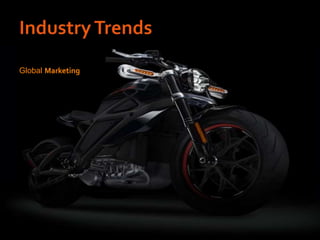
  • #50 Harley-Davidson's recently unveiled Project LiveWire, an electric motorcycle concept that could help make electric bikes more mainstream, will feature prominently in the upcoming movie "Avengers: Age of Ultron.“ Electric motorcycles have faced some significant issues so far. The lack of engine noise can unnerve many motorcycle enthusiasts. LiveWire is louder than most electric bikes, but it still lacks the traditional rumble of a Harley-Davidson V-twin engine. Battery life is also an issue. Most electric motorcycles, including LiveWire, have a maximum range of about 100 miles on a full charge, and charging takes several hours. This makes them more suited to city life than the traditional highway mindset of Harley-Davidson bikers. The solution will undoubtedly be found eventually, but it may take some time.
  • #51 Harley-Davidson manufacturing facilities aspire to reach zero landfill status. They have established a goal of less than 10% waste to landfill for 2013 for their US manufacturing operations, compared to their performance of less than 13% in 2012 Most significantly, in 2012 Harley-Davidson completed the restructuring/consolidation of the York facility. The project eliminated numerous waste streams from Harley-Davidson operations. This resulted in the reduction of hazardous waste by 52% or 313 tons, residual waste by 68% or 7,075 tons and universal waste by 44% or 3 tons. Overall waste was reduced by 67% or 7,391 tons In 2012, the Pilgrim Road facility reduced water intake by 1,166,000 gallons. The water reductions were the result of the full implementation of a new powder-coat system.
  • #52 EPA, foreign governments, uncertain future for regulations, taxes. EPA- always need to be aware of plant chemicals effects on the environment. Ground water pollution. Foreign Governments- economical status (recession, currency value, corruption, politics, policy on seizing assets. Taxes, regulations, import and export cost and policies. Laws directly affecting motorcycle community
  • #53 Competitors 1.Royal Enfield 2.Boulevard Threats • Increased environmental regulations. • Increased standards in the European market. • Some of the competitors of the company is using more resources in marketing their product line (bicycles) and is a  threat because it can change your risk factor for having diversified product line. • Because of the low cost of making a bike and the higher profit margin, it is clear that more competition can participate, especially those already in the car manufacturing market
  • #54  Emerging Markets and Expansion abroad Product and Services Expansion Expanding Demographics Innovation Markets in EU, Japan, Inida, China Products- Street 750, electric motorcycle Demographics-women, Asians Opportunities • The demand for Harley Davidson is the highest in Europe on the international market. • It must market their products more competitive, especially in the European market. • India is a large untapped market for motorcycle too. • Women and young people are more inclined to ride a bike. • International market for bicycles is much larger than the U.S. market. • Customer value parts in the international market. • Even in regions where the economy is at a low level, Harley may take the opportunity by the thought of customers in that situation, a bicycle is a cheaper way to travel, which would be favorable for the Harley.
  • #56 Harley offers a high quality product in a niche market. The high-end product Harley offers is very customizable and allows each customer to have a unique product. These customers tend to form together and belong to an elite community viewed as the Harley lifestyle. Living the Harley lifestyle creates a brand loyalty that is unlike most. When living the Harley lifestyle customers are a walking advertisements for Harley with clothing and such strong support for the brand, it is constant word-of-mouth advertising. The demand is impacted by all these previous factors and Harley capitalizes on this by under-manufacturing product to keep demand up, almost as an idea of if you can’t have it now you will want it more.
  • #57 Harley has a very specific and well-defined market. Baby-boomers have been the biggest success factor for Harley and caused them to have a average age of customers around 25 but now as the generation ages the average age is rising as well, it currently is around the mid 30s. As the average age increases Harley wants to appeal to both new customers as well as maintain there appeal towards current customers. Harley is expanding into the trike area for the aging customers and looking to expand into the sport-bike segment for new customers. By reaching both new younger and older customers Harley will expand the overall target market. Harley also expands its target market and market share through acquisition on other brands. Purchasing another brand eliminates competition and allows for less risk seeing that the brand is already in existance and has market share.
  • #58 Harley currently falls under the defender section of Miles and Snow but is also slowly expanding into the analyzer segment by entering new markets such as trikes and sport-bikes. Harley has a very defined target market that is stable based on brand loyalty. The growth Harley sees comes both slow and incremental by gaining customers through word-of-mouth advertising or whole new target markets with product expansion. Harley’s profits are based on market share and increasing sales with customers.
  • #59 Harley Davidson looks to grow globally by expanding into international markets to reach new demographics Apply customer-led ideas as well as local market perspective into the development of their products They also have operations set up in regional areas around the world.
  • #60 Harley Davidson is seen as a global firm and is placed in the lower right corner of the Global box because while they they already try and keep costs down and respond to local demand, they do not feel to much pressure to do so, but they do push certain products harder depending on the country and their bike preference.
  • #61 Added 118 new dealer points internationally since 2009 – goal of 150 by this year 2013: 36% of new motorcycles were shipped internationally – goal of 40% by this year Looking at the chart you can see that over the past 4 years Harley has been increasing its sales both at home and abroad with an average growth rate of 7.4% over that span.
  • #62 -Harley Davidson has regional headquarters in U.S (Wisconsin), Latin America (Florida), Europe, Middle East and Africa (England), and Asia-Pacific (Singapore). -International countries are experiencing growth in disposable income making international expansion key to Harley Davidson’s continuous growth.
  • #63 -While there are limited growth opportunities in the U.S, international segments are looking to experience strong growth in terms of heavyweight motorcycles. -Focus more on capturing potential market share while still appealing to current customers. -Sales to” non-core”(young adults, 18-34, women, African Americans, and Hispanics) customers grew at more than twice the rate of sales to “core” customers (Caucasian men, 35+) in 2013. Non-core customers are also increasing at a much more steady rate.
  • #64 Harley is mainly known for their 3 types of bikes (Sportster, Custom, and Touring) but also offers various customization to its bikes as well as part upgrades. They also are looking to expand into the electric motorcycle market which is a pretty new market. They also offer Harley Davidson Brand accessories as well as a clothing line which adds to the “lifestyle” culture of the company. Harley has recently come out with its new “Project Rushmore” which is a customer-driven package of upgrades designed for 8 of its bikes. They have also chosen to keep its New Castalloy component and wheel plant open which will allow Harley to keep making its wheels in-house along with its paint and bike assembly lines. In terms of new markets, Harley is reaching out to gain female riders and offers bikes that are smaller and more confortable for females. They are also extending into the untapped “Trike” market in Japan, which happens to be Harleys 2nd largest international market. Harley differentiates itself by also offers its own financial services by offering financing options as well as insurance.
  • #65 Harley Davidson needs to look to expand internationally and capture a market that is not saturated like the US market is. They also need to keep focusing on the brand as a whole and keep the “lifestyle” image they have already imbedded in consumers heads. Continue to improve manufacturing processes and be a more “green” company Keep investing in new products such as the Livewire Project and other innovative ideas. This will allow Harley to keep new, relevant products in the market as well as expand into new, untouched markets. Target new and growing customer segments. These new segments can give the company new product ideas allowing the company to grow in new markets.