INTRODUCTION
• Rasna is a soft drink concentrate brand owned by Pioma Industries
which in based in Ahmadabad, India.
• Pioma launched SDC under the brand name Jaffe in 1976 &
marketed it with the help of Voltas.
• The brand name was changed to Rasna in 1979.
• First to introduce Dual Format.
• Rasna claims 92.7% market share in non carbonated soft drinks
concentrate powder.
PIOMA STARTED SELLING RASNA
• Pioma was the first company to introduce the concept of SDC
(soft drink concentration) in India.
• Competitors like Cola and MNC cola prevailed in the market.
• Untapped market potential.
• Closing of its operations in India due to policy changes with
regard to MNC’s operation in India.
REASONS FOR THE BRAND’S SUCCESS
• Available in various flavors like Pineapple, Orange Mango, etc.
• Do-It-Yourself concept.
• Real fruit like flavor and taste.
• Most affordable Drink available in the market.( 50ps per glass)
RESEARCH AND DEVELOPMENT
• Dedicated R&D team launching new flavors in quick succession.
• Over the years new flavors were launched such as Kala Khatta,
Khus, Rose.
• Pilferage-Proof pack with moisture resistant lining thus retaining
freshness and flavor.
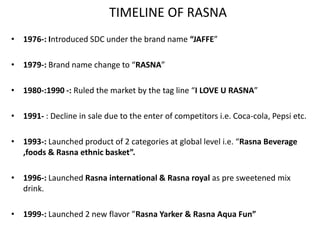
TIMELINE OF RASNA
• 1976-: Introduced SDC under the brand name “JAFFE”
• 1979-: Brand name change to “RASNA”
• 1980-:1990 -: Ruled the market by the tag line “I LOVE U RASNA”
• 1991- : Decline in sale due to the enter of competitors i.e. Coca-cola, Pepsi etc.
• 1993-: Launched product of 2 categories at global level i.e. “Rasna Beverage
,foods & Rasna ethnic basket”.
• 1996-: Launched Rasna international & Rasna royal as pre sweetened mix
drink.
• 1999-: Launched 2 new flavor ”Rasna Yarker & Rasna Aqua Fun”
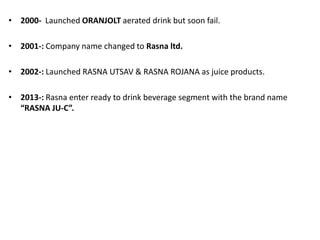
• 2000- Launched ORANJOLT aerated drink but soon fail.
• 2001-: Company name changed to Rasna ltd.
• 2002-: Launched RASNA UTSAV & RASNA ROJANA as juice products.
• 2013-: Rasna enter ready to drink beverage segment with the brand name
“RASNA JU-C”.
PEST Analysis
POLITICAL
• Supply of raw material
• Government rules and regulation regarding the soft drinks and aerated
drinks
Economical
• Economies of scale –introduced in small sachet to target a low income
group
• The rise in prices had been in line with the inflation through the years.
• Efficient sales and distribution network.
Social
 Increase the nutrious value by introducing the juice beverage which effect
the health of consumers.
 Rasna CSR trust ties up with US varsity for management sources.
 PR companion of Rasna are very strong
 For promotion free sachet of Rasna are distributed in rural area.
 Work with a belief of “everything for everyone” .
Technical
• Highly introvert towards the advertisement ,marked by many
popular agencies Mudra Voltas etc.
• Many buses and vans are used for distribution network.
• Varieties of flavor.
• R&D experts for every product.
• The packs were pilferage-proof with moisture-resistant
lining, thus, retaining both flavor and freshness.
SWOT ANALYSIS
STRENGTHS
• They are always ready to fight with competition ATTITUDE.
• Marketing and Brand Building.
• Strong Brand name with 93+ market shares.
• One of the most visible advertising Featured many
celebrities from the field of entertainment and sports, like
Hrithik Roshan, Karishma Kapoor, Paresh Rawal, Anupam
Kher, Kapil Dev.
• Suits all classes of the society.
• Efficient sales and distribution network.
WEAKNESS
• Takes extra effort to mix the components to prepare.
• Rasna targeted specifically for children.
• Major products of Rasna are seasonal.
• Failed to understand shifting preference towards
ready-to-drink preparations.
• Not able to stop Piracy .
OPPORTUNITY
• Opportunity to enter into ready drink section.
• Rasna can also bring its international products into Indian
market.
• Entering into glucose section is definitely a good initiative.
• Also concentrating on rural markets.
THREAT
• Entrance of soft-drink brands like Coke and Pepsi etc.
• Other competitor brands like HUL,PARLE etc.
• Fruit juice section ,which is much suitable for Rasna, but that
section is also established by other brands.
• New regulations & policies .
• Change in concept.
Competitors of Rasna
Sunfill (coca-cola),2%
Tang (Kraft food),0.5%
Sugar free D’lite (Zydus cadila),0.2%
Kissan Mr. fruit (HUL),8%
Roohafza,7%
Rasna was able to retain its leadership in the
Rs2.5 billion preparatory soft drink market, with
an estimated 82% market share.
Segmentation
Geographic
• Region- Semi-urban, Urban
Demographic
• Age- Above 4 years
Psychographic
• Life style- sport oriented, outdoor oriented and family oriented
• Personality- Ambitious, gregarious & individualistic
Behavioural
• Occasions- regular, special
• Benefits- quality, economic & taste
• User status- regular, potential & first time
• Loyalty status- medium
• Usage rate- medium & light
• Attitude towards product- positive
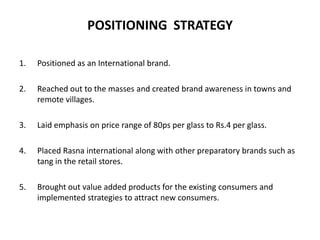
POSITIONING STRATEGY
1. Positioned as an International brand.
2. Reached out to the masses and created brand awareness in towns and
remote villages.
3. Laid emphasis on price range of 80ps per glass to Rs.4 per glass.
4. Placed Rasna international along with other preparatory brands such as
tang in the retail stores.
5. Brought out value added products for the existing consumers and
implemented strategies to attract new consumers.
Product Life Cycle
Time
Product
Development
Introduction
Profits
Sales
Growth Maturity Decline
Losses/
Investments ($)
Sales and
Profits ($)
Introduction Stage of the PLC
Sales
Costs
Profits
Marketing Objectives
Product
Price
Low sales
High cost per customer
Negative
Create product awareness
and trial
Offer a basic product
Use cost-plus
Distribution Build selective distribution
Advertising Build product awareness among early
adopters and dealers
Growth Stage of the PLC
Sales
Costs
Profits
Marketing Objectives
Product
Price
Rapidly rising sales
Average cost per customer
Rising profits
Maximize market share
Offer product extensions, service,
warranty
Price to penetrate market
Distribution Build intensive distribution
Advertising Build awareness and interest in the
mass market
Maturity Stage of the PLC
Sales
Costs
Profits
Marketing Objectives
Product
Price
Peak sales
Low cost per customer
High profits
Maximize profit while defending
market share
Diversify brand and models
Price to match or best competitors
Distribution Build more intensive distribution
Advertising Stress brand differences and benefits
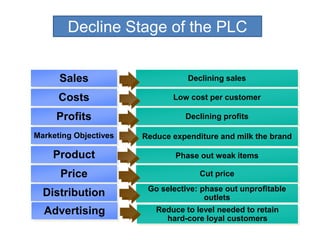
Decline Stage of the PLC
Sales
Costs
Profits
Marketing Objectives
Product
Price
Declining sales
Low cost per customer
Declining profits
Reduce expenditure and milk the brand
Phase out weak items
Cut price
Distribution Go selective: phase out unprofitable
outlets
Advertising Reduce to level needed to retain
hard-core loyal customers
Product Mix
1. Width :- Rasna Utsav ,Rasna Rozana Amrit, Rasna Rozana Ras,
Rasna Fruit Booster. (i.e., Total 4)
2. Length :- Rasna Utsav (10 flavors), Rasna Rozana Amrit (3
flavors), Rasna Rozana Ras (3 flavors), Rasna Fruit Booster (3
flavors). (i.e., Total 19)
3. Depth :- Rasna Utsav (10 flavors)
Rasna Rozana Amrit (3 flavors)
Rasna Rozana Ras (3 flavors)
Rasna Fruit Booster (3 flavors)
4. Average Length :- 19/4 = 4.75 (Total Length / Total Width)
ITEM
PRODUCT TYPE
PRODUCT LINE
PRODUCT CLASS
PRODUCT FAMILY
NEED FAMILY
Product Hierarchy
1. Need Family :- Thurst
2. Product Family :- Hot or Chill
3. Product Class :- Aerated / Non-Aerated
4. Product Line :- Rasna Fruit fun, Rasna Utsav , Rasna 1 ka 2.
5. Product Type :- Sunfill (Coca-cola), Tang (Kraft Food) .
6. ITEMs :- Rasna Utsav (1,6, 8 lit.),Rasna Rozana Amrit ( 1 ,10
glasses), Rasna Rozana Ras (100,200 ml) , Rasna Fruit Booster
(200,500 mg)
4 P’s of Rasna
1. PRODUCT
2. PRICE
3. PROMOTION
4. PLACE
Product
Rasna began with 9 flavors in 1982.
 It added 10th flavor in 1987. The company was revamped in
the year 2002. With a new tagline “relish a gain”, today Rasna
has tried a deep penetration in the rural and semi urban
market.
 Recent product line of Rasna are:
1. Rasna frootfun in various flavors
2. Rasna fresh fun in various flavors
 The company follows different pack size on carton basis. The
pack sizes may vary with the local market demand.
Product of Rasna
 Rasna Utsav
• Rasna Nimbu Pani
• Rasna Orange
• Rasna Mango
• Rasna Cola-Cola
 Rasna Rozana Amrit
• Rasna mango
• Rasna orange
• Rasna lemon
 Rasna Rozana Ras
• Rasna mango
• Rasna orange
• Rasna Pineapple
 Rasna Fruit Booster
• Rasna mango
• Rasna orange
• Rasna Pineapple
Price
The pricing strategy has always been the key of Rasna’s success. It targeted the
mass rather than the class.
Rasna has always made its product such an way that it can be accessible to all
socio-economic classes.
1. Its volume sale comes from its Rs 1.
2.The added sugar product Rasna Frootplus starts from Rs 2 and goes up to
family pack which costs Rs 105.
3.The Box pack has starting price of Rs 10 which is enough for 12 glass of
water.
4.The family box pack is available at the price of Rs 35 which is for 32 glass of
water.
5. The air tight jar has different pack size with price range starting from Rs 75.
6. The company is constantly focusing on the rural market of India. So pricing
accurately is very important for the growth.
Promotion
 Rasna has started its media campaign heavily since its inception. The
famous mass media campaign of “I love you Rasna”, was one of the
India’s longest running TV ad
• The promotion of Rasna is always highlighted a strong brand
association with there customer.
• Rasna always want to create a good brand value by emotionally
attaching there customer with there brand.
• Focus of the company always is the quality of Rasna.
• Once , Rasna was the only soft drink company in India. So they has
been trying for a good brand recall by there various ad campaign.
Promotion of Rasna
• Communication :- Through attractive banners, posters , news papers etc
• Activities promotion
• Outdoor
• TV channels
• Celebrity promotion
1.Anupam Kher
2. Kapil Dev
3. Karishma Kapoor
4. Hrithik Roshan
5. Vivian Richards
6. Paresh Rawal
7.Johny Lever
• In various ad campaign of Rasna, various child artists have been used heavily.
This kind of campaign shows a high focus on quality. The quality of Rasna has
been really the success factor and in there various advertisement they are
heavily focusing on that part.
• In India where summer is very hot and long, focus of a soft drink company
should be to understand that and to associate themselves with the misery of their
customer.
• Rasna has done a great deal to understand the pain of a long and hot summer
and to delver a product which would make that summer a little less painful.
• This kind of unique marketing idea and innovative ad campaign helped Rasna
to become a monopoly in the concentrated soft drink market.
Timeline of Rasna (T.V Commercials)
Places
1. Delhi
2. Lucknow
3. Ghaziabad
4. Dehradun
5. Ambala
6. Ludhiana
7. Chandigarh
8. Jammu
9. Kolkata
10. Patna
11. Rachi
12. Guwahati
13. Ahmadabad
14. Bangalore
15. Bhubaneswar
16. Jaipur
17. Chennai
18. Goa
19. Mumbai
20. Trichi
21. Vijayawada
22. Bhiwandi
23. Indore
24. Nagpur
25. Raipur
26. Jabalpur
Advertisement strategy
1. Advertisements were targeted at the urban and semi-urban families.
2. The company focused on multimedia advertising and promotions which
included TV, Radio and print.
3. Advertising and promotional activities were undertaken by “Mudra
communications” (a leading advertisement agency).
4. Emphasis was laid on outdoor visibility and over 45,000 bus shelters, 300 bus
panels and over 200 bill boards were used to display the brand message.
5. Catchy Brand taglines like “WHENEVER YOU FEEL LIKE CELEBRATING, DRINK
RASNA“ and RELISH A GAIN” .
6. The advertising strategy was changed to include every age group and every
section of the society.
Conti..
7. It categorized its product line into two brands, Rasna Utsav , Rasna Rosana and
sub brand Rosana fruit boosters.
8. For distinct visibility of its products Rasna chose the leaf as its brand symbol.
9. New brands were enriched with vitamins and ingredients to render instant
energy.
10. Priced Rosana Amrit sachets at Rs.2 competing Sunfill and Tang.
Distribution channel of Rasna
Steps Distribution channel
• Rasna use supper-sub concept of distribution and Follows 3-5 Tier
Architecture
1. First the product is produced in the factory which is strategically located to
minimize the transportation cost.
2. The packed product has been sent to various company depot across the country
to distribute & meet the respective market demand.
3. From the company depot the product has been delivered to the different supper
stockiest according to there previously placed order.
4. Then the goods has been send to the sub stockiest point or in some cases
wholesale store.
5. The secondary sale from the sub stockiest or from the supper stockiest is
ensured by the constant monitoring by the company personal.
Channel View
1. Super – stockiest
2. Sub stockiest
3. Making a sub- stockiest
Super-stockiest :-
Super stockiest is the kind of C&F agency, where companies keep their stock to pass
it on to the next stage of the distribution cycle viz. wholesalers, dealers, retailers and
finally to the consumers. They do all kinds of jobs like sales and marketing, stock
analysis, inventory management & control, packaging and distribution etc.
Super stockiest are appointed by the company itself for receiving, warehousing, safe
storage and dispatching of the Company's goods. The super stockiest works
according to the area assigned and is liable for the dispatch of the consignments
ordered by other sub- stockiest and is responsible for all theft & damage to goods
in his custody.
Sub stockiest:
Sub stockiest is a person in the next level of distribution cycle who is
appointed by the company person or by the super- stockiest. The Sub-
stockiest receives consignments from the super- stockiest and delivers
them to the retailers according to the consignment ordered.
Making a sub- stockiest:
A sub-stockiest is appointed by the company person or a super-
stockiest along the interior villages and towns which is beyond the
reach of the company itself. The variables that come into play in the
appointment of a sub-stockiest are:-
1. His ability to pay at a stipulated time period of his orders placed.
2. His ability to reach to every retailers in the market.
3. Area of his work so that order could be supplied to him at any point of
time.
4. Large space of warehousing for storing or stocking goods
Intermediates
1. Retail stockiest (2500)
2. 7 Distributing Branches
3. 35 Depots across India
Recommendations
• Promotional events along with the distribution of brochures,
stickers and leaflets are nil.
So, It is hereby recommended to distribute such materials to the
sub-stockiest and retailers which will help in Increasing the brand
value.

rasna marketing management

  • 2.
    INTRODUCTION • Rasna isa soft drink concentrate brand owned by Pioma Industries which in based in Ahmadabad, India. • Pioma launched SDC under the brand name Jaffe in 1976 & marketed it with the help of Voltas. • The brand name was changed to Rasna in 1979. • First to introduce Dual Format. • Rasna claims 92.7% market share in non carbonated soft drinks concentrate powder.
  • 3.
    PIOMA STARTED SELLINGRASNA • Pioma was the first company to introduce the concept of SDC (soft drink concentration) in India. • Competitors like Cola and MNC cola prevailed in the market. • Untapped market potential. • Closing of its operations in India due to policy changes with regard to MNC’s operation in India.
  • 4.
    REASONS FOR THEBRAND’S SUCCESS • Available in various flavors like Pineapple, Orange Mango, etc. • Do-It-Yourself concept. • Real fruit like flavor and taste. • Most affordable Drink available in the market.( 50ps per glass)
  • 5.
    RESEARCH AND DEVELOPMENT •Dedicated R&D team launching new flavors in quick succession. • Over the years new flavors were launched such as Kala Khatta, Khus, Rose. • Pilferage-Proof pack with moisture resistant lining thus retaining freshness and flavor.
  • 6.
    TIMELINE OF RASNA •1976-: Introduced SDC under the brand name “JAFFE” • 1979-: Brand name change to “RASNA” • 1980-:1990 -: Ruled the market by the tag line “I LOVE U RASNA” • 1991- : Decline in sale due to the enter of competitors i.e. Coca-cola, Pepsi etc. • 1993-: Launched product of 2 categories at global level i.e. “Rasna Beverage ,foods & Rasna ethnic basket”. • 1996-: Launched Rasna international & Rasna royal as pre sweetened mix drink. • 1999-: Launched 2 new flavor ”Rasna Yarker & Rasna Aqua Fun”
  • 7.
    • 2000- LaunchedORANJOLT aerated drink but soon fail. • 2001-: Company name changed to Rasna ltd. • 2002-: Launched RASNA UTSAV & RASNA ROJANA as juice products. • 2013-: Rasna enter ready to drink beverage segment with the brand name “RASNA JU-C”.
  • 8.
    PEST Analysis POLITICAL • Supplyof raw material • Government rules and regulation regarding the soft drinks and aerated drinks
  • 9.
    Economical • Economies ofscale –introduced in small sachet to target a low income group • The rise in prices had been in line with the inflation through the years. • Efficient sales and distribution network.
  • 10.
    Social  Increase thenutrious value by introducing the juice beverage which effect the health of consumers.  Rasna CSR trust ties up with US varsity for management sources.  PR companion of Rasna are very strong  For promotion free sachet of Rasna are distributed in rural area.  Work with a belief of “everything for everyone” .
  • 11.
    Technical • Highly introverttowards the advertisement ,marked by many popular agencies Mudra Voltas etc. • Many buses and vans are used for distribution network. • Varieties of flavor. • R&D experts for every product. • The packs were pilferage-proof with moisture-resistant lining, thus, retaining both flavor and freshness.
  • 12.
    SWOT ANALYSIS STRENGTHS • Theyare always ready to fight with competition ATTITUDE. • Marketing and Brand Building. • Strong Brand name with 93+ market shares. • One of the most visible advertising Featured many celebrities from the field of entertainment and sports, like Hrithik Roshan, Karishma Kapoor, Paresh Rawal, Anupam Kher, Kapil Dev. • Suits all classes of the society. • Efficient sales and distribution network.
  • 13.
    WEAKNESS • Takes extraeffort to mix the components to prepare. • Rasna targeted specifically for children. • Major products of Rasna are seasonal. • Failed to understand shifting preference towards ready-to-drink preparations. • Not able to stop Piracy .
  • 14.
    OPPORTUNITY • Opportunity toenter into ready drink section. • Rasna can also bring its international products into Indian market. • Entering into glucose section is definitely a good initiative. • Also concentrating on rural markets.
  • 15.
    THREAT • Entrance ofsoft-drink brands like Coke and Pepsi etc. • Other competitor brands like HUL,PARLE etc. • Fruit juice section ,which is much suitable for Rasna, but that section is also established by other brands. • New regulations & policies . • Change in concept.
  • 16.
    Competitors of Rasna Sunfill(coca-cola),2% Tang (Kraft food),0.5% Sugar free D’lite (Zydus cadila),0.2% Kissan Mr. fruit (HUL),8% Roohafza,7% Rasna was able to retain its leadership in the Rs2.5 billion preparatory soft drink market, with an estimated 82% market share.
  • 17.
    Segmentation Geographic • Region- Semi-urban,Urban Demographic • Age- Above 4 years Psychographic • Life style- sport oriented, outdoor oriented and family oriented • Personality- Ambitious, gregarious & individualistic Behavioural • Occasions- regular, special • Benefits- quality, economic & taste • User status- regular, potential & first time • Loyalty status- medium • Usage rate- medium & light • Attitude towards product- positive
  • 18.
    POSITIONING STRATEGY 1. Positionedas an International brand. 2. Reached out to the masses and created brand awareness in towns and remote villages. 3. Laid emphasis on price range of 80ps per glass to Rs.4 per glass. 4. Placed Rasna international along with other preparatory brands such as tang in the retail stores. 5. Brought out value added products for the existing consumers and implemented strategies to attract new consumers.
  • 19.
    Product Life Cycle Time Product Development Introduction Profits Sales GrowthMaturity Decline Losses/ Investments ($) Sales and Profits ($)
  • 20.
    Introduction Stage ofthe PLC Sales Costs Profits Marketing Objectives Product Price Low sales High cost per customer Negative Create product awareness and trial Offer a basic product Use cost-plus Distribution Build selective distribution Advertising Build product awareness among early adopters and dealers
  • 21.
    Growth Stage ofthe PLC Sales Costs Profits Marketing Objectives Product Price Rapidly rising sales Average cost per customer Rising profits Maximize market share Offer product extensions, service, warranty Price to penetrate market Distribution Build intensive distribution Advertising Build awareness and interest in the mass market
  • 22.
    Maturity Stage ofthe PLC Sales Costs Profits Marketing Objectives Product Price Peak sales Low cost per customer High profits Maximize profit while defending market share Diversify brand and models Price to match or best competitors Distribution Build more intensive distribution Advertising Stress brand differences and benefits
  • 23.
    Decline Stage ofthe PLC Sales Costs Profits Marketing Objectives Product Price Declining sales Low cost per customer Declining profits Reduce expenditure and milk the brand Phase out weak items Cut price Distribution Go selective: phase out unprofitable outlets Advertising Reduce to level needed to retain hard-core loyal customers
  • 24.
    Product Mix 1. Width:- Rasna Utsav ,Rasna Rozana Amrit, Rasna Rozana Ras, Rasna Fruit Booster. (i.e., Total 4) 2. Length :- Rasna Utsav (10 flavors), Rasna Rozana Amrit (3 flavors), Rasna Rozana Ras (3 flavors), Rasna Fruit Booster (3 flavors). (i.e., Total 19) 3. Depth :- Rasna Utsav (10 flavors) Rasna Rozana Amrit (3 flavors) Rasna Rozana Ras (3 flavors) Rasna Fruit Booster (3 flavors) 4. Average Length :- 19/4 = 4.75 (Total Length / Total Width)
  • 25.
    ITEM PRODUCT TYPE PRODUCT LINE PRODUCTCLASS PRODUCT FAMILY NEED FAMILY Product Hierarchy
  • 26.
    1. Need Family:- Thurst 2. Product Family :- Hot or Chill 3. Product Class :- Aerated / Non-Aerated 4. Product Line :- Rasna Fruit fun, Rasna Utsav , Rasna 1 ka 2. 5. Product Type :- Sunfill (Coca-cola), Tang (Kraft Food) . 6. ITEMs :- Rasna Utsav (1,6, 8 lit.),Rasna Rozana Amrit ( 1 ,10 glasses), Rasna Rozana Ras (100,200 ml) , Rasna Fruit Booster (200,500 mg)
  • 27.
    4 P’s ofRasna 1. PRODUCT 2. PRICE 3. PROMOTION 4. PLACE
  • 28.
    Product Rasna began with9 flavors in 1982.  It added 10th flavor in 1987. The company was revamped in the year 2002. With a new tagline “relish a gain”, today Rasna has tried a deep penetration in the rural and semi urban market.  Recent product line of Rasna are: 1. Rasna frootfun in various flavors 2. Rasna fresh fun in various flavors  The company follows different pack size on carton basis. The pack sizes may vary with the local market demand.
  • 29.
    Product of Rasna Rasna Utsav • Rasna Nimbu Pani • Rasna Orange • Rasna Mango • Rasna Cola-Cola  Rasna Rozana Amrit • Rasna mango • Rasna orange • Rasna lemon  Rasna Rozana Ras • Rasna mango • Rasna orange • Rasna Pineapple  Rasna Fruit Booster • Rasna mango • Rasna orange • Rasna Pineapple
  • 30.
    Price The pricing strategyhas always been the key of Rasna’s success. It targeted the mass rather than the class. Rasna has always made its product such an way that it can be accessible to all socio-economic classes. 1. Its volume sale comes from its Rs 1. 2.The added sugar product Rasna Frootplus starts from Rs 2 and goes up to family pack which costs Rs 105. 3.The Box pack has starting price of Rs 10 which is enough for 12 glass of water. 4.The family box pack is available at the price of Rs 35 which is for 32 glass of water. 5. The air tight jar has different pack size with price range starting from Rs 75. 6. The company is constantly focusing on the rural market of India. So pricing accurately is very important for the growth.
  • 31.
    Promotion  Rasna hasstarted its media campaign heavily since its inception. The famous mass media campaign of “I love you Rasna”, was one of the India’s longest running TV ad • The promotion of Rasna is always highlighted a strong brand association with there customer. • Rasna always want to create a good brand value by emotionally attaching there customer with there brand. • Focus of the company always is the quality of Rasna. • Once , Rasna was the only soft drink company in India. So they has been trying for a good brand recall by there various ad campaign.
  • 32.
    Promotion of Rasna •Communication :- Through attractive banners, posters , news papers etc • Activities promotion • Outdoor • TV channels • Celebrity promotion 1.Anupam Kher 2. Kapil Dev 3. Karishma Kapoor 4. Hrithik Roshan 5. Vivian Richards 6. Paresh Rawal 7.Johny Lever
  • 33.
    • In variousad campaign of Rasna, various child artists have been used heavily. This kind of campaign shows a high focus on quality. The quality of Rasna has been really the success factor and in there various advertisement they are heavily focusing on that part. • In India where summer is very hot and long, focus of a soft drink company should be to understand that and to associate themselves with the misery of their customer. • Rasna has done a great deal to understand the pain of a long and hot summer and to delver a product which would make that summer a little less painful. • This kind of unique marketing idea and innovative ad campaign helped Rasna to become a monopoly in the concentrated soft drink market.
  • 34.
    Timeline of Rasna(T.V Commercials)
  • 35.
    Places 1. Delhi 2. Lucknow 3.Ghaziabad 4. Dehradun 5. Ambala 6. Ludhiana 7. Chandigarh 8. Jammu 9. Kolkata 10. Patna 11. Rachi 12. Guwahati 13. Ahmadabad 14. Bangalore 15. Bhubaneswar
  • 36.
    16. Jaipur 17. Chennai 18.Goa 19. Mumbai 20. Trichi 21. Vijayawada 22. Bhiwandi 23. Indore 24. Nagpur 25. Raipur 26. Jabalpur
  • 37.
    Advertisement strategy 1. Advertisementswere targeted at the urban and semi-urban families. 2. The company focused on multimedia advertising and promotions which included TV, Radio and print. 3. Advertising and promotional activities were undertaken by “Mudra communications” (a leading advertisement agency). 4. Emphasis was laid on outdoor visibility and over 45,000 bus shelters, 300 bus panels and over 200 bill boards were used to display the brand message. 5. Catchy Brand taglines like “WHENEVER YOU FEEL LIKE CELEBRATING, DRINK RASNA“ and RELISH A GAIN” . 6. The advertising strategy was changed to include every age group and every section of the society.
  • 38.
    Conti.. 7. It categorizedits product line into two brands, Rasna Utsav , Rasna Rosana and sub brand Rosana fruit boosters. 8. For distinct visibility of its products Rasna chose the leaf as its brand symbol. 9. New brands were enriched with vitamins and ingredients to render instant energy. 10. Priced Rosana Amrit sachets at Rs.2 competing Sunfill and Tang.
  • 39.
  • 40.
    Steps Distribution channel •Rasna use supper-sub concept of distribution and Follows 3-5 Tier Architecture 1. First the product is produced in the factory which is strategically located to minimize the transportation cost. 2. The packed product has been sent to various company depot across the country to distribute & meet the respective market demand. 3. From the company depot the product has been delivered to the different supper stockiest according to there previously placed order. 4. Then the goods has been send to the sub stockiest point or in some cases wholesale store. 5. The secondary sale from the sub stockiest or from the supper stockiest is ensured by the constant monitoring by the company personal.
  • 41.
    Channel View 1. Super– stockiest 2. Sub stockiest 3. Making a sub- stockiest Super-stockiest :- Super stockiest is the kind of C&F agency, where companies keep their stock to pass it on to the next stage of the distribution cycle viz. wholesalers, dealers, retailers and finally to the consumers. They do all kinds of jobs like sales and marketing, stock analysis, inventory management & control, packaging and distribution etc. Super stockiest are appointed by the company itself for receiving, warehousing, safe storage and dispatching of the Company's goods. The super stockiest works according to the area assigned and is liable for the dispatch of the consignments ordered by other sub- stockiest and is responsible for all theft & damage to goods in his custody.
  • 42.
    Sub stockiest: Sub stockiestis a person in the next level of distribution cycle who is appointed by the company person or by the super- stockiest. The Sub- stockiest receives consignments from the super- stockiest and delivers them to the retailers according to the consignment ordered. Making a sub- stockiest: A sub-stockiest is appointed by the company person or a super- stockiest along the interior villages and towns which is beyond the reach of the company itself. The variables that come into play in the appointment of a sub-stockiest are:- 1. His ability to pay at a stipulated time period of his orders placed. 2. His ability to reach to every retailers in the market. 3. Area of his work so that order could be supplied to him at any point of time. 4. Large space of warehousing for storing or stocking goods
  • 43.
    Intermediates 1. Retail stockiest(2500) 2. 7 Distributing Branches 3. 35 Depots across India
  • 44.
    Recommendations • Promotional eventsalong with the distribution of brochures, stickers and leaflets are nil. So, It is hereby recommended to distribute such materials to the sub-stockiest and retailers which will help in Increasing the brand value.