Presented by
Neelutpal Saha (222012)
Sachin Dhir (222018)
1
Questions
– Identify Harley‐Davidson’s strategy and explain its rationale.
– Compare Harley‐Davidson’s resources and capabilities with
those of Honda. What does your analysis imply for Harley’s
potential to establish cost and differentiation advantage over
Honda?
– What threats to continued success does Harley‐Davidson face?
– How can Harley‐Davidson sustain and enhance its competitive
position?
2
Industry Attractiveness
(Where to compete?)
- Heavyweight Cruiser and Touring
bikes
- Performance Models through
Buell Motorcycles
- Spares, Repairs & Maintenance
through their dealer networks
- General Merchandise through
third-party manufacturers
Competitive Advantage
(How should we compete?)
- According to Porter’s Generic
strategies Harley Davidson’s has
a Focus - Differentiation Strategy
- It is in the business of selling
lifestyle (a unique Harley
Experience), not transportation
Corporate
Strategy
Business
Strategy
3
Strategic Importance
RelativeStrength
SUPERFLUOUS STRENGTH KEY STRENGTHS
ZONE OF IRRELEVANCE KEY WEAKNESSES
• Brand & Customer Loyalty
• Distribution
• MAN (Material As Needed)
• Customized Design
• Manufacturing
• R&D
• Product Development
• International Exposure
• Public Relationship
Resources and Capabilities
4
Resources &
Capabilities
Harley Davidson Honda
Technology R&D expenditure of only 179
million (2005), technologically
laggard
Huge R&D expenditure of
4356 million (2005)
Design Traditional (old-style) but wide
range of customization
opportunities (ex- Chrome
Consulting)
Imitated design but
engineered motorcycles for
greater smoothness and
comfort
Purchasing Lack of bargaining power but
Harley fostered close relations
with key suppliers. Its SAC
promoted collaboration and
best practice sharing within the
Harley network
Honda produced over 5
million bikes per year. It
has global purchasing
power with huge
bargaining power
Manufacturing Development of capabilities in
TQM, Just-in-time scheduling,
CAD/CAM and delegating
decision making to the shop-
floor
A world leader in
economies of scale
production, had advantage
of economies of scale and
advanced automation 5
Resources &
Capabilities
Harley Davidson Honda
Distribution 85% of dealership in US was
exclusive and were regulated
through dealer development
program. Harley Davidson
University was established to
enhance dealer competencies
Worldwide dealership
network
Brand Ultimate biker status symbol, a
quasi-religion, an institution, a
way of life
Strong reputation for
quality, performance,
reliability and value for
money
Customer Service Direct linkage with customers.
The Harley Owner’s Group was
formed in 1983 to increase
Harley’s involvement in
customer’s riding experience.
Almost entirely through
dealers
6
Differentiation Advantage
Customer Value Chain
Harley Davidson Value Chain 7
Analyzing Harley’s Cost Position
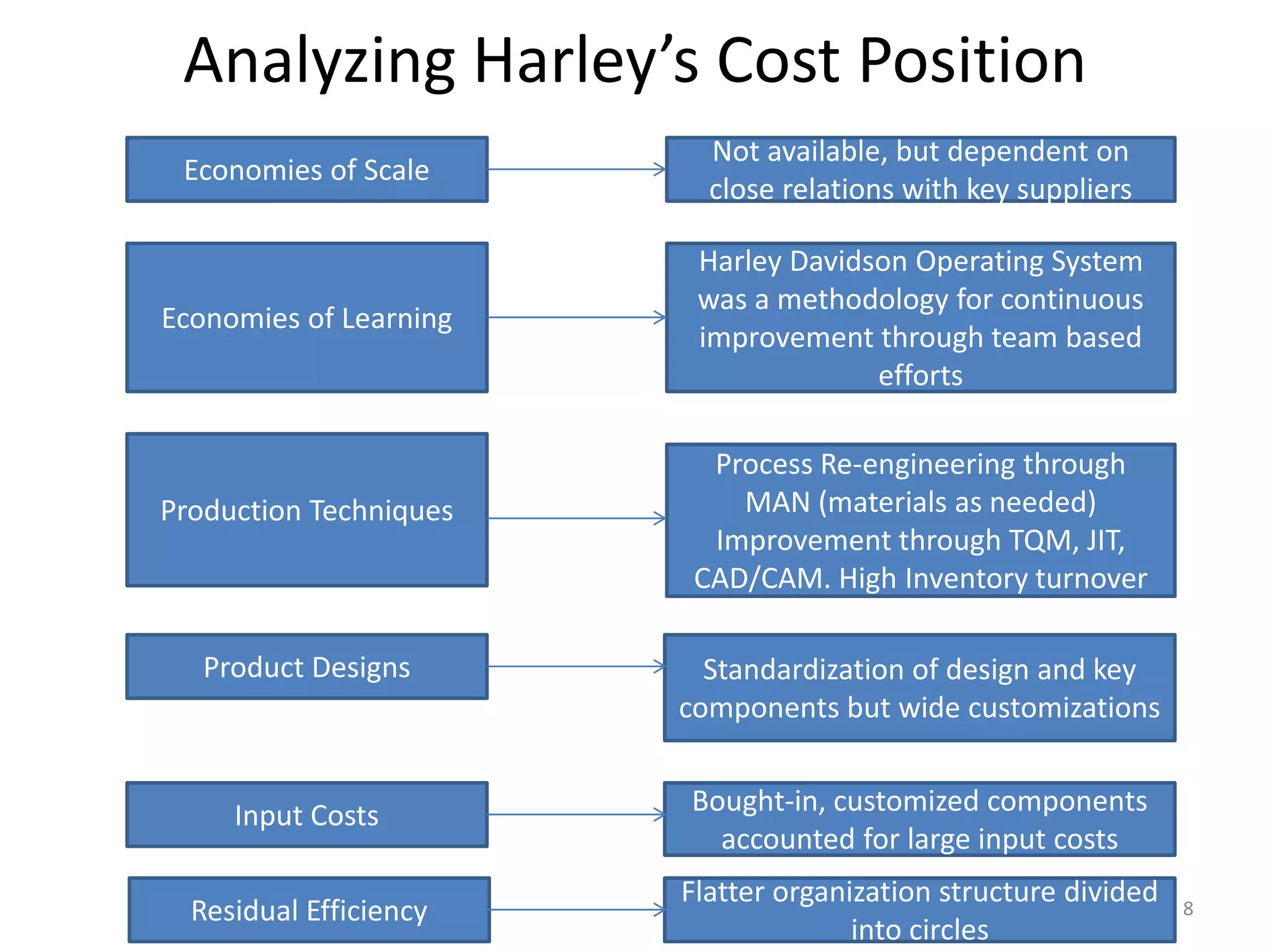
Economies of Scale
Not available, but dependent on
close relations with key suppliers
Economies of Learning
Harley Davidson Operating System
was a methodology for continuous
improvement through team based
efforts
Production Techniques
Process Re-engineering through
MAN (materials as needed)
Improvement through TQM, JIT,
CAD/CAM. High Inventory turnover
Product Designs Standardization of design and key
components but wide customizations
Input Costs Bought-in, customized components
accounted for large input costs
Residual Efficiency
Flatter organization structure divided
into circles
8
Harley-Davidson’s Threats
• Threats faced by Harley-Davidson creating a barrier to sustain
competitive advantage:
1. Brand Recognition
2. Customers
3. International Exposure
4. Intellectual Property
5. Lack of Diversification
9
1. Brand Recognition
• Increase in demand and sales led to loss of exclusivity
• Losing appeal  loss of their strongest asset
• Risk of changing consumer preferences (increasing interest in
sports models)
10
2. Customers
• Harley-Davidson highly focused on American traditional style
for higher-class customers
• In 1987, 50% of buyers are under 35 and now less than 15%
• Generation threat  Current customers are ageing
 More focus on younger middle-class customers
11
3. International Exposure
• EU and Asia prefer lightweight, high technology, sportive
and low-priced motorcycles
• Falling back on innovation and technology
• High cost due to low production  high prices for above
• Acquired Buell  in order to gain market share outside
America  tried offering same experience as Harley-
Davidson  Unsuccessful
 Low market-share in Europe and Asia
12
4. Intellectual Property
Offering average or similar product  price will play the final role
13
• Example: V-twin cruisers  competitors like Honda offers the
same product by imitating HOWEVER advanced technology
and lower price
5. Lack of Diversification
• Portfolio consisted mainly Cruiser Motorcycles
However, competitors imitated Harley-Davidson  loss of
competitive advantage
• Touring Motorcycles not up to customers’ requirements 
low on technology
• No market of Performance Motorcycles  most demanded by
consumers
Harley-Davidson maintains on a vision of traditional heavyweight
motorcycles  lowers the potential of diversification
14
Sustain & Enhance Competitive
Advantage
• Grant (2010) identified that superior Economic and
Financial performance is viewed as evidence of
competitive advantage:
As identified, Harley-Davidson falls behind its competitors and
therefore needs to sustain and enhance its competitive position
In 2005 Harley-Davidson Honda
Income after tax $960 million $3,628 million
Operating Cash Flow -$961 million $6,944million
R&D Expenditure $179 million $4,356 million
Return On Equity 31.10% 11.86%
15
Measuring sustainability: VRIO Framework
Valuable
• HD motorcycles are valuable because of the lifestyle factor. HD neutralizes
other competitors in this category because the lifestyle and culture cannot be
duplicated. Rivals in the industry all compete for different, yet complementary,
lifestyle factors.
Rare
• HD motorcycles are not rare. However, the reputation and personal value is rare
and controlled only by that individual. Motorcycle manufacturers are many,.
That image is rare.
Imitability
• HD has a causally ambiguous position within the market, This market position is
difficult to imitate, as is the culture that customers, suppliers, and employees
participate in. passion for HD cannot be imitated or substituted.
Organization
• Harley-Davidson’s most un-substitutable capabilities are the knowledge,.
fosters and encourages the culture that makes its company special to
customers, employees and suppliers. Without this culture, HD would not
survive in today’s market
16
Harley Davidson Core Competencies
• Human Resources and Capital – Trust, know-how, managerial
capabilities and company culture.
• Innovation resources from suppliers, employees and
management
• Reputational resources – Brand name, reputation with
suppliers and product perception
17
Harley Davidson Capabilities
• Integrated technological resources – Usage of Information
system to ensure smooth flow of production
• Unique skills of employees – Provide high level training
programs for its employees to add value to the company
• Manufacturing – HD manufacturing plants are capable of
producing many different models
18
Strategic Recommendation
• According to Grant (2010), sustainability can be achieved
through price-based strategies, differentiation, and lock in.
1. Price-based strategy 2. Differentiation 3. Lock-in
Accept reduced margin Create difficulties for
imitation
Achieve size/market
dominance
Win a price war Achieve imperfect mobility
of
resources/competencies
First-mover advantage
Reduce costs Reduce margin Reinforcement
Focus on specific
segments
Rigorous enforcement
19
1. Price-based strategies
 Harley-Davidson?
• Potential cost reduction throughout value chain
• Improvement in price transparency
• Increase of sales in European and Asian market  leading to
economies of scale
• Increase production volume to lower cost per unit
20
2. Differentiation Strategy
 Harley-Davidson?
• Roberts (1999): “Sustainable advantage comes from
…innovation, pure and simple.”
• Separate department for R&D  in order to realize and
obtain consumer preferences
• Sustain intellectual property  make imitation difficult
21
3. Lock-in
 Harley-Davidson?
• Sustain dominance in American market
• Aim to achieve higher market share in Europe and Asia
through lightweight motorcycles
• Economies of scale through price-based strategy
• Reinforce intellectual property rights such as more patents 
difficult to imitate
22
Conclusion
• Harley-Davidson remains to be among the market leaders in
America
• There are many threats regarding losing competitive
advantage
• Trends of heavyweight is going down
• Temporary advantage needs to be retained with proactive
strategies
• International exposure is essential as it will open many new
sources of cash flow for the company
23
Thanks
24

Harley davidson strategic management

  • 1.
    Presented by Neelutpal Saha(222012) Sachin Dhir (222018) 1
  • 2.
    Questions – Identify Harley‐Davidson’sstrategy and explain its rationale. – Compare Harley‐Davidson’s resources and capabilities with those of Honda. What does your analysis imply for Harley’s potential to establish cost and differentiation advantage over Honda? – What threats to continued success does Harley‐Davidson face? – How can Harley‐Davidson sustain and enhance its competitive position? 2
  • 3.
    Industry Attractiveness (Where tocompete?) - Heavyweight Cruiser and Touring bikes - Performance Models through Buell Motorcycles - Spares, Repairs & Maintenance through their dealer networks - General Merchandise through third-party manufacturers Competitive Advantage (How should we compete?) - According to Porter’s Generic strategies Harley Davidson’s has a Focus - Differentiation Strategy - It is in the business of selling lifestyle (a unique Harley Experience), not transportation Corporate Strategy Business Strategy 3
  • 4.
    Strategic Importance RelativeStrength SUPERFLUOUS STRENGTHKEY STRENGTHS ZONE OF IRRELEVANCE KEY WEAKNESSES • Brand & Customer Loyalty • Distribution • MAN (Material As Needed) • Customized Design • Manufacturing • R&D • Product Development • International Exposure • Public Relationship Resources and Capabilities 4
  • 5.
    Resources & Capabilities Harley DavidsonHonda Technology R&D expenditure of only 179 million (2005), technologically laggard Huge R&D expenditure of 4356 million (2005) Design Traditional (old-style) but wide range of customization opportunities (ex- Chrome Consulting) Imitated design but engineered motorcycles for greater smoothness and comfort Purchasing Lack of bargaining power but Harley fostered close relations with key suppliers. Its SAC promoted collaboration and best practice sharing within the Harley network Honda produced over 5 million bikes per year. It has global purchasing power with huge bargaining power Manufacturing Development of capabilities in TQM, Just-in-time scheduling, CAD/CAM and delegating decision making to the shop- floor A world leader in economies of scale production, had advantage of economies of scale and advanced automation 5
  • 6.
    Resources & Capabilities Harley DavidsonHonda Distribution 85% of dealership in US was exclusive and were regulated through dealer development program. Harley Davidson University was established to enhance dealer competencies Worldwide dealership network Brand Ultimate biker status symbol, a quasi-religion, an institution, a way of life Strong reputation for quality, performance, reliability and value for money Customer Service Direct linkage with customers. The Harley Owner’s Group was formed in 1983 to increase Harley’s involvement in customer’s riding experience. Almost entirely through dealers 6
  • 7.
    Differentiation Advantage Customer ValueChain Harley Davidson Value Chain 7
  • 8.
    Analyzing Harley’s CostPosition Economies of Scale Not available, but dependent on close relations with key suppliers Economies of Learning Harley Davidson Operating System was a methodology for continuous improvement through team based efforts Production Techniques Process Re-engineering through MAN (materials as needed) Improvement through TQM, JIT, CAD/CAM. High Inventory turnover Product Designs Standardization of design and key components but wide customizations Input Costs Bought-in, customized components accounted for large input costs Residual Efficiency Flatter organization structure divided into circles 8
  • 9.
    Harley-Davidson’s Threats • Threatsfaced by Harley-Davidson creating a barrier to sustain competitive advantage: 1. Brand Recognition 2. Customers 3. International Exposure 4. Intellectual Property 5. Lack of Diversification 9
  • 10.
    1. Brand Recognition •Increase in demand and sales led to loss of exclusivity • Losing appeal  loss of their strongest asset • Risk of changing consumer preferences (increasing interest in sports models) 10
  • 11.
    2. Customers • Harley-Davidsonhighly focused on American traditional style for higher-class customers • In 1987, 50% of buyers are under 35 and now less than 15% • Generation threat  Current customers are ageing  More focus on younger middle-class customers 11
  • 12.
    3. International Exposure •EU and Asia prefer lightweight, high technology, sportive and low-priced motorcycles • Falling back on innovation and technology • High cost due to low production  high prices for above • Acquired Buell  in order to gain market share outside America  tried offering same experience as Harley- Davidson  Unsuccessful  Low market-share in Europe and Asia 12
  • 13.
    4. Intellectual Property Offeringaverage or similar product  price will play the final role 13 • Example: V-twin cruisers  competitors like Honda offers the same product by imitating HOWEVER advanced technology and lower price
  • 14.
    5. Lack ofDiversification • Portfolio consisted mainly Cruiser Motorcycles However, competitors imitated Harley-Davidson  loss of competitive advantage • Touring Motorcycles not up to customers’ requirements  low on technology • No market of Performance Motorcycles  most demanded by consumers Harley-Davidson maintains on a vision of traditional heavyweight motorcycles  lowers the potential of diversification 14
  • 15.
    Sustain & EnhanceCompetitive Advantage • Grant (2010) identified that superior Economic and Financial performance is viewed as evidence of competitive advantage: As identified, Harley-Davidson falls behind its competitors and therefore needs to sustain and enhance its competitive position In 2005 Harley-Davidson Honda Income after tax $960 million $3,628 million Operating Cash Flow -$961 million $6,944million R&D Expenditure $179 million $4,356 million Return On Equity 31.10% 11.86% 15
  • 16.
    Measuring sustainability: VRIOFramework Valuable • HD motorcycles are valuable because of the lifestyle factor. HD neutralizes other competitors in this category because the lifestyle and culture cannot be duplicated. Rivals in the industry all compete for different, yet complementary, lifestyle factors. Rare • HD motorcycles are not rare. However, the reputation and personal value is rare and controlled only by that individual. Motorcycle manufacturers are many,. That image is rare. Imitability • HD has a causally ambiguous position within the market, This market position is difficult to imitate, as is the culture that customers, suppliers, and employees participate in. passion for HD cannot be imitated or substituted. Organization • Harley-Davidson’s most un-substitutable capabilities are the knowledge,. fosters and encourages the culture that makes its company special to customers, employees and suppliers. Without this culture, HD would not survive in today’s market 16
  • 17.
    Harley Davidson CoreCompetencies • Human Resources and Capital – Trust, know-how, managerial capabilities and company culture. • Innovation resources from suppliers, employees and management • Reputational resources – Brand name, reputation with suppliers and product perception 17
  • 18.
    Harley Davidson Capabilities •Integrated technological resources – Usage of Information system to ensure smooth flow of production • Unique skills of employees – Provide high level training programs for its employees to add value to the company • Manufacturing – HD manufacturing plants are capable of producing many different models 18
  • 19.
    Strategic Recommendation • Accordingto Grant (2010), sustainability can be achieved through price-based strategies, differentiation, and lock in. 1. Price-based strategy 2. Differentiation 3. Lock-in Accept reduced margin Create difficulties for imitation Achieve size/market dominance Win a price war Achieve imperfect mobility of resources/competencies First-mover advantage Reduce costs Reduce margin Reinforcement Focus on specific segments Rigorous enforcement 19
  • 20.
    1. Price-based strategies Harley-Davidson? • Potential cost reduction throughout value chain • Improvement in price transparency • Increase of sales in European and Asian market  leading to economies of scale • Increase production volume to lower cost per unit 20
  • 21.
    2. Differentiation Strategy Harley-Davidson? • Roberts (1999): “Sustainable advantage comes from …innovation, pure and simple.” • Separate department for R&D  in order to realize and obtain consumer preferences • Sustain intellectual property  make imitation difficult 21
  • 22.
    3. Lock-in  Harley-Davidson? •Sustain dominance in American market • Aim to achieve higher market share in Europe and Asia through lightweight motorcycles • Economies of scale through price-based strategy • Reinforce intellectual property rights such as more patents  difficult to imitate 22
  • 23.
    Conclusion • Harley-Davidson remainsto be among the market leaders in America • There are many threats regarding losing competitive advantage • Trends of heavyweight is going down • Temporary advantage needs to be retained with proactive strategies • International exposure is essential as it will open many new sources of cash flow for the company 23
  • 24.

Editor's Notes

  • #5 Step 1: Identification Key internal and external success factors must be identified Step 2: Appraising Importance: ‘Which resources and capabilities are most important in conferring sustainable competitive advantage?’ Relative Strength: ‘Analyzing the strengths and weaknesses of the resources and capabilities.’ Grant, 2010, p.140-145
  • #21 Price transparency  helping buyers understand how the pricing works and what the real value of the product they buy is
  • #22 Bullet point 3: such as style, technology, etc