


The Harbin Clinic
Leadership Academy
Session 2: Building Strategy
What Is the Right Direction for Growth?
Presenter:
Dr. Michael Burcham
EXECUTIVE AURA, LLC
105 Broadway, Suite 200
Nashville, TN 37201
In life, there is no dress
rehearsal. You get one
shot. Make it count.
Brand Promise
What do you provide that your Core Customers need that highly
differentiates you from your competitors?
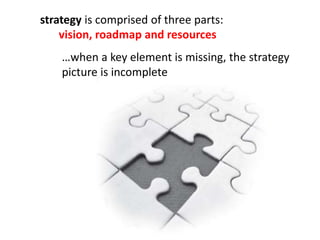
…when a key element is missing, the strategy
picture is incomplete
strategy is comprised of three parts:
vision, roadmap and resources
Strategy
Formulation
Strategic
Change
Strategic
Thinking
1. Vision:
Compelling vision of the
future that attracts others
2. Roadmap:
Ability to show others
what should be done
3. Resources:
Capable people actually
choose to do things differently
The Strategy Process
Assess
External
Environment
Internal
Organizational
Assessment
Strategic
Direction
Define &
Select Base
Strategy
Implement
Strategy Plan
Evaluate
Performance
The Strategy Process
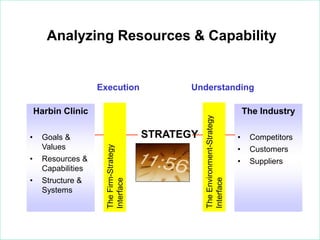
Harbin Clinic
• Goals &
Values
• Resources &
Capabilities
• Structure &
Systems
The Industry
• Competitors
• Customers
• Suppliers
STRATEGY
TheFirm-Strategy
Interface
TheEnvironment-Strategy
Interface
Execution Understanding
Analyzing Resources & Capability
Costs & Prices
Always Decline
Competitive
Position Drives
Options
Customers &
Profits Don’t
Stand Still
Simplicity Gets
Results
The Laws of Strategy
The Road to Results
Law 1:
Law 2:
Law 4:
Law 3:
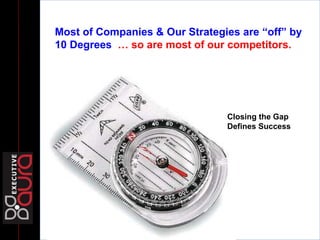
Most of Companies & Our Strategies are “off” by
10 Degrees … so are most of our competitors.
Closing the Gap
Defines Success
Executive Decision Making
An Executive, by profession, is a decision maker.
Uncertainty is you opponent.
Overcoming uncertainty is your mission.
Nothing rots morale more quickly and more completely
than the feeling that those in authority do not know their
own minds…
1. High-quality data. This a prerequisite for consistently sound
decision- making. The greater your understanding of your
company, your competitors and your environment, the more
you can move from guesswork to making strategic choices.
2. Executives need access to good technology and training.
Access to advanced information systems is crucial to
improved decision-making, as is training in helping employees
to make full use of them. Such tools must also be easy to use.
There is no point in spending on new technology if people do
not use it.
Ingredients for
Great Executive Decisions5
3. Sound judgment. Decision-making processes, whether formal
or not, need to leverage the strengths of human intuition. Data
does not run companies; people do.
4. Trust. To gain employees’ confidence in management
decisions, establishing transparency and trust is at least as
essential as a good track record.
5. Flexibility. Approaches to decision-making, and even to the
use of data, need to reflect the fact that the world is a diverse
place, and one size does not always fit all.
Ingredients for
Great Executive Decisions5
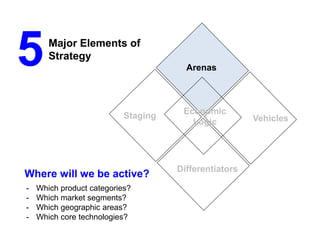
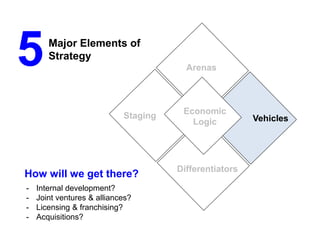
Arenas
Vehicles
Differentiators
Staging
Economic
Logic
5Major Elements of
Strategy
Hambrick & Frederickson
Academy of Management Executive, Vol. 15, No. 4
Arenas
Vehicles
Differentiators
Staging
Economic
Logic
5Major Elements of
Strategy
- Which product categories?
- Which market segments?
- Which geographic areas?
- Which core technologies?
Where will we be active?
Arenas
Vehicles
Differentiators
Staging
Economic
Logic
5Major Elements of
Strategy
How will we get there?
- Internal development?
- Joint ventures & alliances?
- Licensing & franchising?
- Acquisitions?
Arenas
Vehicles
Differentiators
Staging
Economic
Logic
5Major Elements of
Strategy
How will we win in the
marketplace?
- Image?
- Price?
- Product reliability?
- Customization?
Arenas
Vehicles
Differentiators
Staging
Economic
Logic
5Major Elements of
Strategy
What will be our speed
and sequence of moves?
- Availability of resources?
- Speed of expansion?
- Sequence of initiatives?
Arenas
Vehicles
Differentiators
Staging
Economic
Logic
5Major Elements of
Strategy
How will we obtain our
returns (make money)?
- Lowest costs through scale advantage?
- Lowest costs through scope advantage?
- Premium prices due to unmatched services?
- Premium prices due to proprietary features?
The Activity System
Value Chain
The Activity System
Primary and Support Activities
Potential Entrants
BuyersSuppliers
Substitutes
The Industry
Competition
Threat of substitutes
Bargaining powerBargaining power
Threat of entrants
Adapted from M. E. Porter, Competitive Strategy
Drivers of Competition
Porters 5 Forces
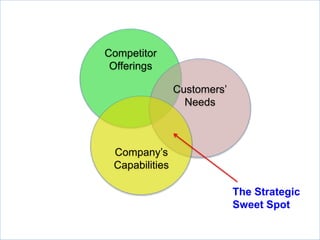
Competitor
Offerings
Customers’
Needs
Company’s
Capabilities
The Strategic
Sweet Spot
Customer | Product
Profitability Analysis
You have a long list of people, organizations, special interest
groups, demographic groups, etc. that are all Stakeholders
Stakeholder Analysis
• Process whereby we identify relevant stakeholders and analyze
their interest and power
• Asks 4 Questions:
1. Who are the relevant stakeholders?
2. What are the interests of each stakeholder?
3. What is the power of each stakeholder?
4. How/what are coalitions likely to form?
Stakeholder Analysis
Concern
Power
Identification – Stakeholders
Post-It™
Stakeholder
Analysis
Low High
LowHigh
Map out your stakeholders using the Power/Concern Grid.
Stakeholder Analysis
Stakeholder Map
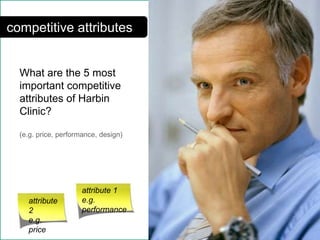
What are the 5 most
important competitive
attributes of Harbin
Clinic?
(e.g. price, performance, design)
attribute
2
e.g.
price
attribute 1
e.g.
performance
competitive attributes
1
2
3
4
-
-
1. most important attribute
2. second most important
3. …
4. …
5. …
5 attributes
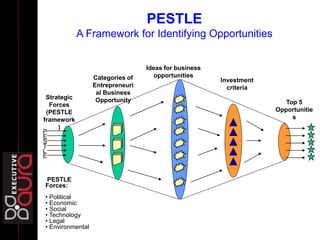
Strategic
Forces
(PESTLE
framework
)
Categories of
Entrepreneuri
al Business
Opportunity
Ideas for business
opportunities
Investment
criteria
Top 5
Opportunitie
s
P
E
S
T
L
E
PESTLE
Forces:
• Political
• Economic
• Social
• Technology
• Legal
• Environmental
PESTLE
A Framework for Identifying Opportunities
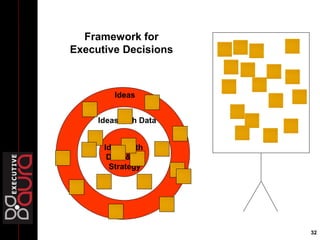
32
Ideas
Ideas with
Data & Fit
Strategy
Ideas with Data
Framework for
Executive Decisions
“In God we trust; all others must bring data.”
W. Edwards Deming
Physicist & Quality Improvement Pioneer
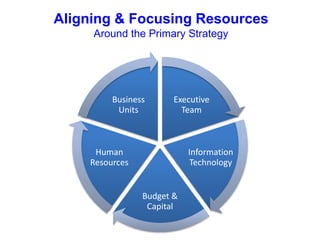
Executive
Team
Information
Technology
Budget &
Capital
Human
Resources
Business
Units
Aligning & Focusing Resources
Around the Primary Strategy
Companies typically realize only about 60% of their
strategies’ potential value because of defects and
breakdowns in execution.
Build a strategy that the CEO can communicate, the board
can support, and the organization can execute.
Strategy Execution
1. Keep it Elegantly Simple.
– Avoid drawn-out descriptions of lofty goals.
– Instead, clearly describe what your company will and won’t
do.
Rules for Successful
Strategy Execution7
2. Challenge Assumptions.
– Ensure that the assumptions underlying your long-term
strategic plans reflect real market economics and your
organization’s actual performance relative to rivals’.
– Check all the math.
– Validate marketing beliefs with real customer input and
feedback.
Rules for Successful
Strategy Execution7
3. Speak the Same Language.
– Business Unit Leaders & Corporate Strategy, Marketing and
Finance teams must agree on a common framework for
assessing performance.
– Transparency of the various measurement tools is vital.
Rules for Successful
Strategy Execution7
4. Discuss Resource Deployment Early.
– What new resources will be required to execute strategy at
the Business Unit Level?
– By asking questions such as, “How fast can you deploy the
new sales force?” and “How quickly will competitors
respond?” you create more feasible forecasts and plans.
Rules for Successful
Strategy Execution7
5. Identify Priorities.
– Delivering planned performance requires a few key actions
taken at the right time, in the right way.
– Make strategic priorities explicit, so everyone knows what to
focus on.
Rules for Successful
Strategy Execution7
6. Continuously Monitor Performance.
– Track real-time results against your plan, resetting planning
assumptions and reallocating resources as needed.
– Doing so allows the team to remedy flaws in the plan AND
its execution – and avoid confusing the two.
Rules for Successful
Strategy Execution7
7. Develop Execution Ability.
– No strategy can be better than the people who must
implement it.
– Make selection and development of managers a priority.
Rules for Successful
Strategy Execution7
Strategy is Never Done…
• The market is always changing; your strategy needs
to change with it.
• Since design thinking is inherently rooted in the world,
it is ideally suited to helping your strategy evolve.
Exercise: Identify 1 Key Strategy
Include These Elements in Your Plan
• Efficiency: How do we improve our overall efficiency in the
delivery of care – standardization, lower costs, maintain
margins.
• Data: How do you show, communicate, track, prove quality of
the Harbin experience?
• Incentives: How do we create the right incentives and
compensation plans that focus on value?
• Culture: What is the culture of Harbin that would be required to
execute this….

Harbin Clinic Presentation | Part 2

  • 1.
    The Harbin Clinic LeadershipAcademy Session 2: Building Strategy What Is the Right Direction for Growth? Presenter: Dr. Michael Burcham EXECUTIVE AURA, LLC 105 Broadway, Suite 200 Nashville, TN 37201 In life, there is no dress rehearsal. You get one shot. Make it count.
  • 2.
    Brand Promise What doyou provide that your Core Customers need that highly differentiates you from your competitors?
  • 3.
    …when a keyelement is missing, the strategy picture is incomplete strategy is comprised of three parts: vision, roadmap and resources
  • 4.
    Strategy Formulation Strategic Change Strategic Thinking 1. Vision: Compelling visionof the future that attracts others 2. Roadmap: Ability to show others what should be done 3. Resources: Capable people actually choose to do things differently The Strategy Process
  • 5.
  • 6.
    Harbin Clinic • Goals& Values • Resources & Capabilities • Structure & Systems The Industry • Competitors • Customers • Suppliers STRATEGY TheFirm-Strategy Interface TheEnvironment-Strategy Interface Execution Understanding Analyzing Resources & Capability
  • 7.
    Costs & Prices AlwaysDecline Competitive Position Drives Options Customers & Profits Don’t Stand Still Simplicity Gets Results The Laws of Strategy The Road to Results Law 1: Law 2: Law 4: Law 3:
  • 8.
    Most of Companies& Our Strategies are “off” by 10 Degrees … so are most of our competitors. Closing the Gap Defines Success
  • 9.
  • 10.
    An Executive, byprofession, is a decision maker. Uncertainty is you opponent. Overcoming uncertainty is your mission.
  • 11.
    Nothing rots moralemore quickly and more completely than the feeling that those in authority do not know their own minds…
  • 12.
    1. High-quality data.This a prerequisite for consistently sound decision- making. The greater your understanding of your company, your competitors and your environment, the more you can move from guesswork to making strategic choices. 2. Executives need access to good technology and training. Access to advanced information systems is crucial to improved decision-making, as is training in helping employees to make full use of them. Such tools must also be easy to use. There is no point in spending on new technology if people do not use it. Ingredients for Great Executive Decisions5
  • 13.
    3. Sound judgment.Decision-making processes, whether formal or not, need to leverage the strengths of human intuition. Data does not run companies; people do. 4. Trust. To gain employees’ confidence in management decisions, establishing transparency and trust is at least as essential as a good track record. 5. Flexibility. Approaches to decision-making, and even to the use of data, need to reflect the fact that the world is a diverse place, and one size does not always fit all. Ingredients for Great Executive Decisions5
  • 14.
    Arenas Vehicles Differentiators Staging Economic Logic 5Major Elements of Strategy Hambrick& Frederickson Academy of Management Executive, Vol. 15, No. 4
  • 15.
    Arenas Vehicles Differentiators Staging Economic Logic 5Major Elements of Strategy -Which product categories? - Which market segments? - Which geographic areas? - Which core technologies? Where will we be active?
  • 16.
    Arenas Vehicles Differentiators Staging Economic Logic 5Major Elements of Strategy Howwill we get there? - Internal development? - Joint ventures & alliances? - Licensing & franchising? - Acquisitions?
  • 17.
    Arenas Vehicles Differentiators Staging Economic Logic 5Major Elements of Strategy Howwill we win in the marketplace? - Image? - Price? - Product reliability? - Customization?
  • 18.
    Arenas Vehicles Differentiators Staging Economic Logic 5Major Elements of Strategy Whatwill be our speed and sequence of moves? - Availability of resources? - Speed of expansion? - Sequence of initiatives?
  • 19.
    Arenas Vehicles Differentiators Staging Economic Logic 5Major Elements of Strategy Howwill we obtain our returns (make money)? - Lowest costs through scale advantage? - Lowest costs through scope advantage? - Premium prices due to unmatched services? - Premium prices due to proprietary features?
  • 20.
  • 21.
    The Activity System Primaryand Support Activities
  • 22.
    Potential Entrants BuyersSuppliers Substitutes The Industry Competition Threatof substitutes Bargaining powerBargaining power Threat of entrants Adapted from M. E. Porter, Competitive Strategy Drivers of Competition Porters 5 Forces
  • 23.
  • 24.
  • 25.
    You have along list of people, organizations, special interest groups, demographic groups, etc. that are all Stakeholders Stakeholder Analysis
  • 26.
    • Process wherebywe identify relevant stakeholders and analyze their interest and power • Asks 4 Questions: 1. Who are the relevant stakeholders? 2. What are the interests of each stakeholder? 3. What is the power of each stakeholder? 4. How/what are coalitions likely to form? Stakeholder Analysis
  • 27.
    Concern Power Identification – Stakeholders Post-It™ Stakeholder Analysis LowHigh LowHigh Map out your stakeholders using the Power/Concern Grid. Stakeholder Analysis
  • 28.
  • 29.
    What are the5 most important competitive attributes of Harbin Clinic? (e.g. price, performance, design) attribute 2 e.g. price attribute 1 e.g. performance competitive attributes
  • 30.
    1 2 3 4 - - 1. most importantattribute 2. second most important 3. … 4. … 5. … 5 attributes
  • 31.
    Strategic Forces (PESTLE framework ) Categories of Entrepreneuri al Business Opportunity Ideasfor business opportunities Investment criteria Top 5 Opportunitie s P E S T L E PESTLE Forces: • Political • Economic • Social • Technology • Legal • Environmental PESTLE A Framework for Identifying Opportunities
  • 32.
    32 Ideas Ideas with Data &Fit Strategy Ideas with Data Framework for Executive Decisions
  • 33.
    “In God wetrust; all others must bring data.” W. Edwards Deming Physicist & Quality Improvement Pioneer
  • 34.
  • 35.
    Companies typically realizeonly about 60% of their strategies’ potential value because of defects and breakdowns in execution. Build a strategy that the CEO can communicate, the board can support, and the organization can execute. Strategy Execution
  • 36.
    1. Keep itElegantly Simple. – Avoid drawn-out descriptions of lofty goals. – Instead, clearly describe what your company will and won’t do. Rules for Successful Strategy Execution7
  • 37.
    2. Challenge Assumptions. –Ensure that the assumptions underlying your long-term strategic plans reflect real market economics and your organization’s actual performance relative to rivals’. – Check all the math. – Validate marketing beliefs with real customer input and feedback. Rules for Successful Strategy Execution7
  • 38.
    3. Speak theSame Language. – Business Unit Leaders & Corporate Strategy, Marketing and Finance teams must agree on a common framework for assessing performance. – Transparency of the various measurement tools is vital. Rules for Successful Strategy Execution7
  • 39.
    4. Discuss ResourceDeployment Early. – What new resources will be required to execute strategy at the Business Unit Level? – By asking questions such as, “How fast can you deploy the new sales force?” and “How quickly will competitors respond?” you create more feasible forecasts and plans. Rules for Successful Strategy Execution7
  • 40.
    5. Identify Priorities. –Delivering planned performance requires a few key actions taken at the right time, in the right way. – Make strategic priorities explicit, so everyone knows what to focus on. Rules for Successful Strategy Execution7
  • 41.
    6. Continuously MonitorPerformance. – Track real-time results against your plan, resetting planning assumptions and reallocating resources as needed. – Doing so allows the team to remedy flaws in the plan AND its execution – and avoid confusing the two. Rules for Successful Strategy Execution7
  • 42.
    7. Develop ExecutionAbility. – No strategy can be better than the people who must implement it. – Make selection and development of managers a priority. Rules for Successful Strategy Execution7
  • 45.
    Strategy is NeverDone… • The market is always changing; your strategy needs to change with it. • Since design thinking is inherently rooted in the world, it is ideally suited to helping your strategy evolve.
  • 46.
    Exercise: Identify 1Key Strategy Include These Elements in Your Plan • Efficiency: How do we improve our overall efficiency in the delivery of care – standardization, lower costs, maintain margins. • Data: How do you show, communicate, track, prove quality of the Harbin experience? • Incentives: How do we create the right incentives and compensation plans that focus on value? • Culture: What is the culture of Harbin that would be required to execute this….