

The Entrepreneurial
Ecosystem

Part 5:
                      Dr. Michael R. Burcham
Building an Angel
                      e.   michael@michaelburcham.com
Community             w.   www.michaelburcham.com
                      t.   www.twitter.com/michaelrburcham
                      f.   www.facebook.com/michael.r.burcham
                      l.   www.linkedin/in/michaelburcham
Starting companies are like having babies –
fun to conceive but hell to deliver.

And once their born, they’re yours to feed
until they are self sustaining.

- Anonymous
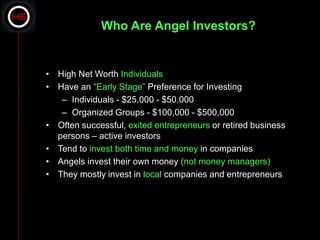
Who Are Angel Investors?


• High Net Worth Individuals
• Have an “Early Stage” Preference for Investing
   – Individuals - $25,000 - $50,000
   – Organized Groups - $100,000 - $500,000
• Often successful, exited entrepreneurs or retired business
  persons – active investors
• Tend to invest both time and money in companies
• Angels invest their own money (not money managers)
• They mostly invest in local companies and entrepreneurs
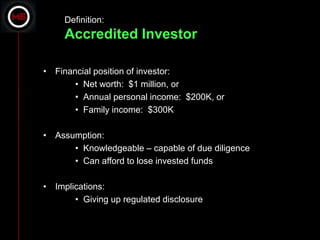
Definition:
     Accredited Investor

• Financial position of investor:
       • Net worth: $1 million, or
       • Annual personal income: $200K, or
       • Family income: $300K

• Assumption:
      • Knowledgeable – capable of due diligence
      • Can afford to lose invested funds

• Implications:
       • Giving up regulated disclosure
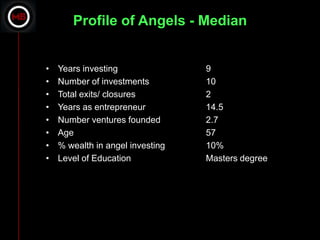
Profile of Angels - Median


•   Years investing               9
•   Number of investments         10
•   Total exits/ closures         2
•   Years as entrepreneur         14.5
•   Number ventures founded       2.7
•   Age                           57
•   % wealth in angel investing   10%
•   Level of Education            Masters degree
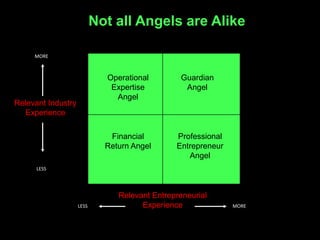
Not all Angels are Alike

     MORE


                             Operational        Guardian
                              Expertise          Angel
                               Angel
Relevant Industry
   Experience

                              Financial        Professional
                             Return Angel      Entrepreneur
                                                  Angel
      LESS


                                Relevant Entrepreneurial
                    LESS              Experience              MORE
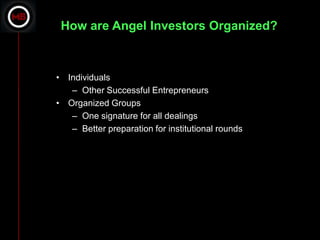
How are Angel Investors Organized?


• Individuals
   – Other Successful Entrepreneurs
• Organized Groups
   – One signature for all dealings
   – Better preparation for institutional rounds
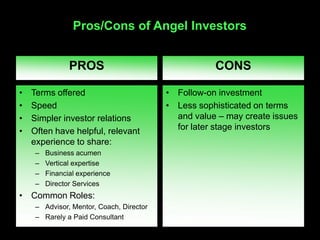
Pros/Cons of Angel Investors


                PROS                                 CONS

•   Terms offered                         • Follow-on investment
•   Speed                                 • Less sophisticated on terms
•   Simpler investor relations              and value – may create issues
•   Often have helpful, relevant            for later stage investors
    experience to share:
     –   Business acumen
     –   Vertical expertise
     –   Financial experience
     –   Director Services
• Common Roles:
     – Advisor, Mentor, Coach, Director
     – Rarely a Paid Consultant
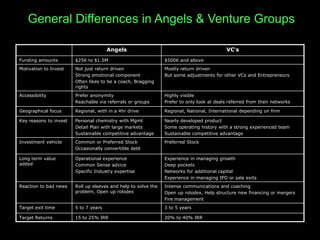
General Differences in Angels & Venture Groups

                                       Angels                                               VC’s
Funding amounts         $25K to $1.5M                           $500K and above
Motivation to Invest    Not just return driven                  Mostly return driven
                        Strong emotional component              But some adjustments for other VCs and Entrepreneurs
                        Often likes to be a coach, Bragging
                        rights
Accessibility           Prefer anonymity                        Highly visible
                        Reachable via referrals or groups       Prefer to only look at deals referred from their networks

Geographical focus      Regional, with in a 4hr drive           Regional, National, International depending on firm

Key reasons to invest   Personal chemistry with Mgmt            Nearly developed product
                        Detail Plan with large markets          Some operating history with a strong experienced team
                        Sustainable competitive advantage       Sustainable competitive advantage
Investment vehicle      Common or Preferred Stock               Preferred Stock
                        Occasionally convertible debt

Long term value         Operational experience                  Experience in managing growth
added                   Common Sense advice                     Deep pockets
                        Specific Industry expertise             Networks for additional capital
                                                                Experience in managing IPO or sale exits
Reaction to bad news    Roll up sleeves and help to solve the   Intense communications and coaching
                        problem, Open up rolodex                Open up rolodex, Help structure new financing or mergers
                                                                Fire management
Target exit time        5 to 7 years                            3 to 5 years

Target Returns          15 to 25% IRR                           20% to 40% IRR
How Do Angel Investors Fit within the
Entrepreneur Ecosystem?
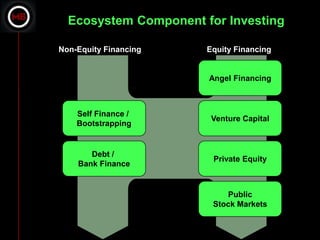
Ecosystem Component for Investing

Non-Equity Financing   Equity Financing


                       Angel Financing


    Self Finance /
                        Venture Capital
    Bootstrapping


       Debt /
                        Private Equity
    Bank Finance


                           Public
                        Stock Markets
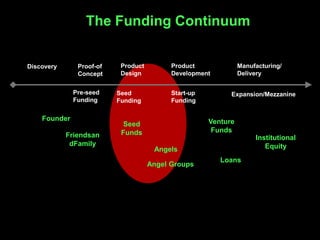
The Funding Continuum


Discovery       Proof-of    Product         Product              Manufacturing/
                Concept     Design          Development          Delivery


               Pre-seed
            Idea           Seed             Start-up         Expansion/Mezzanine
              Funding      Funding          Funding
                                                           Source of Capital

    Founder                                            Venture
                            Seed
                            Funds                       Funds
            Friendsan                                                   Institutional
             dFamily                                                       Equity
                                       Angels
                                                          Loans
                                      Angel Groups
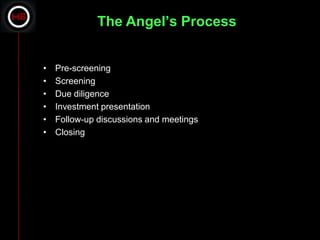
The Angel’s Process


•   Pre-screening
•   Screening
•   Due diligence
•   Investment presentation
•   Follow-up discussions and meetings
•   Closing
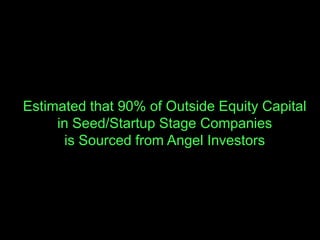
Estimated that 90% of Outside Equity Capital
     in Seed/Startup Stage Companies
      is Sourced from Angel Investors
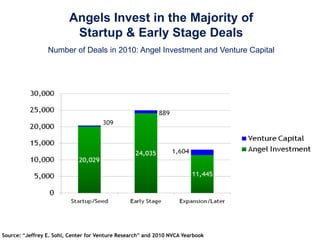
Angels Invest in the Majority of
                          Startup & Early Stage Deals
                 Number of Deals in 2010: Angel Investment and Venture Capital


Source: “Jeffrey E. Sohl, Center for Venture Research” and 2010 NVCA Yearbook
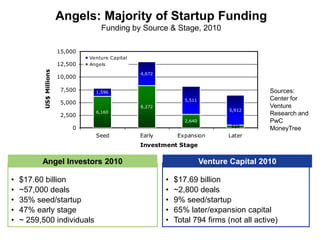
Angels: Majority of Startup Funding
                                      Funding by Source & Stage, 2010
                                         Funding by Source and Stage- 2009
                         15,000
                                  Venture Capital
                         12,500   Angels
          US$ Millions


                                                    4,672
                         10,000

                          7,500     1,596                                                    Sources:
                                                                   5,511                     Center for
                          5,000
                                                    8,272                                    Venture
                                    6,160                                         5,912
                          2,500                                                              Research and
                                                                   2,640                     PwC
                             0                                                     528
                                                                                             MoneyTree
                                    Seed            Early        Expansion        Later
                                                    Investment Stage

          Angel Investors 2010                                             Venture Capital 2010

•   $17.60 billion                                          •   $17.69 billion
•   ~57,000 deals                                           •   ~2,800 deals
•   35% seed/startup                                        •   9% seed/startup
•   47% early stage                                         •   65% later/expansion capital
•   ~ 259,500 individuals                                   •   Total 794 firms (not all active)
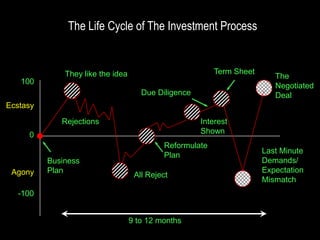
The Life Cycle of The Investment Process


              They like the idea                          Term Sheet
                                                                          The
   100
                                                                          Negotiated
                                      Due Diligence                       Deal
Ecstasy

             Rejections                               Interest
     0                                                Shown
                                            Reformulate
                                                                       Last Minute
                                            Plan
          Business                                                     Demands/
 Agony    Plan                                                         Expectation
                                    All Reject
                                                                       Mismatch
  -100


                                   9 to 12 months
What Behaviors Drive

Investors?
1. Fear
2. Greed
How Do We Find & Develop Angels
within our Entrepreneurial Ecosystem?
Recommendation 1:
Identify Potential Angels in the Community


Examples:

•   High Net Worth Individuals
•   Retired Business Executives
•   Active Serial Entrepreneurs
•   Known Angels Who are Relatively Inactive
Finding Angels

•   Friends and Family
•   Other Entrepreneurs who you worked with in the past
•   Services providers – Attorneys, Accounting firms, etc
•   Angel Groups
•   Investment Conferences


            Its all about Networking! There are no short-cuts!
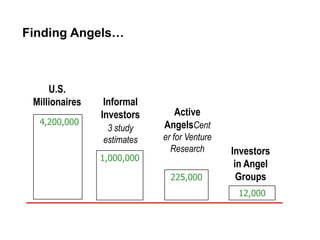
Finding Angels…


     U.S.
 Millionaires    Informal
                Investors     Active
  4,200,000                 AngelsCent
                 3 study
                estimates   er for Venture
                              Research       Investors
                1,000,000
                                              in Angel
                              225,000          Groups
                                              12,000
Recommendation 2:
Organize a Meet Up or Discussion


• Angel investing works best when there is a sense
  of “community” within the group. As they get to
  know one another and discuss the idea, you’re
  likely to gain more traction.

• Invite 3-4 active Angels from nearby cities if you
  don’t really have any active Angels – to share their
  story and discuss why they invest.
Motivation:
Why Be an Angel Investor?

• Helping entrepreneurs
• Stay engaged – using skills and experiences to help build
  business
• Giving back to community or university
• An active form of investing – not just watching markets
• Return on Investment is the metric
Recommendation 3:
Provide Formal Training


•   Process for Investing
•   Terms and Term Sheets
•   Valuation Models
•   Thinking “Portfolio” as an Approach
•   Risks
•   Expectations and Time Horizons
•   Board Roles, etc
Angel Investor Realities


• Statistically Angel Investors reject 80% of the deals presented
• Average outcomes of Investments made:
   – 45% fail
   – 40% are the “living dead”
   – 15% are winners
• Since at the seed stage it is impossible to predict which ones will be
  winners …………….
• Therefore, all portfolio companies must demonstrate the opportunity
  for a 10-20X return on investment.
Recommendation 4:
Establish a Process for Angels


• Timing for when the entrepreneur is introduced to
  or meets with the angel
• Periodic “Pitch Days” for groups of angels to hear a
  concept (or several concepts) to be followed up
  with individual meetings
• Ensure all legal and accounting issues are already
  addressed before angel meetings
• Timing for the funding-raising process, expectations
  for closing a round, etc.
Do’s & Don’ts


• Get deals done – angels need to invest in 2-4 deals per year or
  more to be proficient.

• Investors choose people over ideas.

• Don’t drag on decisions, be helpful. It’s “angel” investor not
  “devil” investor

• Don’t ever charge the entrepreneur to present to the angels.
Recommendation 5:
Deliver a GREAT Product to the Angels


• Ensure the entrepreneur has had good mentoring
  and coaching before Angel meetings – including
  having a viable business model and a few early
  customers (or potential customers)

• Insist the entrepreneur tell their story well and are
  well prepared for the meeting (materials, etc)
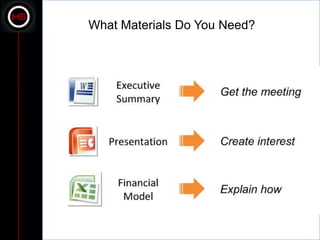
What Materials Do You Need?
Recommendation 6:
Periodic (Quarterly) Meet-ups for Angels


• Continue to build a sense of “community” – makes
  it easy to invite new individual Angels into the
  group or discussion

• Share best-practices, celebrate wins, learn from
  those investments that don’t go so well.
Summary:
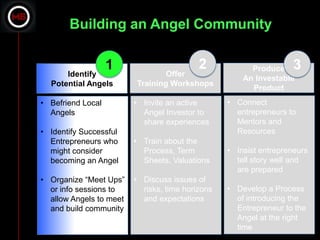
Building an Angel Community

                   1                       2            Produce     3
      Identify                   Offer
                                                      An Investable
  Potential Angels       Training Workshops
                                                        Product
• Befriend Local         • Invite an active       • Connect
  Angels                   Angel Investor to        entrepreneurs to
                           share experiences        Mentors and
• Identify Successful                               Resources
  Entrepreneurs who      • Train about the
  might consider           Process, Term          • Insist entrepreneurs
  becoming an Angel        Sheets, Valuations       tell story well and
                                                    are prepared
• Organize “Meet Ups”    • Discuss issues of
  or info sessions to      risks, time horizons   • Develop a Process
  allow Angels to meet     and expectations         of introducing the
  and build community                               Entrepreneur to the
                                                    Angel at the right
                                                    time
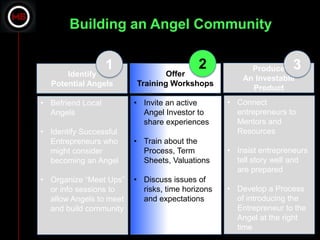
Building an Angel Community

                   1                       2            Produce     3
      Identify                   Offer
                                                      An Investable
  Potential Angels       Training Workshops
                                                        Product
• Befriend Local         • Invite an active       • Connect
  Angels                   Angel Investor to        entrepreneurs to
                           share experiences        Mentors and
• Identify Successful                               Resources
  Entrepreneurs who      • Train about the
  might consider           Process, Term          • Insist entrepreneurs
  becoming an Angel        Sheets, Valuations       tell story well and
                                                    are prepared
• Organize “Meet Ups”    • Discuss issues of
  or info sessions to      risks, time horizons   • Develop a Process
  allow Angels to meet     and expectations         of introducing the
  and build community                               Entrepreneur to the
                                                    Angel at the right
                                                    time
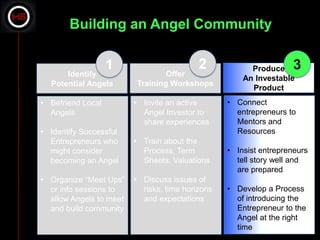
Building an Angel Community

                   1                       2            Produce     3
      Identify                   Offer
                                                      An Investable
  Potential Angels       Training Workshops
                                                        Product
• Befriend Local         • Invite an active       • Connect
  Angels                   Angel Investor to        entrepreneurs to
                           share experiences        Mentors and
• Identify Successful                               Resources
  Entrepreneurs who      • Train about the
  might consider           Process, Term          • Insist entrepreneurs
  becoming an Angel        Sheets, Valuations       tell story well and
                                                    are prepared
• Organize “Meet Ups”    • Discuss issues of
  or info sessions to      risks, time horizons   • Develop a Process
  allow Angels to meet     and expectations         of introducing the
  and build community                               Entrepreneur to the
                                                    Angel at the right
                                                    time
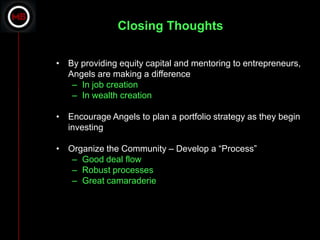
Closing Thoughts

• By providing equity capital and mentoring to entrepreneurs,
  Angels are making a difference
   – In job creation
   – In wealth creation

• Encourage Angels to plan a portfolio strategy as they begin
  investing

• Organize the Community – Develop a “Process”
   – Good deal flow
   – Robust processes
   – Great camaraderie

Entrepreneurial ecosystem p5 angels

  • 1.
    The Entrepreneurial Ecosystem Part 5: Dr. Michael R. Burcham Building an Angel e. michael@michaelburcham.com Community w. www.michaelburcham.com t. www.twitter.com/michaelrburcham f. www.facebook.com/michael.r.burcham l. www.linkedin/in/michaelburcham
  • 2.
    Starting companies arelike having babies – fun to conceive but hell to deliver. And once their born, they’re yours to feed until they are self sustaining. - Anonymous
  • 3.
    Who Are AngelInvestors?
  • 4.
    Who Are AngelInvestors? • High Net Worth Individuals • Have an “Early Stage” Preference for Investing – Individuals - $25,000 - $50,000 – Organized Groups - $100,000 - $500,000 • Often successful, exited entrepreneurs or retired business persons – active investors • Tend to invest both time and money in companies • Angels invest their own money (not money managers) • They mostly invest in local companies and entrepreneurs
  • 5.
    Definition: Accredited Investor • Financial position of investor: • Net worth: $1 million, or • Annual personal income: $200K, or • Family income: $300K • Assumption: • Knowledgeable – capable of due diligence • Can afford to lose invested funds • Implications: • Giving up regulated disclosure
  • 6.
    Profile of Angels- Median • Years investing 9 • Number of investments 10 • Total exits/ closures 2 • Years as entrepreneur 14.5 • Number ventures founded 2.7 • Age 57 • % wealth in angel investing 10% • Level of Education Masters degree
  • 7.
    Not all Angelsare Alike MORE Operational Guardian Expertise Angel Angel Relevant Industry Experience Financial Professional Return Angel Entrepreneur Angel LESS Relevant Entrepreneurial LESS Experience MORE
  • 8.
    How are AngelInvestors Organized? • Individuals – Other Successful Entrepreneurs • Organized Groups – One signature for all dealings – Better preparation for institutional rounds
  • 9.
    Pros/Cons of AngelInvestors PROS CONS • Terms offered • Follow-on investment • Speed • Less sophisticated on terms • Simpler investor relations and value – may create issues • Often have helpful, relevant for later stage investors experience to share: – Business acumen – Vertical expertise – Financial experience – Director Services • Common Roles: – Advisor, Mentor, Coach, Director – Rarely a Paid Consultant
  • 10.
    General Differences inAngels & Venture Groups Angels VC’s Funding amounts $25K to $1.5M $500K and above Motivation to Invest Not just return driven Mostly return driven Strong emotional component But some adjustments for other VCs and Entrepreneurs Often likes to be a coach, Bragging rights Accessibility Prefer anonymity Highly visible Reachable via referrals or groups Prefer to only look at deals referred from their networks Geographical focus Regional, with in a 4hr drive Regional, National, International depending on firm Key reasons to invest Personal chemistry with Mgmt Nearly developed product Detail Plan with large markets Some operating history with a strong experienced team Sustainable competitive advantage Sustainable competitive advantage Investment vehicle Common or Preferred Stock Preferred Stock Occasionally convertible debt Long term value Operational experience Experience in managing growth added Common Sense advice Deep pockets Specific Industry expertise Networks for additional capital Experience in managing IPO or sale exits Reaction to bad news Roll up sleeves and help to solve the Intense communications and coaching problem, Open up rolodex Open up rolodex, Help structure new financing or mergers Fire management Target exit time 5 to 7 years 3 to 5 years Target Returns 15 to 25% IRR 20% to 40% IRR
  • 11.
    How Do AngelInvestors Fit within the Entrepreneur Ecosystem?
  • 12.
    Ecosystem Component forInvesting Non-Equity Financing Equity Financing Angel Financing Self Finance / Venture Capital Bootstrapping Debt / Private Equity Bank Finance Public Stock Markets
  • 13.
    The Funding Continuum Discovery Proof-of Product Product Manufacturing/ Concept Design Development Delivery Pre-seed Idea Seed Start-up Expansion/Mezzanine Funding Funding Funding Source of Capital Founder Venture Seed Funds Funds Friendsan Institutional dFamily Equity Angels Loans Angel Groups
  • 14.
    The Angel’s Process • Pre-screening • Screening • Due diligence • Investment presentation • Follow-up discussions and meetings • Closing
  • 15.
    Estimated that 90%of Outside Equity Capital in Seed/Startup Stage Companies is Sourced from Angel Investors
  • 16.
    Angels Invest inthe Majority of Startup & Early Stage Deals Number of Deals in 2010: Angel Investment and Venture Capital Source: “Jeffrey E. Sohl, Center for Venture Research” and 2010 NVCA Yearbook
  • 17.
    Angels: Majority ofStartup Funding Funding by Source & Stage, 2010 Funding by Source and Stage- 2009 15,000 Venture Capital 12,500 Angels US$ Millions 4,672 10,000 7,500 1,596 Sources: 5,511 Center for 5,000 8,272 Venture 6,160 5,912 2,500 Research and 2,640 PwC 0 528 MoneyTree Seed Early Expansion Later Investment Stage Angel Investors 2010 Venture Capital 2010 • $17.60 billion • $17.69 billion • ~57,000 deals • ~2,800 deals • 35% seed/startup • 9% seed/startup • 47% early stage • 65% later/expansion capital • ~ 259,500 individuals • Total 794 firms (not all active)
  • 18.
    The Life Cycleof The Investment Process They like the idea Term Sheet The 100 Negotiated Due Diligence Deal Ecstasy Rejections Interest 0 Shown Reformulate Last Minute Plan Business Demands/ Agony Plan Expectation All Reject Mismatch -100 9 to 12 months
  • 19.
  • 20.
    How Do WeFind & Develop Angels within our Entrepreneurial Ecosystem?
  • 21.
    Recommendation 1: Identify PotentialAngels in the Community Examples: • High Net Worth Individuals • Retired Business Executives • Active Serial Entrepreneurs • Known Angels Who are Relatively Inactive
  • 22.
    Finding Angels • Friends and Family • Other Entrepreneurs who you worked with in the past • Services providers – Attorneys, Accounting firms, etc • Angel Groups • Investment Conferences Its all about Networking! There are no short-cuts!
  • 23.
    Finding Angels… U.S. Millionaires Informal Investors Active 4,200,000 AngelsCent 3 study estimates er for Venture Research Investors 1,000,000 in Angel 225,000 Groups 12,000
  • 24.
    Recommendation 2: Organize aMeet Up or Discussion • Angel investing works best when there is a sense of “community” within the group. As they get to know one another and discuss the idea, you’re likely to gain more traction. • Invite 3-4 active Angels from nearby cities if you don’t really have any active Angels – to share their story and discuss why they invest.
  • 25.
    Motivation: Why Be anAngel Investor? • Helping entrepreneurs • Stay engaged – using skills and experiences to help build business • Giving back to community or university • An active form of investing – not just watching markets • Return on Investment is the metric
  • 26.
    Recommendation 3: Provide FormalTraining • Process for Investing • Terms and Term Sheets • Valuation Models • Thinking “Portfolio” as an Approach • Risks • Expectations and Time Horizons • Board Roles, etc
  • 27.
    Angel Investor Realities •Statistically Angel Investors reject 80% of the deals presented • Average outcomes of Investments made: – 45% fail – 40% are the “living dead” – 15% are winners • Since at the seed stage it is impossible to predict which ones will be winners ……………. • Therefore, all portfolio companies must demonstrate the opportunity for a 10-20X return on investment.
  • 28.
    Recommendation 4: Establish aProcess for Angels • Timing for when the entrepreneur is introduced to or meets with the angel • Periodic “Pitch Days” for groups of angels to hear a concept (or several concepts) to be followed up with individual meetings • Ensure all legal and accounting issues are already addressed before angel meetings • Timing for the funding-raising process, expectations for closing a round, etc.
  • 29.
    Do’s & Don’ts •Get deals done – angels need to invest in 2-4 deals per year or more to be proficient. • Investors choose people over ideas. • Don’t drag on decisions, be helpful. It’s “angel” investor not “devil” investor • Don’t ever charge the entrepreneur to present to the angels.
  • 30.
    Recommendation 5: Deliver aGREAT Product to the Angels • Ensure the entrepreneur has had good mentoring and coaching before Angel meetings – including having a viable business model and a few early customers (or potential customers) • Insist the entrepreneur tell their story well and are well prepared for the meeting (materials, etc)
  • 31.
  • 32.
    Recommendation 6: Periodic (Quarterly)Meet-ups for Angels • Continue to build a sense of “community” – makes it easy to invite new individual Angels into the group or discussion • Share best-practices, celebrate wins, learn from those investments that don’t go so well.
  • 33.
  • 34.
    Building an AngelCommunity 1 2 Produce 3 Identify Offer An Investable Potential Angels Training Workshops Product • Befriend Local • Invite an active • Connect Angels Angel Investor to entrepreneurs to share experiences Mentors and • Identify Successful Resources Entrepreneurs who • Train about the might consider Process, Term • Insist entrepreneurs becoming an Angel Sheets, Valuations tell story well and are prepared • Organize “Meet Ups” • Discuss issues of or info sessions to risks, time horizons • Develop a Process allow Angels to meet and expectations of introducing the and build community Entrepreneur to the Angel at the right time
  • 35.
    Building an AngelCommunity 1 2 Produce 3 Identify Offer An Investable Potential Angels Training Workshops Product • Befriend Local • Invite an active • Connect Angels Angel Investor to entrepreneurs to share experiences Mentors and • Identify Successful Resources Entrepreneurs who • Train about the might consider Process, Term • Insist entrepreneurs becoming an Angel Sheets, Valuations tell story well and are prepared • Organize “Meet Ups” • Discuss issues of or info sessions to risks, time horizons • Develop a Process allow Angels to meet and expectations of introducing the and build community Entrepreneur to the Angel at the right time
  • 36.
    Building an AngelCommunity 1 2 Produce 3 Identify Offer An Investable Potential Angels Training Workshops Product • Befriend Local • Invite an active • Connect Angels Angel Investor to entrepreneurs to share experiences Mentors and • Identify Successful Resources Entrepreneurs who • Train about the might consider Process, Term • Insist entrepreneurs becoming an Angel Sheets, Valuations tell story well and are prepared • Organize “Meet Ups” • Discuss issues of or info sessions to risks, time horizons • Develop a Process allow Angels to meet and expectations of introducing the and build community Entrepreneur to the Angel at the right time
  • 37.
    Closing Thoughts • Byproviding equity capital and mentoring to entrepreneurs, Angels are making a difference – In job creation – In wealth creation • Encourage Angels to plan a portfolio strategy as they begin investing • Organize the Community – Develop a “Process” – Good deal flow – Robust processes – Great camaraderie

Editor's Notes

  • #20 Good afternoon. Thank you to the Rotary Club for this opportunity.Your interests, hobbies, travel, a little of your personal story -- small town boy; find ways to be playful, funny, and make a personal connection.I am Michael BurchamI am a Serial EntrepreneurAnd I AM MUSIC CITY
  • #30 You community needs to be known as a place that can complete the deal making cycle. With 24hrs in a day, entrepreneurs and investors will begin to shy away if you don’t close deals. Additionally, going back the education point earlier, investors HAVE to understand that large numbers dramatically increase their chances for success and good success at that.People drive the idea. Period.Again, be efficient in getting to “yes” and “no”It’s wrong. Period.