Execution of the Strategy Plan


       September 20, 2011


           This document intends to share author’s learning, ideas and personal
           reflection on the topic. If you intend to quote or replicate any part of this
           presentation, acknowledgement of this document and other authors
           cited in this document as your sources would be greatly appreciated
                                                                                           1
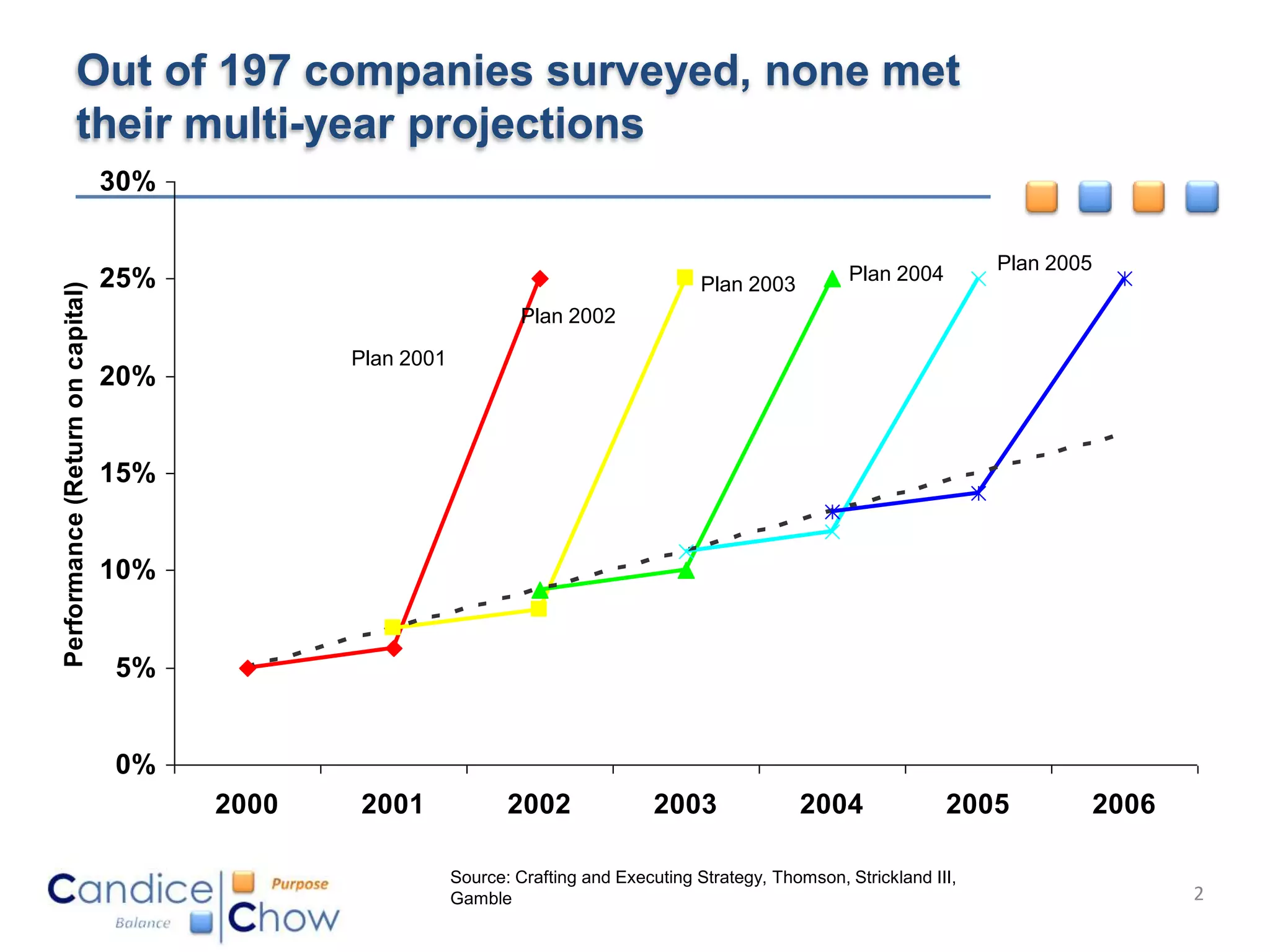
Out of 197 companies surveyed, none met
                their multi-year projections
                                  30%

                                                                                                                               Plan 2005
                                  25%                                                                         Plan 2004
                                                                                           Plan 2003
Performance (Return on capital)


                                                                    Plan 2002

                                               Plan 2001
                                  20%


                                  15%


                                  10%


                                  5%


                                  0%
                                        2000   2001               2002               2003              2004               2005             2006

                                                           Source: Crafting and Executing Strategy, Thomson, Strickland III,
                                                           Gamble                                                                                 2
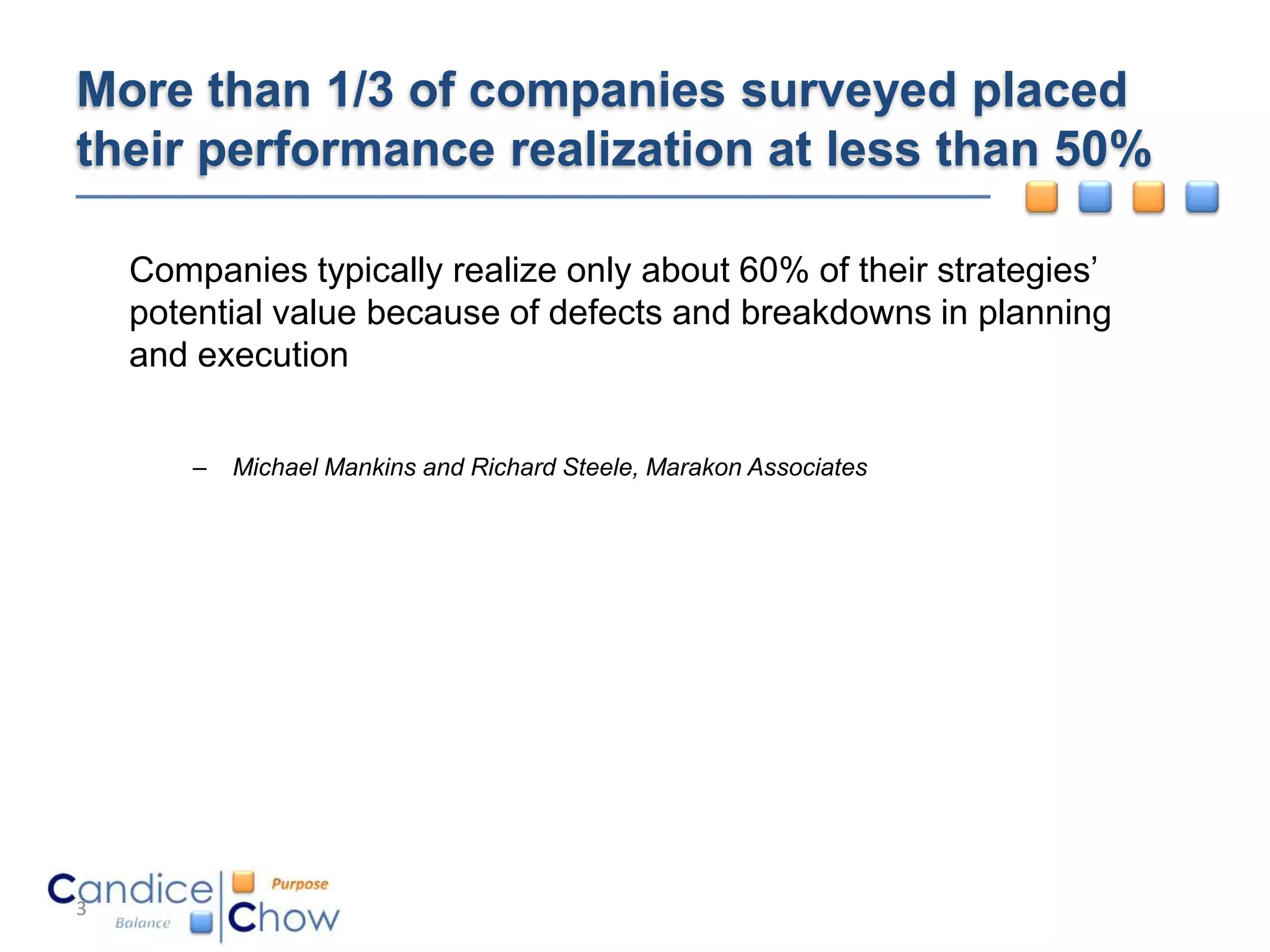
More than 1/3 of companies surveyed placed
their performance realization at less than 50%

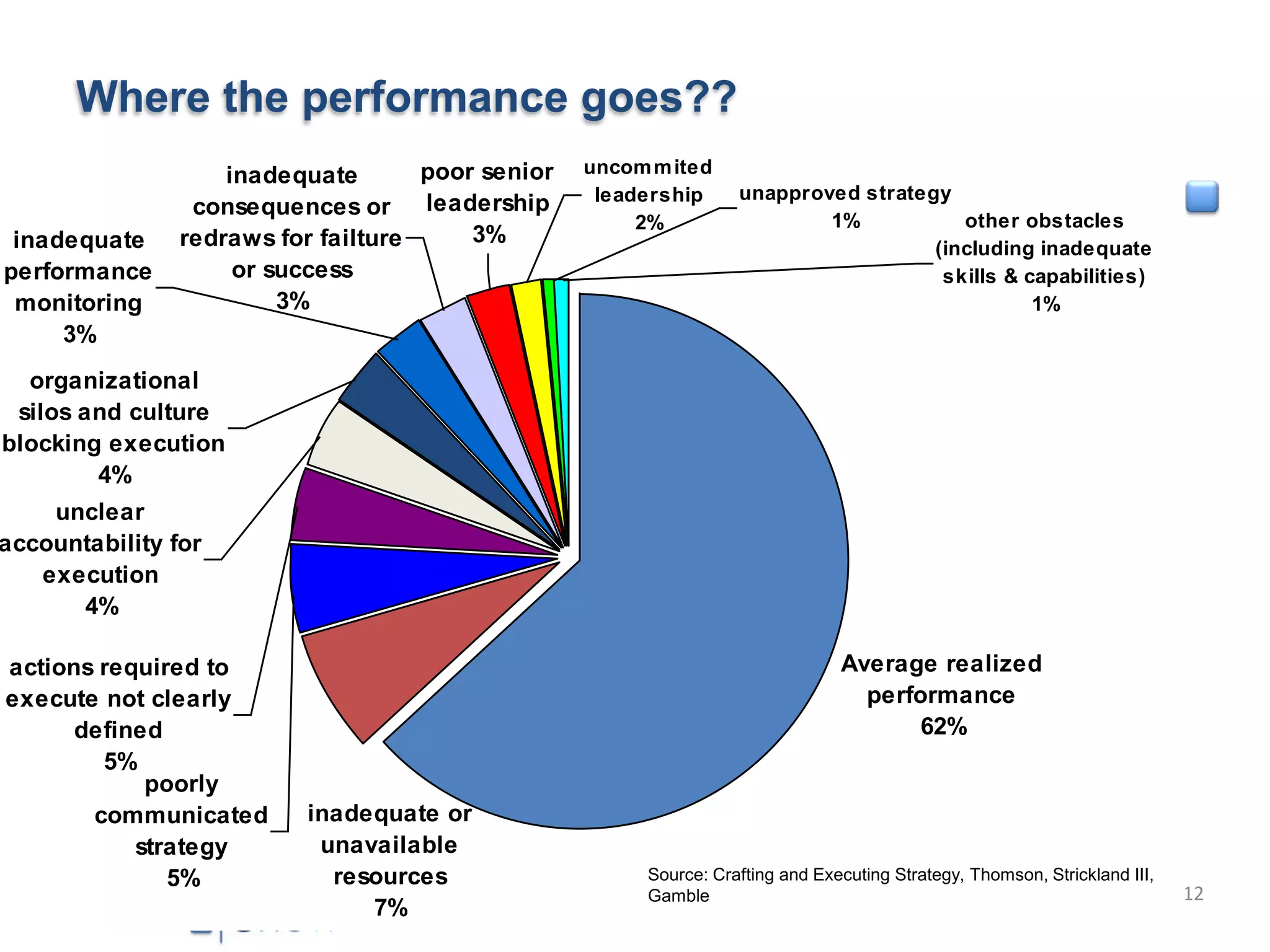
    Companies typically realize only about 60% of their strategies’
    potential value because of defects and breakdowns in planning
    and execution


        –   Michael Mankins and Richard Steele, Marakon Associates


3
Session objective

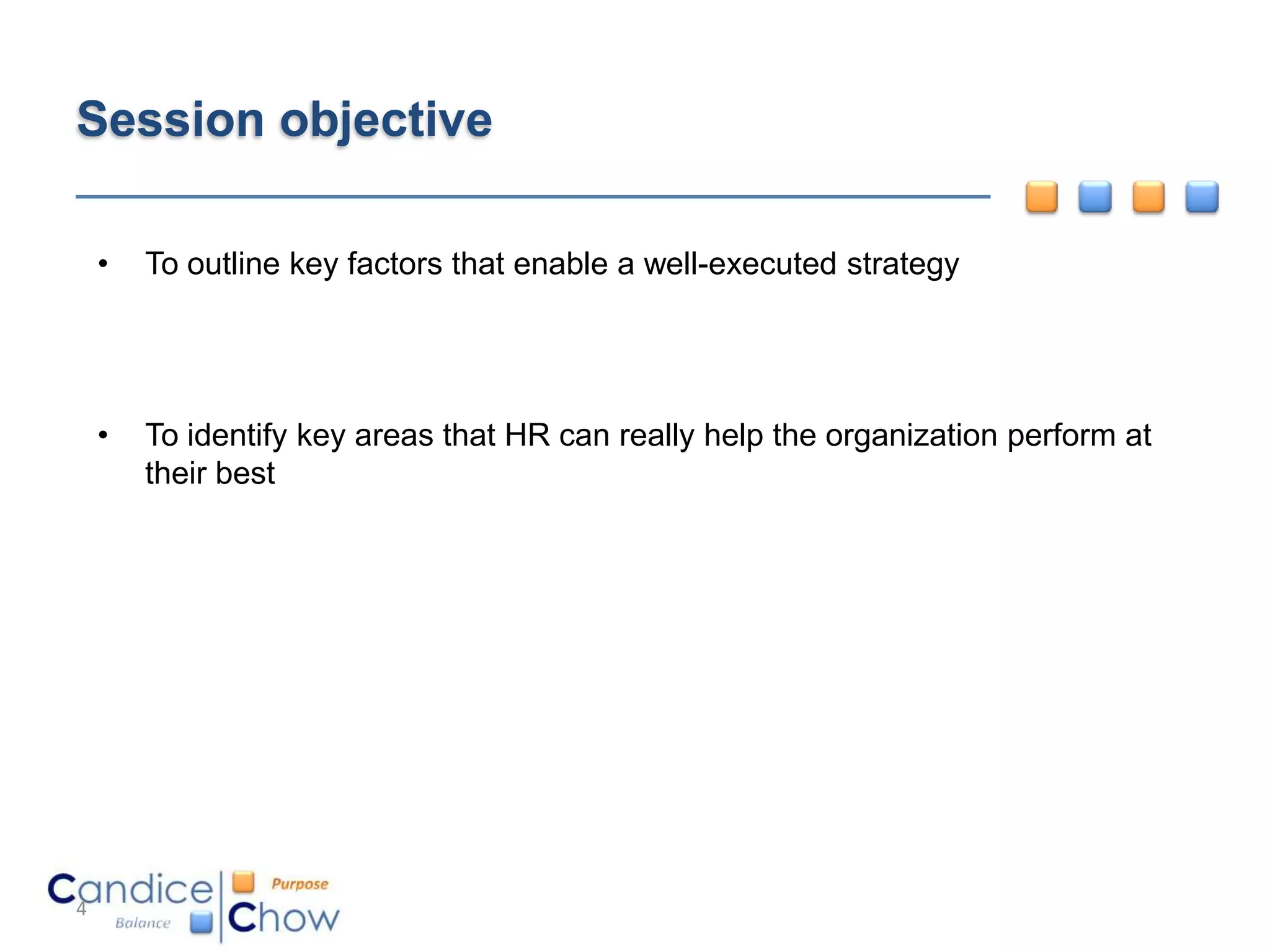
    •   To outline key factors that enable a well-executed strategy


    •   To identify key areas that HR can really help the organization perform at
        their best


4
Table of content

    •   What is a strategic plan


    •   How to translate a strategic plan into action plan?


    •   What is HR’s (your) role?


    •   Key takeaways


5
What is a strategic plan and why do we need
it?

•   What is a strategic plan?
     – A long-term business plan that outlines its vision, purpose and goals for
       a finite period of time – typically 3 – 5 years
     – A roadmap for the organization so to achieve its vision, fulfill its purpose
       alongside with meeting financial goals and shareholder requirement


•   Why do we need it?
     – Provide its stakeholders with a clear direction of growth
     – Enable trade-offs, resource allocation and decision making on day to
       day activities and investment
     – Provide a set of criteria and framework around which the appropriate
       new opportunities can be identified for pursuit


6
What is good strategy versus a well-executed
strategy?

•   What is a good strategy?
     – Creates uniqueness, differentiation for customers that is hard to emulate
     – Creates value for not only the customers and shareholders but key
       stakeholders (suppliers, community, government etc)
     – Leverages one’s strengths to exploit opportunities and mitigate threats
       and enables the organization to learn and progress through optimization
       of resources

•   What is a well-executed strategy
     – Strategy is understood by the entire organization and aligned with
       everyone’s objectives with measurable outcomes
     – Functions and business units are aligned and work collaboratively
     – Results are reviewed and courses are adjusted accordingly to achieve
       the objectives
     – Outcomes are delivered

7
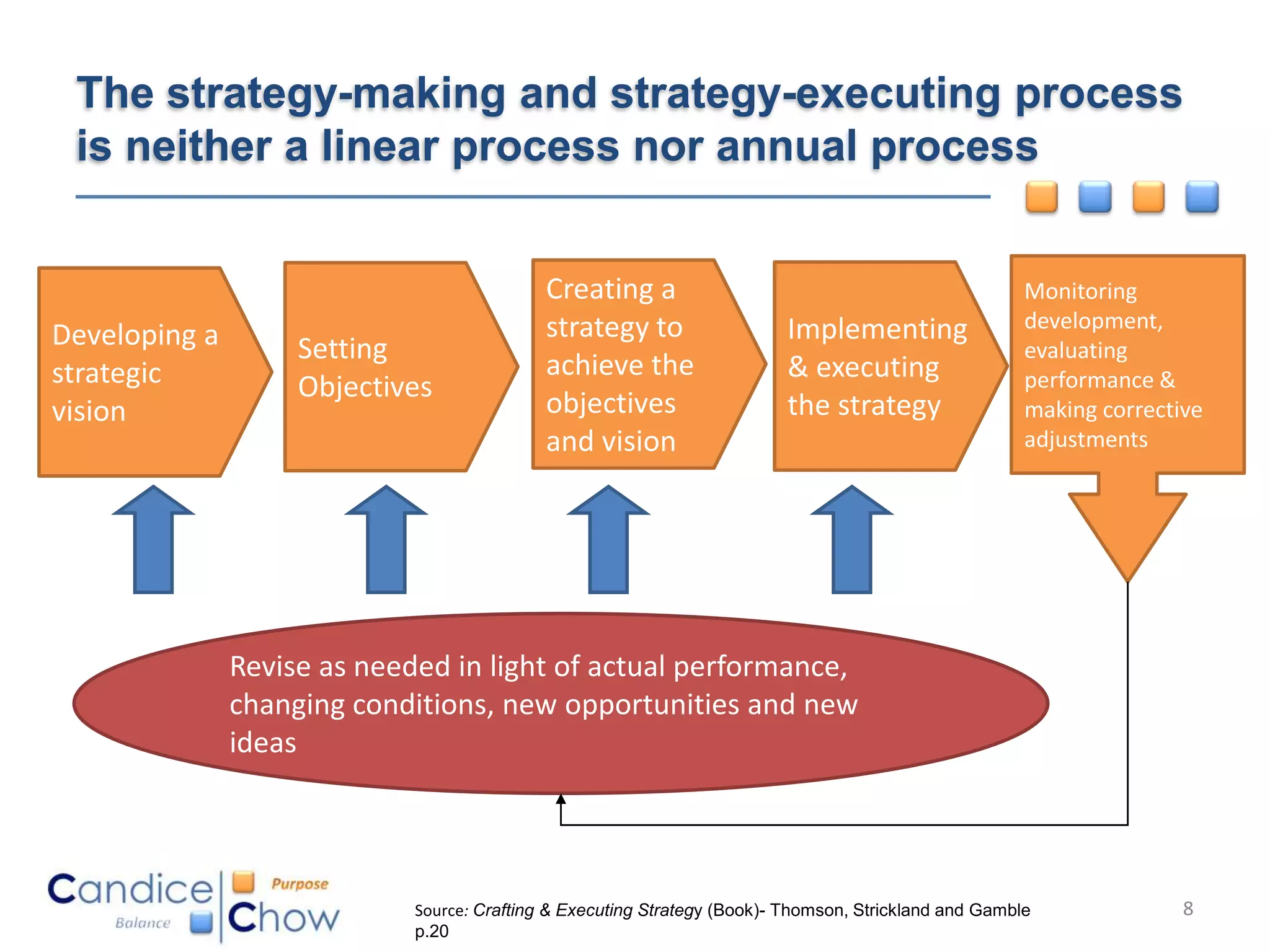
The strategy-making and strategy-executing process
 is neither a linear process nor annual process


                                             Creating a                                                 Monitoring
                                             strategy to                  Implementing                  development,
Developing a        Setting                                                                             evaluating
strategic                                    achieve the                  & executing                   performance &
                    Objectives
vision                                       objectives                   the strategy                  making corrective
                                             and vision                                                 adjustments


               Revise as needed in light of actual performance,
               changing conditions, new opportunities and new
               ideas


                             Source: Crafting & Executing Strategy (Book)- Thomson, Strickland and Gamble              8
                             p.20
A second-rate strategy perfectly executed will beat a
    first-rate strategy poorly executed
        Richard M. Kovacevich, Chairman and CEO Wells Fargo


9
Table of content

 •   What is a strategic plan


 •   How to translate a strategic plan into action plan?


 •   What is HR’s (your) role?


 •   Key takeaways


10
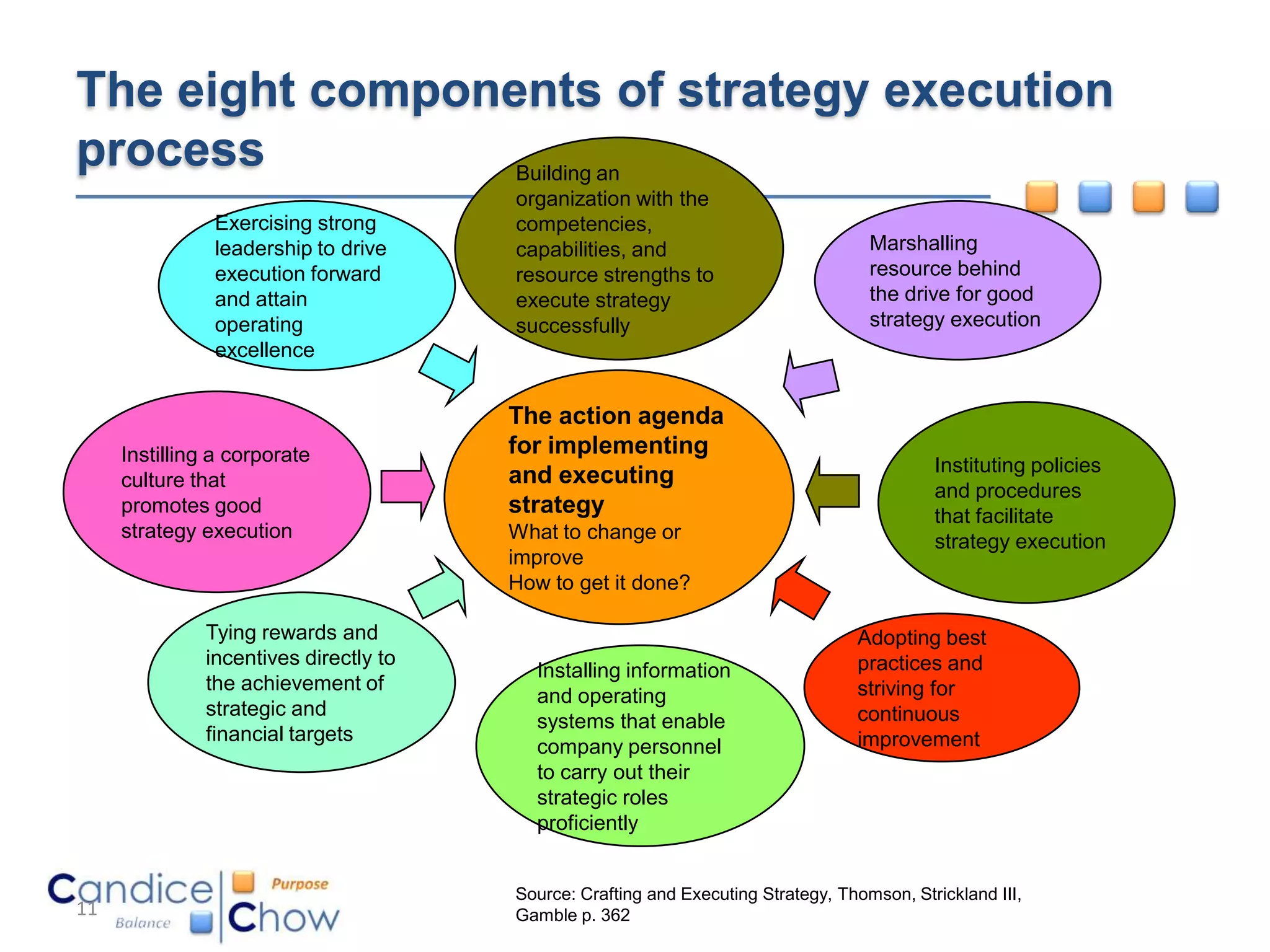
The eight components of strategy execution
process          Building an
                                       organization with the
               Exercising strong       competencies,
               leadership to drive     capabilities, and                            Marshalling
               execution forward       resource strengths to                        resource behind
               and attain              execute strategy                             the drive for good
               operating               successfully                                 strategy execution
               excellence


                                       The action agenda
     Instilling a corporate            for implementing
                                                                                            Instituting policies
     culture that                      and executing
                                                                                            and procedures
     promotes good                     strategy                                             that facilitate
     strategy execution                What to change or                                    strategy execution
                                       improve
                                       How to get it done?

              Tying rewards and                                                   Adopting best
              incentives directly to                                              practices and
                                         Installing information
              the achievement of                                                  striving for
                                         and operating
              strategic and                                                       continuous
                                         systems that enable
              financial targets                                                   improvement
                                         company personnel
                                         to carry out their
                                         strategic roles
                                         proficiently


                                       Source: Crafting and Executing Strategy, Thomson, Strickland III,
11                                     Gamble p. 362
Where the performance goes??
                    inadequate       poor senior   uncom m ited
                                                    leadership     unapproved strategy
                 consequences or leadership
                                                        2%                 1%           other obstacles
 inadequate     redraws for failture     3%
                                                                                     (including inadequate
performance          or success                                                       skills & capabilities)
 monitoring              3%                                                                     1%
     3%
  organizational
 silos and culture
blocking execution
        4%
    unclear
accountability for
   execution
      4%

actions required to                                                             Average realized
execute not clearly                                                               performance
      defined                                                                          62%
        5%
            poorly
       communicated       inadequate or
           strategy        unavailable
              5%            resources                   Source: Crafting and Executing Strategy, Thomson, Strickland III,
                                                        Gamble                                                              12
                               7%
Table of content

 •   What is a strategic plan


 •   How to translate a strategic plan into action plan?


 •   What is HR’s (your) role?


 •   Key takeaways


13
Let’s think about your role…

• Gaps

• Possible role / actions

• What is required? Ease of implementation ? Timing

• How do you know you are successful


14
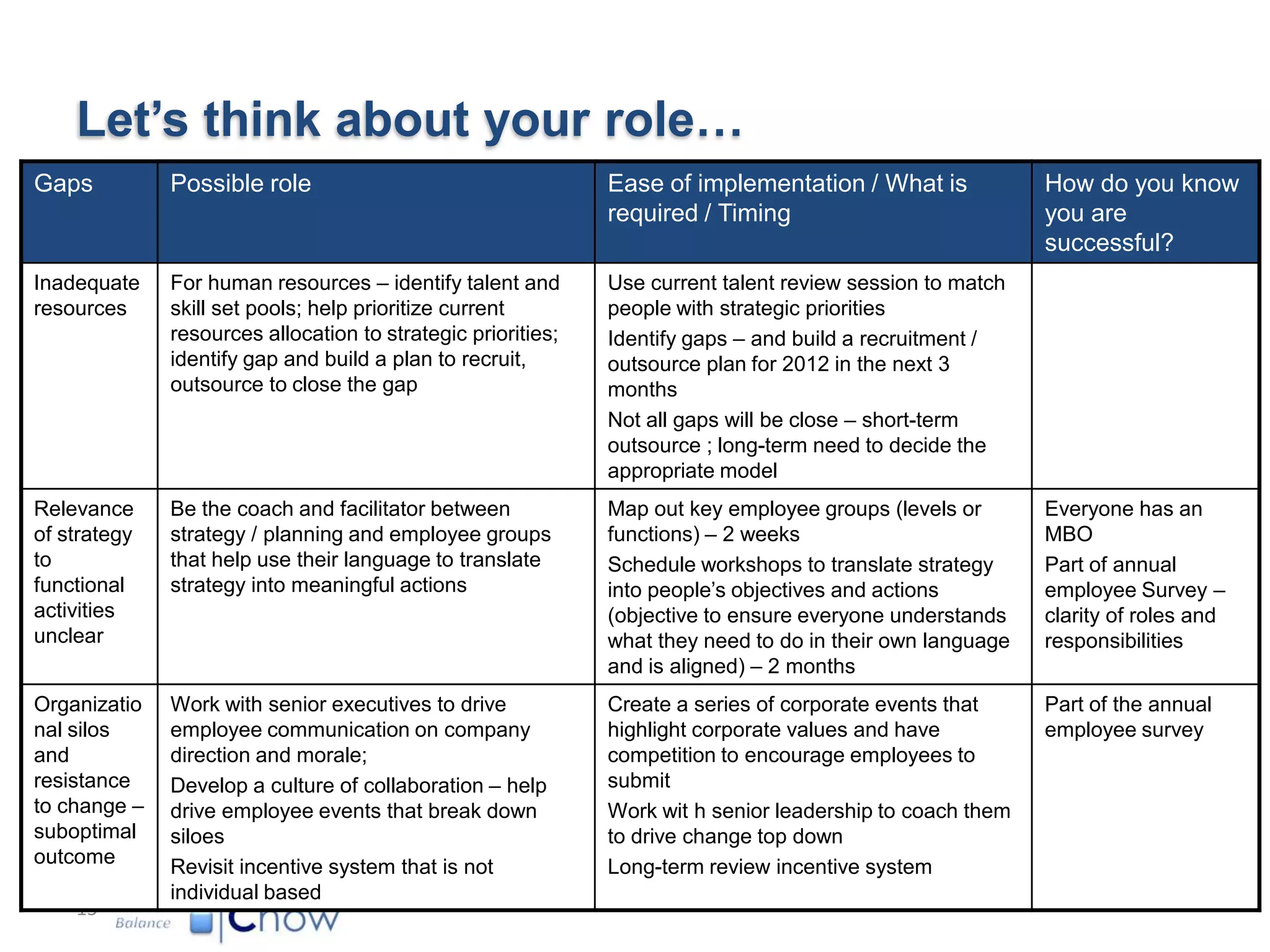
Let’s think about your role…
Gaps          Possible role                                   Ease of implementation / What is             How do you know
                                                              required / Timing                            you are
                                                                                                           successful?
Inadequate    For human resources – identify talent and       Use current talent review session to match
resources     skill set pools; help prioritize current        people with strategic priorities
              resources allocation to strategic priorities;   Identify gaps – and build a recruitment /
              identify gap and build a plan to recruit,       outsource plan for 2012 in the next 3
              outsource to close the gap                      months
                                                              Not all gaps will be close – short-term
                                                              outsource ; long-term need to decide the
                                                              appropriate model
Relevance     Be the coach and facilitator between            Map out key employee groups (levels or       Everyone has an
of strategy   strategy / planning and employee groups         functions) – 2 weeks                         MBO
to            that help use their language to translate       Schedule workshops to translate strategy     Part of annual
functional    strategy into meaningful actions                into people’s objectives and actions         employee Survey –
activities                                                    (objective to ensure everyone understands    clarity of roles and
unclear                                                       what they need to do in their own language   responsibilities
                                                              and is aligned) – 2 months
Organizatio   Work with senior executives to drive            Create a series of corporate events that     Part of the annual
nal silos     employee communication on company               highlight corporate values and have          employee survey
and           direction and morale;                           competition to encourage employees to
resistance    Develop a culture of collaboration – help       submit
to change –   drive employee events that break down           Work wit h senior leadership to coach them
suboptimal    siloes                                          to drive change top down
outcome       Revisit incentive system that is not            Long-term review incentive system
              individual based
    15
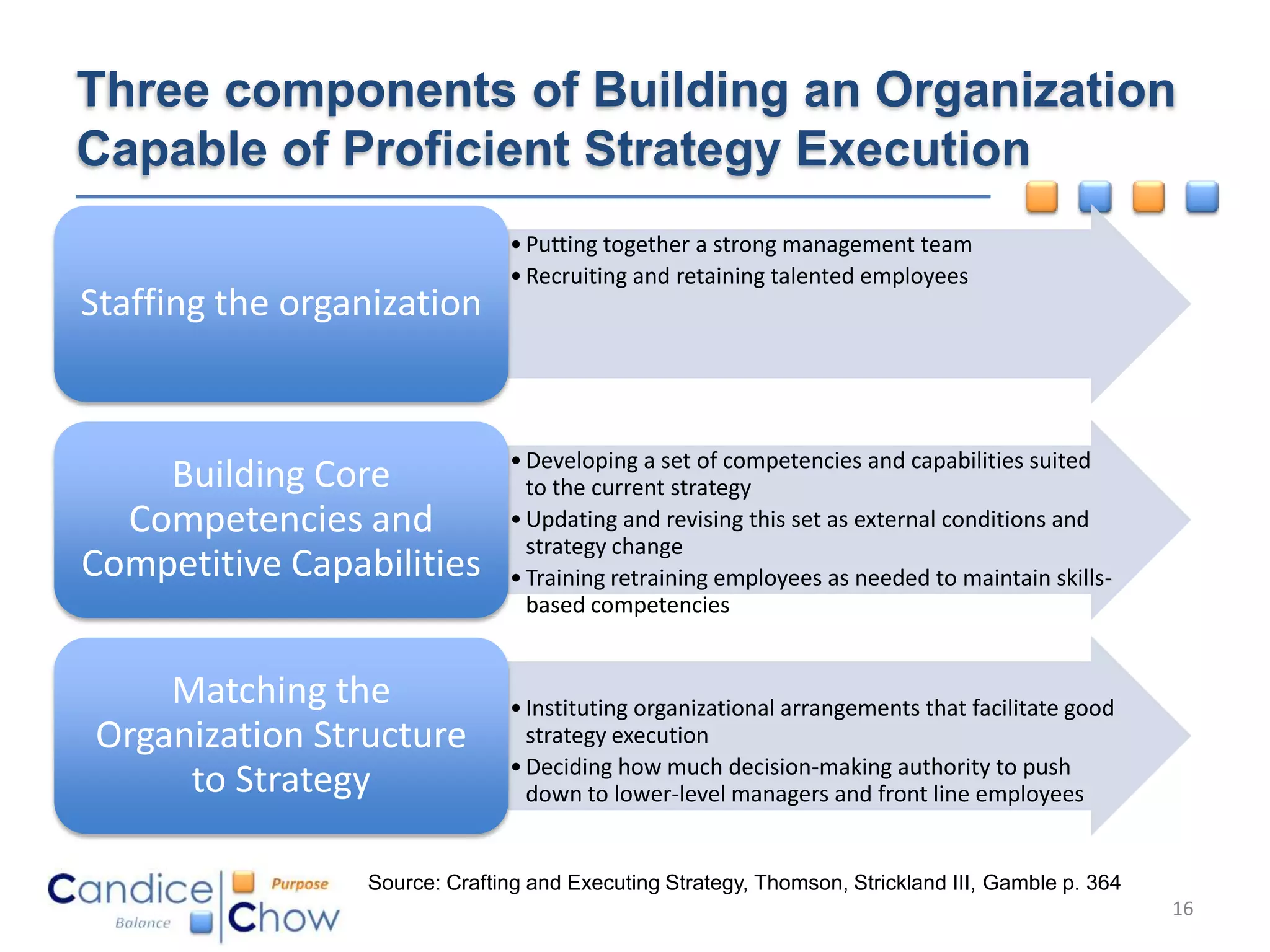
Three components of Building an Organization
Capable of Proficient Strategy Execution
                               • Putting together a strong management team
                               • Recruiting and retaining talented employees
Staffing the organization


                               • Developing a set of competencies and capabilities suited
    Building Core                to the current strategy
  Competencies and             • Updating and revising this set as external conditions and
                                 strategy change
Competitive Capabilities       • Training retraining employees as needed to maintain skills-
                                 based competencies


    Matching the               • Instituting organizational arrangements that facilitate good
Organization Structure           strategy execution
                               • Deciding how much decision-making authority to push
     to Strategy                 down to lower-level managers and front line employees


                 Source: Crafting and Executing Strategy, Thomson, Strickland III, Gamble p. 364
                                                                                                   16
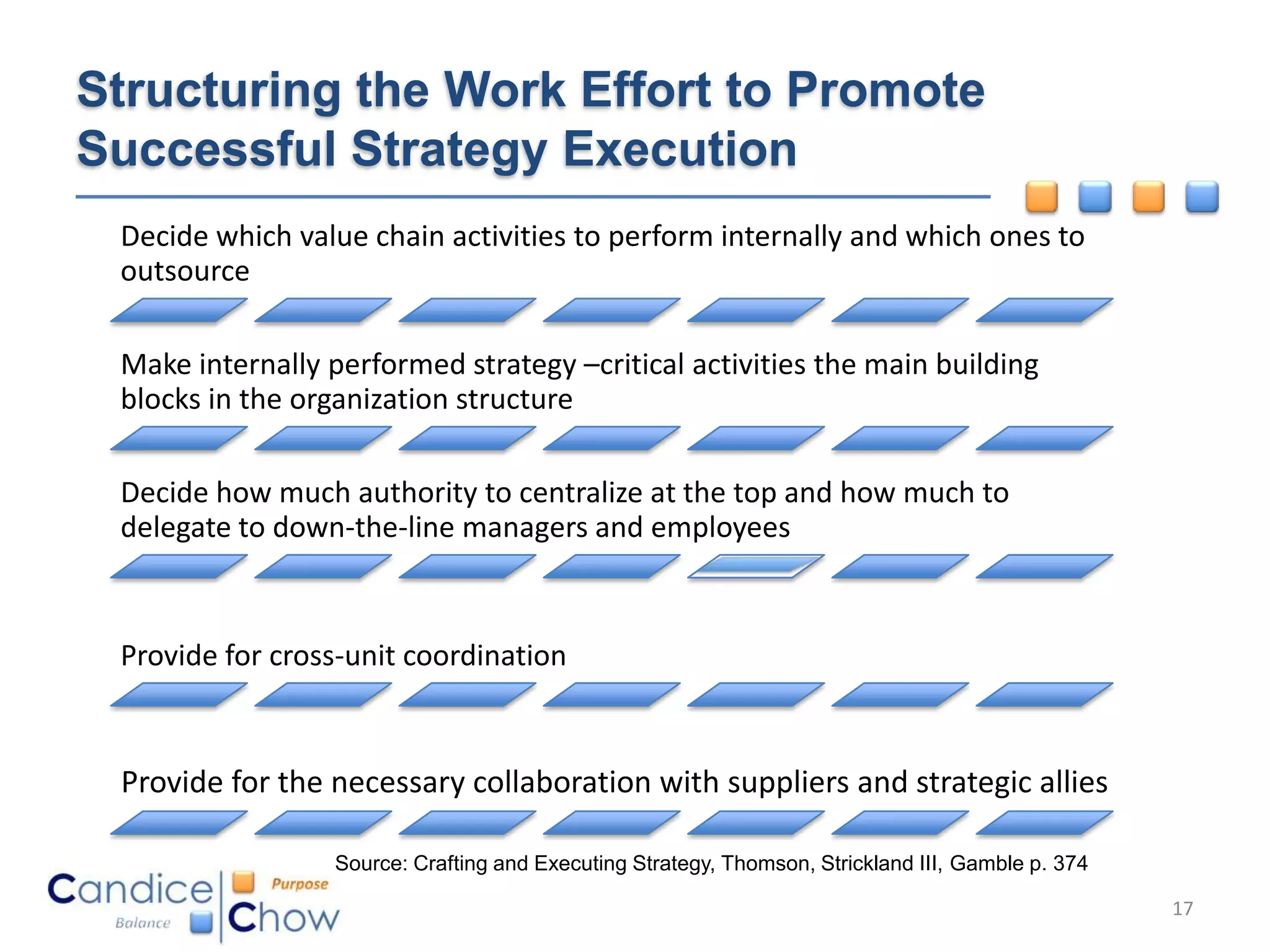
Structuring the Work Effort to Promote
Successful Strategy Execution
 Decide which value chain activities to perform internally and which ones to
 outsource

 Make internally performed strategy –critical activities the main building
 blocks in the organization structure

 Decide how much authority to centralize at the top and how much to
 delegate to down-the-line managers and employees


 Provide for cross-unit coordination


 Provide for the necessary collaboration with suppliers and strategic allies

                  Source: Crafting and Executing Strategy, Thomson, Strickland III, Gamble p. 374

                                                                                                    17
Trends - Five tools of organizational design

• Managers and workers empowered to act on their
  own judgments
• Work process redesign (streamline)
• Self-directed work teams
• Rapid incorporation of Internet technology
  applications
• Networking with outsiders to improve existing
  organizational capabilities and create new ones.

                Source: Crafting and Executing Strategy, Thomson,
                Strickland III, Gamble p. 384
                                                                    18
Table of content

 •   What is a strategic plan


 •   How to translate a strategic plan into action plan?


 •   What is HR’s (your) role?


 •   Key takeaways


19
Building an organization that executes well
takes time
     Key success factors                      Role

                                              •   Coach
     •    Leadership

     •    Communication                       •   Relentless communicator

     •    Clarity, simplicity and relevance   •   Facilitator with an understanding
                                                  employees’ levels, roles and needs
     •    Accountability and performance
          management
                                              •   Performance management & coach;
                                                  Incentives system designer

     •    Measurement
                                              •
                                          Monitor of key people measurements
                                          and linkages with performance
         Baby steps – pick a few key tasks and do them well

20

Execution of Strategic Plan

  • 1.
    Execution of theStrategy Plan September 20, 2011 This document intends to share author’s learning, ideas and personal reflection on the topic. If you intend to quote or replicate any part of this presentation, acknowledgement of this document and other authors cited in this document as your sources would be greatly appreciated 1
  • 2.
    Out of 197companies surveyed, none met their multi-year projections 30% Plan 2005 25% Plan 2004 Plan 2003 Performance (Return on capital) Plan 2002 Plan 2001 20% 15% 10% 5% 0% 2000 2001 2002 2003 2004 2005 2006 Source: Crafting and Executing Strategy, Thomson, Strickland III, Gamble 2
  • 3.
    More than 1/3of companies surveyed placed their performance realization at less than 50% Companies typically realize only about 60% of their strategies’ potential value because of defects and breakdowns in planning and execution – Michael Mankins and Richard Steele, Marakon Associates 3
  • 4.
    Session objective • To outline key factors that enable a well-executed strategy • To identify key areas that HR can really help the organization perform at their best 4
  • 5.
    Table of content • What is a strategic plan • How to translate a strategic plan into action plan? • What is HR’s (your) role? • Key takeaways 5
  • 6.
    What is astrategic plan and why do we need it? • What is a strategic plan? – A long-term business plan that outlines its vision, purpose and goals for a finite period of time – typically 3 – 5 years – A roadmap for the organization so to achieve its vision, fulfill its purpose alongside with meeting financial goals and shareholder requirement • Why do we need it? – Provide its stakeholders with a clear direction of growth – Enable trade-offs, resource allocation and decision making on day to day activities and investment – Provide a set of criteria and framework around which the appropriate new opportunities can be identified for pursuit 6
  • 7.
    What is goodstrategy versus a well-executed strategy? • What is a good strategy? – Creates uniqueness, differentiation for customers that is hard to emulate – Creates value for not only the customers and shareholders but key stakeholders (suppliers, community, government etc) – Leverages one’s strengths to exploit opportunities and mitigate threats and enables the organization to learn and progress through optimization of resources • What is a well-executed strategy – Strategy is understood by the entire organization and aligned with everyone’s objectives with measurable outcomes – Functions and business units are aligned and work collaboratively – Results are reviewed and courses are adjusted accordingly to achieve the objectives – Outcomes are delivered 7
  • 8.
    The strategy-making andstrategy-executing process is neither a linear process nor annual process Creating a Monitoring strategy to Implementing development, Developing a Setting evaluating strategic achieve the & executing performance & Objectives vision objectives the strategy making corrective and vision adjustments Revise as needed in light of actual performance, changing conditions, new opportunities and new ideas Source: Crafting & Executing Strategy (Book)- Thomson, Strickland and Gamble 8 p.20
  • 9.
    A second-rate strategyperfectly executed will beat a first-rate strategy poorly executed Richard M. Kovacevich, Chairman and CEO Wells Fargo 9
  • 10.
    Table of content • What is a strategic plan • How to translate a strategic plan into action plan? • What is HR’s (your) role? • Key takeaways 10
  • 11.
    The eight componentsof strategy execution process Building an organization with the Exercising strong competencies, leadership to drive capabilities, and Marshalling execution forward resource strengths to resource behind and attain execute strategy the drive for good operating successfully strategy execution excellence The action agenda Instilling a corporate for implementing Instituting policies culture that and executing and procedures promotes good strategy that facilitate strategy execution What to change or strategy execution improve How to get it done? Tying rewards and Adopting best incentives directly to practices and Installing information the achievement of striving for and operating strategic and continuous systems that enable financial targets improvement company personnel to carry out their strategic roles proficiently Source: Crafting and Executing Strategy, Thomson, Strickland III, 11 Gamble p. 362
  • 12.
    Where the performancegoes?? inadequate poor senior uncom m ited leadership unapproved strategy consequences or leadership 2% 1% other obstacles inadequate redraws for failture 3% (including inadequate performance or success skills & capabilities) monitoring 3% 1% 3% organizational silos and culture blocking execution 4% unclear accountability for execution 4% actions required to Average realized execute not clearly performance defined 62% 5% poorly communicated inadequate or strategy unavailable 5% resources Source: Crafting and Executing Strategy, Thomson, Strickland III, Gamble 12 7%
  • 13.
    Table of content • What is a strategic plan • How to translate a strategic plan into action plan? • What is HR’s (your) role? • Key takeaways 13
  • 14.
    Let’s think aboutyour role… • Gaps • Possible role / actions • What is required? Ease of implementation ? Timing • How do you know you are successful 14
  • 15.
    Let’s think aboutyour role… Gaps Possible role Ease of implementation / What is How do you know required / Timing you are successful? Inadequate For human resources – identify talent and Use current talent review session to match resources skill set pools; help prioritize current people with strategic priorities resources allocation to strategic priorities; Identify gaps – and build a recruitment / identify gap and build a plan to recruit, outsource plan for 2012 in the next 3 outsource to close the gap months Not all gaps will be close – short-term outsource ; long-term need to decide the appropriate model Relevance Be the coach and facilitator between Map out key employee groups (levels or Everyone has an of strategy strategy / planning and employee groups functions) – 2 weeks MBO to that help use their language to translate Schedule workshops to translate strategy Part of annual functional strategy into meaningful actions into people’s objectives and actions employee Survey – activities (objective to ensure everyone understands clarity of roles and unclear what they need to do in their own language responsibilities and is aligned) – 2 months Organizatio Work with senior executives to drive Create a series of corporate events that Part of the annual nal silos employee communication on company highlight corporate values and have employee survey and direction and morale; competition to encourage employees to resistance Develop a culture of collaboration – help submit to change – drive employee events that break down Work wit h senior leadership to coach them suboptimal siloes to drive change top down outcome Revisit incentive system that is not Long-term review incentive system individual based 15
  • 16.
    Three components ofBuilding an Organization Capable of Proficient Strategy Execution • Putting together a strong management team • Recruiting and retaining talented employees Staffing the organization • Developing a set of competencies and capabilities suited Building Core to the current strategy Competencies and • Updating and revising this set as external conditions and strategy change Competitive Capabilities • Training retraining employees as needed to maintain skills- based competencies Matching the • Instituting organizational arrangements that facilitate good Organization Structure strategy execution • Deciding how much decision-making authority to push to Strategy down to lower-level managers and front line employees Source: Crafting and Executing Strategy, Thomson, Strickland III, Gamble p. 364 16
  • 17.
    Structuring the WorkEffort to Promote Successful Strategy Execution Decide which value chain activities to perform internally and which ones to outsource Make internally performed strategy –critical activities the main building blocks in the organization structure Decide how much authority to centralize at the top and how much to delegate to down-the-line managers and employees Provide for cross-unit coordination Provide for the necessary collaboration with suppliers and strategic allies Source: Crafting and Executing Strategy, Thomson, Strickland III, Gamble p. 374 17
  • 18.
    Trends - Fivetools of organizational design • Managers and workers empowered to act on their own judgments • Work process redesign (streamline) • Self-directed work teams • Rapid incorporation of Internet technology applications • Networking with outsiders to improve existing organizational capabilities and create new ones. Source: Crafting and Executing Strategy, Thomson, Strickland III, Gamble p. 384 18
  • 19.
    Table of content • What is a strategic plan • How to translate a strategic plan into action plan? • What is HR’s (your) role? • Key takeaways 19
  • 20.
    Building an organizationthat executes well takes time Key success factors Role • Coach • Leadership • Communication • Relentless communicator • Clarity, simplicity and relevance • Facilitator with an understanding employees’ levels, roles and needs • Accountability and performance management • Performance management & coach; Incentives system designer • Measurement • Monitor of key people measurements and linkages with performance Baby steps – pick a few key tasks and do them well 20

Editor's Notes

  • #17 StaffingStrong management team – clear thinkers, good at figuring out what needs to be done, and skilled in making it happening an delivering results. Weak executives – can’t differentiate between ideas and approaches that have merit and those that are disguidedStrong strategy implementation capabilities are those that are good at asking touch inquisitive questions. Internal promotion vs from outside – but true believers are those that embrace the changes and get on the process. The goal is to create a critical mass of managers that are agents of change. Because when first rate managers enouy the help from others, the whole is greater than the sum of individual efforts. Recruiting and retaining – screening, training, stretch assignments, rotating jobs to enhance experience, encourage employees to be creaive and innovative; retain talent through promotions and perks., coaching. CompetenciesCore competencies and competitive capabilities are bundles of skills and knowhow that most often grow out of the combined efforts of cross-functional work groups and departments performing complementary activities at different locations in the firm’s value chain. – training becomes key. It is easy for rivals to duplicate smart strategies but harder to replicate great execution as it is complex. To achieve lasting competitive advantage is to outexecute by performing certain value chain activities in a superior fashion.
  • #18 Outsourcing is critical to enable the company to focus on ever better performance; or to streamline processes; many electronical and vehicle manufactuers outsource their parts. Companies should refrain from outsourcing value chains they need direct strategic and operational control – such as tech support or payroll.The rationale for making strategy-critical activities the main building blocks in structuring business is compelling. What types of org structures? – say in 1 line of business – traditional functional deparment (R&D, production, S&M); and process departments such as supply chain management, new product development For multi-national – they will organization around geographic units, division may have process departmentsCentralizedvs decentralized decision – making. Centralized – advantages – fixes accountabilityDisadvantages – Lengthens response time due to bureaurcracy; does not encourate responsibility amongst lower level; discourage rank and file form exercising any initiativeDecentralized Advantages – encourages lower level to exercise initaitive; promotes motivation and involement; new ideas; fast response times; fewer layers of mgmtProvidining for cross-unit coordination – ensure functions that are closely rlatdeport to a single function. This resembles the traditional functional organization and the wekaness is no one group is accountable for strategic relevant activities. Some companies build process departments, pull people with functional expertise into one group. e.g. filling customer orders accurately and prmptly; introduction of new products – poduct quality; supply chain managementAlliances – nothing is realized until relationship gros and trust happens. Relationship ManagerTrend – leaner and faster and more responsive to customers. Compaies have made downsizing.
  • #19 Provide for cross-unit coordination