UNDERSTANDING
LOCAL NETWORKS
HUMANITIES 2
Anna Mary B. De Vera
Eastern Pangasinan Agricultural
College
UNDERSTANDING
STRATEGIC
ANALYSIS AND
INTUITIVE
THINKING
STRATEGIC ANALYSIS
UNDERSTANDING
STRATEGIC
ANALYSIS AND
INTUITIVE
THINKING
INTUITIVE THINKING
DEFINE STRATEGIC ANALYSIS
•The process of conducting research on
the business environment within which
an organization operates and on the
organization itself, in order to formulate
strategy.
TOOLS OF
STRATEGIC
ANALYSIS
WHAT IS PEST ANALYSIS?
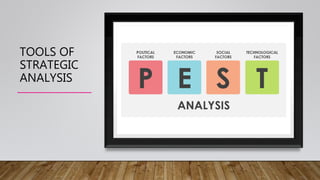
• A PEST analysis is an analysis of the external macro-
environment that affects all firms. P.E.S.T. is an
acronym for the Political, Economic, Social, and
Technological factors of the external macro-
environment. Such external factors usually are beyond
the firm's control and sometimes present themselves
as threats.
POLITICAL FACTORS
•Political factors, are how and to what
degree a government intervenes in the
economy. Specifically, political factors
include areas such as tax policy, labour law,
environmental law, trade restrictions, tariffs,
and political stability.
ECONOMIC FACTORS
• Economic factors include economic growth,
interest rates, exchange rates and the inflation
rate. These factors have major impacts on how
businesses operate and make decisions. For
example Exchange rates affect the costs of
exporting goods and the supply and price of
imported goods in an economy
SOCIAL FACTORS
• Social factors include the cultural aspects and include
health consciousness, population growth rate, age
distribution, career attitudes and emphasis on safety.
Trends in social factors affect the demand for a
company's products and how that company operates.
For example, an ageing population may involve a
smaller and less-willing workforce (thus increasing the
cost of labor).
TECHNOLOGICAL FACTORS
•Technological factors include ecological and
environmental aspects, such as R&D activity,
automation, technology incentives and the rate
of technological change. They can determine
barriers to entry, minimum efficient production
level and influence outsourcing decisions.
TOOLS OF
STRATEGIC
ANALYSIS
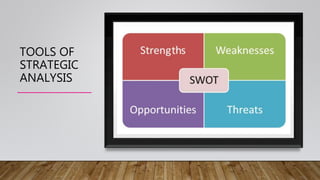
SWOT ANALYSIS
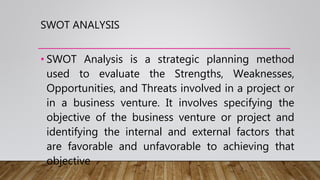
• SWOT Analysis is a strategic planning method
used to evaluate the Strengths, Weaknesses,
Opportunities, and Threats involved in a project or
in a business venture. It involves specifying the
objective of the business venture or project and
identifying the internal and external factors that
are favorable and unfavorable to achieving that
objective
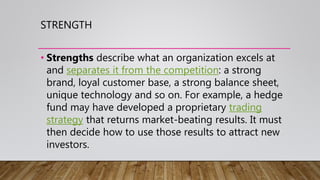
STRENGTH
• Strengths describe what an organization excels at
and separates it from the competition: a strong
brand, loyal customer base, a strong balance sheet,
unique technology and so on. For example, a hedge
fund may have developed a proprietary trading
strategy that returns market-beating results. It must
then decide how to use those results to attract new
investors.
WEAKNESS
•Weaknesses stop an organization from
performing at its optimum level. They are
areas where the business needs to improve
to remain competitive: higher-than-industry-
average turnover, high levels of debt, an
inadequate supply chain or lack of capital.
OPPORTUNITIES
•Opportunities refer to favorable external
factors that an organization can use to give it
a competitive advantage. For example, a car
manufacturer can export its cars into a new
market, increasing sales and market share, if
a country cuts tariffs.
THREATS
• Threats refer to factors that have the potential to
harm an organization. For example, a drought is a
threat to a wheat-producing company, as it may
destroy or reduce the crop yield. Other common
threats include things like rising costs for inputs,
increasing competition, tight labor supply and so
on.
ADVANTAGES OF SWOT ANALYSIS
• A SWOT analysis is a great way to guide business-strategy
meetings. It's powerful to have everyone in the room to
discuss the company's core strengths and weaknesses and
then move from there to defining the opportunities and
threats, and finally to brainstorming ideas. Oftentimes, the
SWOT analysis you envision before the session changes
throughout to reflect factors you were unaware of and would
never have captured if not for the group’s input.
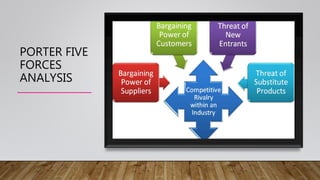
PORTER FIVE
FORCES
ANALYSIS
VALUE CHAIN ANALYSIS
• Value chain analysis is based on the
principle that organizations exist to
create value for their customers. In the
analysis, the organization's activities are
divided into separate sets of activities
that add value.
THE THREE STEPS FOR CONDUCTING A VALUE
CHAIN ANALYSIS ARE:
•1. Separate the organization's operations
into primary and support activities
• 2. Allocate cost to each activity.
• 3. Identify the activities that are important
to customer’s satisfaction and market
success.
DEFINE INTUITIVE THINKING
•Intuitive thinking is a feeling (a sense) that
doesn't use rational processes such as facts
and data. Good intuition comes from years
of knowledge and experience that allows you
to understand how people and the world
works. Many situations are intuitive.
INTUITIVE
THINKING
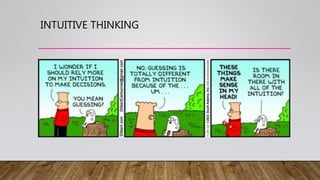
INTUITIVE THINKING
INTUITION
•The Oxford Dictionaries define intuition
as
“the ability to understand something
instinctively, without the need for
conscious reasoning.”
DOES INTUITION HAVE LINKAGE WITH THE STATE
OF FLOW?
• Flow is characterized by complete absorption in what
one does. A state of mind, when conscious thoughts
seem to meld together with the action itself. I would
say that when someone is in the zone, that person
doesn’t have any other choice just to go with his/her
gut feelings and listen to the appearing intuitions.
Conscious mechanisms would interrupt and detour
the decision making in these states.
WHAT ARE THE CHARACTERISTICS OF INTUITIVE
LEADERS?
• They recognize the patterns:
• They see the big picture and don’t worry about taking risks
• They use analysis as a supporting tool ensuring that their intuition don’t mislead
them.
• They know and check themselves
• They are good at sizing people up by reading their body language and non-
verbal clues.
• They are life-long learners: always seek for new experiences and are unafraid of
asking questions.
WHAT ARE THE CHARACTERISTICS OF INTUITIVE
LEADERS?
• They put energy into understanding the
situation they face to and they always think
ahead.
• They don’t confuse desire (intensely wanting
something to happen) with intuition
HOW INTUITIVE DECISION MAKING CAN BE
IMPROVED?
•Beside acquiring and practicing the above
listed characteristics of an intuitive leader
(this list is not exclusive and can be
completed with many other characteristics)
there is a fun and risk free way of doing it
as well.
Understanding local networks

Understanding local networks

  • 1.
    UNDERSTANDING LOCAL NETWORKS HUMANITIES 2 AnnaMary B. De Vera Eastern Pangasinan Agricultural College
  • 2.
  • 3.
  • 4.
    DEFINE STRATEGIC ANALYSIS •Theprocess of conducting research on the business environment within which an organization operates and on the organization itself, in order to formulate strategy.
  • 5.
  • 6.
    WHAT IS PESTANALYSIS? • A PEST analysis is an analysis of the external macro- environment that affects all firms. P.E.S.T. is an acronym for the Political, Economic, Social, and Technological factors of the external macro- environment. Such external factors usually are beyond the firm's control and sometimes present themselves as threats.
  • 7.
    POLITICAL FACTORS •Political factors,are how and to what degree a government intervenes in the economy. Specifically, political factors include areas such as tax policy, labour law, environmental law, trade restrictions, tariffs, and political stability.
  • 8.
    ECONOMIC FACTORS • Economicfactors include economic growth, interest rates, exchange rates and the inflation rate. These factors have major impacts on how businesses operate and make decisions. For example Exchange rates affect the costs of exporting goods and the supply and price of imported goods in an economy
  • 9.
    SOCIAL FACTORS • Socialfactors include the cultural aspects and include health consciousness, population growth rate, age distribution, career attitudes and emphasis on safety. Trends in social factors affect the demand for a company's products and how that company operates. For example, an ageing population may involve a smaller and less-willing workforce (thus increasing the cost of labor).
  • 10.
    TECHNOLOGICAL FACTORS •Technological factorsinclude ecological and environmental aspects, such as R&D activity, automation, technology incentives and the rate of technological change. They can determine barriers to entry, minimum efficient production level and influence outsourcing decisions.
  • 11.
  • 12.
    SWOT ANALYSIS • SWOTAnalysis is a strategic planning method used to evaluate the Strengths, Weaknesses, Opportunities, and Threats involved in a project or in a business venture. It involves specifying the objective of the business venture or project and identifying the internal and external factors that are favorable and unfavorable to achieving that objective
  • 13.
    STRENGTH • Strengths describewhat an organization excels at and separates it from the competition: a strong brand, loyal customer base, a strong balance sheet, unique technology and so on. For example, a hedge fund may have developed a proprietary trading strategy that returns market-beating results. It must then decide how to use those results to attract new investors.
  • 14.
    WEAKNESS •Weaknesses stop anorganization from performing at its optimum level. They are areas where the business needs to improve to remain competitive: higher-than-industry- average turnover, high levels of debt, an inadequate supply chain or lack of capital.
  • 15.
    OPPORTUNITIES •Opportunities refer tofavorable external factors that an organization can use to give it a competitive advantage. For example, a car manufacturer can export its cars into a new market, increasing sales and market share, if a country cuts tariffs.
  • 16.
    THREATS • Threats referto factors that have the potential to harm an organization. For example, a drought is a threat to a wheat-producing company, as it may destroy or reduce the crop yield. Other common threats include things like rising costs for inputs, increasing competition, tight labor supply and so on.
  • 17.
    ADVANTAGES OF SWOTANALYSIS • A SWOT analysis is a great way to guide business-strategy meetings. It's powerful to have everyone in the room to discuss the company's core strengths and weaknesses and then move from there to defining the opportunities and threats, and finally to brainstorming ideas. Oftentimes, the SWOT analysis you envision before the session changes throughout to reflect factors you were unaware of and would never have captured if not for the group’s input.
  • 18.
  • 19.
    VALUE CHAIN ANALYSIS •Value chain analysis is based on the principle that organizations exist to create value for their customers. In the analysis, the organization's activities are divided into separate sets of activities that add value.
  • 20.
    THE THREE STEPSFOR CONDUCTING A VALUE CHAIN ANALYSIS ARE: •1. Separate the organization's operations into primary and support activities • 2. Allocate cost to each activity. • 3. Identify the activities that are important to customer’s satisfaction and market success.
  • 21.
    DEFINE INTUITIVE THINKING •Intuitivethinking is a feeling (a sense) that doesn't use rational processes such as facts and data. Good intuition comes from years of knowledge and experience that allows you to understand how people and the world works. Many situations are intuitive.
  • 22.
  • 23.
  • 24.
    INTUITION •The Oxford Dictionariesdefine intuition as “the ability to understand something instinctively, without the need for conscious reasoning.”
  • 25.
    DOES INTUITION HAVELINKAGE WITH THE STATE OF FLOW? • Flow is characterized by complete absorption in what one does. A state of mind, when conscious thoughts seem to meld together with the action itself. I would say that when someone is in the zone, that person doesn’t have any other choice just to go with his/her gut feelings and listen to the appearing intuitions. Conscious mechanisms would interrupt and detour the decision making in these states.
  • 26.
    WHAT ARE THECHARACTERISTICS OF INTUITIVE LEADERS? • They recognize the patterns: • They see the big picture and don’t worry about taking risks • They use analysis as a supporting tool ensuring that their intuition don’t mislead them. • They know and check themselves • They are good at sizing people up by reading their body language and non- verbal clues. • They are life-long learners: always seek for new experiences and are unafraid of asking questions.
  • 27.
    WHAT ARE THECHARACTERISTICS OF INTUITIVE LEADERS? • They put energy into understanding the situation they face to and they always think ahead. • They don’t confuse desire (intensely wanting something to happen) with intuition
  • 28.
    HOW INTUITIVE DECISIONMAKING CAN BE IMPROVED? •Beside acquiring and practicing the above listed characteristics of an intuitive leader (this list is not exclusive and can be completed with many other characteristics) there is a fun and risk free way of doing it as well.