AimsandObjectivesofTeachingMathematics
By
J.Binoshini
UNIT - I
MEANING :
Mathematicsis thesciencethatdealswiththe Logic
of Shape,QuantityandArrangement.Mathsis all
aroundus.
❖Aristotle defined mathematics as “the science of quantity”.
❖Bacon said, “ Mathematics is the gateway and key to all
sciences”.
❖Locke said , “ Mathematics is a way to settle in the mind, a
habit of reasoning”.
❖Gauss referred to Mathematics as the “Queen of sciences”.
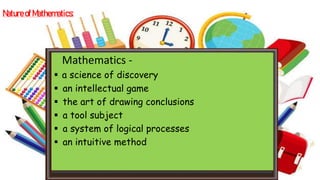
Nature ofMathematics:
Mathematics -
▪ a science of discovery
▪ an intellectual game
▪ the art of drawing conclusions
▪ a tool subject
▪ a system of logical processes
▪ an intuitive method
Scope of Mathematics :
• Mathematics is all pervasive. So the demarcation of it scope is a difficult task, if not
impossible.
• It is a science of all the sciences and provides basis to all the disciplines.
• According to this definition, two main aspects or categories of Maths are ‘Basic
Mathematics’ and ‘Applied Mathematics.’
(i) Basic Mathematics or Pure Mathematics :
• The Theoretical aspect of Mathematics is termed as basic Mathematics or Pure
Mathematics.
• It involves systematic and deductive reasoning.
• It treats only theories and principles without regard to this application to concrete
things.
• It is developed on an abstract self – contained basis without any regard to possible
practical applications that may follow.
The following are sub branches of Pure Mathematics.
Algebra:
➢ It includes Arithmetic, Elementary and Multivariate Algebra, Linear Multivariate
Algebra, Algebraic Structure etc.
Geometry:
➢ It includes Euclidean geometry, Projection, Analytical geometry, Trigonometry,
Combinatorial geometry, differential and Algebraic Geometry etc.
Modern Mathematics:
It consists of following topics.
(i) Set theory –Origin and definition, fundamental set concepts, postulates of
axiomatic set theory, etc.
(ii) Topology – General topology, Topological groups, Differential topology,
Algebraic topology.
(iii) Algebraic System- Groups, Rings, Field, Vector Spaces.
Analysis:
➢ It includes Real and Complex analysis, Functional Analysis, Differential Equation,
Fourier, Theory of Probability, Vector and Tensor.
(ii) Applied Mathematics:
➢ Applied Mathematics is the application of pure Mathematics in developing the
various
means to score the human and humanity.
➢ It considers those part of Mathematical theories that have certain direct or practical
application to objects in the material world.
The following are sub branches of applied Mathematics
(a) Calculatory Science – It includes numeral notations, calculating aspects of
algebra, calculating use of tables and graphs, geometrical aids, mathematical
models, analogic, computation, digital computations etc.
(b) Statistics- Basic principles, Estimation, Hypothesis testing structure etc.
(c) Numerical analysis
(d) Mathematical theory of optimization
(e) Automation theory
(f) Information theory
(g) Mathematical aspects of physical theories.
Aims of teaching Mathematics:
❖To enable the students to solve mathematical problems of daily life. We have to select
the content and methods of teaching so that the students are able to make use of their
learning of mathematics in daily life.
❖To enable the students to understand the contribution of mathematics to the
development of culture and civilisation.
❖ To develop thinking and reasoning power of the students.
❖ To prepare a sound foundation needed for various vocations. Mathematics is needed
in various professions such as those of engineers, bankers, scientists, accountants,
statisticians etc.
❖To prepare the child for further learning in mathematics and the related fields. School
mathematics should also aim at preparing him for higher learning in mathematics.
❖ To develop in the child desirable habits and attitudes like habit of hard work, self
reliance, concentration and discovery.
❖To give the child an insight into the relationship of different topics and branches of
the subject.
❖To enable the child to understand popular literature. He should be so prepared that he
finds no handicap in understanding mathematical terms and concepts used in various
journals, magazines, newspapers etc.
❖ To teach the child the art of economic and creative living.
❖ To develop in the child rational and scientific attitude towards life.
Pedagogy of Mathematics

Pedagogy of Mathematics

  • 1.
  • 2.
    MEANING : Mathematicsis thesciencethatdealswiththeLogic of Shape,QuantityandArrangement.Mathsis all aroundus.
  • 3.
    ❖Aristotle defined mathematicsas “the science of quantity”. ❖Bacon said, “ Mathematics is the gateway and key to all sciences”. ❖Locke said , “ Mathematics is a way to settle in the mind, a habit of reasoning”. ❖Gauss referred to Mathematics as the “Queen of sciences”.
  • 4.
    Nature ofMathematics: Mathematics - ▪a science of discovery ▪ an intellectual game ▪ the art of drawing conclusions ▪ a tool subject ▪ a system of logical processes ▪ an intuitive method
  • 5.
    Scope of Mathematics: • Mathematics is all pervasive. So the demarcation of it scope is a difficult task, if not impossible. • It is a science of all the sciences and provides basis to all the disciplines. • According to this definition, two main aspects or categories of Maths are ‘Basic Mathematics’ and ‘Applied Mathematics.’ (i) Basic Mathematics or Pure Mathematics : • The Theoretical aspect of Mathematics is termed as basic Mathematics or Pure Mathematics. • It involves systematic and deductive reasoning. • It treats only theories and principles without regard to this application to concrete things. • It is developed on an abstract self – contained basis without any regard to possible practical applications that may follow.
  • 6.
    The following aresub branches of Pure Mathematics. Algebra: ➢ It includes Arithmetic, Elementary and Multivariate Algebra, Linear Multivariate Algebra, Algebraic Structure etc. Geometry: ➢ It includes Euclidean geometry, Projection, Analytical geometry, Trigonometry, Combinatorial geometry, differential and Algebraic Geometry etc. Modern Mathematics: It consists of following topics. (i) Set theory –Origin and definition, fundamental set concepts, postulates of axiomatic set theory, etc.
  • 7.
    (ii) Topology –General topology, Topological groups, Differential topology, Algebraic topology. (iii) Algebraic System- Groups, Rings, Field, Vector Spaces. Analysis: ➢ It includes Real and Complex analysis, Functional Analysis, Differential Equation, Fourier, Theory of Probability, Vector and Tensor. (ii) Applied Mathematics: ➢ Applied Mathematics is the application of pure Mathematics in developing the various means to score the human and humanity. ➢ It considers those part of Mathematical theories that have certain direct or practical application to objects in the material world.
  • 8.
    The following aresub branches of applied Mathematics (a) Calculatory Science – It includes numeral notations, calculating aspects of algebra, calculating use of tables and graphs, geometrical aids, mathematical models, analogic, computation, digital computations etc. (b) Statistics- Basic principles, Estimation, Hypothesis testing structure etc. (c) Numerical analysis (d) Mathematical theory of optimization (e) Automation theory (f) Information theory (g) Mathematical aspects of physical theories.
  • 9.
    Aims of teachingMathematics: ❖To enable the students to solve mathematical problems of daily life. We have to select the content and methods of teaching so that the students are able to make use of their learning of mathematics in daily life. ❖To enable the students to understand the contribution of mathematics to the development of culture and civilisation. ❖ To develop thinking and reasoning power of the students. ❖ To prepare a sound foundation needed for various vocations. Mathematics is needed in various professions such as those of engineers, bankers, scientists, accountants, statisticians etc.
  • 10.
    ❖To prepare thechild for further learning in mathematics and the related fields. School mathematics should also aim at preparing him for higher learning in mathematics. ❖ To develop in the child desirable habits and attitudes like habit of hard work, self reliance, concentration and discovery. ❖To give the child an insight into the relationship of different topics and branches of the subject. ❖To enable the child to understand popular literature. He should be so prepared that he finds no handicap in understanding mathematical terms and concepts used in various journals, magazines, newspapers etc. ❖ To teach the child the art of economic and creative living. ❖ To develop in the child rational and scientific attitude towards life.