Building Your Own 
Watson Powered 
Application on 
Bluemix
2 
Interactivity Tips 
1. Ask A Question 
2. Download a PDF copy of today’s presentation 
3. Social Networking Tools 
© 2014 International Business Machines Corporation
Building Your Own 
Watson Powered 
Application on 
Bluemix
4 
Chris Madison (Speaker) 
Solution Architect, Watson Innovations 
@ChrisMadisonIBM 
Nathan Vega (Moderator) 
Developer Engagement, IBM Bluemix 
@IBMBluemix 
Bluemix Blog
5 
Agenda 
• Introduction 
• Who I am and what I do 
• BlueMix 
•Watson Platform Services 
• User Modeling Demo: Node 
• Question and Answer Demo: Java on Liberty 
• Question and Answer Session 
© 2014 International Business Machines Corporation
BlueMix 
© 2014 International Business Machines Corporation 
6
7 
What is BlueMix? 
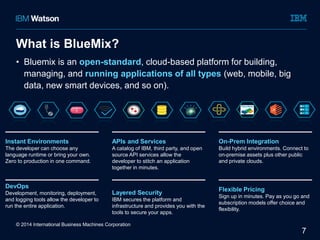
• Bluemix is an open-standard, cloud-based platform for building, 
managing, and running applications of all types (web, mobile, big 
data, new smart devices, and so on). 
Instant Environments 
The developer can choose any 
language runtime or bring your own. 
Zero to production in one command. 
APIs and Services 
A catalog of IBM, third party, and open 
source API services allow the 
developer to stitch an application 
together in minutes. 
© 2014 International Business Machines Corporation 
On-Prem Integration 
Build hybrid environments. Connect to 
on-premise assets plus other public 
and private clouds. 
DevOps 
Development, monitoring, deployment, 
and logging tools allow the developer to 
run the entire application. 
Layered Security 
IBM secures the platform and 
infrastructure and provides you with the 
tools to secure your apps. 
Flexible Pricing 
Sign up in minutes. Pay as you go and 
subscription models offer choice and 
flexibility.
8 
Why are developers using BlueMix? 
© 2014 International Business Machines Corporation 
Go from zero to running code in a 
matter of minutes 
Automate the development and 
delivery of many applications 
To rapidly bring products 
and services to market at 
lower cost 
To continuously deliver 
new functionality to their 
applications 
To extend existing 
investments in IT 
infrastructure 
Extend existing investments by 
connecting securely to on-premise 
infrastructure
Watson Platform Services 
© 2014 International Business Machines Corporation 
9
10 
A cognitive learning system enhances our abilities to 
perceive, reason and relate. 
© 2014 International Business Machines Corporation 
Perception: 
Watson understands the world as we do: it 
interprets sensory input beyond traditional 
data 
Reasoning: 
Watson thinks through complex problems: 
it deepens our analysis and inspires 
creativity 
Relating: 
Watson understands how we 
communicate, and personalizes its 
interactions with each of us 
Learning: 
Watson learns from every interaction, 
scaling our ability to build experience
• The generated profile includes personality and 
11 
User Modeling 
• User Modeling leverages linguistic analytics to construct 
a personality profile of an individual based on their 
social footprint and other written artifacts. 
Psycholinguistic 
Analytics 
social traits, values, needs and the Big 5 
personality traits 
• Openness 
• Conscientiousness 
• Extraversion 
• Agreeableness 
• Neuroticism 
© 2014 International Business Machines Corporation
12 
User Modeling 
Input: The application provides text input 
generated by the individual: emails, tweets, blogs 
and other text documents. 
Portrait API: JSON object of cognitive and social 
characteristics 
Visualization API: Uses Portrait API output to 
generate a visual portrait 
© 2014 International Business Machines Corporation
中國哲學書電子化計劃 
Input: UTF-8 formatted text Output: IETF language tag 
13 
Language Identification 
Analyzes text and identifies the primary language 
of the text. 
© 2014 International Business Machines Corporation 
zh-TW
14 
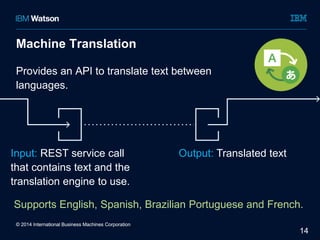
Machine Translation 
Provides an API to translate text between 
languages. 
Input: REST service call 
that contains text and the 
translation engine to use. 
© 2014 International Business Machines Corporation 
Output: Translated text 
Supports English, Spanish, Brazilian Portuguese and French.
15 
Relationship Extraction 
Analyzes text and identifies relationships 
between sentence components. 
© 2014 International Business Machines Corporation
16 
Relationship Extraction 
Input: Text to analyze, 
model, output format 
© 2014 International Business Machines Corporation 
Output: Extracted 
relationships in text, json or 
xml format. 
Supports English and Spanish language news models.
17 
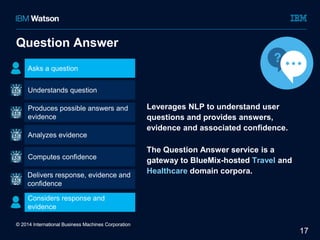
Question Answer 
Leverages NLP to understand user 
questions and provides answers, 
evidence and associated confidence. 
The Question Answer service is a 
gateway to BlueMix-hosted Travel and 
Healthcare domain corpora. 
Asks a question 
Understands question 
Produces possible answers and 
evidence 
Analyzes evidence 
Computes confidence 
Delivers response, evidence and 
confidence 
Considers response and 
evidence 
© 2014 International Business Machines Corporation
18 
Question Answer Question Answer 
Answer - QAAPI 
Input: A QA API formatted question 
{ question: { 
questionText: “Should I take aspirin on a daily basis?” 
}} 
Output: QA API JSON response with 
answers, evidence and confidence 
levels. 
© 2014 International Business Machines Corporation
19 
Question Answer Question Answer 
Answer - Travel 
The Watson for Travel corpus contains content from the 
following sources: 
•Wikivoyage 
•CDC Travel 
•TSA.gov 
© 2014 International Business Machines Corporation
20 
Question Answer Question Answer 
Answer - Healthcare 
The Watson for Healthcare corpus is populated from the 
following sources: 
•Healthfinder.gov 
•CDC Health Topics 
•National Heart, Lung, and Blood Institute (NHLBI) 
•National Institute of Arthritis and Musculoskeletal and 
Skin Diseases (NIAMS) 
•National Institute of Diabetes and Digestive and Kidney 
Diseases (NIDDK) 
•National Institute of Neurological Disorders and Stroke 
(NINDS) 
•Cancer.gov (physician data query) 
© 2014 International Business Machines Corporation
21 
Concept Expansion 
Analyzes text and compares it to a set of 
unstructured data to extract similar concepts. 
Concept Expansion is a process that is also known as Semantic Lexicon 
Induction, or Semantic Set Expansion. It is the process by which a 
semantic class, such as fruit goes from a list of terms like "apple, orange, 
cherry" to "apple, orange, cherry, limes, strawberries". 
© 2014 International Business Machines Corporation
22 
Input: List of words to 
expand and a corpus id 
© 2014 International Business Machines Corporation 
Output: List of expanded 
concept with prevalence in 
corpus 
Concept Expansion 
Hematoma, medtrans
23 
Message Resonance 
Analyzes content and scores how well the 
message is to be received by a target 
community. 
© 2014 International Business Machines Corporation
24 
Message Resonance 
Input: Content to analyze 
and a corpus identifier 
© 2014 International Business Machines Corporation 
Output: JSON object with 
resonance rankings 
Supports Cloud Computing and Big Data communities
25 
Visualization Rendering 
Visualization Rendering in an SDK that drives 
data visualization using JSON. 
© 2014 International Business Machines Corporation 
Charts are created using a set 
of composable features 
Infinite chart flexibility - one 
chart widget may handle many 
chart specifications 
Supports Java, JavaScript, iOS and Android
26 
Feedback Tools 
Each service provides a feedback mechanism in order to learn from the 
community. 
The feedback is PUT to the 
service in JSON format. 
Services leveraging this feedback 
mechanism: 
• User Modeling 
• Concept Expansion 
• Machine Translation 
• Relationship Extraction 
• Language Identification 
© 2014 International Business Machines Corporation
The Question Answer service also has a Feedback API, of which the feedback is 
used by Watson to increase precision and accuracy. 
27 
Feedback Tools 
© 2014 International Business Machines Corporation
User Modeling Demo: Node 
© 2014 International Business Machines Corporation 
28
29 
User Modeling Demo 
• Developer Tools 
• IBM SDK for Node 
– https://www.ibm.com/developerworks/web/nodesdk/ 
• Cloud Foundry 
– /cloudfoundry/cli in github 
© 2014 International Business Machines Corporation
Question and Answer Demo: Java on Liberty 
© 2014 International Business Machines Corporation 
30
31 
Question and Answer Demo 
• Developer Tools 
• Eclipse 
– Rational Software Architect used on Mac in demo 
• WebSphere Liberty Profile 
– https://developer.ibm.com/wasdev/downloads/liberty-profile-using-eclipse/ 
• IBM Eclipse Tools for BlueMix 
– http://marketplace.eclipse.org/content/ibm-eclipse-tools-bluemix#. 
VE6YtUgfBaY 
© 2014 International Business Machines Corporation
32 
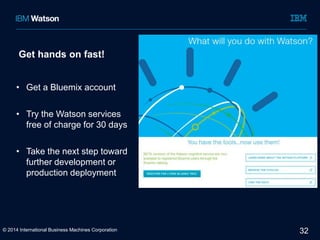
Get hands on fast! 
• Get a Bluemix account 
• Try the Watson services 
free of charge for 30 days 
• Take the next step toward 
further development or 
production deployment 
© 2014 International Business Machines Corporation
33 
IBM Watson 
IBM Bluemix 
facebook.com/ibmbluemix Bluemix.net @ibmbluemix 
© 2014 International Business Machines Corporation
Question and Answer Session 
© 2014 International Business Machines Corporation 
34

Building Your Own Watson Powered Application on Bluemix

  • 1.
    Building Your Own Watson Powered Application on Bluemix
  • 2.
    2 Interactivity Tips 1. Ask A Question 2. Download a PDF copy of today’s presentation 3. Social Networking Tools © 2014 International Business Machines Corporation
  • 3.
    Building Your Own Watson Powered Application on Bluemix
  • 4.
    4 Chris Madison(Speaker) Solution Architect, Watson Innovations @ChrisMadisonIBM Nathan Vega (Moderator) Developer Engagement, IBM Bluemix @IBMBluemix Bluemix Blog
  • 5.
    5 Agenda •Introduction • Who I am and what I do • BlueMix •Watson Platform Services • User Modeling Demo: Node • Question and Answer Demo: Java on Liberty • Question and Answer Session © 2014 International Business Machines Corporation
  • 6.
    BlueMix © 2014International Business Machines Corporation 6
  • 7.
    7 What isBlueMix? • Bluemix is an open-standard, cloud-based platform for building, managing, and running applications of all types (web, mobile, big data, new smart devices, and so on). Instant Environments The developer can choose any language runtime or bring your own. Zero to production in one command. APIs and Services A catalog of IBM, third party, and open source API services allow the developer to stitch an application together in minutes. © 2014 International Business Machines Corporation On-Prem Integration Build hybrid environments. Connect to on-premise assets plus other public and private clouds. DevOps Development, monitoring, deployment, and logging tools allow the developer to run the entire application. Layered Security IBM secures the platform and infrastructure and provides you with the tools to secure your apps. Flexible Pricing Sign up in minutes. Pay as you go and subscription models offer choice and flexibility.
  • 8.
    8 Why aredevelopers using BlueMix? © 2014 International Business Machines Corporation Go from zero to running code in a matter of minutes Automate the development and delivery of many applications To rapidly bring products and services to market at lower cost To continuously deliver new functionality to their applications To extend existing investments in IT infrastructure Extend existing investments by connecting securely to on-premise infrastructure
  • 9.
    Watson Platform Services © 2014 International Business Machines Corporation 9
  • 10.
    10 A cognitivelearning system enhances our abilities to perceive, reason and relate. © 2014 International Business Machines Corporation Perception: Watson understands the world as we do: it interprets sensory input beyond traditional data Reasoning: Watson thinks through complex problems: it deepens our analysis and inspires creativity Relating: Watson understands how we communicate, and personalizes its interactions with each of us Learning: Watson learns from every interaction, scaling our ability to build experience
  • 11.
    • The generatedprofile includes personality and 11 User Modeling • User Modeling leverages linguistic analytics to construct a personality profile of an individual based on their social footprint and other written artifacts. Psycholinguistic Analytics social traits, values, needs and the Big 5 personality traits • Openness • Conscientiousness • Extraversion • Agreeableness • Neuroticism © 2014 International Business Machines Corporation
  • 12.
    12 User Modeling Input: The application provides text input generated by the individual: emails, tweets, blogs and other text documents. Portrait API: JSON object of cognitive and social characteristics Visualization API: Uses Portrait API output to generate a visual portrait © 2014 International Business Machines Corporation
  • 13.
    中國哲學書電子化計劃 Input: UTF-8formatted text Output: IETF language tag 13 Language Identification Analyzes text and identifies the primary language of the text. © 2014 International Business Machines Corporation zh-TW
  • 14.
    14 Machine Translation Provides an API to translate text between languages. Input: REST service call that contains text and the translation engine to use. © 2014 International Business Machines Corporation Output: Translated text Supports English, Spanish, Brazilian Portuguese and French.
  • 15.
    15 Relationship Extraction Analyzes text and identifies relationships between sentence components. © 2014 International Business Machines Corporation
  • 16.
    16 Relationship Extraction Input: Text to analyze, model, output format © 2014 International Business Machines Corporation Output: Extracted relationships in text, json or xml format. Supports English and Spanish language news models.
  • 17.
    17 Question Answer Leverages NLP to understand user questions and provides answers, evidence and associated confidence. The Question Answer service is a gateway to BlueMix-hosted Travel and Healthcare domain corpora. Asks a question Understands question Produces possible answers and evidence Analyzes evidence Computes confidence Delivers response, evidence and confidence Considers response and evidence © 2014 International Business Machines Corporation
  • 18.
    18 Question AnswerQuestion Answer Answer - QAAPI Input: A QA API formatted question { question: { questionText: “Should I take aspirin on a daily basis?” }} Output: QA API JSON response with answers, evidence and confidence levels. © 2014 International Business Machines Corporation
  • 19.
    19 Question AnswerQuestion Answer Answer - Travel The Watson for Travel corpus contains content from the following sources: •Wikivoyage •CDC Travel •TSA.gov © 2014 International Business Machines Corporation
  • 20.
    20 Question AnswerQuestion Answer Answer - Healthcare The Watson for Healthcare corpus is populated from the following sources: •Healthfinder.gov •CDC Health Topics •National Heart, Lung, and Blood Institute (NHLBI) •National Institute of Arthritis and Musculoskeletal and Skin Diseases (NIAMS) •National Institute of Diabetes and Digestive and Kidney Diseases (NIDDK) •National Institute of Neurological Disorders and Stroke (NINDS) •Cancer.gov (physician data query) © 2014 International Business Machines Corporation
  • 21.
    21 Concept Expansion Analyzes text and compares it to a set of unstructured data to extract similar concepts. Concept Expansion is a process that is also known as Semantic Lexicon Induction, or Semantic Set Expansion. It is the process by which a semantic class, such as fruit goes from a list of terms like "apple, orange, cherry" to "apple, orange, cherry, limes, strawberries". © 2014 International Business Machines Corporation
  • 22.
    22 Input: Listof words to expand and a corpus id © 2014 International Business Machines Corporation Output: List of expanded concept with prevalence in corpus Concept Expansion Hematoma, medtrans
  • 23.
    23 Message Resonance Analyzes content and scores how well the message is to be received by a target community. © 2014 International Business Machines Corporation
  • 24.
    24 Message Resonance Input: Content to analyze and a corpus identifier © 2014 International Business Machines Corporation Output: JSON object with resonance rankings Supports Cloud Computing and Big Data communities
  • 25.
    25 Visualization Rendering Visualization Rendering in an SDK that drives data visualization using JSON. © 2014 International Business Machines Corporation Charts are created using a set of composable features Infinite chart flexibility - one chart widget may handle many chart specifications Supports Java, JavaScript, iOS and Android
  • 26.
    26 Feedback Tools Each service provides a feedback mechanism in order to learn from the community. The feedback is PUT to the service in JSON format. Services leveraging this feedback mechanism: • User Modeling • Concept Expansion • Machine Translation • Relationship Extraction • Language Identification © 2014 International Business Machines Corporation
  • 27.
    The Question Answerservice also has a Feedback API, of which the feedback is used by Watson to increase precision and accuracy. 27 Feedback Tools © 2014 International Business Machines Corporation
  • 28.
    User Modeling Demo:Node © 2014 International Business Machines Corporation 28
  • 29.
    29 User ModelingDemo • Developer Tools • IBM SDK for Node – https://www.ibm.com/developerworks/web/nodesdk/ • Cloud Foundry – /cloudfoundry/cli in github © 2014 International Business Machines Corporation
  • 30.
    Question and AnswerDemo: Java on Liberty © 2014 International Business Machines Corporation 30
  • 31.
    31 Question andAnswer Demo • Developer Tools • Eclipse – Rational Software Architect used on Mac in demo • WebSphere Liberty Profile – https://developer.ibm.com/wasdev/downloads/liberty-profile-using-eclipse/ • IBM Eclipse Tools for BlueMix – http://marketplace.eclipse.org/content/ibm-eclipse-tools-bluemix#. VE6YtUgfBaY © 2014 International Business Machines Corporation
  • 32.
    32 Get handson fast! • Get a Bluemix account • Try the Watson services free of charge for 30 days • Take the next step toward further development or production deployment © 2014 International Business Machines Corporation
  • 33.
    33 IBM Watson IBM Bluemix facebook.com/ibmbluemix Bluemix.net @ibmbluemix © 2014 International Business Machines Corporation
  • 34.
    Question and AnswerSession © 2014 International Business Machines Corporation 34

Editor's Notes

  • #7 The instant power and speed of cloud has brought about new expectations for building applications on it. Developers now expect: To be able to deploy updates to their applications in seconds To write their code in whichever tool or language they choose Each has its own distinct “personality” and followings of developers have evolved around each of these To be able to continually integrate working copies of code into a shared mainline at multiple points during the day To focus on writing code, not on the administration of servers, virtualization, operating systems, and middleware. To “fail fast” - or ensure applications fail immediately and visibly to speed debugging and fixes To integrate useful APIs into their applications - who wants to write code that’s already been written and tested? To build applications that are mobile ready - as users today expect their experience to be tailored to whatever device they happen to be using.
  • #8 Key themes Speed Instant environments Quick deployments Sign up in minutes Ease of Use Instant Environments Services prebuilt for your use - IBM, Third Party, Community DevOps tools to monitor, plan, deploy, and manage your apps Flexibility On-Prem integration Flexible pricing Security IBM secures the platform and infrastructure - leveraging experience with softlayer and proven on-prem security implementations Provides you with the tools to secure your apps
  • #9 We’ve seen over 30,000 beta applications thus far and have spoken to numerous developers about the value Bluemix provides. We’ve learned that developers are joining for 3 key reasons (go through reasons on the page). Rapid setup and time to production Frequent releases - delivery of fixes or new functionality quickly Integrating apps with on premise infrastructure
  • #11 Main point: Watson today is a cognitive learning system that enhances our abilities to perceive, reason and relate Based on our initial learnings, our Watson program has grown much bigger and much more valuable as the foundation for this next era of computing We have expanded the ways in which Watson can scale our: Perception – or the ways we understand the world, beyond the initial challenge of language Reasoning – not only thinking through questions, but synthesizing information, evaluating pros and cons, and creating inferences… types of thinking that traditional systems cannot perform Relating – adapting our interaction to the user, not only in understanding how they communicate, but also customizing our interactions to what we know about them Learning -- enabling us to build experience quickly by accelerating how many cases we can process
  • #12 What is it? Solution to analyze social media footprints, e.g. Twitter, to derive customers’ personality characteristics, and provide a deeper understanding
  • #13 How does it work? User modeling uses linguistic analytics to predict person's personality traits from linguistic "footprints" people leave in social media (Twitter, Facebook, etc.), digital communications, or from any originally written text. The derived personal traits create a psychological portrait of an individual, including their personality, fundamental needs, basic values, and social genome (the make-up of one’s social network and potential) This information can then be used to augment information a company already has about the person (e.g. transaction history, demographics) to develop a comprehensive and enhanced digital portrait of individuals to tailor and time engagement via the preferred channel Value: Targeted marketing improving customer interaction and acquisition via personality-driven engagements (offers, etc.) Individualized customer care by establishing, maintaining, and enhancing customer equity via hyper-personalized care A smarter workforce using derived personality characteristics for recruiting talent for “stronger” fit or better understanding potential “risks” of existing employees for potential fraud, insider threats, etc.
  • #16 Tool to build concept detectors and relations between concepts.
  • #17 How does it work? An application developer defines the concepts (PER, ORG, etc.) and relations (LocatedAt, OwnerOf, etc.) they want to extract from a corpus for their application domain. Representative pages of the corpus are manually annotated for mentions of the concepts and relations between concept mentions. SIRE toolkit is used to train/adapt a statistical annotator that can be used to annotate the whole corpus with the defined concepts and relations. The machine processed corpus can be used to improve to enable multiple functions such improved answer selection, enable downstream applications such as mapping unstructured content to a database records, and/or enable BigData text analytics. Value: Enables automated processes to understand unstructured content in healthcare, drug discovery, financial reports, news and blog monitoring, etc. Making sense of large unstructured data sets; enable browsing of large collection of data via predefined set of concepts and relations among them; e.g. a collection of scientific papers on Hypersonics: who are the major inventors, what technologies are being developed, etc. that are mentioned in a document collection on Hypersonics.
  • #18 Question is passed through he API Watson decomposes the question to understand multiple interpretations of it Generates hypothesis through multiple sources Scores the hypothesis and evidence Synthesis the scoring to generate a response Delivers response Evidence
  • #22 What is it? Dictionaries are a cornerstone of any natural language processing. Concept Expansion searches a domain relevant body of text for seed words. It identifies the context that those words are used in and returns other words from the text that are used in the same context . The user then edits the list glimpse returned to ensure accuracy How does it work? Dictionaries tell programs “cool” means “good” and “ride” means “car” Value: Connecting different words into natural language processing allows greater insight across multitude of documents.
  • #23 How does it work? Dictionaries tell programs “cool” means “good” and “ride” means “car” Value: Connecting different words into natural language processing allows greater insight across multitude of documents.
  • #24 What is it? Tool to analyze the popularity of a given word within a set “community” based on several factors. Using this ranking system it is then possible for the tool to recommend more resonant words to use when crafting messages targeted at specific audiences. How does it work? Ingests and analyzes a selected community’s tweets enabling a user to explore what people are talking about how many people are talking about it Ranks words based on the frequency with which a word is tweeted, the frequency with which it is re-tweeted, and the lifetime of tweets containing that word. Provides recommendations for the most effective words to use when addressing a given community. Value: Enables enterprises to best engage their customers Allows a brand to facilitate consistent messaging by a multitude of brand posters
  • #25  How does it work? Ingests and analyzes a selected community’s tweets enabling a user to explore what people are talking about how many people are talking about it Ranks words based on the frequency with which a word is tweeted, the frequency with which it is re-tweeted, and the lifetime of tweets containing that word. Provides recommendations for the most effective words to use when addressing a given community. Value: Enables enterprises to best engage their customers Allows a brand to facilitate consistent messaging by a multitude of brand posters
  • #26 What is it? Simple services connecting data to visualization. Develop visual rendings that help tell a story. It is a system for the general visualization of all forms of data and is intended to provide a tool that can be used for the overwhelming majority of visualization needs across all business and research needs. How does it work? The traditional visualization engine is type-based. A provider will give you the ability to create one of a fixed set of charts (bar chart, line chart, pie chart, etc.) and customize that chart using an API to set details. In contrast Visualization Rendering uses a human-readable text language to describe a chart by a composable set of features. An interval element (which will make the pie slices) Polar transform (to transform the intervals into slices) Stacking operation (to place the slices on top of each other) Color and Labeling aesthetics (to color and label the slices) Value: Enables visualization with infinite chart flexibility
  • #30 In the cloud era, the application platform will be delivered as a service, often described as Platform as a Service (PaaS). PaaS makes it much easier to deploy, run and scale applications. Some PaaS offerings have limited language and framework support, do not deliver key application services, or restrict deployment to a single cloud. Cloud Foundry is the industry’s Open PaaS and provides a choice of clouds, frameworks and application services. As an open source project, there is a broad community both contributing and supporting Cloud Foundry.
  • #34 Thank you.