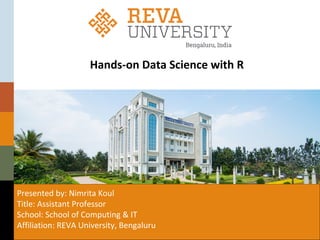
Hands-on Data Science with R
Presented by: Nimrita Koul
Title: Assistant Professor
School: School of Computing & IT
Affiliation: REVA University, Bengaluru
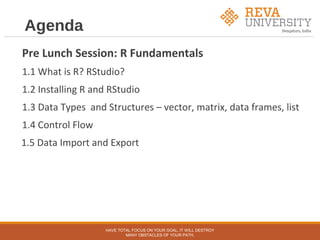
Agenda
Pre Lunch Session: R Fundamentals
1.1 What is R? RStudio?
1.2 Installing R and RStudio
1.3 Data Types and Structures – vector, matrix, data frames, list
1.4 Control Flow
1.5 Data Import and Export
HAVE TOTAL FOCUS ON YOUR GOAL, IT WILL DESTROY
MANY OBSTACLES OF YOUR PATH.
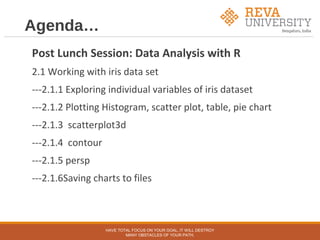
Agenda…
Post Lunch Session: Data Analysis with R
2.1 Working with iris data set
---2.1.1 Exploring individual variables of iris dataset
---2.1.2 Plotting Histogram, scatter plot, table, pie chart
---2.1.3 scatterplot3d
---2.1.4 contour
---2.1.5 persp
---2.1.6Saving charts to files
HAVE TOTAL FOCUS ON YOUR GOAL, IT WILL DESTROY
MANY OBSTACLES OF YOUR PATH.
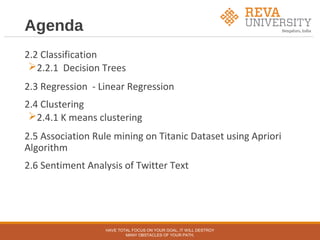
Agenda
2.2 Classification
2.2.1 Decision Trees
2.3 Regression - Linear Regression
2.4 Clustering
2.4.1 K means clustering
2.5 Association Rule mining on Titanic Dataset using Apriori
Algorithm
2.6 Sentiment Analysis of Twitter Text
HAVE TOTAL FOCUS ON YOUR GOAL, IT WILL DESTROY
MANY OBSTACLES OF YOUR PATH.
Session 1
HAVE TOTAL FOCUS ON YOUR GOAL, IT WILL DESTROY
MANY OBSTACLES OF YOUR PATH.
What is R?
R is a free software environment for statistical computing and
graphics.
R can be easily extended with 9,200+ packages available on CRAN (as
of Oct 2016).
http://www.r-project.org/
http://cran.r-project.org/
http://www.bioconductor.org/
http://cran.r-project.org/manuals.html
A great and complete documentation on R is available at:
http://cran.r-project.org/doc/manuals/R-intro.pdf
HAVE TOTAL FOCUS ON YOUR GOAL, IT WILL DESTROY
MANY OBSTACLES OF YOUR PATH.
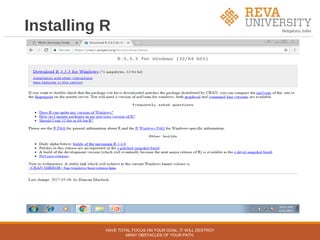
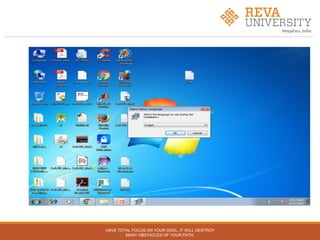
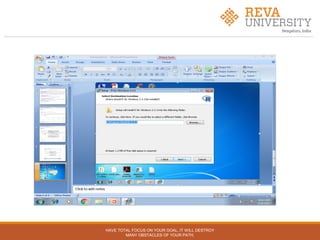
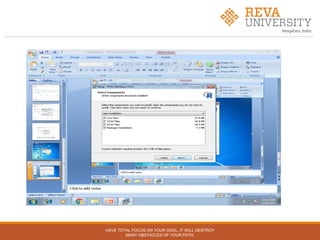
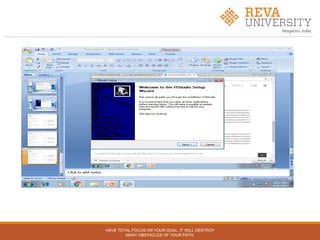
Installing R
HAVE TOTAL FOCUS ON YOUR GOAL, IT WILL DESTROY
MANY OBSTACLES OF YOUR PATH.
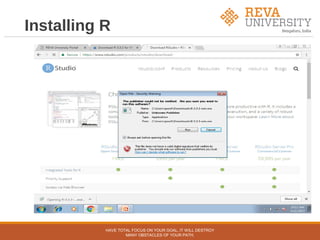
Installing R
HAVE TOTAL FOCUS ON YOUR GOAL, IT WILL DESTROY
MANY OBSTACLES OF YOUR PATH.
HAVE TOTAL FOCUS ON YOUR GOAL, IT WILL DESTROY
MANY OBSTACLES OF YOUR PATH.
HAVE TOTAL FOCUS ON YOUR GOAL, IT WILL DESTROY
MANY OBSTACLES OF YOUR PATH.
HAVE TOTAL FOCUS ON YOUR GOAL, IT WILL DESTROY
MANY OBSTACLES OF YOUR PATH.
HAVE TOTAL FOCUS ON YOUR GOAL, IT WILL DESTROY
MANY OBSTACLES OF YOUR PATH.
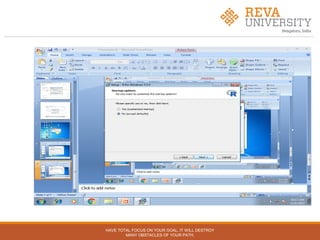
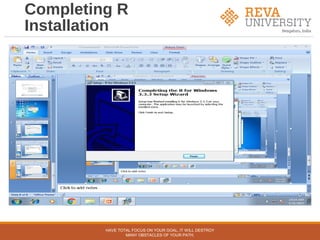
Completing R
Installation
HAVE TOTAL FOCUS ON YOUR GOAL, IT WILL DESTROY
MANY OBSTACLES OF YOUR PATH.
What is RStudio
It is an integrated development environment (IDE) for R
It runs on various operating systems like Windows, Mac OS X and Linux
RStudio project has following folders for default content types:
code: source code
data: raw data, cleaned data
figures: charts and graphs
 docs: documents and reports
 models: analytics models
HAVE TOTAL FOCUS ON YOUR GOAL, IT WILL DESTROY
MANY OBSTACLES OF YOUR PATH.
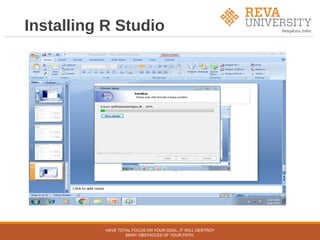
Installing RStudio
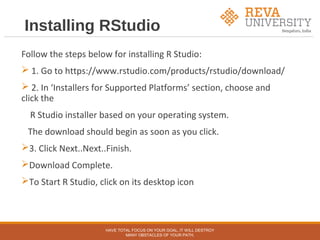
Follow the steps below for installing R Studio:
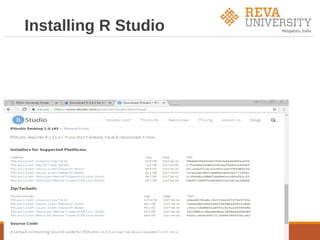
 1. Go to https://www.rstudio.com/products/rstudio/download/
 2. In ‘Installers for Supported Platforms’ section, choose and
click the
R Studio installer based on your operating system.
The download should begin as soon as you click.
3. Click Next..Next..Finish.
Download Complete.
To Start R Studio, click on its desktop icon
HAVE TOTAL FOCUS ON YOUR GOAL, IT WILL DESTROY
MANY OBSTACLES OF YOUR PATH.
Installing R Studio
HAVE TOTAL FOCUS ON YOUR GOAL, IT WILL DESTROY
MANY OBSTACLES OF YOUR PATH.
HAVE TOTAL FOCUS ON YOUR GOAL, IT WILL DESTROY
MANY OBSTACLES OF YOUR PATH.
Installing R Studio
HAVE TOTAL FOCUS ON YOUR GOAL, IT WILL DESTROY
MANY OBSTACLES OF YOUR PATH.
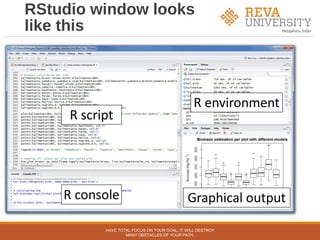
RStudio window looks
like this
HAVE TOTAL FOCUS ON YOUR GOAL, IT WILL DESTROY
MANY OBSTACLES OF YOUR PATH.
Data Types & Structures
Data types
 Integer
Numeric
Character
Factor
Logical
Data structures
Vector
Matrix
Data frame
List
HAVE TOTAL FOCUS ON YOUR GOAL, IT WILL DESTROY
MANY OBSTACLES OF YOUR PATH.
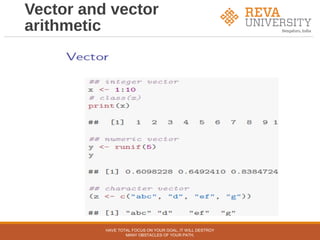
Vector and vector
arithmetic
HAVE TOTAL FOCUS ON YOUR GOAL, IT WILL DESTROY
MANY OBSTACLES OF YOUR PATH.
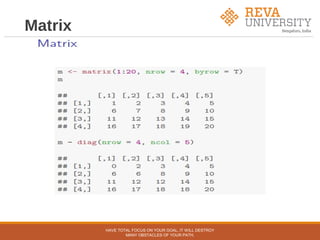
Matrix
HAVE TOTAL FOCUS ON YOUR GOAL, IT WILL DESTROY
MANY OBSTACLES OF YOUR PATH.
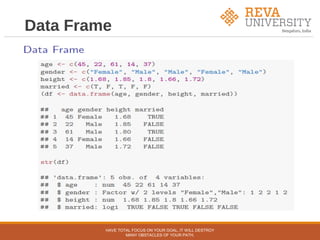
Data Frame
HAVE TOTAL FOCUS ON YOUR GOAL, IT WILL DESTROY
MANY OBSTACLES OF YOUR PATH.
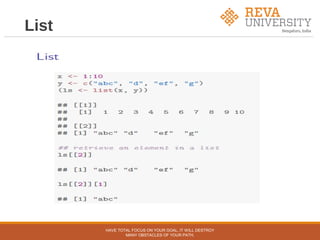
List
HAVE TOTAL FOCUS ON YOUR GOAL, IT WILL DESTROY
MANY OBSTACLES OF YOUR PATH.
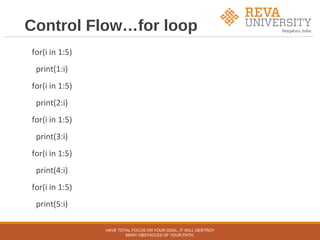
Control Flow…for loop
for(i in 1:5)
print(1:i)
for(i in 1:5)
print(2:i)
for(i in 1:5)
print(3:i)
for(i in 1:5)
print(4:i)
for(i in 1:5)
print(5:i)
HAVE TOTAL FOCUS ON YOUR GOAL, IT WILL DESTROY
MANY OBSTACLES OF YOUR PATH.
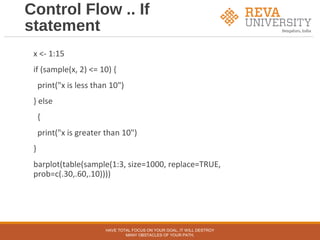
Control Flow .. If
statement
x <- 1:15
if (sample(x, 2) <= 10) {
print("x is less than 10")
} else
{
print("x is greater than 10")
}
barplot(table(sample(1:3, size=1000, replace=TRUE,
prob=c(.30,.60,.10))))
HAVE TOTAL FOCUS ON YOUR GOAL, IT WILL DESTROY
MANY OBSTACLES OF YOUR PATH.
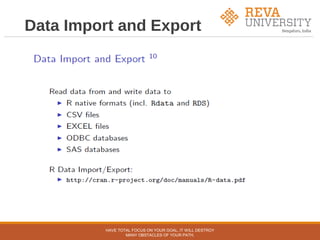
Data Import and Export
HAVE TOTAL FOCUS ON YOUR GOAL, IT WILL DESTROY
MANY OBSTACLES OF YOUR PATH.
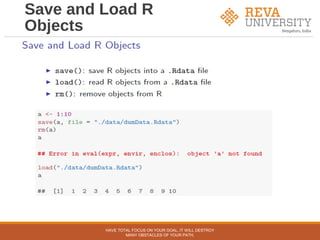
Save and Load R
Objects
HAVE TOTAL FOCUS ON YOUR GOAL, IT WILL DESTROY
MANY OBSTACLES OF YOUR PATH.
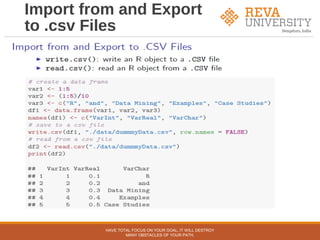
Import from and Export
to .csv Files
HAVE TOTAL FOCUS ON YOUR GOAL, IT WILL DESTROY
MANY OBSTACLES OF YOUR PATH.
Session 2 : Data Analysis
with R
HAVE TOTAL FOCUS ON YOUR GOAL, IT WILL DESTROY
MANY OBSTACLES OF YOUR PATH.
Working with iris data
set
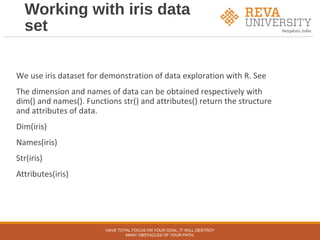
We use iris dataset for demonstration of data exploration with R. See
The dimension and names of data can be obtained respectively with
dim() and names(). Functions str() and attributes() return the structure
and attributes of data.
Dim(iris)
Names(iris)
Str(iris)
Attributes(iris)
HAVE TOTAL FOCUS ON YOUR GOAL, IT WILL DESTROY
MANY OBSTACLES OF YOUR PATH.
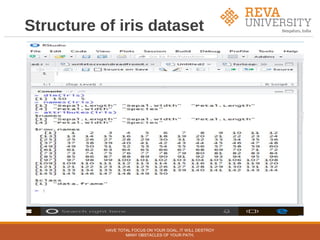
Structure of iris dataset
HAVE TOTAL FOCUS ON YOUR GOAL, IT WILL DESTROY
MANY OBSTACLES OF YOUR PATH.
Working with iris dataset
>iris[1:5] ----to print all 5 columns of iris data set
>iris[1:2] --- to print first two columns of iris data set
>iris[5] – to print only 5th
column of iris data set
>head(iris) --- first five records of iris data set
>tail(iris) --- last five records of iris data set
>iris[1:10, "Sepal.Length"]---- first 10 values in column Sepal.Length
> iris$Sepal.Length[1:10]-----same as above
Individual variables with summary(iris)
>summary(iris)
>quantile(iris$Sepal.Length)
HAVE TOTAL FOCUS ON YOUR GOAL, IT WILL DESTROY
MANY OBSTACLES OF YOUR PATH.
Visualization & Graphics
Histogram
> hist(iris$Sepal.Length)
Density Plot
> plot(density(iris$Sepal.Length))
Table
> table(iris$Species)
Pie Chart
> pie(table(iris$Species))
Box Plot
>boxplot(Sepal.Length~Species,data=iris)
HAVE TOTAL FOCUS ON YOUR GOAL, IT WILL DESTROY
MANY OBSTACLES OF YOUR PATH.
Visualization and
Graphics
Scatter plot
A scatter plot can be drawn for two numeric variables with plot() as
below. Using function with(), we don't need to add “iris$" before
variable names. In the code below, the colors (col) and symbols (pch) of
points are set to Species.
> with(iris, plot(Sepal.Length, Sepal.Width, col=Species,
pch=as.numeric(Species)))
When there are many points, some of them may overlap. We can use
jitter() to add a small amount of noise to the data before plotting
>plot(jitter(iris$Sepal.Length), jitter(iris$Sepal.Width))
HAVE TOTAL FOCUS ON YOUR GOAL, IT WILL DESTROY
MANY OBSTACLES OF YOUR PATH.
3d scatter plot and interactive3d
plots
Install.packages(“scatterplot3d”)
A 3D scatter plot can be produced with package scatterplot3d
We first need to install package scatterplot3d and load it using
library(scatterplot3d)
> library(scatterplot3d)
> scatterplot3d(iris$Petal.Width, iris$Sepal.Length, iris$Sepal.Width)
For interactive 3d plot
>library(rgl)
>plot3d(iris$Petal.Width, iris$Sepal.Length, iris$Sepal.Width)
HAVE TOTAL FOCUS ON YOUR GOAL, IT WILL DESTROY
MANY OBSTACLES OF YOUR PATH.
Heatmap and Contour
plot
A heat map presents a 2D display of a data matrix, which can be
generated with heatmap() in R. We calculate the similarity between
different lowers in the iris data with dist() and then plot it with a heat
map.
> distMatrix <- as.matrix(dist(iris[,1:4]))
> heatmap(distMatrix)
Contour plot needs lattice library
>library(lattice)
>filled.contour(volcano, color=terrain.colors, asp=1,
+ plot.axes=contour(volcano, add=T))
HAVE TOTAL FOCUS ON YOUR GOAL, IT WILL DESTROY
MANY OBSTACLES OF YOUR PATH.
Advanced graphics with
ggplot2
Perspective -persp
Another way to illustrate a numeric matrix is a 3D surface plot shown as
below, which is generated with function persp().
> persp(volcano, theta=25, phi=30, expand=0.5, col="lightblue")
Package ggplot2 supports complex graphics, which are very useful for
exploring data
>library(ggplot2)
> qplot(Sepal.Length, Sepal.Width, data=iris, facets=Species ~.)
HAVE TOTAL FOCUS ON YOUR GOAL, IT WILL DESTROY
MANY OBSTACLES OF YOUR PATH.
Saving charts to pdf
>pdf("myplot.pdf")
>x=1:50
>plot(x,log(x))
>graphics.off()
# file myplot.pdf will contain the resulting plot.
HAVE TOTAL FOCUS ON YOUR GOAL, IT WILL DESTROY
MANY OBSTACLES OF YOUR PATH.
Covariance and
Correlation
> cov(iris$Sepal.Length, iris$Petal.Length)
>cov(iris[,1:4])
> cor(iris$Sepal.Length, iris$Petal.Length)
> cor(iris[,1:4])
HAVE TOTAL FOCUS ON YOUR GOAL, IT WILL DESTROY
MANY OBSTACLES OF YOUR PATH.
Classification with Decision
Trees
We can build a decision tree for the iris data with function ctree() in
package “party”. Sepal.Length, Sepal.Width, Petal.Length and
Petal.Width are used to predict the Species of flowers.
In the package, function ctree() builds a decision tree, and predict()
makes prediction for new data.
Before modeling, the iris data is split below into two subsets: training
(70%) and test (30%).
The random seed is set to a fixed value below to make the results
reproducible
HAVE TOTAL FOCUS ON YOUR GOAL, IT WILL DESTROY
MANY OBSTACLES OF YOUR PATH.
Decision Trees
> set.seed(1234)
> ind <- sample(2, nrow(iris), replace=TRUE, prob=c(0.7, 0.3))
> trainData <- iris[ind==1,]
> testData <- iris[ind==2,]
> library(party) #party package is required to create decision trees
> myFormula <- Species ~ Sepal.Length + Sepal.Width + Petal.Length +
Petal.Width
> iris_ctree <- ctree(myFormula, data=trainData)
> # check the prediction
> table(predict(iris_ctree), trainData$Species)
> print(iris_ctree)
HAVE TOTAL FOCUS ON YOUR GOAL, IT WILL DESTROY
MANY OBSTACLES OF YOUR PATH.
Linear Regression
Regression is to build a function of independent variables (also known
as predictors) to predict a dependent variable (also called response).
For example, banks assess the risk of home-loan applicants based on
their age, income, expenses, occupation, number of dependents, total
credit limit, etc.
y = c0 + c1x1 + c2x2 + + ckxk;
where x1; x2; ; xk are predictors and y is the response to predict.
We demonstrate linear regression using function lm() on Australian
Consumer Price Index(cpi) data , quarterly from 2008 to 2010.
Data is created and plotted, x axis is manually added with function
axis(), las=3 makes text vertical.
HAVE TOTAL FOCUS ON YOUR GOAL, IT WILL DESTROY
MANY OBSTACLES OF YOUR PATH.
Linear Regression
>year=rep(2008:2010,each=4)
> quarter=rep(1:4,3)
>
cpi=c(162.2,164.6,166.5,166.0,166.2,167.0,168.6,169.5,171.0,172.1,17
3.3,174.0)
> plot(cpi,xaxt="n",ylab="CPI",xlab="")
#draw x axis
> axis(1,labels=paste(year,quarter,sep="Q"),at=1:12,las=3)
> cor(year,cpi)
HAVE TOTAL FOCUS ON YOUR GOAL, IT WILL DESTROY
MANY OBSTACLES OF YOUR PATH.
Checking correlation
and plotting 3d
> cor(quarter,cpi)
> fit<-lm(cpi~year+quarter)
> fit
>plot(fit)
>attributes(fit)
>library(scatterplot3d)
>s3d<-
scatterplot3d(year,quarter,cpi,highlight.3d=T,type=“h”,lab=c(2,3))
>s3d$plane3d(fit)
HAVE TOTAL FOCUS ON YOUR GOAL, IT WILL DESTROY
MANY OBSTACLES OF YOUR PATH.
Linear Regression
With the above linear model, CPI is calculated as
cpi = c0 + c1 year + c2 quarter;
where c0, c1 and c2 are coefficients from model fit.
HAVE TOTAL FOCUS ON YOUR GOAL, IT WILL DESTROY
MANY OBSTACLES OF YOUR PATH.
Clustering- K - Means
We remove species from the data to cluster, thenapply function
kmeans() to iris2, and store the clustering result in kmeans.result. The
cluster number is set to 3 in the code below.
>iris2=iris
>iris2$Species=NULL
>(kmeans.result=kmeans(iris2,3))
>table(iris$Species,kmeans.result$cluster)
The above result shows that cluster setosa" can be easily separated
from the other clusters, and that clusters versicolor" and virginica"
are to a small degree overlapped with each other.
HAVE TOTAL FOCUS ON YOUR GOAL, IT WILL DESTROY
MANY OBSTACLES OF YOUR PATH.
Plotting clusters
> plot(iris2[c("Sepal.Length", "Sepal.Width")], col =
kmeans.result$cluster)
# plot cluster centers
> points(kmeans.result$centers[,c("Sepal.Length", "Sepal.Width")], col
= 1:3, pch = 8, cex=2)
HAVE TOTAL FOCUS ON YOUR GOAL, IT WILL DESTROY
MANY OBSTACLES OF YOUR PATH.
Association Rule Mining
on Titanic dataset
Attributes - Passenger class, Gender, Child, Survived
> str(Titanic)
table [1:4, 1:2, 1:2, 1:2] 0 0 35 0 0 0 17 0 118 154 ...
- attr(*, "dimnames")=List of 4
..$ Class : chr [1:4] "1st" "2nd" "3rd" "Crew"
..$ Sex : chr [1:2] "Male" "Female"
..$ Age : chr [1:2] "Child" "Adult"
..$ Survived: chr [1:2] "No" "Yes"
> df <- as.data.frame(Titanic)
> head(df)
HAVE TOTAL FOCUS ON YOUR GOAL, IT WILL DESTROY
MANY OBSTACLES OF YOUR PATH.
Titanic Dataset
Class Sex Age Survived Freq
1 1st Male Child No 0
2 2nd Male Child No 0
3 3rd Male Child No 35
4 Crew Male Child No 0
5 1st Female Child No 0
6 2nd Female Child No 0
HAVE TOTAL FOCUS ON YOUR GOAL, IT WILL DESTROY
MANY OBSTACLES OF YOUR PATH.
Titanic Raw
> titanic.raw <- NULL
> for(i in 1:4) {
+ titanic.raw <- cbind(titanic.raw, rep(as.character(df[,i]), df$Freq))
+ }
> titanic.raw <- as.data.frame(titanic.raw)
> names(titanic.raw) <- names(df)[1:4]
> str(titanic.raw)
> dim(titanic.raw)
> str(titanic.raw)
HAVE TOTAL FOCUS ON YOUR GOAL, IT WILL DESTROY
MANY OBSTACLES OF YOUR PATH.
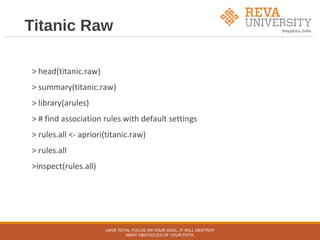
Titanic Raw
> head(titanic.raw)
> summary(titanic.raw)
> library(arules)
> # find association rules with default settings
> rules.all <- apriori(titanic.raw)
> rules.all
>inspect(rules.all)
HAVE TOTAL FOCUS ON YOUR GOAL, IT WILL DESTROY
MANY OBSTACLES OF YOUR PATH.
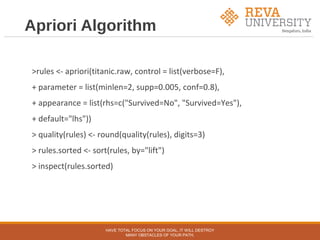
Apriori Algorithm
>rules <- apriori(titanic.raw, control = list(verbose=F),
+ parameter = list(minlen=2, supp=0.005, conf=0.8),
+ appearance = list(rhs=c("Survived=No", "Survived=Yes"),
+ default="lhs"))
> quality(rules) <- round(quality(rules), digits=3)
> rules.sorted <- sort(rules, by="lift")
> inspect(rules.sorted)
HAVE TOTAL FOCUS ON YOUR GOAL, IT WILL DESTROY
MANY OBSTACLES OF YOUR PATH.
Removing redundant
rules
> subset.matrix <- is.subset(rules.sorted, rules.sorted)
> subset.matrix[lower.tri(subset.matrix, diag=T)] <- NA
> redundant <- colSums(subset.matrix, na.rm=T) >= 1
> which(redundant)
> # remove redundant rules
> rules.pruned <- rules.sorted[!redundant]
> inspect(rules.pruned)
HAVE TOTAL FOCUS ON YOUR GOAL, IT WILL DESTROY
MANY OBSTACLES OF YOUR PATH.
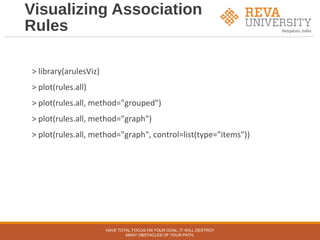
Visualizing Association
Rules
> library(arulesViz)
> plot(rules.all)
> plot(rules.all, method="grouped")
> plot(rules.all, method="graph")
> plot(rules.all, method="graph", control=list(type="items"))
HAVE TOTAL FOCUS ON YOUR GOAL, IT WILL DESTROY
MANY OBSTACLES OF YOUR PATH.
THANK YOU

Hands on data science with r.pptx

  • 1.
    Hands-on Data Sciencewith R Presented by: Nimrita Koul Title: Assistant Professor School: School of Computing & IT Affiliation: REVA University, Bengaluru
  • 2.
    Agenda Pre Lunch Session:R Fundamentals 1.1 What is R? RStudio? 1.2 Installing R and RStudio 1.3 Data Types and Structures – vector, matrix, data frames, list 1.4 Control Flow 1.5 Data Import and Export HAVE TOTAL FOCUS ON YOUR GOAL, IT WILL DESTROY MANY OBSTACLES OF YOUR PATH.
  • 3.
    Agenda… Post Lunch Session:Data Analysis with R 2.1 Working with iris data set ---2.1.1 Exploring individual variables of iris dataset ---2.1.2 Plotting Histogram, scatter plot, table, pie chart ---2.1.3 scatterplot3d ---2.1.4 contour ---2.1.5 persp ---2.1.6Saving charts to files HAVE TOTAL FOCUS ON YOUR GOAL, IT WILL DESTROY MANY OBSTACLES OF YOUR PATH.
  • 4.
    Agenda 2.2 Classification 2.2.1 DecisionTrees 2.3 Regression - Linear Regression 2.4 Clustering 2.4.1 K means clustering 2.5 Association Rule mining on Titanic Dataset using Apriori Algorithm 2.6 Sentiment Analysis of Twitter Text HAVE TOTAL FOCUS ON YOUR GOAL, IT WILL DESTROY MANY OBSTACLES OF YOUR PATH.
  • 5.
    Session 1 HAVE TOTALFOCUS ON YOUR GOAL, IT WILL DESTROY MANY OBSTACLES OF YOUR PATH.
  • 6.
    What is R? Ris a free software environment for statistical computing and graphics. R can be easily extended with 9,200+ packages available on CRAN (as of Oct 2016). http://www.r-project.org/ http://cran.r-project.org/ http://www.bioconductor.org/ http://cran.r-project.org/manuals.html A great and complete documentation on R is available at: http://cran.r-project.org/doc/manuals/R-intro.pdf HAVE TOTAL FOCUS ON YOUR GOAL, IT WILL DESTROY MANY OBSTACLES OF YOUR PATH.
  • 7.
    Installing R HAVE TOTALFOCUS ON YOUR GOAL, IT WILL DESTROY MANY OBSTACLES OF YOUR PATH.
  • 8.
    Installing R HAVE TOTALFOCUS ON YOUR GOAL, IT WILL DESTROY MANY OBSTACLES OF YOUR PATH.
  • 9.
    HAVE TOTAL FOCUSON YOUR GOAL, IT WILL DESTROY MANY OBSTACLES OF YOUR PATH.
  • 10.
    HAVE TOTAL FOCUSON YOUR GOAL, IT WILL DESTROY MANY OBSTACLES OF YOUR PATH.
  • 11.
    HAVE TOTAL FOCUSON YOUR GOAL, IT WILL DESTROY MANY OBSTACLES OF YOUR PATH.
  • 12.
    HAVE TOTAL FOCUSON YOUR GOAL, IT WILL DESTROY MANY OBSTACLES OF YOUR PATH.
  • 13.
    Completing R Installation HAVE TOTALFOCUS ON YOUR GOAL, IT WILL DESTROY MANY OBSTACLES OF YOUR PATH.
  • 14.
    What is RStudio Itis an integrated development environment (IDE) for R It runs on various operating systems like Windows, Mac OS X and Linux RStudio project has following folders for default content types: code: source code data: raw data, cleaned data figures: charts and graphs  docs: documents and reports  models: analytics models HAVE TOTAL FOCUS ON YOUR GOAL, IT WILL DESTROY MANY OBSTACLES OF YOUR PATH.
  • 15.
    Installing RStudio Follow thesteps below for installing R Studio:  1. Go to https://www.rstudio.com/products/rstudio/download/  2. In ‘Installers for Supported Platforms’ section, choose and click the R Studio installer based on your operating system. The download should begin as soon as you click. 3. Click Next..Next..Finish. Download Complete. To Start R Studio, click on its desktop icon HAVE TOTAL FOCUS ON YOUR GOAL, IT WILL DESTROY MANY OBSTACLES OF YOUR PATH.
  • 16.
    Installing R Studio HAVETOTAL FOCUS ON YOUR GOAL, IT WILL DESTROY MANY OBSTACLES OF YOUR PATH.
  • 17.
    HAVE TOTAL FOCUSON YOUR GOAL, IT WILL DESTROY MANY OBSTACLES OF YOUR PATH.
  • 18.
    Installing R Studio HAVETOTAL FOCUS ON YOUR GOAL, IT WILL DESTROY MANY OBSTACLES OF YOUR PATH.
  • 19.
    RStudio window looks likethis HAVE TOTAL FOCUS ON YOUR GOAL, IT WILL DESTROY MANY OBSTACLES OF YOUR PATH.
  • 20.
    Data Types &Structures Data types  Integer Numeric Character Factor Logical Data structures Vector Matrix Data frame List HAVE TOTAL FOCUS ON YOUR GOAL, IT WILL DESTROY MANY OBSTACLES OF YOUR PATH.
  • 21.
    Vector and vector arithmetic HAVETOTAL FOCUS ON YOUR GOAL, IT WILL DESTROY MANY OBSTACLES OF YOUR PATH.
  • 22.
    Matrix HAVE TOTAL FOCUSON YOUR GOAL, IT WILL DESTROY MANY OBSTACLES OF YOUR PATH.
  • 23.
    Data Frame HAVE TOTALFOCUS ON YOUR GOAL, IT WILL DESTROY MANY OBSTACLES OF YOUR PATH.
  • 24.
    List HAVE TOTAL FOCUSON YOUR GOAL, IT WILL DESTROY MANY OBSTACLES OF YOUR PATH.
  • 25.
    Control Flow…for loop for(iin 1:5) print(1:i) for(i in 1:5) print(2:i) for(i in 1:5) print(3:i) for(i in 1:5) print(4:i) for(i in 1:5) print(5:i) HAVE TOTAL FOCUS ON YOUR GOAL, IT WILL DESTROY MANY OBSTACLES OF YOUR PATH.
  • 26.
    Control Flow ..If statement x <- 1:15 if (sample(x, 2) <= 10) { print("x is less than 10") } else { print("x is greater than 10") } barplot(table(sample(1:3, size=1000, replace=TRUE, prob=c(.30,.60,.10)))) HAVE TOTAL FOCUS ON YOUR GOAL, IT WILL DESTROY MANY OBSTACLES OF YOUR PATH.
  • 27.
    Data Import andExport HAVE TOTAL FOCUS ON YOUR GOAL, IT WILL DESTROY MANY OBSTACLES OF YOUR PATH.
  • 28.
    Save and LoadR Objects HAVE TOTAL FOCUS ON YOUR GOAL, IT WILL DESTROY MANY OBSTACLES OF YOUR PATH.
  • 29.
    Import from andExport to .csv Files HAVE TOTAL FOCUS ON YOUR GOAL, IT WILL DESTROY MANY OBSTACLES OF YOUR PATH.
  • 30.
    Session 2 :Data Analysis with R HAVE TOTAL FOCUS ON YOUR GOAL, IT WILL DESTROY MANY OBSTACLES OF YOUR PATH.
  • 31.
    Working with irisdata set We use iris dataset for demonstration of data exploration with R. See The dimension and names of data can be obtained respectively with dim() and names(). Functions str() and attributes() return the structure and attributes of data. Dim(iris) Names(iris) Str(iris) Attributes(iris) HAVE TOTAL FOCUS ON YOUR GOAL, IT WILL DESTROY MANY OBSTACLES OF YOUR PATH.
  • 32.
    Structure of irisdataset HAVE TOTAL FOCUS ON YOUR GOAL, IT WILL DESTROY MANY OBSTACLES OF YOUR PATH.
  • 33.
    Working with irisdataset >iris[1:5] ----to print all 5 columns of iris data set >iris[1:2] --- to print first two columns of iris data set >iris[5] – to print only 5th column of iris data set >head(iris) --- first five records of iris data set >tail(iris) --- last five records of iris data set >iris[1:10, "Sepal.Length"]---- first 10 values in column Sepal.Length > iris$Sepal.Length[1:10]-----same as above Individual variables with summary(iris) >summary(iris) >quantile(iris$Sepal.Length) HAVE TOTAL FOCUS ON YOUR GOAL, IT WILL DESTROY MANY OBSTACLES OF YOUR PATH.
  • 34.
    Visualization & Graphics Histogram >hist(iris$Sepal.Length) Density Plot > plot(density(iris$Sepal.Length)) Table > table(iris$Species) Pie Chart > pie(table(iris$Species)) Box Plot >boxplot(Sepal.Length~Species,data=iris) HAVE TOTAL FOCUS ON YOUR GOAL, IT WILL DESTROY MANY OBSTACLES OF YOUR PATH.
  • 35.
    Visualization and Graphics Scatter plot Ascatter plot can be drawn for two numeric variables with plot() as below. Using function with(), we don't need to add “iris$" before variable names. In the code below, the colors (col) and symbols (pch) of points are set to Species. > with(iris, plot(Sepal.Length, Sepal.Width, col=Species, pch=as.numeric(Species))) When there are many points, some of them may overlap. We can use jitter() to add a small amount of noise to the data before plotting >plot(jitter(iris$Sepal.Length), jitter(iris$Sepal.Width)) HAVE TOTAL FOCUS ON YOUR GOAL, IT WILL DESTROY MANY OBSTACLES OF YOUR PATH.
  • 36.
    3d scatter plotand interactive3d plots Install.packages(“scatterplot3d”) A 3D scatter plot can be produced with package scatterplot3d We first need to install package scatterplot3d and load it using library(scatterplot3d) > library(scatterplot3d) > scatterplot3d(iris$Petal.Width, iris$Sepal.Length, iris$Sepal.Width) For interactive 3d plot >library(rgl) >plot3d(iris$Petal.Width, iris$Sepal.Length, iris$Sepal.Width) HAVE TOTAL FOCUS ON YOUR GOAL, IT WILL DESTROY MANY OBSTACLES OF YOUR PATH.
  • 37.
    Heatmap and Contour plot Aheat map presents a 2D display of a data matrix, which can be generated with heatmap() in R. We calculate the similarity between different lowers in the iris data with dist() and then plot it with a heat map. > distMatrix <- as.matrix(dist(iris[,1:4])) > heatmap(distMatrix) Contour plot needs lattice library >library(lattice) >filled.contour(volcano, color=terrain.colors, asp=1, + plot.axes=contour(volcano, add=T)) HAVE TOTAL FOCUS ON YOUR GOAL, IT WILL DESTROY MANY OBSTACLES OF YOUR PATH.
  • 38.
    Advanced graphics with ggplot2 Perspective-persp Another way to illustrate a numeric matrix is a 3D surface plot shown as below, which is generated with function persp(). > persp(volcano, theta=25, phi=30, expand=0.5, col="lightblue") Package ggplot2 supports complex graphics, which are very useful for exploring data >library(ggplot2) > qplot(Sepal.Length, Sepal.Width, data=iris, facets=Species ~.) HAVE TOTAL FOCUS ON YOUR GOAL, IT WILL DESTROY MANY OBSTACLES OF YOUR PATH.
  • 39.
    Saving charts topdf >pdf("myplot.pdf") >x=1:50 >plot(x,log(x)) >graphics.off() # file myplot.pdf will contain the resulting plot. HAVE TOTAL FOCUS ON YOUR GOAL, IT WILL DESTROY MANY OBSTACLES OF YOUR PATH.
  • 40.
    Covariance and Correlation > cov(iris$Sepal.Length,iris$Petal.Length) >cov(iris[,1:4]) > cor(iris$Sepal.Length, iris$Petal.Length) > cor(iris[,1:4]) HAVE TOTAL FOCUS ON YOUR GOAL, IT WILL DESTROY MANY OBSTACLES OF YOUR PATH.
  • 41.
    Classification with Decision Trees Wecan build a decision tree for the iris data with function ctree() in package “party”. Sepal.Length, Sepal.Width, Petal.Length and Petal.Width are used to predict the Species of flowers. In the package, function ctree() builds a decision tree, and predict() makes prediction for new data. Before modeling, the iris data is split below into two subsets: training (70%) and test (30%). The random seed is set to a fixed value below to make the results reproducible HAVE TOTAL FOCUS ON YOUR GOAL, IT WILL DESTROY MANY OBSTACLES OF YOUR PATH.
  • 42.
    Decision Trees > set.seed(1234) >ind <- sample(2, nrow(iris), replace=TRUE, prob=c(0.7, 0.3)) > trainData <- iris[ind==1,] > testData <- iris[ind==2,] > library(party) #party package is required to create decision trees > myFormula <- Species ~ Sepal.Length + Sepal.Width + Petal.Length + Petal.Width > iris_ctree <- ctree(myFormula, data=trainData) > # check the prediction > table(predict(iris_ctree), trainData$Species) > print(iris_ctree) HAVE TOTAL FOCUS ON YOUR GOAL, IT WILL DESTROY MANY OBSTACLES OF YOUR PATH.
  • 43.
    Linear Regression Regression isto build a function of independent variables (also known as predictors) to predict a dependent variable (also called response). For example, banks assess the risk of home-loan applicants based on their age, income, expenses, occupation, number of dependents, total credit limit, etc. y = c0 + c1x1 + c2x2 + + ckxk; where x1; x2; ; xk are predictors and y is the response to predict. We demonstrate linear regression using function lm() on Australian Consumer Price Index(cpi) data , quarterly from 2008 to 2010. Data is created and plotted, x axis is manually added with function axis(), las=3 makes text vertical. HAVE TOTAL FOCUS ON YOUR GOAL, IT WILL DESTROY MANY OBSTACLES OF YOUR PATH.
  • 44.
    Linear Regression >year=rep(2008:2010,each=4) > quarter=rep(1:4,3) > cpi=c(162.2,164.6,166.5,166.0,166.2,167.0,168.6,169.5,171.0,172.1,17 3.3,174.0) >plot(cpi,xaxt="n",ylab="CPI",xlab="") #draw x axis > axis(1,labels=paste(year,quarter,sep="Q"),at=1:12,las=3) > cor(year,cpi) HAVE TOTAL FOCUS ON YOUR GOAL, IT WILL DESTROY MANY OBSTACLES OF YOUR PATH.
  • 45.
    Checking correlation and plotting3d > cor(quarter,cpi) > fit<-lm(cpi~year+quarter) > fit >plot(fit) >attributes(fit) >library(scatterplot3d) >s3d<- scatterplot3d(year,quarter,cpi,highlight.3d=T,type=“h”,lab=c(2,3)) >s3d$plane3d(fit) HAVE TOTAL FOCUS ON YOUR GOAL, IT WILL DESTROY MANY OBSTACLES OF YOUR PATH.
  • 46.
    Linear Regression With theabove linear model, CPI is calculated as cpi = c0 + c1 year + c2 quarter; where c0, c1 and c2 are coefficients from model fit. HAVE TOTAL FOCUS ON YOUR GOAL, IT WILL DESTROY MANY OBSTACLES OF YOUR PATH.
  • 47.
    Clustering- K -Means We remove species from the data to cluster, thenapply function kmeans() to iris2, and store the clustering result in kmeans.result. The cluster number is set to 3 in the code below. >iris2=iris >iris2$Species=NULL >(kmeans.result=kmeans(iris2,3)) >table(iris$Species,kmeans.result$cluster) The above result shows that cluster setosa" can be easily separated from the other clusters, and that clusters versicolor" and virginica" are to a small degree overlapped with each other. HAVE TOTAL FOCUS ON YOUR GOAL, IT WILL DESTROY MANY OBSTACLES OF YOUR PATH.
  • 48.
    Plotting clusters > plot(iris2[c("Sepal.Length","Sepal.Width")], col = kmeans.result$cluster) # plot cluster centers > points(kmeans.result$centers[,c("Sepal.Length", "Sepal.Width")], col = 1:3, pch = 8, cex=2) HAVE TOTAL FOCUS ON YOUR GOAL, IT WILL DESTROY MANY OBSTACLES OF YOUR PATH.
  • 49.
    Association Rule Mining onTitanic dataset Attributes - Passenger class, Gender, Child, Survived > str(Titanic) table [1:4, 1:2, 1:2, 1:2] 0 0 35 0 0 0 17 0 118 154 ... - attr(*, "dimnames")=List of 4 ..$ Class : chr [1:4] "1st" "2nd" "3rd" "Crew" ..$ Sex : chr [1:2] "Male" "Female" ..$ Age : chr [1:2] "Child" "Adult" ..$ Survived: chr [1:2] "No" "Yes" > df <- as.data.frame(Titanic) > head(df) HAVE TOTAL FOCUS ON YOUR GOAL, IT WILL DESTROY MANY OBSTACLES OF YOUR PATH.
  • 50.
    Titanic Dataset Class SexAge Survived Freq 1 1st Male Child No 0 2 2nd Male Child No 0 3 3rd Male Child No 35 4 Crew Male Child No 0 5 1st Female Child No 0 6 2nd Female Child No 0 HAVE TOTAL FOCUS ON YOUR GOAL, IT WILL DESTROY MANY OBSTACLES OF YOUR PATH.
  • 51.
    Titanic Raw > titanic.raw<- NULL > for(i in 1:4) { + titanic.raw <- cbind(titanic.raw, rep(as.character(df[,i]), df$Freq)) + } > titanic.raw <- as.data.frame(titanic.raw) > names(titanic.raw) <- names(df)[1:4] > str(titanic.raw) > dim(titanic.raw) > str(titanic.raw) HAVE TOTAL FOCUS ON YOUR GOAL, IT WILL DESTROY MANY OBSTACLES OF YOUR PATH.
  • 52.
    Titanic Raw > head(titanic.raw) >summary(titanic.raw) > library(arules) > # find association rules with default settings > rules.all <- apriori(titanic.raw) > rules.all >inspect(rules.all) HAVE TOTAL FOCUS ON YOUR GOAL, IT WILL DESTROY MANY OBSTACLES OF YOUR PATH.
  • 53.
    Apriori Algorithm >rules <-apriori(titanic.raw, control = list(verbose=F), + parameter = list(minlen=2, supp=0.005, conf=0.8), + appearance = list(rhs=c("Survived=No", "Survived=Yes"), + default="lhs")) > quality(rules) <- round(quality(rules), digits=3) > rules.sorted <- sort(rules, by="lift") > inspect(rules.sorted) HAVE TOTAL FOCUS ON YOUR GOAL, IT WILL DESTROY MANY OBSTACLES OF YOUR PATH.
  • 54.
    Removing redundant rules > subset.matrix<- is.subset(rules.sorted, rules.sorted) > subset.matrix[lower.tri(subset.matrix, diag=T)] <- NA > redundant <- colSums(subset.matrix, na.rm=T) >= 1 > which(redundant) > # remove redundant rules > rules.pruned <- rules.sorted[!redundant] > inspect(rules.pruned) HAVE TOTAL FOCUS ON YOUR GOAL, IT WILL DESTROY MANY OBSTACLES OF YOUR PATH.
  • 55.
    Visualizing Association Rules > library(arulesViz) >plot(rules.all) > plot(rules.all, method="grouped") > plot(rules.all, method="graph") > plot(rules.all, method="graph", control=list(type="items")) HAVE TOTAL FOCUS ON YOUR GOAL, IT WILL DESTROY MANY OBSTACLES OF YOUR PATH.
  • 56.