Dublin City University ODCSSS Project Summer 2008 Student: Madalina Fiterau Supervisors: Dr. Olga Ormond Dr. Gabriel-Miro Muntean
Aim of the project Study the performance of  handover   for a   group  of mobile devices as they move simultaneously from one network to another Propose an intelligent  and  adaptive  algorithm to support the movement of the group with the best possible  overall  QoS Apply appropriate metrics for the assesment of  group welfare  in heterogeneous networks
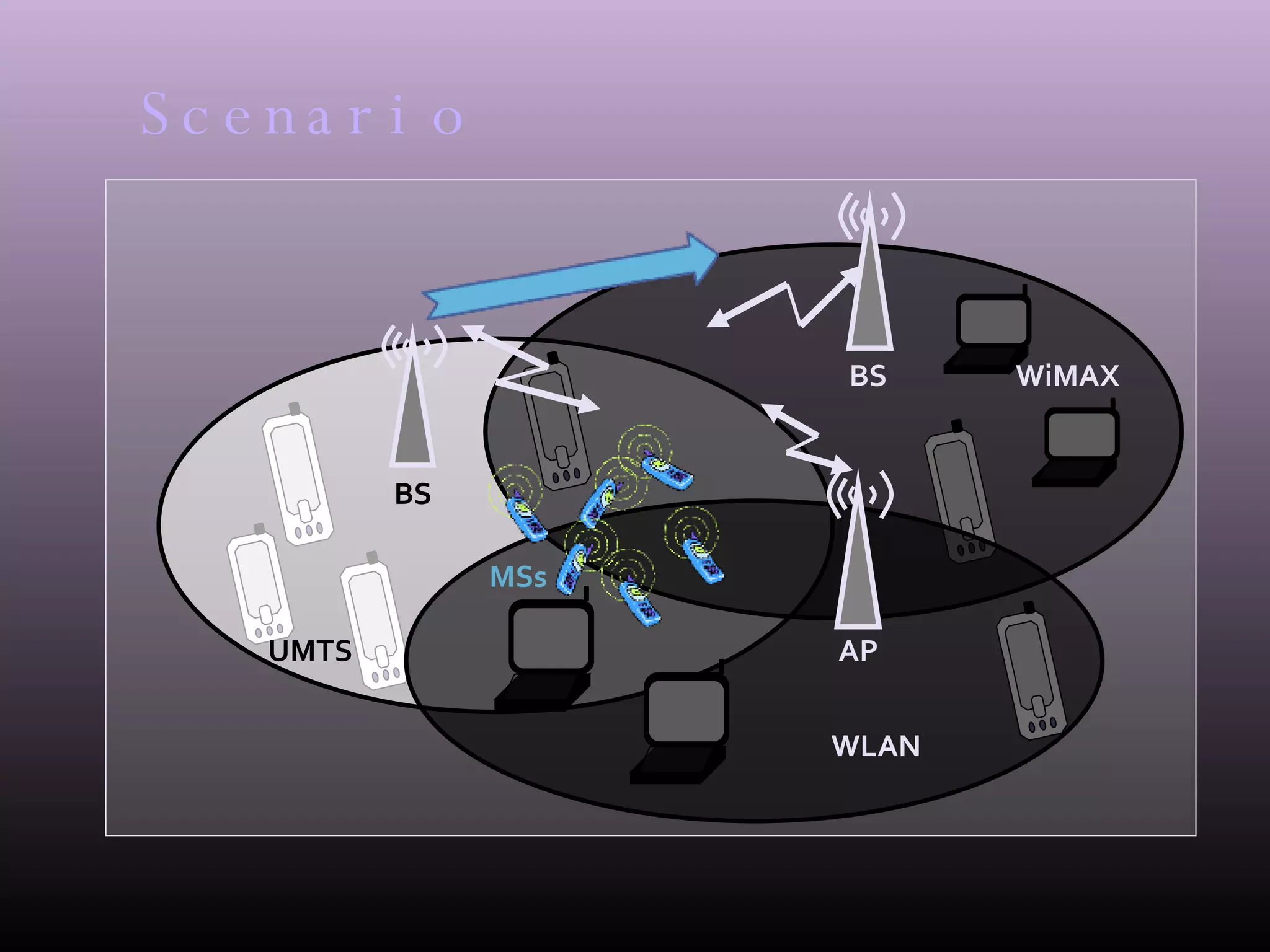
Scenario BS AP BS MSs UMTS WiMAX WLAN
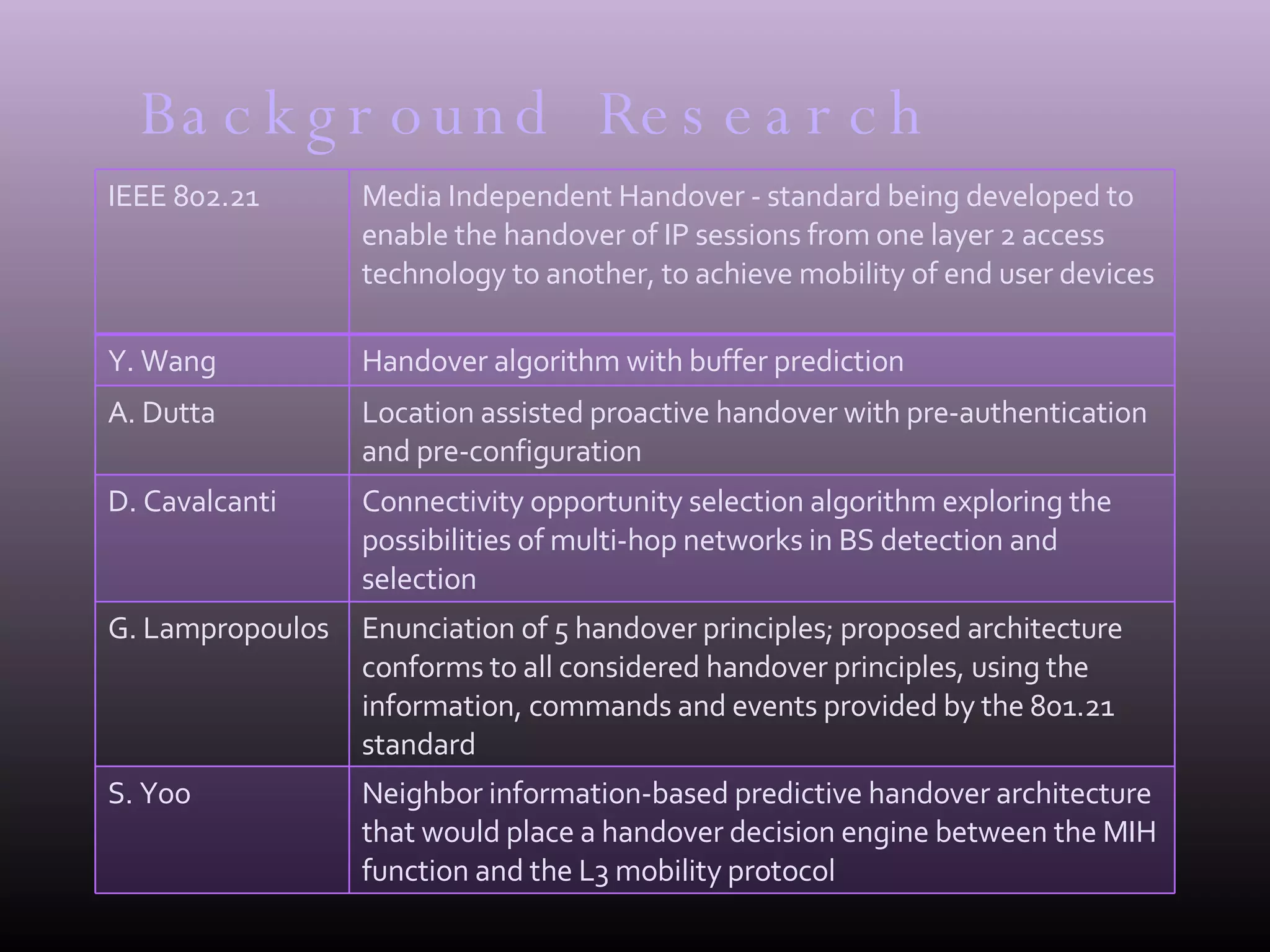
Background Research IEEE 802.21 Media Independent Handover - standard being developed to enable the handover of IP sessions from one layer 2 access technology to another, to achieve mobility of end user devices Y. Wang Handover algorithm with buffer prediction A. Dutta Location assisted proactive handover with pre-authentication and pre-configuration D. Cavalcanti Connectivity opportunity selection algorithm exploring the possibilities of multi-hop networks in BS detection and selection G. Lampropoulos Enunciation of 5 handover principles; proposed architecture conforms to all considered handover principles, using the information, commands and events provided by the 801.21 standard S. Yoo Neighbor information-based predictive handover architecture that would place a handover decision engine between the MIH function and the L3 mobility protocol
What could be improved? Not all the NSAs considered  UMTS  in the simulations – or UMTS/802 handovers Few approaches took into account the situation when  multiple users  switch from one network to another simultaneously Even fewer employed  performance indicators   to evaluate the welfare of the whole group So far, an algorithm  focused  on a group of mobile devices hasn’t been developed
Characteristics of algorithm Focus on multiple users – that might have similar profiles Adaptability Verticality of handover: UMTS/802.21 Real-time / non-real time applications
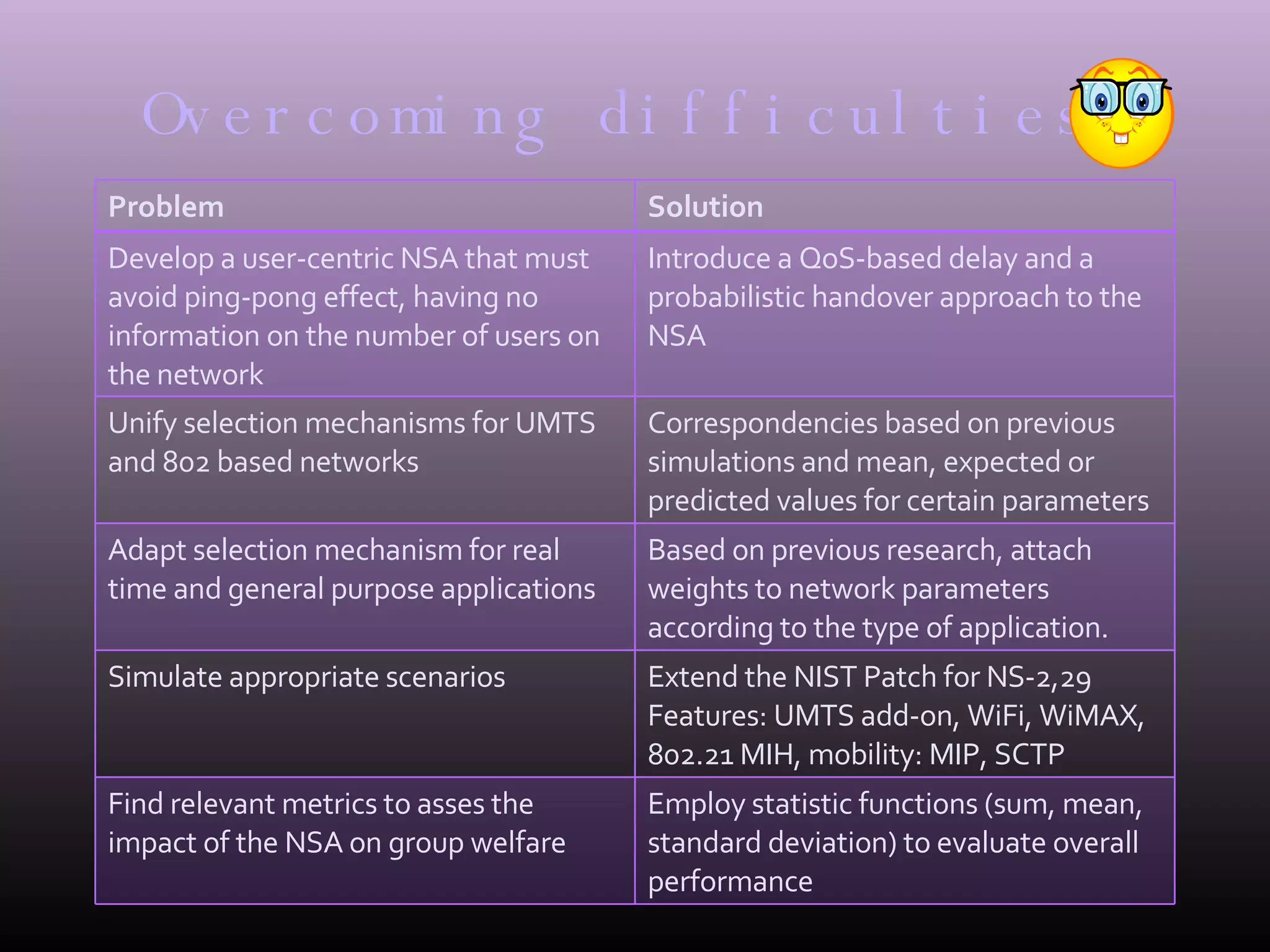
Overcoming difficulties Problem Solution Develop a user-centric NSA that must avoid ping-pong effect, having no information on the number of users on the network Introduce a QoS-based delay and a probabilistic handover approach to the NSA Unify selection mechanisms for UMTS and 802 based networks Correspondencies based on previous simulations and mean, expected or predicted values for certain parameters Adapt selection mechanism for real time and general purpose applications Based on previous research, attach weights to network parameters according to the type of application.  Simulate appropriate scenarios Extend the NIST Patch for NS-2,29 Features: UMTS add-on, WiFi, WiMAX, 802.21 MIH, mobility: MIP, SCTP Find relevant metrics to asses the impact of the NSA on group welfare Employ statistic functions (sum, mean, standard deviation) to evaluate overall performance
Overview 802.21 MIH Function Radio Access Technologies L2 Triggers and Events Handover Messages Information Service
Overview Algorithm begins by scanning for available networks. For each candidate network, compute Quality function based on: Throughput Delay Cost Error rate Jitter According to the difference in quality between the current and first candidate network, delay handover – to allow users that best fit the network to switch first. If, after a handover, a serious degradation of network quality is detected,  switch network according to a random variable  with a probability proportional to the quality degradation. real- time applications non-real-time applications 802.21 MIH Function Radio Access Technologies L2 Triggers and Events Handover Messages Information Service
Overview MIH Trigger r For Each Scanned Network, compute QoS function. QoS gain above threshold or already delayed? Delay Connect! Ping-Pong Detect Y N Y Random 802.21 MIH Function Radio Access Technologies L2 Triggers and Events Handover Messages Information Service
Does it work? Simulation of an “Always select the WLAN” algorithm. All the nodes communicate to the router through the AP, resulting in a drop of throughput  and increasing packet loss. Simulation of the randomized network selection. Part of the nodes will opt for the BS, therefore lessening the strain on the WLAN – reducing packet loss and increasing throughput. AP BS BS AP Router Router
Increase in throughput Throughput (kB/s) Time (s) Readings for the first node that stayed within the WLAN
Increase in throughput Throughput (kB/s) Time  (s) Readings for the second node that stayed within the WLAN Packet loss at the WLAN “ Always WLAN” Randomized NS 365 Pks 210240 Bytes 80 Pks 46080 Bytes
Walkthrough

Handover Microsoft

  • 1.
    Dublin City UniversityODCSSS Project Summer 2008 Student: Madalina Fiterau Supervisors: Dr. Olga Ormond Dr. Gabriel-Miro Muntean
  • 2.
    Aim of theproject Study the performance of handover for a group of mobile devices as they move simultaneously from one network to another Propose an intelligent and adaptive algorithm to support the movement of the group with the best possible overall QoS Apply appropriate metrics for the assesment of group welfare in heterogeneous networks
  • 3.
    Scenario BS APBS MSs UMTS WiMAX WLAN
  • 4.
    Background Research IEEE802.21 Media Independent Handover - standard being developed to enable the handover of IP sessions from one layer 2 access technology to another, to achieve mobility of end user devices Y. Wang Handover algorithm with buffer prediction A. Dutta Location assisted proactive handover with pre-authentication and pre-configuration D. Cavalcanti Connectivity opportunity selection algorithm exploring the possibilities of multi-hop networks in BS detection and selection G. Lampropoulos Enunciation of 5 handover principles; proposed architecture conforms to all considered handover principles, using the information, commands and events provided by the 801.21 standard S. Yoo Neighbor information-based predictive handover architecture that would place a handover decision engine between the MIH function and the L3 mobility protocol
  • 5.
    What could beimproved? Not all the NSAs considered UMTS in the simulations – or UMTS/802 handovers Few approaches took into account the situation when multiple users switch from one network to another simultaneously Even fewer employed performance indicators to evaluate the welfare of the whole group So far, an algorithm focused on a group of mobile devices hasn’t been developed
  • 6.
    Characteristics of algorithmFocus on multiple users – that might have similar profiles Adaptability Verticality of handover: UMTS/802.21 Real-time / non-real time applications
  • 7.
    Overcoming difficulties ProblemSolution Develop a user-centric NSA that must avoid ping-pong effect, having no information on the number of users on the network Introduce a QoS-based delay and a probabilistic handover approach to the NSA Unify selection mechanisms for UMTS and 802 based networks Correspondencies based on previous simulations and mean, expected or predicted values for certain parameters Adapt selection mechanism for real time and general purpose applications Based on previous research, attach weights to network parameters according to the type of application. Simulate appropriate scenarios Extend the NIST Patch for NS-2,29 Features: UMTS add-on, WiFi, WiMAX, 802.21 MIH, mobility: MIP, SCTP Find relevant metrics to asses the impact of the NSA on group welfare Employ statistic functions (sum, mean, standard deviation) to evaluate overall performance
  • 8.
    Overview 802.21 MIHFunction Radio Access Technologies L2 Triggers and Events Handover Messages Information Service
  • 9.
    Overview Algorithm beginsby scanning for available networks. For each candidate network, compute Quality function based on: Throughput Delay Cost Error rate Jitter According to the difference in quality between the current and first candidate network, delay handover – to allow users that best fit the network to switch first. If, after a handover, a serious degradation of network quality is detected, switch network according to a random variable with a probability proportional to the quality degradation. real- time applications non-real-time applications 802.21 MIH Function Radio Access Technologies L2 Triggers and Events Handover Messages Information Service
  • 10.
    Overview MIH Triggerr For Each Scanned Network, compute QoS function. QoS gain above threshold or already delayed? Delay Connect! Ping-Pong Detect Y N Y Random 802.21 MIH Function Radio Access Technologies L2 Triggers and Events Handover Messages Information Service
  • 11.
    Does it work?Simulation of an “Always select the WLAN” algorithm. All the nodes communicate to the router through the AP, resulting in a drop of throughput and increasing packet loss. Simulation of the randomized network selection. Part of the nodes will opt for the BS, therefore lessening the strain on the WLAN – reducing packet loss and increasing throughput. AP BS BS AP Router Router
  • 12.
    Increase in throughputThroughput (kB/s) Time (s) Readings for the first node that stayed within the WLAN
  • 13.
    Increase in throughputThroughput (kB/s) Time (s) Readings for the second node that stayed within the WLAN Packet loss at the WLAN “ Always WLAN” Randomized NS 365 Pks 210240 Bytes 80 Pks 46080 Bytes
  • 14.