Skeletal Age
Assessment
Presented by:
Dr. Gaurav Acharya
2nd year PG Resident
Department of Orthodontics and Dentofacial Orthopedics
Peoples Dental College and Hospital, Kathmandu
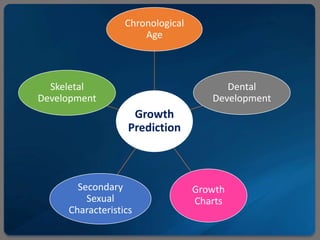
Growth
Prediction
Chronological
Age
Dental
Development
Growth
Charts
Secondary
Sexual
Characteristics
Skeletal
Development
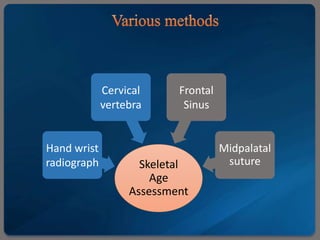
Skeletal
Age
Assessment
Hand wrist
radiograph
Cervical
vertebra
Frontal
Sinus
Midpalatal
suture
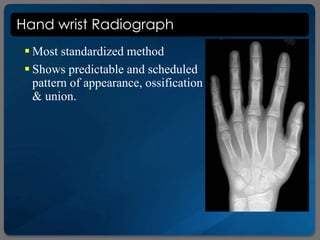
Hand wrist Radiograph
 Most standardized method
 Shows predictable and scheduled
pattern of appearance, ossification
& union.
Hand wrist Radiograph
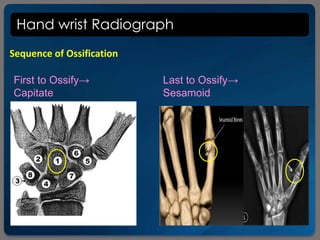
Sequence of Ossification
First to Ossify→
Capitate
Last to Ossify→
Sesamoid
Hand wrist Radiograph
 Infancy
 Toddlers
 Pre-puberty
 Puberty
 Late Puberty
 Post-puberty
Hand wrist Radiograph
 Infancy
 Toddlers
 Pre-puberty
 Puberty
 Late Puberty
 Post-puberty
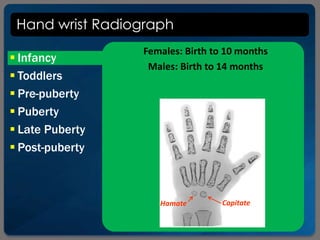
Females: Birth to 10 months
Males: Birth to 14 months
Hamate Capitate
Hand wrist Radiograph
 Infancy
 Toddlers
 Pre-puberty
 Puberty
 Late Puberty
 Post-puberty
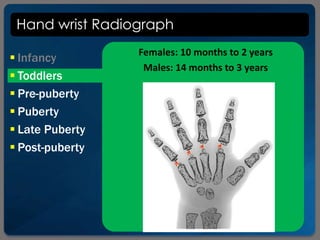
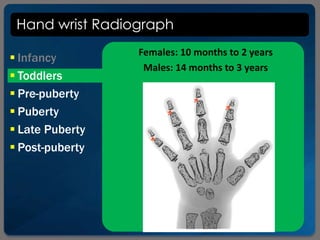
Females: 10 months to 2 years
Males: 14 months to 3 years
Hand wrist Radiograph
 Infancy
 Toddlers
 Pre-puberty
 Puberty
 Late Puberty
 Post-puberty
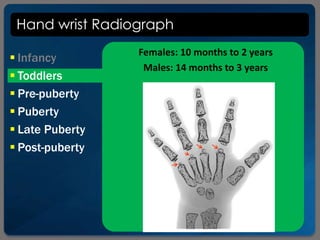
Females: 10 months to 2 years
Males: 14 months to 3 years
Hand wrist Radiograph
 Infancy
 Toddlers
 Pre-puberty
 Puberty
 Late Puberty
 Post-puberty
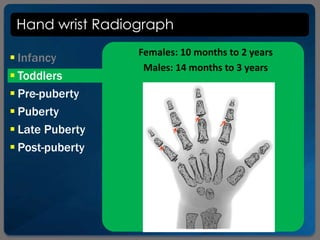
Females: 10 months to 2 years
Males: 14 months to 3 years
Hand wrist Radiograph
 Infancy
 Toddlers
 Pre-puberty
 Puberty
 Late Puberty
 Post-puberty
Females: 10 months to 2 years
Males: 14 months to 3 years
Hand wrist Radiograph
 Infancy
 Toddlers
 Pre-puberty
 Puberty
 Late Puberty
 Post-puberty
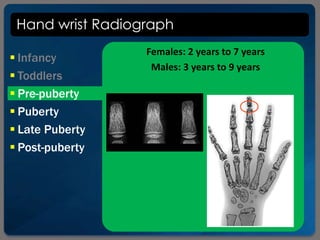
Females: 2 years to 7 years
Males: 3 years to 9 years
Hand wrist Radiograph
 Infancy
 Toddlers
 Pre-puberty
 Puberty
 Late Puberty
 Post-puberty
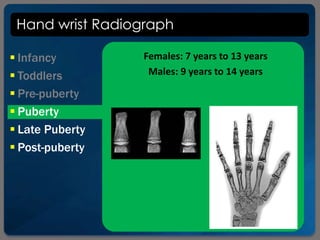
Females: 7 years to 13 years
Males: 9 years to 14 years
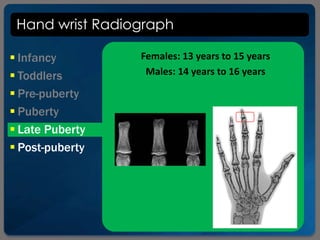
Hand wrist Radiograph
 Infancy
 Toddlers
 Pre-puberty
 Puberty
 Late Puberty
 Post-puberty
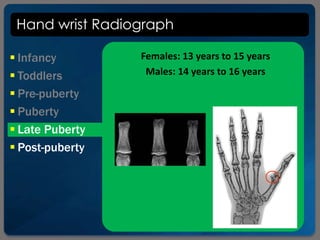
Females: 13 years to 15 years
Males: 14 years to 16 years
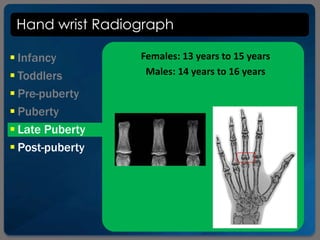
Hand wrist Radiograph
 Infancy
 Toddlers
 Pre-puberty
 Puberty
 Late Puberty
 Post-puberty
Females: 13 years to 15 years
Males: 14 years to 16 years
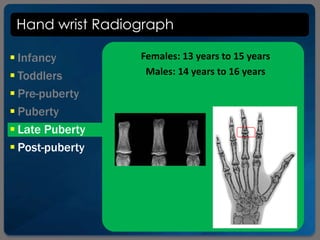
Hand wrist Radiograph
 Infancy
 Toddlers
 Pre-puberty
 Puberty
 Late Puberty
 Post-puberty
Females: 13 years to 15 years
Males: 14 years to 16 years
Hand wrist Radiograph
 Infancy
 Toddlers
 Pre-puberty
 Puberty
 Late Puberty
 Post-puberty
Females: 13 years to 15 years
Males: 14 years to 16 years
Hand wrist Radiograph
 Infancy
 Toddlers
 Pre-puberty
 Puberty
 Late Puberty
 Post-puberty
Females: 15 years to 17 years
Males: 17 years to 19 years
Hand wrist Radiograph
Different methods of assessing
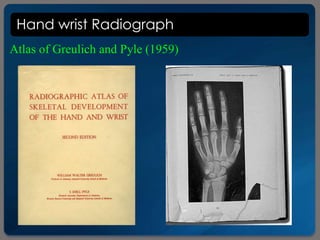
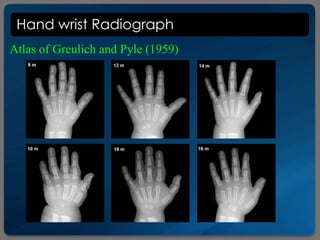
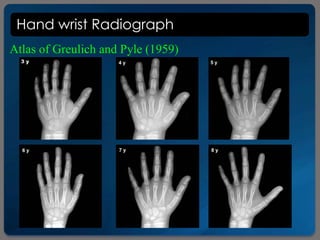
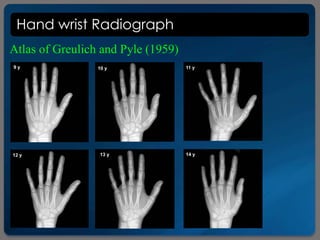
1. Atlas of Greulich and Pyle (1959)
2. Bjork Method (1972)
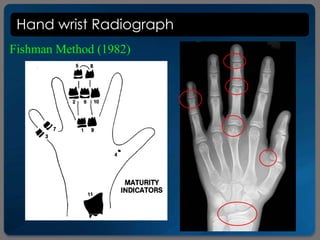
3. Fishman Method (1982)
4. Hagg and Taranger (1982)
Hand wrist Radiograph
Atlas of Greulich and Pyle (1959)
Hand wrist Radiograph
Atlas of Greulich and Pyle (1959)
Hand wrist Radiograph
Atlas of Greulich and Pyle (1959)
Hand wrist Radiograph
Atlas of Greulich and Pyle (1959)
Hand wrist Radiograph
Fishman Method (1982)
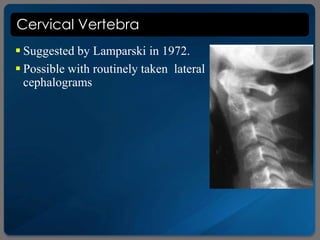
Cervical Vertebra
 Suggested by Lamparski in 1972.
 Possible with routinely taken lateral
cephalograms
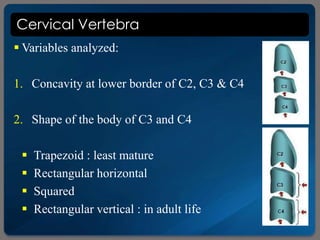
Cervical Vertebra
 Variables analyzed:
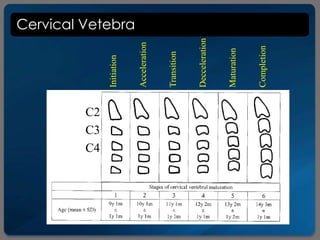
1. Concavity at lower border of C2, C3 & C4
2. Shape of the body of C3 and C4
 Trapezoid : least mature
 Rectangular horizontal
 Squared
 Rectangular vertical : in adult life
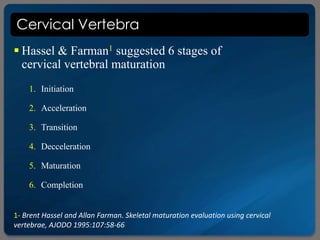
Cervical Vertebra
 Hassel & Farman1 suggested 6 stages of
cervical vertebral maturation
1- Brent Hassel and Allan Farman. Skeletal maturation evaluation using cervical
vertebrae, AJODO 1995:107:58-66
1. Initiation
2. Acceleration
3. Transition
4. Decceleration
5. Maturation
6. Completion
Cervical Vetebra
Initiation
Acceleration
Transition
Decceleration
Maturation
Completion
C2
C3
C4
Cervical Vertebrae
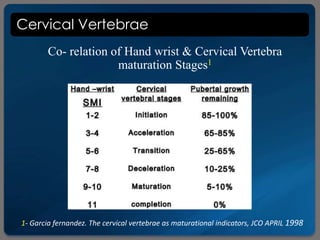
Co- relation of Hand wrist & Cervical Vertebra
maturation Stages1
1- Garcia fernandez. The cervical vertebrae as maturational indicators, JCO APRIL 1998
Frontal Sinus
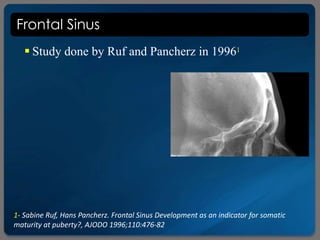
 Study done by Ruf and Pancherz in 19961
1- Sabine Ruf, Hans Pancherz. Frontal Sinus Development as an indicator for somatic
maturity at puberty?, AJODO 1996;110:476-82
Frontal Sinus
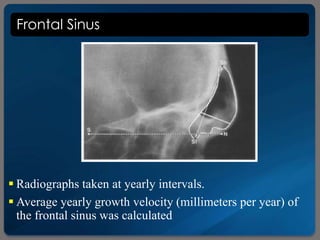
 Radiographs taken at yearly intervals.
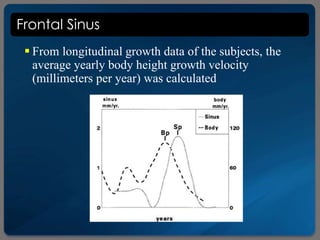
 Average yearly growth velocity (millimeters per year) of
the frontal sinus was calculated
Frontal Sinus
 From longitudinal growth data of the subjects, the
average yearly body height growth velocity
(millimeters per year) was calculated
Frontal Sinus
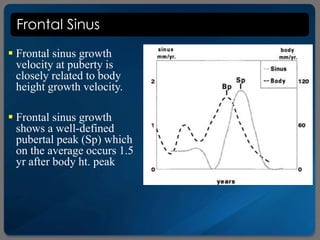
 Frontal sinus growth
velocity at puberty is
closely related to body
height growth velocity.
 Frontal sinus growth
shows a well-defined
pubertal peak (Sp) which
on the average occurs 1.5
yr after body ht. peak
Midpalatine Suture1
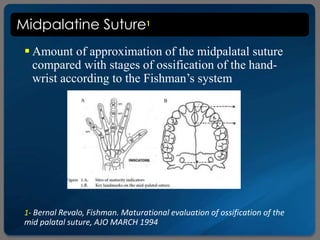
 Amount of approximation of the midpalatal suture
compared with stages of ossification of the hand-
wrist according to the Fishman’s system
1- Bernal Revalo, Fishman. Maturational evaluation of ossification of the
mid palatal suture, AJO MARCH 1994
Midpalatine Suture
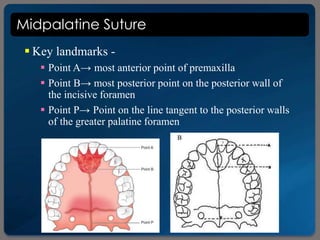
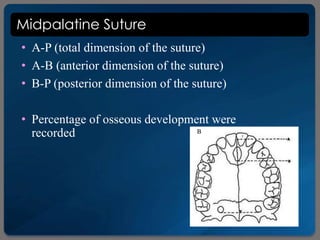
 Key landmarks -
 Point A→ most anterior point of premaxilla
 Point B→ most posterior point on the posterior wall of
the incisive foramen
 Point P→ Point on the line tangent to the posterior walls
of the greater palatine foramen
Midpalatine Suture
• A-P (total dimension of the suture)
• A-B (anterior dimension of the suture)
• B-P (posterior dimension of the suture)
• Percentage of osseous development were
recorded
Midpalatine Suture
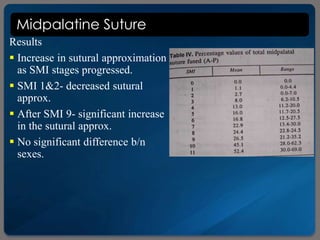
Results
 Increase in sutural approximation
as SMI stages progressed.
 SMI 1&2- decreased sutural
approx.
 After SMI 9- significant increase
in the sutural approx.
 No significant difference b/n
sexes.
Midpalatine Suture
Conclusion:
 Best to accomplish ME-before SMI 9.
 Ideal time- SMI 1- 4
Less orthopedic force required.
 Mid palatal approx. occurs more posteriorly.
Conclusion
 Chronological age of an individual is often not
sufficient to assess the development age and somatic
maturity of the patient
 Skeletal age derived from Hand-wrist radiograph
and cervical vertebra radiograph provide a reliable
and efficient means of assessment.
 Frontal sinus & midpalatine sutute evaluation are the
new approaches for the skeletal maturity assessment
References
 Vicente Gilsanz, Osman Ratib. Bone Age : A Digital Atlas of
Skeletal Maturity, Springer publication 2005
 Greulich-Pyle Hand &Wrist Atlas
 Brent Hassel and Allan Farman. Skeletal maturation evaluation
using cervical vertebrae, AJODO 1995:107:58-66
 Sabine Ruf, Hans Pancherz. Frontal Sinus Development as an
indicator for somatic maturity at puberty?, AJODO
1996;110:476-82
 Heinrich Wehrbein and Faruk Yildizhan. Mid-palatal suture in
young adults. European Journal of Orthodontics 23 (2001) 105—
114
 Garcia fernandez. The cervical vertebrae as maturational
indicators, JCO APRIL 1998
Thank You…

Skeletal age assessment

  • 1.
    Skeletal Age Assessment Presented by: Dr.Gaurav Acharya 2nd year PG Resident Department of Orthodontics and Dentofacial Orthopedics Peoples Dental College and Hospital, Kathmandu
  • 2.
  • 3.
  • 4.
    Hand wrist Radiograph Most standardized method  Shows predictable and scheduled pattern of appearance, ossification & union.
  • 5.
    Hand wrist Radiograph Sequenceof Ossification First to Ossify→ Capitate Last to Ossify→ Sesamoid
  • 6.
    Hand wrist Radiograph Infancy  Toddlers  Pre-puberty  Puberty  Late Puberty  Post-puberty
  • 7.
    Hand wrist Radiograph Infancy  Toddlers  Pre-puberty  Puberty  Late Puberty  Post-puberty Females: Birth to 10 months Males: Birth to 14 months Hamate Capitate
  • 8.
    Hand wrist Radiograph Infancy  Toddlers  Pre-puberty  Puberty  Late Puberty  Post-puberty Females: 10 months to 2 years Males: 14 months to 3 years
  • 9.
    Hand wrist Radiograph Infancy  Toddlers  Pre-puberty  Puberty  Late Puberty  Post-puberty Females: 10 months to 2 years Males: 14 months to 3 years
  • 10.
    Hand wrist Radiograph Infancy  Toddlers  Pre-puberty  Puberty  Late Puberty  Post-puberty Females: 10 months to 2 years Males: 14 months to 3 years
  • 11.
    Hand wrist Radiograph Infancy  Toddlers  Pre-puberty  Puberty  Late Puberty  Post-puberty Females: 10 months to 2 years Males: 14 months to 3 years
  • 12.
    Hand wrist Radiograph Infancy  Toddlers  Pre-puberty  Puberty  Late Puberty  Post-puberty Females: 2 years to 7 years Males: 3 years to 9 years
  • 13.
    Hand wrist Radiograph Infancy  Toddlers  Pre-puberty  Puberty  Late Puberty  Post-puberty Females: 7 years to 13 years Males: 9 years to 14 years
  • 14.
    Hand wrist Radiograph Infancy  Toddlers  Pre-puberty  Puberty  Late Puberty  Post-puberty Females: 13 years to 15 years Males: 14 years to 16 years
  • 15.
    Hand wrist Radiograph Infancy  Toddlers  Pre-puberty  Puberty  Late Puberty  Post-puberty Females: 13 years to 15 years Males: 14 years to 16 years
  • 16.
    Hand wrist Radiograph Infancy  Toddlers  Pre-puberty  Puberty  Late Puberty  Post-puberty Females: 13 years to 15 years Males: 14 years to 16 years
  • 17.
    Hand wrist Radiograph Infancy  Toddlers  Pre-puberty  Puberty  Late Puberty  Post-puberty Females: 13 years to 15 years Males: 14 years to 16 years
  • 18.
    Hand wrist Radiograph Infancy  Toddlers  Pre-puberty  Puberty  Late Puberty  Post-puberty Females: 15 years to 17 years Males: 17 years to 19 years
  • 19.
    Hand wrist Radiograph Differentmethods of assessing 1. Atlas of Greulich and Pyle (1959) 2. Bjork Method (1972) 3. Fishman Method (1982) 4. Hagg and Taranger (1982)
  • 20.
    Hand wrist Radiograph Atlasof Greulich and Pyle (1959)
  • 21.
    Hand wrist Radiograph Atlasof Greulich and Pyle (1959)
  • 22.
    Hand wrist Radiograph Atlasof Greulich and Pyle (1959)
  • 23.
    Hand wrist Radiograph Atlasof Greulich and Pyle (1959)
  • 24.
  • 25.
    Cervical Vertebra  Suggestedby Lamparski in 1972.  Possible with routinely taken lateral cephalograms
  • 26.
    Cervical Vertebra  Variablesanalyzed: 1. Concavity at lower border of C2, C3 & C4 2. Shape of the body of C3 and C4  Trapezoid : least mature  Rectangular horizontal  Squared  Rectangular vertical : in adult life
  • 27.
    Cervical Vertebra  Hassel& Farman1 suggested 6 stages of cervical vertebral maturation 1- Brent Hassel and Allan Farman. Skeletal maturation evaluation using cervical vertebrae, AJODO 1995:107:58-66 1. Initiation 2. Acceleration 3. Transition 4. Decceleration 5. Maturation 6. Completion
  • 28.
  • 29.
    Cervical Vertebrae Co- relationof Hand wrist & Cervical Vertebra maturation Stages1 1- Garcia fernandez. The cervical vertebrae as maturational indicators, JCO APRIL 1998
  • 30.
    Frontal Sinus  Studydone by Ruf and Pancherz in 19961 1- Sabine Ruf, Hans Pancherz. Frontal Sinus Development as an indicator for somatic maturity at puberty?, AJODO 1996;110:476-82
  • 31.
    Frontal Sinus  Radiographstaken at yearly intervals.  Average yearly growth velocity (millimeters per year) of the frontal sinus was calculated
  • 32.
    Frontal Sinus  Fromlongitudinal growth data of the subjects, the average yearly body height growth velocity (millimeters per year) was calculated
  • 33.
    Frontal Sinus  Frontalsinus growth velocity at puberty is closely related to body height growth velocity.  Frontal sinus growth shows a well-defined pubertal peak (Sp) which on the average occurs 1.5 yr after body ht. peak
  • 34.
    Midpalatine Suture1  Amountof approximation of the midpalatal suture compared with stages of ossification of the hand- wrist according to the Fishman’s system 1- Bernal Revalo, Fishman. Maturational evaluation of ossification of the mid palatal suture, AJO MARCH 1994
  • 35.
    Midpalatine Suture  Keylandmarks -  Point A→ most anterior point of premaxilla  Point B→ most posterior point on the posterior wall of the incisive foramen  Point P→ Point on the line tangent to the posterior walls of the greater palatine foramen
  • 36.
    Midpalatine Suture • A-P(total dimension of the suture) • A-B (anterior dimension of the suture) • B-P (posterior dimension of the suture) • Percentage of osseous development were recorded
  • 37.
    Midpalatine Suture Results  Increasein sutural approximation as SMI stages progressed.  SMI 1&2- decreased sutural approx.  After SMI 9- significant increase in the sutural approx.  No significant difference b/n sexes.
  • 38.
    Midpalatine Suture Conclusion:  Bestto accomplish ME-before SMI 9.  Ideal time- SMI 1- 4 Less orthopedic force required.  Mid palatal approx. occurs more posteriorly.
  • 39.
    Conclusion  Chronological ageof an individual is often not sufficient to assess the development age and somatic maturity of the patient  Skeletal age derived from Hand-wrist radiograph and cervical vertebra radiograph provide a reliable and efficient means of assessment.  Frontal sinus & midpalatine sutute evaluation are the new approaches for the skeletal maturity assessment
  • 40.
    References  Vicente Gilsanz,Osman Ratib. Bone Age : A Digital Atlas of Skeletal Maturity, Springer publication 2005  Greulich-Pyle Hand &Wrist Atlas  Brent Hassel and Allan Farman. Skeletal maturation evaluation using cervical vertebrae, AJODO 1995:107:58-66  Sabine Ruf, Hans Pancherz. Frontal Sinus Development as an indicator for somatic maturity at puberty?, AJODO 1996;110:476-82  Heinrich Wehrbein and Faruk Yildizhan. Mid-palatal suture in young adults. European Journal of Orthodontics 23 (2001) 105— 114  Garcia fernandez. The cervical vertebrae as maturational indicators, JCO APRIL 1998
  • 41.

Editor's Notes

  • #3 GP is ofen required in O becauze Rate of facial growth n % of facial growth remaining plays imp role in making decisions regarding growth modification or orthognathic surgery
  • #4 Skeletal age- Most reliable age for assessment of growth for orthodontic purposes Most commonly used skeleton- Hand-wrist and cervical vertebra
  • #5 Idea introduced by Roland in 1896
  • #6 Idea introduced by Roland in 1896
  • #7 In the majority of healthy children, there is an established sequence of ossification for the carpal, metacarpal and phalangeal bones, which is constant and the same for both sexes. First ossification center to appear in hand and wrist radiographs is the capitate, and the last is, most often, the sesamoid of the adductor pollicis of the thumb
  • #8 In different categories of human development, the specific ossification centers can be considered as a best predictors of skeletal maturity.
  • #9 The ossification centers of the capitate and hamate become apparent at about 3 months of age and remain the only useful observable features for the next six months.
  • #10 ossification centers for the epiphyses of all phalanges and metacarpals become recognizable usually in the middle finger first, and the fifth finger last
  • #11 ossification centers for the epiphyses of all phalanges and metacarpals become recognizable usually in the middle finger first, and the fifth finger last
  • #12 ossification centers for the epiphyses of all phalanges and metacarpals become recognizable usually in the middle finger first, and the fifth finger last
  • #13 ossification centers for the epiphyses of all phalanges and metacarpals become recognizable usually in the middle finger first, and the fifth finger last
  • #14 Assessment of Skeletal maturity is based on the epiphyseal size of the phalanges Epiphyses increase in width and thickness and becomes as wide as the metaphyses. Mainly emphasis is given in the distal phalanges than to the middle phalanges, and even less in the proximal phalanges.
  • #15 Epiphyses at this stage continue to grow and their widths become greater than the metaphyis Contours of the epiphyses begin to overlap, or cap, the metaphyses. Sesamoid in the tendon of the abductor pollicis, just medial to the head of the first metacarpal, become recognizable during puberty.
  • #16 Assessments of skeletal maturity in this stage are primarily based on the degree of epiphyseal fusion of the distal phalanges Since all carpal bones have now attained their early adult shape, they are of less value for determination of bone age.
  • #17 Assessments of skeletal maturity in this stage are primarily based on the degree of epiphyseal fusion of the distal phalanges Since all carpal bones have now attained their early adult shape, they are of less value for determination of bone age.
  • #18 Assessments of skeletal maturity in this stage are primarily based on the degree of epiphyseal fusion of the distal phalanges Since all carpal bones have now attained their early adult shape, they are of less value for determination of bone age.
  • #19 Assessments of skeletal maturity in this stage are primarily based on the degree of epiphyseal fusion of the distal phalanges Since all carpal bones have now attained their early adult shape, they are of less value for determination of bone age.
  • #20 all carpals, metacarpals and phalanges are completely developed, assessments of skeletal maturity are based on the degree of epiphyseal fusion of the ulna and radius.
  • #24 Contains pictures of the handwrist for different chronological ages and for each sex Patients radiograoph is matched with the photographs of atlas
  • #27 use of cervical vertebrae to determine skeletal maturity was suggested by Lamparski ¡n 1972.
  • #28 . Presence or absence of a concavity at the lower border of the body of C2, C3, and C4
  • #38 Skeletal parameters, such as hand wrist bones ossification, have been considered to cause an additional radiation exposure. To avoid such situation, new approaches as the cervical vertebrae maturation have been proposed.
  • #39 Lateral ceph orientated with Nasion- Sella line horizontally Peripheral border of sinus traced. Highest (Sh) & lowest (S1) point of sinus extension is marked
  • #40 Skeletal parameters, such as hand wrist bones ossification, have been considered to cause an additional radiation exposure. To avoid such situation, new approaches as the cervical vertebrae maturation have been proposed.
  • #41 Skeletal parameters, such as hand wrist bones ossification, have been considered to cause an additional radiation exposure. To avoid such situation, new approaches as the cervical vertebrae maturation have been proposed.
  • #43 The key landmarks and planes were identified: Point A, most anterior point of the premaxilla, Point B, most posterior point on the posterior wall of the incisive foramen; and Point P, point on the line tangent to the posterior walls of the greater palatine foramen
  • #44 The key landmarks and planes were identified: Point A, most anterior point of the premaxilla, Point B, most posterior point on the posterior wall of the incisive foramen; and Point P, point on the line tangent to the posterior walls of the greater palatine foramen
  • #46 Very large increases in approximation are evident during the late maturation period, from SMI 8 to 11. There is no significant difference between the amount of midpalatal sutural approximation between the male and female groups, although the male values were slightly higher in numerical value.
  • #47 The key landmarks and planes were identified: Point A, most anterior point of the premaxilla, Point B, most posterior point on the posterior wall of the incisive foramen; and Point P, point on the line tangent to the posterior walls of the greater palatine foramen