Three Milestones: Teacher Standards Learner Standards Curriculum Standards 国家汉办 The Office of Chinese Language Council International
Introduction With its recent rise to prominence on the global stage, China has begun to claim a major share of the international spotlight.  Accompanying this growth in world attention, the Chinese language has rightfully been viewed as a vital tool for understanding and networking with Chinese individuals, institutions, and enterprises.
Urgent Needs The enormously practical value of learning Chinese has accordingly begun to be grasped by national governments and ministries of education, global businesses, and private citizens.  For this reason, there is an urgent need to train an unprecedented number of highly qualified teachers to meet the growing and diverse demands of the world’s Chinese language learners.
Three Standards In response to this emerging imperative, we have developed a comprehensive series of systematic and scientific standards for teaching Chinese to speakers of other languages (TCSOL).  Namely, we have developed the following three standards: Standards for Teachers of Chinese to Speakers of Other Languages (TCSOL) Chinese Language Proficiency Scales for Speakers of Other Languages (CLPS) International Curriculum for Chinese Language Education (ICCLE)
TCSOL Standards TCSOL Standards, in both its scope and content, draw heavily from the most recent research on second language acquisition and teaching methodology as well as from a wide range of practical teaching experience gained from instructors in all teaching contexts and with learners at all proficiency levels.
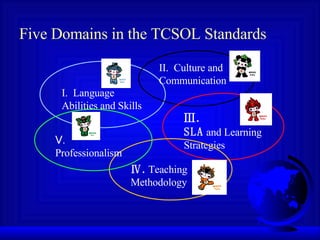
I.  Language Abilities and Skills II.  Culture and Communication Ⅲ .  SLA  and Learning Strategies   Ⅳ . Teaching Methodology Ⅴ . Professionalism  Five Domains in the TCSOL Standards
Ten Standards in TCSOL 1)  Chinese Language Abilities and Skills 2)  Foreign Language Abilities and Skills 3)  Chinese Culture and Cultural Comparisons 4)  Intercultural Communication 5)  Second Language Acquisition and Learning Strategies 6)  Chinese Language Teaching Methodology 7)  Testing and Assessment 8)  Curricula, Syllabi, and Teaching Materials 9)  Technology-Enhanced Language Teaching 10) Professionalism
Flexibility of the TCSOL Standards TCSOL is meant to be the benchmark for teacher knowledge, abilities and skills in teaching Chinese as a second or foreign language.  Given highly varied teaching contexts, mixed teaching levels, diverse students needs, and different teaching objectives, a number of context-specific variations will subsequently be developed based on TCSOL domains and standards.
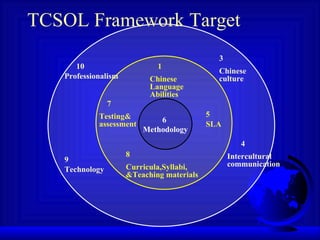
TCSOL Framework Target 6  Methodology 1 Chinese Language Abilities 5 SLA 8 Curricula,Syllabi, &Teaching materials 7 Testing&  assessment 3 Chinese culture 4 Intercultural communication 9 Technology 10 Professionalism
HIERARCY OF INSTRUMENTALITY
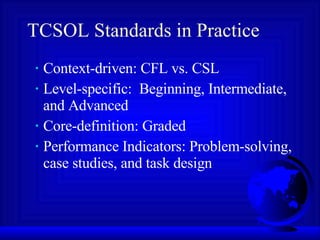
TCSOL Standards in Practice Context-driven: CFL vs. CSL Level-specific:  Beginning, Intermediate, and Advanced Core-definition: Graded Performance Indicators: Problem-solving, case studies, and task design
TCSOL Guidebook Introduction Basic Concepts Skills and Abilities Annotated Bibliography Resources
8.5 Teachers should understand and be able to describe the scope and sequence of the Chinese textbooks they use in the classrooms. 8.5.1. Be familiar with the criteria for textbooks Problem-solving: Teacher Wang is puzzled about which textbook to use when the principal asked him to decide on the teaching materials.  What are the basic criteria should Teacher Wang rely on in his decision-making?
8.5 Teachers should understand and be able to describe the scope and sequence of the Chinese textbooks they use in the classrooms. 8.5.1. Be familiar with the criteria for textbooks Case-analysis: Miss Zhang is not happy with the textbook for Chinese 101, but the decision was made by her coordinator, Mr. Zhou.  One day, she complained about the difficulty level of the textbook to Mr. Zhou who was deeply unhappy.  Mr. Zhou wanted to defend his decision.  What are the things he could have possibly said?
8.5 Teachers should understand and be able to describe the scope and sequence of the Chinese textbooks they use in the classrooms. 8.5.1. Be familiar with the criteria for textbooks Task Design: You’ve been using a new textbook for a semester.  By the end of the semester, you want to know the students’ feedback on the textbook.  Please design a questionnaire (about 10 questions) that you believe can best reflect different aspects of the textbook.
Training and Certification  Training models Testing models Certification models
Process of TCSOL Standards Development Product the China Office International (Hanban).  Leadership by Lin Xu, Jianfei Ma, and Jialu Xu Designed by a special Task force  Contribution from more than 100 scholars and experts More than 20  twenty meetings, workshops, and roundtable discussions  Feedback from more than  300 scholars, experts and teachers

Hanban Three Milestones

  • 1.
    Three Milestones: TeacherStandards Learner Standards Curriculum Standards 国家汉办 The Office of Chinese Language Council International
  • 2.
    Introduction With itsrecent rise to prominence on the global stage, China has begun to claim a major share of the international spotlight. Accompanying this growth in world attention, the Chinese language has rightfully been viewed as a vital tool for understanding and networking with Chinese individuals, institutions, and enterprises.
  • 3.
    Urgent Needs Theenormously practical value of learning Chinese has accordingly begun to be grasped by national governments and ministries of education, global businesses, and private citizens. For this reason, there is an urgent need to train an unprecedented number of highly qualified teachers to meet the growing and diverse demands of the world’s Chinese language learners.
  • 4.
    Three Standards Inresponse to this emerging imperative, we have developed a comprehensive series of systematic and scientific standards for teaching Chinese to speakers of other languages (TCSOL). Namely, we have developed the following three standards: Standards for Teachers of Chinese to Speakers of Other Languages (TCSOL) Chinese Language Proficiency Scales for Speakers of Other Languages (CLPS) International Curriculum for Chinese Language Education (ICCLE)
  • 5.
    TCSOL Standards TCSOLStandards, in both its scope and content, draw heavily from the most recent research on second language acquisition and teaching methodology as well as from a wide range of practical teaching experience gained from instructors in all teaching contexts and with learners at all proficiency levels.
  • 6.
    I. LanguageAbilities and Skills II. Culture and Communication Ⅲ . SLA and Learning Strategies Ⅳ . Teaching Methodology Ⅴ . Professionalism Five Domains in the TCSOL Standards
  • 7.
    Ten Standards inTCSOL 1) Chinese Language Abilities and Skills 2) Foreign Language Abilities and Skills 3) Chinese Culture and Cultural Comparisons 4) Intercultural Communication 5) Second Language Acquisition and Learning Strategies 6) Chinese Language Teaching Methodology 7) Testing and Assessment 8) Curricula, Syllabi, and Teaching Materials 9) Technology-Enhanced Language Teaching 10) Professionalism
  • 8.
    Flexibility of theTCSOL Standards TCSOL is meant to be the benchmark for teacher knowledge, abilities and skills in teaching Chinese as a second or foreign language. Given highly varied teaching contexts, mixed teaching levels, diverse students needs, and different teaching objectives, a number of context-specific variations will subsequently be developed based on TCSOL domains and standards.
  • 9.
    TCSOL Framework Target6 Methodology 1 Chinese Language Abilities 5 SLA 8 Curricula,Syllabi, &Teaching materials 7 Testing& assessment 3 Chinese culture 4 Intercultural communication 9 Technology 10 Professionalism
  • 10.
  • 11.
    TCSOL Standards inPractice Context-driven: CFL vs. CSL Level-specific: Beginning, Intermediate, and Advanced Core-definition: Graded Performance Indicators: Problem-solving, case studies, and task design
  • 12.
    TCSOL Guidebook IntroductionBasic Concepts Skills and Abilities Annotated Bibliography Resources
  • 13.
    8.5 Teachers shouldunderstand and be able to describe the scope and sequence of the Chinese textbooks they use in the classrooms. 8.5.1. Be familiar with the criteria for textbooks Problem-solving: Teacher Wang is puzzled about which textbook to use when the principal asked him to decide on the teaching materials. What are the basic criteria should Teacher Wang rely on in his decision-making?
  • 14.
    8.5 Teachers shouldunderstand and be able to describe the scope and sequence of the Chinese textbooks they use in the classrooms. 8.5.1. Be familiar with the criteria for textbooks Case-analysis: Miss Zhang is not happy with the textbook for Chinese 101, but the decision was made by her coordinator, Mr. Zhou. One day, she complained about the difficulty level of the textbook to Mr. Zhou who was deeply unhappy. Mr. Zhou wanted to defend his decision. What are the things he could have possibly said?
  • 15.
    8.5 Teachers shouldunderstand and be able to describe the scope and sequence of the Chinese textbooks they use in the classrooms. 8.5.1. Be familiar with the criteria for textbooks Task Design: You’ve been using a new textbook for a semester. By the end of the semester, you want to know the students’ feedback on the textbook. Please design a questionnaire (about 10 questions) that you believe can best reflect different aspects of the textbook.
  • 16.
    Training and Certification Training models Testing models Certification models
  • 17.
    Process of TCSOLStandards Development Product the China Office International (Hanban). Leadership by Lin Xu, Jianfei Ma, and Jialu Xu Designed by a special Task force Contribution from more than 100 scholars and experts More than 20 twenty meetings, workshops, and roundtable discussions Feedback from more than 300 scholars, experts and teachers